REVIEW 4 major objections 5 minor
XGrammar-2: Dynamic and Efficient Structured Generation Engine for Agentic LLMs
T0 review · 4 major / 5 minor · reviewed 2026-08-03 · deepseek-v4-flash
Pith's one-line read XGrammar-2 claims that dynamic structured generation for LLM agents—where the required output format changes across requests and within a request—can be served with over 6× faster grammar compilation than prior engines and near-zero end-to-
desk verdict Good systems idea with a real efficiency win, but the repetition-compression algorithm as printed over-accepts, so the 100% schema-validity claim doesn't hold up. read the letter →
The pith
A machine-rendered reading of the paper's core claim, the machinery that carries it, and where it could break.
The reading
What carries the argument
The load-bearing pieces are the Earley-parser-based adaptive token mask cache, the Cross-Grammar Cache with its hierarchical FSM hashing, and TagDispatch. The adaptive cache stores token validity only for scannable Earley states—states whose next symbol is a terminal—avoiding the exponential state blow-up of pushdown-automaton caches. The Cross-Grammar Cache assigns consistent hash values to FSMs, so when two grammars share a substructure (a JSON schema, a tool argument pattern), the cached accepted/rejected/uncertain token sets are reused across requests, with lookahead mismatches repaired by rechecking only the uncertain tokens. TagDispatch is an EBNF intrinsic that uses an Aho–Corasick au
What would settle it
Build a grammar containing a repetition R{20,1024} and decode a large corpus through the compressed engine, checking whether any emitted string has fewer than 20 or more than 1024 repetitions; or construct two non-deterministic FSMs that hash to the same value but accept different languages, then observe whether a cache hit ever yields a token mask that the original grammar would reject. Either outcome would refute the 100% schema-validity claim and the semantic-preservation assumption.
Extended reading notes
Core claim
The central discovery is that dynamic structured generation can be made nearly free by changing what gets cached. Instead of compiling the whole grammar ahead of time and caching token masks for every parser state, the engine caches at the substructure level, identifying reusable FSM sub-automata through a hierarchical hashing algorithm, and compiles only the masks encountered at runtime via just-in-time compilation. TagDispatch expresses intra-request switching as a first-class EBNF construct, so a tag such as '<function=get_weather>' routes decoding into the corresponding JSON-schema grammar and then back to free text. The engine replaces the pushdown-automaton state representation with an
Load-bearing premise
The engine's correctness rests on the assumption that its compressed repetition states and hash-based cache reuse accept exactly the same set of token sequences as the original grammar—so that no schema-invalid token can ever be produced.
Editorial extensions
If this is right
- Dynamic tool calling with dozens or hundreds of tools becomes practical: grammar construction drops from seconds to roughly 10 ms, reducing time-to-first-token in agentic serving.
- End-to-end latency with constraint enforcement stays within about 6% of unconstrained decoding, so output reliability gains no longer cost throughput.
- Cross-grammar cache reuse means even when entire grammars differ across requests (near zero full-structure reuse), roughly half the substructure computation can be reused, making per-request compilation affordable.
- TagDispatch makes intra-request structure switching expressible and compact, avoiding the rapid growth of hand-translated EBNF dispatchers as the number of tags increases.
- The combination of just-in-time compilation and repetition compression cuts preprocessing time by over three orders of magnitude on JSON schema benchmarks while keeping per-token mask generation under about 130 microseconds.
Reading between the lines
- If the semantic-preservation assumptions hold, the same architecture could extend to other dynamic structures—multi-step code generation, changing SQL schemas, or chained tool protocols—where the active grammar is not known until generation time.
- The hierarchical hash-based substructure reuse suggests a fingerprinting approach that serving systems could use to version grammars incrementally, avoiding recompilation when only a subset of tools or fields change.
- The configurable just-in-time tradeoff between prefill-time and decode-time compilation could be tuned automatically per hardware backend or per workload, a knob the paper leaves as a fixed constant.
- A natural testable extension is applying repetition-state compression to streaming or incremental validation of long structured outputs, where the compressed state could serve as a compact representation of the current constraint frontier.
Signed reviews
Editorial analysis
A structured set of objections, weighed in public.
Referee Report
Summary. The paper presents XGrammar-2, a structured generation engine targeting dynamic agentic LLM workloads. It introduces TagDispatch for intra-request tag-triggered structure switching, a cross-grammar cache for inter-request substructure reuse, an Earley-based adaptive token mask cache, JIT compilation, and repetition state compression. The experiments claim over 6x faster compilation than prior engines and near-zero end-to-end overhead in LLM serving systems.
Significance. The problem is timely and practically important: dynamic tool calling and response protocols are central to modern agentic LLM serving. The proposed design—especially the TagDispatch abstraction and cross-grammar cache—is plausible and would be a meaningful contribution if the efficiency and correctness claims hold. The paper also reports integration with SGLang and vLLM, which increases the potential impact. However, the correctness of the core repetition compression algorithm is not established, and as printed the algorithm is incorrect, which undermines the central 100% schema-validity claim. The end-to-end evaluation also contains baseline-comparison issues that need to be addressed.
major comments (4)
- [3.6, Algorithm 3 (Appendix B)] Algorithm 3's min<t branch is incorrect. For R{min,max} with min<t<max, the expression Concat(Repeat(t,max), Expand(0,max-t)) accepts repetition counts in [t, 2max-t]; the union with Expand(min,t) covers [min, 2max-t] rather than [min,max]. Concretely, for R{2,5} with t=3, the printed algorithm accepts 6 and 7 repetitions, violating the schema bound. This directly contradicts the §4.5 claim of 100% schema-valid tool-call arguments. The runtime k-check mentioned in §3.6 is not specified or proven to restore exactness; the cache built from the over-approximating expression can accept the token that starts a 7th repetition. Please correct the algorithm or provide a formal correctness proof, including a precise description and proof of any runtime bound check.
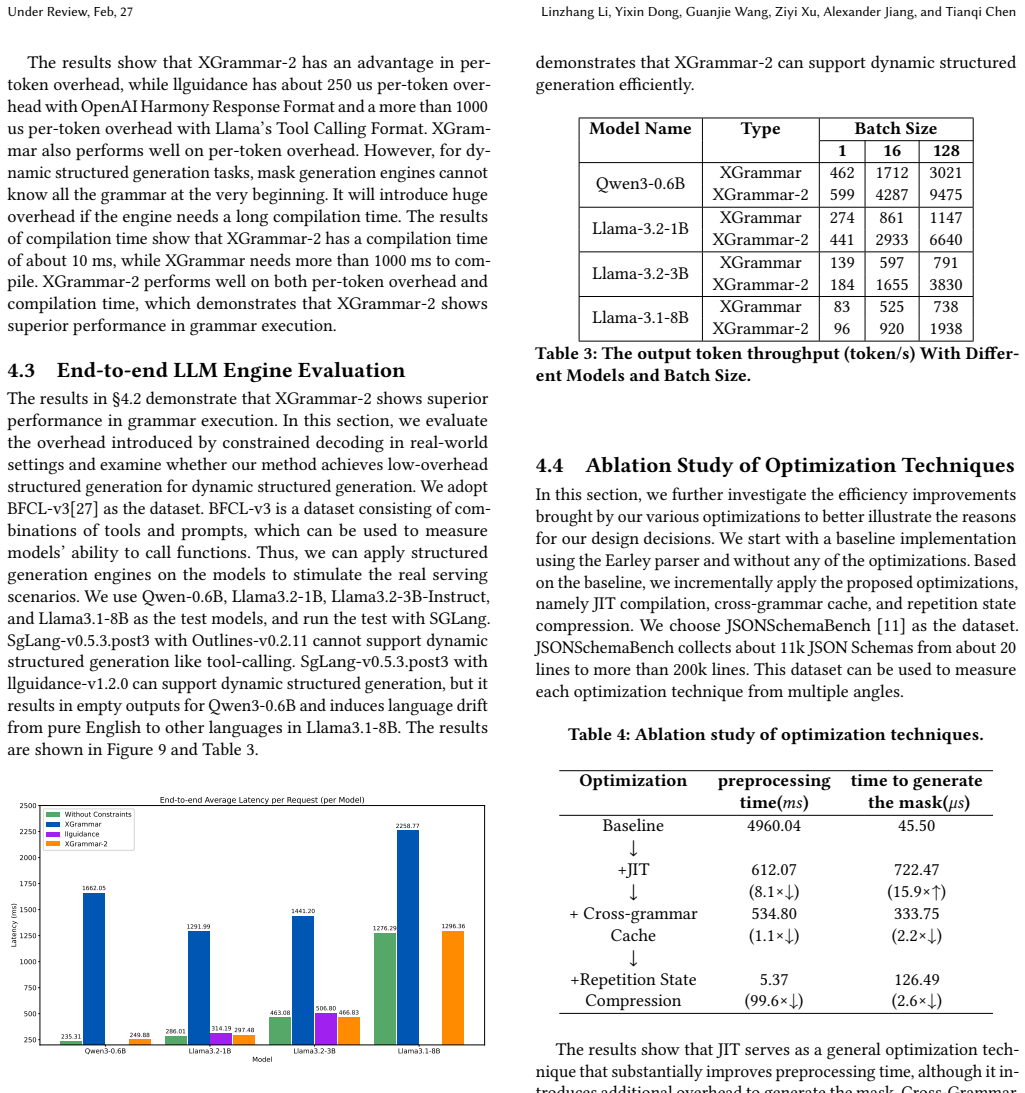
- [4.3, Figure 9] The comparison against llguidance is uninterpretable for two of the four models. The text reports that llguidance produces empty outputs for Qwen3-0.6B and induces language drift from English to other languages for Llama3.1-8B. For these models, the reported latency and throughput numbers are not measuring the same task as the other engines. The claim that 'XGrammar-2 shows a small latency and better compatibility' is not supported unless these cases are handled separately or excluded, or a valid llguidance fallback configuration is provided and evaluated.
- [4.4, Table 4] The ablation shows that the full optimization stack yields a per-token mask generation time of 126.49 us, which is about 2.8x slower than the Earley baseline of 45.50 us. The abstract and text emphasize 'near-zero overhead,' but this is only demonstrated in end-to-end measurements where mask generation may be hidden by other latencies. Please provide an end-to-end overhead breakdown (e.g., time-to-first-token and per-token latency relative to unconstrained decoding) and discuss the discrepancy between the per-token mask time and the near-zero-overhead claim.
- [3.3, Appendix C] The cross-grammar cache relies on the claim that if two FSMs have equal hash values, they must have the same structure. No collision analysis or formal proof is given, and Appendix C concedes inconsistent hashes for non-DFA or duplicated FSMs. If a hash collision ever occurs, the reused token mask cache could accept invalid tokens or reject valid ones, which would again violate the §4.5 correctness guarantee. Please state the precise invariant ('equal hash implies isomorphic automaton') and prove it for the supported grammar subset, or provide strong empirical validation on the evaluated grammar classes.
minor comments (5)
- [4.3] Typo: 'SgLang' should be 'SGLang'. Also, the model name 'Qwen-0.6B' is inconsistent with 'Qwen3-0.6B' used in the text.
- [Figure 9] The bar chart would be easier to read with numerical labels on each bar or a separate table, since the y-axis values in the text are dense and hard to map.
- [4.1, Table 1] In the static setting, all requests use the same 5/20/50 tools, so the full-structure reuse rate should be 100%. The reported 99.0% needs an explanation (e.g., measurement noise or a small fraction of mismatched metadata).
- [4.5] The correctness claim is stated as 'by construction' but no proof or machine-checked verification is provided. A formal theorem would be valuable, especially given the complexity of the compression and caching logic.
- [General] The paper says the engine is 'open-source' but does not provide a repository URL. Please include an artifact link; this is important for reproducibility, especially since no error bars or repeated runs are reported for the efficiency numbers.
Circularity Check
No significant circularity: XGrammar-2's efficiency results are benchmarked against independent engines; its reliance on the authors' XGrammar is foundational but not load-bearing for the new dynamic-generation claims.
full rationale
The central efficiency claims are not derived from assumed values. Compilation and mask-generation times are measured against independent engines (llguidance, Outlines, XGrammar) on external datasets (CONFETTI, BFCL-v3, JSONSchemaBench), and the ablation study measures JIT, cross-grammar cache, and repetition-state compression against a baseline Earley implementation. No parameter is fitted to the reported target metric and then relabeled as a prediction. The main self-citation is to XGrammar [9], the prior engine this work extends; it is cited for cache semantics and a foundational parser, but the dynamic dispatch (TagDispatch) and cross-grammar reuse are independently implemented and measured. Section 4.5's 'by construction' semantic-preservation assertion is an equivalence claim to XGrammar rather than a circular reduction, though it is under-proved. The printed Algorithm 3 has a genuine soundness risk: in the min<t branch, choice = Concat(Repeat(t,max), Expand(0,max-t)) accepts up to 2*max-t repetitions instead of max, which would contradict the reported 100% schema validity in Section 4.5. Appendix C's admission of inconsistent hashes for non-DFA or duplicated FSMs similarly weakens cache-reuse guarantees. These are correctness/robustness concerns, not circularity, and do not change the verdict that the efficiency derivation is self-contained against external benchmarks.
Assumptions & free parameters
free parameters (2)
- JIT compile-ahead count K =
unspecified (adjusted for best performance)
- Repetition compression threshold t =
unspecified (chosen constant)
assumptions (5)
- standard math Earley parser correctness for CFGs used here; scan/predict/complete rules in Table 6 are sound and complete.
- standard math Aho-Corasick automaton gives exact simultaneous tag matching in dispatching mode.
- domain assumption Hash-based FSM equivalence is safe for cache reuse: same hash => same structure.
- ad hoc to paper Repetition state compression preserves exact language of R{l,r}.
- domain assumption CONFETTI, BFCL-v3, and JSONSchemaBench are representative of dynamic agentic structured-generation workloads.
invented entities (2)
-
TagDispatch intrinsic
-
Cross-grammar cache pool
Cite this review
Pith. "Pith review of XGrammar-2: Dynamic and Efficient Structured Generation Engine for Agentic LLMs." pith.science (2026). https://pith.science/paper/RKCMNGGY
@misc{pith2026260104426,
  author       = {Pith},
  title        = {Pith review of: XGrammar-2: Dynamic and Efficient Structured Generation Engine for Agentic LLMs},
  year         = {2026},
  howpublished = {\url{https://pith.science/paper/RKCMNGGY}},
  note         = {Machine review of arXiv:2601.04426}
}
read the original abstract
Modern LLM agents increasingly rely on dynamic structured generation, such as tool calling and response protocols. Unlike traditional structured generation with static structures, these workloads vary both across requests and within a request, posing new challenges to existing engines. We present XGrammar-2, a structured generation engine for dynamic agentic workloads. Our design is based on two key ideas: first-class support for tag-triggered structure switching, and fine-grained reuse across requests with different output structures. Concretely, XGrammar-2 introduces TagDispatch for dynamic structural dispatching and Cross-Grammar Cache for substructure-level cache reuse across grammars. It further improves efficiency with an Earley-based adaptive token mask cache, just-in-time compilation, and repetition state compression. Experiments show that XGrammar-2 achieves over 6x faster compilation than prior structured generation engines, and incurs near-zero end-to-end overhead in modern LLM serving systems.
Figures


Figures from the paper (7 more)




Reviewed August 3, 2026 · model on record in the stance chip above.
Discussion (0). Continue with ORCID to comment.