REVIEW 4 major objections 3 minor 46 references
SAGE shows that giving VLA models executable, programmatic object blueprints—analytic concepts—consistently improves success rate and learning efficiency in both simulation and real-world manipulation.
Reviewed by Pith at T0; open to challenge. T0 means a machine referee read the full paper against a public rubric. the ladder, T0–T4 →
T0 review · deepseek-v4-flash
2026-08-01 14:09 UTC pith:RKHCYK6O
load-bearing objection SAGE is a plausible and useful recipe for injecting explicit kinematic structure into VLA fine-tuning, but the central mechanism — a self-referential tracker feeding the reward — is not yet nailed down, and the evidence would be much stronger with seeds, error bars, and a tracker-fidelity check across more than one task. the 4 major comments →
Explicit Kinematic Guidance from Analytic Concepts for Vision-Language-Action Models
The pith
A machine-rendered reading of the paper's core claim, the machinery that carries it, and where it could break.
Core claim
The paper's core discovery is that executable Analytic Concepts—explicit, programmatic blueprints of an object's structure and manipulation affordances—can be injected into VLA post-training as dense rewards and kinematic-constraint supervision, yielding consistent gains in success rate and sample efficiency across supervised fine-tuning, offline RL, online RL, and real-world deployment. The mechanism works because the concept parameters (structural parameters like hinge axes, and kinematic parameters like drawer displacement) are estimated once from 3D features at initialization, then tracked online by a Dynamic Parameter Head attached to the VLA's own intermediate features. The tracked par
What carries the argument
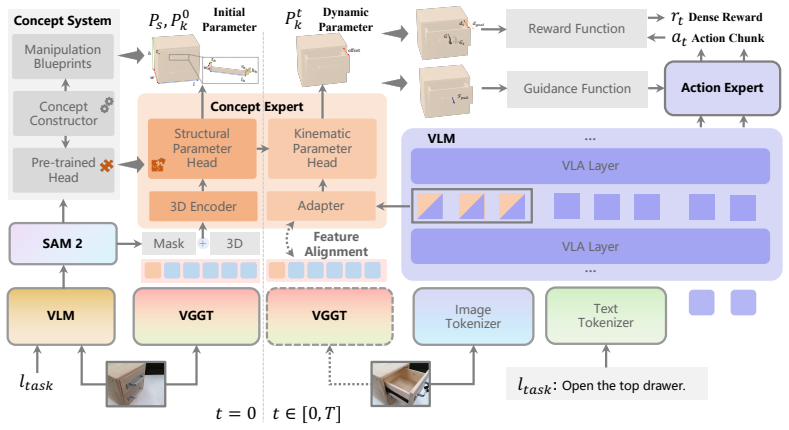
The key machinery is the Analytic Concept: a programmatic representation made of structural blueprints (parametric geometry and joint layout) and manipulation blueprints (procedures computing grasp poses and force directions). SAGE wraps every VLA with a Concept Expert that (a) at t=0 estimates the initial structural and kinematic parameters using 3D features from a vision foundation model and an object segmentation step, and (b) during rollout tracks the kinematic parameters through a Dynamic Parameter Head that consumes the VLA's own aligned intermediate features. This tracked state Pt feeds two guidance signals: L_kcs, a cosine-similarity loss pulling the predicted action direction toward
Load-bearing premise
The dynamic parameter head that tracks the object's joint state is reliable enough to generate good training signals even though its own output is the source of the reward and it is never supervised directly against ground truth.
What would settle it
Run a SAPIEN open-drawer training run with PPO(SAGE) while logging the Dynamic Parameter Head's output against simulator ground truth; if the head reports kinematic progress toward the goal while the physical drawer displacement stays below the task's success threshold (e.g., <0.01), the reward is being gamed rather than guiding, and the central claim collapses.
If this is right
- If correct, VLA fine-tuning no longer has to rediscover hinge and rail constraints from data: an explicit blueprint supplies the relevant geometric prior, reducing the amount of task-specific demonstrations needed.
- Dense concept-derived rewards can replace hand-shaped sparse rewards for articulated-object RL, which should make online fine-tuning of VLA policies more stable and sample-efficient in contact-rich tasks.
- The dynamic parameter head demonstrates that a VLA's own latents can serve as an accurate kinematic tracker, potentially replacing separate perception modules at deployment time.
- The authors report a real-world improvement from 60% to 85% on a representative insertion task, suggesting the gains transfer beyond simulation.
- The paper explicitly limits its current scope to objects with clear structural regularities, leaving deformable objects and broader VLA backbones as future work.
Where Pith is reading between the lines
- Editorial: Because the training reward R_AC is computed from the same Dynamic Parameter Head that provides the tracked state Pt, and the total objective has no direct ground-truth loss on Pt, a policy could in principle inflate its reward by making the tracker report phantom motion. The known ablation with ground-truth parameters (0.94 vs 0.91 for PPO) shows tracking error is small in the tested t
- Editorial: If tracking accuracy degrades in cluttered or occluded scenes, the guidance vector v* and the progress reward would both become unreliable, so the method's robustness hinges on the tracker's fidelity in precisely the conditions where manipulation is hardest.
- Editorial: The alignment loss between VLA features and 3D geometry could be reused as a self-supervised pretraining objective for VLAs, potentially improving spatial awareness before any task-specific fine-tuning occurs.
- Editorial: Concept-derived rewards may serve as a currency for verifying policies in world models: if the same analytic concept can be instantiated from a simulator's ground truth, it could provide dense reward signals for sim-to-real transfer without hand engineering.
Editorial analysis
A structured set of objections, weighed in public.
Referee Report
Summary. The paper proposes SAGE, a post-training framework that injects explicit Analytic Concepts—programmatic blueprints of object structure and affordances—into Vision-Language-Action (VLA) models. A Concept Expert first estimates initial structural and kinematic parameters from VGGT/SAM/VLM outputs, then a Dynamic Parameter Head tracks kinematic state from VLA internal features aligned to VGGT via L_align. The tracked parameters generate a dense reward R_AC (Eq. 8) and a kinematic constraint loss L_kcs (Eq. 4), combined with the task loss in Eq. (9). Experiments compare SFT and offline CQL on SimplerEnv, online PPO/GRPO on six SAPIEN ShapeNet-Mobility tasks, and real-world pi0.5 fine-tuning, reporting consistent improvements in success rate and learning efficiency. The paper also includes an ablation replacing the learned tracker with ground-truth kinematic state on the Open Drawer task.
Significance. If the reported results hold, this is a useful contribution: explicit programmatic kinematic and affordance blueprints provide dense, structured supervision that can improve VLA fine-tuning, especially for articulated objects. The use of an external success metric means the headline comparisons are not circular, and the ground-truth-tracker ablation is a sensible check on the learned tracker. The real-world results, despite small sample sizes, are encouraging, and the modular design makes the method applicable to several VLA backbones. However, the paper currently does not secure its central claim because the kinematic tracker is also the source of the reward/guidance signal and has no direct supervision in Eq. (9); moreover, all headline numbers are point estimates with no seeds, error bars, or significance tests.
major comments (4)
- [§3.3–3.4, Eqs. (4), (5), (8), (9)] The reward and guidance loop is self-referential. R_AC in Eq. (8) and v* in Eq. (4) are computed from P_t^k produced by the Dynamic Parameter Head, yet Eq. (9) contains no direct ground-truth loss on P_t^k; L_align in Eq. (3) only aligns VLA features to VGGT features. Since the head is trained jointly with the policy, an RL agent can in principle increase R_AC by driving P_t^k toward the goal, or shrink L_kcs by moving v* toward its own action direction, without the physical object moving. The Open Drawer ablation (Table 2a) shows a small gap when P_t^k is replaced with ground truth (PPO 0.91→0.94, GRPO 0.79→0.82), which is reassuring but is only one task. The paper should add a direct kinematic-state supervision term where ground truth is available, report tracking error for all SAPIEN tasks, and preferably run the ground-truth-tracker ablation across all tasks.
- [§4.2, Table 2a, Table 3] The evidence for tracker fidelity is insufficient. Table 3 evaluates static concept instantiation only (distance from point cloud to the mesh rendered from estimated static parameters); it does not measure dynamic tracking error. The only dynamic tracking evidence is the one-task Open Drawer ablation. For the other five SAPIEN tasks and the real-world experiments, no tracking error, no ground-truth replacement, and no trajectory-level evaluation are reported. Please provide per-task tracker error (e.g., mean/median error of P_t^k against simulator ground truth) and state whether the learned tracker is also used for the success signal or only for R_AC.
- [§4.1–4.2, Tables 1–2, Fig. 3] All reported results are point estimates. There are no multiple seeds, standard deviations, confidence intervals, or significance tests for the SimplerEnv tables, the SAPIEN radar plot, or the online learning curves. RL fine-tuning is high-variance, so the claim of 'consistent improvements' is not statistically established, especially for per-task differences of a few points. Please report at least 3–5 seeds with means and variances, and where possible test whether the SAGE-vs-baseline differences are significant.
- [§4.3 and Appendix B] The real-world evaluation is reported over 5 tasks, but Appendix B states 'we collected a small, task-specific dataset consisting of 25 expert demonstrations for each of the three evaluation tasks.' This inconsistency should be corrected. Also, success rates are over 20 trials per task, so a 5–10 percentage point difference is within the confidence interval of a binomial proportion; please report the number of successes/failures and, if possible, confidence intervals or a binomial test.
minor comments (3)
- [Appendix B] The hyperparameter list says 'The concept reward weights wprog = 2 and wprog = 1'; the second should presumably be w_afford = 1.
- [Eq. (9)] It is unclear which terms of L_total are used in each variant. SAGE-SFT likely uses L_task + λ_k L_kcs + λ_a L_align, while SAGE-CQL may also use L_kcs in addition to the CQL objective; this should be specified explicitly.
- [Appendix D] The limitation paragraph already acknowledges dependence on external perception modules, extra initialization cost, and evaluation on a limited set of VLA backbones. These caveats should be reflected in the abstract or introduction so that the 'consistent improvements' claim is not overgeneralized.
Circularity Check
The headline success-rate comparisons are external and non-circular, but the claimed kinematic grounding is partially circular: the reward and constraint signals are computed from P_t^k, a dynamic parameter output of the VLA's own feature stream, with no ground-truth supervision on P_t^k in the total objective.
specific steps
-
self definitional
[Sec. 3.3–3.4, Eqs. (5), (8), (9)]
"“The dynamically tracked parameters ( P t k) are then utilized by Reward and Guidance functions to provide dense, structured feedback to the VLA’s output layers (Action Expert)... ϕprog(st) = exp(− 1/σ ∥∆P t k −∆P goal k ∥2)... RAC(st) = w prog · ϕ prog(st) + w afford · ϕ afford(st)... Ltotal = L task + λ k Lkcs + λ a Lalign”"
P_t^k is not an external measurement; it is the output of the Dynamic Parameter Head operating on the VLA's own intermediate features. R_AC is defined directly in terms of P_t^k, and Eq. (9) contains no ground-truth loss on P_t^k. Therefore an RL agent can increase R_AC by driving P_t^k toward ΔP_goal^k without moving the physical object; the 'kinematic progress' reward is a self-consistency signal with the tracker, so the claim that gains come from explicit kinematic grounding does not follow from the equations.
-
self definitional
[Sec. 3.3–3.4, Eq. (4)]
"“the VLA’s own intermediate features (FVLA) or action predictions (at) are used as a contextual prior to guide the tracker’s attention” ... “the ideal constraint vector v∗ derived from Pt: Lkcs = E s,v∗ [1 − (v at · v ∗ t)/(∥v at ∥ · ∥v ∗ t ∥)]”"
The 'ideal' direction v* is derived from P_t^k, and P_t^k is estimated from the same VLA features/actions that Lkcs supervises. Minimizing Lkcs can therefore be achieved by shifting P_t^k (and hence v*) toward the predicted action direction, rather than by making the action obey an external kinematic constraint. The total objective provides no direct supervision anchoring P_t^k to a measured kinematic state, so the constraint supervision is partly a tautological alignment between the policy and its own tracker.
full rationale
The empirical headline claims—SimplerEnv success rates, SAPIEN RL success rates, and real-world π0.5 results—are measured against external task success, so the overall performance comparison is not circular. The circularity lies in the internal guidance mechanism: the kinematic state P_t^k is produced by a head on the VLA's own features, and the same P_t^k is the sole source of the dense reward R_AC (Eqs. 5, 8) and the constraint direction v* in Lkcs (Eq. 4). Since Ltotal (Eq. 9) has no ground-truth term for P_t^k, the 'explicit kinematic guidance' is not anchored to an independent measurement. The Open Drawer ablation (Table 2b(a)) reports only a small gain from replacing SAGE's tracker with ground-truth P* on one task, which is suggestive but insufficient to establish tracker fidelity across the other five SAPIEN tasks and the real-world tasks. The self-citations to the Analytic Concept system and pre-trained head are design inputs and are partly supported by the static Table 3 evaluation; they are not the main circular step. Overall, partial circularity: score 6.
Axiom & Free-Parameter Ledger
free parameters (7)
- λ_k (kinematic constraint loss weight) =
0.5
- λ_a^0 and T_a (alignment loss schedule) =
λ_a^0 = 0.5, annealed to 0 over T_a
- α (success reward weight) =
0.8
- w_prog, w_afford =
w_prog = 2, w_afford = 1 (as printed; text says wprog twice)
- σ and ρ =
1
- w_p, w_q (6D pose distance weights) =
empirically determined, values not reported
- CQL conservative coefficient =
not reported
axioms (5)
- domain assumption Analytic Concepts (Sun et al. 2024, 2025a) capture reusable structural and manipulation patterns across 46 PartNet-Mobility categories with only 39 concepts (Appendix A.1).
- domain assumption The pretrained Structural Parameter Head (Wei et al., 2026) accurately maps point clouds to blueprint parameters P_s and P_k^0.
- domain assumption VGGT and SAM provide sufficiently accurate 3D features and segmentation for parameter estimation at initialization.
- ad hoc to paper The Dynamic Parameter Head outputs P_t^k remain faithful to true object state while trained jointly with the policy.
- domain assumption Recognition-by-Components as a model of human perception transfers to robot policy learning.
read the original abstract
Current Vision-Language-Action (VLA) models rely mainly on 2D inputs, neglecting the rich object structural information and commonsense knowledge inherent in the 3D physical world. This deficiency restricts their spatial awareness and adaptability for complex, high-precision manipulation. To bridge this crucial gap, we construct a Concept Expert module for VLA to build executable Analytic Concepts that represent objects as explicit, programmatic blueprints. Our mechanism operates in two synergistic phases: First, prior to VLA inference, the Concept Expert leverages 3D information from Vision Foundation Models (VFMs) to estimate the initial kinematic and structural parameters. Second, throughout the manipulation process, the VLA model utilizes its inherent capability to dynamically track the dynamic concept parameters, continuously aligning them with observational changes to ensure persistent accuracy. Once established, the Analytic Concepts provide explicit, high-quality guidance for VLA fine-tuning through (1) dense, programmatic manipulation rewards and (2) precise spatial guidance. This formulation allows VLA models to learn physically grounded interaction behaviors while maintaining end-to-end learning flexibility. Our experimental results show consistent improvements in success rate and learning efficiency across supervised and reinforcement learning settings, demonstrating the effectiveness of structured, concept-based guidance for VLA post-training.
Figures



Reference graph
Works this paper leans on
-
[1]
Sanketi and Quan Vuong and Thomas Kollar and Benjamin Burchfiel and Russ Tedrake and Dorsa Sadigh and Sergey Levine and Percy Liang and Chelsea Finn , editor =
Moo Jin Kim and Karl Pertsch and Siddharth Karamcheti and Ted Xiao and Ashwin Balakrishna and Suraj Nair and Rafael Rafailov and Ethan Paul Foster and Pannag R. Sanketi and Quan Vuong and Thomas Kollar and Benjamin Burchfiel and Russ Tedrake and Dorsa Sadigh and Sergey Levine and Percy Liang and Chelsea Finn , editor =. OpenVLA: An Open-Source Vision-Lang...
2024
-
[2]
2025 , eprint=
Fine-Tuning Vision-Language-Action Models: Optimizing Speed and Success , author=. 2025 , eprint=
2025
-
[3]
2025 , eprint=
Executable Analytic Concepts as the Missing Link Between VLM Insight and Precise Manipulation , author=. 2025 , eprint=
2025
-
[4]
2026 , eprint=
Physically Ground Commonsense Knowledge for Articulated Object Manipulation with Analytic Concepts , author=. 2026 , eprint=
2026
-
[5]
Proceedings of the AAAI Conference on Artificial Intelligence , volume=
Discovering conceptual knowledge with analytic ontology templates for articulated objects , author=. Proceedings of the AAAI Conference on Artificial Intelligence , volume=
-
[6]
Fanbo Xiang and Yuzhe Qin and Kaichun Mo and Yikuan Xia and Hao Zhu and Fangchen Liu and Minghua Liu and Hanxiao Jiang and Yifu Yuan and He Wang and Li Yi and Angel X. Chang and Leonidas J. Guibas and Hao Su , title =. 2020. 2020 , url =. doi:10.1109/CVPR42600.2020.01111 , timestamp =
arXiv 2020
-
[7]
Joshi and Ryan Julian and Dmitry Kalashnikov and Yuheng Kuang and Isabel Leal and Kuang
Anthony Brohan and Noah Brown and Justice Carbajal and Yevgen Chebotar and Joseph Dabis and Chelsea Finn and Keerthana Gopalakrishnan and Karol Hausman and Alexander Herzog and Jasmine Hsu and Julian Ibarz and Brian Ichter and Alex Irpan and Tomas Jackson and Sally Jesmonth and Nikhil J. Joshi and Ryan Julian and Dmitry Kalashnikov and Yuheng Kuang and Is...
-
[8]
2024 , eprint=
_0 : A Vision-Language-Action Flow Model for General Robot Control , author=. 2024 , eprint=
2024
-
[9]
Xinghang Li and Peiyan Li and Minghuan Liu and Dong Wang and Jirong Liu and Bingyi Kang and Xiao Ma and Tao Kong and Hanbo Zhang and Huaping Liu , title =. CoRR , volume =. 2024 , url =. doi:10.48550/ARXIV.2412.14058 , eprinttype =. 2412.14058 , timestamp =
-
[10]
ConceptFactory: Facilitate 3D Object Knowledge Annotation with Object Conceptualization , booktitle =
Jianhua Sun and Yuxuan Li and Longfei Xu and Nange Wang and Jiude Wei and Yining Zhang and Cewu Lu , editor =. ConceptFactory: Facilitate 3D Object Knowledge Annotation with Object Conceptualization , booktitle =. 2024 , url =
2024
-
[11]
Conservative Q-Learning for Offline Reinforcement Learning , booktitle =
Aviral Kumar and Aurick Zhou and George Tucker and Sergey Levine , editor =. Conservative Q-Learning for Offline Reinforcement Learning , booktitle =. 2020 , url =
2020
-
[12]
Robotics: Science and Systems , year=
Octo: An Open-Source Generalist Robot Policy , author=. Robotics: Science and Systems , year=
-
[13]
Chao Yu and Yuanqing Wang and Zhen Guo and Hao Lin and Si Xu and Hongzhi Zang and Quanlu Zhang and Yongji Wu and Chunyang Zhu and Junhao Hu and Zixiao Huang and Mingjie Wei and Yuqing Xie and Ke Yang and Bo Dai and Zhexuan Xu and Xiangyuan Wang and Xu Fu and Zhihao Liu and Kang Chen and Weilin Liu and Gang Liu and Boxun Li and Jianlei Yang and Zhi Yang an...
-
[14]
Evaluating Real-World Robot Manipulation Policies in Simulation , booktitle =
Xuanlin Li and Kyle Hsu and Jiayuan Gu and Oier Mees and Karl Pertsch and Homer Rich Walke and Chuyuan Fu and Ishikaa Lunawat and Isabel Sieh and Sean Kirmani and Sergey Levine and Jiajun Wu and Chelsea Finn and Hao Su and Quan Vuong and Ted Xiao , editor =. Evaluating Real-World Robot Manipulation Policies in Simulation , booktitle =. 2024 , url =
2024
-
[15]
The Thirteenth International Conference on Learning Representations,
Nikhila Ravi and Valentin Gabeur and Yuan. The Thirteenth International Conference on Learning Representations,. 2025 , url =
2025
-
[16]
Jianyuan Wang and Minghao Chen and Nikita Karaev and Andrea Vedaldi and Christian Rupprecht and David Novotn. 2025 , url =. doi:10.1109/CVPR52734.2025.00499 , timestamp =
arXiv 2025
-
[17]
FirstName Alpher and FirstName Gamow , title =
-
[18]
2025 , eprint=
SimpleVLA-RL: Scaling VLA Training via Reinforcement Learning , author=. 2025 , eprint=
2025
-
[19]
2025 , eprint=
What Can RL Bring to VLA Generalization? An Empirical Study , author=. 2025 , eprint=
2025
-
[20]
Xinyi Chen and Yilun Chen and Yanwei Fu and Ning Gao and Jiaya Jia and Weiyang Jin and Hao Li and Yao Mu and Jiangmiao Pang and Yu Qiao and Yang Tian and Bin Wang and Bolun Wang and Fangjing Wang and Hanqing Wang and Tai Wang and Ziqin Wang and Xueyuan Wei and Chao Wu and Shuai Yang and Jinhui Ye and Junqiu Yu and Jia Zeng and Jingjing Zhang and Jinyu Zha...
-
[21]
Forty-first International Conference on Machine Learning,
Haoyu Zhen and Xiaowen Qiu and Peihao Chen and Jincheng Yang and Xin Yan and Yilun Du and Yining Hong and Chuang Gan , title =. Forty-first International Conference on Machine Learning,. 2024 , url =
2024
-
[22]
Xinyang Tong and Pengxiang Ding and Yiguo Fan and Donglin Wang and Wenjie Zhang and Can Cui and Mingyang Sun and Han Zhao and Hongyin Zhang and Yonghao Dang and Siteng Huang and Shangke Lyu , title =. 2025 , url =. doi:10.1109/ICRA55743.2025.11127693 , timestamp =
arXiv 2025
-
[23]
arXiv preprint arXiv:2510.07975 , year=
Executable Analytic Concepts as the Missing Link Between VLM Insight and Precise Manipulation , author=. arXiv preprint arXiv:2510.07975 , year=
-
[24]
Physical Intelligence and Kevin Black and Noah Brown and James Darpinian and Karan Dhabalia and Danny Driess and Adnan Esmail and Michael Equi and Chelsea Finn and Niccolo Fusai and Manuel Y. Galliker and Dibya Ghosh and Lachy Groom and Karol Hausman and Brian Ichter and Szymon Jakubczak and Tim Jones and Liyiming Ke and Devin LeBlanc and Sergey Levine an...
-
[25]
, author=
Recognition-by-components: a theory of human image understanding. , author=. Psychological review , year=
-
[26]
arXiv preprint arXiv:2406.10788 , year=
Physically embodied gaussian splatting: A realtime correctable world model for robotics , author=. arXiv preprint arXiv:2406.10788 , year=
-
[27]
European Conference on Computer Vision , pages=
Doughnet: A visual predictive model for topological manipulation of deformable objects , author=. European Conference on Computer Vision , pages=. 2024 , organization=
2024
-
[28]
arXiv preprint arXiv:2501.15830 , year=
Spatialvla: Exploring spatial representations for visual-language-action model , author=. arXiv preprint arXiv:2501.15830 , year=
-
[29]
Proceedings of the IEEE/CVF international conference on computer vision , pages=
Point transformer , author=. Proceedings of the IEEE/CVF international conference on computer vision , pages=
-
[30]
IEEE Robotics and Automation Letters , volume=
Object-centric task and motion planning in dynamic environments , author=. IEEE Robotics and Automation Letters , volume=. 2020 , publisher=
2020
-
[31]
2025 , eprint=
Spatial Forcing: Implicit Spatial Representation Alignment for Vision-language-action Model , author=. 2025 , eprint=
2025
-
[32]
Advances in Neural Information Processing Systems , volume=
What’s left? concept grounding with logic-enhanced foundation models , author=. Advances in Neural Information Processing Systems , volume=
-
[33]
Conference on Robot Learning , pages=
Sornet: Spatial object-centric representations for sequential manipulation , author=. Conference on Robot Learning , pages=. 2022 , organization=
2022
-
[34]
CoRL 2023 Workshop on Learning Effective Abstractions for Planning (LEAP) , year=
Nod-tamp: Multi-step manipulation planning with neural object descriptors , author=. CoRL 2023 Workshop on Learning Effective Abstractions for Planning (LEAP) , year=
2023
-
[35]
The International Journal of Robotics Research , volume=
An incremental constraint-based framework for task and motion planning , author=. The International Journal of Robotics Research , volume=. 2018 , publisher=
2018
-
[36]
2022 International Conference on Robotics and Automation (ICRA) , pages=
Neural descriptor fields: Se (3)-equivariant object representations for manipulation , author=. 2022 International Conference on Robotics and Automation (ICRA) , pages=. 2022 , organization=
2022
-
[37]
The International Symposium of Robotics Research , pages=
kpam: Keypoint affordances for category-level robotic manipulation , author=. The International Symposium of Robotics Research , pages=. 2019 , organization=
2019
-
[38]
arXiv preprint arXiv:2409.01652 , year=
Rekep: Spatio-temporal reasoning of relational keypoint constraints for robotic manipulation , author=. arXiv preprint arXiv:2409.01652 , year=
-
[39]
2025 , eprint=
Open X-Embodiment: Robotic Learning Datasets and RT-X Models , author=. 2025 , eprint=
2025
-
[40]
2025 , eprint=
Vision-Language-Action Models: Concepts, Progress, Applications and Challenges , author=. 2025 , eprint=
2025
-
[41]
Tran and Radu Soricut and Anikait Singh and Jaspiar Singh and Pierre Sermanet and Pannag R
Brianna Zitkovich and Tianhe Yu and Sichun Xu and Peng Xu and Ted Xiao and Fei Xia and Jialin Wu and Paul Wohlhart and Stefan Welker and Ayzaan Wahid and Quan Vuong and Vincent Vanhoucke and Huong T. Tran and Radu Soricut and Anikait Singh and Jaspiar Singh and Pierre Sermanet and Pannag R. Sanketi and Grecia Salazar and Michael S. Ryoo and Krista Reymann...
2023
-
[42]
2025 , eprint=
ControlVLA: Few-shot Object-centric Adaptation for Pre-trained Vision-Language-Action Models , author=. 2025 , eprint=
2025
-
[43]
2025 , eprint=
Interleave-VLA: Enhancing Robot Manipulation with Interleaved Image-Text Instructions , author=. 2025 , eprint=
2025
-
[44]
2025 , eprint=
VLA-0: Building State-of-the-Art VLAs with Zero Modification , author=. 2025 , eprint=
2025
-
[45]
arXiv preprint arXiv:2510.00406 , year=
VLA-RFT: Vision-Language-Action Reinforcement Fine-tuning with Verified Rewards in World Simulators , author=. arXiv preprint arXiv:2510.00406 , year=
-
[46]
arXiv preprint arXiv:2505.22159 , year=
ForceVLA: Enhancing VLA Models with a Force-aware MoE for Contact-rich Manipulation , author=. arXiv preprint arXiv:2505.22159 , year=
discussion (0)
Sign in with ORCID, Apple, or X to comment. Anyone can read and Pith papers without signing in.