REVIEW 2 major objections 4 minor 1 cited by
Noise Resilience of Variational Quantum Compiling
T0 review · 2 major / 4 minor · reviewed 2026-08-14 · deepseek-v4-flash
Pith's one-line read The paper proves that incoherent noise during cost evaluation leaves the optimal parameters of variational quantum compiling unchanged for broad classes of depolarizing, Pauli, gate, and measurement noise.
desk verdict OPR is a real, well-proved concept for VQC, but the weak-OPR theorem does not by itself justify the claim that noisy training on a fixed ansatz finds correct parameters. read the letter →
The pith
A machine-rendered reading of the paper's core claim, the machinery that carries it, and where it could break.
The reading
What carries the argument
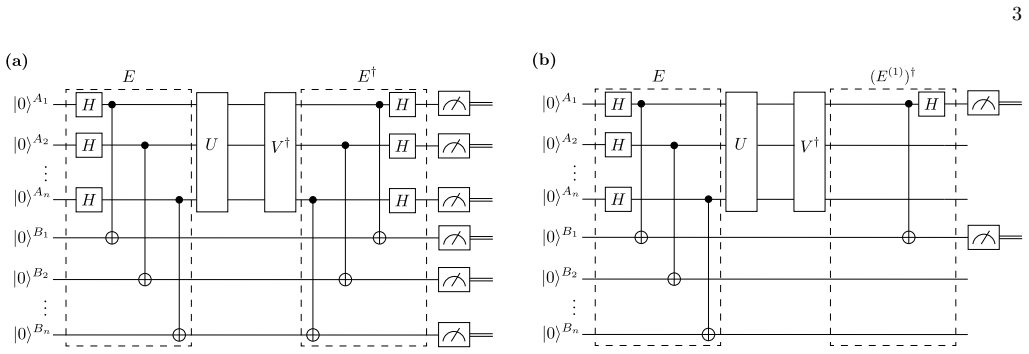
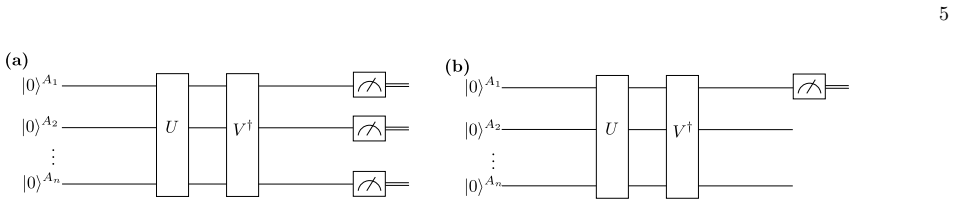
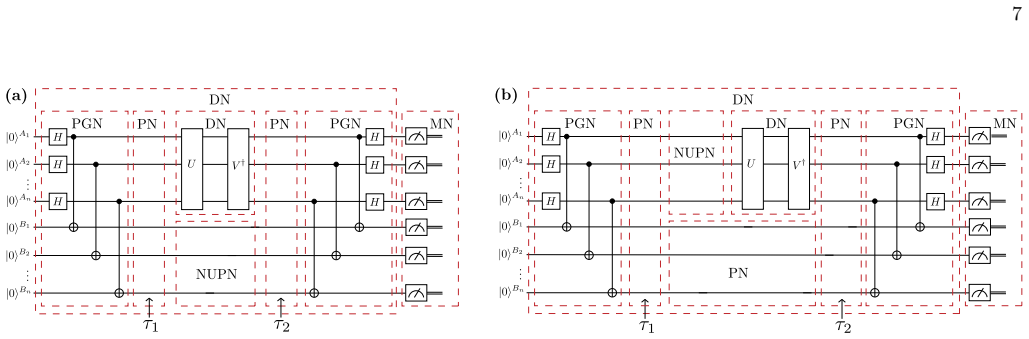
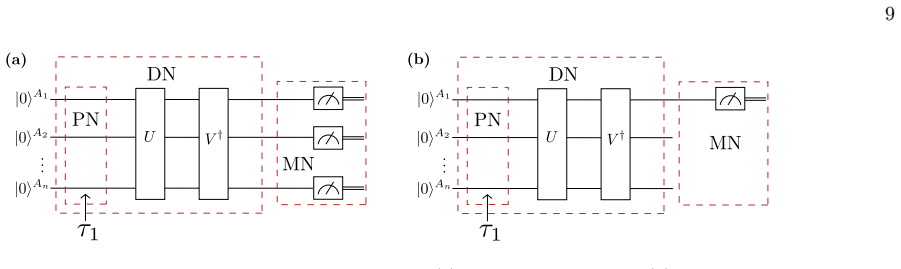
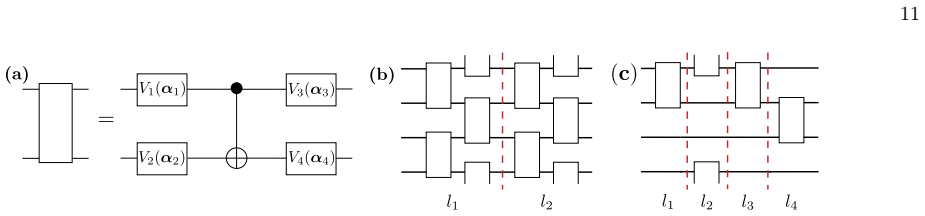
The central objects are four cost-evaluation circuits: the Hilbert-Schmidt Test (HST) and Local Hilbert-Schmidt Test (LHST) for full unitary compiling, and the Loschmidt Echo Test (LET) and Local Loschmidt Echo Test (LLET) for fixed-input compiling. The mechanism carrying the argument is the expansion of noisy circuits in the Pauli basis, where Pauli channels are diagonal, non-unital Pauli channels add a Pauli tail to the identity, and measurement noise becomes a weighted bit-flip POVM. In the HST and LHST proofs, the noisy cost decomposes into a sum over Pauli strings, and each term is bounded by a Cauchy-Schwarz inequality; strict positivity of the noise coefficients $\kappa$, $\xi$, $\vartheta$, and $\tau$ makes the bound tight exactly when $W = V^\dagger U$ is proportional to the identity. For the LET and LLET proofs, a rearrangement inequality on the doubly stochastic matrix $w_{il} = |\langle i|W|l\rangle|^2$ bounds the noisy fidelity by the ordered inner product $p^\downarrow \cdot q^\downarrow$, saturated by permutations that map the noisy input basis to the noisy measurement basis, a subset of the noiseless optima.
What would settle it
Compile a known two-qubit unitary with a complete ansatz using the HST cost, first with no noise and then with a Pauli channel that has one of its Pauli eigenvalues set to zero while preserving complete positivity, and compare the optimal parameters; the strong-OPR theorem predicts identical optima only when the positivity condition holds, so any shift would falsify the claim.
Extended reading notes
Core claim
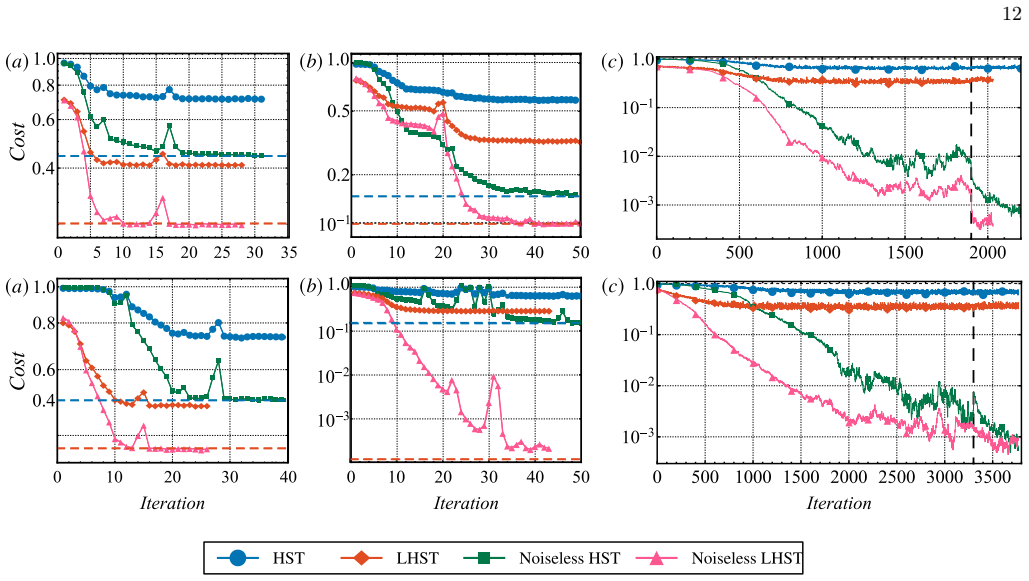
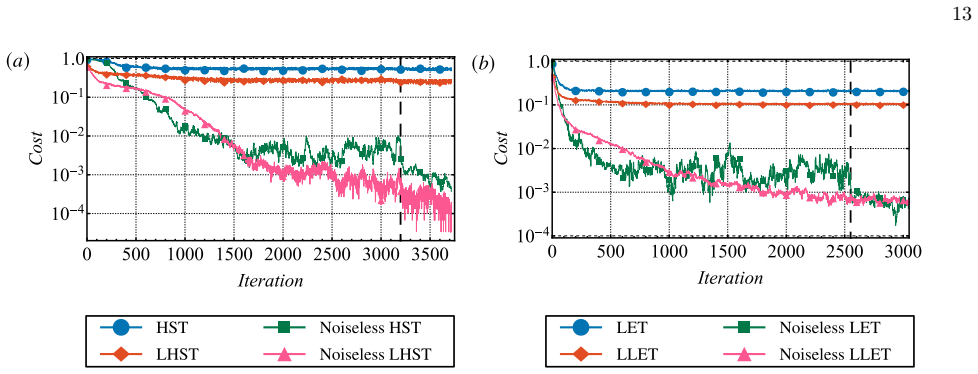
On its own terms, the paper's central discovery is that Optimal Parameter Resilience is a genuine property of variational quantum compiling. For Full Unitary Matrix Compiling, the cost functions $C_{\mathrm{HST}} = 1 - |\mathrm{Tr}(V^\dagger U)|^2/d^2$ and its local counterpart $C_{\mathrm{LHST}}$ have exactly the same set of global optimizers in the presence of Noise Model 1 or Noise Model 2 as in the absence of noise (strong-OPR, Theorems 1 and 2). For Fixed Input State Compiling, the Loschmidt Echo cost $C_{\mathrm{LET}}$ and its local version $C_{\mathrm{LLET}}$ have the property that every optimizer under Noise Model 3 is also a noiseless optimizer (weak-OPR, Theorem 3). The proofs show that the noisy cost is bounded by a noise-dependent constant through Cauchy-Schwarz or rearrangement inequalities, with equality holding exactly at the noiseless optima when the noise coefficients are strictly positive. Numerical simulations with a realistic hardware noise model show that training in the noisy setting drives the noiseless cost to about $10^{-4}$ to $10^{-5}$, matching and even extending the theorems.
Load-bearing premise
The theorems require that every noise coefficient entering the Cauchy-Schwarz and rearrangement bounds be strictly positive, which for Pauli channels means all Pauli eigenvalues are positive and for measurement noise means the correct outcome is more likely than the incorrect one, and they further assume the variational ansatz is complete enough to contain an exact compilation of the target unitary.
Editorial extensions
If this is right
- Circuit-depth compression with VQC remains meaningful on noisy hardware: because the parameters learned in noise match the noiseless optimum, the shorter compiled circuit $V$ should genuinely incur less noise than the longer target $U$.
- Readout errors do not need to be corrected or calibrated for the purpose of finding the optimal compilation; the optimal parameters are unaffected by the measurement noise model of Definition 5.
- Pauli gate noise during the entangling and disentangling stages, depolarizing noise throughout, and non-unital (T1-like) noise at specified times are all tolerated together in FUMC; Clifford or tensor-product structure of $W$ extends this resilience to noise acting during $W$ itself.
- For fixed-input compiling, weak-OPR means noisy training may select a subset of the already degenerate noiseless optima, so any circuit it finds still compiles $U|0\rangle$ correctly, but the optimizer might not explore all equally good compilations.
- Because each VQC cost is an expectation value of an effective Hamiltonian, the paper's results show that VQE exhibits the same optimal parameter resilience for those specific Hamiltonians.
Reading between the lines
- A testable extension: the proof mechanism suggests resilience should hold when the noise channel is any unital or non-unital Pauli map with strictly positive Pauli coefficients, even if the noise acts at times not covered by Theorems 1–3; the numerics already hint at this because the simulator noise includes non-unital terms throughout $W$.
- The strict positivity condition draws a sharp boundary: as any coefficient approaches zero, the Cauchy-Schwarz bound stops being tight at the noiseless optimum, so one might see a transition where noise resilience fails; scanning a dephasing strength from small to large would map where the optimal parameters start to move.
- Weak-OPR could be turned into a design tool: since noise prunes the degenerate set of noiseless optima, one could engineer the measurement noise to select an optimum with desirable properties such as fewer entangling gates, though the paper does not explore this.
Editorial analysis
A structured set of objections, weighed in public.
Referee Report
Summary. The paper introduces Optimal Parameter Resilience (OPR) for variational quantum compiling (VQC). It defines strong-OPR as equality of the noisy and noiseless global-optimizer sets over the full unitary group V_d, and weak-OPR as inclusion of the noisy optimizers in the noiseless optimizers. The main analytic results are Theorem 1 and Theorem 2, which state that the Hilbert-Schmidt Test and Local Hilbert-Schmidt Test costs exhibit strong-OPR under two composite incoherent noise models (depolarizing, Pauli, non-unital Pauli, Pauli gate noise, and measurement noise), and Theorem 3, which states that the Loschmidt Echo Test and Local Loschmidt Echo Test costs exhibit weak-OPR under a simpler noise model. Corollaries extend some results to noise acting during the implementation of W = V^dagger U for Clifford and tensor-product cases. The paper also reports numerical implementations on IBM's noisy simulator for the Toffoli gate, the three-qubit QFT, and W-state preparation, observing that noisy training reduces the noiseless costs. The central mathematical statements are proven in Appendices D-G with explicit assumptions, and the core Cauchy-Schwarz and rearrangement arguments are valid.
Significance. If the results hold as stated, they identify a genuinely surprising property that is potentially useful for NISQ algorithms: for certain VQC cost circuits, the global optimum of the noisy cost over all unitaries coincides with, or is contained in, the noiseless global optimum, so the noise does not shift the target unitary. The proof strategy is transparent and the assumptions about positive Pauli eigenvalues and measurement-error probabilities are explicit. The strong-OPR results for FUMC are especially clean because equality of the full optimizer sets transfers to any complete ansatz containing an exact compilation. The numerical demonstrations are a useful proof-of-principle, although they consist of individual optimization runs without statistical error bars. The main caveat, discussed in the major comments, is that the weak-OPR theorem for FISC does not by itself justify the paper's parameter-training claims, because variational training optimizes over a parameterized ansatz rather than over the full unitary group.
major comments (2)
- [Definition 6, Section V.B, Appendix F] The inference from weak-OPR over the full unitary group to parameter-level noise resilience is not justified. Definition 6 and Theorem 3 concern the sets Vopt_d and ~Vopt_d defined over all d-by-d unitaries in Eqs. (16)-(17), but variational quantum compiling optimizes a cost over an ansatz A = {V(alpha)}. For strong-OPR this gap is harmless: if the ansatz contains a noiseless optimizer and the noisy optimizer set equals the noiseless optimizer set, then the same element optimizes both costs over A. For weak-OPR, however, Theorem 3 only shows ~Vopt_d is a subset of Vopt_d; the proof in Appendix F shows noise can break the degeneracy and select the subset S defined in Eq. (F10). A complete ansatz contains some V with W = V^dagger U in Vopt_d, but it need not contain any W in S. If A intersects Vopt_d but not S, the global optimum of the noisy cost over A is not a noiseless global optimum. Therefore the statement in Section V.B that weak-OPR 'implies that training in the presence of noise will lead one to find the correct optimal parameters for V(alpha)' is unsupported, and the remark in Section VII.C that the theorems are restricted to the complete-ansatz case does not repair the gap, since completeness is sufficient for strong-OPR but not for weak-OPR. The same issue affects Corollaries 6-8, which invoke Theorem 3. The authors should either prove a version of Theorem 3 for parameterized ansatze, for example under a condition ensuring A intersects ~Vopt_d, or explicitly restrict the training-level conclusion and state Theorem 3 as a property of the cost landscape over unitaries.
- [Appendices D-E, Eqs. (D20), (D26), (E9), (E18)] The saturation arguments establishing strong-OPR in Theorems 1 and 2 require strict positivity of the coefficients kappa, xi, theta, and tau. These coefficients are positive only under the assumptions in Definitions 2, 3, and 5, namely all Pauli eigenvalues c_lk > 0 and measurement probabilities satisfying p00 > p01 and p11 > p10. Physical Pauli channels with a non-positive eigenvalue, such as a dephasing channel with error probability above 1/2, are therefore outside the theorems' scope. This is an explicit restriction rather than an internal inconsistency, but the abstract's phrase 'broad class of noise models, such as ... Pauli channel noise' should be qualified in the main text so readers do not conclude that all Pauli channels are covered.
minor comments (4)
- [Section VI and Figures 7-8] The numerical evidence consists of single optimization runs without statistical uncertainties. The text already uses cautious language such as 'appear to exhibit OPR', but it would be helpful to state explicitly that each curve is one run and that no error bars or repeated-initialization statistics are provided.
- [Figure 1-4 captions] The figure captions contain placeholder text 'Lorem ipsum'. These placeholders must be replaced with the intended descriptions before publication.
- [Section VI.B and Figure 7 caption] The color labels are inconsistent between the text and the caption: the text refers to 'blue and red' curves while the caption says 'blue and green', and the pair 'green and pink' is used for two different roles. Please harmonize the color names.
- [Corollary 5 statement] The statement reads 'The cost functions CHST exhibits strong-OPR'; since only CHST is discussed, it should read 'The cost function CHST exhibits strong-OPR'.
Circularity Check
No significant circularity: the noisy optima are derived algebraically from explicit noise models, and self-citations are background rather than load-bearing.
full rationale
The derivation chain is self-contained. Theorems 1–3 begin from explicit circuit descriptions and noise models (Definitions 1–5, 7–9), expand the noisy cost functions in the Pauli basis (Appendices B–F), and obtain closed-form expressions such as f(V) and g(V) in Appendix D, Eq. (D15)–(D26), and the rearrangement-inequality bounds in Appendix F, Eqs. (F4)–(F17). The upper bounds are established with Cauchy–Schwarz or rearrangement inequalities, and saturation at the noiseless optimizers is verified by direct substitution. The positivity assumptions on coefficients such as κ, ξ, ϑ, τ are explicit conditions under which the inequalities are tight; they are not fitted parameters and are not renamed predictions. Self-citations appear for prior definitions and numerical tools (e.g., the cost functions from Ref. [19] and the iCANS optimizer from Ref. [44]), but the central OPR statements do not reduce to those citations. The only substantive concern is interpretational rather than circular: weak-OPR is proven for the full unitary group, so the statement in Section V.B that noisy training 'will lead one to find the correct optimal parameters' is not implied for a restricted ansatz unless that ansatz contains a noisy global optimizer; however, this is a scope limitation or overclaim, not a reduction of the result to its own inputs. No circular step can be exhibited.
Assumptions & free parameters
assumptions (5)
- domain assumption Pauli channel eigenvalues are strictly positive (Definition 2: c_lk > 0 for all Pauli terms).
- domain assumption Measurement noise satisfies pkk > pkl for l ≠ k (Definition 5).
- standard math Standard Pauli algebra and trace identities (Appendix A, Eq. A2).
- standard math Cauchy-Schwarz and rearrangement inequalities.
- domain assumption The ansatz is complete, i.e., contains an exact compilation of U (assumed in applying theorems to V(α)).
Cite this review
Pith. "Pith review of Noise Resilience of Variational Quantum Compiling." pith.science (2026). https://pith.science/paper/RKTOKCX7
@misc{pith2026190804416,
  author       = {Pith},
  title        = {Pith review of: Noise Resilience of Variational Quantum Compiling},
  year         = {2026},
  howpublished = {\url{https://pith.science/paper/RKTOKCX7}},
  note         = {Machine review of arXiv:1908.04416}
}
abstract
Variational hybrid quantum-classical algorithms (VHQCAs) are near-term algorithms that leverage classical optimization to minimize a cost function, which is efficiently evaluated on a quantum computer. Recently VHQCAs have been proposed for quantum compiling, where a target unitary $U$ is compiled into a short-depth gate sequence $V$. In this work, we report on a surprising form of noise resilience for these algorithms. Namely, we find one often learns the correct gate sequence $V$ (i.e., the correct variational parameters) despite various sources of incoherent noise acting during the cost-evaluation circuit. Our main results are rigorous theorems stating that the optimal variational parameters are unaffected by a broad class of noise models, such as measurement noise, gate noise, and Pauli channel noise. Furthermore, our numerical implementations on IBM's noisy simulator demonstrate resilience when compiling the quantum Fourier transform, Toffoli gate, and W-state preparation. Hence, variational quantum compiling, due to its robustness, could be practically useful for noisy intermediate-scale quantum devices. Finally, we speculate that this noise resilience may be a general phenomenon that applies to other VHQCAs such as the variational quantum eigensolver.
Figures
Figures from the paper (5 more)

Forward citations
Cited by 1 Pith paper
-
Effects of Quantum Noise on Quantum Approximate Optimization Algorithm
For dephasing, bit-flip, and depolarizing noise on a 7-qubit Max-Cut QAOA, fidelity, cost, and gradients decay like (1-p)^(αN), and fitted optimal parameters stay close to noiseless values for Np<0.5.
Reference graph
Works this paper leans on
-
[1]
Quantum computing in the NISQ era and beyond,
J. Preskill, “Quantum computing in the NISQ era and beyond,” Quantum2, 79 (2018)
2018
-
[2]
Error mitigation for short-depth quantum circuits,
K. Temme, S. Bravyi, and J. M. Gambetta, “Error mitigation for short-depth quantum circuits,” Physical Review Letters 119, 180509 (2017)
work page 2017
-
[3]
Measuring the renyi entropy of a two-site fermi-hubbard model on a trapped ion quantum computer,
Norbert M Linke, Sonika Johri, Caroline Figgatt, Kevin A Landsman, Anne Y Matsuura, and Christopher Monroe, “Measuring the renyi entropy of a two-site fermi-hubbard model on a trapped ion quantum computer,” Physical Review A 98, 052334 (2018)
work page 2018
-
[4]
Entanglement spectroscopy with a depth-two quantum circuit,
Yiğit Subaşı, Lukasz Cincio, and Patrick J Coles, “Entanglement spectroscopy with a depth-two quantum circuit,” Journal of Physics A: Mathematical and Theoretical52, 044001 (2019)
work page 2019
-
[5]
Noise-adaptive compiler mappings for noisy intermediate-scale quantum computers,
Prakash Murali, Jonathan M Baker, Ali Javadi-Abhari, Frederic T Chong, and Margaret Martonosi, “Noise-adaptive compiler mappings for noisy intermediate-scale quantum computers,” inProceedings of the Twenty-Fourth International Conference on Architectural Support for Programming Languages and Operating Systems (ACM, 2019) pp. 1015–1029
work page 2019
-
[6]
Learning the quantum algorithm for state overlap,
L. Cincio, Y. Subaşı, A. T. Sornborger, and P. J. Coles, “Learning the quantum algorithm for state overlap,” New J. Phys. 20, 113022 (2018)
work page 2018
-
[7]
The theory of variational hybrid quantum-classical algorithms,
J. R. McClean, J. Romero, R. Babbush, and A. Aspuru-Guzik, “The theory of variational hybrid quantum-classical algorithms,” New Journal of Physics18, 023023 (2016)
work page 2016
-
[8]
A variational eigenvalue solver on a photonic quantum processor,
A. Peruzzo, J. McClean, P. Shadbolt, M.-H. Yung, X.-Q. Zhou, P. J. Love, A. Aspuru-Guzik, and J. L. O’Brien, “A variational eigenvalue solver on a photonic quantum processor,” Nature Communications5, 4213 (2014)
work page 2014
Show all 53 references
-
[9]
A quantum approximate optimization algorithm,
E. Farhi, J. Goldstone, and S. Gutmann, “A quantum approximate optimization algorithm,” arXiv:1411.4028 (2014)
2014 arXiv
-
[10]
QVECTOR: an algorithm for device-tailored quantum error correction,
P. D. Johnson, J. Romero, J. Olson, Y. Cao, and A. Aspuru-Guzik, “QVECTOR: an algorithm for device-tailored quantum error correction,” arXiv:1711.02249 (2017)
2017 arXiv
-
[11]
Quantum autoencoders for efficient compression of quantum data,
Jonathan Romero, Jonathan P Olson, and Alan Aspuru-Guzik, “Quantum autoencoders for efficient compression of quantum data,” Quantum Science and Technology2, 045001 (2017)
2017
-
[12]
Variational quantum state diago- nalization,
Ryan LaRose, Arkin Tikku, Étude O’Neel-Judy, Lukasz Cincio, and Patrick J Coles, “Variational quantum state diago- nalization,” npj Quantum Information5, 8 (2019)
2019
-
[13]
Variational consistent histories as a hybrid algorithm for quantum foundations,
Andrew Arrasmith, Lukasz Cincio, Andrew T Sornborger, Wojciech H Zurek, and Patrick J Coles, “Variational consistent histories as a hybrid algorithm for quantum foundations,” Nature Communications10, 3438 (2019)
2019
-
[14]
Variational Quantum Fidelity Estimation,
Marco Cerezo, Alexander Poremba, Lukasz Cincio, and Patrick J. Coles, “Variational Quantum Fidelity Estimation,” Quantum 4, 248 (2020)
2020
-
[15]
Variational quantum algorithms for discovering hamiltonian spectra,
Tyson Jones, Suguru Endo, Sam McArdle, Xiao Yuan, and Simon C Benjamin, “Variational quantum algorithms for discovering hamiltonian spectra,” Physical Review A99, 062304 (2019)
2019
-
[16]
Theory of variational quantum simulation,
Xiao Yuan, Suguru Endo, Qi Zhao, Ying Li, and Simon C. Benjamin, “Theory of variational quantum simulation,” Quantum 3, 191 (2019). 17
2019
-
[17]
Efficient variational quantum simulator incorporating active error minimization,
Ying Li and Simon C Benjamin, “Efficient variational quantum simulator incorporating active error minimization,” Physical Review X7, 021050 (2017)
2017
-
[18]
Self-verifying variational quantum simulation of lattice models,
C Kokail, C Maier, R van Bijnen, T Brydges, MK Joshi, P Jurcevic, CA Muschik, P Silvi, R Blatt, CF Roos,et al. , “Self-verifying variational quantum simulation of lattice models,” Nature569, 355 (2019)
2019
-
[19]
Quantum- assisted quantum compiling,
SumeetKhatri, RyanLaRose, AlexanderPoremba, LukaszCincio, AndrewT.Sornborger, andPatrickJ.Coles,“Quantum- assisted quantum compiling,” Quantum3, 140 (2019)
2019
-
[20]
Quantum compilation and circuit optimisation via energy dissipation,
T. Jones and S. C. Benjamin, “Quantum compilation and circuit optimisation via energy dissipation,” arXiv:1811.03147 (2018)
2018 arXiv
-
[21]
Variational quantum gate optimization,
Kentaro Heya, Yasunari Suzuki, Yasunobu Nakamura, and Keisuke Fujii, “Variational quantum gate optimization,” arXiv preprint arXiv:1810.12745 (2018)
2018 arXiv
-
[22]
Variational quantum unsampling on a quantum photonic processor,
Jacques Carolan, Masoud Mohseni, Jonathan P Olson, Mihika Prabhu, Changchen Chen, Darius Bunandar, Mur- phy Yuezhen Niu, Nicholas C Harris, Franco NC Wong, Michael Hochberg, et al. , “Variational quantum unsampling on a quantum photonic processor,” Nature Physics , 1–6 (2020)
2020
-
[23]
Quantum error correction for beginners,
Simon J Devitt, William J Munro, and Kae Nemoto, “Quantum error correction for beginners,” Reports on Progress in Physics 76, 076001 (2013)
2013
-
[24]
Surface codes: Towards practical large-scale quantum computation,
A. G. Fowler, M. Mariantoni, J. M. Martinis, and A. N. Cleland, “Surface codes: Towards practical large-scale quantum computation,” Physical Review A86, 032324 (2012)
2012
-
[25]
Programming languages and compiler design for realistic quantum hard- ware,
F. T. Chong, D. Franklin, and M. Martonosi, “Programming languages and compiler design for realistic quantum hard- ware,” Nature549, 180 (2017)
2017
-
[26]
A software methodology for compiling quantum programs,
Thomas Häner, Damian S Steiger, Krysta Svore, and Matthias Troyer, “A software methodology for compiling quantum programs,” Quantum Science and Technology3, 020501 (2018)
2018
-
[27]
Compiling quantum circuits to realistic hardware architectures using temporal planners,
D. Venturelli, M. Do, E. Rieffel, and J. Frank, “Compiling quantum circuits to realistic hardware architectures using temporal planners,” Quantum Science and Technology3, 025004 (2018)
2018
-
[28]
Open quantum assembly language,
Andrew W Cross, Lev S Bishop, John A Smolin, and Jay M Gambetta, “Open quantum assembly language,” arXiv preprint arXiv:1707.03429 (2017)
2017 arXiv
-
[29]
General teleportation channel, singlet fraction, and qua- sidistillation,
Michał Horodecki, Paweł Horodecki, and Ryszard Horodecki, “General teleportation channel, singlet fraction, and qua- sidistillation,” Physical Review A60, 1888 (1999)
1999
-
[30]
A simple formula for the average gate fidelity of a quantum dynamical operation,
Michael A Nielsen, “A simple formula for the average gate fidelity of a quantum dynamical operation,” Physics Letters A 303, 249–252 (2002)
2002
-
[31]
Cost-function-dependent barren plateaus in shallow quantum neural networks,
M Cerezo, Akira Sone, Tyler Volkoff, Lukasz Cincio, and Patrick J Coles, “Cost-function-dependent barren plateaus in shallow quantum neural networks,” arXiv preprint arXiv:2001.00550 (2020)
2020 arXiv
-
[32]
Loschmidt echo,
Arseni Goussev, Rodolfo A Jalabert, Horacio M Pastawski, and Diego Ariel Wisniacki, “Loschmidt echo,” Scholarpedia 7, 11687 (2012)
2012
-
[33]
M. A. Nielsen and I. L. Chuang,Quantum Computation and Quantum Information, Cambridge University Press (2010)
2010
-
[34]
M. M. Wilde,Quantum Information Theory , 2nd ed. (Cambridge University Press, 2017)
2017
-
[35]
Both toffoli and controlled-not need little help to do universal quantum computing,
Yaoyun Shi, “Both toffoli and controlled-not need little help to do universal quantum computing,” Quantum Information & Computation3, 84–92 (2003)
2003
-
[36]
Polynomial-time algorithms for prime factorization and discrete logarithms on a quantum computer,
P. Shor, “Polynomial-time algorithms for prime factorization and discrete logarithms on a quantum computer,” SIAM Journal on Computing26, 1484–1509 (1997)
1997
-
[37]
X y mixers: Analytical and numerical results for the quantum alternating operator ansatz,
Zhihui Wang, Nicholas C Rubin, Jason M Dominy, and Eleanor G Rieffel, “X y mixers: Analytical and numerical results for the quantum alternating operator ansatz,” Physical Review A101, 012320 (2020)
2020
-
[38]
On the CNOT-cost of Toffoli gates,
V. V. Shende and I. L. Markov, “On the CNOT-cost of Toffoli gates,” Quantum Information and Computation9, 0461–0486 (2009)
2009
-
[39]
Deterministic preparation of dicke states,
Andreas Bärtschi and Stephan Eidenbenz, “Deterministic preparation of dicke states,” inInternational Symposium on Fundamentals of Computation Theory (Springer, 2019) pp. 126–139
2019
-
[40]
Efficient quantum algorithms for ghz and w states, and implementation on the ibm quantum computer,
Diogo Cruz, Romain Fournier, Fabien Gremion, Alix Jeannerot, Kenichi Komagata, Tara Tosic, Jarla Thiesbrummel, Chun Lam Chan, Nicolas Macris, Marc-André Dupertuis,et al., “Efficient quantum algorithms for ghz and w states, and implementation on the ibm quantum computer,” Advance...
2019
-
[41]
Qiskit: An Open-source Framework for Quantum Computing,
Gadi Aleksandrowicz et.al., “Qiskit: An Open-source Framework for Quantum Computing,” (2019)
2019
-
[42]
Qiskit/qiskit-tutorials,
Qiskit, “Qiskit/qiskit-tutorials,” (2019)
2019
-
[43]
Quantum circuit learning,
K. Mitarai, M. Negoro, M. Kitagawa, and K. Fujii, “Quantum circuit learning,” Physical Review A98, 032309 (2018)
2018
-
[44]
An adaptive optimizer for measurement-frugal variational algorithms,
Jonas M Kübler, Andrew Arrasmith, Lukasz Cincio, and Patrick J Coles, “An adaptive optimizer for measurement-frugal variational algorithms,” arXiv preprint arXiv:1909.09083 (2019)
2019 arXiv
-
[45]
Noise-assisted variational hybrid quantum-classical optimization,
Laura Gentini, Alessandro Cuccoli, Stefano Pirandola, Paola Verrucchi, and Leonardo Banchi, “Noise-assisted variational hybrid quantum-classical optimization,” arXiv preprint arXiv:1912.06744 (2019)
2019 arXiv
-
[46]
Dynamically error-corrected gates for universal quantum computation,
Kaveh Khodjasteh and Lorenza Viola, “Dynamically error-corrected gates for universal quantum computation,” Physical review letters102, 080501 (2009)
2009
-
[47]
Variational quantum linear solver: A hybrid algorithm for linear systems,
Carlos Bravo-Prieto, Ryan LaRose, M Cerezo, Yigit Subasi, Lukasz Cincio, and Patrick J Coles, “Variational quantum linear solver: A hybrid algorithm for linear systems,” arXiv preprint arXiv:1909.05820 (2019)
2019 arXiv
-
[48]
Hardy, J.E
G.H. Hardy, J.E. Littlewood, Karreman Mathematics Research Collection, G. Pólya, D.E. Littlewood, and G. Pólya, Inequalities, Cambridge Mathematical Library (Cambridge University Press, 1952). 18 Appendix A: Preliminaries The main goal of the Appendix is to provide the proofs ...
1952
-
[49]
(A4) All-zero state
The aforementioned tensor product of maximally entangled states can be written in the Pauli basis as follows: |Φ+⟩⟨Φ+|AB = 1 22n ∑ l,k X l AZ k A⊗X l BZ k B = 1 22n ∑ l,k Z k AX l A⊗Z k BX l B. (A4) All-zero state. Noting that|0⟩⟨0| = (11 +σz)/2, then in the Pauli basis the al...
-
[50]
In the Heisenberg picture, this corresponds to the evolution of the measurement operator with respect to the unitary EAB
Effective noisy measurement operator for the HST In the noiseless HST, the measurement is preceded by the disentangling unitary(EAB)†, whereEAB is defined in (B1). In the Heisenberg picture, this corresponds to the evolution of the measurement operator with respect to the unitar...
-
[51]
Effective noisy measurement operator for the LHST In the LHST, a noisy measurement on two qubitsAjBj is preceded by the disentangling unitary(EAjBj)† acting on the same two qubits. Similar to Section C1, we now derive the effective POVM element as the evolution of the operator Q...
-
[52]
The term that depends onW at timeτ2 is given by ~σ(2) =p(1)q(2)r(2)W2◦P A NU◦W 1(|Φ+⟩⟨Φ+|) +r(2)(1−p(1)q(2))1 d ∑ (g,h)⁄=(0,0) dg,hW2X g AZ h AW† 2⊗11B
Similarly, we break up the the time interval betweenτ2 andτ′ into m steps. The term that depends onW at timeτ2 is given by ~σ(2) =p(1)q(2)r(2)W2◦P A NU◦W 1(|Φ+⟩⟨Φ+|) +r(2)(1−p(1)q(2))1 d ∑ (g,h)⁄=(0,0) dg,hW2X g AZ h AW† 2⊗11B . (G12) Let ~FHST(V )∝f(V ) := Tr[|Φ+⟩⟨Φ+|~σ(2)] ....
-
[53]
Moreover, by using the arguments similar to (E10)–(E13), we find thatf2(V ) is independent ofW
Therefore, the inequality follows from Theorem 2. Moreover, by using the arguments similar to (E10)–(E13), we find thatf2(V ) is independent ofW. This completes the proof. 31 Corollary 6.The cost functionsCLET andCLLET exhibit weak-OPR to a noise model that includes the followi...
Reviewed August 14, 2026 · model on record in the stance chip above.
Discussion (0). Continue with ORCID to comment.