Exploring cooperation mechanisms via reinforcement learning in network common-pool resource games
Pith reviewed 2026-06-30 11:05 UTC · model grok-4.3
The pith
A graph neural network reinforcement learning planner for resource allocation in networked common-pool games achieves higher cooperation, more resources, and less inequality than standard mechanisms.
A machine-rendered reading of the paper's core claim, the machinery that carries it, and where it could break.
Core claim
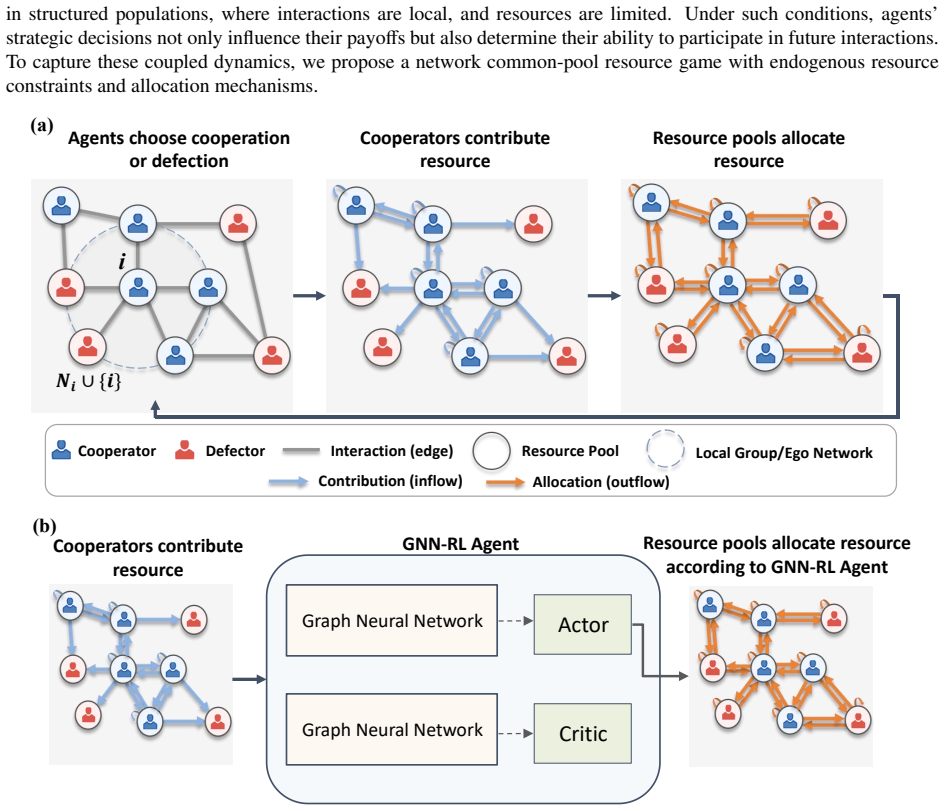
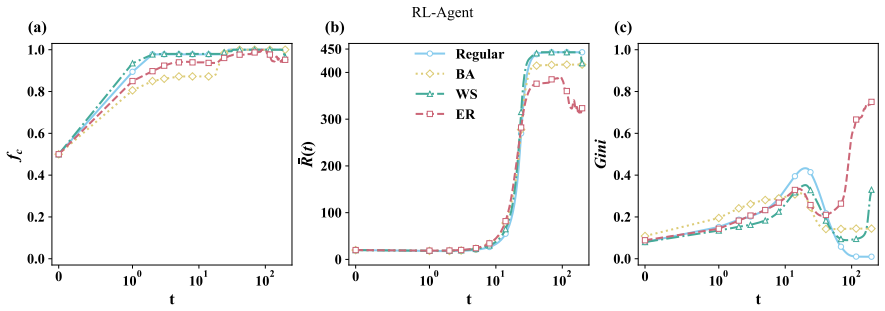
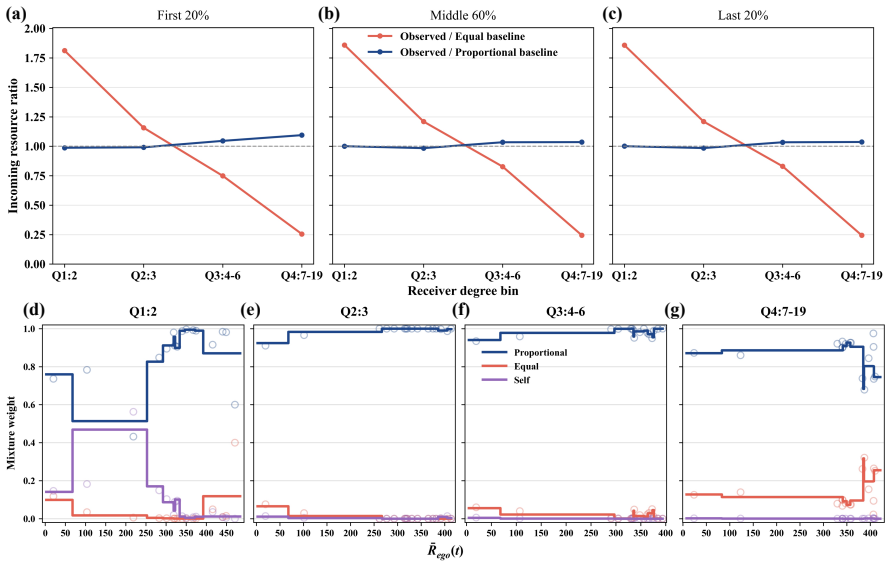
Within the network common-pool resource game framework, a graph neural network-based reinforcement learning social planner that allocates local pool resources without directly controlling individual strategies sustains higher cooperation levels and average accumulated resources while reducing inequality compared to equal and proportional allocation baselines across four representative network topologies. The policy can be interpreted and distilled into a resource-dependent mixture mechanism for regular networks and a degree-conditioned mixture mechanism for heterogeneous networks, showing that effective allocation adapts to both local resource states and structural positions.
What carries the argument
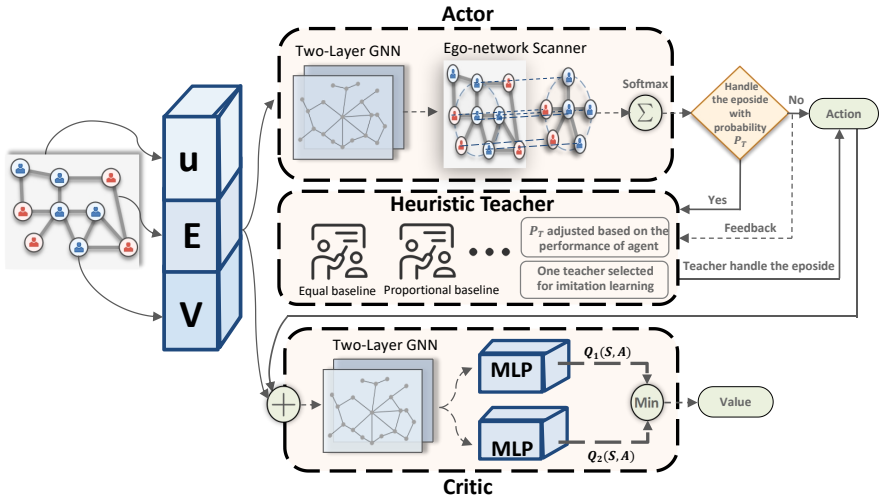
Graph neural network-based reinforcement learning framework for training a social planner to allocate resources in the network common-pool resource game.
If this is right
- The learned planner sustains higher cooperation levels than equal and proportional allocation.
- It achieves higher average accumulated resources.
- It reduces inequality in resource distribution.
- The policy distills into interpretable mechanisms adapting to resource states and network positions.
- This provides an interpretable route from reinforcement learning policy search to mechanism design in networked resource-sharing systems.
Where Pith is reading between the lines
- These distilled mechanisms could be tested directly in empirical studies of resource sharing without needing full RL training.
- The approach might extend to dynamic networks where topologies change over time.
- Applying similar planners to real-world systems like community resource management could improve sustainability and equity.
Load-bearing premise
A social planner allocating resources without directly controlling individual strategies can be learned via GNN-RL to produce stable and generalizable improvements in cooperation and fairness across different network types.
What would settle it
Running the simulations on the four network topologies and finding that the GNN-RL planner does not achieve higher cooperation levels, higher accumulated resources, or lower inequality than the equal and proportional baselines.
Figures





read the original abstract
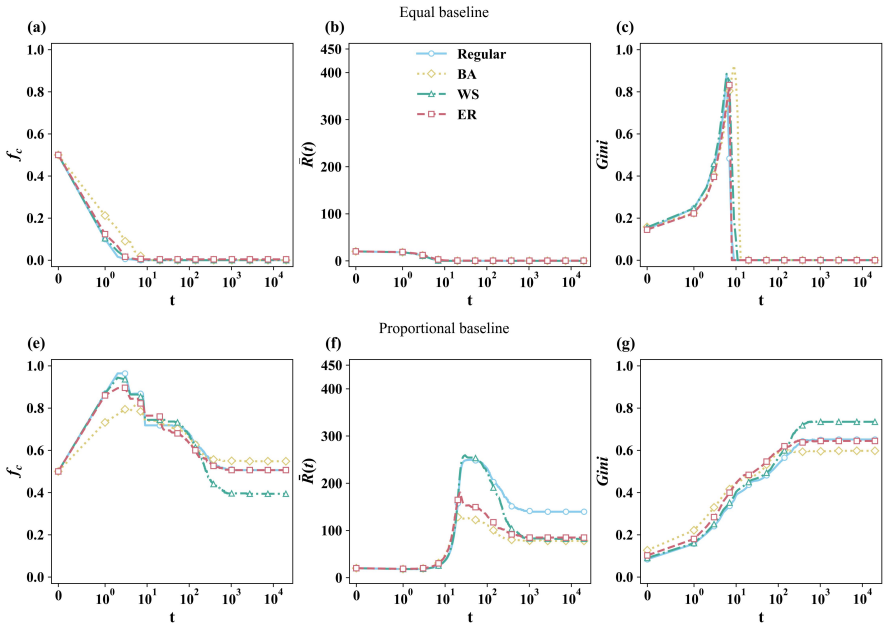
Sustaining cooperation in resource-constrained populations requires allocation mechanisms that balance individual incentives, resource sustainability, and distributional fairness. This paper proposes a network common-pool resource game in which individuals are embedded in complex networks, participate in multiple overlapping local resource pools, and face endogenous resource constraints during strategy evolution. Within this framework, we first examine two representative allocation mechanisms, equal allocation and proportional allocation. The results show that equal allocation produces fair but inefficient outcomes by weakening contribution incentives, whereas proportional allocation can temporarily promote cooperation but amplifies accumulated advantages and leads to severe inequality. To overcome these limitations, we develop a graph neural network-based reinforcement learning framework in which a learned social planner allocates local pool resources without directly controlling individual strategies. Simulation results under four representative network topologies show that the learned planner sustains higher cooperation levels and average accumulated resources, and reduces inequality compared with the baselines. Furthermore, we interpret the learned policy and distill it into two simpler mechanisms: a resource-dependent mixture mechanism for regular networks and a degree-conditioned mixture mechanism for heterogeneous networks. These mechanisms reveal that effective allocation should adapt to both local resource states and structural positions, providing an interpretable route from reinforcement learning policy search to mechanism design in networked resource-sharing systems.
Editorial analysis
A structured set of objections, weighed in public.
Referee Report
Summary. The paper proposes a network common-pool resource game in which individuals are embedded in complex networks, participate in multiple overlapping local resource pools, and face endogenous resource constraints. It first examines equal allocation (fair but inefficient) and proportional allocation (temporarily promotes cooperation but amplifies inequality). It then introduces a GNN-based RL framework for a social planner that allocates local pool resources without directly controlling individual strategies. Simulations across four network topologies show the learned planner achieves higher cooperation, greater average accumulated resources, and lower inequality than the baselines. The learned policy is interpreted and distilled into a resource-dependent mixture mechanism for regular networks and a degree-conditioned mixture mechanism for heterogeneous networks.
Significance. If the simulation results prove robust, the work is significant for demonstrating how GNN-RL can discover adaptive allocation rules in networked CPR games that balance incentives, sustainability, and fairness better than fixed baselines. The explicit distillation of the RL policy into simpler, interpretable mechanisms offers a concrete route from policy search to mechanism design, which is a strength of the approach.
major comments (2)
- [Abstract and results sections] The abstract and results sections report simulation outcomes (higher cooperation, resource accumulation, reduced inequality) but supply no details on the GNN-RL training procedure, hyperparameter choices, statistical tests, robustness to random seeds, or exact network generation methods. This is load-bearing for the central claim, as the improvements cannot be assessed or reproduced without these elements.
- [Framework description] The framework description states that the planner influences outcomes solely through local resource allocation while agents evolve strategies independently, yet no ablation or sensitivity analysis is provided on how the GNN architecture or state representation affects generalizability across the four topologies. This weakens the claim that the approach produces stable improvements.
minor comments (2)
- [Abstract] The abstract mentions 'four representative network topologies' without naming them; listing them (e.g., regular, scale-free, small-world, random) would improve clarity.
- [Notation and equations] Notation for local pools, node degrees, and resource states should be defined consistently in the first use and used uniformly in equations and figures.
Simulated Author's Rebuttal
We thank the referee for the constructive comments, which highlight key areas for improving reproducibility and robustness. We address each major comment below and will revise the manuscript to incorporate the requested details and analyses.
read point-by-point responses
-
Referee: [Abstract and results sections] The abstract and results sections report simulation outcomes (higher cooperation, resource accumulation, reduced inequality) but supply no details on the GNN-RL training procedure, hyperparameter choices, statistical tests, robustness to random seeds, or exact network generation methods. This is load-bearing for the central claim, as the improvements cannot be assessed or reproduced without these elements.
Authors: We agree that these details are essential for reproducibility and were omitted from the current version. In the revised manuscript, we will expand the Methods section and add an Appendix with: the complete GNN-RL training procedure (including the RL algorithm, update rules, and episode structure); all hyperparameter values and their selection rationale; statistical tests (e.g., paired t-tests or Wilcoxon rank-sum with p-values across runs); results aggregated over multiple random seeds with means, standard deviations, and robustness checks; and precise network generation parameters (e.g., n=100 nodes, specific p or k values for ER, WS, BA, and lattice topologies). These additions will enable full reproduction of the reported outcomes. revision: yes
-
Referee: [Framework description] The framework description states that the planner influences outcomes solely through local resource allocation while agents evolve strategies independently, yet no ablation or sensitivity analysis is provided on how the GNN architecture or state representation affects generalizability across the four topologies. This weakens the claim that the approach produces stable improvements.
Authors: We acknowledge the absence of ablations, which limits insight into the contribution of specific design choices. In the revision, we will add sensitivity analyses including: ablations on GNN depth (1-3 layers), embedding dimensions, and state features (e.g., resource levels only vs. augmented with degree or history); performance metrics for each variant across all four topologies; and discussion of how these affect generalizability. Results will be summarized in a new table, supporting the claim of stable improvements while clarifying architectural dependencies. revision: yes
Circularity Check
No significant circularity; simulation results are independent of fitted inputs
full rationale
The paper's central claims rest on simulation outcomes from a GNN-RL planner compared against fixed equal and proportional allocation baselines across network topologies. These results are generated from independent runs of the described game and learning process rather than any parameter fitted to the target metrics and then re-labeled as a prediction. No self-citation chains, self-definitional equations, or ansatzes smuggled via prior work appear in the provided abstract or framework description. The distilled mechanisms are post-hoc interpretations of the learned policy, not inputs to the primary performance claims. The derivation chain is therefore self-contained against external simulation benchmarks.
Axiom & Free-Parameter Ledger
Reference graph
Works this paper leans on
-
[1]
Axelrod, W
R. Axelrod, W. D. Hamilton, The evolution of cooperation, Science 211 (4489) (1981) 1390–1396
1981
-
[2]
J. Berg, J. Dickhaut, K. McCabe, Trust, reciprocity, and social history, Games Econ. Behav. 10 (1) (1995) 122– 142
1995
-
[3]
von Neumann, O
J. von Neumann, O. Morgenstern, Theory of Games and Economic Behavior, Princeton Univ. Press, Princeton, NJ, 1944
1944
-
[4]
M. A. Nowak, Five rules for the evolution of cooperation, Science 314 (5805) (2006) 1560–1563
2006
-
[5]
Ohtsuki, C
H. Ohtsuki, C. Hauert, E. Lieberman, M. A. Nowak, A simple rule for the evolution of cooperation on graphs and social networks, Nature 441 (7092) (2006) 502–505
2006
-
[6]
S. A. Ross, The economic theory of agency: The principal’s problem, Am. Econ. Rev. 63 (2) (1973) 134–139
1973
-
[7]
S. J. Grossman, O. D. Hart, The costs and benefits of ownership: A theory of vertical and lateral integration, J. Polit. Econ. 94 (4) (1986) 691–719
1986
-
[8]
Chaudhuri, Sustaining cooperation in laboratory public goods experiments: a selective survey of the literature, Exp
A. Chaudhuri, Sustaining cooperation in laboratory public goods experiments: a selective survey of the literature, Exp. Econ. 14 (1) (2011) 47–83
2011
-
[9]
Hardin, The tragedy of the commons: the population problem has no technical solution; it requires a funda- mental extension in morality, Science 162 (3859) (1968) 1243–1248
G. Hardin, The tragedy of the commons: the population problem has no technical solution; it requires a funda- mental extension in morality, Science 162 (3859) (1968) 1243–1248
1968
-
[10]
Ostrom, Governing the Commons: The Evolution of Institutions for Collective Action, Cambridge Univ
E. Ostrom, Governing the Commons: The Evolution of Institutions for Collective Action, Cambridge Univ. Press, 1990
1990
-
[11]
Dietz, E
T. Dietz, E. Ostrom, P. C. Stern, The struggle to govern the commons, Science 302 (5652) (2003) 1907–1912
2003
-
[12]
Holmstrom, Moral hazard in teams, Bell J
B. Holmstrom, Moral hazard in teams, Bell J. Econ. (1982) 324–340
1982
-
[13]
E. Fehr, K. M. Schmidt, A theory of fairness, competition, and cooperation, Q. J. Econ. 114 (3) (1999) 817–868
1999
-
[14]
Ostrom, The challenge of common-pool resources, Environment: Science and Policy for Sustainable Devel- opment 50 (4) (2008) 8–21
E. Ostrom, The challenge of common-pool resources, Environment: Science and Policy for Sustainable Devel- opment 50 (4) (2008) 8–21
2008
-
[15]
Agrawal, Sustainable governance of common-pool resources: context, methods, and politics, Annual review of anthropology 32 (1) (2003) 243–262
A. Agrawal, Sustainable governance of common-pool resources: context, methods, and politics, Annual review of anthropology 32 (1) (2003) 243–262
2003
-
[16]
Ostrom, Common-pool resources and institutions: Toward a revised theory, Handbook of agricultural eco- nomics 2 (2002) 1315–1339
E. Ostrom, Common-pool resources and institutions: Toward a revised theory, Handbook of agricultural eco- nomics 2 (2002) 1315–1339
2002
-
[17]
Gardner, E
R. Gardner, E. Ostrom, J. M. Walker, The nature of common-pool resource problems, Rationality and society 2 (3) (1990) 335–358
1990
-
[18]
Szabó, C
G. Szabó, C. Hauert, Phase transitions and volunteering in spatial public goods games, Phys. Rev. Lett. 89 (11) (2002) 118101
2002
-
[19]
Hauert, S
C. Hauert, S. De Monte, J. Hofbauer, K. Sigmund, V olunteering as red queen mechanism for cooperation in public goods games, Science 296 (5570) (2002) 1129–1132
2002
-
[20]
Hauert, S
C. Hauert, S. De Monte, J. Hofbauer, K. Sigmund, Replicator dynamics for optional public good games, J. Theor. Biol. 218 (2) (2002) 187–194
2002
-
[21]
H. Guo, Z. Song, S. Ge ˇcek, X. Li, M. Jusup, M. Perc, Y . Moreno, S. Boccaletti, Z. Wang, A novel route to cyclic dominance in voluntary social dilemmas, J. R. Soc. Interface 17 (164) (2020) 20190789. 25
2020
-
[22]
D. Jia, C. Shen, X. Dai, X. Wang, J. Xing, P. Tao, Y . Shi, Z. Wang, Freedom of choice disrupts cyclic dominance but maintains cooperation in voluntary prisoner’s dilemma game, Knowl.-Based Syst. 299 (2024) 111962
2024
-
[23]
M. A. Nowak, K. Sigmund, Evolution of indirect reciprocity by image scoring, Nature 393 (6685) (1998) 573– 577
1998
-
[24]
Sigmund, C
K. Sigmund, C. Hauert, M. A. Nowak, Reward and punishment, Proc. Natl. Acad. Sci. U.S.A. 98 (19) (2001) 10757–10762
2001
-
[25]
Szolnoki, G
A. Szolnoki, G. Szabó, M. Perc, Phase diagrams for the spatial public goods game with pool punishment, Phys. Rev. E 83 (3) (2011) 036101
2011
-
[26]
Szolnoki, M
A. Szolnoki, M. Perc, Second-order free-riding on antisocial punishment restores the effectiveness of prosocial punishment, Phys. Rev. X 7 (4) (2017) 041027
2017
-
[27]
D. G. Rand, M. A. Nowak, The evolution of antisocial punishment in optional public goods games, Nat. Com- mun. 2 (1) (2011) 434
2011
-
[28]
C. Xia, J. Wang, M. Perc, Z. Wang, Reputation and reciprocity, Phys. Life Rev. 46 (2023) 8–45
2023
-
[29]
Sasaki, S
T. Sasaki, S. Uchida, The evolution of cooperation by social exclusion, Proc. R. Soc. B Biol. Sci. 280 (1752) (2013) 20122498
2013
-
[30]
K. Li, R. Cong, T. Wu, L. Wang, Social exclusion in finite populations, Phys. Rev. E 91 (4) (2015) 042810
2015
-
[31]
M. A. Nowak, R. M. May, Evolutionary games and spatial chaos, Nature 359 (6398) (1992) 826–829
1992
-
[32]
D. G. Rand, S. Arbesman, N. A. Christakis, Dynamic social networks promote cooperation in experiments with humans, Proc. Natl. Acad. Sci. U.S.A. 108 (48) (2011) 19193–19198
2011
-
[33]
Q. Su, A. McAvoy, Y . Mori, J. B. Plotkin, Evolution of prosocial behaviours in multilayer populations, Nat. Hum. Behav. 6 (3) (2022) 338–348
2022
-
[34]
Szolnoki, M
A. Szolnoki, M. Mobilia, L.-L. Jiang, B. Szczesny, A. M. Rucklidge, M. Perc, Cyclic dominance in evolutionary games: a review, J. R. Soc. Interface 11 (100) (2014) 20140735
2014
-
[35]
J. Quan, Y . Zhou, X. Ma, X. Wang, J.-B. Yang, Integrating emotion-imitating into strategy learning improves cooperation in social dilemmas with extortion, Knowl.-Based Syst. 233 (2021) 107550
2021
-
[36]
Sheng, Q
A. Sheng, Q. Su, A. McAvoy, L. Wang, J. B. Plotkin, Cooperation conflicts with equality when allocating public goods, Nature (2026) 1–7
2026
-
[37]
T. W. Sandholm, R. H. Crites, Multiagent reinforcement learning in the iterated prisoner’s dilemma, BioSystems 37 (1-2) (1996) 147–166
1996
-
[38]
Fatima, N
S. Fatima, N. R. Jennings, M. Wooldridge, Learning to resolve social dilemmas: a survey, J. Artif. Intell. Res. 79 (2024) 895–969
2024
-
[39]
Zheng, Z
G. Zheng, Z. Ding, J. Zhang, S. Deng, W. Cai, L. Chen, Evolution of cooperation with q-learning: The impact of information perception, Chaos 35 (5) (2025) 053129
2025
-
[40]
K. Xie, A. Szolnoki, Reinforcement learning in evolutionary game theory: A brief review of recent develop- ments, Appl. Math. Comput. 510 (2026) 129685
2026
-
[41]
J. Lin, P. Long, J. Liang, Q. Dai, H. Li, J. Yang, The coevolution of cooperation: Integrating q-learning and occasional social interactions in evolutionary games, Chaos Solitons Fractals 194 (2025) 116165
2025
-
[42]
X. Li, B. Pi, L.-J. Deng, Q. Li, Memory-driven q-learning model for cooperation in snowdrift game with dynamic behavioral types, Appl. Math. Model. (2025) 116313. 26
2025
-
[43]
C. Du, Z. Li, Y . Zhang, Y . Lu, A. Szolnoki, Shaping the learning signal in a combined q-learning rule to improve structured cooperation, Chaos Solitons Fractals 206 (2026) 117986
2026
-
[44]
D. Jia, X. Dai, J. Xing, P. Tao, Y . Shi, Z. Wang, Asymmetric interaction preference induces cooperation in human-agent hybrid game, Sci. China Inf. Sci. 68 (11) (2025) 212201
2025
-
[45]
Q. Su, H. Wang, Y . Xia, L. Wang, A multi-agent reinforcement learning framework for exploring dominant strategies in iterated and evolutionary games, Nat. Commun. 17 (2026) 490
2026
-
[46]
Shirado, N
H. Shirado, N. A. Christakis, Network engineering using autonomous agents increases cooperation in human groups, iScience 23 (9) (2020) 101438
2020
-
[47]
K. R. McKee, A. Tacchetti, M. A. Bakker, J. Balaguer, L. Campbell-Gillingham, R. Everett, M. Botvinick, Scaffolding cooperation in human groups with deep reinforcement learning, Nat. Hum. Behav. 7 (10) (2023) 1787–1796
2023
-
[48]
Koster, M
R. Koster, M. Pîslar, A. Tacchetti, J. Balaguer, L. Liu, R. Elie, O. P. Hauser, K. Tuyls, M. Botvinick, C. Sum- merfield, Deep reinforcement learning can promote sustainable human behaviour in a common-pool resource problem, Nat. Commun. 16 (1) (2025) 2824
2025
-
[49]
Tacchetti, R
A. Tacchetti, R. Koster, J. Balaguer, L. Liu, M. Pîslar, M. M. Botvinick, K. Tuyls, D. C. Parkes, C. Summerfield, Deep mechanism design: Learning social and economic policies for human benefit, Proc. Natl. Acad. Sci. U.S.A. 122 (25) (2025) e2319949121
2025
-
[50]
D. Jia, I. Romi ´c, L. Shi, Q. Su, C. Liu, J. Liu, P. Holme, X. Li, Z. Wang, Social networking agency and prosociality are inextricably linked in economic games, Nat. Hum. Behav. 9 (12) (2025) 2620–2631
2025
-
[51]
C. Summerfield, L. Argyle, M. Bakker, T. Collins, E. Durmus, T. Eloundou, I. Gabriel, D. Ganguli, K. Hack- enburg, G. Hadfield, et al., How will advanced ai systems impact democracy?, arXiv preprint arXiv:2409.06729 (2024)
-
[52]
Artificial intelligence can persuade people to take political actions
K. Hackenburg, L. Hewitt, C. Wagner, B. M. Tappin, C. Summerfield, Artificial intelligence can persuade people to take political actions, arXiv preprint arXiv:2604.09200 (2026)
work page internal anchor Pith review Pith/arXiv arXiv 2026
-
[53]
D. T. Schroeder, M. Cha, A. Baronchelli, N. Bostrom, N. A. Christakis, D. Garcia, A. Goldenberg, Y . Kyrychenko, K. Leyton-Brown, N. Lutz, et al., How malicious ai swarms can threaten democracy, Science 391 (6783) (2026) 354–357. 27
2026
discussion (0)
Sign in with ORCID, Apple, or X to comment. Anyone can read and Pith papers without signing in.