REVIEW 3 major objections 4 minor 116 references
WIde Separation Planets In Time (WISPIT): A Gap-clearing Planet in a Multi-ringed Disk around the Young Solar-type Star WISPIT 2
T0 review · 3 major / 4 minor · reviewed 2026-08-05 · deepseek-v4-flash
Pith's one-line read WISPIT 2b is a directly imaged, gap-clearing ~4.9-Jupiter-mass proto-planet co-moving with its young solar-type host star.
desk verdict A genuinely new discovery that deserves referee time, but the planet classification hinges on an age systematic the authors should quantify. read the letter →
The pith
A machine-rendered reading of the paper's core claim, the machinery that carries it, and where it could break.
The reading
What carries the argument
The argument rides on four coupled pieces: multi-epoch, multi-mode high-contrast imaging that detects the same point source in several independent reductions; astrometry showing the source is neither stationary nor background, with the orbit fitted under a disk-aligned, co-planar assumption; H- and Ks-band photometry placed on a color-magnitude diagram against AMES-COND and AMES-DUSTY, two grids of young-object evolutionary models; and the gap-width-versus-planet-mass scaling relations of Kanagawa et al. (2016) and Zhang et al. (2018) that tie the observed 59-au gap to the inferred mass. The planet WISPIT 2b itself, sitting in the cleanest gap, is the object that binds these pieces together.
What would settle it
A dynamical mass for WISPIT 2b from high-precision astrometry (for example VLTI/GRAVITY) or radial velocities over several years, combined with a spectroscopic age for the host star: if the mass exceeds the deuterium-burning limit (~13 Jupiter masses) or the orbit is not coplanar with the disk, the planetary and gap-opening interpretations fail.
Extended reading notes
Core claim
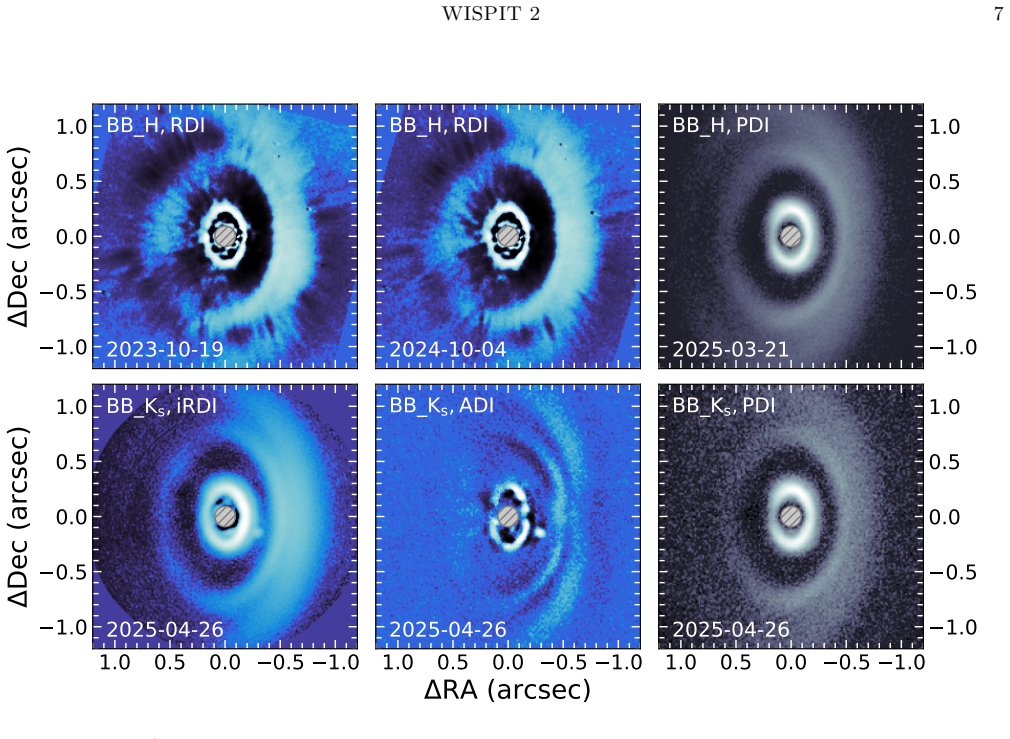
The central claim is that WISPIT 2b is a directly imaged young proto-planet embedded in the widest gap of the disk and co-moving with its host star. The companion is recovered in multiple independent reductions—RDI in H-band and cADI, PCA-ADI, and iRDI in Ks-band—and its positions are inconsistent with a stationary background object. The two cleanest epochs yield an orbital fit with a most probable semi-major axis of about 57 au, placing the planet inside the gap. H- and Ks-band photometry matches a 4.9+0.9/-0.6 Jupiter-mass object on the AMES-COND and AMES-DUSTY young-object tracks at the adopted stellar age of 5.1 Myr. The paper further argues that this mass is consistent with the observed
Load-bearing premise
The planetary classification rests on the host star being about 5 Myr old and on treating the two-epoch astrometric motion as Keplerian; if the star is actually about 19 Myr old, the same photometry would imply a mass above the deuterium-burning limit, and if the 2024 epoch is excluded the orbital constraint is thin.
Editorial extensions
If this is right
- If WISPIT 2b is indeed a ~4.9-MJup planet in the gap, the system becomes the first case where a ring gap is unambiguously associated with an embedded planet, linking disk substructure to ongoing planet formation.
- The gap-width analysis yields a disk viscosity constraint: the photometric mass matches a viscous alpha of ~1e-2 under the Kanagawa et al. (2016) model or ~1e-4 under the Zhang et al. (2018) model, offering a way to measure disk viscosity from an embedded planet.
- The independent H-alpha detection indicates ongoing accretion and possibly a circumplanetary disk, making WISPIT 2b comparable to the PDS 70 planets and opening the door to detailed accretion studies.
- The system supports in-situ formation of wide-separation gas giants by core accretion, without rapid migration, since the planet sits in a cleared and seemingly unperturbed gap.
- Future ALMA and JWST observations of gas kinematics, dust structure, and atmospheric composition can calibrate indirect planet-detection techniques used on other multi-ringed disks.
Reading between the lines
- If the host-star age is pinned down spectroscopically and the companion's dynamical mass is measured, WISPIT 2b would provide a rare test of whether young-object evolutionary tracks over- or under-predict masses near the deuterium-burning boundary—a test the paper does not perform.
- The tentative detection of the inner disk's bottom side through the gap implies the gap is nearly devoid of small dust; a high-resolution ALMA map would test whether dust filtration at the planet's gap is as efficient as the scattered-light morphology suggests.
- The morphological similarity to HD 97048—nearly identical inclination and ring structure but a lower-mass host—hints that wide-orbit giant planets may form around low-mass T Tauri stars as readily as around Herbig stars, an occurrence-rate comparison the paper leaves implicit.
- If the planet's orbit can be constrained to be exactly coplanar with the disk, WISPIT 2b could serve as a clean calibration target for kinematic planet-detection methods, because its gap is empty enough to give a direct view of the planet's influence on the gas.
Editorial analysis
A structured set of objections, weighed in public.
Referee Report
Summary. The paper presents VLT/SPHERE observations of the young solar-type star WISPIT 2, resolving a ~380 au scattered-light disk with four rings and a wide gap, and directly detecting a point source (WISPIT 2b) inside that gap. The authors argue that the source is co-moving with the star, that its H and Ks photometry imply a ~4.9 MJup mass at an adopted stellar age of 5.1 Myr, that its astrometry is consistent with a Keplerian orbit in the disk plane, and that the width of the disk gap is consistent with the planet's mass according to gap-opening models. The abstract concludes that WISPIT 2b is the first unambiguous planet detection in a multi-ringed disk and a laboratory for planet-disk interaction.
Significance. If the central claim holds, the paper is a significant step: it would add a rare, directly imaged embedded protoplanet in a multi-ringed disk around a young solar analog, complementing PDS 70 and providing a direct test of gap-opening theory. The observational work is substantial: four SPHERE epochs, careful RDI/PDI/ADI reductions, a multi-epoch background-source rejection, and an independent comparison to hydrodynamical gap-width models. The photometric interpretation is internally consistent, and the authors are appropriately cautious in several places, including flagging that the mass uncertainty may be underestimated and that spectral characterization is needed. The main weakness is that the 'unambiguous planet' and 'Keplerian orbital motion' claims are not yet fully supported by the presented analysis.
major comments (3)
- [§5.2, Table 4; Appendix A.3] The planetary classification rests on converting M_Ks = 11.95 mag and M_H = 12.8 mag into a mass with AMES-COND/DUSTY at an adopted age of 5.1^{+2.4}_{-1.3} Myr. This age sits at the lower end of the EAGLES v2.0 group age (11.1^{+5.9}_{-8.1} Myr) and below the older literature group ages (~20-35 Myr) listed in Appendix A.2. At fixed absolute magnitude, the inferred mass increases with adopted age, and the quoted 0.6-0.9 MJup uncertainties do not include this age systematic. The paper should explicitly compute the companion mass at 11, 17, 20, and 35 Myr and show that it remains below the deuterium-burning limit. Without that calculation, the abstract's 'first unambiguous planet' and §8's 'consistent with a planetary-mass object' are not secured; the authors' own caution that 'the reported uncertainty may be underestimated' supports this concern.
- [§5.1, Table 3, Figure 8] After excluding the 2024 epoch, the 'orbital motion consistent with Keplerian motion' claim rests on only two epochs (2023-10-19 and 2025-04-26). Two astrometric points cannot demonstrate Keplerian motion; any two points are consistent with some Keplerian orbit. The posterior peak at a~57 au is obtained with inclination/node fixed to the disk orientation and with a post-fit down-selection to a<=70 au. Please (i) include the 2024 epoch in the orbit fit or quantitatively justify its exclusion for the orbit determination, (ii) report the sensitivity of the semi-major axis posterior to the 70 au cut and to the disk-orientation assumptions, and (iii) temper the abstract/conclusion language from 'demonstrate' to 'is compatible with' a Keplerian orbit. The background rejection itself is more robust because it uses all three epochs against the stationary-source track, but that is a separate stat
- [§6, Eqs. (2)-(3), Figure 10] The gap-opening consistency claim is weaker than stated. With alpha spanning 10^-4 to 10^-2, the Kanagawa et al. model gives 0.5-5.3 MJup and the Zhang et al. model gives 4-16 MJup; the photometric 4.9 MJup overlaps only a portion of the combined model range, and the scattered-light gap width is not obviously the same quantity as the gas/dust gap width in the Zhang et al. model. The statement in §8 that the mass is 'consistent with the modeled planet mass required to open such a gap' should be qualified by the strong alpha and model dependence, or the range of allowed masses should be propagated into the comparison.
minor comments (4)
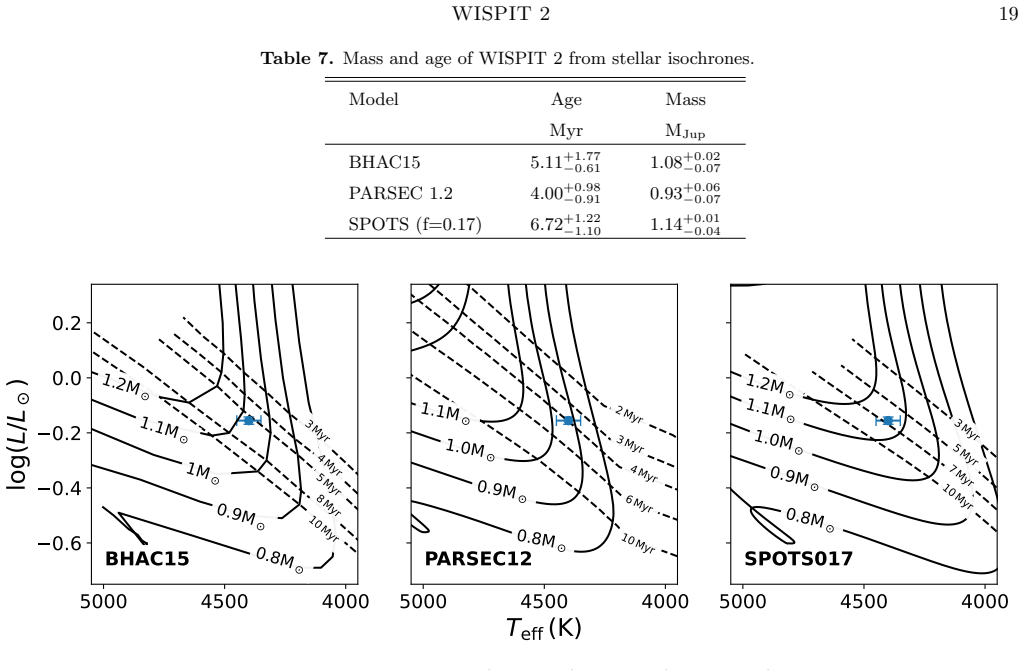
- [Table 7] The column header 'Mass M_Jup' appears to be a typo; the listed masses (0.93-1.14) are clearly in solar masses. Please correct to M_sun.
- [§3.2] The pixel scales are quoted as '12.246 ± 0.009 mas yr^-1' and '12.266 ± 0.009 mas yr^-1'; the units should be mas pixel^-1, not mas yr^-1.
- [§5.1, Table 3] The 2024 H-band astrometry is used in Figure 7 for background rejection but excluded from the orbital fit. The text explains the exclusion, but the abstract and §8 should avoid implying that all three epochs contribute to the 'Keplerian motion' statement. A sentence distinguishing 'background rejection' from 'orbit fit' would prevent confusion.
- [Appendix G] The composite image shifts the 2023 H-band planet position to the 2025 Ks-band position for display. This is stated in the appendix, but the main-text Figure 1 caption should also note that the planet position shown is for 2025-04-26 and that the H-band emission was shifted.
Circularity Check
The orbital 'in-the-gap' result is partly inherited from the fit's priors and post-hoc down-selection; the direct detection, co-moving rejection, and photometric mass are independent.
-
self definitional
[Section 5.1 (orbital fit) and Section 8 (conclusions); see also Abstract]
"As the planet is located in the disk gap, and the disk appears very symmetric and unperturbed in scattered light, we assume that the planet does not cross the disk. ... After the fits were concluded we then down-selected only solutions with a maximum semi-major axis of 70 au, which are then fully contained within the disk gap."
The reported result that the most probable semi-major axis is ~57 au and 'falls in the inner region of the gap' is not an independent orbital measurement: the prior already assumes the planet does not cross the disk, the inclination is fixed to the disk plane, and the posterior is down-selected to a <= 70 au, i.e., fully contained within the gap. Because the 2024 epoch was excluded, only two epochs define a short arc, so the likelihood cannot determine a; the posterior is dominated by these priors and the truncation. Thus the phrase 'orbital motion consistent with Keplerian motion in the observed disk gap' is in part a restatement of the input constraints. The co-moving/background rejection, the direct imaging position in the gap, and the photometric mass remain independent.
full rationale
The paper's central discovery—direct detection of a point source, proper-motion rejection of a background object, and a photometric mass from AMES-COND/DUSTY tracks—does not reduce to the circular step identified. The orbit fit uses the observed gap as a prior and then presents the resulting semi-major axis as if it independently places the planet in the gap; this is a mild but real self-definitional element. The H-alpha confirmation is cited from a submitted companion letter with overlapping authorship (Close et al., submitted), but it is described as 'additionally strengthened' and 'further confirms,' so it is not load-bearing. The paper also explicitly cautions that the mass uncertainty may be underestimated because of the adopted age (Section 5.2), which is a limitation rather than a circularity: the stellar age and the evolutionary-model mass tracks are independent inputs. Overall, one supporting 'prediction' (orbit inside the gap) is partly inherited from priors, while the main detection and characterization are self-contained, giving a score of 4.
Assumptions & free parameters
free parameters (6)
- Stellar age =
5.1 +2.4/-1.3 Myr
- Stellar mass =
1.08 +0.06/-0.17 Msun
- Extinction AV =
0.136 +/- 0.087 mag
- Adopted H-band contrast =
9.8 +0.4/-0.3 mag (2023); 2024 value 10.6 not adopted
- Orbital prior bounds and gap cut =
a prior 40-100 au, posterior cut at 70 au; mode ~57 au
- Disk flaring power law =
h0 = 24.0 au at r0 = 163.6 au, alpha = 1.77 (H), 2.22 (Ks)
assumptions (6)
- domain assumption The planet's orbit is co-planar and aligned with the disk; inclination fixed at 135 deg and ascending node at 0 deg.
- ad hoc to paper The planet does not cross the disk and remains inside the observed gap; orbital solutions with semi-major axis above 70 au are removed after the fit.
- domain assumption AMES-COND and AMES-DUSTY isochrones at ~5.1 Myr describe the young planet's photosphere, and BHAC15/PARSEC/SPOTS tracks describe the host star.
- domain assumption Gaia DR3 parallax and proper motion of WISPIT 2 define the reference frame for rejecting a stationary background source.
- domain assumption Scattered-light rings and gaps in the Q_phi images trace the disk surface density structure and mid-plane geometry.
- domain assumption The H-alpha detection reported in Close et al. (submitted) confirms accretion onto WISPIT 2b.
Cite this review
Pith. "Pith review of WIde Separation Planets In Time (WISPIT): A Gap-clearing Planet in a Multi-ringed Disk around the Young Solar-type Star WISPIT 2." pith.science (2026). https://pith.science/paper/RLQZN2TP
@misc{pith2026250819053,
  author       = {Pith},
  title        = {Pith review of: WIde Separation Planets In Time (WISPIT): A Gap-clearing Planet in a Multi-ringed Disk around the Young Solar-type Star WISPIT 2},
  year         = {2026},
  howpublished = {\url{https://pith.science/paper/RLQZN2TP}},
  note         = {Machine review of arXiv:2508.19053}
}
abstract
In the past decades several thousand exoplanet systems have been discovered around evolved, main-sequence stars, revealing a wide diversity in their architectures. To understand how the planet formation process can lead to vastly different outcomes in system architecture we have to study the starting conditions of planet formation within the disks around young stars. In this study we are presenting high resolution direct imaging observations with VLT/SPHERE of the young ($\sim$5 Myr), nearby ($\sim$133 pc), solar-analog designated as WISPIT 2($=$ TYC~5709-354-1). These observations were taken as part of our survey program that explores the formation and orbital evolution of wide-separation gas giants. WISPIT 2 was observed in four independent epochs using polarized light and total intensity observations. They reveal for the first time an extended (380 au) disk in scattered light with a multi-ringed sub-structure. We directly detect a young proto-planet WISPIT 2b, embedded in a disk gap and show that it is co-moving with its host star. Multiple SPHERE epochs demonstrate that it shows orbital motion consistent with Keplerian motion in the observed disk gap. Our $H$ and $K_s$-band photometric data are consistent with thermal emission from a young planet. By comparison with planet evolutionary models, we find a mass of the planet of $4.9^{+0.9}_{-0.6}$ Jupiter masses. This mass is also consistent with the width of the observed disk gap, retrieved from hydrodynamic models. WISPIT 2b is the first unambiguous planet detection in a multi-ringed disk, making the WISPIT 2 system the ideal laboratory to study planet-disk interaction and subsequent evolution.
Figures


Figures from the paper (16 more)




Reference graph
Works this paper leans on
-
[1]
Allard, F., Hauschildt, P. H., Alexander, D. R., Tamanai, A., & Schweitzer, A. 2001, The Astrophysical Journal, 556, 357, doi: 10.1086/321547
doi:10.1086/321547 2001
-
[2]
Rajpurohit, A. S. 2013, Memorie della Societa Astronomica Italiana Supplementi, 24, 128, doi: 10.48550/arXiv.1302.6559 30 van Capelleveen et al
-
[4]
Avenhaus, H., Quanz, S. P., Garufi, A., et al. 2018, ApJ, 863, 44, doi: 10.3847/1538-4357/aab846
-
[5]
2023, in Astronomical Society of the Pacific Conference Series, Vol
Bae, J., Isella, A., Zhu, Z., et al. 2023, in Astronomical Society of the Pacific Conference Series, Vol. 534, Protostars and Planets VII, ed. S. Inutsuka, Y. Aikawa, T. Muto, K. Tomida, & M. Tamura, 423, doi: 10.48550/arXiv.2210.13314
-
[6]
2017, The Astrophysical Journal, 850, 201, doi: 10.3847/1538-4357/aa9705
Bae, J., Zhu, Z., & Hartmann, L. 2017, The Astrophysical Journal, 850, 201, doi: 10.3847/1538-4357/aa9705
-
[7]
2021, AJ, 161, 147, doi: 10.3847/1538-3881/abd806
Demleitner, M., & Andrae, R. 2021, AJ, 161, 147, doi: 10.3847/1538-3881/abd806
-
[8]
2015, A&A, 577, A42, doi: 10.1051/0004-6361/201425481
Baraffe, I., Homeier, D., Allard, F., & Chabrier, G. 2015, A&A, 577, A42, doi: 10.1051/0004-6361/201425481
-
[9]
2008, A&A, 492, 277, doi: 10.1051/0004-6361:200810395
Bayo, A., Rodrigo, C., Barrado Y Navascu´ es, D., et al. 2008, A&A, 492, 277, doi: 10.1051/0004-6361:200810395
Show all 116 references
-
[10]
2021, ApJL, 916, L2, doi: 10.3847/2041-8213/ac0f83
Benisty, M., Bae, J., Facchini, S., et al. 2021, ApJL, 916, L2, doi: 10.3847/2041-8213/ac0f83
2021 doi
-
[11]
2023, in Astronomical Society of the Pacific Conference Series, Vol
Benisty, M., Dominik, C., Follette, K., et al. 2023, in Astronomical Society of the Pacific Conference Series, Vol. 534, Protostars and Planets VII, ed. S. Inutsuka, Y. Aikawa, T. Muto, K. Tomida, & M. Tamura, 605, doi: 10.48550/arXiv.2203.09991
-
[12]
L., Vigan, A., Mouillet, D., et al
Beuzit, J. L., Vigan, A., Mouillet, D., et al. 2019, A&A, 631, A155, doi: 10.1051/0004-6361/201935251
2019 doi
-
[13]
2011, Ap&SS, 335, 161, doi: 10.1007/s10509-010-0581-x
Bianchi, L., Herald, J., Efremova, B., et al. 2011, Ap&SS, 335, 161, doi: 10.1007/s10509-010-0581-x
2011 doi
-
[14]
L., De Rosa, R
Blunt, S., Nielsen, E. L., De Rosa, R. J., et al. 2017, AJ, 153, 229, doi: 10.3847/1538-3881/aa6930
2017 doi
-
[15]
J., Angelo, I., et al
Blunt, S., Wang, J. J., Angelo, I., et al. 2020, The Astronomical Journal, 159, 89, doi: 10.3847/1538-3881/ab6663
2020 doi
-
[16]
J., Kenworthy, M
Bohn, A. J., Kenworthy, M. A., Ginski, C., et al. 2019, A&A, 624, A87, doi: 10.1051/0004-6361/201834523
2019 doi
-
[17]
J., Ginski, C., Kenworthy, M
Bohn, A. J., Ginski, C., Kenworthy, M. A., et al. 2021, A&A, 648, A73, doi: 10.1051/0004-6361/202140508
2021 doi
-
[18]
Boss, A. P. 1997, Science, 276, 1836, doi: 10.1126/science.276.5320.1836
1997
-
[19]
1989, A&A, 211, 99
Bouvier, J., & Bertout, C. 1989, A&A, 211, 99
1989
-
[20]
P., Zhou, Y., Biddle, L
Bowler, B. P., Zhou, Y., Biddle, L. I., et al. 2025, AJ, 169, 258, doi: 10.3847/1538-3881/adb6a1
2025 doi
-
[21]
2016, Photutils: Photometry tools
Bradley, L., Sipocz, B., Robitaille, T., et al. 2016, Photutils: Photometry tools. http://ascl.net/1609.011
2016
-
[22]
2012, MNRAS, 427, 127, doi: 10.1111/j.1365-2966.2012.21948.x
Bressan, A., Marigo, P., Girardi, L., et al. 2012, MNRAS, 427, 127, doi: 10.1111/j.1365-2966.2012.21948.x
2012
-
[23]
2000, ApJ, 542, 464, doi: 10.1086/309513
Chabrier, G., Baraffe, I., Allard, F., & Hauschildt, P. 2000, ApJ, 542, 464, doi: 10.1086/309513
2000 doi
-
[24]
C., Magnier, E
Chambers, K. C., Magnier, E. A., Metcalfe, N., et al. 2016, ArXiv e-prints. https://arxiv.org/abs/1612.05560
2016 arXiv
-
[25]
2019, ApJL, 877, L33, doi: 10.3847/2041-8213/ab212b
Christiaens, V., Cantalloube, F., Casassus, S., et al. 2019, ApJL, 877, L33, doi: 10.3847/2041-8213/ab212b
2019 doi
-
[26]
M., Males, J
Close, L. M., Males, J. R., Li, J., et al. 2025, AJ, 169, 35, doi: 10.3847/1538-3881/ad8648
2025 doi
-
[27]
2024, A&A, 681, A19, doi: 10.1051/0004-6361/202347109
Columba, G., Rigliaco, E., Gratton, R., et al. 2024, A&A, 681, A19, doi: 10.1051/0004-6361/202347109
2024 doi
-
[28]
2019, The Astrophysical Journal Letters, 877, L3, doi: 10.3847/2041-8213/ab1b42
Currie, T., Marois, C., Cieza, L., et al. 2019, The Astrophysical Journal Letters, 877, L3, doi: 10.3847/2041-8213/ab1b42
2019 doi
-
[29]
2022, Nature Astronomy, 6, 751, doi: 10.1038/s41550-022-01634-x
Currie, T., Lawson, K., Schneider, G., et al. 2022, Nature Astronomy, 6, 751, doi: 10.1038/s41550-022-01634-x
2022 doi
-
[30]
M., Skrutskie, M
Cutri, R. M., Skrutskie, M. F., van Dyk, S., et al. 2003, 2MASS All Sky Catalog of point sources. (Infrared Science Archive)
2003
-
[31]
M., Wright, E
Cutri, R. M., Wright, E. L., Conrow, T., et al. 2012, Explanatory Supplement to the WISE All-Sky Data Release Products, Explanatory Supplement to the WISE All-Sky Data Release Products
2012
-
[32]
I., & Fabrycky, D
Dawson, R. I., & Fabrycky, D. C. 2010, ApJ, 722, 937, doi: 10.1088/0004-637X/722/1/937 de Boer, J., Salter, G., Benisty, M., et al. 2016, A&A, 595, A114, doi: 10.1051/0004-6361/201629267 de Boer, J., Langlois, M., van Holstein, R. G., et al. 2020, A&A, 633, A63, doi: 10.1051/0...
2010 doi
-
[33]
2024, A&A, 688, A149, doi: 10.1051/0004-6361/202348555
Derkink, A., Ginski, C., Pinilla, P., et al. 2024, A&A, 688, A149, doi: 10.1051/0004-6361/202348555
2024 doi
-
[34]
2008, in Society of Photo-Optical Instrumentation Engineers (SPIE) Conference Series, Vol
Dohlen, K., Langlois, M., Saisse, M., et al. 2008, in Society of Photo-Optical Instrumentation Engineers (SPIE) Conference Series, Vol. 7014, Ground-based and Airborne Instrumentation for Astronomy II, ed. I. S. McLean & M. M. Casali, 70143L, doi: 10.1117/12.789786
2008 doi
-
[35]
J., Liu, M
Dupuy, T. J., Liu, M. C., Allers, K. N., et al. 2018, The Astronomical Journal, 156, 57, doi: 10.3847/1538-3881/aacbc2
2018 doi
-
[36]
1999, A&A, 349, 236
Epchtein, N., Deul, E., Derriere, S., et al. 1999, A&A, 349, 236
1999
-
[37]
2021, MNRAS, 500, 4257, doi: 10.1093/mnras/staa3420
Fiorellino, E., Elia, D., Andr´ e, P., et al. 2021, MNRAS, 500, 4257, doi: 10.1093/mnras/staa3420
2021 doi
-
[38]
Fitzpatrick, E. L. 1999, PASP, 111, 63, doi: 10.1086/316293 WISPIT 2 31
1999 doi
-
[39]
B., Rameau, J., Dong, R., et al
Follette, K. B., Rameau, J., Dong, R., et al. 2017, AJ, 153, 264, doi: 10.3847/1538-3881/aa6d85 Gaia Collaboration, Vallenari, A., Brown, A. G. A., et al. 2023, A&A, 674, A1, doi: 10.1051/0004-6361/202243940
2017 doi
-
[40]
M., Barstow, J
Gapp, C., Evans-Soma, T. M., Barstow, J. K., et al. 2025, AJ, 169, 341, doi: 10.3847/1538-3881/ad9c6e
2025 doi
- [41]
-
[42]
2016, A&A, 595, A112, doi: 10.1051/0004-6361/201629265
Ginski, C., Stolker, T., Pinilla, P., et al. 2016, A&A, 595, A112, doi: 10.1051/0004-6361/201629265
2016 doi
-
[43]
2021, ApJL, 908, L25, doi: 10.3847/2041-8213/abdf57
Ginski, C., Facchini, S., Huang, J., et al. 2021, ApJL, 908, L25, doi: 10.3847/2041-8213/abdf57
2021 doi
-
[44]
2024, A&A, 685, A52, doi: 10.1051/0004-6361/202244005
Ginski, C., Garufi, A., Benisty, M., et al. 2024, A&A, 685, A52, doi: 10.1051/0004-6361/202244005
2024 doi
-
[45]
A., et al
Goffo, E., Gandolfi, D., Egger, J. A., et al. 2023, ApJL, 955, L3, doi: 10.3847/2041-8213/ace0c7
2023 doi
-
[46]
A., Devine, D., Woodgate, B., et al
Grady, C. A., Devine, D., Woodgate, B., et al. 2000, ApJ, 544, 895, doi: 10.1086/317222
2000 doi
-
[47]
2019, A&A, 623, A140, doi: 10.1051/0004-6361/201834760
Gratton, R., Ligi, R., Sissa, E., et al. 2019, A&A, 623, A140, doi: 10.1051/0004-6361/201834760
2019 doi
-
[48]
M., Schlafly, E
Green, G. M., Schlafly, E. F., Finkbeiner, D., et al. 2018, MNRAS, 478, 651, doi: 10.1093/mnras/sty1008
2018 doi
-
[49]
Y., Bohn, A
Haffert, S. Y., Bohn, A. J., de Boer, J., et al. 2019, Nature Astronomy, 3, 749, doi: 10.1038/s41550-019-0780-5
2019 doi
-
[50]
J., et al
Hammond, I., Christiaens, V., Price, D. J., et al. 2023, MNRAS, 522, L51, doi: 10.1093/mnrasl/slad027
2023 doi
-
[51]
Hoch, K. K. W., Rowland, M., Petrus, S., et al. 2025, Nature, doi: 10.1038/s41586-025-09174-w Høg, E., Fabricius, C., Makarov, V. V., et al. 2000, A&A, 363, 385
2025 doi
-
[52]
Hom, E. F. Y., Marchis, F., Lee, T. K., et al. 2007, Journal of the Optical Society of America A, 24, 1580, doi: 10.1364/JOSAA.24.001580
2007 doi
-
[53]
L., & Reffert, S
Hunt, E. L., & Reffert, S. 2024, A&A, 686, A42, doi: 10.1051/0004-6361/202348662
2024 doi
-
[54]
S., Babler, B
Indebetouw, R., Mathis, J. S., Babler, B. L., et al. 2005, ApJ, 619, 931, doi: 10.1086/426679
2005 doi
-
[55]
2021, Nature, 600, 231, doi: 10.1038/s41586-021-04124-8
Janson, M., Gratton, R., Rodet, L., et al. 2021, Nature, 600, 231, doi: 10.1038/s41586-021-04124-8
2021 doi
-
[56]
D., Jackson, R
Jeffries, R. D., Jackson, R. J., Wright, N. J., et al. 2023, MNRAS, 523, 802, doi: 10.1093/mnras/stad1293
2023 doi
-
[57]
2022, A&A, 668, A125, doi: 10.1051/0004-6361/202244402
Juillard, S., Christiaens, V., & Absil, O. 2022, A&A, 668, A125, doi: 10.1051/0004-6361/202244402
2022 doi
-
[58]
D., Muto, T., Tanaka, H., et al
Kanagawa, K. D., Muto, T., Tanaka, H., et al. 2016, Publications of the Astronomical Society of Japan, 68, doi: 10.1093/pasj/psw037
2016 doi
-
[59]
2018, A&A, 617, A44, doi: 10.1051/0004-6361/201832957
Keppler, M., Benisty, M., M¨ uller, A., et al. 2018, A&A, 617, A44, doi: 10.1051/0004-6361/201832957
2018 doi
-
[60]
Kerr, R. M. P., Rizzuto, A. C., Kraus, A. L., & Offner, S. S. R. 2021, ApJ, 917, 23, doi: 10.3847/1538-4357/ac0251
2021 doi
-
[61]
B., Orosz, J
Kostov, V. B., Orosz, J. A., Feinstein, A. D., et al. 2020, AJ, 159, 253, doi: 10.3847/1538-3881/ab8a48
2020 doi
-
[62]
2019, AJ, 158, 122, doi: 10.3847/1538-3881/ab339a
Kounkel, M., & Covey, K. 2019, AJ, 158, 122, doi: 10.3847/1538-3881/ab339a
2019 doi
-
[63]
1995, MNRAS, 277, 1491, doi: 10.1093/mnras/277.4.1491
Kroupa, P. 1995, MNRAS, 277, 1491, doi: 10.1093/mnras/277.4.1491
1995 doi
-
[64]
R., Potter, D., & Parise, B
Kuhn, J. R., Potter, D., & Parise, B. 2001, ApJL, 553, L189, doi: 10.1086/320686 Lafreni` ere, D., Marois, C., Doyon, R., & Barman, T. 2009, ApJL, 694, L148, doi: 10.1088/0004-637X/694/2/L148
2001 doi
-
[65]
M., Gratadour, D., Chauvin, G., et al
Lagrange, A. M., Gratadour, D., Chauvin, G., et al. 2009, A&A, 493, L21, doi: 10.1051/0004-6361:200811325
2009 doi
-
[66]
F., Flaccomio, E., Messina, S., et al
Lanza, A. F., Flaccomio, E., Messina, S., et al. 2016, ˚A, 592, A140, doi: 10.1051/0004-6361/201628382
2016 doi
-
[67]
M., Kulkarni, A
Long, M., Romanova, M. M., Kulkarni, A. K., & Donati, J.-F. 2011, Monthly Notices of the Royal Astronomical Society, 413, 1061, doi: 10.1111/j.1365-2966.2010.18193.x
2011
-
[68]
J., & Madhusudhan, N
MacDonald, R. J., & Madhusudhan, N. 2017, MNRAS, 469, 1979, doi: 10.1093/mnras/stx804
2017 doi
-
[69]
MacKay, D. J. C. 2003, Information Theory, Inference, and Learning Algorithms (Copyright Cambridge University Press)
2003
-
[70]
1985, ApJ, 295, 402, doi: 10.1086/163385
Magnani, L., Blitz, L., & Mundy, L. 1985, ApJ, 295, 402, doi: 10.1086/163385
1985 doi
-
[71]
2016, in Society of Photo-Optical Instrumentation Engineers (SPIE) Conference Series, Vol
Maire, A.-L., Langlois, M., Dohlen, K., et al. 2016, in Society of Photo-Optical Instrumentation Engineers (SPIE) Conference Series, Vol. 9908, Ground-based and Airborne Instrumentation for Astronomy VI, ed. C. J. Evans, L. Simard, & H. Takami, 990834, doi: 10.1117/12.2233013
2016 doi
-
[72]
2021, Journal of Astronomical Telescopes, Instruments, and Systems, 7, 035004, doi: 10.1117/1.JATIS.7.3.035004
Maire, A.-L., Langlois, M., Delorme, P., et al. 2021, Journal of Astronomical Telescopes, Instruments, and Systems, 7, 035004, doi: 10.1117/1.JATIS.7.3.035004
2021 doi
-
[73]
2006, ApJ, 641, 556, doi: 10.1086/500401
Nadeau, D. 2006, ApJ, 641, 556, doi: 10.1086/500401
2006 doi
-
[74]
2019, A&A, 632, A25, doi: 10.1051/0004-6361/201936764
Mesa, D., Keppler, M., Cantalloube, F., et al. 2019, A&A, 632, A25, doi: 10.1051/0004-6361/201936764
2019 doi
-
[75]
M., et al
Milli, J., Mouillet, D., Lagrange, A. M., et al. 2012, A&A, 545, A111, doi: 10.1051/0004-6361/201219687
2012 doi
-
[76]
D., Harries, T
Monnier, J. D., Harries, T. J., Aarnio, A., et al. 2017, ApJ, 838, 20, doi: 10.3847/1538-4357/aa6248
2017 doi
-
[77]
D., Harries, T
Monnier, J. D., Harries, T. J., Bae, J., et al. 2019, ApJ, 872, 122, doi: 10.3847/1538-4357/aafe87 M¨ uller, A., Keppler, M., Henning, T., et al. 2018, A&A, 617, L2, doi: 10.1051/0004-6361/201833584
2019 doi
-
[78]
Oliphant, T. E. 2006, A guide to NumPy, Vol. 1 (Trelgol Publishing USA)
2006
-
[79]
2006, A&A, 453, 1129–1140, doi: 10.1051/0004-6361:20054449
Paardekooper, S.-J., & Mellema, G. 2006, A&A, 453, 1129–1140, doi: 10.1051/0004-6361:20054449
2006 doi
-
[80]
J., Min, K
Park, S. J., Min, K. W., Seon, K. I., et al. 2012, ApJ, 754, 10, doi: 10.1088/0004-637X/754/1/10 32 van Capelleveen et al
2012 doi
-
[81]
2024, A&A, 689, A270, doi: 10.1051/0004-6361/202347768
Paunzen, E., Netopil, M., Priˇ segen, M., & Faltov´ a, N. 2024, A&A, 689, A270, doi: 10.1051/0004-6361/202347768
2024 doi
-
[82]
2019, Nature Astronomy, 419, doi: 10.1038/s41550-019-0852-6
Pinte, C., van der Plas, G., M´ enard, F., et al. 2019, Nature Astronomy, 419, doi: 10.1038/s41550-019-0852-6
2019 doi
-
[83]
B., Hubickyj, O., Bodenheimer, P., et al
Pollack, J. B., Hubickyj, O., Bodenheimer, P., et al. 1996, Icarus, 124, 62, doi: 10.1006/icar.1996.0190
1996
-
[84]
2023, Research Notes of the American Astronomical Society, 7, 150, doi: 10.3847/2515-5172/ace88e
Prato, L., & Simon, M. 2023, Research Notes of the American Astronomical Society, 7, 150, doi: 10.3847/2515-5172/ace88e
2023 doi
-
[85]
2023, ApJS, 265, 12, doi: 10.3847/1538-4365/acadd6
Qin, S., Zhong, J., Tang, T., & Chen, L. 2023, ApJS, 265, 12, doi: 10.3847/1538-4365/acadd6
2023 doi
-
[86]
P., Avenhaus, H., Buenzli, E., et al
Quanz, S. P., Avenhaus, H., Buenzli, E., et al. 2013, ApJL, 766, L2, doi: 10.1088/2041-8205/766/1/L2
2013 doi
-
[87]
2019, AJ, 157, 118, doi: 10.3847/1538-3881/aafee2
Ruane, G., Ngo, H., Mawet, D., et al. 2019, AJ, 157, 118, doi: 10.3847/1538-3881/aafee2
2019 doi
-
[88]
K., Mukherjee, S., et al
Rustamkulov, Z., Sing, D. K., Mukherjee, S., et al. 2023, Nature, 614, 659, doi: 10.1038/s41586-022-05677-y
2023 doi
-
[89]
W., Wang, J
Sanghi, A., Xuan, J. W., Wang, J. J., et al. 2024, The Astronomical Journal, 168, 215, doi: 10.3847/1538-3881/ad769f
2024 doi
-
[90]
F., Finkbeiner, D
Schlafly, E. F., Finkbeiner, D. P., Schlegel, D. J., et al. 2010, ApJ, 725, 1175, doi: 10.1088/0004-637X/725/1/1175
2010 doi
-
[91]
F., Green, G., Finkbeiner, D
Schlafly, E. F., Green, G., Finkbeiner, D. P., et al. 2014, ApJ, 786, 29, doi: 10.1088/0004-637X/786/1/29
2014 doi
-
[92]
J., Finkbeiner, D
Schlegel, D. J., Finkbeiner, D. P., & Davis, M. 1998, ApJ, 500, 525, doi: 10.1086/305772
1998 doi
-
[93]
I., & Sunyaev, R
Shakura, N. I., & Sunyaev, R. A. 1976, MNRAS, 175, 613, doi: 10.1093/mnras/175.3.613
1976 doi
-
[94]
Thorsett, S. E. 2003, Science, 301, 193, doi: 10.1126/science.1086326
2003 doi
-
[95]
A., & Terrile, R
Smith, B. A., & Terrile, R. J. 1984, Science, 226, 1421, doi: 10.1126/science.226.4681.1421
1984
-
[96]
Somers, G., Cao, L., & Pinsonneault, M. H. 2020, ApJ, 891, 29, doi: 10.3847/1538-4357/ab722e
2020 doi
-
[97]
2012, ApJL, 755, L28, doi: 10.1088/2041-8205/755/2/L28
Soummer, R., Pueyo, L., & Larkin, J. 2012, ApJL, 755, L28, doi: 10.1088/2041-8205/755/2/L28
2012 doi
-
[98]
M., & Ginski, C
Stapper, L. M., & Ginski, C. 2022, A&A, 668, A50, doi: 10.1051/0004-6361/202142820
2022 doi
-
[99]
G., Oelkers, R
Stassun, K. G., Oelkers, R. J., Paegert, M., et al. 2019, AJ, 158, 138, doi: 10.3847/1538-3881/ab3467
2019 doi
-
[100]
J., Quanz, S
Stolker, T., Bonse, M. J., Quanz, S. P., et al. 2019, A&A, 621, A59, doi: 10.1051/0004-6361/201834136
2019 doi
-
[101]
D., Cugno, G., et al
Stolker, T., Marleau, G. D., Cugno, G., et al. 2020a, A&A, 644, A13, doi: 10.1051/0004-6361/202038878
-
[102]
P., Todorov, K
Stolker, T., Quanz, S. P., Todorov, K. O., et al. 2020b, A&A, 635, A182, doi: 10.1051/0004-6361/201937159
-
[103]
2018, ApJL, 860, L12, doi: 10.3847/2041-8213/aac6d7
Foreman-Mackey, D. 2018, ApJL, 860, L12, doi: 10.3847/2041-8213/aac6d7
2018 doi
-
[104]
2025, The Astrophysical Journal Letters, 984, L6, doi: 10.3847/2041-8213/adc43b
Teague, R., Benisty, M., Facchini, S., et al. 2025, The Astrophysical Journal Letters, 984, L6, doi: 10.3847/2041-8213/adc43b
2025 doi
-
[105]
Torres, C. A. O., Quast, G. R., da Silva, L., et al. 2006, A&A, 460, 695, doi: 10.1051/0004-6361:20065602 Valeg ˚ ard, P. G., Ginski, C., Derkink, A., et al. 2024, A&A, 685, A54, doi: 10.1051/0004-6361/202347452 van Boekel, R., Henning, T., Menu, J., et al. 2017, ApJ, 837, 132...
2006 doi
-
[106]
E., et al
Virtanen, P., Gommers, R., Oliphant, T. E., et al. 2020, Nature Methods, 17, 261, doi: https://doi.org/10.1038/s41592-019-0686-2 ˇZerjal, M., Rains, A. D., Ireland, M. J., et al. 2021, MNRAS, 503, 938, doi: 10.1093/mnras/stab513
2020 doi
-
[107]
2021, A&A, 648, A26, doi: 10.1051/0004-6361/202038794
Wahhaj, Z., Milli, J., Romero, C., et al. 2021, A&A, 648, A26, doi: 10.1051/0004-6361/202038794
2021 doi
-
[108]
2024, ˚A, 687, A257, doi: 10.1051/0004-6361/202349018
Wahhaj, Z., Benisty, M., Ginski, C., et al. 2024, ˚A, 687, A257, doi: 10.1051/0004-6361/202349018
2024 doi
-
[109]
J., Vigan, A., Lacour, S., et al
Wang, J. J., Vigan, A., Lacour, S., et al. 2021, AJ, 161, 148, doi: 10.3847/1538-3881/abdb2d
2021 doi
-
[110]
L., Henden, A
Watson, C. L., Henden, A. A., & Price, A. 2006, Society for Astronomical Sciences Annual Symposium, 25, 47
2006
-
[111]
D., & Jackson, R
Weaver, G., Jeffries, R. D., & Jackson, R. J. 2024, MNRAS, 534, 2014, doi: 10.1093/mnras/stae2133
2024 doi
-
[112]
2022, A&A, 666, A32, doi: 10.1051/0004-6361/202243379
Xie, Chen, Choquet, Elodie, Vigan, Arthur, et al. 2022, A&A, 666, A32, doi: 10.1051/0004-6361/202243379
2022 doi
-
[113]
Zeeuw, P. T. 2018, A&A, 620, A172, doi: 10.1051/0004-6361/201834150
2018 doi
-
[114]
2018, The Astrophysical Journal Letters, 869, L47, doi: 10.3847/2041-8213/aaf744
Zhang, S., Zhu, Z., Huang, J., et al. 2018, The Astrophysical Journal Letters, 869, L47, doi: 10.3847/2041-8213/aaf744
2018 doi
-
[115]
Zhang, Y., Snellen, I. A. G., Bohn, A. J., et al. 2021a, Nature, 595, 370, doi: 10.1038/s41586-021-03616-x
-
[116]
2024, AJ, 168, 246, doi: 10.3847/1538-3881/ad7ea9
Zhang, Y., Gonz´ alez Picos, D., de Regt, S., et al. 2024, AJ, 168, 246, doi: 10.3847/1538-3881/ad7ea9
2024 doi
-
[117]
C., Claytor, Z
Zhang, Z., Liu, M. C., Claytor, Z. R., et al. 2021b, ApJL, 916, L11, doi: 10.3847/2041-8213/ac1123
Reviewed August 5, 2026 · model on record in the stance chip above.
Discussion (0). Sign in to comment.