REVIEW 5 major objections 4 minor 27 references
Multi-Grained Spatio-temporal Modeling for Lip-reading
T0 review · 5 major / 4 minor · reviewed 2026-08-14 · deepseek-v4-flash
Pith's one-line read A multi-grained lip-reading network with learned fusion and forward attention reports state-of-the-art accuracy on LRW and LRW-1000 benchmarks.
desk verdict A modest fusion-mask architecture with a small LRW gain, undermined by a baseline reproduction gap and a SOTA claim its own table contradicts. read the letter →
The pith
A machine-rendered reading of the paper's core claim, the machinery that carries it, and where it could break.
The reading
What carries the argument
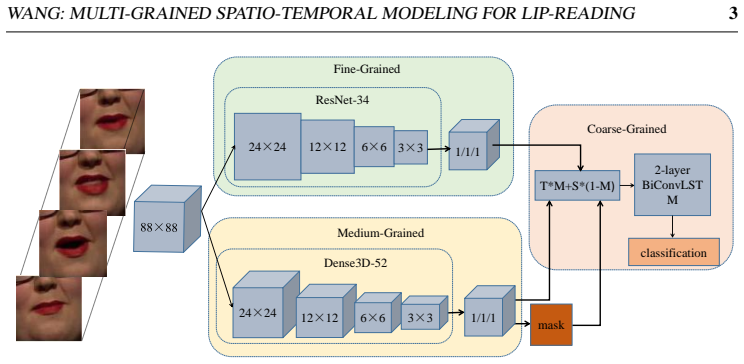
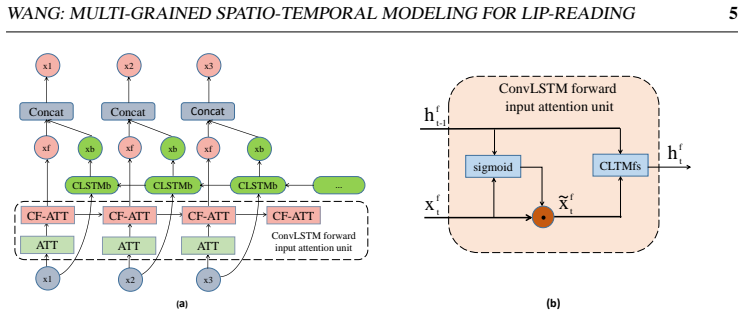
The load-bearing object is the multi-grained spatio-temporal network. It runs two branches in parallel: a 34-layer 2D ResNet that produces per-frame, fine-grained appearance features $S$, and a 52-layer 3D DenseNet that produces short-term, motion-sensitive features $T$. A $1\times1\times1$ convolutional layer learns a spatial mask $M=\sigma(WT)$, and the branches are fused as $F = T\odot M + S\odot (1-M)$, so each spatial location can choose between appearance and motion evidence. The fused features feed a two-layer bidirectional ConvLSTM whose forward direction is gated by an input attention unit $a_t=\sigma(W_{Xa}X_{f;t}+W_{ha}h_{f;t-1})$; this selects important frames while preserving spatial structure. Together these components are what the paper credits for its accuracy figures.
What would settle it
Re-run the proposed model and the original 3D+2D baseline on LRW-1000 with the exact protocol of [23], including the fully-connected layers and three-stage training, and check whether the proposed model exceeds the published 38.19% accuracy; if it does not, the architecture's claimed advantage over the state of the art is not established.
Extended reading notes
Core claim
The central claim is that a multi-grained spatio-temporal network, rather than any single-scale video model, is the right architecture for word-level lip-reading. The paper argues that homophemes require frame-level appearance detail, that most word distinctions live in short-term motion captured by 3D convolution, and that whole-sequence aggregation with a bidirectional ConvLSTM supplies robustness to speaker and appearance variation. It reports that its architecture, a 2D ResNet-34 branch plus a 3D DenseNet-52 branch fused by a learned spatial mask and followed by a forward-input-attention Bi-ConvLSTM, achieves 83.34% accuracy on LRW and 36.91% on LRW-1000. These numbers are presented as state of the art, with the LRW result exceeding the previous 83.0% mark, and as evidence that multi-grained modeling is what makes the difference.
Load-bearing premise
The load-bearing premise is that the baseline systems used for comparison are trained as strongly as the original published systems; the paper's own reproduction of the 3D+2D baseline on LRW-1000 is 4.41 percentage points below the published score, which it attributes to omitted fully-connected layers and missing three-stage training, so if the same under-training affects the other baselines, the claimed gains could be an artifact of weaker comparison systems.
Editorial extensions
If this is right
- If the multi-grained design works as claimed, word-level lip-reading systems can be built by pairing any strong 2D face encoder with a 3D motion encoder and letting the learned mask decide how to combine them at each spatial location, instead of hand-tuning the fusion.
- A forward attention gate on a Bi-ConvLSTM gives the model a way to down-weight frames that contain surrounding context rather than the target word; on LRW clips, which include such context, this should reduce word error rate.
- Because ConvLSTM keeps spatial layout through the recurrence, the network can average predictions over spatial positions at the output, a simple decision rule the paper uses for its final accuracy.
- The architecture separates feature extraction from temporal aggregation, so stronger visual backbones can be substituted into the two branches without altering the fusion mask or the recurrent stage.
Reading between the lines
- A fair test of the method's value would be to pit it against the original 3D+2D baseline of [23] under identical three-stage training with fully-connected layers; the paper's own reproduction of that baseline is 4.41 points below the published number, so the comparison could change.
- The learned mask could be inspected beyond the lip region: if it allocates weight to teeth, tongue, or jaw, that would indicate the model exploits articulator cues beyond the cropped lips; if it does not, the mask's job may be mostly to suppress background.
- The attention gate could be ablated against a fixed gate of the same capacity; if accuracy barely changes, the observed gain may come from added parameters or regularization rather than from frame selection, a distinction the paper does not directly test.
Signed reviews
Editorial analysis
A structured set of objections, weighed in public.
Referee Report
Summary. This paper proposes a multi-grained spatio-temporal network for word-level lip-reading. The front-end uses parallel 2D ResNet-34 and 3D DenseNet-52 branches to extract fine- and medium-grained features, which are fused by a learned spatial attention mask. A two-layer bidirectional ConvLSTM with forward input attention then aggregates long-range spatio-temporal information. On LRW the method achieves 83.34% and on LRW-1000 36.91%; the authors claim state-of-the-art performance on both benchmarks. The paper also reports ablations comparing two-branch Bi-GRU, two-branch Bi-ConvLSTM, and the full proposed model.
Significance. If the results were fully supported, the paper would make a meaningful contribution: it identifies a plausible limitation of cascaded 3D+2D architectures, introduces an adaptive fusion mechanism, and is apparently the first to apply ConvLSTM to lip-reading. The ablation structure is reasonable, and the disclosure that the reproduced 3D+2D baseline is weaker than the published number is candid. However, the central empirical claim is not currently supported: the paper's own Table 2(b) lists a published method (3D+2D, 38.19%) that beats the proposed model on LRW-1000 by 1.28 points, and the only comparison against that method uses an under-trained reproduction. The margins over the next-best published result on LRW are also very small (0.34%), with no error bars. The paper therefore needs additional experiments and a careful reframing of its claims.
major comments (5)
- [Section 4.4 / Table 2(b) / Conclusion] The conclusion claims state-of-the-art performance on two benchmarks, but Table 2(b) lists 3D+2D [23] at 38.19% on LRW-1000, which is 1.28 points above the proposed model's 36.91%. The state-of-the-art claim for LRW-1000 is therefore contradicted by the paper's own reported numbers; please retract or substantially qualify the claim and provide a direct comparison with the published 3D+2D system.
- [Section 4.4 / Table 2(b)] The reproduced 3D+2D baseline reaches 33.78% on LRW-1000 versus the published 38.19%, and the authors attribute this 4.41-point gap to omitted fully-connected layers and the missing three-stage training. Because the proposed model's advantage over this reproduction is only 3.13 points, the experiment does not establish that the proposed architecture is superior to a properly trained 3D+2D baseline; a comparison using the full training protocol of [23] is required before the improvement claim can be assessed.
- [Section 4.3 / Table 1] The text states that bidirectional ConvLSTM modules 'significantly improve' performance over two-branch Bi-GRU, but Table 1 shows only a 0.17% gain on LRW (82.98% to 83.15%) and a decrease on LRW-1000 (36.48% to 36.12%). This claim is not supported by the reported numbers, and the paper should avoid significance language unless error bars or statistical tests are provided.
- [Table 1 / Table 2(b)] The baseline labels are internally inconsistent: Table 1 attributes 38.19% on LRW-1000 to 'ResNet-34 + Bi-GRU [23]' and 34.76% to 'DenseNet-3D + Bi-GRU [23]', while Table 2(b) attributes 38.19% to 3D+2D [23] and 34.76% to D3D [23]. The reader cannot tell which numbers are cited from [23] and which are the author's own reproductions; please correct the table and clarify the provenance of every row.
- [Section 4.3 / Table 1 / Table 2] All reported accuracies are single-run point estimates with no error bars, standard deviations, or significance tests. The key margins are small (0.34% over Stafylakis17 on LRW and 0.19% for the forward-attention ablation on LRW), so the reported differences may be within run-to-run variation; please report multiple seeds or an uncertainty estimate and adjust the conclusions accordingly.
minor comments (4)
- [Section 3.3.1] Please specify how the forward and backward hidden states of the Bi-ConvLSTM are combined at each time step and how the final prediction is obtained; the current text only says framewise predictions are averaged.
- [Section 4.2] Please report the hidden-state channel count of the Bi-ConvLSTM, the number of training epochs, batch size, and the exact two-stage training schedule; these details are necessary for reproducibility.
- [Abstract / Section 4.4] The phrase 'coarse-gained' appears in the abstract and should be 'coarse-grained'; the manuscript also contains several ungrammatical sentences (e.g., the sentence about the reproduced 3D+2D in Section 4.4), and a careful proofread is needed.
- [Figure 1] The tensor dimensions and the configuration of the two-branch front-end are difficult to read in Figure 1; please enlarge or redraw the figure.
Circularity Check
No significant circularity.
full rationale
Walked the paper's claimed derivation chain: the central result is an architecture (two-branch 2D/3D front-end with a learned fusion mask and a Bi-ConvLSTM with forward input attention) evaluated by classification accuracy on the public LRW and LRW-1000 benchmarks (Sec. 4.3, Table 1). There is no step in which a predicted quantity is defined in terms of the fitted target, no parameter fitted to a subset and then reported as a prediction for a closely related quantity, and no load-bearing uniqueness theorem imported from the authors' prior work. The learned fusion mask (Eq. 1) and attention weights (Eqs. 3–4) are trained and then measured; their effect is empirically compared against control architectures, so the evaluation is self-contained with respect to the external benchmarks. The weak reproduced 3D+2D baseline (33.78% vs. 38.19% in [23], Sec. 4.4) is a legitimate comparison-fairness concern, and the paper's own Table 2(b) shows the proposed model (36.91%) does not beat the originally reported 3D+2D (38.19%) on LRW-1000, but these are correctness and benchmark-fairness issues rather than circularity. The paper explicitly attributes the reproduction gap to omitted fully-connected layers and missing three-stage training (Sec. 4.4), which is an implementation-fidelity note, not an input-dependent derivation. No substitution of a fitted constant for a prediction, no definitional equivalence, and no self-citation chain forces the claimed outcome. Verdict: no significant circularity.
Assumptions & free parameters
free parameters (2)
- Learned network weights and fusion mask W =
not released
- Architecture hyperparameters =
not justified
assumptions (3)
- domain assumption LRW and LRW-1000 labels and bounding-box annotations are correct, and the standard train/validation/test splits are used.
- ad hoc to paper Two-stage training, pretraining each branch to convergence and then fine-tuning end-to-end, is a fair protocol for comparing with prior end-to-end methods.
- domain assumption The learned fusion mask T * mask + S * (1 - mask) preserves more discriminative information than simple concatenation or cascading.
Cite this review
Pith. "Pith review of Multi-Grained Spatio-temporal Modeling for Lip-reading." pith.science (2026). https://pith.science/paper/RM2QNJLR
@misc{pith2026190811618,
  author       = {Pith},
  title        = {Pith review of: Multi-Grained Spatio-temporal Modeling for Lip-reading},
  year         = {2026},
  howpublished = {\url{https://pith.science/paper/RM2QNJLR}},
  note         = {Machine review of arXiv:1908.11618}
}
read the original abstract
Lip-reading aims to recognize speech content from videos via visual analysis of speakers' lip movements. This is a challenging task due to the existence of homophemes-words which involve identical or highly similar lip movements, as well as diverse lip appearances and motion patterns among the speakers. To address these challenges, we propose a novel lip-reading model which captures not only the nuance between words but also styles of different speakers, by a multi-grained spatio-temporal modeling of the speaking process. Specifically, we first extract both frame-level fine-grained features and short-term medium-grained features by the visual front-end, which are then combined to obtain discriminative representations for words with similar phonemes. Next, a bidirectional ConvLSTM augmented with temporal attention aggregates spatio-temporal information in the entire input sequence, which is expected to be able to capture the coarse-gained patterns of each word and robust to various conditions in speaker identity, lighting conditions, and so on. By making full use of the information from different levels in a unified framework, the model is not only able to distinguish words with similar pronunciations, but also becomes robust to appearance changes. We evaluate our method on two challenging word-level lip-reading benchmarks and show the effectiveness of the proposed method, which also demonstrate the above claims.
Figures

Reference graph
Works this paper leans on
-
[23]
Lrw-1000: A naturally-distributed large-scale benchmark for lip reading in the wild
Shuang Yang, Yuanhang Zhang, Dalu Feng, Mingmin Yang, Chenhao Wang, Jingyun Xiao, Keyu Long, Shiguang Shan, and Xilin Chen. Lrw-1000: A naturally-distributed large-scale benchmark for lip reading in the wild. In 2019 14th IEEE International Conference on Automatic Face & Gesture Recognition (FG 2019) , pages 1–8. IEEE, 2019
work page 2019
-
[1]
Improved speaker independent lipreading using speaker adaptive training and deep neural networks
Ibrahim Almajai, Stephen Cox, Richard Harvey, and Yuxuan Lan. Improved speaker independent lipreading using speaker adaptive training and deep neural networks. In 10 W ANG: MULTI-GRAINED SPA TIO-TEMPORAL MODELING FOR LIP-READING IEEE International Conference on Acoustics , 2016
work page 2016
-
[2]
Lip- net: End-to-end sentence-level lipreading
Yannis M Assael, Brendan Shillingford, Shimon Whiteson, and Nando de Freitas. Lip- net: End-to-end sentence-level lipreading. arXiv preprint arXiv:1611.01599, 2016
arXiv 2016
-
[3]
The natural statistics of audiovisual speech
Chandramouli Chandrasekaran, Andrea Trubanova, Sébastien Stillittano, Alice Caplier, and Asif A Ghazanfar. The natural statistics of audiovisual speech. PLoS computational biology, 5(7):e1000436, 2009
work page 2009
-
[4]
Greg I Chiou and Jenq-Neng Hwang. Lipreading from color video. IEEE Transactions on Image Processing, 6(8):1192–1195, 1997
work page 1997
-
[5]
Joon Son Chung and Andrew Zisserman. Lip reading in the wild. In Asian Conference on Computer Vision, pages 87–103. Springer, 2016
work page 2016
-
[6]
Learning to lip read words by watching videos
Joon Son Chung and Andrew Zisserman. Learning to lip read words by watching videos. Computer Vision and Image Understanding, 2018
work page 2018
-
[7]
Lip reading sentences in the wild
Joon Son Chung, Andrew Senior, Oriol Vinyals, and Andrew Zisserman. Lip reading sentences in the wild. In 2017 IEEE Conference on Computer Vision and Pattern Recognition (CVPR), pages 3444–3453. IEEE, 2017
work page 2017
Show all 27 references
-
[8]
Toward movement-invariant automatic lip-reading and speech recognition
Paul Duchnowski, Martin Hunke, Dietrich Busching, Uwe Meier, and Alex Waibel. Toward movement-invariant automatic lip-reading and speech recognition. In Acous- tics, Speech, and Signal Processing, 1995. ICASSP-95., 1995 International Conference on, volume 1, pages 109–112. IEEE, 1995
1995
-
[9]
Long short-term memory
Sepp Hochreiter and Jürgen Schmidhuber. Long short-term memory. Neural computa- tion, 9(8):1735–1780, 1997
1997
-
[10]
Videolstm convolves, attends and flows for action recognition
Zhenyang Li, Kirill Gavrilyuk, Efstratios Gavves, Mihir Jain, and Cees GM Snoek. Videolstm convolves, attends and flows for action recognition. Computer Vision and Image Understanding, 166:41–50, 2018
2018
-
[11]
Audio-visual speech recognition using deep learning
Kuniaki Noda, Yuki Yamaguchi, Kazuhiro Nakadai, Hiroshi G Okuno, and Tetsuya Ogata. Audio-visual speech recognition using deep learning. Applied Intelligence, 42 (4):722–737, 2015
2015
-
[12]
End-to-end audiovisual speech recognition
Stavros Petridis, Themos Stafylakis, Pingehuan Ma, Feipeng Cai, Georgios Tz- imiropoulos, and Maja Pantic. End-to-end audiovisual speech recognition. In 2018 IEEE International Conference on Acoustics, Speech and Signal Processing (ICASSP) , pages 6548–6552. IEEE, 2018
2018
-
[13]
An image transform ap- proach for hmm based automatic lipreading
Gerasimos Potamianos, Hans Peter Graf, and Eric Cosatto. An image transform ap- proach for hmm based automatic lipreading. In Image Processing, 1998. ICIP 98. Proceedings. 1998 International Conference on, pages 173–177. IEEE, 1998
1998
-
[14]
Recent advances in the automatic recognition of audiovisual speech
Gerasimos Potamianos, Chalapathy Neti, Guillaume Gravier, Ashutosh Garg, and An- drew W Senior. Recent advances in the automatic recognition of audiovisual speech. Proceedings of the IEEE, 91(9):1306–1326, 2003. W ANG: MULTI-GRAINED SPA TIO-TEMPORAL MODELING FOR LIP-READING 11
2003
-
[15]
Lip reading using optical flow and support vector machines
Ayaz A Shaikh, Dinesh K Kumar, Wai C Yau, MZ Che Azemin, and Jayavardhana Gubbi. Lip reading using optical flow and support vector machines. In Image and Signal Processing (CISP), 2010 3rd International Congress on , volume 1, pages 327–
2010
-
[16]
Convolutional lstm network: A machine learning approach for pre- cipitation nowcasting
Xingjian Shi, Zhourong Chen, Hao Wang, Dit Yan Yeung, Wai Kin Wong, and Wang Chun Woo. Convolutional lstm network: A machine learning approach for pre- cipitation nowcasting. In International Conference on Neural Information Processing Systems, 2015
2015
-
[17]
Two-stream convolutional networks for ac- tion recognition in videos
Karen Simonyan and Andrew Zisserman. Two-stream convolutional networks for ac- tion recognition in videos. InAdvances in neural information processing systems, pages 568–576, 2014
2014
-
[18]
Combining residual networks with lstms for lipreading
Themos Stafylakis and Georgios Tzimiropoulos. Combining residual networks with lstms for lipreading. arXiv preprint arXiv:1703.04105, 2017
2017 arXiv
-
[19]
Convolutional long short-term memory networks for recognizing first person interactions
Swathikiran Sudhakaran and Oswald Lanz. Convolutional long short-term memory networks for recognizing first person interactions. In Proceedings of the IEEE Interna- tional Conference on Computer Vision, pages 2339–2346, 2017
2017
-
[20]
Improving lip-reading performance for robust audiovisual speech recognition using dnns
Kwanchiva Thangthai, Richard W Harvey, Stephen J Cox, and Barry-John Theobald. Improving lip-reading performance for robust audiovisual speech recognition using dnns. In A VSP, pages 127–131, 2015
2015
-
[21]
Hu- man action recognition by learning spatio-temporal features with deep neural networks
Lei Wang, Yangyang Xu, Jun Cheng, Haiying Xia, Jianqin Yin, and Jiaji Wu. Hu- man action recognition by learning spatio-temporal features with deep neural networks. IEEE Access, 6:17913–17922, 2018
2018
-
[22]
Pre- drnn: Recurrent neural networks for predictive learning using spatiotemporal lstms
Yunbo Wang, Mingsheng Long, Jianmin Wang, Zhifeng Gao, and S Yu Philip. Pre- drnn: Recurrent neural networks for predictive learning using spatiotemporal lstms. In Advances in Neural Information Processing Systems , pages 879–888, 2017
2017
-
[24]
Learning spatiotemporal features using 3dcnn and convolutional lstm for gesture recognition
Liang Zhang, Guangming Zhu, Peiyi Shen, Juan Song, Syed Afaq Shah, and Mo- hammed Bennamoun. Learning spatiotemporal features using 3dcnn and convolutional lstm for gesture recognition. In Proceedings of the IEEE International Conference on Computer Vision, pages 3120–3128, 2017
2017
-
[25]
Adding attentiveness to the neurons in recurrent neural networks
Pengfei Zhang, Jianru Xue, Cuiling Lan, Wenjun Zeng, Zhanning Gao, and Nanning Zheng. Adding attentiveness to the neurons in recurrent neural networks. In Proceed- ings of the European Conference on Computer Vision (ECCV) , pages 135–151, 2018
2018
-
[26]
Lipreading with local spatiotem- poral descriptors
Guoying Zhao, Mark Barnard, and Matti Pietikainen. Lipreading with local spatiotem- poral descriptors. IEEE Transactions on Multimedia, 11(7):1254–1265, 2009
2009
-
[27]
Multimodal gesture recog- nition using 3-d convolution and convolutional lstm.IEEE Access, 5:4517–4524, 2017
Guangming Zhu, Liang Zhang, Peiyi Shen, and Juan Song. Multimodal gesture recog- nition using 3-d convolution and convolutional lstm.IEEE Access, 5:4517–4524, 2017
2017
Reviewed August 14, 2026 · model on record in the stance chip above.
Discussion (0). Continue with ORCID to comment.