MSC-CMA-ES: Structure-Aware Restarts for CMA-ES via Cyclic Nearest-Better Basin Discovery
Pith reviewed 2026-06-30 11:11 UTC · model grok-4.3
The pith
MSC-CMA-ES makes CMA-ES restarts structure-aware by seeding one per basin discovered via nearest-better clustering on Sobol pre-samples.
A machine-rendered reading of the paper's core claim, the machinery that carries it, and where it could break.
Core claim
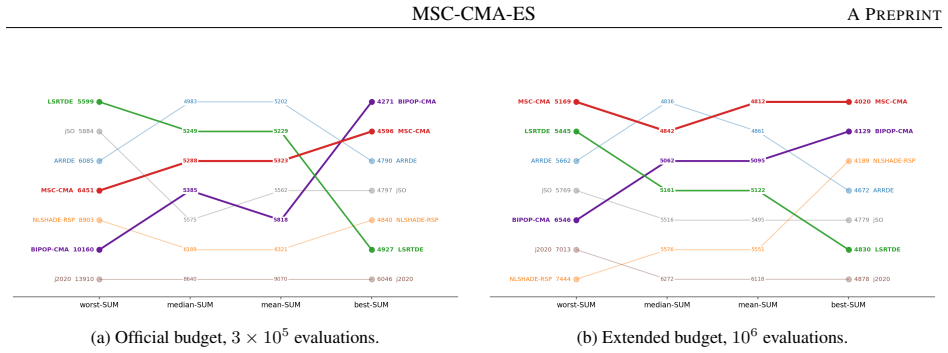
MSC-CMA-ES discovers approximate basins of attraction from a Sobol pre-sample using nearest-better clustering in alternating cycles, then seeds one restart per basin with locally scaled step and population sizes, excludes redundant basin visits, and spends remaining budget on unbounded local refinement of the best-so-far solution, resulting in higher target coverage on composition functions than uniform restart strategies like BIPOP-CMA-ES.
What carries the argument
Nearest-better clustering applied to a Sobol pre-sample to partition the search space into approximate basins of attraction that guide non-redundant, basin-specific restarts.
If this is right
- On composition functions, MSC-CMA-ES attains the best value on all four aggregate measures.
- It achieves 2.7x the fixed-budget target coverage of BIPOP-CMA-ES, the highest among all algorithms evaluated.
- On basic functions, it achieves the best median error but exhibits lower deep-target coverage because budget is spent on landscape discovery.
- On hybrid functions both CMA variants trail the leading differential-evolution algorithms, so the deficit belongs to the CMA family rather than the restart mechanism.
Where Pith is reading between the lines
- The cyclic discovery pattern could reduce the need for hand-tuned restart frequencies in other multimodal evolutionary algorithms.
- Public release of all results and scripts allows direct comparison of basin partitions against known ground-truth basins on standard test functions.
- The method's budget split between discovery and refinement may need rebalancing when moving from 30D CEC problems to real-world black-box tasks with different basin densities.
Load-bearing premise
Nearest-better clustering applied to a Sobol pre-sample produces a sufficiently accurate partition into basins of attraction to guide effective restarts without excessive overhead or missed important basins.
What would settle it
On a multimodal test function whose true basins of attraction are known in advance, measure whether the partitions from nearest-better clustering on Sobol samples match those basins closely enough that basin-seeded restarts produce measurably higher success rates than uniform restarts at the same budget.
Figures
read the original abstract
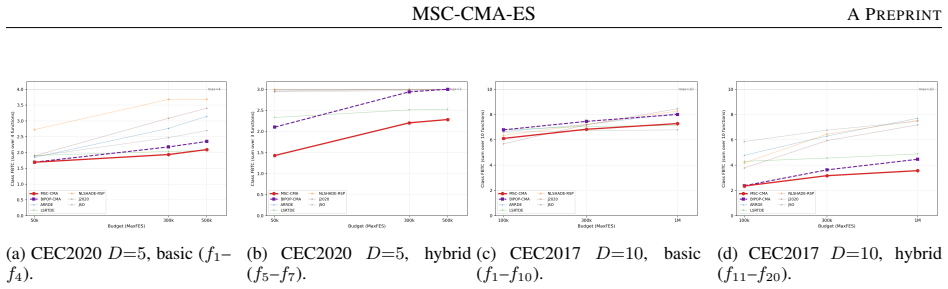
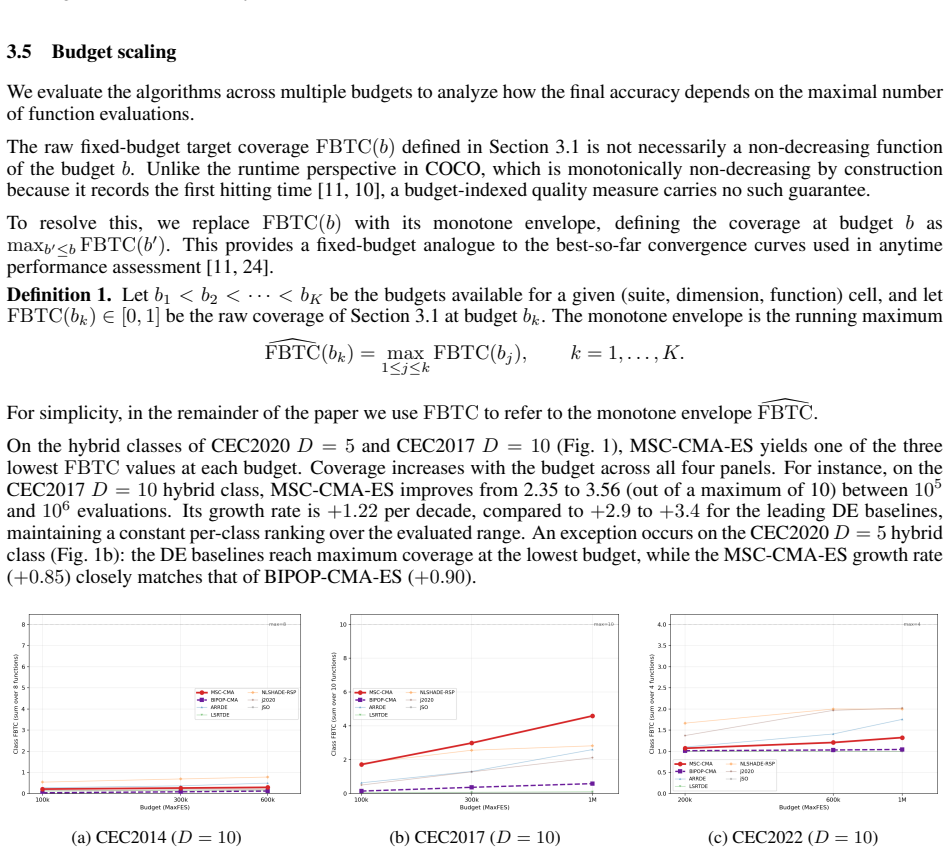
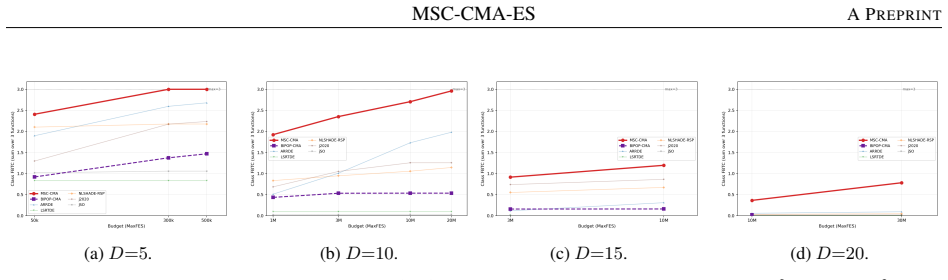
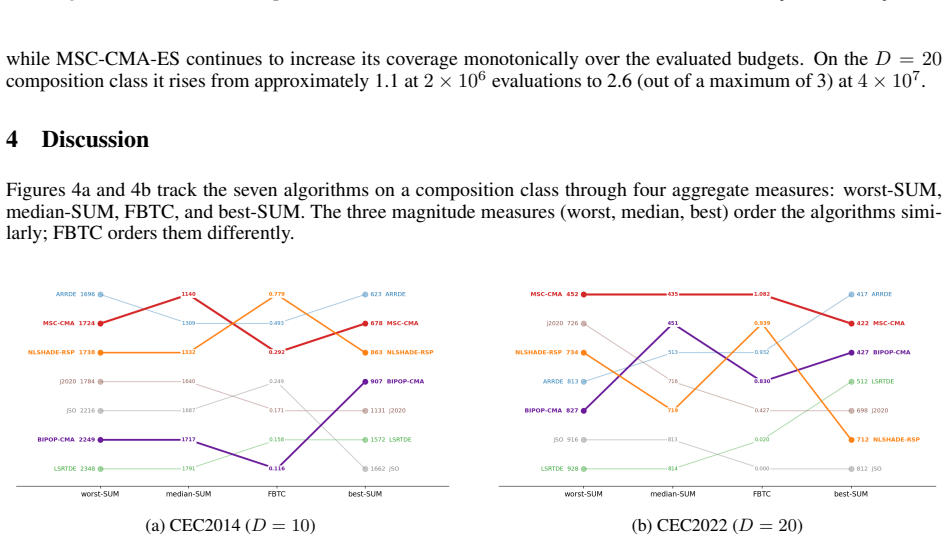
CMA-ES is, per run, a local optimizer; multimodal search relies on restart strategies such as IPOP and BIPOP, which draw every restart uniformly and reuse no information from previous evaluations. Multi-Start Clustering CMA-ES (MSC-CMA-ES) makes restarts structure-aware: in alternating cycles, a Sobol pre-sample is partitioned into approximate basins of attraction by nearest-better clustering, restarts are seeded basin by basin with locally scaled step sizes and population sizes, redundant basin visits are detected and excluded, and the remaining budget is spent on an unbounded local refinement of the best-so-far solution. We evaluate the method on four CEC suites (CEC2014, CEC2017, CEC2020, CEC2022) at their official budgets, across ten (suite, dimension) cells with dimensions 5-30, 51 runs per function, against BIPOP-CMA-ES and five differential-evolution algorithms (ARRDE, jSO, j2020, NL-SHADE-RSP, LSRTDE). Read per function class, MSC-CMA-ES leads on one class, is mixed on a second, and trails on the third. On composition functions, MSC-CMA-ES attains the best value on all four aggregate measures, with 2.7x the fixed-budget target coverage of BIPOP-CMA-ES - the highest composition coverage of any algorithm evaluated. On basic functions, it achieves the best (lowest) median error but exhibits a lower deep-target coverage - the measured price of spending budget on landscape discovery. On hybrid functions both CMA variants trail the leading DE algorithms; the deficit belongs to the CMA family, not to the restart mechanism. All results and scripts are publicly available.
Editorial analysis
A structured set of objections, weighed in public.
Referee Report
Summary. The paper introduces MSC-CMA-ES, a restart strategy for CMA-ES that alternates Sobol pre-sampling with nearest-better clustering to partition the search space into approximate basins of attraction, seeds restarts basin-by-basin using locally scaled step-size and population-size parameters, detects and skips redundant basin visits, and allocates remaining budget to unbounded local refinement of the best-so-far solution. It reports results on CEC2014/2017/2020/2022 suites (dimensions 5–30, official budgets, 51 runs per function) against BIPOP-CMA-ES and five DE variants, claiming that on composition functions MSC-CMA-ES leads on all four aggregate measures with 2.7× the fixed-budget target coverage of BIPOP-CMA-ES.
Significance. If the reported performance differentials hold after verification of implementation details and statistical procedures, the work supplies a concrete, reproducible demonstration that nearest-better basin discovery can convert restart budget into higher coverage on composition landscapes without altering the underlying CMA-ES local search. Public release of all results and scripts is a clear strength that supports direct replication and extension.
major comments (1)
- [Method description / experimental setup] The central performance claim on composition functions rests on the assumption that nearest-better clustering of the Sobol pre-sample yields sufficiently accurate, non-redundant basin partitions; the manuscript should supply a quantitative validation (e.g., agreement with known basin counts on a subset of CEC composition functions or sensitivity analysis to the Sobol sample size) to confirm this step is load-bearing rather than incidental.
minor comments (2)
- [Algorithm description] Clarify whether the local scaling factors for step-size and population size are fixed a priori or adapted per basin; if the latter, state the adaptation rule explicitly.
- [Results] The abstract states that results are reported 'per function class'; include a supplementary table that breaks down the four aggregate measures by individual function within each class so readers can assess whether the composition-function advantage is uniform or driven by a few outliers.
Simulated Author's Rebuttal
We thank the referee for the constructive review and the recommendation of minor revision. The positive assessment of the method's significance and the emphasis on reproducibility are appreciated. We address the single major comment below.
read point-by-point responses
-
Referee: [Method description / experimental setup] The central performance claim on composition functions rests on the assumption that nearest-better clustering of the Sobol pre-sample yields sufficiently accurate, non-redundant basin partitions; the manuscript should supply a quantitative validation (e.g., agreement with known basin counts on a subset of CEC composition functions or sensitivity analysis to the Sobol sample size) to confirm this step is load-bearing rather than incidental.
Authors: We agree that the manuscript would benefit from explicit quantitative validation of the nearest-better basin partitioning step. In the revised version we will add a dedicated subsection containing (i) a sensitivity study of final performance and detected basin count with respect to Sobol pre-sample size and (ii) an agreement analysis against known or literature-reported basin counts on a representative subset of the CEC composition functions. All additional experiments will reuse the publicly released code base. revision: yes
Circularity Check
No significant circularity
full rationale
The manuscript describes an algorithmic restart strategy for CMA-ES that uses nearest-better clustering on a Sobol pre-sample to seed restarts, with all performance claims resting on direct empirical comparisons to independent external baselines (BIPOP-CMA-ES and multiple DE variants) across CEC suites. No equations, derivations, fitted parameters renamed as predictions, or self-citation chains appear in the provided text; the central claims are falsifiable via the publicly released code and results rather than being definitionally equivalent to the method's own inputs.
Axiom & Free-Parameter Ledger
free parameters (2)
- Sobol pre-sample size
- local scaling factors for step-size and population size
axioms (1)
- domain assumption Nearest-better clustering on a Sobol pre-sample yields an approximate partition into basins of attraction that is useful for guiding restarts.
Reference graph
Works this paper leans on
-
[1]
T. Akiba, S. Sano, T. Yanase, T. Ohta, and M. Koyama. Optuna: A next-generation hyperparameter optimization framework. In Proc. ACM SIGKDD, pages 2623–2631, 2019. doi:10.1145/3292500.3330701
-
[2]
A. Auger and N. Hansen. A restart CMA evolution strategy with increasing population size. In Proc. IEEE Congress on Evolutionary Computation (CEC), pages 1769–1776, 2005. doi:10.1109/CEC.2005.1554902
-
[3]
N. H. Awad, M. Z. Ali, J. J. Liang, B. Y . Qu, and P. N. Suganthan. Problem definitions and evaluation criteria for the CEC 2017 special session on single objective real-parameter numerical optimization. Technical report, Nanyang Technological University, 2017
2017
-
[4]
R. Biedrzycki. A version of IPOP-CMA-ES algorithm with midpoint for CEC 2017 single objective bound constrained problems. In Proc. IEEE CEC, pages 1489–1494, 2017. doi:10.1109/CEC.2017.7969479
-
[5]
J. Brest, M. S. Mau ˇcec, and B. Boškoviˇc. Single objective real-parameter optimization: Algorithm jSO. In Proc. IEEE CEC, pages 1311–1318, 2017. doi:10.1109/CEC.2017.7969456
-
[6]
J. Brest, M. S. Mau ˇcec, and B. Boškovi´c. Differential evolution algorithm for single objective bound-constrained optimization: Algorithm j2020. In Proc. IEEE CEC, pages 1–8, 2020. doi:10.1109/CEC48606.2020.9185551
-
[7]
N. Hansen and A. Ostermeier. Completely derandomized self-adaptation in evolution strategies. Evolutionary Computation, 9(2):159–195, 2001. doi:10.1162/106365601750190398
-
[8]
N. Hansen. Benchmarking a BI-population CMA-ES on the BBOB-2009 function testbed. In Proc. GECCO Companion, pages 2389–2396, 2009. doi:10.1145/1570256.1570333
-
[9]
N. Hansen, Y . Akimoto, and P. Baudis. CMA-ES/pycma on Github. Zenodo, 2019. https://github.com/ CMA-ES/pycma. doi:10.5281/zenodo.2559634. 11 MSC-CMA-ES A PREPRINT
-
[10]
N. Hansen, A. Auger, R. Ros, O. Mersmann, T. Tušar, and D. Brockhoff. COCO: A platform for compar- ing continuous optimizers in a black-box setting. Optimization Methods and Software , 36(1):114–144, 2021. doi:10.1080/10556788.2020.1808977
-
[11]
N. Hansen, A. Auger, D. Brockhoff, and T. Tušar. Anytime performance assessment in blackbox optimization benchmarking. IEEE Transactions on Evolutionary Computation , 26(6):1293–1305, 2022. doi:10.1109/TEVC.2022.3210897
-
[12]
J. J. Liang, B. Y . Qu, and P. N. Suganthan. Problem definitions and evaluation criteria for the CEC 2014 special session on single objective real-parameter numerical optimization. Technical report, Zhengzhou University / Nanyang Technological University, 2013
2014
-
[13]
M. A. Muñoz, M. Kirley, and K. Smith-Miles. Analyzing randomness effects on the reliability of landscape analysis. Natural Computing, 21:131–154, 2022. doi:10.1007/s11047-021-09847-1
-
[14]
K. F. Muzakka, S. Möller, and M. Finsterbusch. Minion: a high-performance derivative-free optimization library. https://github.com/khoirulmuzakka/Minion, 2025
2025
-
[15]
K. F. Muzakka, A. H. Shali, H. Suhendar, S. Möller, and M. Finsterbusch. Robust differential evolution via nonlinear population size reduction and adaptive restart: The ARRDE algorithm. arXiv:2511.18429, 2025. doi:10.48550/arXiv.2511.18429
work page internal anchor Pith review Pith/arXiv arXiv doi:10.48550/arxiv.2511.18429 2025
-
[16]
M. Preuss. Niching the CMA-ES via nearest-better clustering. In Proceedings of the 12th annual conference companion on Genetic and evolutionary computation, pages 1711–1718, 2010. doi:10.1145/1830761.1830793
-
[17]
M. Preuss. Improved topological niching for real-valued global optimization. In European Conference on the Applications of Evolutionary Computation, pages 386–395. Springer, 2012. doi:10.1007/978-3-642-29178-4_39
-
[18]
Q. Renau, C. Doerr, J. Dreo, and B. Doerr. Exploratory landscape analysis is strongly sensitive to the sampling strategy. arXiv:2006.11135, 2020. doi:10.48550/arXiv.2006.11135
-
[19]
V . Stanovov, S. Akhmedova, and E. Semenkin. NL-SHADE-RSP algorithm with adaptive archive and selective pressure for CEC 2021 numerical optimization. In Proc. IEEE CEC , pages 809–816, 2021. doi:10.1109/CEC45853.2021.9504959
-
[20]
Critical current of a Josephson junction containing a conical magnet
V . Stanovov and E. Semenkin. Success rate-based adaptive differential evolution L-SRTDE for CEC 2024 com- petition. In Proc. IEEE CEC, pages 1–8, 2024. doi:10.1109/CEC60901.2024.10611907
work page internal anchor Pith review Pith/arXiv arXiv doi:10.1109/cec60901.2024.10611907 2024
-
[21]
R. Tanabe and A. S. Fukunaga. Improving the search performance of SHADE using linear population size reduction. In Proc. IEEE CEC, pages 1658–1665, 2014. doi:10.1109/CEC.2014.6900380
-
[22]
R. Tanabe. Towards exploratory landscape analysis for large-scale optimization: a dimensionality reduction framework. In Proc. GECCO, pages 546–555, 2021. doi:10.1145/3449639.3459300
-
[23]
Törn and S
A. Törn and S. Viitanen. Topographical global optimization. In Recent Advances in Global Optimization, pages 384–398. Princeton University Press, 1992
1992
-
[24]
H. Wang, D. Vermetten, F. Ye, C. Doerr, and T. Bäck. IOHanalyzer: Detailed performance analyses for itera- tive optimization heuristics. ACM Transactions on Evolutionary Learning and Optimization , 2(3):1–29, 2022. doi:10.1145/3510426
-
[25]
C. T. Yue, K. V . Price, P. N. Suganthan, J. J. Liang, M. Z. Ali, B. Y . Qu, N. H. Awad, and P. P. Biswas. Prob- lem definitions and evaluation criteria for the CEC 2020 special session and competition on single objective bound constrained numerical optimization. Technical report, Zhengzhou University / Nanyang Technological University, 2019. 12
2020
discussion (0)
Sign in with ORCID, Apple, or X to comment. Anyone can read and Pith papers without signing in.