REVIEW 2 major objections 6 minor 12 references
Struct-GStream: Towards Efficient Free-Viewpoint Video Streaming at Low-Bitrates with Structured 3D Gaussians
T0 review · 2 major / 6 minor · reviewed 2026-08-06 · deepseek-v4-flash
Pith's one-line read Struct-GStream claims that splitting a dynamic scene into rigid anchored Gaussians and a free patch layer lets free-viewpoint video be trained online in under 10 seconds per frame while storing only about 3–5 MB per frame.
desk verdict Struct-GStream has a real speed win and a novel movable-anchor scheme, but its own Tables 1-3 show iFVC is better on PSNR and 30-50x smaller, so the 'storage and quality' headline doesn't survive contact with the data. read the letter →
The pith
A machine-rendered reading of the paper's core claim, the machinery that carries it, and where it could break.
The reading
What carries the argument
Dynamic anchor points with frozen offsets: each anchor $v$ has a learnable position $x_v$, a per-axis scaling factor $l_v$, a fixed set of $k$ offsets $\{O_0,\dots,O_{k-1}\}$, and a feature vector $f_v$; the attached structured Gaussians move by $\{x'_v + O_j \cdot l'_v\}$, so only anchor translation and scale carry inter-frame motion. This enforces local rigidity and shrinks the per-frame parameter delta. The complementary mechanism is the global free-3DG patching strategy: new free Gaussians are sampled near any primitive whose positional gradient exceeds $\tau_{\mathrm{grad}}=0.001$, they are inherited across frames instead of regenerated, jointly optimized, and pruned below opacity $\tau
What would settle it
A stress test: run Struct-GStream on a multi-view scene containing a visibly rotating rigid object (e.g., a spinning fan) and measure per-frame free-3DG count and storage against rotation speed. If free-3DG population and storage grow steeply as rotation increases while PSNR drops to the level of 3DGStream at matched storage, then the local-rigidity scaffold is not carrying the motion and the claimed low-bitrate advantage is contingent on scenes dominated by translation.
Extended reading notes
Core claim
The central claim is that the expensive part of online dynamic reconstruction can be separated from the part that actually moves. At frame 0 the method builds a static structured scaffold of anchor points, each carrying k small Gaussian primitives at fixed offsets, together with MLPs that generate their opacity, color, and covariance. For every later frame, optimization is restricted to the anchor positions, per-axis scaling factors, and the covariance MLP; the offsets stay frozen at their frame-0 values. This is a local-rigidity model: an anchor translates or stretches and its attached cloud moves with it, so the inter-frame update is a compact delta. A second layer of unanchored free 3D Ga
Load-bearing premise
The central load-bearing premise is that most scene motion is locally rigid, so a small anchored cluster of Gaussians can follow it by translating and stretching as a unit with frozen internal offsets; secondary, the paper itself notes that the whole stream inherits the frame-0 reconstruction quality, so sparsely reconstructed initial regions propagate jitter.
Editorial extensions
If this is right
- Per-frame stream data becomes a compact delta (anchor positions, scales, covariance-MLP updates), so bitrate tracks the number of anchors rather than the total primitive count.
- Live streaming is plausible: under 10 seconds of training per frame and >100 FPS rendering would let a capture rig publish explorable frames shortly after acquisition.
- Emerging objects stay temporally coherent because free 3DGs are inherited and refined across frames rather than regenerated independently, lowering flicker and warping-error metrics.
- Static and rigid portions of a scene stop paying full reconstruction cost each frame, so training time and storage scale with the amount of genuinely new motion.
Reading between the lines
- The local-rigidity scaffold cannot rotate its frozen offsets, so rotating or heavily deforming content will be pushed into the free-3DG layer; the paper does not quantify how fast free-3DG population and storage grow in that regime. A natural stress test is to measure free-3DG count versus rotation rate on a scene with a spinning object.
- Because each frame transmits only anchor deltas and small MLP updates, applying temporal coding or quantization to those deltas should push bitrate well below the reported 3–5 MB per frame without changing the representation.
- The global inheritance-and-prune policy for free primitives is separable from the anchor mechanism; other online Gaussian or point-based streaming methods could adopt it to improve temporal consistency even without structured anchors.
- The paper states that output is capped by frame-0 reconstruction quality, with jitter in indoor corners and unseen outdoor areas; this makes the first frame, not the per-frame optimizer, the practical bottleneck for deployment.
Editorial analysis
A structured set of objections, weighed in public.
Referee Report
Summary. The paper proposes Struct-GStream, an online free-viewpoint video construction method based on structured 3D Gaussians. It introduces dynamic anchor points that generate a fixed set of structured 3D Gaussians, whose positions and per-axis scales are optimized under a local-rigidity assumption, and a global patching strategy with free 3D Gaussians to handle deficient regions and emerging objects. Experiments on N3DV, Meet Room, and Google Immersive report training times of 0.08–0.26 min/frame, rendering speeds of 96–123 FPS, and storage of 3.02–5.4 MB/frame including the initial model. The central claim is that this outperforms existing online methods in training time, storage, and rendering quality while maintaining competitive rendering speed.
Significance. If the claimed advantages held, the method would be a meaningful step toward practical FVV streaming: it is the fastest online training method among the compared baselines, and it improves over 3DGStream in both storage and PSNR on all three datasets. The structured-anchor idea is an interesting and plausible way to reduce per-frame optimization cost. However, the paper's own quantitative results contradict its headline claim: iFVC achieves higher PSNR and 30–50× lower storage on every benchmark. The contribution is therefore better positioned as a training-efficiency-oriented trade-off, not as a simultaneous win in storage, quality, and speed. The technical core appears internally consistent, and the ablation studies provide useful insight into the proposed components, but the central comparative claim requires substantial revision.
major comments (2)
- [Abstract; Sec. 5.3.1; Tables 1–3] The central claim that Struct-GStream 'significantly outperforms existing online training methods in terms of training time, storage, and rendering quality' is contradicted by the paper's own tables. In Table 1 (N3DV), iFVC has higher PSNR (31.88 vs. 31.72) and far lower storage (0.14 vs. 4.8 MB including initial model). Table 2 (Meet Room) shows iFVC at 31.16 dB / 0.10 MB vs. 30.95 dB / 3.02 MB; Table 3 (Google Immersive) shows 28.65 dB / 0.16 MB vs. 28.48 dB / 5.4 MB. Thus iFVC dominates quality and storage on all three datasets. The only consistent advantage is training time (0.14 vs. 0.24, 0.08 vs. 0.15, 0.26 vs. 0.70 minutes), plus rendering speed on Meet Room and Google Immersive. The abstract's phrasing in particular overstates the findings. The claims in Sec. 5.3.1 ('superior rendering quality... highly competitive storage efficiency') should be revised to reflect that iFVC is su
- [Eq. (6) and Sec. 4.2] The local-rigidity motion model fixes the offsets O_v of each anchor's structured 3DGs to their frame-0 values and updates only the anchor position x_v and per-axis scale l_v. This cannot represent rotation of a local structure; any rotational or non-rigid deformation must be compensated by newly generated free 3DGs. The paper acknowledges this in Sec. 4.2, but the central low-storage claim depends on the free-3DG population remaining small. The experiments do not include a scene with substantial rotational or non-rigid motion where this failure mode would be stress-tested. The authors should either add such an evaluation, or explicitly qualify the claim to scenes where local rigidity approximately holds. Without this, the storage/quality trade-off in challenging conditions is unverified.
minor comments (6)
- [Sec. 4.1, Eq. (6)] The notation for offsets is inconsistent: the text says 'the set {O_1,...,O_{k-1}}' while Eq. (6) uses {O_0,...,O_{k-1}}. Use a single indexing convention.
- [Tables 1–3] The color coding for 'top three performing methods' mixes static, offline, and online methods. Clarify the legend so the reader can distinguish which entries are online methods, especially since the online-method comparison is the focus of the paper.
- [Table 5] The variant name 'w/oQuant.Ctrl' is unclear; from the text it means 'without pruning/quantity control.' Reword the table label to 'w/o pruning' or spell out 'quantity control.'
- [Sec. 5.4.2] T-LPIPS and E_warp are used as temporal-consistency metrics but are only briefly described. Provide formal definitions or a citation for these metrics so the reader can interpret the numbers.
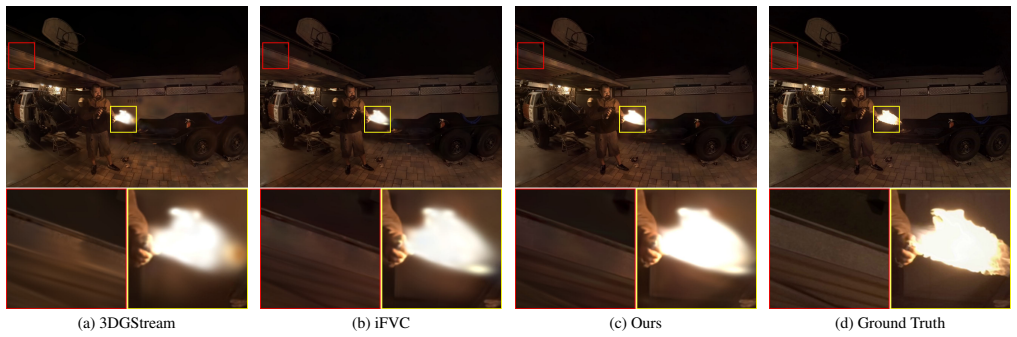
- [Sec. 5.3.2] The qualitative section states 'Our method achieves superior rendering quality compared to the state-of-the-art,' which conflicts with the quantitative results. Rephrase to 'competitive rendering quality' or align with the actual PSNR values.
- [Sec. 6] The conclusion reports 'less than 10 seconds per frame' training; the tables report 0.08–0.26 minutes per frame (4.8–15.6 s). Make the units and per-frame numbers consistent.
Circularity Check
No circularity: the method is evaluated on held-out views, and the self-citations are comparative rather than load-bearing.
full rationale
The derivation chain is empirical rather than analytic: frame-0 anchors are obtained via the external Scaffold-GS method, per-frame structured Gaussians are obtained by Eq. (6) from optimizable anchor positions and scales with fixed offsets, and free Gaussians are generated and pruned using view-space gradients and opacity thresholds. No predicted quantity is defined in terms of the quantity it is supposed to explain; the paper does not fit a parameter to a test metric and then report that metric as a prediction. Evaluations in Tables 1-3 use held-out test views on public benchmarks, so the central claims are checked against external data. The paper cites 3DGStream [SJL*24], which shares authors, but only as a comparison baseline and as a source of inspiration ("Initially inspired by previous online training methods"), not as justification for correctness or uniqueness. Ablations (Tables 4-6) vary components on the same scenes, which is standard component analysis rather than circular prediction. The fact that Tables 1-3 show iFVC achieving higher PSNR and far lower storage than the claimed "significantly outperforms" is a correctness/consistency concern, not a circularity one. No self-definitional, fitted-input-as-prediction, or self-citation-chain circularity is present.
Assumptions & free parameters
free parameters (7)
- k (number of structured 3DGs per anchor) =
5
- view-space gradient threshold τ_grad =
0.001
- opacity pruning threshold τ_α =
0.005
- loss weights λ_SSIM, λ_vol, λ_dist =
0.2, 0.01, 0.005
- online training learning rates =
anchor pos 4e-4, scale 5e-3, cov-MLP 4e-3, free pos 2e-4, free scale 5e-3, free rot 1e-3, free opacity 5e-2, free color
- iterations per frame =
100
- Scaffold-GS initialization checkpoint =
iteration 4000 (densification at 1500)
assumptions (4)
- domain assumption Per-anchor offsets O_v are fixed to frame-0 values; motion is modeled as anchor translation plus per-axis scaling of offsets (Eq. 6).
- domain assumption Large view-space positional gradients reliably indicate regions needing free 3DGs.
- domain assumption Scaffold-GS provides a sufficient frame-0 static reconstruction (anchors, offsets, MLPs) that remains usable for all subsequent frames.
- domain assumption Fixed anchor count after frame 0 is sufficient; topological changes are handled exclusively by free 3DGs.
invented entities (1)
-
dynamic anchor points (movable Scaffold-GS anchors)
Cite this review
Pith. "Pith review of Struct-GStream: Towards Efficient Free-Viewpoint Video Streaming at Low-Bitrates with Structured 3D Gaussians." pith.science (2026). https://pith.science/paper/RMMPG6TQ
@misc{pith2026260801053,
  author       = {Pith},
  title        = {Pith review of: Struct-GStream: Towards Efficient Free-Viewpoint Video Streaming at Low-Bitrates with Structured 3D Gaussians},
  year         = {2026},
  howpublished = {\url{https://pith.science/paper/RMMPG6TQ}},
  note         = {Machine review of arXiv:2608.01053}
}
read the original abstract
Constructing photorealistic Free-Viewpoint Videos (FVVs) of dynamic scenes from a set of posed 2D images has been an intriguing yet challenging task in computer vision. Methods based on neural rendering achieve high-fidelity image quality in FVV construction. However, most of these methods are unable to achieve real-time rendering and often require complete video sequences to train. Despite the existence of some online training methods capable of rendering FVVs in real time, they struggle to meet the requirements for storage and training time for downstream applications. To overcome this problem, we propose Struct-GStream, which can achieve efficient FVV streaming using structured 3D Gaussians (3DGs). Specifically, we introduce dynamic anchor points to generate structured 3DGs to construct basic scenes and model approximate scene movements based on the assumption of local rigidity in object motion. Besides, we introduce a global free 3DGs patching strategy involving free 3DGs' generation, pruning, and optimization to patch and model deficient areas and emerging objects. Our method achieves fast training at low bitrates while maintaining high rendering quality. Extensive experiments demonstrate that Struct-GStream significantly outperforms existing online training methods for FVV construction in terms of training time, storage, and rendering quality while maintaining competitive rendering speed.
Figures


Figures from the paper (9 more)



Reference graph
Works this paper leans on
-
[1]
[AHR∗23] ATTALB., HUANGJ.-B., RICHARDTC., ZOLLHOEFERM., KOPFJ., O’TOOLEM., KIMC.: Hyperreel: High-fidelity 6-dof video with ray-conditioned sampling, 2023.arXiv:2301.02238. 8 [BFO∗20a] BROXTONM., FLYNNJ., OVERBECKR., ERICKSOND., HEDMANP., DUVALLM., DOURGARIANJ., BUSCHJ., WHALENM., DEBEVECP.: Immersive light field video with a layered mesh represen- tation...
arXiv 2023
-
[2]
2023, pp. 453–464. 2 [GKJ∗21] GARBINS. J., KOWALSKIM., JOHNSONM., SHOTTONJ., VALENTINJ.: Fastnerf: High-fidelity neural rendering at 200fps,
work page 2023
-
[5]
VRVVC: Variable-Rate NeRF-Based Volumetric Video Compression
URL:https://arxiv.org/abs/ 2412.11362,arXiv:2412.11362. 3 [JBS∗23] JUNGH., BRASCHN., SONGJ., PEREZ-PELLITEROE., ZHOUY., LIZ., NAVABN., BUSAMB.: Deformable 3d gaussian splat- ting for animatable human avatars,
-
[7]
URL:https://onlinelibrary.wiley.com/doi/abs/ 10.1111/cgf.70256,arXiv:https://onlinelibrary
1, 3, 8 [LDZ∗25] LIJ., DANGH., ZHOUZ., ZHUJ., HUANGZ.: G-splatgan: Disentangled 3d gaussian generation for complex shapes via multi-scale patch discriminators.Computer Graphics Forum 44, 7 (2025), e70256. URL:https://onlinelibrary.wiley.com/doi/abs/ 10.1111/cgf.70256,arXiv:https://onlinelibrary. wiley.com/doi/pdf/10.1111/cgf.70256,doi:https: //doi.org/10....
-
[8]
2023, pp. 441–452. 2 [LKLR23] LUITENJ., KOPANASG., LEIBEB., RAMANAND.: Dy- namic 3d gaussians: Tracking by persistent dynamic view synthesis,
work page 2023
-
[9]
InPro- ceedings of the IEEE/CVF Conference on Computer Vision and Pattern Recognition(2021), pp
1, 3, 4 [LNSW21] LIZ., NIKLAUSS., SNAVELYN., WANGO.: Neural scene flow fields for space-time view synthesis of dynamic scenes. InPro- ceedings of the IEEE/CVF Conference on Computer Vision and Pattern Recognition(2021), pp. 6498–6508. 1, 3 [LSW∗22] LIL., SHENZ., WANGZ., SHENL., TANP.: Streaming radiance fields for 3d video synthesis.Advances in Neural Inf...
arXiv 2021
-
[10]
URL:https: //arxiv.org/abs/2306.07581,arXiv:2306.07581. 4 [TTG∗21] TRETSCHKE., TEWARIA., GOLYANIKV., ZOLLHÖFERM., LASSNERC., THEOBALTC.: Non-rigid neural radiance fields: Recon- struction and novel view synthesis of a dynamic scene from monocular video, 2021.arXiv:2012.12247. 3 [TYP∗25] TANGL., YANGJ., PENGR., ZHAIY., SHENS., WANG R.: Compressing streamab...
arXiv 2021
-
[11]
URL:https://arxiv.org/abs/2406.03697,arXiv:2406. 03697. 1, 3 [WPYS21] WIZADWONGSAS., PHONGTHAWEEP., YENPHRAPHAIJ., SUWAJANAKORNS.: Nex: Real-time view synthesis with neural basis expansion, 2021.arXiv:2103.05606. 2 [WSBL03] WIEGANDT., SULLIVANG., BJONTEGAARDG., LUTHRA A.: Overview of the h.264/avc video coding standard.IEEE Transac- tions on Circuits and ...
arXiv 2021
Show all 12 references
-
[12]
2 [YYPZ24] YANGZ., YANGH., PANZ., ZHANGL.: Real-time photo- realistic dynamic scene representation and rendering with 4d gaussian splatting, 2024.arXiv:2310.10642
arXiv:2103.14024. 2 [YYPZ24] YANGZ., YANGH., PANZ., ZHANGL.: Real-time photo- realistic dynamic scene representation and rendering with 4d gaussian splatting, 2024.arXiv:2310.10642. 3, 8, 11 [ZKU∗04] ZITNICKC. L., KANGS. B., UYTTENDAELEM., WINDER S., SZELISKIR.: High-quality v...
2024 arXiv
-
[2021]
2 [GSD∗23] GUOX., SUNJ., DAIY., CHENG., YEX., TANX., DING E., ZHANGY., WANGJ.: Forward flow for novel view synthesis of dynamic scenes, 2023.arXiv:2309.17390
arXiv:2103.10380. 2 [GSD∗23] GUOX., SUNJ., DAIY., CHENG., YEX., TANX., DING E., ZHANGY., WANGJ.: Forward flow for novel view synthesis of dynamic scenes, 2023.arXiv:2309.17390. 3 [GXC∗24] GAOQ., XUQ., CAOZ., MILDENHALLB., MAW., CHEN L., TANGD., NEUMANNU.: Gaussianflow: Splatti...
2023 arXiv
-
[2023]
1, 3 [KKLD23] KERBLB., KOPANASG., LEIMKÜHLERT., DRETTAKISG.: 3d gaussian splatting for real-time radiance field rendering.ACM Trans- actions on Graphics 42, 4 (2023), 1–14
3 [JSW∗23] JIANGY., SHENZ., WANGP., SUZ., HONGY., ZHANGY., YUJ., XUL.: Hifi4g: High-fidelity human performance rendering via compact gaussian splatting, 2023.arXiv:2312.03461. 1, 3 [KKLD23] KERBLB., KOPANASG., LEIMKÜHLERT., DRETTAKISG.: 3d gaussian splatting for real-time radi...
2023 arXiv
-
[2024]
URL:https://onlinelibrary.wiley.com/doi/abs/ 10.1111/cgf.70227,arXiv:https://onlinelibrary
1, 3 [HLW∗25] HEH., LIANGY., WANGL., CAIY., XUX., GUOH., WEN X., CHENY.: Lucidfusion: Reconstructing 3d gaussians with arbitrary unposed images.Computer Graphics Forum 44, 7 (2025), e70227. URL:https://onlinelibrary.wiley.com/doi/abs/ 10.1111/cgf.70227,arXiv:https://onlinelibr...
2025 arXiv
Reviewed August 6, 2026 · model on record in the stance chip above.
Discussion (0). Sign in to comment.