REVIEW 3 major objections 4 minor 63 references
Upside/Downside statistical mechanics of nonequilibrium Brownian motion. II. Heat transfer and energy partitioning of a free particle
T0 review · 3 major / 4 minor · reviewed 2026-08-14 · deepseek-v4-flash
Pith's one-line read For a free Brownian particle in contact with multiple reservoirs, each bath contributes a fraction gamma_k T_k / (gamma T) of the particle's energy change during both energy-gaining (upside) and energy-losing (downside) events.
desk verdict Solid upside/downside heat-current results, but the energy-partition ratio rests on a plausible yet unproved per-bath factorization, and the master-equation check has a sign error. read the letter →
The pith
A machine-rendered reading of the paper's core claim, the machinery that carries it, and where it could break.
The reading
Extended reading notes
Core claim
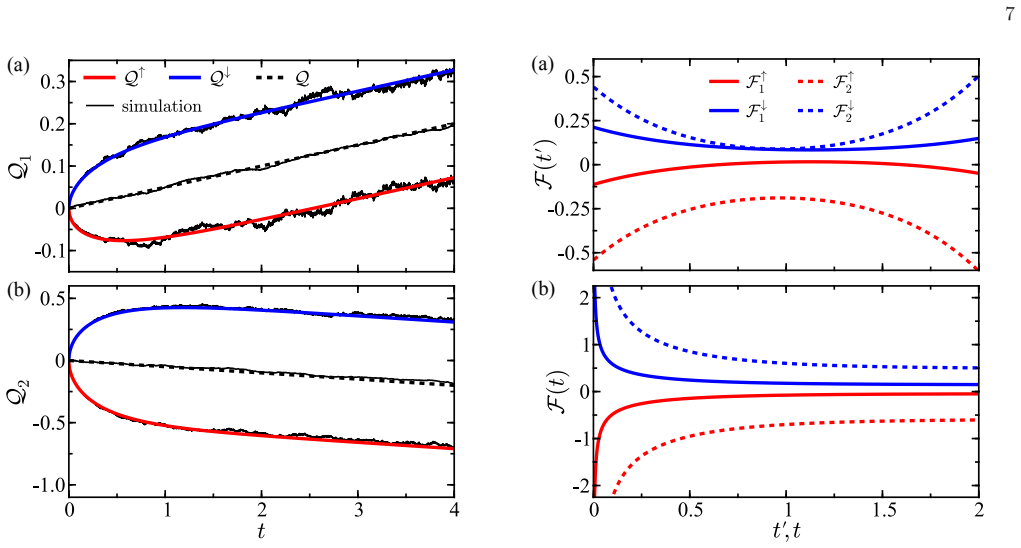
The central claim is that the restricted heat currents for a free Brownian particle driven by N thermal baths are given by Q_up_k = J_ss_k t - 2 gamma_k k_B T_k / (gamma pi) G(t) and Q_down_k = J_ss_k t + 2 gamma_k k_B T_k / (gamma pi) G(t) (Eqs. 51-52), and that the energy partitioning ratio is R_up_DeltaE_k = R_down_DeltaE_k = gamma_k T_k / (gamma T) (Eqs. 86, 93, 106). If correct, the heat exchanged with each bath during activation and relaxation events can be decomposed into a heat-current term and an energy-change term, with each bath's share of the energy change set by its friction-temperature product.
Load-bearing premise
The load-bearing premise is that the restricted noise-velocity correlation for each bath k factorizes as k_B gamma_k T_k D(t) with a single, temperature-independent D(t) for all baths (Eqs. 45-50). This permits splitting the total heat into per-bath contributions and leads directly to the gamma_k T_k / (gamma T) partition. The argument in Appendix B shows that a linear function with independent temperature terms can be decomposed term-by-term, but it does not prove that the restricted averages generated by the nonlinear conditioning E(t) > E(0) or E(t) > <E> contain no cross-temperature terms. If this factorization fails, the Q_k formulas and the partition ratio would not hold exactly.
Signed reviews
Editorial analysis
A structured set of objections, weighed in public.
Referee Report
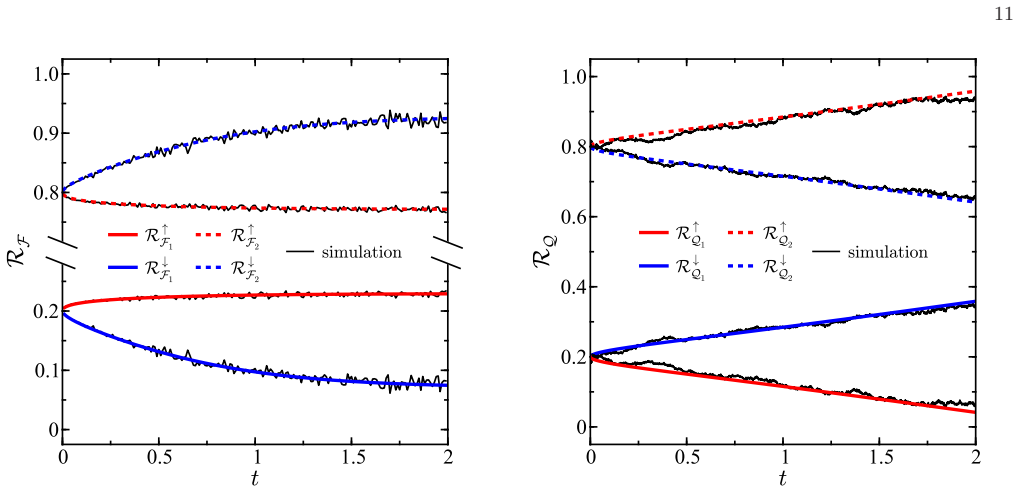
Summary. The manuscript considers a free Brownian particle driven by N thermal baths at different temperatures and uses the upside/downside trajectory classification of the companion paper (Ref. 30) to split, at time t, the ensemble into trajectories whose energy is above or below a threshold (the initial energy E(0) or the average energy <E>). It derives restricted heat currents Q^up_k and Q^down_k (Eqs. (51)-(52) for E^‡=E(0), Eqs. (71)-(72) for E^‡=<E>), restricted energy fluxes, flux ratios, heat ratios, and claims the energy-partition ratio R^up_ΔE_k = R^down_ΔE_k = γ_k T_k/(γ T) (Eqs. (86), (93)). The heat-current formulas are validated against Euler-Maruyama simulations for N=2; the paper explicitly notes that the energy-partition ratio itself cannot be measured directly in simulation.
Significance. If the underlying factorization assumptions hold, the paper provides the first closed-form per-bath decomposition of heat into a heat-current part and a system-energy-change part for conditioned Brownian trajectories, together with a strikingly simple, parameter-free partition ratio. The derivation has no fitted parameters, and the unrestricted heat currents reduce to the known Lebowitz result. The simulation agreement for Q_k and the flux ratios in Figs. 2, 4, and 6-9 is a genuine strength. The main limitation is that the central partition ratio rests on the per-bath factorization of the restricted noise-velocity correlation, which is asserted rather than rigorously proved, and the paper itself states that this ratio cannot be measured in simulation. The significance is therefore conditional on closing that proof gap, although the result is plausibly correct and a Gaussian-conditioning argument would likely establish it.
major comments (3)
- [Sec. III.B, Eqs. (45)-(50), and Appendix B] The load-bearing step is the per-bath factorization of the restricted noise-velocity correlation, Eqs. (49)-(50): ∫ m <ξ_k v>_up dt' = k_B γ_k T_k D_up(t) and the analogous downside expression. Appendix B attempts to justify this by a linear-function decomposition, but the argument assumes that the restricted averages are linear in the bath temperatures with no cross-temperature terms. The nonlinear conditioning E(t) > E(0) (or E(t) > <E>) is a function of the Gaussian noises, and the limit T_l → 0 does not exclude cross-temperature terms at finite T_l; the condition g_l → 0 in that limit only fixes the behavior on a low-dimensional boundary. Because Eqs. (51)-(52), (71)-(72), and the energy-partition ratios (86), (93) all follow from this factorization, the proof is incomplete as written. I ask the authors to supply a rigorous derivation (for example, by Gaussian regression/conditioning on v(t) and v(0), which shows the coefficient of T_k is independent of the other bath temperatures) or to state the factorization explicitly as a conjecture and mark the downstream results as conditional.
- [Sec. IV.A-IV.B, Eqs. (84)-(86) and (93)] The derivation of the central ratio R^up_ΔE_k = R^down_ΔE_k = γ_k T_k/(γ T) proceeds by 'identifying the terms ... proportional to a temperature gradient between baths, i.e., Q^(hc)_k ∝ J_ss_k' and subtracting them to obtain <ΔE_k>. This identification is not independently derived; <ΔE_k> is defined only through the per-bath split of the noise-velocity correlation used in Eqs. (49)-(50). In other words, Eq. (86) is a restatement of the assumed factorization rather than an independent consequence of energy conservation. Since the paper explicitly states that the energy ratio cannot be measured in simulation, the analytical proof is the only support for this claim, and it needs to be made rigorous.
- [Sec. IV.C, Eqs. (97)-(101)] The master-equation corroboration contains sign and notation errors. In Eq. (97) the loss term should carry a minus sign, and the bracket in γ_k [(n_k(ΔE)+1] P(E) is unbalanced; as written, combining Eq. (97) with the steady-state condition Eq. (98) gives P(E) < 0 for positive rates. Eq. (100) should be written as (1-P(E))/P(E) = Σ γ_k n_k e^{ΔE/k_B T_k} / Σ γ_k n_k, which follows from the corrected steady-state balance. Please fix these errors and clarify whether this section is intended as a rigorous derivation for general systems or as a heuristic analogy; in its present form it cannot support the statement that the result 'appears to be valid for a robust class of systems.'
minor comments (4)
- [Sec. III.B.1, Eq. (33)] In the definition of <ΔE>_↓, the second term on the right-hand side conditions on E(t) > E^‡; it should condition on E(t) < E^‡.
- [Sec. IV, Eq. (79)] The second displayed ratio repeats R^up_ΔE_k; it should be R^down_ΔE_k = <ΔE_k>_↓ / <ΔE>_↓.
- [Sec. IV.C, Eq. (97)] The bracket in γ_k [(n_k(ΔE)+1] P(E) is missing a closing parenthesis or bracket; please correct the typesetting.
- [Sec. III.B, Eqs. (40)-(41) and (65)-(66)] It would help to state explicitly that the restricted second velocity moments are for the case t' < t with the upside/downside constraint imposed at t, since the notation is otherwise easy to misread.
Assumptions & free parameters
assumptions (4)
- domain assumption The restricted noise-velocity correlation integral for each bath k factorizes as k_B gamma_k T_k D(t) with a common D(t); see Eqs. (45)-(50).
- standard math The Ornstein-Uhlenbeck transition density (Eq. 3) and steady-state velocity distribution (Eq. 7) for the multi-bath Langevin equation (Eq. 1) are valid.
- domain assumption The restricted moments and energy-change expressions from Ref 30 (Eqs. 37-41, 63-66) are assumed correct.
- domain assumption Energy conservation holds for each restricted ensemble, i.e., <Delta E>_up = -sum_k Q_up_k (Eq. 34).
Cite this review
Pith. "Pith review of Upside/Downside statistical mechanics of nonequilibrium Brownian motion. II. Heat transfer and energy partitioning of a free particle." pith.science (2026). https://pith.science/paper/RNC4SOQP
@misc{pith2026190800502,
  author       = {Pith},
  title        = {Pith review of: Upside/Downside statistical mechanics of nonequilibrium Brownian motion. II. Heat transfer and energy partitioning of a free particle},
  year         = {2026},
  howpublished = {\url{https://pith.science/paper/RNC4SOQP}},
  note         = {Machine review of arXiv:1908.00502}
}
read the original abstract
The energy partitioning during activation and relaxation events under steady-state conditions for a Brownian particle driven by multiple thermal reservoirs of different local temperatures is investigated. Specifically, we apply the formalism derived in a previous article [G. T. Craven and A. Nitzan, J. Chem. Phys. 148, 044101 (2018)] to examine the thermal transport properties of two sub-ensembles of Brownian processes, distinguished at any given time by the specification that all the trajectories in each group have, at that time, energy either above (upside) or below (downside) a preselected energy threshold. Dynamical properties describing energy accumulation and release during activation/relaxation events and relations for upside/downside energy partitioning between thermal reservoirs are derived. The implications for heat transport induced by upside and downside events are discussed.
Figures


Figures from the paper (3 more)


Reference graph
Works this paper leans on
-
[1]
author R. F. Rodr \' guez and author L. De la Pe \ n a-Auerbach , journal Physica A volume 123 , pages 609 ( year 1984 ), doi:10.1016/0378-4371(84)90177-8
-
[2]
author D. J. Evans , author E. G. D. Cohen , and author G. P. Morriss , journal Phys. Rev. Lett. volume 71 , pages 2401 ( year 1993 ), doi:10.1103/PhysRevLett.71.2401
-
[3]
author C. Jarzynski , journal Phys. Rev. Lett. volume 78 , pages 2690 ( year 1997 ), doi:10.1103/PhysRevLett.78.2690
-
[4]
Kurchan , journal J
author J. Kurchan , journal J. Phys. A volume 31 , pages 3719 ( year 1998 ), http://stacks.iop.org/0305-4470/31/i=16/a=003
1998
-
[5]
author G. E. Crooks , journal Phys. Rev. E volume 61 , pages 2361 ( year 2000 ), doi:10.1103/PhysRevE.61.2361
-
[6]
author T. Harada and author S.-I. Sasa , journal Phys. Rev. Lett. volume 95 , pages 130602 ( year 2005 ), doi:10.1103/PhysRevLett.95.130602
-
[7]
author H. Teramoto and author S.-I. Sasa , journal Phys. Rev. E volume 72 , pages 060102 ( year 2005 ), doi:10.1103/PhysRevE.72.060102
-
[8]
author U. Seifert and author T. Speck , journal Europhys. Lett. volume 89 , pages 10007 ( year 2010 ), doi:10.1209/0295-5075/89/10007
Show all 63 references
-
[9]
Seifert , journal Rep
author U. Seifert , journal Rep. Prog. Phys. volume 75 , pages 126001 ( year 2012 ), http://stacks.iop.org/0034-4885/75/i=12/a=126001
2012
-
[10]
Lippiello , author M
author E. Lippiello , author M. Baiesi , and author A. Sarracino , journal Phys. Rev. Lett. volume 112 , pages 140602 ( year 2014 ), doi:10.1103/PhysRevLett.112.140602
2014 doi
-
[11]
Onsager , journal Phys
author L. Onsager , journal Phys. Rev. volume 37 , pages 405 ( year 1931 ), doi:10.1103/PhysRev.37.405
1931 doi
-
[12]
Sekimoto , journal Prog
author K. Sekimoto , journal Prog. Theor. Phys. Supp. volume 130 , pages 17 ( year 1998 ), doi:10.1143/PTPS.130.17
1998 doi
-
[13]
Seifert , journal Phys
author U. Seifert , journal Phys. Rev. Lett. volume 95 , pages 040602 ( year 2005 ), doi:10.1103/PhysRevLett.95.040602
2005 doi
-
[14]
Van den Broeck , in booktitle Physics of Complex Colloids ( publisher IOS Press , year 2013 ), vol
author C. Van den Broeck , in booktitle Physics of Complex Colloids ( publisher IOS Press , year 2013 ), vol. volume 184 , pp. pages 155--193
2013
-
[15]
author J. L. Lebowitz , journal Phys. Rev. volume 114 , pages 1192 ( year 1959 ), doi:10.1103/PhysRev.114.1192
1959 doi
-
[16]
Rieder , author J
author Z. Rieder , author J. L. Lebowitz , and author E. Lieb , journal J. Math. Phys. volume 8 , pages 1073 ( year 1967 ), doi:10.1063/1.1705319
1967 doi
-
[17]
Casher and author J
author A. Casher and author J. L. Lebowitz , journal J. Math. Phys. volume 12 , pages 1701 ( year 1971 ), doi:10.1063/1.1665794
1971 doi
-
[18]
Segal , author A
author D. Segal , author A. Nitzan , and author P. H\"anggi , journal J. Chem. Phys. volume 119 , pages 6840 ( year 2003 ), doi:10.1063/1.1603211
2003 doi
-
[19]
Segal and author A
author D. Segal and author A. Nitzan , journal Phys. Rev. Lett. volume 94 , pages 034301 ( year 2005 ), doi:10.1103/PhysRevLett.94.034301
2005 doi
-
[20]
Dhar and author J
author A. Dhar and author J. L. Lebowitz , journal Phys. Rev. Lett. volume 100 , pages 134301 ( year 2008 ), doi:10.1103/PhysRevLett.100.134301
2008 doi
-
[21]
Kannan , author A
author V. Kannan , author A. Dhar , and author J. L. Lebowitz , journal Phys. Rev. E volume 85 , pages 041118 ( year 2012 ), doi:10.1103/PhysRevE.85.041118
2012 doi
-
[22]
Sabhapandit , journal Phys
author S. Sabhapandit , journal Phys. Rev. E volume 85 , pages 021108 ( year 2012 ), doi:10.1103/PhysRevE.85.021108
2012 doi
-
[23]
Dhar and author R
author A. Dhar and author R. Dandekar , journal Physica A volume 418 , pages 49 ( year 2015 ), doi:10.1016/j.physa.2014.06.002
2015 doi
-
[24]
author K. A. Velizhanin , author S. Sahu , author C.-C. Chien , author Y. Dubi , and author M. Zwolak , journal Sci. Rep. volume 5 ( year 2015 ), doi:10.1038/srep17506
2015 doi
-
[25]
Murashita and author M
author Y. Murashita and author M. Esposito , journal Phys. Rev. E volume 94 , pages 062148 ( year 2016 ), doi:10.1103/PhysRevE.94.062148
2016 doi
-
[26]
author G. T. Craven and author A. Nitzan , journal Proc. Natl. Acad. Sci. volume 113 , pages 9421 ( year 2016 ), doi:10.1073/pnas.1609141113
2016 doi
-
[27]
author G. T. Craven and author A. Nitzan , journal J. Chem. Phys. volume 146 , pages 092305 ( year 2017 a ), doi:10.1063/1.4971293
2017 doi
-
[28]
author G. T. Craven and author A. Nitzan , journal Phys. Rev. Lett. volume 118 , pages 207201 ( year 2017 b ), doi:10.1103/PhysRevLett.118.207201
2017 doi
-
[29]
Chen , author G
author R. Chen , author G. T. Craven , and author A. Nitzan , journal J. Chem. Phys. volume 147 , pages 124101 ( year 2017 ), doi:10.1063/1.4990410
2017 doi
-
[30]
author G. T. Craven and author A. Nitzan , journal J. Chem. Phys. volume 148 , pages 044101 ( year 2018 ), doi:10.1063/1.5007854
2018 doi
-
[31]
author M. J. Harrison and author M. I. Reiman , journal Ann. Prob. volume 8 , pages 302 ( year 1981 )
1981
-
[32]
Lin , author J
author B. Lin , author J. Yu , and author S. A. Rice , journal Phys. Rev. E volume 62 , pages 3909 ( year 2000 ), doi:10.1103/PhysRevE.62.3909
2000 doi
-
[33]
author D. C. Morse , journal Adv. Chem. Phys. volume 128 , pages 110 ( year 2004 ), doi:10.1002/0471484237.ch2
2004 doi
-
[34]
author D. S. Grebenkov , journal Rev. Mod. Phys. volume 79 , pages 1077 ( year 2007 ), doi:10.1103/RevModPhys.79.1077
2007 doi
-
[35]
Dieker , journal Wiley Encyclopedia of Operations Research and Management Science ( year 2010 ), doi:10.1002/9780470400531.eorms0711
author A. Dieker , journal Wiley Encyclopedia of Operations Research and Management Science ( year 2010 ), doi:10.1002/9780470400531.eorms0711
2010 doi
-
[36]
author R. A. Marcus , journal J. Chem. Phys. volume 24 , pages 966 ( year 1956 ), doi:10.1063/1.1742723
1956 doi
-
[37]
author R. A. Marcus , journal Annu. Rev. Phys. Chem. volume 15 , pages 155 ( year 1964 ), doi:10.1146/annurev.pc.15.100164.001103
1964
-
[38]
author R. A. Marcus and author N. Sutin , journal Biochim. Biophys. Acta volume 811 , pages 265 ( year 1985 ), doi:10.1016/0304-4173(85)90014-X
1985 doi
-
[39]
author R. A. Marcus , journal Rev. Mod. Phys. volume 65 , pages 599 ( year 1993 ), doi:10.1103/RevModPhys.65.599
1993 doi
-
[40]
H \"a nggi , author P
author P. H \"a nggi , author P. Talkner , and author M. Borkovec , journal Rev. Mod. Phys. volume 62 , pages 251 ( year 1990 ), 10.1103/RevModPhys.62.251
1990 doi
-
[41]
author D. G. Truhlar , author B. C. Garrett , and author S. J. Klippenstein , journal J. Phys. Chem. volume 100 , pages 12771 ( year 1996 )
1996
-
[42]
Komatsuzaki and author R
author T. Komatsuzaki and author R. S. Berry , journal Proc. Natl. Acad. Sci. volume 98 , pages 7666 ( year 2001 ), doi:10.1073/pnas.131627698
2001 doi
-
[43]
Bartsch , author R
author T. Bartsch , author R. Hernandez , and author T. Uzer , journal Phys. Rev. Lett. volume 95 , pages 058301(1) ( year 2005 ), doi:10.1103/PhysRevLett.95.058301
2005 doi
-
[44]
Nitzan , title Chemical Dynamics in Condensed Phases: Relaxation, Transfer, and Reactions in Condensed Molecular Systems ( publisher Oxford University Press , year 2006 )
author A. Nitzan , title Chemical Dynamics in Condensed Phases: Relaxation, Transfer, and Reactions in Condensed Molecular Systems ( publisher Oxford University Press , year 2006 )
2006
-
[45]
Hernandez , author T
author R. Hernandez , author T. Bartsch , and author T. Uzer , journal Chem. Phys. volume 370 , pages 270 ( year 2010 ), doi:10.1016/j.chemphys.2010.01.016
2010 doi
-
[46]
Peters , journal J
author B. Peters , journal J. Phys. Chem. B volume 119 , pages 6349 ( year 2015 ), doi:10.1021/acs.jpcb.5b02547
2015 doi
-
[47]
author G. T. Craven and author R. Hernandez , journal Phys. Rev. Lett. volume 115 , pages 148301 ( year 2015 ), doi:10.1103/PhysRevLett.115.148301
2015 doi
-
[48]
Junginger , author G
author A. Junginger , author G. T. Craven , author T. Bartsch , author F. Revuelta , author F. Borondo , author R. M. Benito , and author R. Hernandez , journal Phys. Chem. Chem. Phys. volume 18 , pages 30270 ( year 2016 ), doi:10.1039/C6CP02519F
2016 doi
-
[49]
Revuelta , author G
author F. Revuelta , author G. T. Craven , author T. Bartsch , and author R. Hernandez , journal J. Chem. Phys. volume 147 , pages 074104 ( year 2017 ), doi:10.1063/1.4997571
2017 doi
-
[50]
author W. H. Greene , title Econometric Analysis ( publisher Prentice Hall , year 2002 )
2002
-
[51]
Ranganatham , title Investment Analysis and Portfolio Management ( publisher Pearson Education India , year 2006 )
author M. Ranganatham , title Investment Analysis and Portfolio Management ( publisher Pearson Education India , year 2006 )
2006
-
[52]
author F. K. Reilly and author K. C. Brown , title Investment Analysis and Portfolio Management ( publisher Cengage Learning , year 2011 )
2011
-
[53]
author F. A. Sortino and author R. Van Der Meer , journal J. Portfolio Manage. volume 17 , pages 27 ( year 1991 )
1991
-
[54]
author F. A. Sortino and author L. N. Price , journal J. Invest. volume 3 , pages 59 ( year 1994 )
1994
-
[55]
Keating and author W
author C. Keating and author W. F. Shadwick , journal J. Perf. Measure. volume 6 , pages 59 ( year 2002 )
2002
-
[56]
Ang , author J
author A. Ang , author J. Chen , and author Y. Xing , journal Rev. Financ. Stud. volume 19 , pages 1191 ( year 2006 ), doi:10.1093/rfs/hhj035
2006 doi
-
[57]
author G. E. Uhlenbeck and author L. S. Ornstein , journal Phys. Rev. volume 36 , pages 823 ( year 1930 ), doi:10.1103/PhysRev.36.823
1930 doi
-
[58]
Zwanzig , title Nonequilibrium Statistical Mechanics ( publisher Oxford University Press , address London , year 2001 )
author R. Zwanzig , title Nonequilibrium Statistical Mechanics ( publisher Oxford University Press , address London , year 2001 )
2001
-
[59]
Cohen , in booktitle Mathematical Analysis, Probability and Applications - Plenary Lectures ISAAC 2015 ( organization Springer , year 2015 ), pp
author L. Cohen , in booktitle Mathematical Analysis, Probability and Applications - Plenary Lectures ISAAC 2015 ( organization Springer , year 2015 ), pp. pages 1--35
2015
-
[60]
( eq:heatrel ) is calculated, E_k is the contribution of heat bath k to the system energy change E and Q ^ ( hc ) _k E_k + Q _k
note It will become more clear later what we mean is that for the given time interval over which Eq. ( eq:heatrel ) is calculated, E_k is the contribution of heat bath k to the system energy change E and Q ^ ( hc ) _k E_k + Q _k
-
[61]
author D. V. Matyushov , journal Proc. Natl. Acad. Sci. volume 113 , pages 9401 ( year 2016 ), doi:10.1073/pnas.1610542113
2016 doi
-
[62]
note The simulations were performed using the Euler - Maruyama method
-
[63]
note In the previous article in this series we denoted the case t'<t with the superscript `` < '' indicating that the property of interest is calculated at time t'<t from the group of trajectories that are upside/downside at future time t . Here, for notational convenience, we...
Reviewed August 14, 2026 · model on record in the stance chip above.
Discussion (0). Continue with ORCID to comment.