REVIEW 3 major objections 5 minor 20 references
A Multi-Analyst LLM Pipeline for Auditable Rule Discovery Across 68 Public Physiological Corpora
T0 review · 3 major / 5 minor · reviewed 2026-07-10 · grok-4.5
Pith's one-line read A four-LLM pipeline turns 68 public physiology corpora into 94 gated, build-ready detector rule components for contactless hardware.
desk verdict A carefully bounded multi-LLM engineering cascade that turns 68 corpora into 94 gated rule candidates; useful process work, not a detector paper. read the letter →
The pith
A machine-rendered reading of the paper's core claim, the machinery that carries it, and where it could break.
The reading
What carries the argument
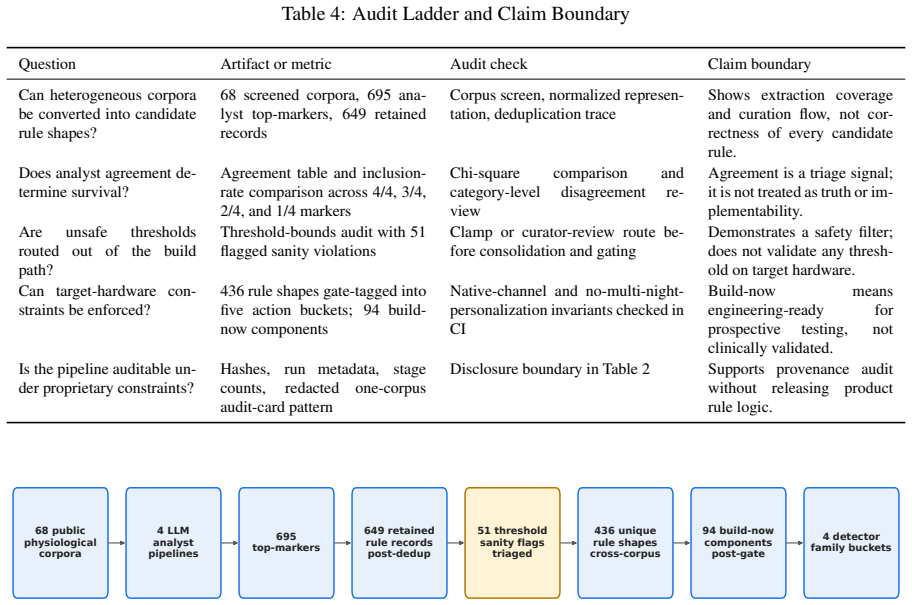
The four-analyst audit cascade: independent LLM top-markers (695) are deduplicated (649), threshold-audited (51 flags), consolidated (436 shapes), then gate-tagged by two hard invariants (native target-hardware channel; no multi-night personalization) to yield 94 build-now components.
What would settle it
Prospective tests of the 94 build-now components on the target contactless hardware against medical-grade ground truth show systematically unusable false-alarm rates or missed events, or an independent second curator rejects a large fraction of the same gated set as non-implementable.
Extended reading notes
Core claim
A controlled multi-analyst LLM extraction workflow, followed by normalization, threshold-bounds auditing, curator review, and CI-enforced hardware invariants, converts heterogeneous public-corpus documentation into a gated library of 94 build-now detector components across four families, while explicitly refusing to claim clinical performance.
Load-bearing premise
A single human curator plus automated invariant checks can catch enough LLM hallucinations, bad thresholds, and literature-to-hardware mismatches that the surviving 94 components are useful starting points for real hardware validation.
Editorial extensions
If this is right
- Contactless platform teams can start implementation from a finite, hardware-gated rule library instead of ad-hoc single-corpus detectors.
- Analyst disagreement becomes a review-routing signal rather than a vote on correctness, changing how multi-LLM extraction is used.
- Literature findings that need proxy sensors or multi-night personalization stay out of the product path until re-validated.
- The same cascade can be re-run when new corpora or hardware channels appear, with CI invariants blocking invalid promotions.
- No sensitivity or clinical-utility claim is licensed until prospective target-hardware data exist.
Reading between the lines
- The same staged multi-analyst plus hard-invariant pattern could triage rule libraries for other multi-sensor medical devices where public data never match the target hardware.
- Cardiac markers showing higher consensus than seizure markers suggests the method will surface easier-to-transfer families first and leave contested clinical event families for heavier human review.
- Withholding proprietary rule text while publishing stage counts and hashes may become a practical disclosure template for industry-adjacent signal-processing papers.
Signed reviews
Editorial analysis
A structured set of objections, weighed in public.
Referee Report
Summary. The manuscript presents a controlled four-analyst LLM pipeline that converts documentation from 68 commercial-use-screened public physiological corpora into an auditable candidate rule library for a multi-sensor contactless nocturnal-monitoring platform. Four independent commercial LLM families produce 695 top-markers; after deduplication (649 retained records), a threshold-bounds audit (51 flags), cross-corpus consolidation (436 unique rule shapes), and gate-tagging against two hard invariants (native target-hardware channel availability; no multi-night per-patient personalization), 94 build-now detector components are obtained across four detector-family buckets. The paper carefully bounds its claim: the output is a gated engineering cascade for prospective hardware validation, not a validated clinical detector, and no sensitivity, specificity, false-alarm, or latency metrics are reported. Supporting analyses include inter-analyst agreement distributions (Tables 7–8), a chi-square test showing agreement does not predict retention, a Fisher exact test on seizure-versus-cardiac single-AI rates, an audit ladder (Table 4), and an explicit disclosure boundary (Table 2).
Significance. If the process claims hold, the work supplies a concrete, auditable pattern for turning heterogeneous open physiological corpora into hardware-gated detector-component candidates without overclaiming clinical performance. Strengths include: (i) a priori engineering invariants enforced in CI rather than post-hoc performance fitting; (ii) explicit use of analyst disagreement as a triage signal rather than as truth (supported by the non-significant chi-square on retention and the significant seizure–cardiac disagreement contrast); (iii) a threshold-bounds safety filter and staged audit ladder; and (iv) a disclosure design that reports aggregate provenance while withholding proprietary rule text. These are useful contributions for biomedical signal-processing and contactless-monitoring engineering, where literature-to-hardware transfer is routinely overstated. The contribution is methodological and process-oriented rather than a new detector or benchmark.
major comments (3)
- Section II.E and the secondary AI spot-check of 50 retained rule-map records: approximately half still required probe-first or gate-clarification treatment for native-channel, contactless-proxy, or baseline-scope risk. The final 94 build-now count therefore still rests on a single human curator’s Phase-0.3 gate-tagging under a fixed rubric, with no independent human inter-rater sample. Because the central claim is that the cascade plus invariants yields useful starting points for prospective validation, please either (a) report curator override / re-tag rates by category and agreement level, or (b) add a small independent human review sample on a stratified subset of the 436 shapes, and state how that would revise the 94 count if disagreement is high.
- Section II.A and Table 8: cardiac markers dominate the retained set (325 of 650 category assignments), while the full 68-corpus registry is withheld even at summary level. Without a public modality/label breakdown of the input set (counts by sensor family and phenomenon, not the full prioritized list), readers cannot judge whether the cascade and the four detector-family buckets (Table 6) reflect balanced multi-corpus coverage or input skew. A compact public summary table of modality and label-family counts would make the 695→94 reduction interpretable without exposing product prioritization or proprietary licensing notes.
- Section III.B / Table 6: the four detector-family buckets (autonomic surge with failed recovery 62; postictal respiratory compromise 24; bed-exit after high-movement event 6; postictal recovery risk 2) are presented as the mapping of the 94 build-now components, but it is not stated whether these families were pre-specified from the shared temporal model or induced post hoc from the gated set. Please clarify the derivation procedure and whether the shared baseline→motor-burst→clonic/high-movement→post-event stillness model was fixed before gate-tagging; post-hoc family invention would weaken the claim that the 94 components form coherent detector families rather than a residual count.
minor comments (5)
- Figure 1 and Figure 2 largely restate the same cascade; consider merging or differentiating (e.g., claim boundary vs. count flow) to save space.
- Table 5 lists the 51 threshold-bounds flags as a stage but notes they are a subset of the 649 rather than a reduction step; a one-line clarification in the table caption would prevent misreading the cascade as 649→51→436.
- Section II.C: the example of four differently worded post-burst stillness rules normalizing to one motion-modality shape is helpful; a second short example from a non-seizure category (e.g., cardiac or respiratory) would illustrate that the normalization is not seizure-specific.
- Keywords and abstract are clear; ensure consistent hyphenation of “build-now” / “build now” and “multi-night” throughout.
- References [1–2] and [16] carry 2025–2026 dates consistent with the arXiv stamp; verify final DOIs/PMIDs at production so that the commercial-use screen claim remains checkable.
Circularity Check
No circular derivation: cascade counts are process outputs under a priori gates, not fitted predictions or self-definitional claims.
full rationale
The paper's load-bearing chain is an engineering extraction cascade (68 corpora → 695 top-markers → 649 retained → 436 shapes → 94 build-now), not a first-principles derivation of performance. The two hard invariants (native target-hardware channel; no multi-night personalization) are stated a priori as CI-enforced engineering gates, not reverse-engineered from the final 94. Agreement is explicitly shown not to predict retention (chi-square = 0.52, p = 0.91), so multi-analyst consensus is not used as a self-justifying correctness criterion. No parameter is fitted to data and then re-presented as a prediction; no uniqueness theorem or ansatz is imported via self-citation; no known empirical law is renamed as a new result. Withheld proprietary rule text and gate rationales create a disclosure boundary, not a circular reduction of the claimed cascade. The paper repeatedly bounds the claim to an auditable candidate library for prospective validation, not a validated detector. Score 0 is therefore appropriate: the reported counts are descriptive outputs of the stated process, not quantities forced by construction from their own targets.
Assumptions & free parameters
free parameters (2)
- number_of_analyst_families =
4
- threshold_bounds_vocabulary
assumptions (4)
- ad hoc to paper Every build-now component must read exclusively from a sensor channel that exists natively on the target hardware; proxy substitution is forbidden.
- ad hoc to paper No build-now component may require multi-night per-patient baseline learning or individualized user-profile setup.
- domain assumption Public corpus documentation (modality, sampling rate, labels) is a sufficient input for extracting candidate rule shapes without access to raw waveforms.
- domain assumption Independent commercial LLM families under an identical controlled prompt produce usefully diverse extractions whose disagreement can be treated as a triage signal.
invented entities (2)
-
build-now / tier-2 probe / feature prior / clinician review / archive gate taxonomy
-
four detector-family buckets (autonomic surge with failed recovery, postictal respiratory compromise, bed-exit after high-movement event, postictal recovery risk)
Cite this review
Pith. "Pith review of A Multi-Analyst LLM Pipeline for Auditable Rule Discovery Across 68 Public Physiological Corpora." pith.science (2026). https://pith.science/paper/RNEDTPMI
@misc{pith2026260706802,
  author       = {Pith},
  title        = {Pith review of: A Multi-Analyst LLM Pipeline for Auditable Rule Discovery Across 68 Public Physiological Corpora},
  year         = {2026},
  howpublished = {\url{https://pith.science/paper/RNEDTPMI}},
  note         = {Machine review of arXiv:2607.06802}
}
read the original abstract
Open physiological corpora are heterogeneous: they use different sensors, labels, sampling rates, recording settings, and clinical endpoints. They can support detector design, but they do not directly specify which detector rules should be built for a new contactless monitoring platform. We report a controlled four-analyst large-language-model (LLM) workflow for converting 68 public physiological corpora, screened for commercial-use compatibility, into an auditable library of candidate rule shapes for prospective validation. Four independent commercial LLM families read the corpus documentation under a controlled prompt and produced 695 candidate rule markers (top-markers). Deduplication retained 649 rule records; a threshold-bounds audit then flagged 51 sanity violations for clamping or curator review. Cross-corpus consolidation produced 436 unique rule shapes. Gate-tagging against two hard invariants, native target-hardware channel availability and no multi-night per-patient personalization, identified 94 build-now detector components across four detector-family buckets. The pipeline does not produce a validated clinical detector. It produces an auditable engineering cascade in which analyst disagreement, threshold checks, curator review, and automated continuous-integration (CI) checks route literature-derived rules toward prospective hardware validation.
Figures

Reference graph
Works this paper leans on
-
[1]
SeizeIT2: Wearable dataset of patients with focal epilepsy,
M. Bhagubai, C. Chatzichristos, L. Swinnen, J. Macea, J. Zhang, L. Lagae, K. Jansen, A. Schulze- Bonhage, F. Sales, B. Mahler, Y . Weber, W. Van Paesschen, and M. De V os, “SeizeIT2: Wearable dataset of patients with focal epilepsy,”Sci. Data, vol. 12, no. 1, p. 1228, 2025, PMID: 40664714, doi: 10.1038/s41597-025-05580-x
-
[2]
L. Swinnen, M. Bhagubai, C. Chatzichristos, et al., “A multicenter, video-EEG-based valida- tion of a multimodal wearable device for focal seizure detection in adults: The SeizeIT2 study,” Epilepsia Open, 2026, PMID: 41949013, doi: 10.1002/epi4.70260
-
[3]
Application of machine learning to epileptic seizure onset detection and treatment,
A. H. Shoeb, “Application of machine learning to epileptic seizure onset detection and treatment,” Ph.D. dissertation, Health Sciences and Technol- ogy Division, Massachusetts Institute of Technol- ogy, Cambridge, MA, USA, 2009. [Online]. Avail- able: https://dspace.mit.edu/handle/1721.1/54669 7
work page 2009
-
[4]
P. Ryvlin, L. Nashef, S. D. Lhatoo,et al., “In- cidence and mechanisms of cardiorespiratory ar- rests in epilepsy monitoring units (MORTEMUS): A retrospective study,”Lancet Neurol., vol. 12, no. 10, pp. 966–977, 2013, PMID: 24012372, doi: 10.1016/S1474-4422(13)70214-X
-
[5]
Postconvulsive central apnea as a biomarker for sudden unexpected death in epilepsy (SUDEP),
L. Vilella, N. Lacuey, J. P. Hampson,et al., “Postconvulsive central apnea as a biomarker for sudden unexpected death in epilepsy (SUDEP),”Neurology, vol. 92, no. 3, pp. e171–e182, 2019, PMID: 30568003, doi: 10.1212/WNL.0000000000006785
-
[6]
S. Beniczky, T. Polster, T. W. Kjaer, and H. Hjalgrim, “Detection of generalized tonic–clonic seizures by a wireless wrist accelerometer: A prospective, multicenter study,”Epilepsia, vol. 54, no. 4, pp. e58–e61, 2013, PMID: 23398578, doi: 10.1111/epi.12120
-
[7]
Automated real-time de- tection of tonic–clonic seizures using a wear- able EMG device,
S. Beniczky, I. Conradsen, O. Henning, M. Fabri- cius, and P. Wolf, “Automated real-time de- tection of tonic–clonic seizures using a wear- able EMG device,”Neurology, vol. 90, no. 5, pp. e428–e434, 2018, PMID: 29305441, doi: 10.1212/WNL.0000000000004893
-
[8]
Mul- ticenter clinical assessment of improved wearable multimodal convulsive seizure detectors,
F. Onorati, G. Regalia, C. Caborni,et al., “Mul- ticenter clinical assessment of improved wearable multimodal convulsive seizure detectors,”Epilep- sia, vol. 58, no. 11, pp. 1870–1879, 2017, PMID: 28980315, doi: 10.1111/epi.13899
Show all 20 references
-
[9]
Beniczky, S
S. Beniczky, S. Wiebe, J. Jeppesen,et al., “Au- tomated seizure detection using wearable devices: A clinical practice guideline of the International League Against Epilepsy and the International Federation of Clinical Neurophysiology,”Epilep- sia, vol. 62, no. 3, pp. 632–646, ...
2021 doi
-
[10]
Mul- timodal nocturnal seizure detection in a res- idential care setting: A long-term prospec- tive trial,
J. Arends, R. D. Thijs, T. Gutter,et al., “Mul- timodal nocturnal seizure detection in a res- idential care setting: A long-term prospec- tive trial,”Neurology, vol. 91, no. 21, pp. e2010–e2019, 2018, PMID: 30355702, doi: 10.1212/WNL.0000000000006545
2018 doi
-
[11]
Mul- timodal, automated detection of nocturnal motor seizures at home: Is a reliable seizure detector fea- sible?,
J. van Andel, C. Ungureanu, J. Arends,et al., “Mul- timodal, automated detection of nocturnal motor seizures at home: Is a reliable seizure detector fea- sible?,”Epilepsia Open, vol. 2, no. 4, pp. 424–431, 2017, PMID: 29588973, doi: 10.1002/epi4.12076
2017 doi
-
[12]
Seizure detection at home: Do de- vices on the market match the needs of people liv- ing with epilepsy and their caregivers?,
E. Bruno, P. F. Viana, M. R. Sperling, and M. P. Richardson, “Seizure detection at home: Do de- vices on the market match the needs of people liv- ing with epilepsy and their caregivers?,”Epilep- sia, vol. 61, no. S1, pp. S11–S24, 2020, PMID: 32385909, doi: 10.1111/epi.16521
2020 doi
-
[13]
The impact of the MIT-BIH Arrhythmia Database,
G. B. Moody and R. G. Mark, “The impact of the MIT-BIH Arrhythmia Database,”IEEE Eng. Med. Biol. Mag., vol. 20, no. 3, pp. 45–50, 2001, doi: 10.1109/51.932724
2001 doi
-
[14]
PhysioBank, PhysioToolkit, and PhysioNet: Components of a new research resource for com- plex physiologic signals,
A. L. Goldberger, L. A. N. Amaral, L. Glass,et al., “PhysioBank, PhysioToolkit, and PhysioNet: Components of a new research resource for com- plex physiologic signals,”Circulation, vol. 101, no. 23, pp. e215–e220, 2000, PMID: 10851218, doi: 10.1161/01.CIR.101.23.e215
-
[15]
A dataset of neonatal EEG record- ings with seizure annotations,
N. J. Stevenson, K. Tapani, L. Lauronen, and S. Vanhatalo, “A dataset of neonatal EEG record- ings with seizure annotations,”Sci. Data, vol. 6, p. 190039, 2019, PMID: 30835259, doi: 10.1038/sdata.2019.39
2019 doi
-
[16]
Radar mul- tiple bin selection for breathing and heart rate mon- itoring in acute stroke patients in a clinical setting,
B. Szmola, L. Hornig, J. P. V ox,et al., “Radar mul- tiple bin selection for breathing and heart rate mon- itoring in acute stroke patients in a clinical setting,” Sensors (Basel), vol. 26, no. 1, p. 251, 2026, PMID: 41516684, doi: 10.3390/s26010251
2026 doi
-
[17]
Large lan- guage models encode clinical knowledge,
K. Singhal, S. Azizi, T. Tu,et al., “Large lan- guage models encode clinical knowledge,”Nature, vol. 620, no. 7972, pp. 172–180, 2023, PMID: 37438534, doi: 10.1038/s41586-023-06291-2
2023 doi
-
[18]
2015 Heart Rhythm Society Expert Consen- sus Statement on the Diagnosis and Treatment of Postural Tachycardia Syndrome, Inappropriate Si- nus Tachycardia, and Vasovagal Syncope,
R. S. Sheldon, B. P. Grubb, B. Olshansky,et al., “2015 Heart Rhythm Society Expert Consen- sus Statement on the Diagnosis and Treatment of Postural Tachycardia Syndrome, Inappropriate Si- nus Tachycardia, and Vasovagal Syncope,”Heart Rhythm, vol. 12, no. 6, pp. e41–e63, 2015, ...
2015 doi
- [19]
-
[20]
Tracking vital signs during sleep leveraging off-the-shelf WiFi,
J. Liu, Y . Wang, Y . Chen, J. Yang, X. Chen, and J. Cheng, “Tracking vital signs during sleep leveraging off-the-shelf WiFi,” in Proc. ACM MobiHoc, 2015, pp. 267–276, doi: 10.1145/2746285.2746303. 8
2015 doi
Reviewed July 10, 2026 · model on record in the stance chip above.
Discussion (0). Continue with ORCID to comment.