REVIEW 1 major objections
The Rise of the Software-Defined Vehicle: Architectures, Enabling Technologies, and Future Opportunities
T0 review · 1 major / 0 minor · reviewed 2026-06-28 · grok-4.3
Pith's one-line read Software-defined vehicles turn fixed hardware designs into platforms that adapt through continuous software updates.
desk verdict This is a standard literature survey on software-defined vehicles that organizes public work into a taxonomy but produces no new technical results or measurements. read the letter →
The pith
A machine-rendered reading of the paper's core claim, the machinery that carries it, and where it could break.
The reading
What carries the argument
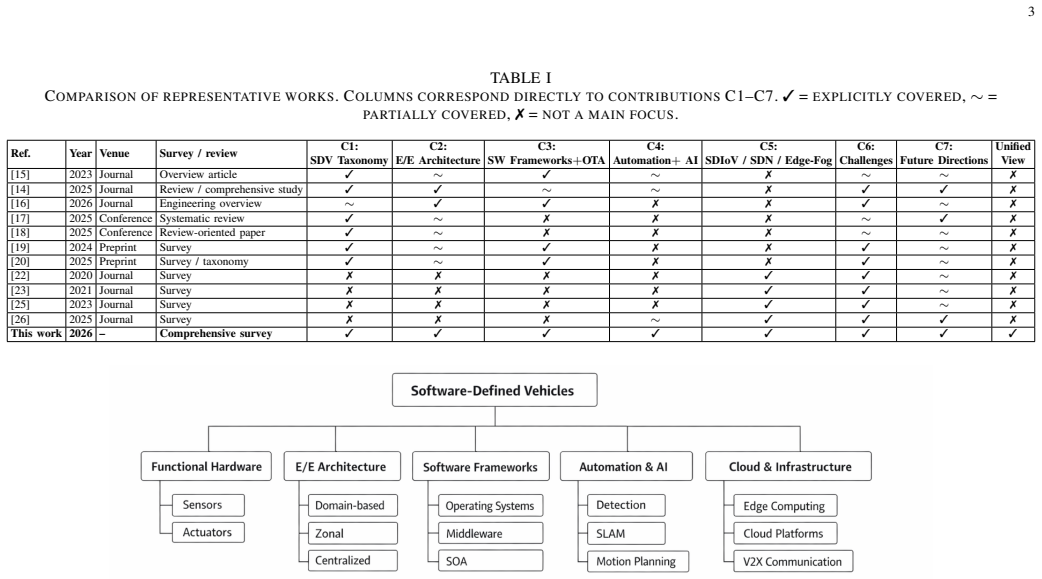
The structured taxonomy organizing SDV technologies into functional hardware, E/E architectures, software frameworks, automation mechanisms, and distributed infrastructure domains, which frames the review of enabling technologies like service-oriented architectures and cloud infrastructures.
What would settle it
Evidence that a significant portion of new vehicle models continue to use only traditional distributed ECU architectures without adopting zonal or centralized platforms would undermine the described transition.
Extended reading notes
Core claim
The transition toward Software-Defined Vehicles (SDVs) represents a major paradigm shift in vehicle design, transforming traditional hardware-centric systems into software-centric platforms capable of dynamic adaptation and continuous functional evolution. SDVs enable advanced capabilities such as Over-the-Air (OTA) updates, intelligent automation, and connected services driven by AI.
Load-bearing premise
The body of reviewed literature provides a representative and complete picture of SDV architectures and technologies without major omissions of recent or proprietary developments.
Signed reviews
Editorial analysis
A structured set of objections, weighed in public.
Referee Report
Summary. The manuscript surveys Software-Defined Vehicles (SDVs) as a paradigm shift from hardware-centric to software-centric vehicle design. It reviews the evolution of E/E architectures from distributed ECUs to domain-based, zonal, and centralized platforms; examines enabling technologies including service-oriented architectures, middleware, AI, automation pipelines, and cloud infrastructure; introduces a taxonomy organizing SDV elements into functional hardware, E/E architectures, software frameworks, automation mechanisms, and distributed infrastructure; discusses the Software-Defined Internet of Vehicles (SDIoV) integrating SDN with edge/fog computing; and covers challenges in cybersecurity, interoperability, data management, and scalability along with future trends.
Significance. If the literature selection is representative, the structured taxonomy and overview of SDV architectures and SDIoV integration could serve as a useful reference point for researchers working on automotive embedded systems and connected-vehicle platforms, helping to map the transition toward OTA-updatable, AI-driven vehicles.
major comments (1)
- [Abstract] Abstract: The claim of a 'comprehensive survey' of architectures, enabling technologies, and SDIoV is load-bearing for the central argument that SDVs represent a completed paradigm shift, yet the manuscript provides no explicit literature-search methodology, inclusion/exclusion criteria, or discussion of coverage gaps for proprietary OEM/Tier-1 developments that are not publicly available; without this, the representativeness of the reviewed body of work cannot be assessed.
Simulated Author's Rebuttal
We thank the referee for the detailed and constructive review. We address the single major comment below.
read point-by-point responses
-
Referee: [Abstract] Abstract: The claim of a 'comprehensive survey' of architectures, enabling technologies, and SDIoV is load-bearing for the central argument that SDVs represent a completed paradigm shift, yet the manuscript provides no explicit literature-search methodology, inclusion/exclusion criteria, or discussion of coverage gaps for proprietary OEM/Tier-1 developments that are not publicly available; without this, the representativeness of the reviewed body of work cannot be assessed.
Authors: We agree that an explicit description of the literature review process is missing and that this limits the ability to assess coverage, particularly for proprietary developments. In the revised manuscript we will add a new subsection (placed after the introduction) titled 'Survey Methodology and Scope' that specifies: (1) the databases searched (IEEE Xplore, ACM DL, ScienceDirect, arXiv, SAE Digital Library), (2) the keyword combinations and Boolean strings employed, (3) the time window (primarily 2018–2024 with selected foundational references), (4) inclusion/exclusion criteria (peer-reviewed journal/conference papers, industry white papers from recognized consortia, English language; exclusion of non-technical marketing material and duplicates), and (5) the final selection counts. We will also add an explicit paragraph acknowledging that the survey is necessarily limited to publicly available sources and cannot claim exhaustive coverage of closed OEM/Tier-1 implementations. The phrase 'comprehensive survey' in the abstract will be qualified to 'structured survey of the publicly available literature'. These changes directly address the concern while preserving the paper’s core contributions. revision: yes
Circularity Check
No circularity: descriptive survey with no derivations or self-referential reductions
full rationale
The paper is a literature survey reviewing external sources on SDV architectures and technologies. It contains no equations, fitted parameters, predictions, uniqueness theorems, or ansatzes. All content is organized as a taxonomy and discussion drawn from cited prior work by other authors. No load-bearing step reduces to the paper's own inputs by construction. This matches the default expectation for non-circular survey papers.
Assumptions & free parameters
Cite this review
Pith. "Pith review of The Rise of the Software-Defined Vehicle: Architectures, Enabling Technologies, and Future Opportunities." pith.science (2026). https://pith.science/paper/RNRMTEWM
@misc{pith2026260530001,
  author       = {Pith},
  title        = {Pith review of: The Rise of the Software-Defined Vehicle: Architectures, Enabling Technologies, and Future Opportunities},
  year         = {2026},
  howpublished = {\url{https://pith.science/paper/RNRMTEWM}},
  note         = {Machine review of arXiv:2605.30001}
}
read the original abstract
The transition toward Software-Defined Vehicles (SDVs) represents a major paradigm shift in vehicle design, transforming traditional hardware-centric systems into software-centric platforms capable of dynamic adaptation and continuous functional evolution. SDVs enable advanced capabilities such as Over-the-Air (OTA) updates, intelligent automation, and connected services driven by AI. This paper presents a comprehensive survey of the architectures, enabling technologies, and operational frameworks that define modern SDVs. It examines the evolution of vehicle architectures from distributed electronic control unit (ECU) systems to domain-based, zonal, and centralized computing platforms. Key enabling technologies are reviewed, including service-oriented software architectures, middleware, automation pipelines, artificial intelligence mechanisms, and cloud-based infrastructures. A structured taxonomy is introduced to organize SDV technologies into functional hardware, E/E architectures, software frameworks, automation mechanisms, and distributed infrastructure domains. The study also investigates the Software-Defined Internet of Vehicles (SDIoV) paradigm, integrating Software-Defined Networking (SDN) with edge and fog computing to support scalable vehicular communication and data processing. Furthermore, key technical challenges related to cybersecurity, interoperability, data management, and system scalability are discussed, along with emerging research directions and future development trends.
Figures


Reviewed June 28, 2026 · model on record in the stance chip above.
Discussion (0). Continue with ORCID to comment.