REVIEW 3 major objections 4 minor 25 references
4DR P2T: 4D Radar Tensor Synthesis with Point Clouds
T0 review · 3 major / 4 minor · reviewed 2026-08-08 · deepseek-v4-flash
Pith's one-line read This paper claims that a conditional generative adversarial network can regenerate dense 4D radar tensors from sparse point clouds, reaching an average PSNR of 30.39 dB and SSIM of 0.96, and that percentile-1% point clouds offer the best…
desk verdict A plausible new task—radar tensor reconstruction from point clouds without LiDAR—but the paper's headline conclusion about which point cloud method is best for deep learning is not demonstrated by the evidence. read the letter →
The pith
A machine-rendered reading of the paper's core claim, the machinery that carries it, and where it could break.
The reading
What carries the argument
The load-bearing machinery is an encoder-decoder generator with skip connections: the encoder processes sparse point clouds with 3D sparse convolutions at downsampling stages and submanifold sparse convolutions at full-resolution stages, while the decoder uses 3D dense convolutions to produce a complete dense tensor. A multi-scale 3D discriminator judges the output, and the training objective combines a conditional adversarial loss, an L1 loss, and a perceptual loss. The model treats the point cloud as an encoded version of the tensor, so its reconstruction quality serves as a measuring stick for how much environmental information each point-cloud generation method preserves.
What would settle it
Train a downstream object detector on tensors regenerated from percentile-1% point clouds and compare its performance against the same detector trained on raw tensors; if detection performance does not follow the PSNR/SSIM ranking, the proxy assumption fails. Alternatively, compute PSNR and SSIM directly on the full 3D tensors without height-pooling and check whether percentile-5% still ranks first.
Extended reading notes
Core claim
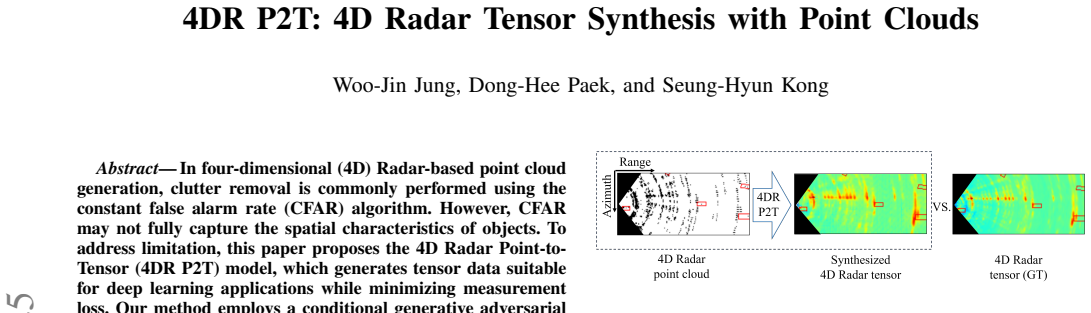
The central discovery is that a cGAN composed of a 3D sparse-convolution encoder and a 3D dense-convolution decoder can reconstruct dense 4D radar tensors from sparse point clouds well enough to rank different point-cloud generation methods. Evaluated on K-Radar, the model achieves its best reconstruction with percentile-5% point clouds (34.43 dB PSNR, 0.98 SSIM), and the percentile-1% method attains the highest deep-learning efficiency score of 0.48, indicating the most favorable ratio of reconstruction fidelity to point-cloud density. The paper interprets tensor-generation performance as a proxy for how well a point cloud preserves environmental information, which is what makes the comparison of extraction methods meaningful.
Load-bearing premise
The paper's load-bearing premise is that PSNR and SSIM computed after mean-pooling the generated 3D tensor along the height axis correctly indicate how much environmental information a point cloud preserved and how suitable the reconstructed tensor is for downstream deep learning; if this proxy is wrong, the recommendation of the 1% percentile method loses its basis.
Editorial extensions
If this is right
- The 4DR P2T model can act as a decoder that regenerates dense radar tensors from sparse point clouds, enabling point-cloud storage or transmission with later tensor reconstruction.
- Percentile-5% point clouds should be preferred when reconstruction quality is the priority, since they yield the highest PSNR and SSIM.
- Percentile-1% point clouds offer the best performance-to-data-volume ratio, making them a strong choice for training deep learning models under bandwidth or memory limits.
- The model's current form excludes Doppler information to keep computational costs low, so extending it to full four-dimensional tensors is a natural next step.
Reading between the lines
- If reconstruction quality is a valid proxy for information preservation, the same point-to-tensor training could be applied to radar datasets that only provide point clouds, effectively manufacturing tensor supervision.
- The method suggests a practical radar data-compression pipeline: retain the 1% percentile point cloud and regenerate the dense tensor on demand, trading some fidelity for lower transmission cost.
- The paper does not validate the proxy assumption with a downstream object-detection experiment on the reconstructed tensors; that experiment would directly test whether the PSNR/SSIM ranking matters for deep learning.
Editorial analysis
A structured set of objections, weighed in public.
Referee Report
Summary. This paper proposes 4DR P2T, a conditional generative adversarial network (cGAN) that synthesizes dense 3D radar tensors from sparse 4D radar point clouds. The model uses 3D sparse convolutions in the encoder and 3D dense convolutions in the decoder, with a multi-scale discriminator, and is trained on the K-Radar dataset with ground-truth tensors as supervision. The authors evaluate the method using PSNR and SSIM computed after mean-pooling the output along the height axis, and introduce a deep-learning efficiency score (DES) that divides normalized quality scores by point cloud density. The paper reports an average PSNR of 30.39 dB and SSIM of 0.96, and concludes that the 5% percentile point cloud generation method gives the best tensor quality while the 1% percentile method is best suited for deep learning applications.
Significance. If the claims were fully substantiated, the paper would offer a useful data-format conversion tool for 4D radar perception and an empirical comparison of point cloud generation methods. The work has several strengths: it uses the public K-Radar dataset, evaluates against held-out ground-truth tensors, and clearly describes the architecture. The reported reconstruction scores are computed against held-out ground truth. However, the central conclusion that the 1% percentile is optimal for deep learning rests on an unvalidated, density-normalized metric, and the evaluation lacks baseline comparisons and 3D-aware quality measures.
major comments (3)
- [Section IV.C, Eq. (6)] The DES metric divides the normalized PSNR and SSIM by D(i), the point cloud density (in percent). Because D(i) is in the denominator, the metric systematically rewards sparser point clouds; for example, the 1% percentile row in Table I achieves the highest DES (0.48) mainly because its PCD (1.11) is much smaller than the 5% row's PCD (4.46), despite having lower raw PSNR/SSIM than the 5% row. The conclusion in Section IV.D that the 1% method is 'well-suited for deep learning model training' is therefore an artifact of the metric's construction unless DES is validated against an actual downstream task. The paper should either demonstrate such validation (e.g., object detection or segmentation performance on the reconstructed tensor) or soften the claim.
- [Section IV.C] The evaluation converts the 3D generated tensor to a 2D image by mean pooling along the height axis before computing PSNR and SSIM. This can mask errors in the elevation dimension and is dominated by large empty regions of the BEV projection, so two tensors with very different 3D fidelity can receive similar scores. The paper's central proxy claim, stated in Section I ('tensor generation performance ... serves as a proxy for assessing how well a given point cloud preserves environmental information'), is therefore not established. The authors should additionally report 3D voxel-wise metrics or demonstrate that height-pooled quality correlates with downstream perception performance.
- [Section IV.B and Table I] The evaluation lacks any baseline comparison. The paper does not report how simple alternatives—such as direct voxelization of the input point cloud, interpolation, a deterministic UNet without the adversarial loss, or a non-learned fill—perform on the same metrics. Without such baselines, the abstract's claim that results 'validate the effectiveness of the 4DR P2T model' is unsupported, as the reported average PSNR of 30.39 dB has no reference point. Adding at least a voxelization baseline and an ablation that removes the GAN objective would clarify the model's contribution.
minor comments (4)
- [Section IV.D] The 'average PSNR across all methods is 30.39dB' is the mean of the six method-level PSNR values in Table I, not an average over test frames. The paper should clarify this and report per-frame statistics with standard deviations to substantiate the claimed stability.
- [Section IV.C] The text defines D(i) as a 'ratio' of detected points to total possible points, but the table reports PCD as percentages (e.g., 1.11, 4.46). The inconsistency in units should be fixed, since the absolute DES values depend on the scale of D(i).
- [Section III.C] The perceptual loss is not fully specified; the paper should name the pre-trained network (e.g., VGG) and the layers used for feature extraction to enable reproducibility.
- [Section IV.D] The use of a 20–25 dB 'acceptable quality' threshold from wireless communication studies [24], [25] is not directly applicable to radar tensor reconstruction, and the paper should provide a more relevant justification for interpreting the reported PSNR as 'sufficiently high performance.'
Circularity Check
Core cGAN reconstruction is independent, but the '1% percentile optimal for deep learning' conclusion is a restatement of the self-defined DES metric rather than an empirical result.
-
self definitional
[Section IV.C (Metrics, Eq. 6) and Section IV.D (Results, Table I discussion)]
"The deep-learning efficiency score (DES) metric, defined in Eq. 6, was used to identify efficient point cloud generation methods for deep learning. ... Meanwhile, the percentile 1% method attains the highest DES value of 0.48, while also demonstrating superior point generation ability while reducing data volume, making it well-suited for deep learning model training."
Eq. 6 defines DES as a density-normalized combination of min-max normalized PSNR and SSIM, with D(i) equal to point-cloud density. The paper then treats 'highest DES' as evidence that the 1% percentile method is 'well-suited for deep learning model training.' No downstream detector, segmentation experiment, or non-learning baseline validates DES as a proxy for deep-learning suitability; the conclusion is therefore equivalent to saying that 1% has the largest value of the quantity the authors chose to call the deep-learning efficiency score. In particular, the 1%-over-5% ranking is driven by dividing by D(i) (1.11 vs 4.46), not by any measured task performance, so the headline recommendation reduces to the metric's own construction.
full rationale
The tensor-generation model itself is not circular: 4DR P2T is trained against held-out K-Radar ground-truth tensors using cGAN, L1, and perceptual losses, and the reported PSNR/SSIM (30.39 dB / 0.96) are direct reconstruction metrics computed on held-out data. The percentile/CFAR comparison in Table I is likewise an honest empirical ranking on those metrics. The only circular step is the 'deep-learning suitability' conclusion: DES (Eq. 6) is defined by the authors as a density-normalized combination of min-max normalized PSNR and SSIM, and Section IV.D converts 'highest DES' directly into 'well-suited for deep learning model training.' Because no downstream detector, segmentation model, or non-learning tensor-voxelization baseline is used to validate DES as a proxy, the 1%-optimal recommendation is a restatement of the metric's definition (including the equal weighting alpha=beta=0.5 and density division D(i)), not an independently demonstrated result. Self-citations to K-Radar [10], RTNH+ [11], and Enhanced K-Radar [12] supply dataset and preprocessing choices; they are not used as a uniqueness theorem or to forbid alternatives, so they do not add circularity. Overall score 4: the core reconstruction is independent, but one of the paper's two headline conclusions reduces to a self-defined metric.
Assumptions & free parameters
free parameters (3)
- lambda_L1 and lambda_perc loss weights =
not reported
- DES weights alpha and beta =
alpha = 0.5, beta = 0.5
- ROI boundaries =
x [0, 76.8], y [-16, 16], z [-2, 10.8]
assumptions (4)
- domain assumption A point cloud can be treated as an encoded version of the radar tensor, and the cGAN can learn to decode it back to the original tensor.
- domain assumption PSNR and SSIM computed on a mean-pooled 2D projection are valid proxies for 3D radar tensor fidelity.
- domain assumption Excluding Doppler information from the tensor target does not compromise the evaluation of spatial synthesis quality.
- ad hoc to paper The DES metric with equal weights alpha = beta = 0.5 and min-max normalization yields a meaningful ranking of point cloud methods.
Cite this review
Pith. "Pith review of 4DR P2T: 4D Radar Tensor Synthesis with Point Clouds." pith.science (2026). https://pith.science/paper/RO673GHC
@misc{pith2026250205550,
  author       = {Pith},
  title        = {Pith review of: 4DR P2T: 4D Radar Tensor Synthesis with Point Clouds},
  year         = {2026},
  howpublished = {\url{https://pith.science/paper/RO673GHC}},
  note         = {Machine review of arXiv:2502.05550}
}
read the original abstract
In four-dimensional (4D) Radar-based point cloud generation, clutter removal is commonly performed using the constant false alarm rate (CFAR) algorithm. However, CFAR may not fully capture the spatial characteristics of objects. To address limitation, this paper proposes the 4D Radar Point-to-Tensor (4DR P2T) model, which generates tensor data suitable for deep learning applications while minimizing measurement loss. Our method employs a conditional generative adversarial network (cGAN), modified to effectively process 4D Radar point cloud data and generate tensor data. Experimental results on the K-Radar dataset validate the effectiveness of the 4DR P2T model, achieving an average PSNR of 30.39dB and SSIM of 0.96. Additionally, our analysis of different point cloud generation methods highlights that the 5% percentile method provides the best overall performance, while the 1% percentile method optimally balances data volume reduction and performance, making it well-suited for deep learning applications.
Figures


Figures from the paper (1 more)

Reference graph
Works this paper leans on
-
[1]
An overview of radar clutter simulation
Ting An, Sai Zhu, Lidong Wang, and Zhiyong Liu. An overview of radar clutter simulation. In IOP conference series: materials science and engineering , volume 452, page 042198. IOP Publishing, 2018
work page 2018
-
[2]
4d millimeter-wave radar in autonomous driving: A survey
Zeyu Han, Jiahao Wang, Zikun Xu, Shuocheng Yang, Lei He, Shaob- ing Xu, Jianqiang Wang, and Keqiang Li. 4d millimeter-wave radar in autonomous driving: A survey. arXiv preprint arXiv:2306.04242 , 2023
arXiv 2023
-
[3]
Rpfa-net: A 4d radar pillar feature attention network for 3d object detection
Baowei Xu, Xinyu Zhang, Li Wang, Xiaomei Hu, Zhiwei Li, Shuyue Pan, Jun Li, and Yongqiang Deng. Rpfa-net: A 4d radar pillar feature attention network for 3d object detection. In 2021 IEEE International Intelligent Transportation Systems Conference (ITSC) , pages 3061–
work page 2021
-
[4]
Dpft: Dual perspective fusion transformer for camera-radar-based object detection
Felix Fent, Andras Palffy, and Holger Caesar. Dpft: Dual perspective fusion transformer for camera-radar-based object detection. arXiv preprint arXiv:2404.03015, 2024
arXiv 2024
-
[5]
Introduction to 4d radar: Hard- ware, mimo, signal processing, dataset, and ai
Dong-Hee Paek and Junfeng Guan. Introduction to 4d radar: Hard- ware, mimo, signal processing, dataset, and ai. In Tutorial on 2024 IEEE Intelligent V ehicles Symposium , 2024. Tutorial presentation
work page 2024
-
[6]
Exploring radar data representations in autonomous driving: A comprehensive review
S Yao et al. Exploring radar data representations in autonomous driving: A comprehensive review. arXiv preprint arXiv:2312.04861 , 2023
arXiv 2023
-
[7]
3drimr: 3d reconstruction and imaging via mmwave radar based on deep learning
Yue Sun, Zhuoming Huang, Honggang Zhang, Zhi Cao, and Deqiang Xu. 3drimr: 3d reconstruction and imaging via mmwave radar based on deep learning. In 2021 IEEE International Performance, Computing, and Communications Conference (IPCCC) , pages 1–8. IEEE, 2021
work page 2021
-
[8]
A novel radar point cloud generation method for robot environment perception
Yuwei Cheng, Jingran Su, Mengxin Jiang, and Yimin Liu. A novel radar point cloud generation method for robot environment perception. IEEE Transactions on Robotics , 38(6):3754–3773, 2022
work page 2022
Show all 25 references
-
[9]
U-net: Con- volutional networks for biomedical image segmentation
Olaf Ronneberger, Philipp Fischer, and Thomas Brox. U-net: Con- volutional networks for biomedical image segmentation. In Medical image computing and computer-assisted intervention–MICCAI 2015: 18th international conference, Munich, Germany, October 5-9, 2015, proceedings, par...
2015
-
[10]
K-radar: 4d radar object detection for autonomous driving in various weather conditions
Dong-Hee Paek, Seung-Hyun Kong, and Kevin Tirta Wijaya. K-radar: 4d radar object detection for autonomous driving in various weather conditions. Advances in Neural Information Processing Systems , 35:3819–3829, 2022
2022
-
[11]
Rtnh+: Enhanced 4d radar object detection network using two-level pre- processing and vertical encoding
Seung-Hyun Kong, Dong-Hee Paek, and Sangyeong Lee. Rtnh+: Enhanced 4d radar object detection network using two-level pre- processing and vertical encoding. IEEE Transactions on Intelligent V ehicles, 2024
2024
-
[12]
En- hanced k-radar: Optimal density reduction to improve detection per- formance and accessibility of 4d radar tensor-based object detection
Dong-Hee Paek, Seung-Hyun Kong, and Kevin Tirta Wijaya. En- hanced k-radar: Optimal density reduction to improve detection per- formance and accessibility of 4d radar tensor-based object detection. In 2023 IEEE Intelligent V ehicles Symposium (IV) , pages 1–6. IEEE, 2023
2023
-
[13]
Raw high-definition radar for multi-task learning
Julien Rebut, Arthur Ouaknine, Waqas Malik, and Patrick P ´erez. Raw high-definition radar for multi-task learning. In Proceedings of the IEEE/CVF Conference on Computer Vision and Pattern Recognition , pages 17021–17030, 2022
2022
-
[14]
Image-to-image translation with conditional adversarial networks
Phillip Isola, Jun-Yan Zhu, Tinghui Zhou, and Alexei A Efros. Image-to-image translation with conditional adversarial networks. In Proceedings of the IEEE conference on computer vision and pattern recognition, pages 1125–1134, 2017
2017
-
[15]
High-resolution image synthesis and semantic manipulation with conditional gans
Ting-Chun Wang, Ming-Yu Liu, Jun-Yan Zhu, Andrew Tao, Jan Kautz, and Bryan Catanzaro. High-resolution image synthesis and semantic manipulation with conditional gans. In Proceedings of the IEEE conference on computer vision and pattern recognition , pages 8798– 8807, 2018
2018
-
[16]
Radsimreal: Bridging the gap be- tween synthetic and real data in radar object detection with simulation
Oded Bialer and Yuval Haitman. Radsimreal: Bridging the gap be- tween synthetic and real data in radar object detection with simulation. In Proceedings of the IEEE/CVF Conference on Computer Vision and Pattern Recognition, pages 15407–15416, 2024
2024
-
[17]
L2r gan: Lidar-to-radar translation
Leichen Wang, Bastian Goldluecke, and Carsten Anklam. L2r gan: Lidar-to-radar translation. In Proceedings of the Asian Conference on Computer Vision, 2020
2020
-
[18]
V oxelnet: End-to-end learning for point cloud based 3d object detection
Yin Zhou and Oncel Tuzel. V oxelnet: End-to-end learning for point cloud based 3d object detection. In Proceedings of the IEEE conference on computer vision and pattern recognition , pages 4490– 4499, 2018
2018
-
[19]
Lidar-to-radar translation based on voxel feature extraction module for radar data augmentation
Jinho Lee, Geonkyu Bang, Takaya Shimizu, Masato Iehara, and Shunsuke Kamijo. Lidar-to-radar translation based on voxel feature extraction module for radar data augmentation. Sensors, 24(2):559, 2024
2024
-
[20]
Sparse convolutional neural networks
Baoyuan Liu, Min Wang, Hassan Foroosh, Marshall Tappen, and Mar- ianna Pensky. Sparse convolutional neural networks. In Proceedings of the IEEE conference on computer vision and pattern recognition , pages 806–814, 2015
2015
-
[21]
3d semantic segmentation with submanifold sparse convolutional networks
Benjamin Graham, Martin Engelcke, and Laurens Van Der Maaten. 3d semantic segmentation with submanifold sparse convolutional networks. In Proceedings of the IEEE conference on computer vision and pattern recognition , pages 9224–9232, 2018
2018
-
[22]
K- radar: 4d radar object detection for autonomous driving in various weather conditions
Dong-Hee Paek, Seung-Hyun Kong, and Kevin Tirta Wijaya. K- radar: 4d radar object detection for autonomous driving in various weather conditions. In Thirty-sixth Conference on Neural Information Processing Systems Datasets and Benchmarks Track , 2022
2022
-
[23]
Adam: A method for stochastic optimization
Diederik P Kingma. Adam: A method for stochastic optimization. arXiv preprint arXiv:1412.6980 , 2014
2014 arXiv
-
[24]
Optimized transmission of jpeg2000 streams over wireless channels
Nikolaos Thomos, Nikolaos V Boulgouris, and Michael G Strintzis. Optimized transmission of jpeg2000 streams over wireless channels. IEEE Transactions on image processing , 15(1):54–67, 2005
2005
-
[25]
Robust transmission of jpeg2000 encoded images over packet loss channels
Xiangjun Li and Jianfei Cai. Robust transmission of jpeg2000 encoded images over packet loss channels. In 2007 IEEE International Conference on Multimedia and Expo , pages 947–950. IEEE, 2007
2007
Reviewed August 8, 2026 · model on record in the stance chip above.
Discussion (0). Continue with ORCID to comment.