Structural functional identifiability and model discovery in differential equation models
Pith reviewed 2026-06-30 03:43 UTC · model grok-4.3
The pith
Functional identifiability generalizes parameter identifiability so that unknown functions in differential equation models can be checked for unique recovery using differential algebra.
A machine-rendered reading of the paper's core claim, the machinery that carries it, and where it could break.
Core claim
We generalise the classical notion of structural parameter identifiability to functional identifiability. Functional identifiability can be assessed for differential equation models using differential algebra-based techniques which are well-established as a means of assessing structural identifiability for ordinary differential equation-based models. Our framework reveals new phenomena that arise in the transition from parametric to functional inference and have no analogue in the classical setting. We characterise functional identifiability in several common model classes.
What carries the argument
Differential algebra techniques extended from parameter identifiability to determine whether unknown functional components in differential equation models admit unique recovery from observations.
If this is right
- Unique functional recovery is impossible in broad classes of models.
- New phenomena without analogue in the parameter setting appear during the shift to functional inference.
- Functional identifiability can be characterized explicitly in several common model classes.
- Machine learning representations of unknown system components now have a theoretical foundation for assessing whether they can be recovered uniquely.
Where Pith is reading between the lines
- The same differential algebra approach could be used to test whether neural-network or other flexible representations of unknown terms remain identifiable after training.
- Experiment design or choice of observation locations could be guided by functional identifiability results to guarantee unique recovery is possible in principle.
- The framework might be adapted to check identifiability for constitutive relations in partial differential equation models or stochastic differential equations.
Load-bearing premise
Differential algebra techniques developed for parameter identifiability in ordinary differential equation models extend directly to functional identifiability without new foundational results or insurmountable obstacles.
What would settle it
A concrete differential equation model with an unknown function for which the differential algebra procedure predicts functional identifiability, yet two distinct functions generate identical observations under noise-free conditions.
Figures
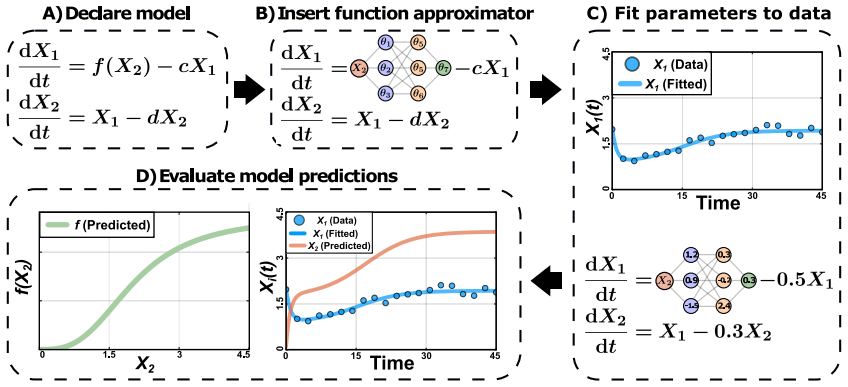
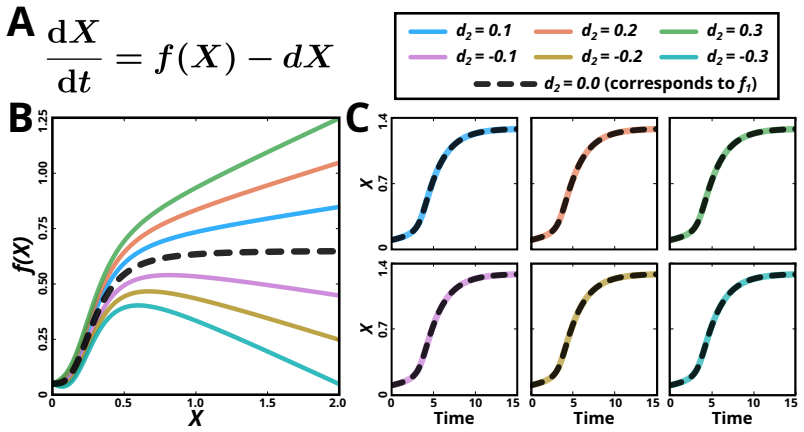
read the original abstract
Differential equation models are widely used to describe, interpret, and predict dynamical phenomena across science and engineering. In practice, however, the governing dynamics are rarely fully known and must be inferred from observational data. Traditionally, inverse problems in differential equation modelling have focused on estimating unknown parameter values. In this setting, structural identifiability determines whether parameter values can, in principle, be uniquely recovered from ideal observations and is, therefore, a prerequisite for meaningful inference. More recently, the integration of machine learning with mechanistic modelling has enabled the discovery of unknown equations, functions, and constitutive relationships, substantially expanding the space of admissible models. This raises a fundamental question: under what conditions can unknown functional components be uniquely recovered from data? In this paper, we generalise the classical notion of structural parameter identifiability to functional identifiability. We first identify broad classes of models for which unique functional recovery is impossible. We then show how functional identifiability can be assessed for differential equation models using differential algebra-based techniques which are well-established as a means of assessing structural identifiability for ordinary differential equation-based models. Our framework reveals new phenomena that arise in the transition from parametric to functional inference and have no analogue in the classical setting. Finally, we characterise functional identifiability in several common model classes. Taken together, our results demonstrate that functional identifiability provides a theoretical foundation for modern inverse problems in differential equation modelling, particularly those that use machine learning representations of unknown system components.
Editorial analysis
A structured set of objections, weighed in public.
Referee Report
Summary. This paper generalizes the classical notion of structural parameter identifiability to functional identifiability for differential equation models. It identifies classes of models where unique recovery of unknown functions is impossible, demonstrates the use of differential algebra techniques for assessing functional identifiability, highlights new phenomena arising in the functional setting, and characterizes identifiability for several common model classes. The work aims to provide a theoretical foundation for inverse problems in DE modeling that involve machine learning for unknown components.
Significance. If the technical extension holds, the results would offer a valuable theoretical framework for ensuring unique recovery in functional model discovery, which is increasingly relevant with the integration of machine learning in mechanistic modeling. The identification of impossible cases and the discussion of new phenomena without parametric analogues represent potential strengths. Credit is due for attempting to bridge classical differential algebra methods with modern functional inference problems.
major comments (1)
- [§3 (framework for assessment)] §3 (framework for assessment): The assertion that differential algebra techniques extend directly to functional identifiability lacks an explicit re-derivation of the existence of a finite characteristic set or the rank conditions on the differential ideal when the ring is enlarged to include function-valued indeterminates rather than constant parameters. The classical pipeline assumes finite transcendence degree over the base field; the functional case requires a redefined notion of generic input/initial condition and a proof that the ideal membership problem remains decidable in this setting. This is load-bearing for the central claim that the same techniques suffice.
minor comments (2)
- [Abstract] The abstract refers to 'broad classes of models' where recovery is impossible; a concrete example or forward reference to the relevant theorem would improve clarity.
- [Introduction] Notation distinguishing functional unknowns from parameters could be introduced earlier to aid readability.
Simulated Author's Rebuttal
We thank the referee for their careful reading and constructive feedback on the manuscript. We address the single major comment below.
read point-by-point responses
-
Referee: The assertion that differential algebra techniques extend directly to functional identifiability lacks an explicit re-derivation of the existence of a finite characteristic set or the rank conditions on the differential ideal when the ring is enlarged to include function-valued indeterminates rather than constant parameters. The classical pipeline assumes finite transcendence degree over the base field; the functional case requires a redefined notion of generic input/initial condition and a proof that the ideal membership problem remains decidable in this setting. This is load-bearing for the central claim that the same techniques suffice.
Authors: We agree that the manuscript would be strengthened by an explicit re-derivation of the relevant differential-algebraic results in the functional setting. While the framework in §3 builds directly on the standard theory by adjoining function-valued indeterminates to the differential ring and applying the same elimination procedures, we acknowledge that the existence of a finite characteristic set, the appropriate rank conditions, and decidability of ideal membership require careful justification when the transcendence degree is no longer finite in the classical sense. In the revised version we will add a dedicated subsection (or appendix) that (i) redefines generic inputs and initial conditions for function-valued unknowns, (ii) establishes the existence of a finite characteristic set under the paper’s standing assumptions on the differential ideal, and (iii) confirms that the ideal-membership problem remains decidable. This addition will make the central claim self-contained without altering the overall results. revision: yes
Circularity Check
No circularity: extension of external differential algebra techniques to functional identifiability
full rationale
The paper's central claim is an extension of classical differential algebra methods (characteristic sets, Rosenfeld-Groebner bases) already established for parametric structural identifiability in ODEs. The abstract and description explicitly frame the functional case as an application of these pre-existing techniques rather than a self-derived result. No equations or steps reduce the claimed assessment procedure to a fitted parameter, a self-definition, or a load-bearing self-citation chain; the algebraic pipeline is treated as an independent external tool whose applicability is asserted but not re-derived from the paper's own inputs. This satisfies the criteria for a self-contained derivation against external benchmarks.
Axiom & Free-Parameter Ledger
axioms (1)
- domain assumption Differential algebra techniques established for parameter identifiability extend to functional components without additional foundational obstacles
Reference graph
Works this paper leans on
-
[1]
On Structural Identifiability,
Bellman R, ˚Astr¨ om KJ. 1970 On structural identifiability.Mathematical Biosciences7, 329–339. (10.1016/0025-5564(70)90132-X)
-
[2]
Raue A, Kreutz C, Maiwald T, Bachmann J, Schilling M, Klingm¨ uller U, Timmer J. 2009 Struc- tural and practical identifiability analysis of partially observed dynamical models by exploiting the profile likelihood.Bioinformatics25, 1923–1929. (10.1093/bioinformatics/btp358)
-
[4]
2022 A protocol for dynamic model calibration.Briefings in Bioinformatics23, bbab387
Villaverde AF, Pathirana D, Fr¨ ohlich F, Hasenauer J, Banga JR. 2022 A protocol for dynamic model calibration.Briefings in Bioinformatics23, bbab387. (10.1093/bib/bbab387)
-
[5]
Simpson M, Baker R. 2026 Parameter Identifiability, Parameter Estimation, and Model Predic- tion for Differential Equation Models.SIAM REVIEW. (10.1137/24M1667968)
-
[6]
Alber M, Buganza Tepole A, Cannon WR, De S, Dura-Bernal S, Garikipati K, Karniadakis G, Lytton WW, Perdikaris P, Petzold L, Kuhl E. 2019 Integrating machine learning and multiscale modeling—perspectives, challenges, and opportunities in the biological, biomedical, and behav- ioral sciences.npj Digital Medicine2, 115. (10.1038/s41746-019-0193-y)
-
[7]
Noordijk B, Garcia Gomez ML, ten Tusscher KHWJ, de Ridder D, van Dijk ADJ, Smith RW. 2024 The rise of scientific machine learning: a perspective on combining mechanistic mod- elling with machine learning for systems biology.Frontiers in Systems Biology4. (10.3389/f- sysb.2024.1407994)
work page doi:10.3389/f- 2024
-
[8]
Willard J, Jia X, Xu S, Steinbach M, Kumar V. 2022 Integrating Scientific Knowledge with Machine Learning for Engineering and Environmental Systems.ACM Comput. Surv.55, 66:1– 66:37. (10.1145/3514228)
-
[9]
Universal Differential Equations for Scientific Machine Learning
Rackauckas C, Ma Y, Martensen J, Warner C, Zubov K, Supekar R, Skinner D, Ramad- han A, Edelman A. 2021 Universal Differential Equations for Scientific Machine Learning. arXiv:2001.04385 [cs] (10.48550/arXiv.2001.04385)
work page internal anchor Pith review Pith/arXiv arXiv doi:10.48550/arxiv.2001.04385 2021
-
[10]
Raissi M, Perdikaris P, Karniadakis GE. 2019 Physics-informed neural networks: A deep learn- ing framework for solving forward and inverse problems involving nonlinear partial differential equations.Journal of Computational Physics378, 686–707. (10.1016/j.jcp.2018.10.045)
-
[11]
Physics-informed machine learning
Karniadakis GE, Kevrekidis IG, Lu L, Perdikaris P, Wang S, Yang L. 2021 Physics-informed machine learning.Nature Reviews Physics3, 422–440. (10.1038/s42254-021-00314-5)
-
[12]
2022 Bayesian Neural Ordinary Differential Equations
Dandekar R, Chung K, Dixit V, Tarek M, Garcia-Valadez A, Vemula KV, Rack- auckas C. 2022 Bayesian Neural Ordinary Differential Equations. arXiv:2012.07244 [cs] (10.48550/arXiv.2012.07244)
-
[13]
Cobelli C, DiStefano JJ. 1980 Parameter and structural identifiability concepts and ambiguities: a critical review and analysis.The American Journal of Physiology239, R7–24. (10.1152/a- jpregu.1980.239.1.R7) 17
work page doi:10.1152/a- 1980
-
[14]
2014 Determination of parameter identifiability in non- linear biophysical models: A Bayesian approach.The Journal of General Physiology143, 401–
Hines KE, Middendorf TR, Aldrich RW. 2014 Determination of parameter identifiability in non- linear biophysical models: A Bayesian approach.The Journal of General Physiology143, 401–
2014
-
[15]
(10.1085/jgp.201311116)
-
[16]
Chis OT, Banga JR, Balsa-Canto E. 2011 Structural Identifiability of Systems Biology Models: A Critical Comparison of Methods.PLOS ONE6, e27755. (10.1371/journal.pone.0027755)
-
[17]
Meshkat N, Eisenberg M, Distefano JJ. 2009 An algorithm for finding globally identifiable pa- rameter combinations of nonlinear ODE models using Gr¨ obner Bases.Mathematical Biosciences 222, 61–72. (10.1016/j.mbs.2009.08.010)
-
[18]
2021 On structural and practical identifiability.Current Opinion in Systems Biology25, 60–69
Wieland FG, Hauber AL, Rosenblatt M, T¨ onsing C, Timmer J. 2021 On structural and practical identifiability.Current Opinion in Systems Biology25, 60–69. (10.1016/j.coisb.2021.03.005)
-
[19]
Loman TE, Baker RE. 2025 Functional and parametric identifiability for universal differential equations applied to chemical reaction networks. arXiv:2510.14140 [math] (10.48550/arXiv.2510.14140)
-
[20]
Neural Ordinary Differential Equations
Chen RTQ, Rubanova Y, Bettencourt J, Duvenaud D. 2019 Neural Ordinary Differential Equa- tions. arXiv:1806.07366 [cs] (10.48550/arXiv.1806.07366)
work page internal anchor Pith review Pith/arXiv arXiv doi:10.48550/arxiv.1806.07366 2019
-
[21]
2020 Neural Controlled Differential Equations for Irregular Time Series
Kidger P, Morrill J, Foster J, Lyons T. 2020 Neural Controlled Differential Equations for Irregular Time Series. arXiv:2005.08926 [cs] (10.48550/arXiv.2005.08926)
-
[22]
Hahl SK, Kremling A. 2016 A Comparison of Deterministic and Stochastic Modeling Approaches for Biochemical Reaction Systems: On Fixed Points, Means, and Modes.Frontiers in Genetics 7, 157. (10.3389/fgene.2016.00157)
-
[23]
2019Foundations of Chemical Reaction Network Theoryvol
Feinberg M. 2019Foundations of Chemical Reaction Network Theoryvol. 202Applied Mathemat- ical Sciences. Cham: Springer International Publishing. (10.1007/978-3-030-03858-8)
-
[24]
1965 Oscillatory behavior in enzymatic control processes.Advances in Enzyme Regulation3, 425–437
Goodwin BC. 1965 Oscillatory behavior in enzymatic control processes.Advances in Enzyme Regulation3, 425–437. (10.1016/0065-2571(65)90067-1)
-
[25]
Avram F, Adenane R, Neagu M. 2024 Advancing Mathematical Epidemiology and Chemical Reaction Network Theory via Synergies Between Them.Entropy26, 936. Publisher: Multidisci- plinary Digital Publishing Institute (10.3390/e26110936)
-
[26]
Zou H, Banerjee P, Leung SSY, Yan X. 2020 Application of Pharmacokinetic-Pharmacodynamic Modeling in Drug Delivery: Development and Challenges.Frontiers in Pharmacology11. Pub- lisher: Frontiers (10.3389/fphar.2020.00997)
-
[27]
1974 Oscillations in chemical systems
Field RJ, Noyes RM. 1974 Oscillations in chemical systems. IV. Limit cycle behavior in a model of a real chemical reaction.The Journal of Chemical Physics60, 1877–1884. (10.1063/1.1681288)
-
[28]
In: Leonardis, A., Ricci, E., Roth, S., Russakovsky, O., Sattler, T., Varol, G
Warnatz J, Maas U, Dibble RW. 1999Combustion. Berlin, Heidelberg: Springer. (10.1007/978- 3-642-98027-5) 18
-
[29]
Segel LA. 2003 J. D. Murray: Mathematical Biology (3rd Ed), Volume I (An Introduction) and Volume II (Spatial Models and Biomedical Applications).Mathematical Medicine and Bi- ology: A Journal of the IMA20, 377–378. eprint: https://academic.oup.com/imammb/article- pdf/20/4/377/2109357/200377.pdf (10.1093/imammb/20.4.377)
-
[30]
Fronk C, Yun J, Singh P, Petzold L. 2024 Bayesian polynomial neural networks and polynomial neural ordinary differential equations.PLOS Computational Biology20, e1012414. (10.1371/jour- nal.pcbi.1012414)
-
[31]
Giampiccolo S, Reali F, Fochesato A, Iacca G, Marchetti L. 2024 Robust parameter estimation and identifiability analysis with hybrid neural ordinary differential equations in computational biology.npj Systems Biology and Applications10, 139. (10.1038/s41540-024-00460-3)
-
[32]
2024 Learning Governing Equations of Unobserved States in Dynamical Systems
Grigorian G, George SV, Arridge S. 2024 Learning Governing Equations of Unobserved States in Dynamical Systems. arXiv:2404.18572 [cs] (10.48550/arXiv.2404.18572)
-
[33]
Renardy M, Kirschner D, Eisenberg M. 2022 Structural identifiability analysis of age-structured PDE epidemic models.Journal of Mathematical Biology84, 9. (10.1007/s00285-021-01711-1)
-
[34]
Browning AP, Ta¸ sc˘ a M, Falc´ o C, Baker RE. 2024 Structural identifiability analysis of linear reaction–advection–diffusion processes in mathematical biology.Proceedings of the Royal Society A: Mathematical, Physical and Engineering Sciences480, 20230911. (10.1098/rspa.2023.0911)
-
[35]
2025 Algebraic identifiability of partial differential equation models.Nonlinearity38, 025022
Byrne HM, Harrington HA, Ovchinnikov A, Pogudin G, Rahkooy H, Soto P. 2025 Algebraic identifiability of partial differential equation models.Nonlinearity38, 025022. (10.1088/1361- 6544/ada510)
-
[36]
Browning AP, Chappell MJ, Rahkooy H, Loman TE, Baker RE. 2025 Exact identifiability analysis for a class of partially observed near-linear stochastic differential equation models. arXiv:2503.19241 [stat] (10.48550/arXiv.2503.19241)
-
[37]
Dong R, Goodbrake C, Harrington H, G. P. 2023 Differential Elimination for Dynamical Models via Projections with Applications to Structural Identifiability.SIAM Journal on Applied Algebra and Geometry7, 194–235. 19 A Proofs A.1 Proofs for Section 3 A.1.1 Proof of Proposition 3.1 Given an admissible choice (f 1,p 1), we wish to show that any proposed choic...
2023
-
[38]
Case 2:fis affine.Writef i(X2) =a iX2 +b i
Thus dis identifiable, but onlyf ′ (notfitself) is identifiable. Case 2:fis affine.Writef i(X2) =a iX2 +b i. Substituting into Equations (49)–(50) and equating coefficients gives (1−d 1)a1 = (1−d 2)a2, (1−d 1)b1 = (1−d 2)b2, d1 +a 1 =d 2 +a 2. The first and third relations show thata+dand (1−d)aare globally identifiable. Substituting a= (a+d)−dinto (1−d)a...
discussion (0)
Sign in with ORCID, Apple, or X to comment. Anyone can read and Pith papers without signing in.