REVIEW 2 major objections 4 minor 24 references
Covert Millimeter-Wave Communication via a Dual-Beam Transmitter
T0 review · 2 major / 4 minor · reviewed 2026-08-14 · deepseek-v4-flash
Pith's one-line read A dual-beam mmWave transmitter with random jamming power can hide a positive-rate data beam from Willie, and the paper gives closed forms for the detection and outage trade-off.
desk verdict A workmanlike extension of jammer-assisted covert communication to mmWave with solid closed-form analysis, but the positive-rate claim only works if Willie is trying to detect a data beam on top of an always-on jammer, not the existence of any transmission. read the letter →
The pith
A machine-rendered reading of the paper's core claim, the machinery that carries it, and where it could break.
The reading
What carries the argument
The load-bearing object is the dual-beam transmitter and, specifically, the independent jamming beam. Willie's optimal detector is a threshold on average received power; under $H_0$ (no data beam) Willie still sees the jammer's received power plus noise, and under $H_1$ the data term is added. Because $P_J$ is uniform and unknown, and the Alice\u2013Willie link is averaged over LOS/NLOS blockage, Nakagami fading, and array misalignment, the two hypotheses' received-power distributions overlap. The analysis chain uses the sectored antenna model, a gamma CDF approximation, and gamma moment generating functions to convert the overlap into closed-form error and outage expressions.
What would settle it
Run Willie's detector with the jammer turned off under $H_0$ (i.e., $P_J=0$ when Alice sends nothing to Bob): then the received power under $H_0$ is just the noise, while under $H_1$ it contains both jamming and data terms, so an optimal threshold can drive $P_{e,w}^*$ to $0$ for large $n$\u2014exactly the regime the paper's positive-rate claim avoids. Detecting this behavior would refute any reading of the result as hiding all transmissions from Alice.
Extended reading notes
Core claim
The central claim is that by randomizing the jamming power $P_J$ over $[0,P_J^{\max}]$ and steering it at Willie, Alice can force Willie's minimum detection error $P_{e,w}^*$ toward $1$ (i.e., $E[P_{e,w}^*]\ge 1-\epsilon$ for any $\epsilon>0$) while still sending Bob data at positive rate $R_b(1-P_{\mathrm{out}}^{AB})$. The paper proves this in the large-block regime $n\to\infty$ under optimal threshold detection: Theorem 1 gives Willie's error for fixed channels, Theorem 2 gives its expectation over blockage, beam misalignment, and fading, and Theorem 3 gives Bob's outage probability. Proposition 4 then defines the optimal covert rate by choosing the largest $P_J^{\max}$ that keeps Willie's expected error at least $1-\epsilon$. Numerical results show effective rates up to roughly $4.35$ bits per channel use for $\epsilon=0.05$ in the benchmark setting, with the caveat that mmWave's wide bandwidths translate these per-use rates into large bit-per-second gains.
Load-bearing premise
Covertness is only claimed against a warden who already knows Alice is radiating a jamming beam; under the null hypothesis the jammer stays on, so the analysis hides the data beam, not the transmitter's activity.
Editorial extensions
If this is right
- For any $\epsilon>0$, there are parameter choices (large enough $P_J^{\max}$ and suitable beam gains) under which Alice and Bob communicate at positive rate while Willie's expected detection error stays above $1-\epsilon$.
- The optimal jamming power for a fixed covertness requirement is the root of $E[P_{e,w}^*]=1-\epsilon$, giving $R_{a,b}^*=R_b(1-P_{\mathrm{out}}^{AB})$.
- Increasing the jammer's main-lobe gain toward Willie or reducing Alice's side-lobe leakage toward Willie improves covertness, whereas increasing the data power $P_a$ or its side-lobe gain worsens it.
- Because Bob receives the data beam through its main lobe and the jammer through a side lobe, mmWave beamforming separates the two roles; the same physical setup in omnidirectional RF would not achieve the same separation.
- The derived expressions reduce to Rayleigh fading by setting the Nakagami parameter $\nu_B=1$.
Reading between the lines
- The covertness guarantee is relative: Willie is assumed to know and expect the jamming beam. If Willie instead tests whether Alice is radiating at all, the jamming beam itself is a detectable transmission, so the result is better read as 'covert data on top of a public/cover jammer' rather than 'invisible transmitter.'
- The same structure could be applied to other random jamming distributions; the paper's uniform-$P_J$ choice is convenient but not essential, and skewed distributions might improve the rate\u2013outage tradeoff.
- At finite blocklength, fluctuations in the empirical received power will add a further penalty; the $n\to\infty$ limit here is optimistic, and quantifying that penalty is a natural next step.
- One testable extension is to let Willie's location be random: the closed forms already average over blockage and beam misalignment, so adding warden position would directly give a spatially averaged covert rate for a network.
Signed reviews
Editorial analysis
A structured set of objections, weighed in public.
Referee Report
Summary. The paper studies covert communication over millimeter-wave bands using a dual-beam transmitter: one array sends a data beam to Bob, and a second array sends an independent, block-varying jamming beam toward Willie, with jamming power uniformly distributed in [0, Pmax_J]. The authors characterize Willie's optimal-detection error probability Pe,w in closed form (Theorem 1), its expectation from Alice's perspective (Theorem 2), the Alice-Bob outage probability for a target rate (Theorem 3), and a numerically evaluated optimization of the effective covert rate via the jamming power limit (Proposition 4, Table I). The central claim is that positive-rate covert communication is possible for any ε>0 with E[Pe,w] ≥ 1−ε as n→∞, and that mmWave operation outperforms conventional RF covert communication.
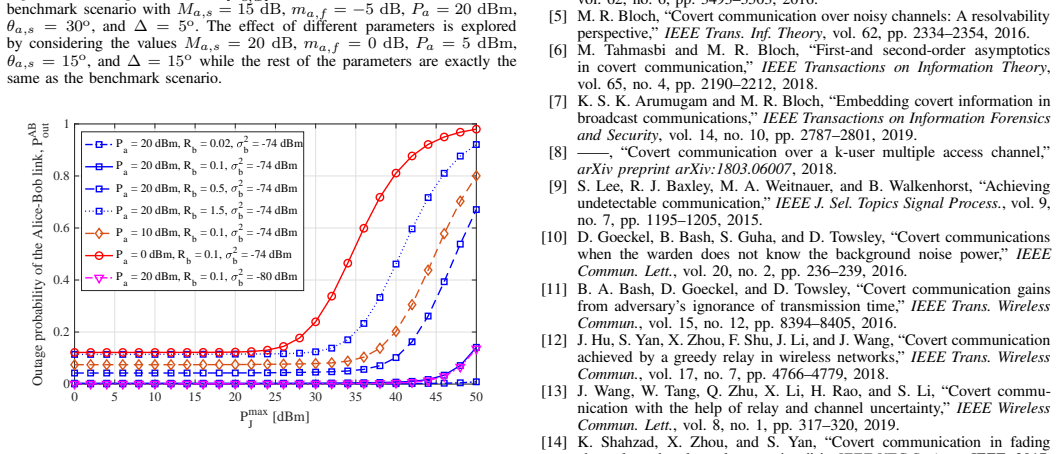
Significance. If the results are interpreted in the right operational setting, the paper provides a useful and fairly tractable framework for jammer-assisted covert communication with directional mmWave beams. The derivations are largely transparent, the channel model is standard, and Theorem 1 is exact and cleanly proved. The numerical behavior in Figures 1 and 2 is consistent with the monotonicity statements. However, two issues materially reduce the significance as stated: the null hypothesis in Section III still has Alice transmitting a jamming beam, so the paper does not actually analyze 'hiding the existence of transmission' as claimed in the abstract; and the closed forms in Theorems 2 and 3 rely on Alzer's approximation used with equality signs, making those results approximate rather than exact. The framework is a legitimate study of jamming-assisted covertness, but the paper's framing and the exactness of its formulas need substantial correction.
major comments (2)
- [Section III, Eqs. (5)–(8); abstract and Section I] The covertness analysis uses a null hypothesis under which Alice is still transmitting. In Eq. (5), T_H0^w = PJ Gaw,s Law |h~_aw,s|^2 + σ_w^2, so under H0 Alice's second array radiates the jamming beam toward Willie. If Willie's task is to detect the existence of any transmission from Alice, as stated in the abstract and in the introduction's definition of covert communication, the correct H0 is T_H0^w = σ_w^2. In that case, for any Pa>0 the H1 energy exceeds the noise power almost surely, and Willie can choose τ slightly above σ_w^2 to obtain PFA=0 and PMD→0 as n→∞, i.e., P*e,w=0. The positive-rate result in Theorems 1–3 therefore establishes covertness of the data beam on top of a known, always-on jamming beam, not covertness of Alice's transmission. This is a legitimate jammer-assisted covertness model, but it is a structural modeling choice that must be stated prominently; as written, the abstract and conclusion go beyond what the model supports.
- [Theorems 2 and 3, Eqs. (16) and (24)] Alzer's lemma is an approximation, not an identity, yet the proofs use it with equality signs. In Eq. (16), step (a) states that Pr(X<x) 'can tightly be approximated' with [1−exp(−η_B x)]^{ν_B}, and the derivation then proceeds with '='; the same occurs in Eq. (24), step (b). Consequently Eqs. (11) and (21) are approximate closed forms, not exact characterizations. The paper should state this explicitly and, if possible, provide a bound on the approximation error. This matters for Proposition 4, which solves E[P*e,w] = 1−ε exactly to obtain the optimal Pmax_J; the equality is only approximate under the current derivation.
minor comments (4)
- [Proposition 4, Section IV-B] The statement 'P*AB_out is defined as (11)' refers to Eq. (11), which is the expression for E[P*e,w] from Theorem 2, not the outage probability. The intended meaning is presumably that P*AB_out is Theorem 3 evaluated at the Pmax_J,opt obtained from E[P*e,w] = 1−ε; this typo should be corrected.
- [Section III-B, Remark 2; Section IV-A] The closed-form results exclude the cases where Willie lies in the main lobe of Alice's first array and where Bob lies in the main lobe of the jamming array; Remark 2 only notes that additional averaging would be needed. This limitation should be stated in the abstract or conclusion, because the claimed superiority over RF is only demonstrated for the side-lobe configuration.
- [Table I and Section V] The effective rates R*_a,b in Table I are in bits per channel use, while the conclusion refers to 'much higher data rates, in bits per second' due to mmWave bandwidth. That extrapolation is not quantified and should be separated from the technical rate results.
- [Throughout] Several subscripted and superscripted symbols, such as g(a,s)_k and b(a,s)_k, are difficult to parse in the typeset equations; a table of notation would improve readability. Figures 1 and 2 also lose subscripts in the legends (e.g., 'a,s= 15o' should be θ_a,s = 15°).
Circularity Check
No circularity found: all claimed results follow from the stated channel model, the uniform PJ assumption, and standard external lemmas; the H0 modeling choice is a scope limitation, not a circular step.
full rationale
The paper's derivation chain is self-contained and does not reduce any claimed result to its own inputs. Willie's detection error (Theorem 1) is computed directly from the two hypotheses in Eqs. (5) and (6), which are consequences of the stated received-signal model (2) and the independent uniform distribution of PJ; the optimal threshold interval and P*e,w then follow by elementary probability. Theorem 2 only averages this P*e,w over the channel fading, beamsteering, and LOS/NLOS states using Alzer's lemma and moment generating functions, with no fitted parameter renamed as a prediction. Theorem 3 derives the Alice-Bob outage probability from the SINR in Eq. (20), again using Alzer's lemma and the MGF of the gamma distribution. Proposition 4 numerically solves the equation E[P*e,w] = 1 - epsilon for Pmax_J, which is an optimization over a model parameter, not a fit to data used to manufacture a result. The only self-citations are [20] as motivational context and [24] for a routine integration technique in the proof of Theorem 2; neither is load-bearing or imported as an unverified uniqueness theorem. The reader's concern about H0 is a legitimate modeling critique: Eq. (5) includes the always-on jamming beam PJ G_aw,s L_aw |h_aw,s|^2, so 'hiding the existence of transmission' refers to the data beam on top of a known jamming beam rather than Alice's complete silence. However, this is a deliberate system-model assumption (stated in Section II-B and Section III), not a case where a conclusion is assumed by definition or where a fitted value is relabeled as a prediction. Therefore the circularity score is 0.
Assumptions & free parameters
assumptions (6)
- standard math Alzer's lemma approximation for the Gamma CDF is valid and tight for integer Nakagami parameters.
- domain assumption The jamming power P_J is uniformly distributed over [0, P_max_J] and is independent across blocks, with Willie knowing only the distribution.
- domain assumption The jamming beam is active in both H0 and H1, so Willie's task is to detect the data beam, not the transmitter's activity.
- domain assumption Millimeter-wave channel model with LOS/NLOS path loss, deterministic blockage probability, sectored-pattern antenna gains with symmetric beamsteering errors, and Nakagami fading.
- standard math Infinite blocklength and the strong law of large numbers make Willie's test statistic equal to the average received power.
- domain assumption The signals x_a and x_J have zero mean and unit power and are independent of the noise and each other.
Cite this review
Pith. "Pith review of Covert Millimeter-Wave Communication via a Dual-Beam Transmitter." pith.science (2026). https://pith.science/paper/RO6ZOZZK
@misc{pith2026190807591,
  author       = {Pith},
  title        = {Pith review of: Covert Millimeter-Wave Communication via a Dual-Beam Transmitter},
  year         = {2026},
  howpublished = {\url{https://pith.science/paper/RO6ZOZZK}},
  note         = {Machine review of arXiv:1908.07591}
}
read the original abstract
In this paper, we investigate covert communication over millimeter-wave (mmWave) frequencies. In particular, a dual-beam mmWave transmitter, comprised of two independent antenna arrays, attempts to reliably communicate to a receiver Bob when hiding the existence of transmission from a warden Willie. In this regard, operating over mmWave bands not only increases the covertness thanks to directional beams, but also increases the transmission data rates given much more available bandwidths and enables ultra-low form factor transceivers due to the lower wavelengths used compared to the conventional radio frequency (RF) counterpart. We assume that the transmitter Alice employs one of its antenna arrays to form a directive beam for transmission to Bob. The other antenna array is used by Alice to generate another beam toward Willie as a jamming signal with its transmit power changing independently from a transmission block to another block. We characterize Willie's detection performance with the optimal detector and the closed-form of its expected value from Alice's perspective. We further derive the closed-form expression for the outage probability of the Alice-Bob link, which enables characterizing the optimal covert rate that can be achieved using the proposed setup. Our results demonstrate the superiority of mmWave covert communication, in terms of covertness and rate, compared to the RF counterpart.
Figures

Reference graph
Works this paper leans on
-
[1]
Limits of reliabl e communi- cation with low probability of detection on AWGN channels,
B. A. Bash, D. Goeckel, and D. Towsley, “Limits of reliabl e communi- cation with low probability of detection on AWGN channels,” IEEE J. Sel. Areas Commun. , vol. 31, no. 9, pp. 1921–1930, 2013
1921
-
[2]
Hiding in formation in noise: fundamental limits of covert wireless communicat ion,
B. A. Bash, D. Goeckel, D. Towsley, and S. Guha, “Hiding in formation in noise: fundamental limits of covert wireless communicat ion,” IEEE Commun. Mag. , vol. 53, no. 12, pp. 26–31, 2015
work page 2015
-
[3]
Reliable deniable com munication: Hiding messages in noise,
P . H. Che, M. Bakshi, and S. Jaggi, “Reliable deniable com munication: Hiding messages in noise,” in IEEE Int. Symp. Inf. Theory (ISIT) , 2013, pp. 2945–2949
work page 2013
-
[4]
Fundamental limits of com- munication with low probability of detection,
L. Wang, G. W. Wornell, and L. Zheng, “Fundamental limits of com- munication with low probability of detection,” IEEE Trans. Inf. Theory , vol. 62, no. 6, pp. 3493–3503, 2016
work page 2016
-
[5]
Covert communication over noisy channels: A resolvability perspective,
M. R. Bloch, “Covert communication over noisy channels: A resolvability perspective,” IEEE Trans. Inf. Theory , vol. 62, pp. 2334–2354, 2016
work page 2016
-
[6]
First-and second-order asy mptotics in covert communication,
M. Tahmasbi and M. R. Bloch, “First-and second-order asy mptotics in covert communication,” IEEE Transactions on Information Theory , vol. 65, no. 4, pp. 2190–2212, 2018
work page 2018
-
[7]
Embedding covert infor mation in broadcast communications,
K. S. K. Arumugam and M. R. Bloch, “Embedding covert infor mation in broadcast communications,” IEEE Transactions on Information F orensics and Security , vol. 14, no. 10, pp. 2787–2801, 2019
work page 2019
-
[8]
Covert Communication over a K-User Multiple Access Channel
——, “Covert communication over a k-user multiple access channel,” arXiv preprint arXiv:1803.06007 , 2018
work page Pith review arXiv 2018
Show all 24 references
-
[9]
Achieving undetectable communication,
S. Lee, R. J. Baxley, M. A. Weitnauer, and B. Walkenhorst, “Achieving undetectable communication,” IEEE J. Sel. Topics Signal Process. , vol. 9, no. 7, pp. 1195–1205, 2015
2015
-
[10]
Covert com munications when the warden does not know the background noise power,
D. Goeckel, B. Bash, S. Guha, and D. Towsley, “Covert com munications when the warden does not know the background noise power,” IEEE Commun. Lett. , vol. 20, no. 2, pp. 236–239, 2016
2016
-
[11]
Covert communic ation gains from adversary’s ignorance of transmission time,
B. A. Bash, D. Goeckel, and D. Towsley, “Covert communic ation gains from adversary’s ignorance of transmission time,” IEEE Trans. Wireless Commun., vol. 15, no. 12, pp. 8394–8405, 2016
2016
-
[12]
Covert c ommunication achieved by a greedy relay in wireless networks,
J. Hu, S. Y an, X. Zhou, F. Shu, J. Li, and J. Wang, “Covert c ommunication achieved by a greedy relay in wireless networks,” IEEE Trans. Wireless Commun., vol. 17, no. 7, pp. 4766–4779, 2018
2018
-
[13]
Covert c ommu- nication with the help of relay and channel uncertainty,
J. Wang, W. Tang, Q. Zhu, X. Li, H. Rao, and S. Li, “Covert c ommu- nication with the help of relay and channel uncertainty,” IEEE Wireless Commun. Lett. , vol. 8, no. 1, pp. 317–320, 2019
2019
-
[14]
Covert communication i n fading channels under channel uncertainty,
K. Shahzad, X. Zhou, and S. Y an, “Covert communication i n fading channels under channel uncertainty,” in IEEE VTC Spring . IEEE, 2017, pp. 1–5
2017
-
[15]
Cove rt commu- nications with a full-duplex receiver over wireless fading channels,
J. Hu, K. Shahzad, S. Y an, X. Zhou, F. Shu, and J. Li, “Cove rt commu- nications with a full-duplex receiver over wireless fading channels,” in IEEE Int. Conf. Commun. (ICC) , 2018, pp. 1–6
2018
-
[16]
Millimeter wave mobile communications for 5G cellular: It will work!
T. S. Rappaport, S. Sun, R. Mayzus, H. Zhao, Y . Azar, K. Wa ng, G. N. Wong, J. K. Schulz, M. Samimi, and F. Gutierrez, “Millimeter wave mobile communications for 5G cellular: It will work!” IEEE access , vol. 1, pp. 335–349, 2013
2013
-
[17]
Modeling and analyzing millimeter wave cellul ar systems,
J. G. Andrews, T. Bai, M. N. Kulkarni, A. Alkhateeb, A. K. Gupta, and R. W. Heath, “Modeling and analyzing millimeter wave cellul ar systems,” IEEE Trans. Commun. , vol. 65, no. 1, pp. 403–430, 2017
2017
-
[18]
Coverage and rate analysis for mi llimeter-wave cellular networks,
T. Bai and R. W. Heath, “Coverage and rate analysis for mi llimeter-wave cellular networks,” IEEE Trans. Wireless Commun. , vol. 14, no. 2, pp. 1100–1114, 2015
2015
-
[19]
Stochastic geometry modeling and analysi s of multi- tier millimeter wave cellular networks,
M. Di Renzo, “Stochastic geometry modeling and analysi s of multi- tier millimeter wave cellular networks,” IEEE Trans. Wireless Commun. , vol. 14, no. 9, pp. 5038–5057, 2015
2015
-
[20]
Channel coding at low capacity,
M. Fereydounian, M. V . Jamali, H. Hassani, and H. Mahdav ifar, “Channel coding at low capacity,” arXiv preprint arXiv:1811.04322 , 2018
2018 arXiv
-
[21]
Covert communication in the presence of an uninformed jammer,
T. V . Sobers, B. A. Bash, S. Guha, D. Towsley, and D. Goeck el, “Covert communication in the presence of an uninformed jammer,” IEEE Trans. Wireless Commun., vol. 16, no. 9, pp. 6193–6206, 2017
2017
-
[22]
I. S. Gradshteyn and I. M. Ryzhik, Table of integrals, series, and products. Academic Press, 2007
2007
-
[23]
On some inequalities for the incomplete Gamm a function,
H. Alzer, “On some inequalities for the incomplete Gamm a function,” Math. Comput. , vol. 66, no. 218, pp. 771–778, 1997
1997
-
[24]
Uplink non-orthogonal multiple access over mixed RF-FSO systems,
M. V . Jamali and H. Mahdavifar, “Uplink non-orthogonal multiple access over mixed RF-FSO systems,” arXiv preprint arXiv:1903.00326 , 2019
1903 arXiv
Reviewed August 14, 2026 · model on record in the stance chip above.
Discussion (0). Continue with ORCID to comment.