REVIEW 2 major objections 6 minor 24 references
Learning to Denoise and Decode: A Novel Residual Neural Network Decoder for Polar Codes
T0 review · 2 major / 6 minor · reviewed 2026-08-14 · deepseek-v4-flash
Pith's one-line read Adding a residual-learning denoiser before a neural decoder improves BER for a short polar code over a plain neural decoder at comparable latency.
desk verdict A genuinely new but small combination—residual denoising plus neural polar decoding—with a real BER gain at N=16, undermined by an unauditable latency comparison that the paper's own motivation rests on. read the letter →
The pith
A machine-rendered reading of the paper's core claim, the machinery that carries it, and where it could break.
The reading
This paper adds a denoiser before the decoder. The denoiser is a small neural network that learns to subtract noise from the received signal. Instead of directly mapping the noisy signal to bits, the network first cleans the signal, and then the decoder reads the cleaned signal. Both parts are trained together using a loss that penalizes both denoising error and bit errors.
The authors tested three neural network types (MLP, CNN, RNN) as the denoiser and decoder on a tiny polar code of length 16 with 8 information bits. The best result, an MLP version, got about 0.2 dB better bit-error rate than a plain NND and came close to SC, while supposedly running over 100 times faster than SC. However, the latency comparison lacks implementation details, and the paper does not test whether a simpler denoiser would work as well.
Extended reading notes
Core claim
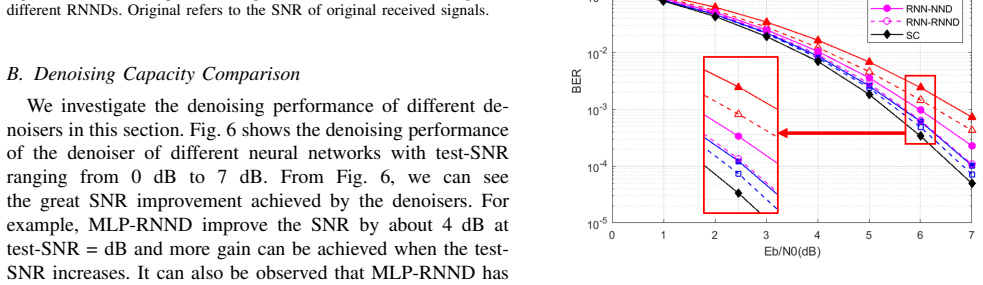
The proposed RNND, which inserts a residual-learning denoiser before the neural decoder and trains both jointly with the multi-task loss L = L_denoise + L_decode (Eq. 6), achieves better BER than the corresponding NND under comparable latency, with MLP-RNND approaching SC performance and claimed to run over 100 times faster than SC (Fig. 8 and Fig. 9).
Load-bearing premise
The computation-time comparison in Section V-D (Fig. 9) assumes that the SC algorithm, NNDs, and RNNDs are implemented and measured under comparable hardware and optimization conditions, but the paper gives no details on platform, software, or whether SC is optimized. If the SC implementation is naive or runs on slower hardware, the claimed >100x speedup of MLP-RNND over SC and the 'comparable latency' between NND and RNND would not be established, undermining the paper's low-latency motivation.
Signed reviews
Editorial analysis
A structured set of objections, weighed in public.
Referee Report
Summary. The paper proposes a residual neural network decoder (RNND) for short polar codes. The RNND inserts a residual-learning denoising module before a neural network decoder and trains both jointly with a multi-task loss L = L_denoise + L_decode (Eq. 6). Using (16,8) polar codes with BPSK over AWGN, the authors compare MLP-, CNN-, and RNN-based RNNDs against their NND counterparts and against successive cancellation (SC). Numerical results show that each RNND improves BER relative to its NND counterpart, with MLP-RNND approaching SC performance, and the paper claims that MLP-RNND runs more than 100 times faster than SC.
Significance. If the reported results hold, this is a modest but useful empirical contribution to neural decoding of short polar codes. The architecture is simple, the comparison across three neural-network families is informative, and the parameter-matched NND baselines are a fair design choice. The paper does not contain mathematical derivations or machine-checked proofs, and the performance claims are based on simulations only; nevertheless, the proposed loss and architecture are concrete and falsifiable, and the reported BER gains are consistent across all three architecture families. The main weakness is that the paper's key motivation, low latency, rests on a computation-time comparison that currently lacks sufficient measurement detail to be verified.
major comments (2)
- [V-D, Fig. 9] The computation-time comparison that underlies the abstract's low-latency claim is not auditable. The manuscript does not report the CPU/GPU model, the software framework, the SC implementation details (language, optimizations, whether a standard or optimized version was used), the batch size, the number of repeated trials, or whether neural-network inference was batched while SC was run serially. As written, the claimed 'more than 100 times faster' figure and the statement that RNNDs run only 'slightly slower' than NNDs cannot be reproduced or verified, and the comparison may not be apples-to-apples. Please document the measurement protocol and provide absolute timings for all decoders on the same platform.
- [V-C, Fig. 8] The BER curves in Fig. 8 appear to be single simulation traces without error bars, confidence intervals, or multiple training seeds. Since the headline gain of MLP-RNND over MLP-NND is about 0.2 dB at BER 10^-4 and the curves are close in some SNR regions, the authors should report the number of test blocks and either error bars or mean plus/minus standard deviation over several independent training runs, so that the reader can assess whether the reported gains are statistically meaningful.
minor comments (6)
- [IV-C] In the sentence 'Since Ldenoise andLdenoise are both continuous and differentiable everywhere', the second loss should be Ldecode; the current text contains a typographical error.
- [IV-D] In the training procedure, 'Leaning rate' should be 'Learning rate'.
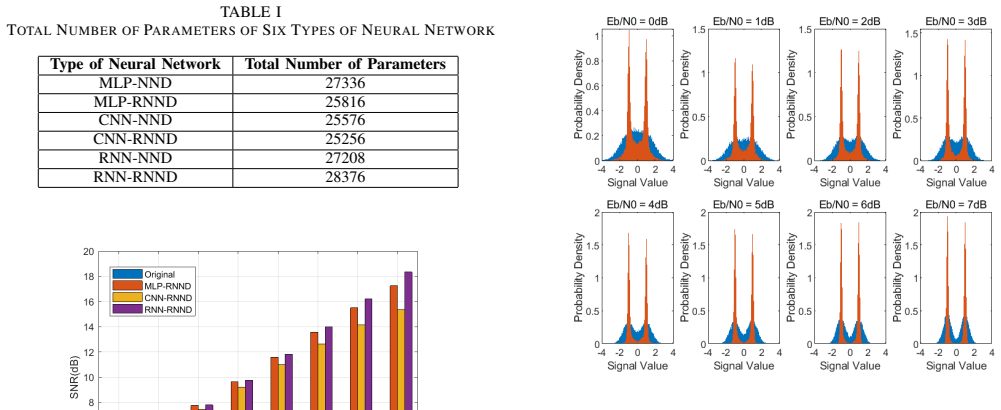
- [V-B] The sentence describing Fig. 6 contains 'test-SNR = dB', which appears to be missing a value; please specify the SNR value and describe how the SNR after denoising is computed.
- [V-D] The statement that 'RNNDs run slightly slower than NNDs' is not quantified; please give the measured inference times so that the reader can judge the magnitude of the difference.
- [VI] The concluding claim that the RNND can be extended to longer code lengths is speculative, because no experiments or training-complexity analysis for longer polar codes are provided; please temper or support this statement.
- [III] There is a typo in 'trainsmitted'; it should be 'transmitted'.
Assumptions & free parameters
free parameters (4)
- train-SNR =
0 dB
- loss weighting (Ldenoise + Ldecode) =
1:1 ratio
- architecture sizes (MLP/CNN/RNN layers and nodes) =
e.g., 3 layers 128-64-32 for MLP
- learning rate, momentum, batch size, epochs =
0.001, 0.99, 64, 216
assumptions (5)
- standard math Polar codes are capacity-achieving for symmetric B-DMCs (Arikan 2009)
- domain assumption A neural network can learn to decode a given code to near-MAP performance for short block lengths
- domain assumption Residual learning can effectively denoise signals
- domain assumption The AWGN channel model with known SNR at test time matches the training distribution except for noise level
- standard math The BPSK mapping s_i = 1 - 2x_i and the polar code generator matrix G_N are correctly implemented
Cite this review
Pith. "Pith review of Learning to Denoise and Decode: A Novel Residual Neural Network Decoder for Polar Codes." pith.science (2026). https://pith.science/paper/ROEG7QTR
@misc{pith2026190800460,
  author       = {Pith},
  title        = {Pith review of: Learning to Denoise and Decode: A Novel Residual Neural Network Decoder for Polar Codes},
  year         = {2026},
  howpublished = {\url{https://pith.science/paper/ROEG7QTR}},
  note         = {Machine review of arXiv:1908.00460}
}
read the original abstract
Polar codes have been adopted as the control channel coding scheme in the fifth generation new radio (5G NR) standard due to its capacity-achievable property. Traditional polar decoding algorithms such as successive cancellation (SC) suffer from high latency problem because of their sequential decoding nature. Neural network decoder (NND) has been proved to be a candidate for polar decoder since it is capable of oneshot decoding and parallel computing. Whereas, the bit-errorrate (BER) performance of NND is still inferior to that of SC algorithm. In this paper, we propose a residual neural network decoder (RNND) for polar codes. Different from previous works which directly use neural network for decoding symbols received from the channel, the proposed RNND introduces a denoising module based on residual learning before NND. The proposed residual learning denoiser is able to remove remarkable amount of noise from received signals. Numerical results show that our proposed RNND outperforms traditional NND with regard to the BER performance under comparable latency.
Figures


Figures from the paper (5 more)



Reference graph
Works this paper leans on
-
[1]
E. Arikan, “Channel polarization: A method for constructing capacity- achieving codes for symmetric binary-input memoryless channels,”IEEE Transactions on Information Theory, vol. 55, no. 7, pp. 3051–3073, July 2009
work page 2009
-
[2]
I. Tal and A. Vardy, “List decoding of polar codes,” IEEE Transactions on Information Theory , vol. 61, no. 5, pp. 2213–2226, May 2015
work page 2015
-
[3]
List successive cancellation decoding of polar codes,
K. Chen, K. Niu, and J. R. Lin, “List successive cancellation decoding of polar codes,” Electronics Letters, vol. 48, no. 9, pp. 500–501, April 2012
work page 2012
-
[4]
Stack decoding of polar codes,
K. Niu and K. Chen, “Stack decoding of polar codes,” Electronics Letters, vol. 48, no. 12, pp. 695 –697, June 2012
work page 2012
-
[5]
Crc-aided decoding of polar codes,
——, “Crc-aided decoding of polar codes,” IEEE Communications Letters, vol. 16, no. 10, pp. 1668–1671, October 2012
work page 2012
-
[6]
Deep residual learning for image recognition,
K. He, X. Zhang, S. Ren, and J. Sun, “Deep residual learning for image recognition,” in 2016 IEEE Conference on Computer Vision and Pattern Recognition (CVPR), June 2016, pp. 770–778
2016
-
[7]
Sequence to Sequence Learning with Neural Networks,
I. Sutskever, O. Vinyals, and Q. V . Le, “Sequence to Sequence Learning with Neural Networks,” arXiv e-prints, p. arXiv:1409.3215, Sep 2014
arXiv 2014
-
[8]
Deepdriving: Learning affordance for direct perception in autonomous driving,
C. Chen, A. Seff, A. Kornhauser, and J. Xiao, “Deepdriving: Learning affordance for direct perception in autonomous driving,” in 2015 IEEE International Conference on Computer Vision (ICCV) , Dec 2015, pp. 2722–2730
work page 2015
Show all 24 references
-
[9]
Automatic differentiation in PyTorch,
A. Paszke, S. Gross, S. Chintala, G. Chanan, E. Yang, Z. DeVito, Z. Lin, A. Desmaison, L. Antiga, and A. Lerer, “Automatic differentiation in PyTorch,” in NIPS Autodiff Workshop, 2017
2017
-
[10]
On deep learning- based channel decoding,
T. Gruber, S. Cammerer, J. Hoydis, and S. t. Brink, “On deep learning- based channel decoding,” in 2017 51st Annual Conference on Informa- tion Sciences and Systems (CISS) , March 2017, pp. 1–6
2017
-
[11]
Decoding of polar code by using deep feed-forward neural networks,
J. Seo, J. Lee, and K. Kim, “Decoding of polar code by using deep feed-forward neural networks,” in 2018 International Conference on Computing, Networking and Communications (ICNC) , March 2018, pp. 238–242
2018
-
[12]
Activation functions of deep neural networks for polar decoding applications,
——, “Activation functions of deep neural networks for polar decoding applications,” in 2017 IEEE 28th Annual International Symposium on Personal, Indoor, and Mobile Radio Communications (PIMRC) , Oct 2017, pp. 1–5
2017
-
[13]
Deep learning for polar codes over flat fading channels,
A. Irawan, G. Witjaksono, and W. K. Wibowo, “Deep learning for polar codes over flat fading channels,” in 2019 International Conference on Artificial Intelligence in Information and Communication (ICAIIC) , Feb 2019, pp. 488–491
2019
-
[14]
Performance evaluation of channel decoding with deep neural networks,
W. Lyu, Z. Zhang, C. Jiao, K. Qin, and H. Zhang, “Performance evaluation of channel decoding with deep neural networks,” in 2018 IEEE International Conference on Communications (ICC) , May 2018, pp. 1–6
2018
-
[15]
A unified deep learning based polar-ldpc decoder for 5g communication systems,
Y . Wang, Z. Zhang, S. Zhang, S. Cao, and S. Xu, “A unified deep learning based polar-ldpc decoder for 5g communication systems,” in 2018 10th International Conference on Wireless Communications and Signal Processing (WCSP) , Oct 2018, pp. 1–6
2018
-
[16]
Beyond a gaussian denoiser: Residual learning of deep cnn for image denoising,
K. Zhang, W. Zuo, Y . Chen, D. Meng, and L. Zhang, “Beyond a gaussian denoiser: Residual learning of deep cnn for image denoising,” IEEE Transactions on Image Processing , vol. 26, no. 7, pp. 3142–3155, July 2017
2017
-
[17]
On the difficulty of training recurrent neural networks,
R. Pascanu, T. Mikolov, and Y . Bengio, “On the difficulty of training recurrent neural networks,” in International conference on machine learning, 2013, pp. 1310–1318
2013
-
[18]
Long short-term memory,
J. Schmidhuber and S. Hochreiter, “Long short-term memory,” Neural Computing, vol. 9, no. 8, pp. 1735–1780, 1997
1997
-
[19]
Gated feedback recurrent neural networks,
J. Chung, C. Gulcehre, K. Cho, and Y . Bengio, “Gated feedback recurrent neural networks,” in International Conference on Machine Learning, 2015, pp. 2067–2075
2015
-
[20]
Deep residual learning for image recognition,
K. He, X. Zhang, S. Ren, and J. Sun, “Deep residual learning for image recognition,” in Proceedings of the IEEE conference on computer vision and pattern recognition , 2016, pp. 770–778
2016
-
[21]
Large-scale machine learning with stochastic gradient de- scent,
L. Bottou, “Large-scale machine learning with stochastic gradient de- scent,” in Proceedings of COMPSTAT’2010. Springer, 2010, pp. 177– 186
2010
-
[22]
Adam: A method for stochastic optimization,
D. P. Kingma and J. Ba, “Adam: A method for stochastic optimization,” arXiv preprint arXiv:1412.6980 , 2014
2014 arXiv
-
[23]
An artificial neural net viterbi decoder,
Xiao-An Wang and S. B. Wicker, “An artificial neural net viterbi decoder,” IEEE Transactions on Communications , vol. 44, no. 2, pp. 165–171, Feb 1996
1996
-
[24]
A theoretical analysis of feature pooling in visual recognition,
Y .-L. Boureau, J. Ponce, and Y . LeCun, “A theoretical analysis of feature pooling in visual recognition,” in Proceedings of the 27th international conference on machine learning (ICML-10) , 2010, pp. 111–118
2010
Reviewed August 14, 2026 · model on record in the stance chip above.
Discussion (0). Continue with ORCID to comment.