REVIEW 3 major objections 4 minor 103 references
Constrained Hebbian Learning Supports Efficient Representational Allocation under Structural Constraints
T0 review · 3 major / 4 minor · reviewed 2026-08-01 · deepseek-v4-flash
Pith's one-line read The paper claims that a strictly local, excitatory Hebbian learning rule, evaluated as a synaptic resource-allocation mechanism, produces representations with lower task-information cost than sparse backpropagation and target propagation at
desk verdict New empirical comparison with a plausible confound in the CTI metric; the resource-allocation story is provisional until bound-tightness is checked, but the paper deserves a serious referee. read the letter →
The pith
A machine-rendered reading of the paper's core claim, the machinery that carries it, and where it could break.
The reading
What carries the argument
The carrying mechanism is the constrained Hebbian update of Eq. (5), an Oja-style neural-PCA rule whose subtractive term −η z_j Σ_k z_k w_ik decorrelates postsynaptic activity. Applied with nonnegative weights, min–max rescaling of activations to [0,1], and per-layer z-score normalization, it yields sparse, Dale's-law-compliant, decorrelated hidden codes. The post hoc Variational Information Bottleneck (VIB) module — a diagonal-Gaussian stochastic encoder trained with a KL-to-prior compression penalty and a linear decoder — converts each frozen representation into a latent Z; CTI = I(Z;H)/I(Z;Y), using the KL proxy for I(Z;H) and a variational lower bound for I(Z;Y), turns that code into a s
What would settle it
Take the three frozen representation sets (Hebbian, sparse BP, DDTP) for one dataset and architecture, and compute I(Z;H) not with the KL-to-N(0,I) proxy but with the aggregated-posterior KL or a nonparametric estimator (e.g., k-NN) on samples from the VIB encoder, then recompute CTI at matched β and accuracy. If the Hebbian CTI advantage over BP/DDTP vanishes or reverses, the paper's resource-allocation conclusion is an estimation artifact.
Extended reading notes
Core claim
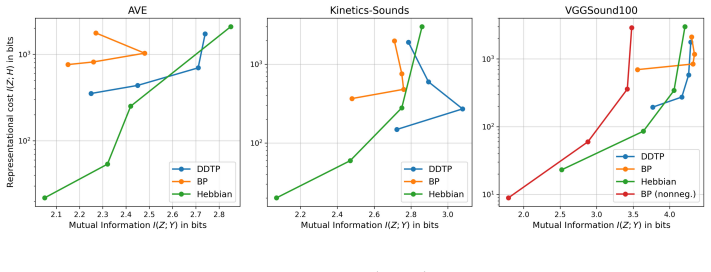
Under matched sparsity (~10% connectivity), nonnegativity, and identical MLP capacity, a local excitatory Hebbian update yields post hoc VIB codes with Task-Information Cost (CTI) roughly 9–23 across datasets and architectures, versus 25–344 for sparse BP and 46–210 for DDTP: as much task-relevant information, far less retained input information. Paired log-ratio tests are significant after Holm correction; accuracy is close but not uniformly higher. The authors frame this as a cost-performance trade-off, note that shallow nonnegative BP matches the low-CTI regime but fails deep, and report a ten-hidden-layer Hebbian control that does not stabilize. CTI is explicitly a comparative proxy, not
Load-bearing premise
The load-bearing premise, spelled out in Secs. 3.2 and 3.6.1, is that CTI = I(Z;H)/I(Z;Y) — an upper-bound KL proxy divided by a variational lower bound — is a valid and comparable measure of representational cost across learning rules; if the Hebbian activations' zero-centered bounded shape makes the Gaussian VIB fit artificially better, the reported CTI advantage is a measurement artifact rather than a property of the rule.
Editorial extensions
If this is right
- A purely local Hebbian rule operating under cortical-like sparsity can keep task-relevant information without global error signals, which would mean brains can assemble efficient associative codes without backpropagation.
- Representational cost can be compared across learning rules independently of raw accuracy: two models with the same Top-1 accuracy can differ by 4–5× in CTI, so accuracy alone is insufficient to evaluate biologically constrained learners.
- Hebbian-trained representations tolerate post hoc pruning down to ~10% connectivity with little accuracy loss, while BP and DDTP degrade earlier, implying the learned connectivity is already close to its functional support.
- Bimodal audiovisual inputs can raise accuracy without proportionally raising CTI, suggesting that cross-modal integration can be representationally inexpensive under this proxy.
Reading between the lines
- The Gaussian VIB posterior may fit the Hebbian activations' zero-centered, bounded [0,1] shape better than it fits BP/DDTP activations, so the CTI gap could shrink or vanish under a nonparametric estimator of I(Z;H); checking this is the most direct test of the resource-allocation interpretation.
- If CTI tracks synaptic maintenance cost as the paper's thermodynamic analogy suggests, Hebbian-trained networks should show measurably lower energy use than BP/DDTP at matched sparsity on neuromorphic hardware; this is a concrete hardware prediction the paper does not test.
- The ten-hidden-layer failure suggests the bottleneck readout, not the Hebbian rule, may be removing task-relevant information at depth; adding an explicit inhibitory population (≈20%) or feedback connections, as the paper sketches, could recover depth while preserving low CTI.
- Because the inputs are fixed MAE embeddings, the result is about downstream associative plasticity, not end-to-end feature discovery; applying the same assay to raw audiovisual streams would test whether the resource-allocation advantage survives upstream learning.
Editorial analysis
A structured set of objections, weighed in public.
Referee Report
Summary. The paper tests whether a strictly local, excitatory, competitive Hebbian rule (a variant of Oja's PCA rule with nonnegativity and normalization) allocates representational resources more efficiently than backpropagation (BP) and Dense Difference Target Propagation (DDTP) under matched sparsity and architectural constraints. Using fixed VideoMAE/AudioMAE embeddings from AVE, Kinetics-Sounds, and VGGSound100, the authors train shallow and deep MLPs with each rule, freeze the encoder, and fit a post hoc Variational Information Bottleneck (VIB) module. The central metric is Task-Information Cost, CTI = I(Z;H)/I(Z;Y), estimated from VIB bounds. The main empirical claim is that Hebbian networks achieve lower CTI than sparse BP and DDTP in compressed comparisons, with accuracy remaining comparable in several settings, and that this supports interpreting Hebbian plasticity as a resource-allocation mechanism rather than a general accuracy-maximizing strategy.
Significance. If the central claim holds, the paper would provide a valuable demonstration that a biologically local Hebbian rule can shift the information-efficiency trade-off in a controlled assay, with implications for synaptic resource allocation theories. Strengths include the two-stage protocol that separates representation learning from the information-theoretic readout, matched sparsity and architecture across rules, paired seed-level statistical testing with Holm correction, and a set of ablations (MNIST, GHA, classical Oja, PCA-to-readout, depth-scaling). The manuscript is also unusually candid about its limitations, including the instability of deep nonnegative BP and the 10-layer Hebbian control. However, the central quantitative claim rests on a CTI estimate whose numerator and denominator are variational bounds of opposite direction; if bound tightness differs systematically across learning rules, the reported Hebbian advantage could be a measurement artifact rather than a property of the learning rule. The significance is therefore contingent on a matched-estimator or bound-tightness check.
major comments (3)
- [§3.2 and §3.6.1, Eq. (9)] CTI is defined as I(Z;H)/I(Z;Y), but the implementation estimates I(Z;H) by E_h KL[q(z|h)||r(z)] = I(Z;H) + KL[q(z)||r(z)] (Eq. 4, an upper bound) and I(Z;Y) by a variational lower bound. The ratio of an upper bound to a lower bound is not a bound on the true ratio, and the two gaps can differ across learning rules. The paper's own preprocessing creates a concrete mechanism: Hebbian and nonnegative-BP activations are Z-score normalized and min-max rescaled to [0,1] (Secs. 3.1, 3.5), while BP/DDTP use tanh activations without rescaling. Since the VIB encoder is a single linear layer into diagonal-Gaussian parameters, the scale and distribution of h directly affect how tightly a diagonal Gaussian posterior can fit. Thus the large Hebbian advantage in Table 1 (geometric CTI ratios 5.37 and 6.73) may reflect smaller bound gaps for Hebbian representations rather than genuinely lower informati
- [§4.1.1, Fig. 2 and Table 1] The main tabular comparison is selected at β=10^-2, and the text states that higher-β operating points for DDTP and BP were excluded because they show a rapid decline in performance. Since CTI generally decreases as β increases, excluding the higher-β points of the reference methods removes exactly the operating points where BP/DDTP might achieve lower CTI. To support the claim that Hebbian learning 'achieves lower CTI than sparse BP and DDTP,' the authors should report complete β trajectories and compare operating points on a comparable basis (e.g., matched I(Z;Y) or matched Top-1 accuracy), not only at a fixed β chosen post hoc. Without this, the reported advantage may be an artifact of the selected operating point.
- [§3.6.1, statistical analysis] The paired Wilcoxon analysis (N=30, pHolm=3.73e-9) is correctly applied to log-transformed CTI ratios and supports the claim that the Table 1 values differ in the matched conditions. However, the analysis inherits the validity of the CTI estimator. If the bound-tightness concern in the first major comment is not addressed, the statistical test only shows that the estimated CTI values differ, not that the true information costs differ. The authors should either defend the comparability of the bounds more rigorously or report the statistical test on a corrected estimator. This is not a call to remove the statistics, but to ensure the quantity being tested is the quantity of scientific interest.
minor comments (4)
- [§3.1, Eq. (5)] The activation function φ(a_j) is defined as a min-max rescaling over 'the corresponding hidden layer,' but it is not stated whether the min/max are computed per batch, per dataset, or over a running statistic. Since the VIB input distribution depends on this, please clarify the exact normalization procedure in the main text.
- [Table 1] The row 'BP (nonneg.) Deep*' contains only em-dashes, and the footnote says dense connectivity only for the first BP row. This is confusing. If deep nonnegative BP was not trained on AVE/Kinetics-Sounds and only a single run exists on VGGSound100, state this explicitly in a table note rather than using an empty row.
- [§4.1.4, Table 4] The 10-hidden-layer depth-scaling control reports an approximate Top-1 range of 7–10% with no multi-seed estimate. Since this is interpreted as a limitation, it would be helpful to state the chance level for the 100-class VGGSound100 split (1%) so readers can assess how close to chance that range is.
- [Global] There are several typographical issues: 'T raining Algorithm' in Section 3.5.1, 'A VE' with a space throughout, and inconsistent use of 'nonneg.' vs. 'nonnegativity-constrained' in tables. These do not affect the science but should be cleaned up.
Circularity Check
No load-bearing circularity; main derivation is empirically self-contained, with minor self-citations and an estimator-comparability caveat.
full rationale
The central claim—that Hebbian representations occupy a lower-CTI regime than sparse BP and DDTP—is an empirical comparison, not a derivation that reduces to its inputs. Hebbian weights are learned in Phase 1 from Eq. (5) without access to the VIB readout; CTI is then measured post hoc (Sec. 3.2, Eq. (6); Sec. 3.6.1, Eq. (9)). The rule is specified in the paper (Eq. (5), Algorithm 1), so citations [22,23] to the authors' earlier work are provenance rather than load-bearing evidence. External controls (MNIST, PCA-to-readout, nonnegativity-constrained BP, ablation without normalization/rescaling) provide independent checks. The main caveat is not circularity: CTI is a ratio of a variational upper bound for I(Z;H) to a variational lower bound for I(Z;Y), so cross-rule differences in bound tightness—possibly tied to the [0,1]/Z-score preprocessing used only for nonnegative networks—could bias the comparison. This is a measurement-validity risk requiring a matched-estimator check, but it does not make any equation equivalent to another by construction. Minor self-citations exist but are not used to force the conclusion, so the score is low.
Assumptions & free parameters
free parameters (5)
- β (VIB Lagrange multiplier) =
10^-2 (main comparison); swept as 0, 10^-3, 10^-2, 10^-1
- Per-rule learning rates =
η=1e-3 BP, 5e-5 Hebbian, 1e-2 DDTP
- Latent dimension K =
256
- Sparsity target =
~90%
- VIB scale offset =
5.0 in softplus
assumptions (6)
- standard math Oja's rule converges to principal components when inputs are mean-centered.
- domain assumption The expected KL to the prior approximates I(Z;H) up to KL(q(z)||r(z)).
- domain assumption The variational lower bound H(Y) - E[-log q(y|z)] approximates I(Z;Y).
- domain assumption Reduced representational complexity (lower entropy/information) maps to reduced metabolic cost.
- domain assumption Fixed VideoMAE/AudioMAE embeddings stand in for fixed early sensory processing.
- ad hoc to paper Normalization and activation rescaling do not confound the CTI comparison.
Cite this review
Pith. "Pith review of Constrained Hebbian Learning Supports Efficient Representational Allocation under Structural Constraints." pith.science (2026). https://pith.science/paper/ROKGMIR6
@misc{pith2026260716027,
  author       = {Pith},
  title        = {Pith review of: Constrained Hebbian Learning Supports Efficient Representational Allocation under Structural Constraints},
  year         = {2026},
  howpublished = {\url{https://pith.science/paper/ROKGMIR6}},
  note         = {Machine review of arXiv:2607.16027}
}
read the original abstract
Introduction: Biological systems face anatomical and metabolic constraints, including costly synaptic maintenance and limited connectivity. These constraints favor neural codes that compress behaviorally relevant information into low-redundancy patterns. We test whether an excitatory competitive Hebbian rule can support synaptic resource allocation under such constraints and whether the resulting representations occupy a more favorable cost-performance regime than reference learning rules. Methods: Representational cost is quantified using mutual-information-based measures derived from the Variational Information Bottleneck. Experiments use fixed audiovisual embeddings from three audiovisual benchmarks (AVE, Kinetics-Sounds, VGGSound100) to isolate downstream associative plasticity. Hebbian learning is compared with Dense Difference Target Propagation (DDTP) and backpropagation (BP) under matched sparsity and architectural constraints. Results: Hebbian learning achieves lower task-information cost (CTI) than sparse BP and DDTP in the main compressed comparisons, while reaching CTI values comparable to shallow BP with nonnegative weights. Rather than uniformly improving classification performance, Hebbian learning shifts the trade-off between task-relevant information and representational cost, yielding lower CTI at comparable functional performance in several settings. Discussion: The results indicate a cost-performance trade-off rather than uniform accuracy gains. For a given level of task-relevant information, Hebbian representations retain less input information while preserving functional performance, although accuracy is slightly reduced on some datasets. These findings support interpreting Hebbian learning as a mechanism for synaptic resource allocation rather than as a general strategy for maximizing audiovisual classification accuracy.
Figures


Reference graph
Works this paper leans on
-
[1]
Information and Effi- ciency in the Nervous System–A Synthesis,
B. Sengupta, M. Stemmler, and K. J. Friston, “Information and Effi- ciency in the Nervous System–A Synthesis,”PLoS Comput. Biol., vol. 9, p. e1003157, Jul. 2013, doi: 10.1371/journal.pcbi.1003157
-
[2]
Structural Plasticity, Effectual Connectivity and Memory in Cortex,
A. Knoblauch and F. T. Sommer, “Structural Plasticity, Effectual Connectivity and Memory in Cortex,”Front. Neuroanat., vol. 10, p. 63, 2016, doi: 10.3389/fnana.2016.00063. Available:https://www. frontiersin.org/articles/10.3389/fnana.2016.00063/full
arXiv 2016
-
[3]
An Energy Budget for Signaling in the Grey Matter of the Brain,
D. Attwell and S. Laughlin, “An Energy Budget for Signaling in the Grey Matter of the Brain,”J. Cereb. Blood Flow Metab., vol. 21, pp. 1133–1145, Oct. 2001, doi: 10.1097/00004647-200110000-00001
-
[4]
The Cost of Cortical Computation,
P. Lennie, “The Cost of Cortical Computation,”Curr. Biol., vol. 13, pp. 493–497, Apr. 2003, doi: 10.1016/S0960-9822(03)00135-0
-
[5]
R. B. Buxton, “Interpreting Oxygenation-Based Neuroimaging Sig- nals: The Importance and the Challenge of Understanding Brain Oxygen Metabolism,”Front. Neuroenergetics, vol. 2, p. 8, 2010, doi: 10.3389/fnene.2010.00008
arXiv 2010
-
[6]
R. B. Buxton, “The Thermodynamics of Thinking: Connections Be- tween Neural Activity, Energy Metabolism and Blood Flow,”Phi- los. Trans. R. Soc. B, vol. 376, no. 1815, p. 20190624, 2021, doi: 10.1098/rstb.2019.0624
arXiv 2021
-
[7]
Receptive Fields and Functional Ar- chitecture of Monkey Striate Cortex,
D. H. Hubel and T. N. Wiesel, “Receptive Fields and Functional Ar- chitecture of Monkey Striate Cortex,”J. Physiol., vol. 195, no. 1, pp. 215–243, 1968, doi: 10.1113/jphysiol.1968.sp008455
-
[8]
Edge Co-Occurrence in Natural Images Predicts Contour Group- ing Performance,
W. S. Geisler, J. S. Perry, B. J. Super, and D. P. Gallogly, “Edge Co-Occurrence in Natural Images Predicts Contour Group- ing Performance,”Vis. Res., vol. 41, no. 6, pp. 711–724, 2001, doi: 10.1016/S0042-6989(00)00263-2. 34
Show all 103 references
-
[10]
Emergence of Simple-Cell Recep- tive Field Properties by Learning a Sparse Code for Natural Images,
B. A. Olshausen and D. J. Field, “Emergence of Simple-Cell Recep- tive Field Properties by Learning a Sparse Code for Natural Images,” Nature, vol. 381, pp. 607–609, 1996, doi: 10.1038/381607a0
1996 doi
-
[11]
Memory Capacities for Synaptic and Structural Plasticity,
A. Knoblauch, G. Palm, and F. T. Sommer, “Memory Capacities for Synaptic and Structural Plasticity,”Neural Comput., vol. 22, no. 2, pp. 289–341, 2010, doi: 10.1162/neco.2009.08-07-588
2010 doi
-
[12]
Die Thermodynamik chemischer Vorg¨ ange,
H. von Helmholtz, “Die Thermodynamik chemischer Vorg¨ ange,” inSitzungsberichte der K¨ oniglich Preußischen Akademie der Wis- senschaften zu Berlin, pp. 22–39, 1882
-
[13]
Energy Efficiency and Coding of Neu- ral Network,
S. Li, C. Yan, and Y. Liu, “Energy Efficiency and Coding of Neu- ral Network,”Front. Neurosci., vol. 16, p. 1089373, Jan. 2023, doi: 10.3389/fnins.2022.1089373
2023
-
[14]
The Free-Energy Principle: A Unified Brain The- ory?,
K. J. Friston, “The Free-Energy Principle: A Unified Brain The- ory?,”Nat. Rev. Neurosci., vol. 11, no. 2, pp. 127–138, 2010, doi: 10.1038/nrn2787
2010 doi
-
[15]
A Free Energy Principle for Biological Sys- tems,
K. J. Friston, “A Free Energy Principle for Biological Sys- tems,”Entropy, vol. 14, no. 11, pp. 2100–2121, 2012, doi: 10.3390/e14112100. Available:https://www.ncbi.nlm.nih.gov/ pmc/articles/PMC3510653/
2012 doi
-
[16]
Deep Varia- tional Information Bottleneck,
A. A. Alemi, I. Fischer, J. V. Dillon, and K. Murphy, “Deep Varia- tional Information Bottleneck,” inProc. Int. Conf. Learn. Represent. (ICLR), OpenReview.net, 2017. Available:https://openreview. net/forum?id=HyxQzBceg
2017
-
[17]
Impact of Structural Plasticity on Memory Formation and Decline,
A. Knoblauch, “Impact of Structural Plasticity on Memory Formation and Decline,” inRewiring the Brain: A Computational Approach to Structural Plasticity in the Adult Brain, A. van Ooyen and M. Butz, Eds. Elsevier/Academic Press, 2017, pp. 361–386, doi: 10.1016/B978- 0-12-80378...
2017 doi
-
[18]
The Lottery Ticket Hypothesis: Find- ing Sparse, Trainable Neural Networks,
J. Frankle and M. Carbin, “The Lottery Ticket Hypothesis: Find- ing Sparse, Trainable Neural Networks,” inProc. Int. Conf. Learn. Represent. (ICLR), 2019. Available:https://arxiv.org/abs/1803. 03635. 35
2019
-
[19]
Provable Benefits of Overparameterization in Model Compression: From Double Descent to Pruning Neural Networks,
X. Chang, Y. Li, S. Oymak, and C. Thrampoulidis, “Provable Benefits of Overparameterization in Model Compression: From Double Descent to Pruning Neural Networks,”Proc. AAAI Conf. Artif. Intell., vol. 35, pp. 6974–6983, May 2021, doi: 10.1609/aaai.v35i8.16859
2021 doi
-
[20]
Learning Both Weights and Connections for Efficient Neural Networks,
S. Han, J. Pool, J. Tran, and W. Dally, “Learning Both Weights and Connections for Efficient Neural Networks,” inAdv. Neural Inf. Pro- cess. Syst., vol. 28, 2015
2015
-
[21]
Pruning Filters for Efficient ConvNets,
H. Li, A. Kadav, I. Durdanovic, H. Samet, and H. P. Graf, “Pruning Filters for Efficient ConvNets,” inProc. Int. Conf. Learn. Represent. (ICLR), 2017. Available:https://arxiv.org/abs/1608.08710
2017 arXiv
-
[22]
Guiding Sparse Neu- ral Networks with Neurobiological Principles to Elicit Biologically Plausible Representations,
P. Inoue, F. R¨ ohrbein, and A. Knoblauch, “Guiding Sparse Neu- ral Networks with Neurobiological Principles to Elicit Biologically Plausible Representations,” arXiv preprint arXiv:2603.03234, 2026, doi: 10.48550/arXiv.2603.03234. Available:https://arxiv.org/ abs/2603.03234
2026 doi
-
[23]
Energy-Efficient Informa- tion Representation in MNIST Classification Using Biologically In- spired Learning,
P. Inoue, F. R¨ ohrbein, and A. Knoblauch, “Energy-Efficient Informa- tion Representation in MNIST Classification Using Biologically In- spired Learning,” inProceedings of the 10th bwHPC Symposium, M. Janczyk, D. von Suchodoletz, B. Wiebelt, and M. Frank, Eds. KIT Scientific P...
2026
-
[24]
Weight Perturbation and Competitive Hebbian Plasticity for Training Sparse Excitatory Neural Networks,
P. Stricker, F. R¨ ohrbein, and A. Knoblauch, “Weight Perturbation and Competitive Hebbian Plasticity for Training Sparse Excitatory Neural Networks,” inProc. IEEE Int. Joint Conf. Neural Netw. (IJCNN), Yokohama, Japan, 2024, doi: 10.1109/IJCNN60899.2024.10650478
2024
-
[25]
Solving the Problem of Negative Synaptic Weights in Cortical Models,
C. Parisien, C. Anderson, and C. Eliasmith, “Solving the Problem of Negative Synaptic Weights in Cortical Models,”Neural Comput., vol. 20, pp. 1473–1494, Jun. 2008, doi: 10.1162/neco.2008.07-06-295
2008 doi
-
[26]
A Theoretical Framework for Target Propagation,
A. Meulemans, F. Carzaniga, J. Suykens, J. Sacramento, and B. F. Grewe, “A Theoretical Framework for Target Propagation,” inAdv. Neural Inf. Process. Syst., vol. 33, pp. 20024–20036, 2020. Available: https://proceedings.neurips.cc/paper_files/paper/2020/ file/e7a425c6ece20cbc9...
2020
-
[27]
Audio-Visual Event Localization in Unconstrained Videos,
Y. Tian, J. Shi, B. Li, Z. Duan, and C. Xu, “Audio-Visual Event Localization in Unconstrained Videos,” inProc. Eur. Conf. Comput. Vis. (ECCV), pp. 252–268, 2018, doi: 10.1007/978-3-030-01216-8 16
2018 doi
-
[28]
Look, Listen and Learn,
R. Arandjelovi´ c and A. Zisserman, “Look, Listen and Learn,” in Proc. IEEE Int. Conf. Comput. Vis. (ICCV), pp. 609–617, 2017, doi: 10.1109/ICCV.2017.73. 36
2017 doi
-
[29]
VGGSound: A Large-Scale Audio-Visual Dataset,
H. Chen, W. Xie, A. Vedaldi, and A. Zisserman, “VGGSound: A Large-Scale Audio-Visual Dataset,” inProc. IEEE Int. Conf. Acoust., Speech Signal Process. (ICASSP), pp. 721–725, May 2020, doi: 10.1109/ICASSP40776.2020.9053174
2020
-
[30]
Metabolic Cost as a Unifying Principle Governing Neuronal Biophysics,
A. Hasenstaub, S. Otte, E. Callaway, and T. J. Sejnowski, “Metabolic Cost as a Unifying Principle Governing Neuronal Biophysics,”Proc. Natl. Acad. Sci. USA, vol. 107, no. 27, pp. 12329–12334, 2010, doi: 10.1073/pnas.0914886107. Available:https://www.pnas.org/doi/ abs/10.1073/p...
2010 doi
-
[31]
The Information Bottle- neck Method,
N. Tishby, F. C. Pereira, and W. Bialek, “The Information Bottle- neck Method,” inProc. 37th Annu. Allerton Conf. Commun., Control Comput., pp. 368–377, 1999. Available:https://arxiv.org/abs/ physics/0004057
1999 arXiv
-
[32]
Neural Networks, Principal Components and Subspaces,
E. Oja, “Neural Networks, Principal Components and Subspaces,” Int. J. Neural Syst., vol. 1, no. 1, pp. 61–68, 1989, doi: 10.1142/S0129065789000475
1989 doi
-
[33]
D. O. Hebb,The Organization of Behavior: A Neuropsychological The- ory. New York, NY, USA: John Wiley & Sons, 1949
1949
-
[34]
Learning in Non-Linear Constrained Hebbian Networks,
E. Oja, “Learning in Non-Linear Constrained Hebbian Networks,” in Proc. ICANN’91, pp. 385–390, 1991
1991
-
[35]
Principal Component Analysis Learning Algorithms: A Neurobiological Anal- ysis,
K. J. Friston, C. D. Frith, and R. S. J. Frackowiak, “Principal Component Analysis Learning Algorithms: A Neurobiological Anal- ysis,”Proc. Biol. Sci., vol. 254, no. 1339, pp. 47–54, 1993, doi: 10.1098/rspb.1993.0125
1993
-
[36]
H. S. Lopez, B. Burger, R. Dickstein, N. L. Desmond, and W. B. Levy, “Associative Synaptic Potentiation and Depression: Quantification of Dissociable Modifications in the Hippocampal Dentate Gyrus Favors a Particular Class of Synaptic Modification Equations,”Synapse, vol. 5, n...
1990 doi
-
[37]
Synaptic Scaling—An Artificial Neu- ral Network Regularization Inspired by Nature,
M. Hofmann and P. M¨ ader, “Synaptic Scaling—An Artificial Neu- ral Network Regularization Inspired by Nature,”IEEE Trans. Neu- ral Netw. Learn. Syst., vol. 33, no. 7, pp. 3094–3108, 2022, doi: 10.1109/TNNLS.2021.3050422
2022
-
[38]
Auto-Encoding Variational Bayes,
D. P. Kingma and M. Welling, “Auto-Encoding Variational Bayes,” in Proc. Int. Conf. Learn. Represent. (ICLR), 2014. Available:https: //arxiv.org/abs/1312.6114. 37
2014 arXiv
-
[39]
The Kinetics Human Action Video Dataset,
W. Kay, J. Carreira, K. Simonyan, B. Zhang, C. Hillier, S. Vijaya- narasimhan, F. Viola, T. Green, T. Back, P. Natsev, M. Suleyman, and A. Zisserman, “The Kinetics Human Action Video Dataset,” arXiv preprint arXiv:1705.06950, 2017, doi: 10.48550/arXiv.1705.06950
-
[40]
Audio-Visual Class- Incremental Learning,
W. Pian, S. Mo, Y. Guo, and Y. Tian, “Audio-Visual Class- Incremental Learning,” inProc. IEEE/CVF Int. Conf. Comput. Vis. (ICCV), Oct. 2023, doi: 10.1109/ICCV51070.2023.00717
2023
-
[41]
VideoMAE: Masked Au- toencoders Are Data-Efficient Learners for Self-Supervised Video Pre- Training,
Z. Tong, Y. Song, J. Wang, and L. Wang, “VideoMAE: Masked Au- toencoders Are Data-Efficient Learners for Self-Supervised Video Pre- Training,” inAdv. Neural Inf. Process. Syst., vol. 35, 2022. Available: https://proceedings.neurips.cc/paper_files/paper/2022/ file/416f9cb327612...
2022
-
[42]
Masked Autoencoders That Listen,
P.-Y. Huang, H. Xu, J. Li, A. Baevski, M. Auli, W. Galuba, F. Metze, and C. Feichtenhofer, “Masked Autoencoders That Listen,” inAdv. Neural Inf. Process. Syst., vol. 35, pp. 28708–28720, 2022. Available: https://proceedings.neurips.cc/paper_files/paper/2022/ file/b89d5e209990b...
2022
-
[43]
Performance-Optimized Hierarchical Models Predict Neural Responses in Higher Visual Cortex,
D. L. K. Yamins, H. Hong, C. F. Cadieu, E. A. Solomon, D. Seibert, and J. J. DiCarlo, “Performance-Optimized Hierarchical Models Predict Neural Responses in Higher Visual Cortex,”Proc. Natl. Acad. Sci. USA, vol. 111, no. 23, pp. 8619–8624, 2014, doi: 10.1073/pnas.1403112111
2014 doi
-
[44]
A Task-Optimized Neural Network Replicates Human Auditory Behavior, Predicts Brain Responses and Reveals a Cortical Processing Hierarchy,
A. J. E. Kell, D. L. K. Yamins, E. N. Shook, S. V. Norman-Haignere, and J. H. McDermott, “A Task-Optimized Neural Network Replicates Human Auditory Behavior, Predicts Brain Responses and Reveals a Cortical Processing Hierarchy,”Neuron, vol. 98, no. 3, pp. 630–644, 2018, doi: 1...
2018 doi
-
[45]
Masked Autoencoders Are Scalable Vision Learners,
K. He, X. Chen, S. Xie, Y. Li, P. Doll´ ar, and R. Girshick, “Masked Autoencoders Are Scalable Vision Learners,” inProc. IEEE Conf. Comput. Vis. Pattern Recognit. (CVPR), pp. 16000–16009, 2022. Available:https://openaccess.thecvf.com/content/CVPR2022/ html/He_Masked_Autoencode...
2022
-
[46]
A Hierar- chy of Temporal Receptive Windows in Human Cortex,
U. Hasson, E. Yang, I. Vallines, D. J. Heeger, and N. Rubin, “A Hierar- chy of Temporal Receptive Windows in Human Cortex,”J. Neurosci., vol. 28, no. 10, pp. 2539–2550, 2008, doi: 10.1523/JNEUROSCI.5487- 07.2008. 38
2008 doi
-
[47]
Slow Cortical Dynamics and the Accumulation of Information Over Long Timescales,
C. J. Honey, T. Thesen, T. H. Donner, L. J. Silbert, C. E. Carlson, O. Devinsky, W. K. Doyle, N. Rubin, D. J. Heeger, and U. Hasson, “Slow Cortical Dynamics and the Accumulation of Information Over Long Timescales,”Neuron, vol. 76, no. 2, pp. 423–434, 2012, doi: 10.1016/j.neur...
2012 doi
-
[48]
Normalization as a Canonical Neural Computation,
M. Carandini and D. J. Heeger, “Normalization as a Canonical Neural Computation,”Nat. Rev. Neurosci., vol. 13, no. 1, pp. 51–62, 2012, doi: 10.1038/nrn3136
2012 doi
-
[49]
A Brain-Inspired Algorithm for Training Highly Sparse Neural Networks,
Z. Atashgahi, J. Pieterse, S. Liu, D. C. Mocanu, R. Veldhuis, and M. Pechenizkiy, “A Brain-Inspired Algorithm for Training Highly Sparse Neural Networks,”Mach. Learn., vol. 111, no. 12, pp. 4411–4452, 2022, doi: 10.1007/s10994-022-06266-w
2022 doi
-
[50]
Learning Sparse Neu- ral Networks ThroughL 0 Regularization,
C. Louizos, M. Welling, and D. P. Kingma, “Learning Sparse Neu- ral Networks ThroughL 0 Regularization,” inProc. Int. Conf. Learn. Represent. (ICLR), OpenReview.net, 2018. Available:https:// openreview.net/forum?id=H1Y8hhg0b
2018
-
[51]
Pruning Neu- ral Networks Without Any Data by Iteratively Conserving Synaptic Flow,
H. Tanaka, D. Kunin, D. Yamins, and S. Ganguli, “Pruning Neu- ral Networks Without Any Data by Iteratively Conserving Synaptic Flow,” inAdv. Neural Inf. Process. Syst., vol. 33, 2020
2020
- [52]
-
[53]
Rigging the Lottery: Making All Tickets Winners,
U. Evci, T. Gale, J. Menick, P. S. Castro, and E. Elsen, “Rigging the Lottery: Making All Tickets Winners,” inProc. Int. Conf. Mach. Learn. (ICML), vol. 119, pp. 2943–2952, Jul. 2020. Available:https: //proceedings.mlr.press/v119/evci20a.html
2020
-
[54]
Braitenberg and A
V. Braitenberg and A. Sch¨ uz,Cortex: Statistics and Geometry of Neu- ronal Connectivity. Berlin, Germany: Springer, 1998
1998
-
[55]
Synaptic Pruning in Devel- opment: A Computational Account,
G. Chechik, I. Meilijson, and E. Ruppin, “Synaptic Pruning in Devel- opment: A Computational Account,”Neural Comput., vol. 10, no. 7, pp. 1759–1777, 1998, doi: 10.1162/089976698300017124
1998 doi
- [56]
-
[57]
A Simplified Neuron Model as a Principal Component Analyzer,
E. Oja, “A Simplified Neuron Model as a Principal Component Analyzer,”J. Math. Biol., vol. 15, no. 3, pp. 267–273, 1982, doi: 10.1007/BF00275687. 39
1982 doi
- [58]
-
[59]
Adam: A Method for Stochastic Optimiza- tion,
D. P. Kingma and J. Ba, “Adam: A Method for Stochastic Optimiza- tion,” inProc. Int. Conf. Learn. Represent. (ICLR), 2015. Available: https://hdl.handle.net/11245/1.505367
2015
-
[60]
Individual Comparisons by Ranking Methods,
F. Wilcoxon, “Individual Comparisons by Ranking Methods,”Biom. Bull., vol. 1, no. 6, pp. 80–83, 1945, doi: 10.2307/3001968
1945 doi
-
[61]
A Simple Sequentially Rejective Multiple Test Procedure,
S. Holm, “A Simple Sequentially Rejective Multiple Test Procedure,” Scand. J. Stat., vol. 6, no. 2, pp. 65–70, 1979, doi: 10.2307/4615733
1979 doi
-
[62]
Is Bio-Inspired Learning Better Than Backprop? Benchmarking Bio Learning vs. Backprop,
M. Gupta, S. K. Modi, H. Zhang, J. H. Lee, and J. H. Lim, “Is Bio-Inspired Learning Better Than Backprop? Benchmarking Bio Learning vs. Backprop,” arXiv preprint arXiv:2212.04614, 2023, doi: 10.48550/arXiv.2212.04614
-
[63]
Unsupervised Repre- sentation Learning with Hebbian Synaptic and Structural Plasticity in Brain-Like Feedforward Neural Networks,
N. Ravichandran, A. Lansner, and P. Herman, “Unsupervised Repre- sentation Learning with Hebbian Synaptic and Structural Plasticity in Brain-Like Feedforward Neural Networks,”Neurocomputing, vol. 626, Art. no. 129440, 2025, doi: 10.1016/j.neucom.2025.129440
2025
- [64]
-
[65]
Accelerating the Training of Feedforward Neural Networks Using Generalized Hebbian Rules for Initializing the Internal Representations,
N. B. Karayiannis, “Accelerating the Training of Feedforward Neural Networks Using Generalized Hebbian Rules for Initializing the Internal Representations,”IEEE Trans. Neural Netw., vol. 7, no. 2, pp. 419– 426, 1996, doi: 10.1109/72.485677
1996 doi
-
[66]
Oja’s Plas- ticity Rule Overcomes Several Challenges of Training Neural Networks Under Biological Constraints,
N. Shervani-Tabar, M. A. Mirhoseini, and R. Rosenbaum, “Oja’s Plas- ticity Rule Overcomes Several Challenges of Training Neural Networks Under Biological Constraints,” arXiv preprint arXiv:2408.08408, 2025, doi: 10.48550/arXiv.2408.08408
-
[67]
Scalable Bio-Inspired Training of Deep Neural Networks with Fas- tHebb,
G. Lagani, F. Falchi, C. Gennaro, H. Fassold, and G. Amato, “Scalable Bio-Inspired Training of Deep Neural Networks with Fas- tHebb,”Neurocomputing, vol. 595, p. 127867, May 2024, doi: 10.1016/j.neucom.2024.127867
2024
-
[68]
Unsupervised Learning by Competing Hidden Units,
D. Krotov and J. J. Hopfield, “Unsupervised Learning by Competing Hidden Units,”Proc. Natl. Acad. Sci. U.S.A., vol. 116, no. 16, pp. 7723–7731, 2019, doi: 10.1073/pnas.1820458116. 40
2019 doi
-
[69]
A Simple Frame- work for Contrastive Learning of Visual Representations,
T. Chen, S. Kornblith, M. Norouzi, and G. Hinton, “A Simple Frame- work for Contrastive Learning of Visual Representations,” inProc. Int. Conf. Mach. Learn. (ICML), vol. 119, pp. 1597–1607, 2020. Available: https://proceedings.mlr.press/v119/chen20j.html
2020
-
[70]
Momentum Contrast for Unsupervised Visual Representation Learning,
K. He, H. Fan, Y. Wu, S. Xie, and R. Girshick, “Momentum Contrast for Unsupervised Visual Representation Learning,” inProc. IEEE Conf. Comput. Vis. Pattern Recognit. (CVPR), pp. 9726–9735, Jun. 2020, doi: 10.1109/CVPR42600.2020.00975
2020
-
[71]
MaskCLIP: Masked Self-Distillation Advances Contrastive Language-Image Pretraining,
X. Donget al., “MaskCLIP: Masked Self-Distillation Advances Contrastive Language-Image Pretraining,” inProc. IEEE Conf. Comput. Vis. Pattern Recognit. (CVPR), pp. 10995–11005, 2023. Available:https://openaccess.thecvf.com/content/CVPR2023/ papers/Dong_MaskCLIP_Masked_Self-Dist...
2023
-
[72]
Self-Distilled Self-Supervised Representation Learning,
J. Jang, S. Kim, K. Yoo, C. Kong, J. Kim, and N. Kwak, “Self-Distilled Self-Supervised Representation Learning,” inProc. IEEE/CVF Win- ter Conf. Appl. Comput. Vis. (WACV), pp. 2829–2839, 2023. Available:https://openaccess.thecvf.com/content/WACV2023/ html/Jang_Self-Distilled_S...
2023
-
[73]
Synaptic Energy Use and Supply,
J. J. Harris, R. Jolivet, and D. Attwell, “Synaptic Energy Use and Supply,”Neuron, vol. 75, no. 5, pp. 762–777, 2012, doi: 10.1016/j.neuron.2012.08.019
2012 doi
-
[74]
Difference Target Propagation,
D.-H. Lee, S. Zhang, A. Fischer, and Y. Bengio, “Difference Target Propagation,” inProc. Joint Eur. Conf. Mach. Learn. Knowl. Discov. Databases, ser. Lecture Notes in Computer Science, pp. 498–515, 2015, doi: 10.1007/978-3-319-23528-8 31
2015 doi
-
[75]
Direct Feedback Alignment Provides Learning in Deep Neural Networks,
A. Nøkland, “Direct Feedback Alignment Provides Learning in Deep Neural Networks,” inAdv. Neural Inf. Process. Syst., vol. 29, pp. 1037– 1045, 2016. Available:https://arxiv.org/abs/1609.01596
2016 arXiv
-
[76]
Size and Depth of Mono- tone Neural Networks: Interpolation and Approximation,
D. Mikulincer and D. Reichman, “Size and Depth of Mono- tone Neural Networks: Interpolation and Approximation,” in Adv. Neural Inf. Process. Syst., vol. 35, 2022. Available:https: //proceedings.neurips.cc/paper_files/paper/2022/file/ 24c523085d10743633f9964e0623dbe0-Paper-Conf...
2022
-
[77]
Certified Monotonic Neural Networks,
X. Liu, X. Han, N. Zhang, and Q. Liu, “Certified Monotonic Neural Networks,” inAdv. Neural Inf. Process. Syst., vol. 33, 2020. Avail- 41 able:https://proceedings.neurips.cc/paper_files/paper/ 2020/file/b139aeda1c2914e3b579aafd3ceeb1bd-Paper.pdf
2020
-
[78]
Un- derstanding Encoder-Decoder Structures in Machine Learning Using Information Measures,
J. F. Silva, V. Faraggi, C. Ram ´ ırez, A. Ega na, and E. Pavez, “Un- derstanding Encoder-Decoder Structures in Machine Learning Using Information Measures,”Signal Process., vol. 234, p. 109983, 2025, doi: 10.1016/j.sigpro.2025.109983
2025
-
[79]
Information Dropout: Learning Optimal Representations Through Noisy Computation,
A. Achille and S. Soatto, “Information Dropout: Learning Optimal Representations Through Noisy Computation,”IEEE Trans. Pat- tern Anal. Mach. Intell., vol. 40, no. 12, pp. 2897–2905, 2018, doi: 10.1109/TPAMI.2017.2784440
2018
-
[80]
Learning Understandable Neu- ral Networks With Nonnegative Weight Constraints,
J. Chorowski and J. M. Zurada, “Learning Understandable Neu- ral Networks With Nonnegative Weight Constraints,”IEEE Trans. Neural Netw. Learn. Syst., vol. 26, pp. 62–69, 2015, doi: 10.1109/TNNLS.2014.2310059
2015
-
[81]
Optimal Unsupervised Learning in a Single-Layer Lin- ear Feedforward Neural Network,
T. D. Sanger, “Optimal Unsupervised Learning in a Single-Layer Lin- ear Feedforward Neural Network,”Neural Networks, vol. 2, no. 6, pp. 459–473, 1989, doi: 10.1016/0893-6080(89)90044-0
1989 doi
-
[82]
Learning Without Forgetting,
Z. Li and D. Hoiem, “Learning Without Forgetting,”IEEE Trans. Pattern Anal. Mach. Intell., vol. 40, no. 12, pp. 2935–2947, 2018, doi: 10.1109/TPAMI.2017.2773081
2018
-
[83]
iCaRL: Incremental Classifier and Representation Learning,
S.-A. Rebuffi, A. Kolesnikov, G. Sperl, and C. H. Lampert, “iCaRL: Incremental Classifier and Representation Learning,” inProc. IEEE Conf. Comput. Vis. Pattern Recognit. (CVPR), pp. 5533–5542, 2017, doi: 10.1109/CVPR.2017.587
2017 doi
-
[84]
SS-IL: Separated Softmax for Incremental Learning,
H. Ahn, J. Kwak, S. Lim, H. Bang, H. Kim, and T. Moon, “SS-IL: Separated Softmax for Incremental Learning,” inProc. IEEE/CVF Int. Conf. Comput. Vis. (ICCV), pp. 824–833, 2021, doi: 10.1109/ICCV48922.2021.00089
2021
-
[85]
Class-Incremental Learning by Knowl- edge Distillation With Adaptive Feature Consolidation,
M. Kang, J. Park, and B. Han, “Class-Incremental Learning by Knowl- edge Distillation With Adaptive Feature Consolidation,” inProc. IEEE Conf. Comput. Vis. Pattern Recognit. (CVPR), pp. 16050– 16059, 2022, doi: 10.1109/CVPR52688.2022.01560
2022
-
[86]
Large-Scale Contrastive Language- Audio Pretraining With Feature Fusion and Keyword-to-Caption Aug- mentation,
Y. Wu, K. Chen, T. Zhang, Y. Hui, M. Nezhurina, T. Berg- Kirkpatrick, and S. Dubnov, “Large-Scale Contrastive Language- Audio Pretraining With Feature Fusion and Keyword-to-Caption Aug- mentation,” inProc. IEEE Int. Conf. Acoust., Speech Signal Process. (ICASSP), pp. 1–5, 2023...
2023
-
[87]
Memory Allocation: Mechanisms and Function,
S. Josselyn and P. Frankland, “Memory Allocation: Mechanisms and Function,”Annu. Rev. Neurosci., vol. 41, pp. 389–413, 2018, doi: 10.1146/annurev-neuro-080317-061956
2018 doi
-
[88]
Neuronal Com- petition: Microcircuit Mechanisms Define the Sparsity of the En- gram,
P. Rao-Ruiz, J. Yu, S. Kushner, and S. Josselyn, “Neuronal Com- petition: Microcircuit Mechanisms Define the Sparsity of the En- gram,”Curr. Opin. Neurobiol., vol. 54, pp. 163–170, 2019, doi: 10.1016/j.conb.2018.10.013
2019 doi
-
[89]
Local Dendritic Balance Enables Learning of Efficient Representations in Networks of Spiking Neurons,
F. Mikulasch, L. Rudelt, and V. Priesemann, “Local Dendritic Balance Enables Learning of Efficient Representations in Networks of Spiking Neurons,”Proc. Natl. Acad. Sci. U.S.A., vol. 118, no. 50, 2021, doi: 10.1073/pnas.2021925118
2021 doi
-
[90]
Learning to Represent Signals Spike by Spike,
W. Brendel, R. Bourdoukan, P. Vertechi, C. Machens, and S. Deneve, “Learning to Represent Signals Spike by Spike,”PLoS Comput. Biol., vol. 16, 2020, doi: 10.1371/journal.pcbi.1007692
2020 doi
-
[91]
Voltage and Spike Timing In- teract in STDP–A Unified Model,
C. Clopath and W. Gerstner, “Voltage and Spike Timing In- teract in STDP–A Unified Model,”Front. Synaptic Neurosci., vol. 2, 2010, doi: 10.3389/fnsyn.2010.00025. Available:https: //www.frontiersin.org/journals/synaptic-neuroscience/ articles/10.3389/fnsyn.2010.00025
2010 arXiv
-
[92]
A General Framework for Interpretable Neural Learning Based on Local Information-Theoretic Goal Functions,
A. Makkeh, M. Graetz, A. Schneider, D. Ehrlich, V. Priesemann, and M. Wibral, “A General Framework for Interpretable Neural Learning Based on Local Information-Theoretic Goal Functions,”Proc. Natl. Acad. Sci. U.S.A., vol. 122, 2025, doi: 10.1073/pnas.2408125122
2025 doi
-
[93]
Model of Autism: In- creased Ratio of Excitation/Inhibition in Key Neural Systems,
J. L. R. Rubenstein and M. M. Merzenich, “Model of Autism: In- creased Ratio of Excitation/Inhibition in Key Neural Systems,”Genes Brain Behav., vol. 2, no. 5, pp. 255–267, 2003, doi: 10.1034/j.1601- 183X.2003.00037.x
2003 arXiv
-
[94]
Genetic Controls Balancing Excitatory and Inhibitory Synaptogenesis in Neurodevelopmental Disorder Models,
C. Gatto and K. Broadie, “Genetic Controls Balancing Excitatory and Inhibitory Synaptogenesis in Neurodevelopmental Disorder Models,” Front. Synaptic Neurosci., vol. 2, p. 4, Jun. 2010, doi: 10.3389/fn- syn.2010.00004
2010 arXiv
-
[95]
Synaptic Tagging and Long-Term Potentiation,
U. Frey and R. G. M. Morris, “Synaptic Tagging and Long-Term Potentiation,”Nature, vol. 385, no. 6616, pp. 533–536, 1997, doi: 10.1038/385533a0
1997 doi
-
[96]
Making Memories Last: The Synaptic Tagging and Capture Hypothesis,
R. L. Redondo and R. G. M. Morris, “Making Memories Last: The Synaptic Tagging and Capture Hypothesis,”Nat. Rev. Neurosci., vol. 12, no. 1, pp. 17–30, 2011, doi: 10.1038/nrn2963. 43
2011 doi
-
[97]
Distributed Hierarchical Pro- cessing in the Primate Cerebral Cortex,
D. J. Felleman and D. C. Van Essen, “Distributed Hierarchical Pro- cessing in the Primate Cerebral Cortex,”Cereb. Cortex, vol. 1, no. 1, pp. 1–47, 1991, doi: 10.1093/cercor/1.1.1-a
1991 doi
-
[98]
NM-Hebb: Coupling Local Heb- bian Plasticity With Metric Learning for More Accurate and In- terpretable CNNs,
D. Miliˇ cevi´ c and R. Grbi´ c, “NM-Hebb: Coupling Local Heb- bian Plasticity With Metric Learning for More Accurate and In- terpretable CNNs,” arXiv preprint arXiv:2508.19896, 2025, doi: 10.48550/arXiv.2508.19896
-
[99]
Hebbian Learning With Gradients: Hebbian Convolutional Neural Networks With Modern Deep Learn- ing Frameworks,
T. Miconi, “Hebbian Learning With Gradients: Hebbian Convolutional Neural Networks With Modern Deep Learn- ing Frameworks,” arXiv preprint arXiv:2107.01729, 2021, doi: 10.48550/arXiv.2107.01729. Available:https://arxiv.org/abs/ 2107.01729
-
[100]
Hebbian Deep Learning Without Feedback,
A. Journ´ e, H. G. Rodriguez, Q. Guo, and T. Moraitis, “Hebbian Deep Learning Without Feedback,” inProc. Int. Conf. Learn. Rep- resent. (ICLR), 2023. Available:https://openreview.net/forum? id=8gd4M-_Rj1
2023
-
[101]
Towards Biologically Plausible Convolutional Networks,
R. Pogodin, Y. Mehta, T. P. Lillicrap, and P. E. Latham, “Towards Biologically Plausible Convolutional Networks,” inAdv. Neural Inf. Process. Syst., vol. 34, pp. 13924–13936, 2021. Available:https://proceedings.neurips.cc/paper/2021/hash/ 746b02b6680562f44ad7526675bac026-Abstract.html
2021
-
[102]
Sterling and S
P. Sterling and S. Laughlin,Principles of Neural Design, pp. 1– 542, 2015, doi: 10.7551/mitpress/9780262028707.001.0001, ISBN: 9780262028707
2015
-
[103]
Hardware Implementation of On-Chip Hebbian Learning Through Integrated Neuromorphic Architecture,
S. Kim, S. Im, I. C. Kwak, J. Lee, D. G. Roe, H. Ju, and J. H. Cho, “Hardware Implementation of On-Chip Hebbian Learning Through Integrated Neuromorphic Architecture,”Adv. Mater., vol. 37, no. 38, p. e2506920, 2025, doi: 10.1002/adma.202506920
2025 doi
-
[104]
Neuromorphic Hebbian Learning With Magnetic Tunnel Junction Synapses,
P. Zhou, A. J. Edwards, F. B. Mancoff, S. Aggarwal, S. K. Heinrich- Barna, and J. S. Friedman, “Neuromorphic Hebbian Learning With Magnetic Tunnel Junction Synapses,”Commun. Eng., vol. 4, no. 1, p. 142, 2025, doi: 10.1038/s44172-025-00479-2. 44
2025 doi
Reviewed August 1, 2026 · model on record in the stance chip above.
Discussion (0). Continue with ORCID to comment.