Strong coupling regimes of an organic exciton mirror in a microcavity
Pith reviewed 2026-06-25 19:38 UTC · model grok-4.3
The pith
An ultra-thin J-aggregated film switches microcavity boundary conditions from dielectric to metallic at resonance, adding a 2π phase shift.
A machine-rendered reading of the paper's core claim, the machinery that carries it, and where it could break.
Core claim
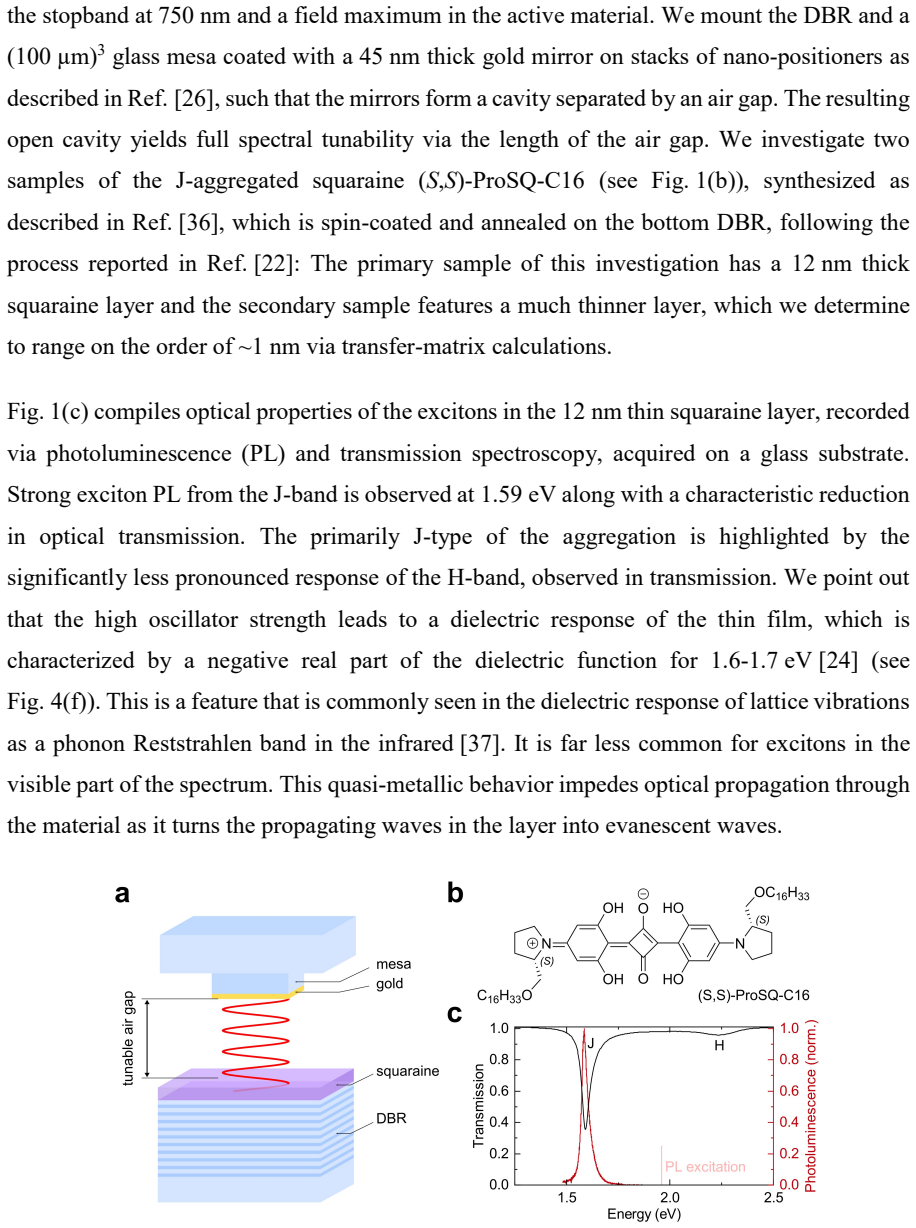
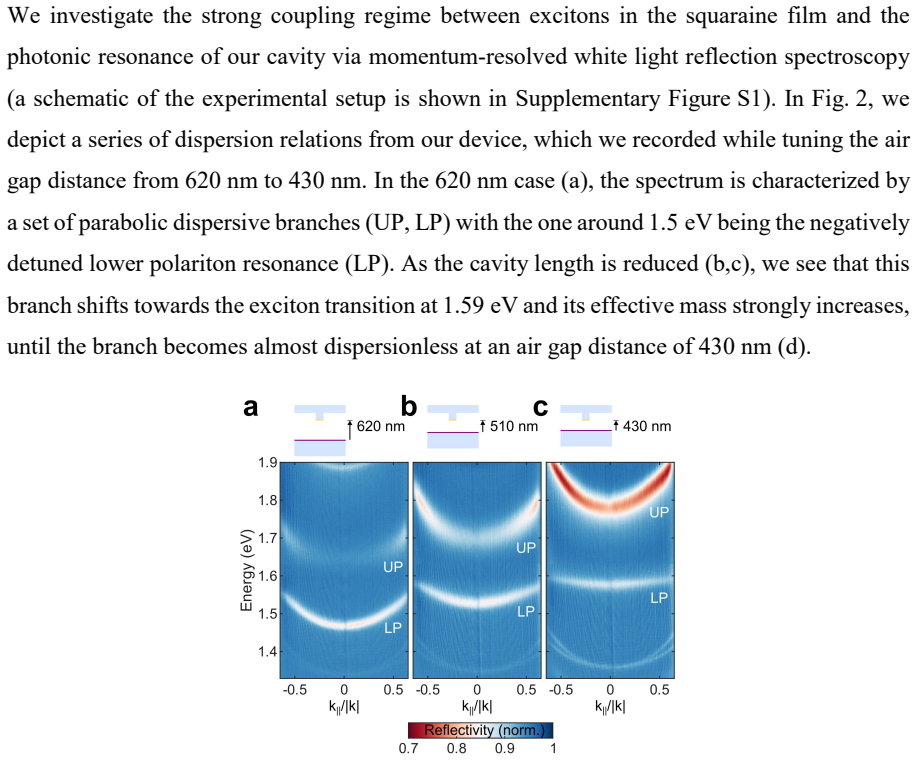
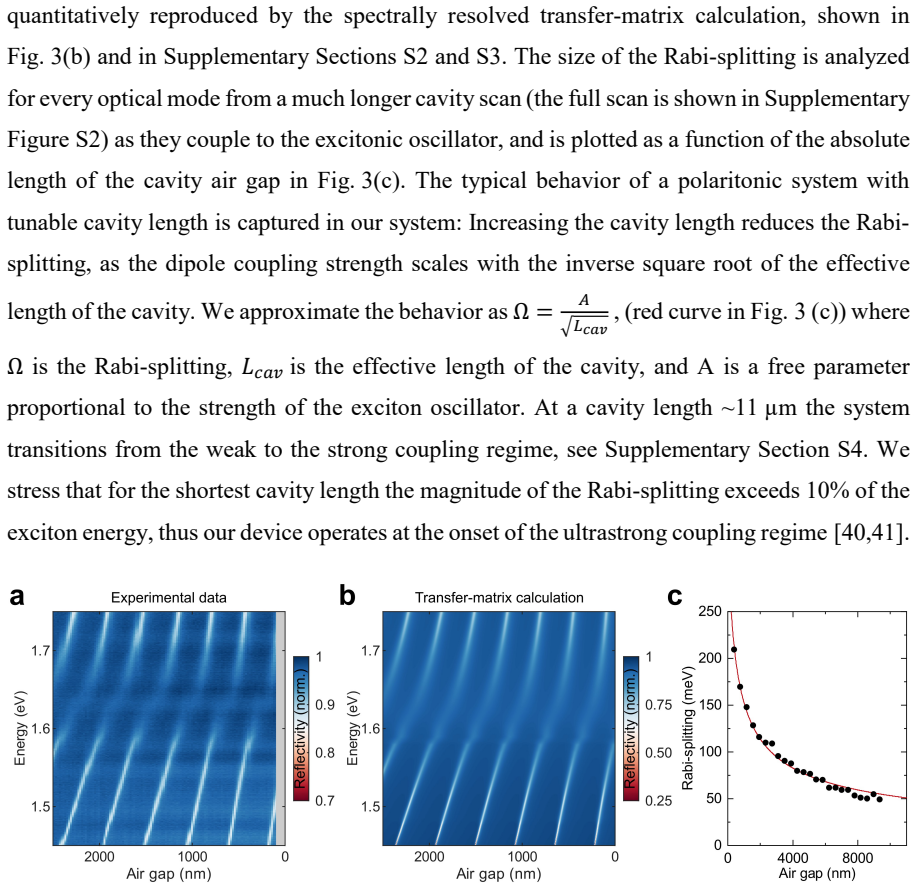
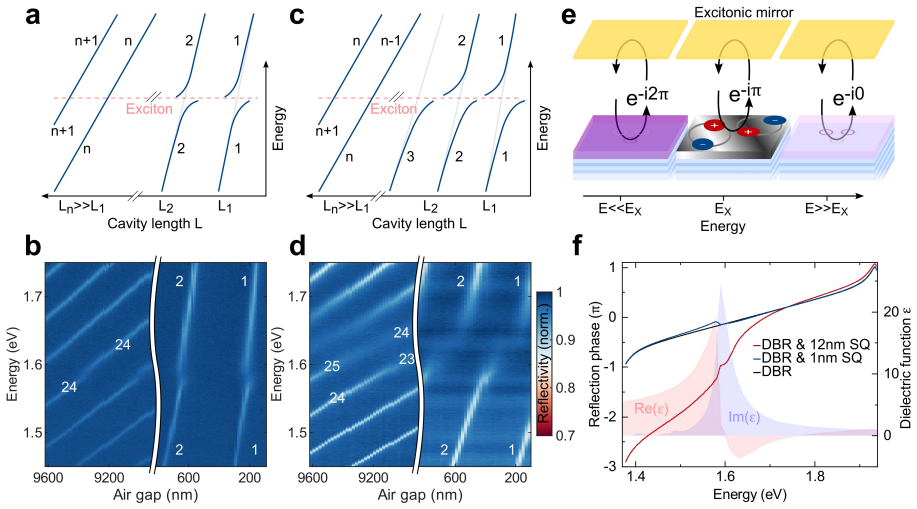
We demonstrate a peculiar regime of strong light-matter coupling that arises when photonic cavity modes couple to an ultra-thin excitonic mirror. We embed a 12 nm J-aggregated thin film in an open microcavity and tune the coupling strength from weak to the onset of ultrastrong coupling. At resonance, the excitonic mirror selectively changes dielectric to metallic field boundary conditions adding a 2π phase, which links optical cavity modes of different order.
What carries the argument
The ultra-thin excitonic mirror formed by the 12 nm J-aggregated film, which at resonance imposes a dielectric-to-metallic boundary-condition transition and a 2π phase shift that couples different-order cavity modes.
If this is right
- Cavity modes of different orders become directly linked through the resonance-induced phase shift.
- The coupling can be tuned continuously from the weak regime into the onset of ultrastrong coupling.
- The configuration supplies a mechanism for ultra-fast cavity switches based on excitonic optical elements.
- Photonic devices can use the mirror to achieve phase-based selection or hybridization of cavity modes.
Where Pith is reading between the lines
- The effective cavity length would jump by half a wavelength at resonance, altering mode spacing without moving mirrors.
- The same boundary-condition switch could appear in other atomically thin excitonic layers such as TMD monolayers.
- All-optical gating of cavity Q or mode order might be realized by detuning the exciton resonance.
- Direct measurement of the reflection phase jump across resonance would provide an independent test.
Load-bearing premise
The 12 nm J-aggregated thin film functions as an ultra-thin excitonic mirror that imposes a dielectric-to-metallic boundary-condition change and 2π phase shift upon resonance.
What would settle it
Transmission or reflection spectra at resonance that show neither an extra 2π phase nor coupling between different-order cavity modes would falsify the claimed boundary-condition switch.
Figures
read the original abstract
The coherent, periodic energy transfer between light- and matter excitations characterizes the strong coupling regime of cavity exciton-polaritons, resulting, in the simplest case, in a Rabi-doublet in the spectral domain. We demonstrate a peculiar regime of strong light-matter coupling, which arises when photonic cavity modes couple to an ultra-thin excitonic mirror. We embed a 12 nm J-aggregated thin film in an open microcavity and tune the coupling strength from weak to the onset of ultrastrong coupling. At resonance, the excitonic mirror selectively changes dielectric to metallic field boundary conditions adding a 2{\pi} phase, which links optical cavity modes of different order. Our work gives an exciting perspective to ultra-fast cavity switches and photonic devices based on excitonic optical elements.
Editorial analysis
A structured set of objections, weighed in public.
Referee Report
Summary. The manuscript reports observation of a novel strong-coupling regime in an open microcavity containing a 12 nm J-aggregated organic thin film. At resonance the film is claimed to function as an excitonic mirror that switches the cavity field boundary conditions from dielectric to metallic, thereby adding a 2π reflection phase that couples cavity modes of different longitudinal order. The authors state they tune the light-matter coupling from the weak regime to the onset of ultrastrong coupling.
Significance. If the asserted boundary-condition switch and associated 2π phase shift are experimentally verified with quantitative optics, the result would provide a new route to mode linking and ultrafast switching in cavity-polariton systems, extending conventional Rabi physics to include controllable boundary conditions via ultra-thin excitonic elements.
major comments (2)
- [Abstract] Abstract: the central claim that resonance in the 12 nm film produces a metallic-like boundary condition (E=0) together with an exact 2π phase shift is asserted without any transfer-matrix calculation, Fresnel-coefficient evaluation, or measured reflection phase that maps the known J-aggregate susceptibility onto this boundary-condition change. For a film thickness ≪ λ this mapping is not automatic and is load-bearing for the mode-linking interpretation.
- [Abstract] Abstract: no spectra, transmission/reflection data, or fitting procedure are supplied to demonstrate that the observed splitting and any phase-related mode coupling arise specifically from the claimed dielectric-to-metallic transition rather than from conventional strong coupling or cavity detuning effects.
minor comments (1)
- [Abstract] The notation “2{\\pi}” should be rendered as 2\pi for clarity.
Simulated Author's Rebuttal
We thank the referee for the careful reading and constructive comments. The main text contains the supporting calculations, spectra, and analysis, but we agree the abstract can be strengthened to better reference this evidence. We respond point-by-point below and will revise accordingly.
read point-by-point responses
-
Referee: [Abstract] Abstract: the central claim that resonance in the 12 nm film produces a metallic-like boundary condition (E=0) together with an exact 2π phase shift is asserted without any transfer-matrix calculation, Fresnel-coefficient evaluation, or measured reflection phase that maps the known J-aggregate susceptibility onto this boundary-condition change. For a film thickness ≪ λ this mapping is not automatic and is load-bearing for the mode-linking interpretation.
Authors: The manuscript body presents transfer-matrix calculations that map the measured J-aggregate susceptibility onto the reflection coefficient and phase. These show that at resonance the 12 nm film produces an effective E=0 boundary condition and a 2π phase shift, even for d ≪ λ, owing to the large oscillator strength. We will revise the abstract to explicitly note that these calculations (detailed in the main text) underpin the boundary-condition interpretation. revision: yes
-
Referee: [Abstract] Abstract: no spectra, transmission/reflection data, or fitting procedure are supplied to demonstrate that the observed splitting and any phase-related mode coupling arise specifically from the claimed dielectric-to-metallic transition rather than from conventional strong coupling or cavity detuning effects.
Authors: The full manuscript includes experimental transmission spectra, reflection data, and fits to a coupled-oscillator model that incorporates the phase shift. The key signature is the observed hybridization between cavity modes of different longitudinal order, which cannot be reproduced by conventional strong coupling or detuning alone. We will update the abstract to indicate that these data and the mode-linking analysis appear in the main text. revision: yes
Circularity Check
No significant circularity detected
full rationale
The manuscript presents the boundary-condition switch and 2π phase shift as an experimental observation obtained by embedding a 12 nm J-aggregate film in an open microcavity and tuning the coupling strength. No equations, transfer-matrix derivations, or fitted parameters are shown that reduce the claimed dielectric-to-metallic transition to a self-referential definition, a renamed input, or a self-citation chain. The central result is therefore not forced by construction from its own inputs.
Axiom & Free-Parameter Ledger
Reference graph
Works this paper leans on
-
[1]
Kasprzak et al., Bose–Einstein condensation of exciton polaritons, Nature 443, 409 (2006)
J. Kasprzak et al., Bose–Einstein condensation of exciton polaritons, Nature 443, 409 (2006)
2006
-
[2]
Byrnes, N
T. Byrnes, N. Y. Kim, and Y. Yamamoto, Exciton–polariton condensates, Nature Physics 10, 803 (2014)
2014
-
[3]
W. H. Nitsche, N. Y. Kim, G. Roumpos, C. Schneider, M. Kamp, S. Höfling, A. Forchel, and Y. Yamamoto, Algebraic order and the Berezinskii-Kosterlitz-Thouless transition in an exciton-polariton gas, Phys. Rev. B 90, 205430 (2014)
2014
-
[4]
Caputo et al., Topological order and thermal equilibrium in polariton condensates, Nat
D. Caputo et al., Topological order and thermal equilibrium in polariton condensates, Nat. Mater. 17, 145 (2018)
2018
-
[5]
A. Amo, J. Lefrère, S. Pigeon, C. Adrados, C. Ciuti, I. Carusotto, R. Houdré, E. Giacobino, and A. Bramati, Superfluidity of polaritons in semiconductor microcavities, Nature Phys 5, 805 (2009). 10
2009
-
[6]
K. G. Lagoudakis, M. Wouters, M. Richard, A. Baas, I. Carusotto, R. André, L. S. Dang, and B. Deveaud-Plédran, Quantized vortices in an exciton–polariton condensate, Nature Phys 4, 706 (2008)
2008
-
[7]
Delteil, T
A. Delteil, T. Fink, A. Schade, S. Höfling, C. Schneider, and A. İmamoğlu, Towards polariton blockade of confined exciton–polaritons, Nature Mater 18, 219 (2019)
2019
-
[8]
Muñoz-Matutano et al., Emergence of quantum correlations from interacting fibre- cavity polaritons, Nature Mater 18, 213 (2019)
G. Muñoz-Matutano et al., Emergence of quantum correlations from interacting fibre- cavity polaritons, Nature Mater 18, 213 (2019)
2019
-
[9]
Schneider et al., An electrically pumped polariton laser, Nature 497, 348 (2013)
C. Schneider et al., An electrically pumped polariton laser, Nature 497, 348 (2013)
2013
-
[10]
Schneider, M
C. Schneider, M. M. Glazov, T. Korn, S. Höfling, and B. Urbaszek, Two-dimensional semiconductors in the regime of strong light-matter coupling, Nat Commun 9, 2695 (2018)
2018
-
[11]
Kavokin, T
A. Kavokin, T. C. H. Liew, C. Schneider, P. G. Lagoudakis, S. Klembt, and S. Hoefling, Polariton condensates for classical and quantum computing, Nat Rev Phys 4, 435 (2022)
2022
-
[12]
D. G. Lidzey, D. D. C. Bradley, M. S. Skolnick, T. Virgili, S. Walker, and D. M. Whittaker, Strong exciton–photon coupling in an organic semiconductor microcavity, Nature 395, 53 (1998)
1998
-
[13]
Kéna-Cohen and S
S. Kéna-Cohen and S. R. Forrest, Room-temperature polariton lasing in an organic single- crystal microcavity, Nature Photonics 4, 371 (2010)
2010
-
[14]
J. D. Plumhof, T. Stöferle, L. Mai, U. Scherf, and R. F. Mahrt, Room-temperature Bose– Einstein condensation of cavity exciton–polaritons in a polymer, Nature Mater 13, 247 (2014)
2014
-
[15]
K. S. Daskalakis, S. A. Maier, R. Murray, and S. Kéna-Cohen, Nonlinear interactions in an organic polariton condensate, Nature Mater 13, 271 (2014)
2014
-
[16]
Bennenhei et al., Polarized room-temperature polariton lasing in elliptical microcavities filled with fluorescent proteins, Opt
C. Bennenhei et al., Polarized room-temperature polariton lasing in elliptical microcavities filled with fluorescent proteins, Opt. Mater. Express, OME 13, 2633 (2023)
2023
-
[17]
Würthner, T
F. Würthner, T. E. Kaiser, and C. R. Saha‐Möller, J‐Aggregates: From Serendipitous Discovery to Supramolecular Engineering of Functional Dye Materials, Angew Chem Int Ed 50, 3376 (2011)
2011
-
[18]
F. C. Spano, Fermion excited states in one-dimensional molecular aggregates with site disorder: Nonlinear optical response, Phys. Rev. Lett. 67, 3424 (1991)
1991
-
[19]
Brixner, R
T. Brixner, R. Hildner, J. Köhler, C. Lambert, and F. Würthner, Exciton Transport in Molecular Aggregates – From Natural Antennas to Synthetic Chromophore Systems, Advanced Energy Materials 7, 1700236 (2017)
2017
-
[20]
N. J. Hestand and F. C. Spano, Expanded Theory of H- and J-Molecular Aggregates: The Effects of Vibronic Coupling and Intermolecular Charge Transfer, Chem. Rev. 118, 7069 (2018)
2018
-
[21]
Bernhardt, L
R. Bernhardt, L. Rieland, T. Wang, M. F. Schumacher, A. Lützen, M. Schiek, and P. H. M. Van Loosdrecht, Ultrafast Excitonic Transitions in Enantiopure and Racemic Squaraine Thin Films, Aggregate 6, e698 (2025)
2025
-
[22]
Quenzel et al., Plasmon-Enhanced Exciton Delocalization in Squaraine-Type Molecular Aggregates, ACS Nano 16, 4693 (2022)
T. Quenzel et al., Plasmon-Enhanced Exciton Delocalization in Squaraine-Type Molecular Aggregates, ACS Nano 16, 4693 (2022)
2022
-
[23]
Timmer, D
D. Timmer, D. C. Lünemann, M. Gittinger, A. De Sio, C. Manzoni, G. Cerullo, and C. Lienau, Phase-cycling and double-quantum two-dimensional electronic spectroscopy using a common-path birefringent interferometer, Optica 11, 1646 (2024)
2024
-
[24]
Schulz, J
M. Schulz, J. Zablocki, O. S. Abdullaeva, S. Brück, F. Balzer, A. Lützen, O. Arteaga, and M. Schiek, Giant intrinsic circular dichroism of prolinol-derived squaraine thin films, Nat Commun 9, 2413 (2018)
2018
-
[25]
L. C. Flatten, Z. He, D. M. Coles, A. A. P. Trichet, A. W. Powell, R. A. Taylor, J. H. Warner, and J. M. Smith, Room-temperature exciton-polaritons with two-dimensional WS2, Sci Rep 6, 33134 (2016). 11
2016
-
[26]
Lackner et al., Tunable exciton-polaritons emerging from WS2 monolayer excitons in a photonic lattice at room temperature, Nat Commun 12, 4933 (2021)
L. Lackner et al., Tunable exciton-polaritons emerging from WS2 monolayer excitons in a photonic lattice at room temperature, Nat Commun 12, 4933 (2021)
2021
-
[27]
Król et al., Universality of open microcavities for strong light-matter coupling, Opt
M. Król et al., Universality of open microcavities for strong light-matter coupling, Opt. Mater. Express, OME 13, 2651 (2023)
2023
-
[28]
Struve et al., Room-Temperature Polariton Condensate in a Two-Dimensional Hybrid Perovskite
M. Struve et al., Room-Temperature Polariton Condensate in a Two-Dimensional Hybrid Perovskite
-
[29]
Georgakilas, R
I. Georgakilas, R. Mirek, D. Urbonas, M. Forster, U. Scherf, R. F. Mahrt, and T. Stöferle, In situ tunable, room-temperature polariton condensation in individual states of a 1D topological lattice, Sci. Adv. 11, eadt8645 (2025)
2025
-
[30]
Georgakilas et al., Room-temperature cavity exciton-polariton condensation in perovskite quantum dots, Nat Commun 16, 5228 (2025)
I. Georgakilas et al., Room-temperature cavity exciton-polariton condensation in perovskite quantum dots, Nat Commun 16, 5228 (2025)
2025
-
[31]
Lackner et al., Topologically Tunable Polaritons Based on a Two-Dimensional Crystal in a Photonic Lattice, Phys
L. Lackner et al., Topologically Tunable Polaritons Based on a Two-Dimensional Crystal in a Photonic Lattice, Phys. Rev. Lett. 135, 166901 (2025)
2025
-
[32]
Zeytinoǧlu, C
S. Zeytinoǧlu, C. Roth, S. Huber, and A. İmamoğlu, Atomically thin semiconductors as nonlinear mirrors, Phys. Rev. A 96, 031801 (2017)
2017
-
[33]
P. Back, S. Zeytinoglu, A. Ijaz, M. Kroner, and A. Imamoğlu, Realization of an Electrically Tunable Narrow-Bandwidth Atomically Thin Mirror Using Monolayer ${\mathrm{MoSe}}_{2}$, Phys. Rev. Lett. 120, 037401 (2018)
2018
-
[34]
Scuri et al., Large Excitonic Reflectivity of Monolayer MoSe 2 Encapsulated in Hexagonal Boron Nitride, Phys
G. Scuri et al., Large Excitonic Reflectivity of Monolayer MoSe 2 Encapsulated in Hexagonal Boron Nitride, Phys. Rev. Lett. 120, 037402 (2018)
2018
-
[35]
D. G. Suárez-Forero et al., Chiral flat-band optical cavity with atomically thin mirrors, Sci. Adv. 10, eadr5904 (2024)
2024
-
[36]
Schulz, M
M. Schulz, M. Mack, O. Kolloge, A. Lützen, and M. Schiek, Organic photodiodes from homochiral L -proline derived squaraine compounds with strong circular dichroism, Phys. Chem. Chem. Phys. 19, 6996 (2017)
2017
-
[37]
Adachi, The Reststrahlen Region, in Optical Properties of Crystalline and Amorphous Semiconductors (Springer US, Boston, MA, 1999), pp
S. Adachi, The Reststrahlen Region, in Optical Properties of Crystalline and Amorphous Semiconductors (Springer US, Boston, MA, 1999), pp. 33–62
1999
-
[38]
Weisbuch, M
C. Weisbuch, M. Nishioka, A. Ishikawa, and Y. Arakawa, Observation of the coupled exciton-photon mode splitting in a semiconductor quantum microcavity, Phys. Rev. Lett. 69, 3314 (1992)
1992
-
[40]
Forn-Díaz, L
P. Forn-Díaz, L. Lamata, E. Rico, J. Kono, and E. Solano, Ultrastrong coupling regimes of light-matter interaction, Rev. Mod. Phys. 91, 025005 (2019)
2019
-
[41]
Frisk Kockum, A
A. Frisk Kockum, A. Miranowicz, S. De Liberato, S. Savasta, and F. Nori, Ultrastrong coupling between light and matter, Nat Rev Phys 1, 19 (2019)
2019
-
[42]
J. Zhan, T. Jehle, S. Stephan, E. Tiguntseva, S. S. Nochowitz, P. Groß, J. Duan, S. Makarov, and C. Lienau, Interferometric Near-field Fano Spectroscopy of Single Halide Perovskite Nanoparticles, Nano Lett. 24, 15738 (2024). SI 1 Supporting Information Strong coupling regimes of an organic exciton mirror in a microcavity Christoph Bennenhei1, Lukas Lackne...
2024
-
[43]
Savona, L
V. Savona, L. C. Andreani, P. Schwendimann, and A. Quattropani, Quantum well excitons in semiconductor microcavities: Unified treatment of weak and strong coupling regimes, Solid State Communications 93, 733 (1995)
1995
-
[44]
Törmä and W
P. Törmä and W. L. Barnes, Strong coupling between surface plasmon polaritons and emitters: a review, Rep. Prog. Phys. 78, 013901 (2015)
2015
discussion (0)
Sign in with ORCID, Apple, or X to comment. Anyone can read and Pith papers without signing in.