REVIEW 3 major objections 5 minor 26 references
Multi-Robot Path Deconfliction through Prioritization by Path Prospects
T0 review · 3 major / 5 minor · reviewed 2026-08-14 · deepseek-v4-flash
Pith's one-line read A robot's number of topologically distinct routes, when used as planning priority, beats five benchmark rules in multi-robot path deconfliction.
desk verdict A new, plausible priority heuristic for decoupled multi-robot planning, with decent simulations and a topological framing that overclaims. read the letter →
The pith
A machine-rendered reading of the paper's core claim, the machinery that carries it, and where it could break.
The reading
What carries the argument
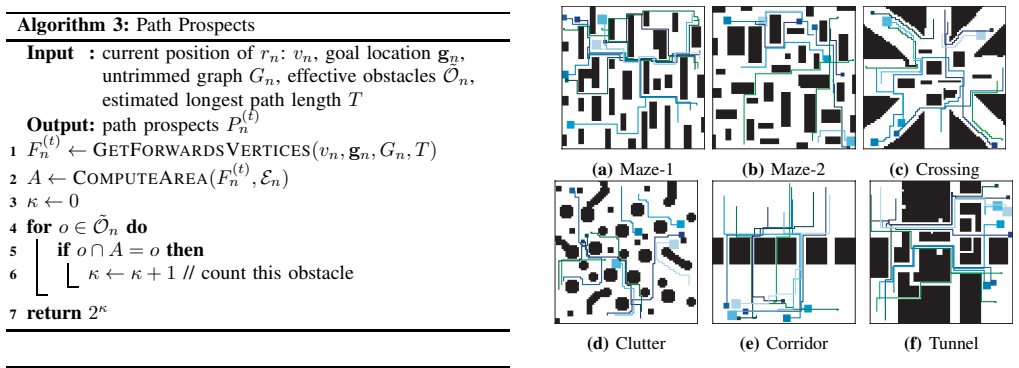
The central object is the path-prospect estimate $P_n^{(t)}$, computed by Algorithm 3. The algorithm builds a forward area $A$ from vertices reachable from the robot's current position whose time-to-goal plus true distance to the goal stays under a global threshold $T$ (the team's estimated longest true distance), then counts effective obstacles — static obstacles merged after inflation by the robot's footprint when no trajectory passes between them — that lie entirely inside $A$; if $\kappa$ obstacles are counted, the robot's prospects are $2^\kappa$. This number is the size of the $Z_2$-coefficient homology class set of trajectories in a planar domain with $\kappa$ connected components of effective obstacles, and it is what converts the environment and the robot's size into a priority: fewer prospects, higher priority. The forward area matters because it prevents obstacles behind the robot from inflating its count.
What would settle it
Take the S1 grid-worlds and, for each robot, compute the exact number of feasible $Z_2$-coefficient homology classes from its current position to its goal via a homology-aware search instead of Algorithm 3's $2^\kappa$ count. If the exact count differs from Algorithm 3's estimate on enough instances that the priority order changes, and the exact-count version then outperforms PP-R on success rate or Pareto dominance, the paper's claim that its estimate carries the improvement is falsified.
Extended reading notes
Core claim
The central claim is that the number of a robot's path prospects, estimated from $Z_2$-coefficient homology classes of trajectories, is the right quantity to prioritize on in decentralized multi-robot path deconfliction. A robot with fewer prospects should have higher priority, because it cannot easily adapt; a robot with more prospects should yield and take an alternative route. The paper reports that the two path-prospect variants lie on the empirical Pareto front for percent increase over ideal makespan and flowtime across all six tested environments, and achieve the highest success rates among the seven compared variants (PP-R 95.7% and PP-LF 94.1%). It further claims that the coordination algorithm is deadlock-free because every robot broadcasts an absolute priority score, making the global relation a strict partial order.
Load-bearing premise
The result rests on Algorithm 3's estimate that a robot with $\kappa$ effective obstacles inside its forward area has $2^\kappa$ genuinely distinct route options; if that count does not track the real number of feasible topologically distinct paths in cluttered or dynamic settings, the priority ordering becomes arbitrary and the reported gains may not hold outside the tested grid worlds.
Editorial extensions
If this is right
- In the six grid-world environments and the 150x150, 100-robot maze, using path prospects as the priority rule achieves the highest success rate of all seven variants (PP-R 95.7%, PP-LF 94.1%).
- Both path-prospect variants lie on the empirical Pareto front for percent increase over ideal makespan and flowtime; no benchmark jointly dominates them on the two objectives.
- Because each robot computes its priority from its own state and the environment, the method avoids evaluating $N!$ priority orderings and can be run online in a distributed fashion with only local communication.
- The deadlock-free property follows from the consistency of absolute priority scores: neighborhoods can merge and the global relation remains a strict partial order, so replanning cannot cycle.
- The prioritization machinery is agnostic to the underlying path planner; HCA* is used in the experiments, but any planner with a TRIM-like collision check can be substituted.
Reading between the lines
- If Algorithm 3's $2^\kappa$ estimate were replaced by an exact enumeration of feasible $Z_2$-homology classes, the priority rule would likely become more robust in dense maps; a direct comparison on the paper's own maps is a cheap test of whether the count or the topology is the active ingredient.
- The rule effectively grants right-of-way to the most mobility-constrained robot, which suggests a connection to bottleneck-based priority schemes in traffic and to completeness guarantees: robots whose choice set is a singleton should never be forced to wait indefinitely, which may help explain the high success rate.
- Because path prospects shrink as a robot nears its goal, the priority ordering is genuinely dynamic: the same pair of robots can swap effective priorities mid-run, something static longest-first heuristics cannot do; exploiting this explicitly might reduce flowtime further than the reported numbers.
- The paper notes future work beyond grid-worlds; in continuous 3-D workspaces, the $2^\kappa$ rule may not carry over directly because the number of homology classes need not be finite for general configuration spaces, so a practical extension would require a bounded or filtered version of the count.
Signed reviews
Editorial analysis
A structured set of objections, weighed in public.
Referee Report
Summary. The paper proposes a decentralized prioritized multi-robot path planning method in which each robot computes a priority score from its ``path prospects'': the number of Z2-coefficient homology classes of trajectories from its current position to its goal. This score is estimated by Algorithm 3 as 2^κ, where κ is the number of effective obstacles fully contained in a forward area A, and A is defined via vertices whose time-to-goal is below a global threshold T. The priority score is used in a dynamic decentralized negotiation algorithm (Algorithm 1), and the authors claim in Proposition 1 that the algorithm is deadlock-free because it maintains a partial order over the robot set. The method is evaluated in grid-world simulations with ten robots on six maps and with one hundred robots on a large map, comparing against five benchmark heuristics plus a random rule. The authors report that their two path-prospect variants (PP-R and PP-LF) achieve the highest success rates (95.7% and 94.1%) and lie on the empirical Pareto front for makespan and flowtime.
Significance. The idea of quantifying a robot's path options through homology classes and using this as an online prioritization signal is novel and potentially useful for decoupled multi-robot planning. The ablation design is a strength: comparing Naive Surroundings (NS) with Coupled Surroundings (CS) and Forwards Looking (FL) with Path Prospects (PP) isolates the contributions of robot-environment coupling and of the forward area. If the path-prospects estimator were validated and the deadlock-freedom argument made rigorous, the method would be a lightweight, decentralized heuristic of broad interest. However, the paper's central explanatory claim is not yet supported: the estimator in Algorithm 3 is not shown to compute the number of feasible homology classes, and the proof of Proposition 1 is only a sketch. The empirical results are described but not reproducible from the manuscript alone, as no code, data, or exact parameter settings are provided. The paper does not contain machine-checked proofs or released code; its main contribution is a falsifiable heuristic whose validation is currently incomplete.
major comments (3)
- [V-B, Algorithm 3, Eq. (1)] The estimate P_n(t)=2^κ is not derived from the homology-counting statement in Section V-A. That statement applies to a planar domain with z connected components of effective obstacles and counts all Z2 homology classes of loops in the whole punctured workspace. Algorithm 3, by contrast, counts only effective obstacles that are entirely contained in the forward area A, omitting obstacles that partially intersect or lie outside A even when feasible paths can wind around them, and it may count obstacles inside A that cannot actually be encircled within the time budget induced by T. Moreover, A is not used to constrain the HCA* planner in Section IV-B, so the scored region and the real plan space can diverge. Since Eq. (1) sets priority directly from P_n, the paper does not establish that robots are prioritized by their actual path prospects. I ask for a direct validation: in small grid worlds, compare P_n with the true number of feasible Z2 homology classes of time-respecting paths, and report sensitivity of the results to T and to the obstacle-inflation rule.
- [IV-A, Proposition 1] The proof that Algorithm 1 is deadlock-free is a sketch and does not establish the claim. It argues that because each robot broadcasts a single priority score, the union of neighborhoods is partially ordered by transitivity. However, ξ_n is recomputed online (Algorithm 1 line 6 and Algorithm 2 line 6) and depends on the robot's current vertex, so relative priorities can change over time and there may be no single static partial order over R. The proof also does not address asynchronous updates or the random tie-breaking used in PP-R: if two robots compute their priorities at slightly different times or use uncoordinated random tie-breaking, both may believe they have higher priority. Please provide a rigorous invariant, such as a proof that priorities are frozen during negotiation or that a consistent total order is maintained, and show that deadlock-freedom follows in the asynchronous model described in Section III.
- [VI, Figures 8-10] The central empirical claims are not reproducible from the manuscript alone. The paper does not provide code, data, or exact values for the threshold T used in Algorithm 3, and the 95% confidence intervals in Figures 8-10 are not defined (e.g., standard error over the 500 random assignments, or over communication ranges). No statistical test is reported for the success-rate differences in Figure 9, so it is unclear whether PP-R's 95.7% is significantly better than PP-LF's 94.1% or than CS. Please report the missing experimental details, including the full parameter settings, and provide a sensitivity analysis for T.
minor comments (5)
- [VI-A] The grid-search for the NS baseline's range z=30 is mentioned but not specified; please report the search range and the criterion used to select 30.
- [III] The definition of effective obstacles is ambiguous: writing \tilde{o}_i \subseteq O suggests each effective obstacle is a subset of the set of original obstacles, but the text later treats it as a subset of the workspace; please clarify the notation.
- [V-B] The ``true distance'' of a vertex is described informally; it should be defined formally to make the construction of the forward area and the threshold T unambiguous.
- [Algorithm 4] GET_FORWARDS_VERTICES returns a set of vertices, but Algorithm 3 requires an area A; please specify how COMPUTE_AREA constructs A from the returned vertices and the edge set E_n.
- [V-C] Equation (1) defines the ordering only when P_n < P_m; please specify the full tie-breaking rule in the formal definition, since the paper uses both random and longest-first tie-breaks.
Circularity Check
No significant circularity: the proposed prioritization is computed from local graph and obstacle data, and its reported advantages come from external benchmark comparisons with no fitted parameters in the proposed method.
full rationale
The paper's derivation chain is self-contained with respect to its central claim. The prioritization rule is defined in Section V-C by Eq. (1): P_n < P_m iff ξ_n precedes ξ_m, where P_n is the path-prospect value returned by Algorithm 3. The inputs to Algorithm 3 are the robot's current position, goal, untrimmed graph, effective obstacles, and an estimated longest path length T; no target metric such as success rate, makespan, or flowtime is used to define or calibrate P_n. The reported success-rate and Pareto-front results are obtained by running the planner in grid-world benchmarks and comparing against five baseline heuristics. The only tuned parameter mentioned in the evaluation, z = 30, belongs to the Naive Surroundings baseline, not to the proposed method. The algebraic-topology statement that Z2-coefficient homology classes in a planar domain with z effective obstacles number 2^z is accompanied by its own short justification in Section V-A: the homology invariant becomes a vector in Z2^z. The self-citations [3] and [4] include one of the authors but are not load-bearing for that elementary counting argument; they do not import an unverified uniqueness theorem or forbid alternative priority rules. The concern that Algorithm 3's kappa may not faithfully estimate the true number of feasible homology classes is a substantive correctness question, but it is not circularity, because the estimator is not defined in terms of the evaluation outcomes. No self-definitional step, fitted-input-called-prediction step, or renaming of a known result is present.
Assumptions & free parameters
free parameters (1)
- T (estimated longest true distance of robot team)
assumptions (5)
- standard math In a planar domain with z connected components of effective obstacles, the number of Z2-coefficient homology classes of loops is 2^z.
- domain assumption Effective obstacles ~O_n are groups of original obstacles such that no feasible trajectory in G_n passes between obstacles in the same group.
- ad hoc to paper The number of path prospects P_n(t) equals 2^κ where κ is the number of effective obstacles fully contained in the forward area A.
- ad hoc to paper The forward area A is the region spanned by vertices reachable from the current position with time-to-goal under the team threshold T.
- domain assumption Robots have synchronized clocks, mutual detection, negligible message delay, and each robot's priority is a global absolute value that can be broadcast.
Cite this review
Pith. "Pith review of Multi-Robot Path Deconfliction through Prioritization by Path Prospects." pith.science (2026). https://pith.science/paper/RQ7VXHG7
@misc{pith2026190802361,
  author       = {Pith},
  title        = {Pith review of: Multi-Robot Path Deconfliction through Prioritization by Path Prospects},
  year         = {2026},
  howpublished = {\url{https://pith.science/paper/RQ7VXHG7}},
  note         = {Machine review of arXiv:1908.02361}
}
read the original abstract
This work deals with the problem of planning conflict-free paths for mobile robots in cluttered environments. Since centralized, coupled planning algorithms are computationally intractable for large numbers of robots, we consider decoupled planning, in which robots plan their paths sequentially in order of priority. Choosing how to prioritize the robots is a key consideration. State-of-the-art prioritization heuristics, however, do not model the coupling between a robot's mobility and its environment. In this paper, we propose a prioritization rule that can be computed online by each robot independently, and that provides consistent, conflict-free path plans. Our innovation is to formalize a robot's path prospects to reach its goal from its current location. To this end, we consider the number of homology classes of trajectories, and use this as a prioritization rule in our decentralized path planning algorithm, whenever any robots enter negotiation to deconflict path plans. This prioritization rule guarantees a partial ordering over the robot set. We perform simulations that compare our method to five benchmarks, and show that it reaches the highest success rate (w.r.t. completeness), and that it strikes the best balance between makespan and flowtime objectives.
Figures


Figures from the paper (6 more)




Reference graph
Works this paper leans on
-
[17]
H. Ma, D. Harabor, P . J. Stuckey, J. Li, and S. Koenig. Sea rching with consistent prioritization for multi-agent path findin g. arXiv preprint arXiv:1812.06356, 2018
work page Pith review arXiv 2018
-
[1]
K. Azarm and G. Schmidt. Conflict-free motion of multiple mobile robots based on decentralized motion planning and negotiat ion. In Robotics and Automation, 1997. Proceedings., 1997 IEEE Int ernational Conference on , volume 4, pages 3526–3533. IEEE, 1997
work page 1997
-
[2]
M. Bennewitz, W. Burgard, and S. Thrun. Finding and optim izing solvable priority schemes for decoupled path planning tech niques for teams of mobile robots. Robotics and autonomous systems , 41(2-3):89– 99, 2002
work page 2002
-
[3]
S. Bhattacharya, R. Ghrist, and V . Kumar. Persistent hom ology for path planning in uncertain environments. IEEE Transactions on Robotics (T- RO), 31(3):578–590, March 2015. DOI: 10.1109/TRO.2015.24120 51
arXiv 2015
-
[4]
S. Bhattacharya, M. Likhachev, and V . Kumar. Topologica l constraints in search-based robot path planning. Autonomous Robots , 33(3):273–290, October 2012. DOI: 10.1007/s10514-012-9304-1
- [5]
-
[6]
Y . Chen, M. Cutler, and J. P . How. Decoupled multiagent pa th planning via incremental sequential convex programming. In Robotics and Automation (ICRA), 2015 IEEE International Conference on , pages 5954–5961. IEEE, 2015
work page 2015
-
[7]
C. M. Clark, T. Bretl, and S. Rock. Applying kinodynamic r andomized motion planning with a dynamic priority system to multi-rob ot space systems. In Aerospace Conference Proceedings, 2002. IEEE , volume 7, pages 7–7. IEEE, 2002
work page 2002
Show all 26 references
-
[8]
A. A. Deshpande and K. R. Nataraj. A review: Priority base d motion control of multiple robot systems. International Journal of Innovative Research in Science, Engineering and Technology , 2(1), 2013
2013
-
[9]
Enright and P
J. Enright and P . R. Wurman. Optimization and coordinate d autonomy in mobile fulfillment systems. In Automated action planning for autonomous mobile robots , pages 33–38, 2011
2011
-
[10]
Erdmann and T
M. Erdmann and T. Lozano-P´ erez. On multiple moving obj ects. Algorithmica, 2(1-4):477, 1987
1987
-
[11]
Ferner, G
C. Ferner, G. Wagner, and H. Choset. ODrM* optimal multi robot path planning in low dimensional search spaces. In 2013 IEEE International Conference on Robotics and Automation , pages 3854–3859. IEEE, 2013
2013
-
[12]
Grippa, D
P . Grippa, D. A. Behrens, C. Bettstetter, and F. Wall. Jo b selection in a network of autonomous uavs for delivery of goods. Robotics: Science and Systems , 2017
2017
-
[13]
H¨ onig, T
W. H¨ onig, T. S. Kumar, L. Cohen, H. Ma, H. Xu, N. Ayanian, and S. Koenig. Multi-agent path finding with kinematic constrai nts. In Twenty-Sixth International Conference on Automated Plann ing and Scheduling, 2016
2016
-
[14]
Hyldmar, Y
N. Hyldmar, Y . He, and A. Prorok. A fleet of miniature cars for experiments in cooperative driving. In IEEE International Conference on Robotics and Automation (ICRA) , 2019
2019
-
[15]
Kant and S
K. Kant and S. W. Zucker. Toward efficient trajectory pla nning: The path-velocity decomposition. The international journal of robotics research, 5(3):72–89, 1986
1986
-
[16]
Kantor, S
G. Kantor, S. Singh, R. Peterson, D. Rus, A. Das, V . Kumar , G. Pereira, and J. Spletzer. Distributed search and rescue with robot an d sensor teams. In Field and Service Robotics , pages 529–538. Springer, 2003
2003
-
[18]
Pavone, S
M. Pavone, S. L. Smith, E. Frazzoli, and D. Rus. Robotic l oad balancing for mobility-on-demand systems. The International Journal of Robotics Research, 31(7):839–854, 2012
2012
-
[19]
Regele and P
R. Regele and P . Levi. Cooperative multi-robot path pla nning by heuristic priority adjustment. In Intelligent Robots and Systems, 2006 IEEE/RSJ International Conference on , pages 5954–5959. IEEE, 2006
2006
-
[20]
Sharon, R
G. Sharon, R. Stern, A. Felner, and N. R. Sturtevant. Con flict- based search for optimal multi-agent pathfinding. Artificial Intelligence , 219:40–66, 2015
2015
-
[21]
D. Silver. Cooperative pathfinding. In Artificial intelligence and interactive digital entertainment , volume 1, pages 117–122, 2005
2005
-
[22]
Turpin, K
M. Turpin, K. Mohta, and N. Michael. Goal assignment and trajectory planning for large teams of interchangeable robots. In Autonomous Robots, volume 37, pages 401–415, 2014
2014
-
[23]
J. P . V an Den Berg and M. H. Overmars. Prioritized motion planning for multiple robots. In IEEE/RSJ International Conference on Intelligent Robots and Systems (IROS) , pages 430–435. IEEE, 2005
2005
-
[24]
V elagapudi, K
P . V elagapudi, K. Sycara, and P . Scerri. Decentralized prioritized planning in large multirobot teams. In Intelligent Robots and Systems (IROS), 2010 IEEE/RSJ International Conference on , pages 4603–4609. IEEE, 2010
2010
-
[25]
Wagner and H
G. Wagner and H. Choset. M*: A complete multirobot path p lanning algorithm with performance bounds. In Intelligent Robots and Systems (IROS), 2011 IEEE/RSJ International Conference on , pages 3260–3267. IEEE, 2011
2011
-
[26]
Y u and S
J. Y u and S. M. LaV alle. Structure and intractability of optimal multi- robot path planning on graphs. In AAAI, 2013
2013
Reviewed August 14, 2026 · model on record in the stance chip above.
Discussion (0). Continue with ORCID to comment.