REVIEW 3 major objections 3 minor 55 references
Tricritical dynamics in $\mathrm{^3He}$-$\mathrm{^4He}$ mixtures and QCD
T0 review · 3 major / 3 minor · reviewed 2026-08-12 · deepseek-v4-flash
Pith's one-line read The paper claims that near a tricritical point in three dimensions, the order parameter and the conserved $O(N)$ charge densities relax with the same dynamic exponent $z = 3/2$, while a conserved energy-like density is subdiffusive with…
desk verdict New rFRG flows for an SSS model with a conserved energy-like density give a solid strong-scaling result for N>2, but the N=2 d=3 claim for 3He-4He relies on a truncation-dependent coincidence. read the letter →
The pith
A machine-rendered reading of the paper's core claim, the machinery that carries it, and where it could break.
The reading
What carries the argument
The central object is the SSS' model, the $N$-component generalization of Model G supplemented by a conserved energy-like density coupled to $\phi^2$; for $N = 2$ it reduces to Model F' of $^3$He-$^4$He mixtures. The argument runs through the real-time functional renormalization group, which yields non-perturbative flow equations for the kinetic coefficients $\Gamma_\phi$, $\gamma$, and $\mu$. The load-bearing identities are the flow equations for the dimensionless relaxation-time ratios $w_n$ and $w_\epsilon$ and the mode-coupling parameter $f$; their fixed-point values decide between strong and weak dynamic scaling. The static anchor is the Gaussian fixed point of $\phi^6$ theory at $d = 3$, where $\alpha_t/\nu_t = 1$ gives $z_\epsilon = 3$.
What would settle it
Simulate the $N = 2$ version of the model (Model F') in three dimensions by Langevin or lattice methods, measure the correlation-time scaling of the order parameter and of the conserved charge density over at least a decade of correlation lengths, and check whether both exponents equal $3/2$ and the energy diffusion coefficient scales as $\xi^{-1}$; unequal exponents would falsify the strong-scaling claim.
Extended reading notes
Core claim
In the paper's own terms, the central discovery is that supplementing the $N$-component model with a conserved energy-like density does not destroy the strong-scaling property at the tricritical point. For all $N \ge 2$ in $d = 3$, the dynamic critical exponents satisfy $z_\phi = z_n = 3/2$, so order-parameter and charge-density fluctuations share one relaxation time, while the energy-like density is subdiffusive with $z_\epsilon = 2 + \alpha_t/\nu_t = 3$. The $N = 2$ case, which describes $^3$He-$^4$He mixtures, is singled out as a limiting case: the strong-scaling fixed point merges with the weak-scaling fixed point exactly at $d = 3$. With explicit symmetry breaking, the linearized equations show the energy-like density mixing with the chiral order parameter; the surviving slow mode becomes the diffusive entropy-per-baryon fluctuation characteristic of the QCD critical point, with a diffusion coefficient that scales as $\xi^{-(1+x_\eta)}$ once momentum modes are included.
Load-bearing premise
The $N = 2$ strong-scaling result depends on the strong-scaling fixed point merging with the weak-scaling fixed point exactly at $d = 3$, where the Gaussian fixed point that anchors the calculation is only valid.
Editorial extensions
If this is right
- If strong scaling holds, the order-parameter and conserved-charge fluctuations in $^3$He-$^4$He mixtures near tricriticality relax with the same correlation-length exponent $3/2$, so measurements of one can predict the other.
- In two-flavor QCD, the tricritical point inherits Model G dynamics, and the energy-like density is subdiffusive; searches for critical slowing-down near the chiral tricritical point should use $z = 3/2$ and $z = 3$, respectively.
- With finite quark masses, the slow mode near the $Z_2$ line is a mixture of energy density and chiral order parameter with $D \sim \xi^{-(1+x_\eta)}$, nearly indistinguishable from tricritical subdiffusion $D \sim \xi^{-1}$, which ties heavy-ion phenomenology to tricritical scaling.
- Shear modes do not change the heat-conductivity exponent at the tricritical point in $d = 3$, so the subdiffusive energy mode is robust to advection.
- For $N = 2$, strong scaling at the tricritical point is a $d \to 3^-$ limiting case, predicting that the $\lambda$-line and tricritical dynamics in $^3$He-$^4$He mixtures are governed by the same exponents.
Reading between the lines
- The fixed-point merging picture suggests a testable crossover: in dimensions slightly below 3, strong scaling should be visible in Model F' simulations, while slightly above 3 weak scaling should appear; this is a sharper signature than measuring only the $d = 3$ exponents.
- The same reasoning may apply to other tricritical points with a positive specific-heat exponent, such as magnets with competing anisotropies, where an energy-like density becomes dynamically relevant.
- The closeness of $z = 3$ (tricritical subdiffusion) and $z = 3 + x_\eta$ (Model H) means experimental or numerical data may not easily distinguish the two; distinguishing them requires measuring the order-parameter exponent $z_\phi$, not just the slow diffusion mode.
- The explicit-symmetry-breaking mechanism could be tested by Langevin simulations of the $N = 4$ model with a small external field $H$, checking whether the pionic mode decouples on timescales of order $H^{-3/5}$.
Editorial analysis
A structured set of objections, weighed in public.
Referee Report
Summary. The manuscript studies the universal critical dynamics near tricritical points in a model that couples an N-component order parameter to conserved O(N) charge densities n_ab and to a conserved energy-like density ε, with applications to the tricritical point of 3He-4He mixtures and to QCD with two massless flavors. Using the real-time functional renormalization group, the authors derive flow equations for the effective potential and for the kinetic coefficients Γ_φ, γ, and μ. At the Gaussian fixed point of the φ^6 theory in d=3 they recover the mean-field static exponents and find that for N>2 a finite fixed-point ratio w_n^* of order-parameter and charge relaxation times enforces strong dynamic scaling z_φ=z_n=3/2, while the energy-like density becomes subdiffusive with z_ε=3. For N=2, the case relevant to 3He-4He, Eq. (88) has no nontrivial solution and the stable fixed point is the weak-scaling point w_n^*=0; the paper nevertheless concludes strong scaling by evaluating the LPA exponents at d=3 and by a fixed-point merging picture as d→3^-. The last part treats explicit chiral symmetry breaking in mean field, obtaining mixing of the energy density with the Z2 order parameter and a crossover to Model B/H dynamics.
Significance. If the results are correct, the paper provides concrete dynamic-universality predictions for the tricritical point in QCD and in 3He-4He mixtures, namely z_φ=z_n=3/2 and z_ε=3, together with a physically appealing connection to the slow entropy-per-baryon mode near the QCD critical point. The rFRG machinery is applied in a self-contained way: the static Gaussian fixed point and mean-field exponents are reproduced, the flow of the kinetic coefficients is derived diagrammatically, and the non-renormalization of the mode-coupling constant and the absence of flow of μ are obtained from symmetries. The authors are transparent about the limitations of their LPA truncation and explicitly call for numerical verification. The main risk is the N=2 case, where the strong-scaling conclusion rests on a marginal equality inside the truncation rather than on a robust fixed-point argument.
major comments (3)
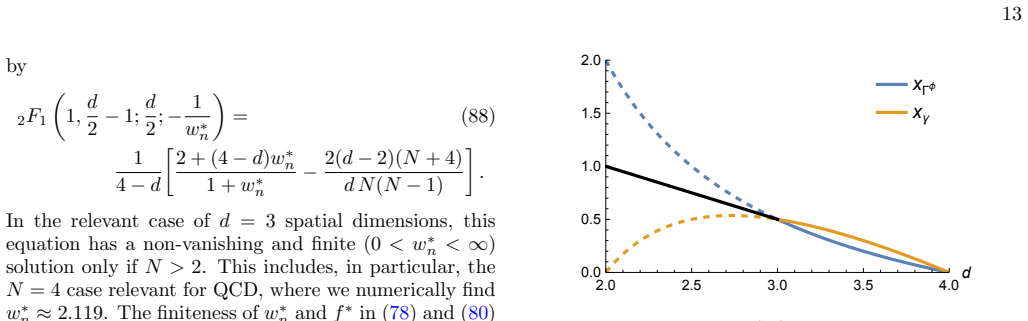
- [Sec. IV B, Eqs. (88)-(92), and Sec. VI] For N=2 in d=3, Eq. (88) has no nontrivial solution, and the stable fixed point is the weak-scaling point w_n^*=0 of Eq. (90). At this point Eq. (78) does not impose any relation between x_Γ and x_γ; the equality x_Γ=x_γ=1/2 used for z_φ=z_n=3/2 follows only after inserting d=3 into the LPA expressions (92) with w_n=0 and the Gaussian fixed-point value v^*. This appears to be a marginal coincidence within the truncation rather than a protected fixed-point relation. The summary statement in Sec. VI that strong scaling holds for all N≥2 therefore needs either an independent argument that the w_n=0 fixed point still yields equal dynamic exponents for the order parameter and charges, or a clear qualification that for N=2 the result is only a limiting LPA equality to be verified by other methods.
- [Sec. IV B, Fig. 6, and Appendix D] The d→3^- merging argument cannot serve as independent evidence for the N=2 result because below d=3 the Gaussian fixed point no longer describes the tricritical point, as the authors themselves state at the end of Sec. IV B and in Appendix D. The strong-scaling fixed point used in Fig. 6 for d<3 is therefore obtained by continuing the Gaussian fixed point outside its domain of validity. The sentence 'it is not surprising that the strong-scaling behavior persists in exactly d=3' overstates the support; the figure should be presented as an illustration of the LPA equations only, and the persistence claim should be either justified by a controlled calculation or softened.
- [Sec. V B, Eq. (116)] Eq. (116) gives the diffusion coefficient of the slow eigenmode as D = μ/χ_ε + σ_0^2 ι^2 χ_ε^2/(N m_σ^2). As written, this D diverges for m_σ→0, which contradicts the subsequent Eq. (118), where D∼m_σ^2→0. The correct expression appears to be D = (μ/χ_ε)/(1 + σ_0^2 ι^2 χ_ε^2/(N m_σ^2)) or an equivalent reciprocal form, which yields the stated slow-mode scaling. Please correct Eq. (116) and check the derivation, since this formula is the basis for identifying the Model B/H crossover.
minor comments (3)
- [Introduction] The word 'underyling' in the paragraph following Fig. 1 should be 'underlying'.
- [Sec. IV B, below Eq. (92)] The statement that the first-order ε expansion is 'in agreement with Model F'' should explicitly remind the reader that this is a first-order result and that at d=3, where ε=1, the O(ε^2) terms need not be small.
- [Fig. 6 caption] The caption should state more prominently that the curves for d<3 are obtained by continuing the Gaussian fixed point beyond its range of validity; currently this important caveat appears only in the main text after the figure.
Circularity Check
No significant circularity: dynamic exponents are read off from derived fixed-point flow equations; self-citations supply framework ingredients, not the tricritical conclusion.
full rationale
The paper's central claims are not equivalent to any input by construction. The dynamic exponents are extracted from the fixed-point structure of explicitly written rFRG flow equations, Eqs. (78)-(85), with no parameter fitted to the target exponents. The static tricritical exponents are obtained from the Gaussian fixed point (73) and reproduce the known mean-field values; z_epsilon = 3 follows from Eq. (75) together with Eq. (86). For N > 2, strong scaling is enforced by the fixed-point conditions for finite w_n^* and f^* in Eqs. (78)-(80). For N = 2, the equality x_Gamma = x_gamma at d = 3 is an explicit algebraic consequence of Eq. (92) evaluated at d = 3, not an assumed input. The paper does import the rFRG formalism and the n_ab diagram result from the authors' prior Refs. [13,14], but these are used as computational ingredients, not as statements of the tricritical scaling conclusion, and the results are benchmarked against known Model F' and Model G dynamics. The d -> 3^- merging argument for N = 2 is a fragility or extrapolation concern that the authors themselves flag and ask to verify numerically; it does not reduce the derivation to its own assumptions.
Assumptions & free parameters
assumptions (6)
- domain assumption The LGW functional (3) with O(N) order parameter, charge densities, and an energy-like density is the correct effective description of tricritical dynamics in QCD and in 3He-4He mixtures.
- domain assumption The dynamic universality class of the O(4) chiral transition is Model G (SSS) as argued by Rajagopal-Wilczek.
- domain assumption At d=3 the Gaussian fixed point of the phi^6 theory describes the tricritical point with mean-field exponents, alpha_t = nu_t = 1/2.
- ad hoc to paper The rFRG truncation, LPA potential (19) and effective average action (47) with scale-dependent kinetic coefficients, captures all RG-relevant couplings; regulators for epsilon and n are unnecessary.
- domain assumption Shear modes do not affect the tricritical dynamic exponents, specifically x_mu = 0 in d=3.
- ad hoc to paper For N=2, the strong-scaling exponents at d=3 follow from merging of the strong- and weak-scaling fixed points as d approaches 3 from below.
Cite this review
Pith. "Pith review of Tricritical dynamics in $\mathrm{^3He}$-$\mathrm{^4He}$ mixtures and QCD." pith.science (2026). https://pith.science/paper/RQE2TVIT
@misc{pith2026260811065,
  author       = {Pith},
  title        = {Pith review of: Tricritical dynamics in $\mathrm^3He$-$\mathrm^4He$ mixtures and QCD},
  year         = {2026},
  howpublished = {\url{https://pith.science/paper/RQE2TVIT}},
  note         = {Machine review of arXiv:2608.11065}
}
abstract
In this paper we study the universal critical dynamics near the tricritical points in $\mathrm{^3He}$-$\mathrm{^4He}$ mixtures and QCD with two massless quark flavors. In particular, we use the real-time formulation of the functional renormalization group to understand how the tricritical region connects the $O(4)$ Model G dynamics of the two-flavor chiral phase transition to that of Model H for the QCD critical point with explicitly broken chiral symmetry. We show that in presence of an additional subdiffusive energy-like density, the tricritical dynamics inherits the strong dynamic scaling of Model G, where the critical fluctuations of order parameter and conserved $O(N)$ charges relax at identical rates. The strong scaling in the planar $O(2)$ case relevant for the $\lambda$-line and the tricritical point in the liquid $\mathrm{^3He}$-$\mathrm{^4He}$ mixtures arises as an interesting limiting case. Including the explicit symmetry breaking by the finite light-quark masses in QCD, the energy-like density of the tricritical dynamics mixes linearly with the $Z_2$ order parameter to eventually produce the characteristic slow fluctuations of the entropy per baryon near the QCD critical point.
Figures


Figures from the paper (3 more)


Reference graph
Works this paper leans on
-
[1]
P. C. Hohenberg and B. I. Halperin, Rev. Mod. Phys. 49, 435 (1977)
1977
-
[2]
R. J. Birgeneau, G. Shirane, M. Blume, and W. C. Koehler, Phys. Rev. Lett.33, 1098 (1974)
work page 1974
-
[3]
J. M. Kosterlitz, D. R. Nelson, and M. E. Fisher, Phys. Rev. B13, 412 (1976)
work page 1976
-
[4]
A. R. King and H. Rohrer, Phys. Rev. B19, 5864 (1979)
work page 1979
-
[5]
R. B. Griffiths, Phys. Rev. Lett.24, 715 (1970)
1970
-
[6]
R. D. Pisarski and F. Wilczek, Phys. Rev. D29, 338 (1984)
1984
-
[7]
A. M. Halasz, A. D. Jackson, R. E. Shrock, M. A. Stephanov, and J. J. M. Verbaarschot, Phys. Rev. D 58, 096007 (1998), hep-ph/9804290
arXiv 1998
-
[8]
Pobell, Matter and methods at low temperatures, 3rd ed., Springer, Berlin, 2007
Wikipedia contributors, Helium Phase Diagram, 2014, see F. Pobell, Matter and methods at low temperatures, 3rd ed., Springer, Berlin, 2007
work page 2014
Show all 55 references
-
[9]
H. T. Dinget al., Phys. Rev. D109, 114516 (2024), 2403.09390
2024 arXiv
-
[10]
Rajagopal and F
K. Rajagopal and F. Wilczek, Nucl. Phys. B399, 395 (1993), hep-ph/9210253
1993 arXiv
- [11]
-
[12]
I. D. Lawrie, J. Phys. A12, 919 (1979)
1979
-
[13]
J. V. Roth, Y. Ye, S. Schlichting, and L. von Smekal, JHEP01, 118 (2025), 2403.04573
2025 arXiv
-
[14]
J. V. Roth, Y. Ye, S. Schlichting, and L. von Smekal, Phys. Rev. D111, L111901 (2025), 2409.14470
2025 arXiv
-
[15]
J. V. Roth, Y. Ye, S. Schlichting, and L. von Smekal, (2026), 2603.17874
2026
-
[16]
D. T. Son and M. A. Stephanov, Phys. Rev. D70, 056001 (2004), hep-ph/0401052
2004 arXiv
-
[17]
Ohta and K
T. Ohta and K. Kawasaki, Prog. Theor. Phys.55, 1384 (1976)
1976
- [18]
-
[19]
Sasv´ ari, F
L. Sasv´ ari, F. Schwabl, and P. Sz´ epfalusy, Physica A: Sta- tistical Mechanics and its Applications81, 108 (1975)
1975
-
[20]
Kawasaki and J
K. Kawasaki and J. D. Gunton, Phys. Rev. Lett.29, 1661 (1972)
1972
-
[21]
M. K. Grover and J. Swift, J. Low. Temp. Phys.11, 751– (1973)
1973
-
[22]
E. D. Siggia and D. R. Nelson, Phys. Rev. B15, 1427 (1977)
1977
-
[23]
Folk and G
R. Folk and G. Moser, J. Low. Temp. Phys.150, 689– (2008)
2008
-
[24]
D. T. Son and M. A. Stephanov, Phys. Rev. Lett.88, 202302 (2002), hep-ph/0111100
2002 arXiv
-
[25]
D. T. Son and M. A. Stephanov, Phys. Rev. D66, 076011 (2002), hep-ph/0204226
2002 arXiv
- [26]
-
[27]
J. A. Lipa, J. A. Nissen, D. A. Stricker, D. R. Swanson, and T. C. P. Chui, Phys. Rev. B68, 174518 (2003)
2003
-
[28]
Takada and T
T. Takada and T. Watanabe, J. Low. Temp. Phys.41, 221 (1980)
1980
-
[29]
E. M. Lifshitz and L. P. Pitaevskii,Statistical Physics, Part 2,Course of Theoretical Physics, Vol. 9 (Butterworth-Heinemann, 1980)
1980
- [30]
-
[31]
Dzyaloshinskii and G
I. Dzyaloshinskii and G. Volovick, Annals of Physics125, 67 (1980)
1980
-
[32]
Folk and G
R. Folk and G. Moser, Journal of Physics A: Mathemat- ical and General39, R207 (2006)
2006
-
[33]
Onuki, J
A. Onuki, J. Low. Temp. Phys.53, 189 (1983)
1983
- [34]
-
[35]
D. F. Litim, Phys. Rev. D64, 105007 (2001), hep- th/0103195
2001
-
[36]
L. M. Sieberer, A. Chiocchetta, A. Gambassi, U. C. T¨ auber, and S. Diehl, Phys. Rev. B92, 134307 (2015), 1505.00912
2015 arXiv
-
[37]
Canet, B
L. Canet, B. Delamotte, and N. Wschebor, Phys. Rev. E91, 053004 (2015), 1411.7778
2015 arXiv
-
[38]
Berges and D
J. Berges and D. Mesterhazy, Nucl. Phys. B Proc. Suppl. 228, 37 (2012), 1204.1489
2012 arXiv
-
[39]
Huelsmann, S
S. Huelsmann, S. Schlichting, and P. Scior, Phys. Rev. D102, 096004 (2020), 2009.04194
2020 arXiv
-
[40]
B. I. Halperin, P. C. Hohenberg, and S.-k. Ma, Phys. Rev. B10, 139 (1974)
1974
-
[41]
Mesterh´ azy, J
D. Mesterh´ azy, J. H. Stockemer, L. F. Palhares, and J. Berges, Phys. Rev. B88, 174301 (2013), 1307.1700
2013 arXiv
-
[42]
M. E. Fisher, Scaling, universality and renormalization group theory, inCritical Phenomena, edited by F. J. W. Hahne, pp. 1–139, Berlin, Heidelberg, 1983, Springer Berlin Heidelberg
1983
-
[43]
Berche, T
B. Berche, T. Ellis, Y. Holovatch, and R. Kenna, SciPost Phys. Lect. Notes60, 1 (2022), 2204.04761
2022 arXiv
-
[44]
U. C. T¨ auber,Critical Dynamics: A Field Theory Ap- proach to Equilibrium and Non-Equilibrium Scaling Be- havior(Cambridge University Press, 2014)
2014
-
[45]
Arcovito, C
G. Arcovito, C. Faloci, M. Roberti, and L. Mistura, Phys. Rev. Lett.22, 1040 (1969)
1969
-
[46]
M. S. Pradeep and M. Stephanov, Phys. Rev. D100, 056003 (2019), 1905.13247
2019 arXiv
-
[47]
M. A. Stephanov, K. Rajagopal, and E. V. Shuryak, Phys. Rev. D60, 114028 (1999), hep-ph/9903292
1999 arXiv
-
[48]
Florio, E
A. Florio, E. Grossi, A. Soloviev, and D. Teaney, Phys. Rev. D105, 054512 (2022), 2111.03640
2022 arXiv
-
[49]
Engels, L
J. Engels, L. Fromme, and M. Seniuch, Nucl. Phys. B 675, 533 (2003), hep-lat/0307032
2003 arXiv
-
[50]
Chattopadhyay, R
C. Chattopadhyay, R. Maguire, J. Ott, T. Schaefer, and V. V. Skokov, (2026), 2603.21479
2026
-
[51]
Florio, E
A. Florio, E. Grossi, A. Mazeliauskas, A. Soloviev, and D. Teaney, Phys. Rev. Lett.135, 242303 (2025), 2504.03516
2025
-
[52]
Florio, E
A. Florio, E. Grossi, A. Mazeliauskas, A. Soloviev, and D. Teaney, Phys. Rev. D112, 114019 (2025), 2504.03514
2025
-
[53]
Devetaket al., JHEP06, 044 (2020), 1909.10485
D. Devetaket al., JHEP06, 044 (2020), 1909.10485
2020 arXiv
-
[54]
P. Lu, R. Kavak, A. Dubla, S. Masciocchi, and I. Se- lyuzhenkov, Nucl. Sci. Tech.36, 142 (2025), 2407.09207
2025 arXiv
- [55]
Reviewed August 12, 2026 · model on record in the stance chip above.
Discussion (0). Continue with ORCID to comment.