REVIEW 4 major objections 2 minor 292 references
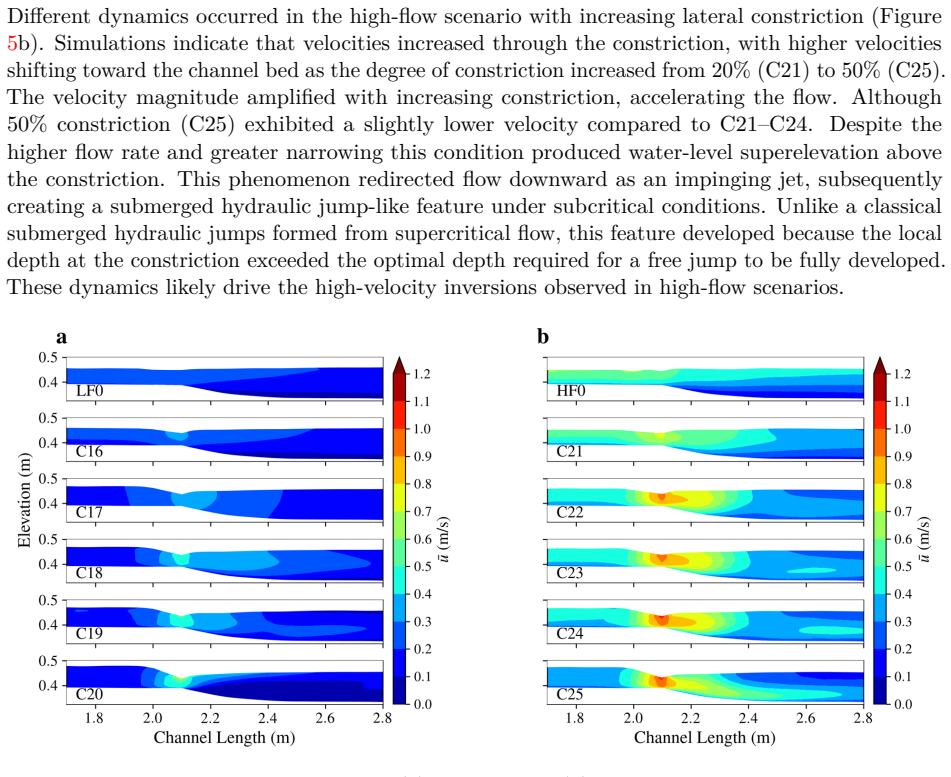
Large-eddy simulations of laboratory-scale bedrock rivers show that the constriction producing the strongest plunging flow shifts with discharge—35% at low flow, 50% at high flow—while maximum bed shear stress occurs at 35% constriction und
Reviewed by Pith at T0; open to challenge. T0 means a machine referee read the full paper against a public rubric. the ladder, T0–T4 →
T0 review · deepseek-v4-flash
2026-08-01 19:34 UTC pith:RQQ5IE3L
load-bearing objection A novel LES study of plunging flows that deserves review, but the central optimum-constriction claim is currently undermined by mass-conservation-inconsistent inlet velocities and a rigid-lid that undercuts the backwater mechanism. the 4 major comments →
Large Eddy Simulation of Plunging Flows in Laboratory-Scale Bedrock Rivers
The pith
A machine-rendered reading of the paper's core claim, the machinery that carries it, and where it could break.
Core claim
On its own terms, the paper claims that large-eddy simulation can reproduce laboratory-scale subcritical plunging flows in bedrock canyon morphologies, and that those simulations reveal a non-monotonic, discharge-dependent control of plunging-flow intensity by lateral constriction. At low flow, the best-defined velocity inversion appears near 35% constriction; at high flow, the most pronounced inversion appears near 50% constriction, where the flow superelevates and plunges as a submerged-hydraulic-jump-like feature. Yet the highest bed shear stresses and turbulent kinetic energy occur at 35% constriction under high flow, because stronger constrictions reduce inlet velocity and produce broad
What carries the argument
The central machinery is a large-eddy simulation of a laboratory-scale constriction-pool-widening bedrock-river flume, with a rigid-lid free-slip water surface, no-slip roughened bed and walls, and a one-equation subgrid-scale turbulence model. The controlled inputs are the percentage of lateral constriction and the inflow discharge and velocity; the key diagnostics are the inversion-strength metric (depth of the maximum-velocity core below the water surface), resolved bed shear stress, and turbulent kinetic energy. The constriction creates a jet that plunges toward the bed, and the simulations isolate the downstream pool entrance as the zone of maximum energy extraction and shear.
Load-bearing premise
The load-bearing premise is that fixing the water surface as a rigid, free-slip lid does not change which constriction-discharge combinations produce plunging flows, even though the paper's mechanism for the high-flow case invokes water-level superelevation and backwater effects that the rigid lid cannot represent.
What would settle it
Run the same constriction-pool geometry at 50% constriction and high discharge with a deformable free surface (e.g., a volume-of-fluid or level-set simulation); if the strong velocity inversion disappears or shifts to another constriction, the rigid-lid assumption is the cause and the optimal-constriction claims fail. Alternatively, an experiment that measures the water-surface profile through the constriction and shows no superelevation would undercut the proposed plunging mechanism.
If this is right
- If these simulations are right, bedrock incision models that assume steady, uniform flow will systematically underestimate erosion in constriction-pool-widening reaches, because the erosive stress is concentrated, intermittent, and localized at the pool entrance.
- The constriction-discharge optimum implies that no single constriction severity can be called 'most erosive'; the same geometry can be erosive at one discharge and less so at another, so landscape evolution models must couple hydraulics with discharge history.
- Because maximum shear stress occurs at moderate (35%) constriction rather than the tightest (50%) pinch, canyon evolution models should account for the trade-off between constriction-driven acceleration and the throttling of inlet velocity by upstream backwater.
- The subcritical character of the simulated plunging flows suggests the same modeling approach could be extended to field-scale canyons, where plunging flows are universally subcritical, opening a path to simulate erosive events at discharges too high to measure in the field.
- The observed intermittency—pulsing of the velocity core at roughly 0.7-second periods amid longer eddy oscillations—implies that short-duration measurements and time-averaged surveys may miss the peak erosive phases of plunging flows.
Where Pith is reading between the lines
- The rigid-lid setup may be suppressing the very backwater the authors invoke; a deformable-free-surface run of the 50%-constriction high-flow case would show whether the velocity inversion survives without the fixed lid.
- Because the inversion-strength maximum (50% constriction) and the shear-stress maximum (35%) do not coincide, future work should separate 'plunging-flow strength' as a kinematic quantity from erosive power when comparing field, lab, and model results.
- The pulsing frequencies reported here (≈1.4 Hz in the core, ≈0.85 Hz in the eddies) could be searched for in field velocity records in real bedrock canyons; their presence at similar nondimensional frequencies would suggest the intermittency is not a lab-scale artifact.
- The two discharges studied bracket a small slice of the parameter space; a systematic sweep of constriction versus discharge would yield a phase diagram of plunging-flow regimes that could directly feed incision models.
Editorial analysis
A structured set of objections, weighed in public.
Referee Report
Summary. This paper presents large-eddy simulations of open-channel flow through laboratory-scale bedrock canyon constriction-pool-widening geometries, based on the Hunt et al. (2018) flume experiments. The authors vary lateral constriction (0–50%) and two nominal discharges (0.003 and 0.006 m3/s) and compare simulated velocity fields with digitized dye-trace observations. They report that LES reproduces velocity inversions, that the optimal constriction for plunging flow is ~35% at low flow and ~50% at high flow, that maximum bed shear stress and TKE occur at 35% constriction at high flow, and that plunging flows are intermittent, with implications for bedrock incision.
Significance. If the results are correct, the paper is a valuable step toward eddy-resolving, three-dimensional characterization of plunging flows in bedrock rivers, with direct implications for bedrock incision modeling. The systematic variation of constriction and discharge, the reported resolution metric (kres/ktotal ≥ 80%), and the public availability of processed data are notable strengths. However, the central quantitative claims are compromised by an apparent violation of mass conservation at the inlet and by an internal inconsistency in the low-flow optimal-constriction result. The interpretation also relies on backwater effects that the rigid-lid, free-slip water surface cannot represent. These issues are load-bearing and require substantive revision.
major comments (4)
- [§2.2.2 / Table 2] The inlet boundary conditions are internally inconsistent. With channel width W=0.2032 m and upstream depth d1=0.08 m (Table 1), continuity requires U_in = Q/(W d1). For LF0 the tabulated Q=0.003 m3/s requires U_in=0.185 m/s, but U_in=0.591 m/s is listed, implying an inlet discharge of 0.0096 m3/s (factor 3.2). For C18, U_in=0.385 implies 0.0063 m3/s instead of 0.003; for HF0, U_in=0.680 implies 0.0111 m3/s instead of 0.006; C21 implies 0.0097 m3/s. Consequently the simulated flows are not at the stated discharges, so the 'low flow' versus 'high flow' comparison and the constriction dependence of inversion strength are not for the claimed flow conditions. The authors must correct this, either by using consistent inlet velocities or by reporting the actual simulated discharges, and re-evaluate the optimal-constriction conclusions.
- [§3.2.3 vs §4.2/Abstract] The paper states two different low-flow optimal constrictions. §3.2.3 says 'C19 (40% constriction) exhibited the strongest velocity inversion', while §4.2 says 'at low flow, the best-defined plunging flow happens at 35% constriction' and the abstract claims ~35%. These cannot both be true; the central claim about an optimal constriction at low flow is therefore internally inconsistent. Please reconcile and specify the metric used to define 'best-defined'.
- [§4.3 / §3.2.2] The simulations use a rigid-lid, free-slip water surface based on the observed surface, which the authors acknowledge 'limited the possible expression of a strong backwater'. Nevertheless, §3.2.2 attributes the lower inlet velocity in highly constricted cases to a backwater effect that raises upstream water level, and §4.2/4.3 invoke 'water-level superelevation above the constriction' and hydrostatic pressure recovery as part of the plunging mechanism. With a rigid lid, the free surface cannot deform, so the model cannot generate the backwater feedback that is part of the proposed explanation. The physical mechanism invoked is therefore not simulated; either a free-surface-capable solver should be used, or the interpretation must be revised to what a rigid-lid pressure field can actually represent.
- [§3.1 / Table 3] The validation evidence for the low-flow cases, which underpin the ~35% optimal-constriction claim, is weak. Table 3 shows that the 35% low-flow case (C18) is not within the experimental uncertainty bounds, and only 2 of 5 low-flow cases (C19, C20) fall within bounds, yet the text states 'approximately 60% of CFD predictions fell within the experimental uncertainty envelope'. The 60% figure is not supported by Table 3. In addition, the model is validated against the same Hunt et al. experiments from which the inlet velocities were extracted (with Venditti as co-author on both), so the validation is partly in-sample. The authors should state this explicitly and temper claims of reproduction for low-flow conditions.
minor comments (2)
- [Global] There are recurring typos and inconsistencies in notation: 'RSME' should be 'RMSE'; the variable index assigns 'v' to the vertical direction but 'w' to the lateral direction, while the text uses u and w as streamwise and vertical in Eqs. (13)–(17); please standardize. Location coordinates in §2.5 (e.g., z = 0.4 m) appear inconsistent with the stated flow depths (~0.13 m).
- [References] The reference 'Kusack, Tingan Li, and Jeremy G Venditti' appears to be missing the first author's initials or has an incorrect citation format; please verify. Also, Eq. (12) uses ν_t to compute bed shear stress; since ν_t is the SGS eddy viscosity, the computed 'bed shear stress' may not equal the physical wall shear stress, especially if the wall model already provides a wall shear stress. Please clarify the definition and whether ν_t or total viscosity is appropriate.
Circularity Check
Partial circularity: inlet velocities are taken from the Hunt et al. (2018) dataset used for validation, and the claimed optimal-constriction result is largely encoded in those prescribed inlet velocities, several of which violate the stated discharges.
specific steps
-
fitted input called prediction
[§2.2.2 (Table 2), §2.3, §3.1]
""For the present simulations, we used inlet velocity values extracted from Hunt’s original experimental dataset at the actual channel inlet, which corresponds to our model’s upstream boundary." (§2.2.2) ... "The validation of the numerical simulations was performed using data from the laboratory experiments that employed dye tracing ... generated velocity profiles that could be directly compared to the numerical simulation." (§2.3)"
The model's inflow boundary condition is taken from the same Hunt et al. (2018) experiments whose dye-trace velocities are then used as the validation target. The agreement reported in §3.1 is therefore a test of internal consistency between the prescribed inlet data and downstream measurements, not an independent prediction. This is partial circularity: the simulation is partly conditioned on the very data it is claimed to reproduce.
-
fitted input called prediction
[§3.2.2 / Table 2; §4.2 and §4.3]
""This reduction occurred because higher downstream resistance in the more constricted cases caused an increase in upstream water level, which in turn lowered the inlet velocity to maintain the same discharge." (§3.2.2) ... "the LES simulations employed a rigid-lid approach based on the observed water surface, which limited the possible expression of a strong backwater" (§4.3)"
The backwater-driven decrease in U_in is invoked to explain why the 'optimal' constriction shifts with discharge, but the free surface is rigid, so this decrease cannot emerge from the simulation; it is imposed via Table 2. The imposed U_in values are not consistent with the stated discharges: with W=0.2032 m and d1=0.08 m, continuity gives U_in=0.185 m/s for Q=0.003 m3/s and 0.369 m/s for Q=0.006 m3/s, while Table 2 lists 0.319–0.680 m/s. The central 'optimal constriction' result is therefore substantially encoded in the prescribed boundary velocities rather than produced by the modeled flow.
full rationale
Most of the paper is a conventional LES study: the filtered Navier–Stokes equations are solved with OpenFOAM, grid resolution is checked via kres/ktotal, and comparison with external experiments would normally be a score-0–2 situation. The circularity is partial. First, the inlet velocities in Table 2 were extracted from the Hunt et al. (2018) experimental dataset, and the same experiments' dye-trace velocities are used as the validation target (§2.2.2, §2.3, §3.1). The model is thus conditioned on the data it is then said to 'predict'; this is not a blind test. Second, and more importantly, the central discovery—an 'optimal' constriction of ~35% at low flow and ~50% at high flow—is explained through backwater-driven reductions of inlet velocity with constriction (§3.2.2), but the rigid-lid free surface (§4.3) cannot produce that backwater; the lower U_in values are imposed inputs in Table 2. Continuity with the stated Q=0.003/0.006 m3/s, W=0.2032 m, and d1=0.08 m would require U_in=0.185/0.369 m/s, while Table 2 lists 0.319–0.680 m/s, so the simulated discharges are not the claimed ones. The optimal-constriction pattern is therefore substantially an artifact of prescribed inlet conditions rather than an emergent flow prediction. I do not see a self-citation uniqueness argument, and the Hunt et al. self-citation is not load-bearing in itself; the issue is using the same dataset as both boundary condition and validation target. Overall score 4: some conditioning/partial circularity; the LES core still has independent content.
Axiom & Free-Parameter Ledger
free parameters (4)
- Wall roughness height ks / z0 =
unreported
- Inlet velocity U_in (per case) =
0.319–0.680 m/s (Table 2)
- SGS model constant Ck =
not stated (standard Yoshizawa value)
- Time-averaging window for mean fields =
not stated (25–85 s used for spectra)
axioms (6)
- standard math Incompressible Navier-Stokes equations with LES filtering
- domain assumption One-equation eddy-viscosity SGS model (kEqn) adequately represents unresolved stresses
- domain assumption No-slip rough-wall log-law wall function with unknown ks
- domain assumption Rigid-lid free-slip water surface
- domain assumption Dye traces represent centerline maximum velocity
- domain assumption Laboratory-scale flow dynamics transfer to field-scale subcritical plunging flows
read the original abstract
Non-uniform flow dynamics in bedrock-bound channel morphologies play a critical role in landscape evolution because these reaches are locations along river long profiles where active bedrock incision occurs. Field observations indicate that plunging flows, characterized by velocity inversions within bedrock-bound constriction-pool-widening (CPW) channel morphologies, drive incision at the local scale. These flows generate high shear stresses that promote sediment transport and contribute to the development and maintenance of CPW morphology. Previous studies of plunging flows have relied on coarse-scale field observations and labor-intensive laboratory experiments to investigate their dynamics. Here, we use eddy-resolving computational fluid dynamics models to examine plunging-flow behavior, building on experimental evidence that lateral channel constriction induces plunging flows. Using large-eddy simulations (LES) of laboratory-scale flows, we found that the optimal constriction for generating plunging flows is approximately 35% under lower-flow conditions but increases to 50% at higher flows because of changes in inlet velocity and flow depth. At higher discharge rates, channel constriction further amplifies the plunging effect, producing substantial shear stresses near the point of velocity inversion. Increasing constriction also leads to greater velocity variance and more intermittent pulsing of plunging flows, both of which are likely to enhance incision potential. These findings highlight the need to refine bedrock incision models to better represent the dynamic and complex nature of plunging flows, moving beyond the simplified steady-flow assumptions that underpin most landscape evolution models.
Figures




Reference graph
Works this paper leans on
-
[6]
and Kwoll, Eva and Fairweather, Kirsti and Haught, Dan and Rennie, Colin D
Venditti, Jeremy G. and Kwoll, Eva and Fairweather, Kirsti and Haught, Dan and Rennie, Colin D. and Church, Michael and Hurson, Max , year =. 2016
2016
-
[7]
and Fairweather, Kirsti and Kwoll, Eva and Wong, Michael and Lin, Chan-Yi Martin and Rennie, Colin D
Venditti, Jeremy G. and Fairweather, Kirsti and Kwoll, Eva and Wong, Michael and Lin, Chan-Yi Martin and Rennie, Colin D. and Church, Michael , year =. Atlas of the
-
[8]
Proceedings of the First AFOSR International Conference on DNS/LES, 1997 , author =
Comments on the. Proceedings of the First AFOSR International Conference on DNS/LES, 1997 , author =. 1997 , pages =
1997
-
[9]
Venditti, Jeremy G. and Rennie, Colin D. and Bomhof, James and Bradley, Ryan W. and Little, Malcolm and Church, Michael , month = sep, year =. Flow in bedrock canyons , volume =. Nature , publisher =. doi:10.1038/nature13779 , abstract =
-
[10]
Bayon, Arnau and Valero, Daniel and García-Bartual, Rafael and López-Jiménez, P Amparo and. Performance assessment of. 2016 , pages =. doi:10.1016/j.envsoft.2016.02.018 , journal =
-
[11]
The computation of transonic flow through two-dimensional gas turbine cascades , volume =
McDonald, Patrick W , year =. The computation of transonic flow through two-dimensional gas turbine cascades , volume =
-
[12]
Experiments on pool formation in bedrock canyons , volume =
Cao, Zhihao and Venditti, Jeremy G and Li, Tingan , year =. Experiments on pool formation in bedrock canyons , volume =. J. Geophys. Res. Earth Surf. , publisher =. doi:10.1029/2021JF006456 , number =
-
[13]
Bedrock rivers , booktitle =
Whipple, Kelin X and Dibiase, Roman Alexander and Crosby, BT , year =. Bedrock rivers , booktitle =
-
[15]
A mechanistic model for river incision into bedrock by saltating bed load , volume =
Sklar, Leonard S and Dietrich, William E , year =. A mechanistic model for river incision into bedrock by saltating bed load , volume =. Water Resour. Res. , publisher =. doi:10.1029/2003WR002496 , number =
-
[16]
A model for fluvial bedrock incision by impacting suspended and bed load sediment , volume =
Lamb, Michael P and Dietrich, William E and Sklar, Leonard S , year =. A model for fluvial bedrock incision by impacting suspended and bed load sediment , volume =. J. Geophys. Res. Earth Surf. , publisher =. doi:10.1029/2007JF000915 , number =
-
[17]
Amplification of plunging flows in bedrock canyons , volume =. Geophys. Res. Lett. , author =. 2022 , pages =. doi:10.1029/2022GL098487 , number =
-
[18]
Experiments on the morphological controls of velocity inversions in bedrock canyons , volume =. Earth Surf. Process Landf. , author =. 2018 , pages =. doi:10.1002/esp.4274 , number =
-
[19]
Plunging flow into a reservoir:. J. Hydraul. Eng. , author =. 1984 , pages =. doi:10.1061/(ASCE)0733-9429(1984)110:4(484) , number =
-
[20]
Analysis and modeling of plunging flows , publisher =
Dai, Hsi-Heng , year =. Analysis and modeling of plunging flows , publisher =
-
[21]
Pool fishways, pre-barages and natural bypass channels , volume =
Larinier, Michel , year =. Pool fishways, pre-barages and natural bypass channels , volume =. doi:10.1051/kmae/2002108 , journal =
-
[22]
Modeling of
Draijer, Simon and Evans, Steven and Cotton, George K , year =. Modeling of. World
-
[23]
Numerical analysis of hydraulic jumps using. J. Hydroinformatics , author =. 2015 , pages =. doi:10.2166/hydro.2015.041 , number =
-
[24]
Te , year =
Chow, V. Te , year =. Open-channel
-
[25]
Hydraulics of embankment weirs , volume =. J. Hydraul. Eng. , author =. 1998 , pages =. doi:10.1061/(ASCE)0733-9429(1998)124:9(963) , number =
-
[26]
Submerged flow regimes of rectangular sharp-crested weirs , volume =. J. Hydraul. Eng. , author =. 1996 , pages =. doi:10.1061/(ASCE)0733-9429(1996)122:7(412) , number =
-
[27]
Note on the. J. Hydraul. Eng. , author =. 2007 , pages =. doi:10.1061/(ASCE)0733-9429(2007)133:6(690) , abstract =
-
[28]
Air entrainment by plunging jets , volume =. Chem. Eng. Sci. , author =. 1988 , pages =. doi:10.1016/0009-2509(88)80005-8 , number =
-
[29]
Simulating air entrainment and vortex dynamics in a hydraulic jump , volume =
Witt, Adam and Gulliver, John and Shen, Lian , year =. Simulating air entrainment and vortex dynamics in a hydraulic jump , volume =. doi:10.1016/j.ijmultiphaseflow.2015.02.012 , journal =
-
[30]
Witt, Adam and Gulliver, John S and Shen, Lian , year =. Numerical investigation of vorticity and bubble clustering in an air entraining hydraulic jump , volume =. doi:10.1016/j.compfluid.2018.06.019 , journal =
-
[31]
Transient drilling fluid flow in
Welahettige, Prasanna Kumara Welahetti , year =. Transient drilling fluid flow in
-
[32]
Numerical simulations and laboratory measurements in hydraulic jumps , author =
-
[33]
Areal sorting of bed-load material: the hypothesis of velocity reversal , volume =
Keller, Edward A , year =. Areal sorting of bed-load material: the hypothesis of velocity reversal , volume =. Geol. Soc. Am. Bull. , publisher =. doi:10.1130/0016-7606(1971)82[753:ASOBMT]2.0.CO;2 , number =
-
[34]
Physical modelling vs
do Carmo, José S Antunes , year =. Physical modelling vs. numerical modelling: complementarity and learning , doi =
-
[35]
Applications of computational fluid dynamics (
Xia, Bin and Sun, Da-Wen , year =. Applications of computational fluid dynamics (. Comput. Electron. Agric. , publisher =. doi:10.1016/S0168-1699(01)00177-6 , number =
-
[36]
Alvarez, Laura V and Grams, Paul E , year =. An. J. Geophys. Res. Earth Surf. , publisher =. doi:10.1029/2021JF006149 , number =
-
[37]
The theoretical foundations and potential for large-eddy simulation (
Keylock, CJ and Hardy, RJ and Parsons, DR and Ferguson, RI and Lane, SN and Richards, KS , year =. The theoretical foundations and potential for large-eddy simulation (. Earth-Sci. Rev. , publisher =. doi:10.1016/j.earscirev.2005.03.001 , number =
-
[38]
A method for characterising the sensitivity of turbulent flow fields to the structure of inlet turbulence , doi =
Keylock, CJ and Tokyay, TE and Constantinescu, G , year =. A method for characterising the sensitivity of turbulent flow fields to the structure of inlet turbulence , doi =. J. Turbul. , publisher =
-
[39]
Large-eddy simulation of sediment transport: currents over ripples , volume =
Zedler, Emily A and Street, Robert L , year =. Large-eddy simulation of sediment transport: currents over ripples , volume =. J. Hydraul. Eng. , publisher =. doi:10.1061/(asce)0733-9429(2001)127:6(444) , number =
-
[40]
Le, Trung B and Khosronejad, Ali and Sotiropoulos, Fotis and Bartelt, Nicole and Woldeamlak, Solomon and Dewall, Petronella , year =. Large-eddy simulation of the. J. Hydraul. Res. , publisher =. doi:10.1080/00221686.2018.1534282 , number =
arXiv 2018
-
[41]
Flora, Kevin and Khosronejad, Ali , year =. Uncertainty quantification of large-eddy simulation results of riverine flows: a field and numerical study , volume =. Environ. Fluid Mech. , publisher =. doi:10.1007/s10652-022-09882-1 , number =
-
[42]
Zhang, Jingxin , year =. Significance of generating synthetic turbulence for zonal detached eddy simulation of shallow water flows , volume =. doi:10.1016/j.oceaneng.2021.109418 , journal =
arXiv 2021
-
[43]
Not. Am. Math. Soc. , author =. 2014 , pages =. doi:10.1090/noti1095 , number =
-
[44]
Goc, Konrad A and Lehmkuhl, Oriol and Park, George Ilhwan and Bose, Sanjeeb T and Moin, Parviz , year =. Large eddy simulation of aircraft at affordable cost: a milestone in computational fluid dynamics , volume =. doi:10.1017/flo.2021.17 , journal =
-
[45]
Helical vortex core dynamics and flame interaction in turbulent premixed swirl combustion:
Taamallah, Soufien and Dagan, Y and Chakroun, N and Shanbhogue, SJ and Vogiatzaki, Konstantina and Ghoniem, Ahmed F , year =. Helical vortex core dynamics and flame interaction in turbulent premixed swirl combustion:. Physics of Fluids , publisher =. doi:10.1063/1.5065508 , number =
-
[46]
A study of daytime convective vortices and turbulence in the martian
Spiga, Aymeric and Murdoch, Naomi and Lorenz, Ralph and Forget, François and Newman, Claire and Rodriguez, Sébastien and Pla-Garcia, Jorge and Moreiras, D Viúdez and Banfield, Don and Perrin, Clément and. A study of daytime convective vortices and turbulence in the martian. J. Geophys. Res. Planets , publisher =. 2021 , pages =. doi:10.1029/2020JE006511 ,...
- [47]
-
[48]
Wall-resolved large-eddy simulation of turbulent channel flows with rough walls , volume =
Li, Shilong and Yang, Xiaolei and Jin, Guodong and He, Guowei , year =. Wall-resolved large-eddy simulation of turbulent channel flows with rough walls , volume =. Theor. Appl. Mech. Lett. , publisher =. doi:10.1038/s41598-020-68830-5 , number =
-
[49]
Alvarez, Laura V and Schmeeckle, Mark W and Grams, Paul E , year =. A detached eddy simulation model for the study of lateral separation zones along a large canyon-bound river , volume =. J. Geophys. Res. Earth. Surf. , publisher =. doi:10.1002/2016JF003895 , number =
-
[50]
Turbulence, sediment transport, erosion, and sandbar beach failure processes in
Rueda, Laura Verónica Alvarez , year =. Turbulence, sediment transport, erosion, and sandbar beach failure processes in
-
[51]
Kinematics, topology and significance of dune-related macroturbulence:
Best, Jim , year =. Kinematics, topology and significance of dune-related macroturbulence:. doi:10.1002/9781444304350.ch3 , journal =
-
[52]
The local structure of turbulence in incompressible viscous fluid for very large. Cr Acad. Sci. URSS , author =. 1941 , pages =
1941
-
[53]
Ten questions concerning the large-eddy simulation of turbulent flows , volume =
Pope, Stephen B , year =. Ten questions concerning the large-eddy simulation of turbulent flows , volume =. New J. Phys. , publisher =. doi:10.1088/1367-2630/6/1/035 , number =
-
[54]
Turbulent flows , publisher =
Pope, Stephen B , year =. Turbulent flows , publisher =
-
[55]
Recent advances on the numerical modelling of turbulent flows , volume =
Argyropoulos, Christos D and Markatos, NC , year =. Recent advances on the numerical modelling of turbulent flows , volume =. Appl. Math. Model. , publisher =. doi:10.1016/j.apm.2014.07.001 , number =
-
[56]
Large-eddy simulations of unidirectional water flow over dunes , volume =
Grigoriadis, DGE and Balaras, E and Dimas, AA , year =. Large-eddy simulations of unidirectional water flow over dunes , volume =. J. Geophys. Res. Earth Surf. , publisher =. doi:10.1029/2008JF001014 , number =
-
[57]
Large eddies in the flow over dunes , doi =
Omidyeganeh, Mohammad and Piomelli, Ugo , year =. Large eddies in the flow over dunes , doi =. Seventh
-
[58]
Guo, Lixian and Zhao, Dan and Xu, Jingyuan and Tokhi, Mohammad Osman and Karimi, Hamid Reza , year =. Predicting unsteady heat-fluid interaction features and nonlinear acoustic behaviors in standing-wave thermoacoustic engines using unsteady. doi:10.1016/j.icheatmasstransfer.2023.106617 , journal =
arXiv 2023
-
[59]
Numerical
Lejeune, Anne-Fleur and Calluaud, Damien and Pineau, Gérard and David, Laurent , year =. Numerical. 39th
-
[60]
Shukla, S and Singh, SN and Sinha, Sawan S and Vijayakumar, R , year =. Comparative assessment of. doi:10.1016/j.oceaneng.2021.108954 , journal =
arXiv 2021
-
[61]
Structural control of the rapids and pools of the
Dolan, Robert and Howard, Alan and Trimble, David , year =. Structural control of the rapids and pools of the. Science , publisher =
-
[62]
Experiments on constriction-pool-widening channel morphology in bedrock canyons , publisher =
Kusack, Kyle , year =. Experiments on constriction-pool-widening channel morphology in bedrock canyons , publisher =
-
[63]
Atlas of the
Venditti, J and Fairweather, K and Kwoll, E and Wong, M and Lin, C and Rennie, C and Church, M , year =. Atlas of the
-
[64]
A tensorial approach to computational continuum mechanics using object-oriented techniques , volume =. Comput. phys. , author =. 1998 , pages =. doi:10.1063/1.168744 , number =
doi:10.1063/1.168744 1998
-
[65]
Model development in. J. Appl. Water Eng. Res. , author =. 2015 , pages =. doi:10.1080/23249676.2015.1025442 , number =
arXiv 2015
-
[66]
Openfoam v6 user guide: 7.2 turbulence models , author =
-
[67]
Statistical theory for compressible turbulent shear flows, with the application to subgrid modeling , volume =. Phys. Fluids , author =. 1986 , pages =. doi:10.1063/1.865552 , number =
-
[69]
One-equation sub-grid scale model with variable eddy-viscosity coefficient , volume =
Taghinia, Javad and Rahman, Md Mizanur and Siikonen, Timo and Agarwal, Ramesh K , year =. One-equation sub-grid scale model with variable eddy-viscosity coefficient , volume =. doi:10.1016/j.compfluid.2014.10.014 , journal =
-
[70]
Openfoam v6 user guide: 4.5 solution and algorithm control , journal =
Greenshields, C , year =. Openfoam v6 user guide: 4.5 solution and algorithm control , journal =
-
[71]
Sedimentation engineering: processes, measurements, modeling, and practice , doi =
Garcia, Marcelo , year =. Sedimentation engineering: processes, measurements, modeling, and practice , doi =
-
[72]
Greenshields, C , year =
-
[73]
Courant, Richard and Friedrichs, Kurt and Lewy, Hans , year =. Über die partiellen. Math. Ann. , publisher =. doi:10.1007/BF01448839 , number =
-
[74]
Klein, Markus , year =. An attempt to assess the quality of large eddy simulations in the context of implicit filtering , volume =. Flow Turbul. Combust. , publisher =. doi:doi.org/10.1115/1.4004636 , number =
-
[75]
Fröhlich, Jochen and Von Terzi, Dominic , year =. Hybrid. Prog. Aerosp. Sci. , publisher =. doi:10.1016/j.paerosci.2008.05.001 , number =
-
[76]
On the use of kinetic-energy balance for the feature-based mesh adaptation applied to
Grenouilloux, Adrien and Balarac, Guillaume and Leparoux, Julien and Moureau, Vincent and Lartigue, Ghislain and Bénard, Pierre and Mercier, Renaud and Ferrey, Paul , year =. On the use of kinetic-energy balance for the feature-based mesh adaptation applied to. doi:10.1115/GT2022-80315 , booktitle =
-
[77]
Comparisons of subgrid-scale models for
Feng, Zhipeng and Qi, Huanhuan and Huang, Xuan and Liu, Shuai and Liu, Jian , year =. Comparisons of subgrid-scale models for. J. doi:10.1088/1742-6596/1802/4/042088 , number =
-
[78]
Experimental hydrodynamics , volume =
Tytell, ED and Farrell, AP , year =. Experimental hydrodynamics , volume =. doi:10.1016/B978-0-12-374553-8.00218-5 , journal =
-
[79]
Texture-based visualization of uncertainty in flow fields , doi =
Botchen, Ralf P and Weiskopf, Daniel and Ertl, Thomas , year =. Texture-based visualization of uncertainty in flow fields , doi =
-
[80]
Nobach, Holger and Bodenschatz, Eberhard , year =. Limitations of accuracy in. doi:10.1007/s00348-009-0627-4 , journal =
-
[81]
Optical studies of wave kinematics , doi =
Greated, Clive A and Emarat, Narumon , year =. Optical studies of wave kinematics , doi =. Advances in coastal and ocean engineering , publisher =
-
[82]
Franco, A and Rock, Norman J , year =. The. Boletim do Instituto Oceanográfico , publisher =
-
[83]
Dynamic flow response of crude oil-in-water emulsion during flow through porous media , volume =
Moradi, Mehrnoosh and Kazempour, Mahdi and French, Joshua T and Alvarado, Vladimir , year =. Dynamic flow response of crude oil-in-water emulsion during flow through porous media , volume =. Fuel , publisher =
-
[84]
Experimental investigation on pressure oscillation induced by steam lateral injection into water flow in a horizontal pipe , volume =
Wang, Jie and Lu, Tao and Deng, Jian and Liu, Yu and Lu, Qi and Zhang, Zhuohua , year =. Experimental investigation on pressure oscillation induced by steam lateral injection into water flow in a horizontal pipe , volume =. International Journal of Heat and Mass Transfer , publisher =
-
[85]
Physically based modeling of bedrock incision by abrasion, plucking, and macroabrasion , volume =
Chatanantavet, Phairot and Parker, Gary , year =. Physically based modeling of bedrock incision by abrasion, plucking, and macroabrasion , volume =. Journal of Geophysical Research: Earth Surface , publisher =. doi:doi:10.1029/2008JF001044 , number =
-
[86]
Bedrock rivers , doi =
Whipple, Kelin X and DiBiase, Roman A and Crosby, Benjamin and Johnson, Joel PL , year =. Bedrock rivers , doi =. Treatise on geomorphology , publisher =
-
[87]
Climatic control of bedrock river incision , volume =
Ferrier, Ken L and Huppert, Kimberly L and Perron, J Taylor , year =. Climatic control of bedrock river incision , volume =. Nature , publisher =. doi:doi:10.1038/nature11982 , number =
discussion (0)
Sign in with ORCID, Apple, or X to comment. Anyone can read and Pith papers without signing in.