REVIEW 4 major objections 5 minor 125 references
Trajectory-Aware Retrieval Agents for Temporal Decision- Making
T0 review · 4 major / 5 minor · reviewed 2026-08-02 · deepseek-v4-flash
Pith's one-line read For decisions from temporally ordered text, standard retrieval-augmented generation discards chronology; this paper argues that fitting a latent growth curve to retrieved evidence and iteratively adding SHAP-flagged chunks yields large, con
desk verdict The LGCM-over-embeddings idea is worth a footnote, but the proof is circular and the baselines are mismatched, so the headline results are not established. read the letter →
The pith
A machine-rendered reading of the paper's core claim, the machinery that carries it, and where it could break.
The reading
What carries the argument
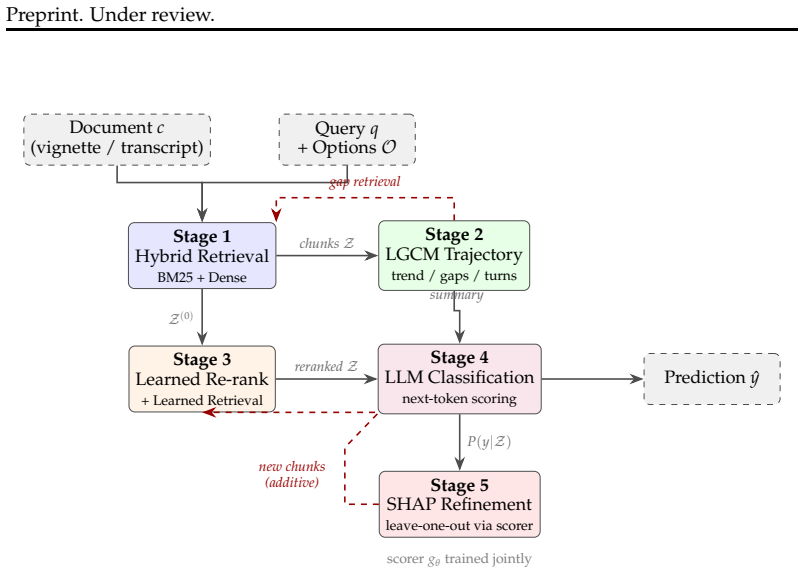
The load-bearing object is the latent growth curve model (LGCM) fit to retrieved chunk embeddings: each chunk is embedded, assigned a normalized time index, and the sequence is regressed on time to estimate an intercept (baseline), slope (rate of change), and residuals. Thresholds on those parameters produce the three signals the pipeline acts on — trend classification, turning-point detection, and gap detection. The second mechanism is the SHAP-guided refinement loop: a small query-gated attention scorer, trained jointly with the LLM, supplies leave-one-out Shapley estimates at about ten milliseconds per chunk, and the mean embedding of positive-contribution chunks seeds a learned query tha
What would settle it
On a held-out set, run the iterative refinement and record the LLM's probability of the correct label before and after each SHAP-guided addition. If a significant fraction of iterations show a decrease — especially when the scorer's φ̂_i is positive — monotonicity is empirically violated. A second check: re-fit the LGCM to chunks in shuffled order; if accuracy does not drop materially, the trajectory summary is not the source of the gains.
Extended reading notes
Core claim
On its own terms, the paper's discovery is that chronological order in retrieved evidence is both recoverable and exploitable. The latent growth curve model decomposes chunk embeddings into a baseline, a linear rate of change, and residuals, and from that decomposition yields three operational signals: trend category, turning points, and trajectory gaps that trigger targeted re-retrieval. A jointly trained lightweight scorer lets the pipeline estimate leave-one-out SHAP values in milliseconds, so evidence refinement can be iterated without repeated LLM forward passes. The paper further asserts a monotonicity guarantee: under a scorer-calibration assumption, additive refinement never decrease
Load-bearing premise
The monotonicity guarantee needs the scorer to be calibrated, meaning a positive leave-one-out score for a chunk genuinely implies that adding that chunk (and any 'semantically similar' chunk retrieved from it) raises the correct class's probability; the paper concedes this holds only approximately.
Editorial extensions
If this is right
- Chronological ordering becomes a first-class input to retrieval for temporal tasks, not a nuisance to be smoothed away.
- Because refinement is additive and argued monotone, the loop can be run many times at inference without a separate utility tracker, making closed-loop retrieval practical.
- The import of classical longitudinal statistics into LLM agents suggests a general recipe: fit structured latent-variable models to evidence embeddings to expose what is missing.
- On financial text, even near near-chance baselines, trajectory-aware retrieval extracts economically meaningful signal — a roughly seven-point accuracy gain over zero-shot on earnings calls, and more than eight thousand dollars in additional final capital in the gap-prediction simulation.
- The method's largest win is where chronology is most explicit (patient trajectories), suggesting temporal structure, not just more context, drives the gains.
Reading between the lines
- A direct test of the trajectory claim: shuffle chunk order within each evidence set at test time and measure accuracy; if gains persist, the model is exploiting content, and if they collapse, temporal ordering is the active ingredient.
- The linear-growth assumption is the likely ceiling; piecewise-linear or change-point growth curves could capture abrupt clinical deterioration or market regime shifts that a single slope cannot represent.
- The calibration assumption in Proposition 1 deserves a direct audit: compare refinement iterations where SHAP-selected chunks were added against random equal-size additions; if random additions perform similarly, the refinement gain is attributable to extra context, not to attribution quality.
- On financial tasks, the gains may partly reflect retrieving high-volatility or high-information chunks rather than true trajectory signal; an ablation replacing the query with a variance-based selection rule would separate the two.
Editorial analysis
A structured set of objections, weighed in public.
Referee Report
Summary. The paper proposes TLM, a five-stage retrieval-augmented agent for temporally structured text: hybrid retrieval; a latent growth curve model over chunk embeddings to extract trend/turning-point/gap signals; learned re-ranking and query construction; LLM next-token classification; and SHAP-guided additive evidence refinement. It claims a monotonicity guarantee (Proposition 1) under a scorer-calibration assumption, and reports large gains over zero-shot LLM and RAG baselines on a MedQA subset, earnings-call surprise prediction, and overnight stock-gap prediction. The central contribution is the combination of LGCM trajectory modeling with SHAP-guided retrieval in the LLM agent loop.
Significance. The problem is well-motivated, and the high-level idea is worth exploring: modeling retrieved evidence as a temporal trajectory and using a cheap attention scorer for leave-one-out Shapley values is a practical way to make iterative refinement feasible; the additive-only design is a sensible safeguard. If the empirical claims survived matched-baseline and ablation tests, this would be a useful contribution to temporal decision-making with LLMs. As written, however, the paper does not establish that LGCM/SHAP cause the reported gains (LoRA fine-tuning alone could), and the main theoretical statement is circular. No code or data is provided, so the numbers cannot be independently checked.
major comments (4)
- [§4.5, Proposition 1] Proposition 1 is not a valid derivation. The calibration assumption ('φ̂_i>0 implies non-negative marginal contribution to P(y*|·)') already assumes the conclusion for the scorer; the proof then adds 'the assumption that semantically similar chunks have non-negative marginal contribution' and concludes non-decrease, which restates the theorem. No argument connects the scorer's aggregate to the LLM softmax probability; adding chunks changes all logits and, under attention pooling, existing chunk representations. The text concedes monotonicity 'holds approximately,' making the guarantee heuristic. Remove Proposition 1 or replace it with a non-circular statement.
- [§5, Tables 3/5/6] All LLM baselines are zero-shot while TLM is LoRA fine-tuned; Table 3 has no RAG+LLM baseline, Tables 5–6 do not state that BM25+LLM/Embedding+LLM are fine-tuned, and §4.6 describes LoRA only for TLM. The reported gains (+29.6, +4.4, +10.8 pts) could therefore come entirely from LoRA adaptation. Add a matched fine-tuned plain-RAG baseline and ablations dropping LGCM and SHAP; otherwise the central empirical claim is unsubstantiated.
- [§5.1, Table 3] The Embedding baseline (15.3%) is below the 20% random chance of 5-way classification. This is implausible for a trained scorer and suggests a bug or typo. It is used to argue that semantic similarity alone is insufficient, so it must be corrected; also report confidence intervals for all accuracies.
- [§5.3, Table 6] The trading comparison lacks number of trades, confidence intervals, and transaction costs. The zero-shot baseline has higher win rate (80.0 vs 71.4) and Sharpe (13.5 vs 5.62); final capital depends on trade frequency and full-investment rule. The paper itself warns that Sharpe figures are unreliable due to few trades. Report trade counts and return distributions before claiming 'economically meaningful gains.'
minor comments (5)
- [§4.2] Define \|\Delta e\| and the 'mean residual norm' used in the turning-point and gap thresholds.
- [Notation] P(y*|Z) denotes both LLM probability and scorer probability (Eq. (3) vs. Proposition 1); use distinct symbols.
- [Table 3] The cell reads '0.1530.642'; missing separator.
- [§5.1] Specify how 'questions containing patient clinical trajectories' were selected; otherwise the subset is not reproducible.
- [§6] The stated limitation that temporal ordering is inferred from chunk position should be tested on interleaved timelines.
Circularity Check
The claimed monotonicity guarantee in Proposition 1 is the calibration assumption restated; the proof imports the conclusion as an extra assumption and conflates the scorer's aggregate with the LLM softmax.
-
self definitional
[Section 4.5, Proposition 1 (statement and proof)]
"Suppose the scorer gθ is calibrated in the sense that φ̂i>0 implies zi has non-negative marginal contribution to the true posterior P(y*|·). ... Under the assumption that semantically similar chunks have non-negative marginal contribution ... adding Znew to the evidence set does not decrease the importance-weighted aggregate score for the correct class. ... we have P(y*|Z(t+1))≥P(y*|Z(t))."
The conclusion to prove is that adding chunks semantically similar to positive-contribution evidence does not decrease P(y*|Z). The proof assumes exactly this property: "Under the assumption that semantically similar chunks have non-negative marginal contribution ... adding Znew to the evidence set does not decrease..." The only stated premise, scorer calibration on the existing chunks, does not imply the same property for newly retrieved chunks; it is simply re-entered as an assumption. Moreover, Eq. (3) defines φ̂i using the lightweight scorer's leave-one-out probabilities, while the proposition's P(y*|·) is the LLM softmax; no equation in the paper identifies the two, so calibration is asserted for a different probability than the one in the conclusion.
full rationale
The paper's main empirical pipeline (LGCM trajectory signals, SHAP-guided additive retrieval, LoRA fine-tuning) is not circular in itself, and the external datasets provide independent evaluation. The one place where a claimed derivation reduces to its own input is Proposition 1: the monotonicity guarantee is obtained by adding the target property as an extra assumption about semantically similar chunks, and the proof silently moves from the scorer's importance-weighted aggregate to the LLM's softmax probability. The abstract and Section 4.5 present this as a proven guarantee, so the circularity is material to the paper's theoretical claims. The missing matched fine-tuned RAG baselines are a genuine confound for the empirical comparison, but that is a validity concern rather than a definitional circularity and is not counted separately here. No load-bearing self-citation or uniqueness-imported-from-authors pattern appears.
Assumptions & free parameters
free parameters (8)
- LGCM trend classification thresholds =
||β|| < 0.05||μ||; cos(β,μ) > 0.3; cos(β,μ) < -0.3
- Gap detection multiplier =
1.5 · ||Δe||
- Hybrid retrieval weight α =
not reported
- Retrieval depths =
kBM25=15, kemb=15, khybrid=8 (top-k sweep {3,5,8,10,12,15})
- Stock gap class thresholds =
±1%
- Event-conditioned selection threshold =
3% overnight return
- Chunk sizes and overlap =
128 words/32 overlap; 5 days/1 day
- SHAP feedback iterations =
1
assumptions (5)
- domain assumption Temporal ordering can be inferred from chunk position within the source document
- ad hoc to paper Scorer calibration: φ̂_i > 0 implies non-negative marginal contribution to the true posterior, and semantically similar chunks inherit non-negative contribution
- domain assumption Linear trajectory in BGE embedding space captures meaningful temporal structure
- domain assumption Event-study market model with a [0,1] CAR window defines the correct earnings surprise label
- ad hoc to paper Retrieval-index order imposes a time axis
Cite this review
Pith. "Pith review of Trajectory-Aware Retrieval Agents for Temporal Decision- Making." pith.science (2026). https://pith.science/paper/RQSSUUHV
@misc{pith2026260721625,
  author       = {Pith},
  title        = {Pith review of: Trajectory-Aware Retrieval Agents for Temporal Decision- Making},
  year         = {2026},
  howpublished = {\url{https://pith.science/paper/RQSSUUHV}},
  note         = {Machine review of arXiv:2607.21625}
}
read the original abstract
We study the problem of decision-making from long-form, temporally structured text using large language model (LLM) agents. Standard retrievalaugmented generation (RAG) pipelines fragment chronological context into isolated snippets, discarding the temporal structure that is often critical for correct downstream decisions. We introduce TLM (Trajectory Language Model), a closed-loop agentic framework that iteratively refines the evidence set using SHAP-guided feedback. The key technical contribution is the latent growth curve model (LGCM) over retrieved chunk embeddings, which provides an interpretable mechanism for detecting trajectory trends, turning points, and information gaps. We show that, under a scorer-calibration assumption (which holds approximately in practice), the iterative refinement procedure is monotonically non-decreasing in the probability assigned to the correct label. Empirically, TLM is evaluated on three temporally grounded decision tasks: medical question answering, earnings call surprise prediction, and overnight stock gap prediction. TLM substantially outperforms both zero-shot LLM baselines and standard retrieval-augmented approaches on the medical task, and yields consistent, economically meaningful gains on the two financial tasks.
Figures
Reference graph
Works this paper leans on
-
[1]
Attention is All you Need , url =
Vaswani, Ashish and Shazeer, Noam and Parmar, Niki and Uszkoreit, Jakob and Jones, Llion and Gomez, Aidan N and Kaiser, ukasz and Polosukhin, Illia , booktitle =. Attention is All you Need , url =
-
[2]
Psychometrika , volume=
Latent curve analysis , author=. Psychometrika , volume=. 1990 , publisher=
1990
-
[3]
2006 , publisher=
Latent Curve Models: A Structural Equation Perspective , author=. 2006 , publisher=
2006
-
[4]
Contributions to the Theory of Games II , editor=
A value for n-person games , author=. Contributions to the Theory of Games II , editor=. 1953 , publisher=
1953
-
[5]
Multivariate Behavioral Research , volume=
A latent difference score approach to growth modeling , author=. Multivariate Behavioral Research , volume=. 1987 , publisher=
1987
-
[6]
2017 , publisher=
Growth Modeling: Structural Equation and Multilevel Modeling Approaches , author=. 2017 , publisher=
2017
-
[7]
Alcoholism: Clinical and Experimental Research , volume=
Integrating person-centered and variable-centered analyses: Growth mixture modeling with latent trajectory classes , author=. Alcoholism: Clinical and Experimental Research , volume=. 2000 , publisher=
2000
-
[8]
2002 , edition=
Hierarchical Linear Models: Applications and Data Analysis Methods , author=. 2002 , edition=
2002
Show all 125 references
-
[9]
2013 , edition=
An Introduction to Latent Variable Growth Curve Modeling: Concepts, Issues, and Applications , author=. 2013 , edition=
2013
-
[10]
Proceedings of the 56th Annual Meeting of the Association for Computational Linguistics , pages=
A multi-axis annotation scheme for event temporal relations , author=. Proceedings of the 56th Annual Meeting of the Association for Computational Linguistics , pages=
-
[11]
When is a liability not a liability?
Loughran, Tim and McDonald, Bill , journal=. When is a liability not a liability?. 2011 , publisher=
2011
-
[12]
Proceedings of the 57th Annual Meeting of the Association for Computational Linguistics , pages=
What you say and how you say it matters: Predicting stock volatility using verbal and vocal cues , author=. Proceedings of the 57th Annual Meeting of the Association for Computational Linguistics , pages=
-
[13]
Proceedings of the 11th ACM International Conference on Web Search and Data Mining , pages=
Listening to chaotic whispers: A deep learning framework for news-oriented stock trend prediction , author=. Proceedings of the 11th ACM International Conference on Web Search and Data Mining , pages=
-
[14]
Advances in Neural Information Processing Systems , volume=
A unified approach to interpreting model predictions , author=. Advances in Neural Information Processing Systems , volume=
-
[15]
2025 , howpublished=
Qwen3 Technical Report , author=. 2025 , howpublished=
2025
-
[17]
Advances in neural information processing systems , volume=
Toolformer: Language models can teach themselves to use tools , author=. Advances in neural information processing systems , volume=
-
[18]
Proceedings of the 41st International Conference on Machine Learning , pages=
Language agent tree search unifies reasoning, acting, and planning in language models , author=. Proceedings of the 41st International Conference on Machine Learning , pages=
-
[19]
Findings of ACL , pages=
Forecasting earnings surprises from conference call transcripts , author=. Findings of ACL , pages=
-
[20]
Journal of financial economics , volume=
Market efficiency, long-term returns, and behavioral finance , author=. Journal of financial economics , volume=. 1998 , publisher=
1998
-
[21]
NAACL , pages=
Reducing hallucination in structured outputs via Retrieval-Augmented Generation , author=. NAACL , pages=
-
[22]
ICML , pages=
Retrieval augmented language model pre-training , author=. ICML , pages=. 2020 , organization=
2020
-
[23]
ICML , year=
Partition First, Embed Later: Laplacian-Based Feature Partitioning for Refined Embedding and Visualization of High-Dimensional Data , author=. ICML , year=
-
[24]
International Conference on Machine Learning (ICML) , year =
Partition First, Embed Later: Feature Partitioning for Refined Embedding and Visualization of High-Dimensional Data , author =. International Conference on Machine Learning (ICML) , year =
-
[25]
Retrieval-Augmented Generation for Knowledge-Intensive
Lewis, Patrick and Perez, Ethan and Piktus, Aleksandra and Petroni, Fabio and Karpukhin, Vladimir and Goyal, Naman and K. Retrieval-Augmented Generation for Knowledge-Intensive. Advances in Neural Information Processing Systems (NeurIPS) , year =
-
[26]
He, Kaiming and Gkioxari, Georgia and Doll. Mask. IEEE International Conference on Computer Vision (ICCV) , year =
-
[27]
European Conference on Computer Vision (ECCV) , year =
End-to-End Object Detection with Transformers , author =. European Conference on Computer Vision (ECCV) , year =
-
[28]
Advances in Neural Information Processing Systems (NeurIPS) , year =
Laplacian Score for Feature Selection , author =. Advances in Neural Information Processing Systems (NeurIPS) , year =
-
[29]
Applied and Computational Harmonic Analysis , year =
Laplacian Eigenmaps and Spectral Techniques for Embedding and Clustering , author =. Applied and Computational Harmonic Analysis , year =
-
[30]
OpenReview submission:
Anonymous , journal =. OpenReview submission:. 2024 , note =
2024
-
[31]
ICML , year =
Sebastian Borgeaud and Arthur Mensch and Jordan Hoffmann and Trevor Cai and Eliza Rutherford and Katie Millican and George Bm Van Den Driessche and Jean-Baptiste Lespiau and Bogdan Damoc and Aidan Clark and others , title =. ICML , year =
-
[32]
ICLR , year =
Gautier Izacard and Edouard Grave , title =. ICLR , year =
-
[33]
ICLR , year =
Urvashi Khandelwal and Omer Levy and Dan Jurafsky and Luke Zettlemoyer and Mike Lewis , title =. ICLR , year =
-
[34]
2023 , note =
Jiatong Li and Yunqing Liu and Wenqi Fan and Xiao-Yong Wei and Hui Liu and Jiliang Tang and Qing Li , title =. 2023 , note =
2023
-
[35]
EMNLP , year =
Sewon Min and Julian Michael and Hannaneh Hajishirzi and Luke Zettlemoyer , title =. EMNLP , year =
-
[36]
Findings of EMNLP , year =
Kurt Shuster and Spencer Poff and Moya Chen and Douwe Kiela and Jason Weston , title =. Findings of EMNLP , year =
-
[37]
International Conference on Learning Representations (ICLR) , year =
Self-RAG: Learning to Retrieve, Generate, and Critique through Self-Reflection , author =. International Conference on Learning Representations (ICLR) , year =
-
[38]
A Survey on
Fan, Wenqi and Ding, Yujuan and Ning, Liangbo and Wang, Shijie and Li, Hengyun and Yin, Dawei and Chua, Tat-Seng and Li, Qing , journal =. A Survey on. 2024 , url =
2024
-
[39]
Retrieval-Augmented Generation for
Zhao, Penghao and Zhang, Hailin and Yu, Qinhan and Wang, Zhengren and Geng, Yunteng and Fu, Fangcheng and Yang, Ling and Zhang, Wentao and Jiang, Jie and Cui, Bin , journal =. Retrieval-Augmented Generation for. 2024 , url =
2024
-
[40]
arXiv preprint arXiv:2506.05176 , year =
Qwen3 Embedding: Advancing Text Embedding and Reranking Through Training on Large-Scale High-Quality Data , author =. arXiv preprint arXiv:2506.05176 , year =
-
[41]
Proceedings of the IEEE/CVF Conference on Computer Vision and Pattern Recognition (CVPR) , year =
Masked-attention Mask Transformer for Universal Image Segmentation , author =. Proceedings of the IEEE/CVF Conference on Computer Vision and Pattern Recognition (CVPR) , year =
-
[42]
ICCV , year =
Segment Anything , author =. ICCV , year =
-
[43]
Proceedings of the 5th International Workshop on Semantic Evaluation (SemEval) , year =
HeidelTime: High Quality Rule-based Extraction and Normalization of Temporal Expressions , author =. Proceedings of the 5th International Workshop on Semantic Evaluation (SemEval) , year =
-
[44]
ACL , year =
Jitao Xu and Josep-Maria Crego and Jean Senellart , title =. ACL , year =
-
[45]
ACL , year =
Jing Xu and Arthur Szlam and Jason Weston , title =. ACL , year =
-
[46]
Journal of economic literature , volume=
Event studies in economics and finance , author=. Journal of economic literature , volume=. 1997 , publisher=
1997
-
[47]
The eleventh international conference on learning representations , year=
React: Synergizing reasoning and acting in language models , author=. The eleventh international conference on learning representations , year=
-
[48]
Position: Truly Self-Improving Agents Require Intrinsic Metacognitive Learning , author=
-
[49]
Frontiers of Computer Science , volume=
A survey on large language model based autonomous agents , author=. Frontiers of Computer Science , volume=. 2024 , publisher=
2024
-
[50]
2014 , publisher=
Practical planning: extending the classical AI planning paradigm , author=. 2014 , publisher=
2014
-
[51]
1998 , publisher=
Reinforcement learning: An introduction , author=. 1998 , publisher=
1998
-
[52]
Handbook of Mathematical Economics , volume=
Game theory models and methods in political economy , author=. Handbook of Mathematical Economics , volume=. 1981 , publisher=
1981
-
[53]
Proceedings of the 31st International Conference on Computational Linguistics , pages=
ALYMPICS: LLM agents meet game theory , author=. Proceedings of the 31st International Conference on Computational Linguistics , pages=
-
[54]
Science , volume=
Social decision-making: insights from game theory and neuroscience , author=. Science , volume=. 2007 , publisher=
2007
-
[55]
Proceedings of the national academy of sciences , volume=
Equilibrium points in n-person games , author=. Proceedings of the national academy of sciences , volume=. 1950 , publisher=
1950
-
[56]
Nature communications , volume=
Matching patients to clinical trials with large language models , author=. Nature communications , volume=. 2024 , publisher=
2024
-
[57]
Science , volume=
The neural basis of economic decision-making in the ultimatum game , author=. Science , volume=. 2003 , publisher=
2003
-
[58]
Computational Linguistics , volume=
Can large language models transform computational social science? , author=. Computational Linguistics , volume=. 2024 , publisher=
2024
-
[59]
1947 , publisher=
Theory of games and economic behavior, 2nd rev , author=. 1947 , publisher=
1947
-
[60]
2012 , publisher=
Handbook of Markov decision processes: methods and applications , author=. 2012 , publisher=
2012
-
[61]
2014 , publisher=
Markov decision processes: discrete stochastic dynamic programming , author=. 2014 , publisher=
2014
-
[62]
arXiv preprint arXiv:2402.03300 , year=
Deepseekmath: Pushing the limits of mathematical reasoning in open language models , author=. arXiv preprint arXiv:2402.03300 , year=
-
[63]
arXiv preprint arXiv:1707.06347 , year=
Proximal policy optimization algorithms , author=. arXiv preprint arXiv:1707.06347 , year=
-
[65]
AMIA Summits on Translational Science Proceedings , volume=
A large-language model framework for relative timeline extraction from pubmed case reports , author=. AMIA Summits on Translational Science Proceedings , volume=
-
[66]
Metric-Fair Prompting: Treating Similar Samples Similarly , author=
-
[67]
Proceedings of the 62nd Annual Meeting of the Association for Computational Linguistics (Volume 1: Long Papers) , pages=
Math-shepherd: Verify and reinforce llms step-by-step without human annotations , author=. Proceedings of the 62nd Annual Meeting of the Association for Computational Linguistics (Volume 1: Long Papers) , pages=
-
[68]
arXiv preprint arXiv:1312.6114 , year=
Auto-encoding variational bayes , author=. arXiv preprint arXiv:1312.6114 , year=
-
[69]
Journal of the American statistical Association , volume=
Variational inference: A review for statisticians , author=. Journal of the American statistical Association , volume=. 2017 , publisher=
2017
-
[70]
VIKING: Deep variational inference with stochastic projections , author=
-
[71]
arXiv preprint arXiv:2110.14168 , year=
Training verifiers to solve math word problems , author=. arXiv preprint arXiv:2110.14168 , year=
-
[72]
Proceedings of the 25th international conference on Machine learning , pages=
Apprenticeship learning using linear programming , author=. Proceedings of the 25th international conference on Machine learning , pages=
-
[73]
arXiv preprint arXiv:2011.00583 , year=
An overview of multi-agent reinforcement learning from game theoretical perspective , author=. arXiv preprint arXiv:2011.00583 , year=
2011 arXiv
-
[74]
Nature Reviews Cancer , volume=
Cooperation among cancer cells: applying game theory to cancer , author=. Nature Reviews Cancer , volume=. 2019 , publisher=
2019
-
[75]
Machine learning , volume=
Q-learning , author=. Machine learning , volume=. 1992 , publisher=
1992
-
[76]
Transactions on Machine Learning Research , year=
Cognitive architectures for language agents , author=. Transactions on Machine Learning Research , year=
-
[77]
arXiv preprint arXiv:2507.22606 , year=
MetaAgent: Automatically Constructing Multi-Agent Systems Based on Finite State Machines , author=. arXiv preprint arXiv:2507.22606 , year=
-
[78]
RepoAudit: An Autonomous LLM-Agent for Repository-Level Code Auditing , author=
-
[79]
2023 , url =
Yao, Shunyu and Zhao, Jeffrey and Yu, Dian and Du, Nan and Shafran, Izhak and Narasimhan, Karthik and Cao, Yuan , booktitle =. 2023 , url =
2023
-
[81]
Retrieval-Augmented Generation for Knowledge-Intensive
Lewis, Patrick and Perez, Ethan and Piktus, Aleksandra and Petroni, Fabio and Karpukhin, Vladimir and Goyal, Naman and K. Retrieval-Augmented Generation for Knowledge-Intensive. Advances in Neural Information Processing Systems , volume =. 2020 , publisher =
2020
-
[82]
Proceedings of the AAAI Conference on Artificial Intelligence , volume =
Informer: Beyond Efficient Transformer for Long Sequence Time-Series Forecasting , author =. Proceedings of the AAAI Conference on Artificial Intelligence , volume =. 2021 , publisher =. doi:10.1609/aaai.v35i12.17325 , url =
2021 doi
-
[83]
The Annals of Statistics , volume=
Statistical behavior and consistency of classification methods based on convex risk minimization , author=. The Annals of Statistics , volume=. 2004 , publisher=
2004
-
[84]
SIGIR , pages=
A test collection for matching patients to clinical trials , author=. SIGIR , pages=
-
[85]
Proceedings of the 2018 conference on empirical methods in natural language processing , pages=
HotpotQA: A dataset for diverse, explainable multi-hop question answering , author=. Proceedings of the 2018 conference on empirical methods in natural language processing , pages=
2018
-
[86]
2022 , url=
Hu, Edward J and Shen, Yelong and Wallis, Phillip and Allen-Zhu, Zeyuan and Li, Yuanzhi and Wang, Shean and Wang, Lu and Chen, Weizhu , booktitle=. 2022 , url=
2022
-
[87]
What disease does this patient have?
Jin, Di and Pan, Eileen and Oufattole, Nassim and Weng, Wei-Hung and Fang, Hanyi and Szolovits, Peter , journal=. What disease does this patient have?. 2021 , publisher=
2021
-
[89]
Self-rag: Learning to retrieve, generate, and critique through self-reflection
Akari Asai, Zeqiu Wu, Yizhong Wang, Avirup Sil, and Hannaneh Hajishirzi. Self-rag: Learning to retrieve, generate, and critique through self-reflection. In International Conference on Learning Representations (ICLR), 2024. URL https://arxiv.org/abs/2310.11511. arXiv:2310.11511
2024 arXiv
-
[90]
Reducing hallucination in structured outputs via retrieval-augmented generation
Orlando Ayala and Patrice Bechard. Reducing hallucination in structured outputs via retrieval-augmented generation. In NAACL, pp.\ 228--238, 2024
2024
-
[91]
Latent Curve Models: A Structural Equation Perspective
Kenneth A Bollen and Patrick J Curran. Latent Curve Models: A Structural Equation Perspective. John Wiley & Sons, 2006
2006
-
[92]
Improving language models by retrieving from trillions of tokens
Sebastian Borgeaud, Arthur Mensch, Jordan Hoffmann, Trevor Cai, Eliza Rutherford, Katie Millican, George Bm Van Den Driessche, Jean-Baptiste Lespiau, Bogdan Damoc, Aidan Clark, et al. Improving language models by retrieving from trillions of tokens. In ICML, pp.\ 2206--2240, 2022
2022
-
[93]
An Introduction to Latent Variable Growth Curve Modeling: Concepts, Issues, and Applications
Terry E Duncan, Susan C Duncan, and Lisa A Strycker. An Introduction to Latent Variable Growth Curve Modeling: Concepts, Issues, and Applications. Routledge, 2nd edition, 2013
2013
-
[94]
Market efficiency, long-term returns, and behavioral finance
Eugene F Fama. Market efficiency, long-term returns, and behavioral finance. Journal of financial economics, 49 0 (3): 0 283--306, 1998
1998
-
[95]
A survey on RAG meeting LLM s: Towards retrieval-augmented large language models
Wenqi Fan, Yujuan Ding, Liangbo Ning, Shijie Wang, Hengyun Li, Dawei Yin, Tat-Seng Chua, and Qing Li. A survey on RAG meeting LLM s: Towards retrieval-augmented large language models. arXiv preprint arXiv:2405.06211, 2024. URL https://arxiv.org/abs/2405.06211
2024 arXiv
-
[96]
Retrieval-augmented generation for large language models: A survey
Yunfan Gao, Yun Xiong, Xinyu Gao, Kangxiang Jia, Jinliu Pan, Yuxi Bi, Yi Dai, Jiawei Sun, and Haofen Wang. Retrieval-augmented generation for large language models: A survey. arXiv preprint arXiv:2312.10997, 2023
2023 arXiv
-
[97]
Growth Modeling: Structural Equation and Multilevel Modeling Approaches
Kevin J Grimm, Nilam Ram, and Ryne Estabrook. Growth Modeling: Structural Equation and Multilevel Modeling Approaches. Guilford Press, 2017
2017
-
[98]
Retrieval augmented language model pre-training
Kelvin Guu, Kenton Lee, Zora Tung, Panupong Pasupat, and Mingwei Chang. Retrieval augmented language model pre-training. In ICML, pp.\ 3929--3938. PMLR, 2020
2020
-
[99]
LoRA : Low-rank adaptation of large language models
Edward J Hu, Yelong Shen, Phillip Wallis, Zeyuan Allen-Zhu, Yuanzhi Li, Shean Wang, Lu Wang, and Weizhu Chen. LoRA : Low-rank adaptation of large language models. In International Conference on Learning Representations, 2022. URL https://openreview.net/forum?id=nZeVKeeFYf9
2022
-
[100]
Listening to chaotic whispers: A deep learning framework for news-oriented stock trend prediction
Ziniu Hu, Weiqing Liu, Jiang Bian, Xuanzhe Liu, and Tie-Yan Liu. Listening to chaotic whispers: A deep learning framework for news-oriented stock trend prediction. In Proceedings of the 11th ACM International Conference on Web Search and Data Mining, pp.\ 261--269, 2018
2018
-
[101]
Distilling knowledge from reader to retriever for question answering
Gautier Izacard and Edouard Grave. Distilling knowledge from reader to retriever for question answering. In ICLR, 2021
2021
-
[102]
What disease does this patient have? A large-scale open domain question answering dataset from medical exams
Di Jin, Eileen Pan, Nassim Oufattole, Wei-Hung Weng, Hanyi Fang, and Peter Szolovits. What disease does this patient have? A large-scale open domain question answering dataset from medical exams. Applied Sciences, 11 0 (14): 0 6421, 2021
2021
-
[103]
Matching patients to clinical trials with large language models
Qiao Jin, Zifeng Wang, Charalampos S Floudas, Fangyuan Chen, Changlin Gong, Dara Bracken-Clarke, Elisabetta Xue, Yifan Yang, Jimeng Sun, and Zhiyong Lu. Matching patients to clinical trials with large language models. Nature communications, 15 0 (1): 0 9074, 2024
2024
-
[104]
Forecasting earnings surprises from conference call transcripts
Ross Koval, Nicholas Andrews, and Xifeng Yan. Forecasting earnings surprises from conference call transcripts. In Findings of ACL, pp.\ 8197--8209, 2023
2023
-
[105]
u ttler, Mike Lewis, Wen-tau Yih, Tim Rockt \
Patrick Lewis, Ethan Perez, Aleksandra Piktus, Fabio Petroni, Vladimir Karpukhin, Naman Goyal, Heinrich K \"u ttler, Mike Lewis, Wen-tau Yih, Tim Rockt \"a schel, Sebastian Riedel, and Douwe Kiela. Retrieval-augmented generation for knowledge-intensive NLP tasks. In Advances i...
2020
-
[106]
When is a liability not a liability? T extual analysis, dictionaries, and 10- K s
Tim Loughran and Bill McDonald. When is a liability not a liability? T extual analysis, dictionaries, and 10- K s. The Journal of Finance, 66 0 (1): 0 35--65, 2011
2011
-
[107]
A unified approach to interpreting model predictions
Scott M Lundberg and Su-In Lee. A unified approach to interpreting model predictions. In Advances in Neural Information Processing Systems, volume 30, 2017
2017
-
[108]
Event studies in economics and finance
A Craig MacKinlay. Event studies in economics and finance. Journal of economic literature, 35 0 (1): 0 13--39, 1997
1997
-
[109]
A latent difference score approach to growth modeling
John J McArdle. A latent difference score approach to growth modeling. Multivariate Behavioral Research, 22 0 (4): 0 479--497, 1987
1987
-
[110]
Latent curve analysis
William Meredith and John Tisak. Latent curve analysis. Psychometrika, 55 0 (1): 0 107--122, 1990
1990
-
[111]
Integrating person-centered and variable-centered analyses: Growth mixture modeling with latent trajectory classes
Bengt Muth \'e n and Linda K Muth \'e n. Integrating person-centered and variable-centered analyses: Growth mixture modeling with latent trajectory classes. Alcoholism: Clinical and Experimental Research, 24 0 (6): 0 882--891, 2000
2000
-
[112]
A multi-axis annotation scheme for event temporal relations
Qiang Ning, Hao Wu, and Dan Roth. A multi-axis annotation scheme for event temporal relations. In Proceedings of the 56th Annual Meeting of the Association for Computational Linguistics, pp.\ 1318--1328, 2018
2018
-
[113]
O'Brien, Carrie J
Joon Sung Park, Joseph C. O'Brien, Carrie J. Cai, Meredith Ringel Morris, Percy Liang, and Michael S. Bernstein. Generative agents: Interactive simulacra of human behavior. In Proceedings of the 36th Annual ACM Symposium on User Interface Software and Technology (UIST '23). AC...
2023
-
[114]
What you say and how you say it matters: Predicting stock volatility using verbal and vocal cues
Yu Qin and Yi Yang. What you say and how you say it matters: Predicting stock volatility using verbal and vocal cues. In Proceedings of the 57th Annual Meeting of the Association for Computational Linguistics, pp.\ 390--401, 2019
2019
-
[115]
Hierarchical Linear Models: Applications and Data Analysis Methods
Stephen W Raudenbush and Anthony S Bryk. Hierarchical Linear Models: Applications and Data Analysis Methods. Sage Publications, 2nd edition, 2002
2002
-
[116]
Toolformer: Language models can teach themselves to use tools
Timo Schick, Jane Dwivedi-Yu, Roberto Dess \` , Roberta Raileanu, Maria Lomeli, Eric Hambro, Luke Zettlemoyer, Nicola Cancedda, and Thomas Scialom. Toolformer: Language models can teach themselves to use tools. Advances in neural information processing systems, 36: 0 68539--68...
2023
-
[117]
A value for n-person games
Lloyd S Shapley. A value for n-person games. In Harold W Kuhn and Albert W Tucker (eds.), Contributions to the Theory of Games II, pp.\ 307--317. Princeton University Press, 1953
1953
-
[118]
Retrieval augmentation reduces hallucination in conversation
Kurt Shuster, Spencer Poff, Moya Chen, Douwe Kiela, and Jason Weston. Retrieval augmentation reduces hallucination in conversation. In Findings of EMNLP, pp.\ 3784--3803, 2021
2021
-
[119]
Heideltime: High quality rule-based extraction and normalization of temporal expressions
Jannik Str \"o tgen and Michael Gertz. Heideltime: High quality rule-based extraction and normalization of temporal expressions. In Proceedings of the 5th International Workshop on Semantic Evaluation (SemEval), 2010. URL https://aclanthology.org/S10-1071/
2010
-
[120]
Cognitive architectures for language agents
Theodore Sumers, Shunyu Yao, Karthik Narasimhan, and Thomas Griffiths. Cognitive architectures for language agents. Transactions on Machine Learning Research, 2023
2023
-
[121]
Qwen3 technical report
Qwen Team. Qwen3 technical report. https://modelscope.cn/models/Qwen/Qwen3-14B, 2025
2025
-
[122]
A large-language model framework for relative timeline extraction from pubmed case reports
Jing Wang and Jeremy C Weiss. A large-language model framework for relative timeline extraction from pubmed case reports. AMIA Summits on Translational Science Proceedings, 2025: 0 598, 2025
2025
-
[123]
Mimic- rnum \ 4 \ -ext-22mcts: A 22 millions-event temporal clinical time-series dataset with relative timestamp for risk prediction
Jing Wang, Xing Niu, Juyong Kim, Jie Shen, Tong Zhang, and Jeremy C Weiss. Mimic- rnum \ 4 \ -ext-22mcts: A 22 millions-event temporal clinical time-series dataset with relative timestamp for risk prediction. arXiv preprint arXiv:2505.00827, 2025
2025
-
[124]
A survey on large language model based autonomous agents
Lei Wang, Chen Ma, Xueyang Feng, Zeyu Zhang, Hao Yang, Jingsen Zhang, Zhiyuan Chen, Jiakai Tang, Xu Chen, Yankai Lin, et al. A survey on large language model based autonomous agents. Frontiers of Computer Science, 18 0 (6): 0 186345, 2024
2024
-
[125]
C-pack: Packaged resources to advance general chinese embedding
Shitao Xiao, Zheng Liu, Peitian Zhang, and Niklas Muennighoff. C-pack: Packaged resources to advance general chinese embedding. arXiv preprint arXiv:2309.07597, 2023
2023 arXiv
-
[126]
ReAct : Synergizing reasoning and acting in language models
Shunyu Yao, Jeffrey Zhao, Dian Yu, Nan Du, Izhak Shafran, Karthik Narasimhan, and Yuan Cao. ReAct : Synergizing reasoning and acting in language models. In International Conference on Learning Representations, 2023. URL https://arxiv.org/abs/2210.03629
2023 arXiv
-
[127]
Retrieval-augmented generation for AI -generated content: A survey
Penghao Zhao, Hailin Zhang, Qinhan Yu, Zhengren Wang, Yunteng Geng, Fangcheng Fu, Ling Yang, Wentao Zhang, Jie Jiang, and Bin Cui. Retrieval-augmented generation for AI -generated content: A survey. arXiv preprint arXiv:2402.19473, 2024. URL https://arxiv.org/abs/2402.19473
2024 arXiv
-
[128]
Language agent tree search unifies reasoning, acting, and planning in language models
Andy Zhou, Kai Yan, Michal Shlapentokh-Rothman, Haohan Wang, and Yu-Xiong Wang. Language agent tree search unifies reasoning, acting, and planning in language models. In Proceedings of the 41st International Conference on Machine Learning, pp.\ 62138--62160, 2024
2024
-
[129]
Can large language models transform computational social science? Computational Linguistics, 50 0 (1): 0 237--291, 2024
Caleb Ziems, William Held, Omar Shaikh, Jiaao Chen, Zhehao Zhang, and Diyi Yang. Can large language models transform computational social science? Computational Linguistics, 50 0 (1): 0 237--291, 2024
2024
Reviewed August 2, 2026 · model on record in the stance chip above.
Discussion (0). Sign in to comment.