Energy extraction from NED-deformed rotating black holes via the Comisso-Asenjo reconnection process
Pith reviewed 2026-06-29 20:18 UTC · model grok-4.3
The pith
NED deformation parameter g in rotating black holes is bounded by shadow size, quasinormal modes, and reconnection energy extraction.
A machine-rendered reading of the paper's core claim, the machinery that carries it, and where it could break.
Core claim
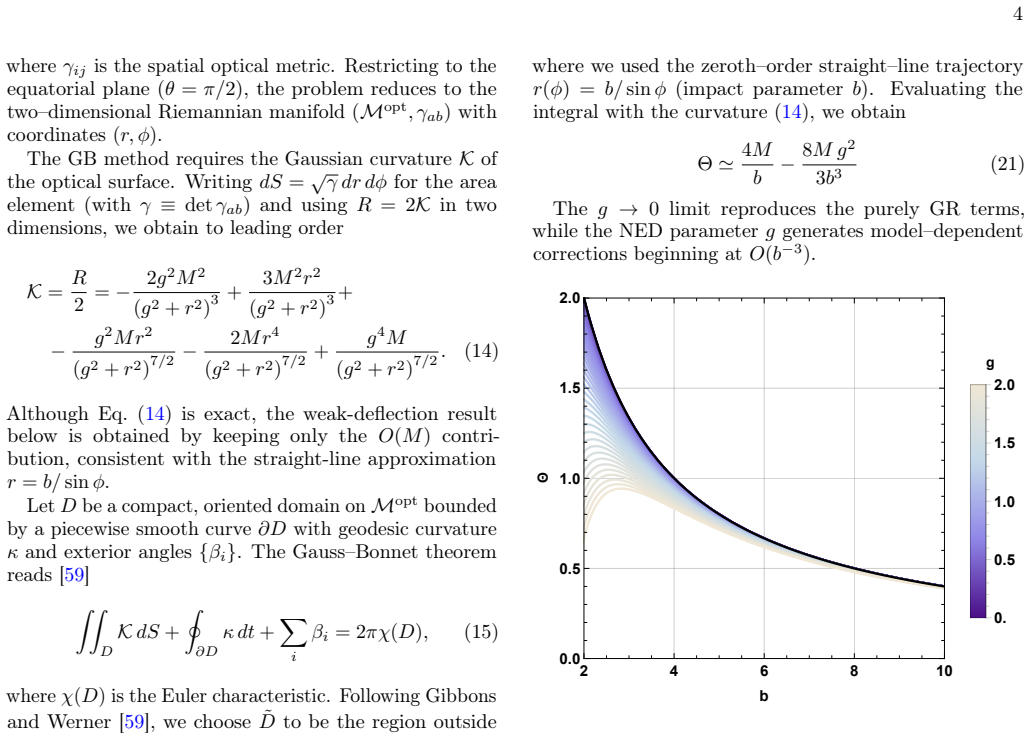
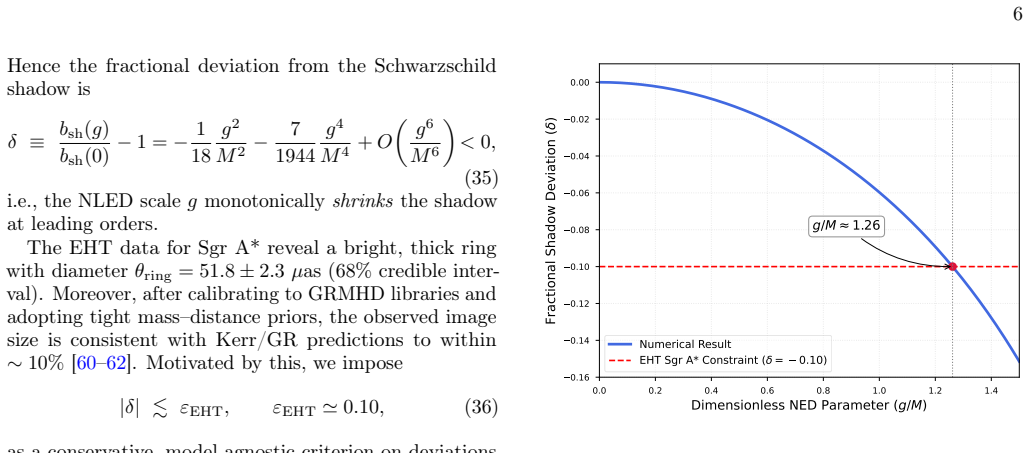
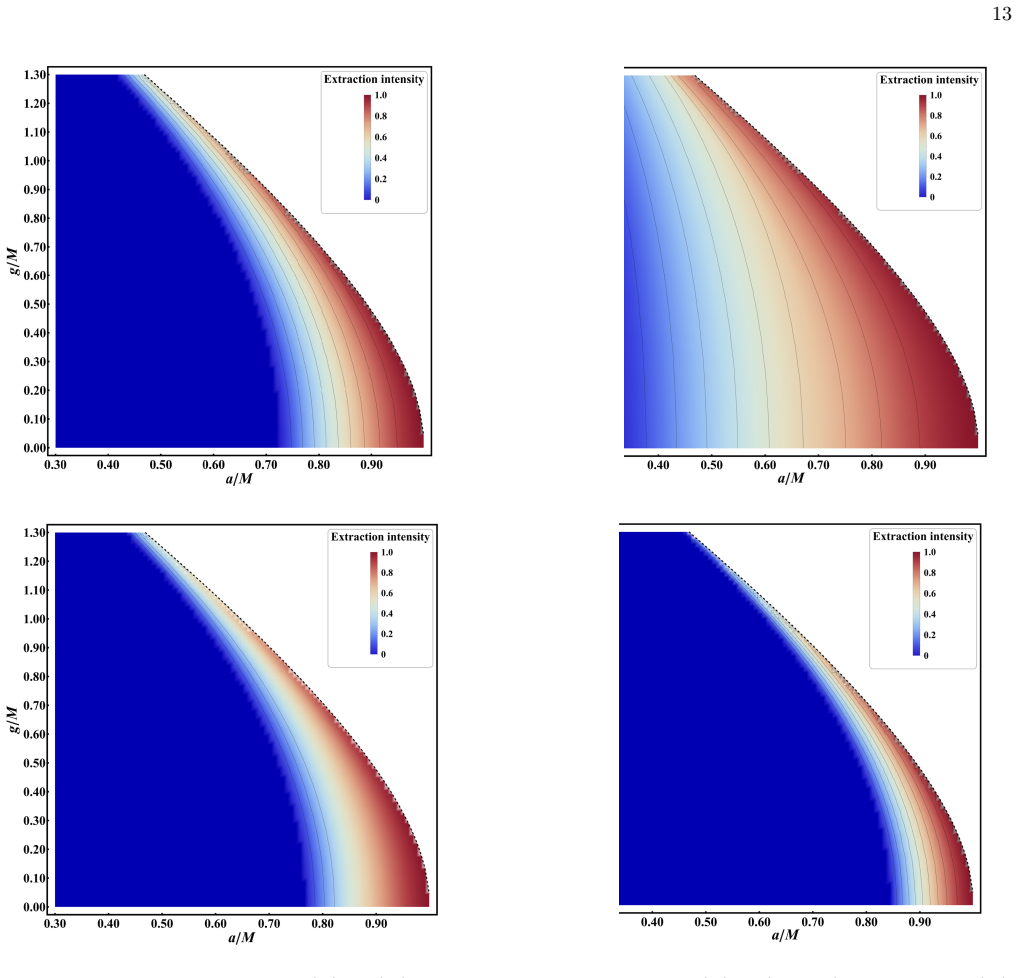
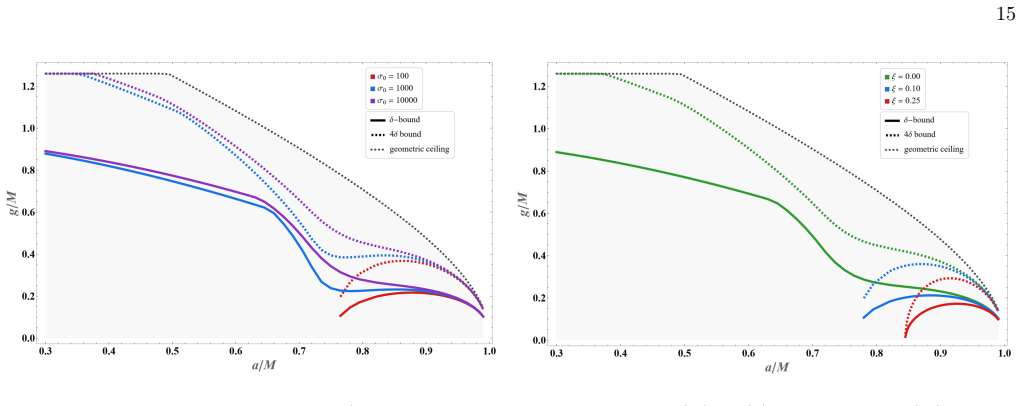
For the spherical seed metric, weak-field lensing and shadow give g/M ≲ 1.26 from Sgr A* tolerance, with matching QNM ceiling; for rotating geometry the ZAMO-frame Comisso-Asenjo process yields an extraction bound g_δ(a|σ0,ξ) such that the two probes together restrict the admissible region for g/M.
What carries the argument
The Comisso-Asenjo magnetic reconnection process formulated in the ZAMO frame, which identifies the negative-energy window and allows integration of extracted power over radii to define the extraction bound.
If this is right
- The non-rotating bound g/M ≲ 1.26 is spin-insensitive.
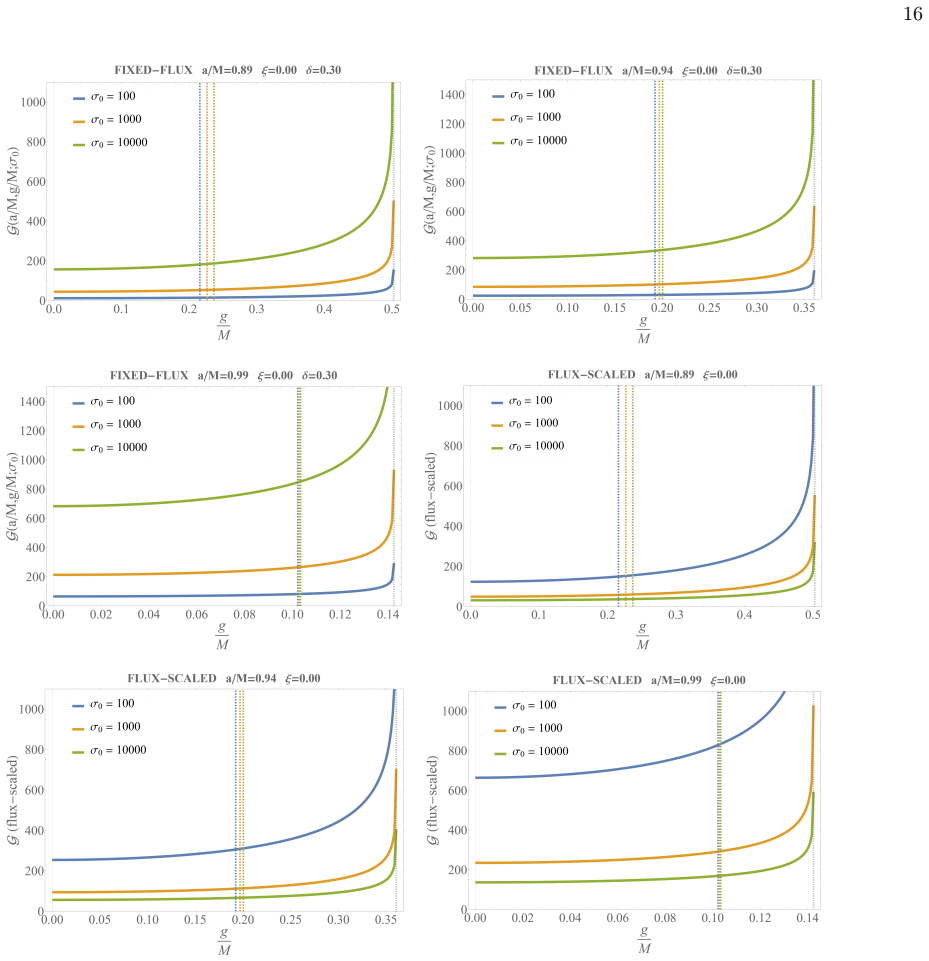
- The rotating extraction bound depends on the spin a/M and tolerance parameters σ0 and ξ.
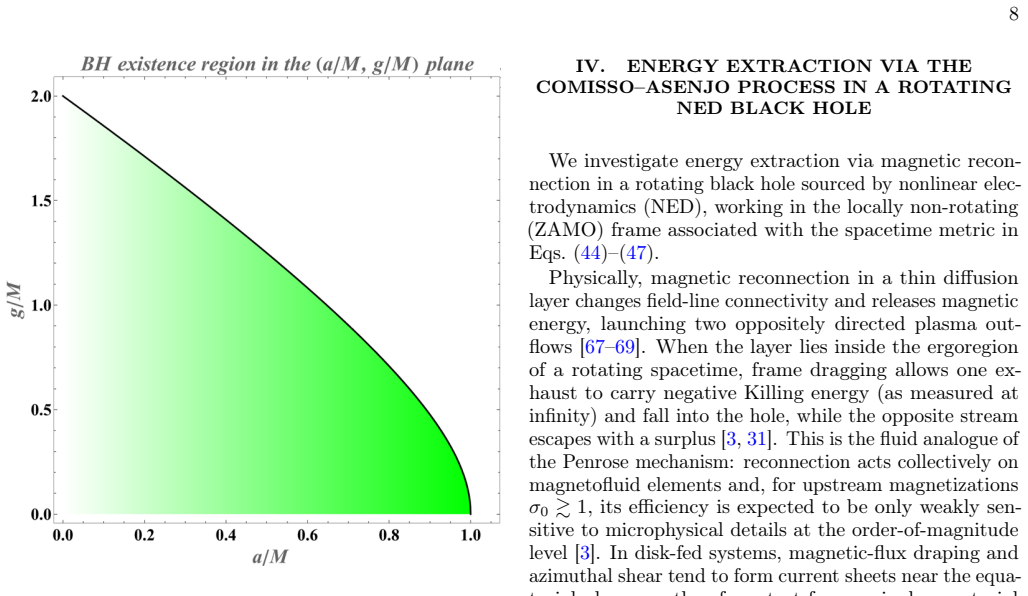
- Combined constraints appreciably narrow the (a/M, g/M) plane.
- The bounds are testable with present data and upcoming horizon-scale and ringdown campaigns.
Where Pith is reading between the lines
- The single-layer equatorial setup could be generalized to include off-equatorial effects or full plasma dynamics to assess robustness of the bounds.
- Similar reconnection analysis might apply to other NED models to derive analogous extraction limits.
- If confirmed, the bounds could guide parameter choices in numerical simulations of accreting NED black holes.
Load-bearing premise
The analysis assumes the axisymmetric NED-deformed metric with parameter g exists in closed form and that the Comisso-Asenjo reconnection channel applies directly in the ZAMO frame without additional NED-induced corrections.
What would settle it
Detection of a shadow radius or quasinormal mode frequency for a black hole that would require g/M larger than 1.26, or measurement of energy extraction efficiency exceeding the Kerr value by more than the tolerated fraction for the derived g.
Figures
read the original abstract
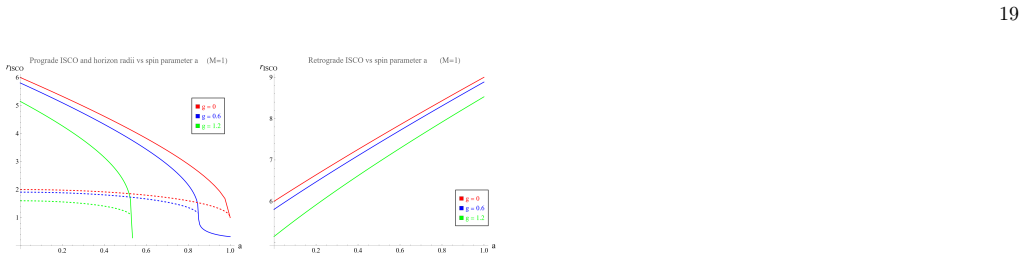
We study rotating black holes in general relativity coupled to nonlinear electrodynamics (NED), focusing on an axisymmetric solution with deformation parameter g. On the spherical seed, weak-field lensing via the Gauss-Bonnet method and the shadow radius yield a spin-insensitive bound by enforcing a conservative ~10% tolerance on the Sgr A* ring size, namely g/M \lesssim 1.26. In the eikonal regime we derive analytic quasinormal-mode shifts, even in g, and obtain an independent ceiling consistent with the shadow constraint. For the rotating geometry, we provide closed-form ZAMO scalars, chart horizons and ergoregion, and analyze equatorial geodesics (photon orbits and ISCO). We then formulate in the ZAMO frame the Comisso-Asenjo reconnection channel, identify the negative-energy window, and integrate the extracted power over the allowed radii; from the tolerated fractional departure from the Kerr power we define a spin-dependent extraction bound g_\delta(a|\sigma_0,\xi). Taken together, the QNM/shadow ceiling and the extraction bound appreciably narrow the admissible region for g/M in the (a/M, g/M) plane, so even within our deliberately simplified, single-layer equatorial setup, the two complementary probes already provide informative constraints on NED deformations, testable with present data and upcoming horizon-scale and ringdown campaigns.
Editorial analysis
A structured set of objections, weighed in public.
Referee Report
Summary. The manuscript derives spin-insensitive bounds on the NED deformation parameter g/M from the shadow radius (via Gauss-Bonnet lensing) and eikonal quasinormal-mode shifts for the spherical seed, enforcing a ~10% tolerance on the Sgr A* ring size. For the rotating axisymmetric solution it supplies closed-form ZAMO scalars, charts the ergoregion and equatorial geodesics, then applies the Comisso-Asenjo reconnection channel in the ZAMO frame to identify the negative-energy window and integrate extracted power, yielding a spin-dependent extraction bound g_δ(a|σ₀,ξ). The central claim is that the combined QNM/shadow ceiling and extraction bound appreciably narrow the admissible region in the (a/M, g/M) plane even within the deliberately simplified equatorial setup.
Significance. If the modeling assumptions hold, the work supplies analytic, observationally testable constraints on NED deformations that are directly comparable to existing Sgr A* shadow data and forthcoming horizon-scale and ringdown measurements; explicit credit is due for the closed-form ZAMO scalars, the even-in-g analytic QNM shifts, and the explicit integration of extracted power over equatorial radii.
major comments (1)
- [Abstract] Abstract and the section formulating the reconnection channel: the extraction bound g_δ(a|σ₀,ξ) and the claim that the two probes narrow the admissible (a/M, g/M) region rest on applying the standard Comisso-Asenjo channel directly to the NED-deformed metric. The formulation assumes g enters solely through the background geometry (ZAMO scalars, horizons, ergoregion, photon orbits) and produces no additional corrections to the local reconnection rate, magnetic-field evolution, or plasma response inside the current sheet. If the NED Lagrangian modifies the electromagnetic stress-energy or reconnection dynamics, both the location of the negative-energy window and the integrated power would shift, directly affecting the tolerated fractional departure from the Kerr case and therefore the spin-dependent bound. This modeling choice is load-bearing for the central narrowing claim but is not quan
minor comments (1)
- [Abstract] Abstract: while the summary of results is clear, the absence of any displayed equations or explicit error tolerances makes it difficult for a reader to assess the numerical values of the bounds (e.g., g/M ≲ 1.26) without immediately turning to the main text.
Simulated Author's Rebuttal
We thank the referee for the careful reading and constructive comments. The major concern is addressed point-by-point below; we will revise the manuscript to clarify the modeling assumptions.
read point-by-point responses
-
Referee: [Abstract] Abstract and the section formulating the reconnection channel: the extraction bound g_δ(a|σ₀,ξ) and the claim that the two probes narrow the admissible (a/M, g/M) region rest on applying the standard Comisso-Asenjo channel directly to the NED-deformed metric. The formulation assumes g enters solely through the background geometry (ZAMO scalars, horizons, ergoregion, photon orbits) and produces no additional corrections to the local reconnection rate, magnetic-field evolution, or plasma response inside the current sheet. If the NED Lagrangian modifies the electromagnetic stress-energy or reconnection dynamics, both the location of the negative-energy window and the integrated power would shift, directly affecting the tolerated fractional departure from the Kerr case and therefore the spin-dependent bound. This modeling choice is load-bearing for the central narrowing claim but
Authors: We agree that the analysis applies the standard Comisso-Asenjo reconnection process assuming the NED parameter g affects only the background geometry (ZAMO frame, ergoregion, photon orbits) without additional corrections to local reconnection rate, magnetic evolution, or plasma response. This is a deliberate simplification, consistent with the abstract's description of a 'deliberately simplified, single-layer equatorial setup,' to isolate geometric effects on the negative-energy window and extracted power. A complete treatment would require coupling the NED Lagrangian to the full electromagnetic stress-energy and MHD equations inside the current sheet, which lies outside the present scope. In the revised manuscript we will add an explicit paragraph in the reconnection section stating this assumption, noting it as a limitation, and indicating that the quantitative bound g_δ(a|σ₀,ξ) could shift under direct NED-plasma coupling. The central claim for geometric narrowing of the (a/M, g/M) region remains valid within the stated model. revision: partial
Circularity Check
No circularity: independent bounds from distinct observables
full rationale
The derivation computes three separate constraints on g/M: (i) shadow radius from Gauss-Bonnet lensing plus ~10% Sgr A* tolerance, (ii) eikonal QNM frequency shifts (even in g), and (iii) integrated extracted power in the ZAMO-frame Comisso-Asenjo channel, from which a spin-dependent g_δ(a|σ0,ξ) is defined via tolerated fractional departure from Kerr. None of these reduces by the paper's own equations to a fitted input, self-citation, or redefinition of another; the extraction calculation uses the closed-form metric scalars directly. No load-bearing self-citation or ansatz smuggling appears. The chain is self-contained against external data and independent calculations.
Axiom & Free-Parameter Ledger
free parameters (1)
- g/M
axioms (2)
- domain assumption Existence of a closed-form axisymmetric solution in GR coupled to NED with deformation parameter g
- domain assumption Comisso-Asenjo reconnection channel applies without modification in the NED-deformed spacetime
Forward citations
Cited by 1 Pith paper
-
Periodic Timelike Motion and Gravitational Wave Signatures around a Magnetically Charged Black Hole Surrounded by Quintessence
Quintessence shifts orbital radii, turning points, and zoom-whirl parameters for timelike geodesics around a magnetically charged black hole, producing burst-like gravitational waveforms whose phase, timing, and milli...
Reference graph
Works this paper leans on
-
[1]
The NED scaleg induces only even–power corrections, reflecting the g→ −g symmetry of(9)
Ωc +O(ℓ 0), −ℑωℓn = (n+ 1 2)λ c +O(ℓ −1), (42) with the orbital frequency and Lyapunov exponent Ωc = 1 3 √ 3M 1 + g2 18M2 − g4 216M4 , λc = 1 3 √ 3M 1− g2 27M2 + 11g 4 648M4 , (43) valid through O(g4/M4)within the linearized-αi eikonal approximation. The NED scaleg induces only even–power corrections, reflecting the g→ −g symmetry of(9). To leading order,...
2017
-
[2]
fast reconnection
and references therein). The two roots correspond to equatorial circular orbits that are co- and counter- rotating with respect to the axial Killing direction(∂ϕ)µ. Throughout this work we take a > 0to fix the spin orientation and define theprograde(co-rotating) branch as the one withsign(ΩK) = sign(a); equivalently, it is the branch that reduces in the K...
-
[3]
S. G. Ghosh and R. K. Walia, Annals of Physics434, 168619 (2021)
2021
- [4]
-
[5]
Comisso and F
L. Comisso and F. A. Asenjo, Physical Review D103, 023014 (2021)
2021
-
[6]
E. H. T. Collaboration, Astrophysical Journal Letters 875, L1 (2019)
2019
-
[7]
K. A. et al., Astrophysical Journal Letters875, L4 (2019)
2019
-
[8]
Collaboration, Astronomy & Astrophysics636, L5 (2020)
G. Collaboration, Astronomy & Astrophysics636, L5 (2020)
2020
-
[9]
S. W. Hawking and G. F. R. Ellis,The Large Scale Struc- ture of Space-Time, Cambridge Monographs on Mathe- matical Physics (Cambridge University Press, 1973)
1973
-
[10]
R. M. Wald, Living Rev. Rel.4, 6 (2001)
2001
-
[11]
J. M. Bardeen, B. Carter, and S. W. Hawking, Commu- nications in Mathematical Physics31, 161 (1973)
1973
-
[12]
A. Allahyari, M. Khodadi, S. Vagnozzi, and D. F. Mota, JCAP02, 003 (2020), arXiv:1912.08231 [gr-qc]
- [13]
-
[14]
E. S. Fradkin and A. A. Tseytlin, Physics Letters B163, 123 (1985)
1985
-
[15]
The Bardeen Model as a Nonlinear Magnetic Monopole
E. Ayon-Beato and A. Garcia, Phys. Lett. B493, 149 (2000), arXiv:gr-qc/0009077
work page internal anchor Pith review Pith/arXiv arXiv 2000
-
[16]
New Regular Black Hole Solution from Nonlinear Electrodynamics
E. Ayon-Beato and A. Garcia, Phys. Lett. B464, 25 (1999), arXiv:hep-th/9911174
work page internal anchor Pith review Pith/arXiv arXiv 1999
-
[17]
G. W. Gibbons and D. A. Rasheed, Nucl. Phys. B454, 185 (1995), arXiv:hep-th/9506035
work page internal anchor Pith review Pith/arXiv arXiv 1995
-
[18]
Construction of Regular Black Holes in General Relativity
Z.-Y. Fan and X. Wang, Phys. Rev. D94, 124027 (2016), arXiv:1610.02636 [gr-qc]
work page internal anchor Pith review Pith/arXiv arXiv 2016
-
[19]
M. Novello, V. A. De Lorenci, J. M. Salim, and R. Klippert, Phys. Rev. D61, 045001 (2000), arXiv:gr- qc/9911085
-
[20]
Higher-dimensional charged black holes solutions with a nonlinear electrodynamics source
M. Hassaine and C. Martinez, Class. Quant. Grav.25, 195023 (2008), arXiv:0803.2946 [hep-th]
work page internal anchor Pith review Pith/arXiv arXiv 2008
-
[21]
Lovelock black holes with a nonlinear Maxwell field
H. Maeda, M. Hassaine, and C. Martinez, Phys. Rev. D 79, 044012 (2009), arXiv:0812.2038 [gr-qc]
work page internal anchor Pith review Pith/arXiv arXiv 2009
-
[22]
S. I. Kruglov, Annals Phys.378, 59 (2017), arXiv:1703.02029 [gr-qc]
work page internal anchor Pith review Pith/arXiv arXiv 2017
-
[23]
S. I. Kruglov, Phys. Rev. D94, 044026 (2016), arXiv:1608.04275 [gr-qc]
work page internal anchor Pith review Pith/arXiv arXiv 2016
-
[24]
Regular electrically charged structures in Nonlinear Electrodynamics coupled to General Relativity
I. Dymnikova, Class. Quant. Grav.21, 4417 (2004), arXiv:gr-qc/0407072
work page internal anchor Pith review Pith/arXiv arXiv 2004
-
[25]
Born and L
M. Born and L. Infeld, Proceedings of the Royal Society of London. Series A, Containing Papers of a Mathematical and Physical Character144, 425 (1934)
1934
-
[26]
A. A. Tseytlin, In: The Many Faces of the Superworld (M. Shifman, ed.) (1999), hep-th/9908105
work page internal anchor Pith review Pith/arXiv arXiv 1999
-
[27]
Lambiaseand A
G. Lambiaseand A. R.Prasanna, Phys. Rev.D70, 063502 (2004)
2004
-
[28]
Lambiase and L
G. Lambiase and L. Mastrototaro, Eur. Phys. J. C79, 728 (2019)
2019
-
[29]
Energy Extraction and Particle Acceleration Around Rotating Black Hole in Horava-Lifshitz Gravity
A. Abdujabbarov, B. Ahmedov, and B. Ahmedov, Phys. Rev. D84, 044044 (2011), arXiv:1107.5389 [astro-ph.SR]
work page internal anchor Pith review Pith/arXiv arXiv 2011
-
[30]
Oteev, A
T. Oteev, A. Abdujabbarov, Z. Stuchlík, and B. Ahme- dov, Astrophys. Space Sci.361, 269 (2016)
2016
-
[31]
Toshmatov, A
B. Toshmatov, A. Abdujabbarov, B. Ahmedov, and Z. Stuchlík, Astrophys. Space Sci.360, 19 (2015)
2015
-
[32]
Kerr Black Holes as Particle Accelerators to Arbitrarily High Energy
M. Banados, J. Silk, and S. M. West, Phys. Rev. Lett. 103, 111102 (2009), arXiv:0909.0169 [hep-ph]
work page internal anchor Pith review Pith/arXiv arXiv 2009
-
[33]
Penrose, Rivista del Nuovo Cimento (1969)
R. Penrose, Rivista del Nuovo Cimento (1969)
1969
-
[34]
Christodoulou and R
D. Christodoulou and R. Ruffini, Physical Review D4, 3552 (1971)
1971
-
[35]
R. D. Blandford and R. L. Znajek, Mon. Not. R. Astron. Soc.179, 433 (1977)
1977
-
[36]
S. S. Komissarov, Mon. Not. R. Astron. Soc.350, 427 (2004)
2004
-
[37]
Tchekhovskoy, R
A. Tchekhovskoy, R. Narayan, and J. C. McKinney, Mon. Not. Roy. Astron. Soc.418, L79 (2011)
2011
-
[38]
Dadhich and A
N. Dadhich and A. R. Prasanna, Phys. Rev. D29, 2712 (1984)
1984
-
[39]
Dadhich and A
N. Dadhich and A. R. Prasanna, Phys. Rev. D30, 1631 (1984)
1984
-
[40]
Dadhich and A
N. Dadhich and A. R. Prasanna, Astrophysical Journal 290, 12 (1985)
1985
-
[41]
Dadhich and A
N. Dadhich and A. R. Prasanna, Astrophysical Journal 370, 38 (1986)
1986
-
[42]
Dadhich, Physics Reports183, 137 (1989)
N. Dadhich, Physics Reports183, 137 (1989)
1989
-
[43]
Dadhich and K
N. Dadhich and K. Lochan, Monthly Notices of the Royal Astronomical Society478, 189 (2018)
2018
-
[44]
Dadhich and K
N. Dadhich and K. Lochan, Universe5, 125 (2019)
2019
-
[45]
Dadhich, Astrophysical Journal895, 14 (2020)
N. Dadhich, Astrophysical Journal895, 14 (2020)
2020
-
[46]
Cheng, S
Z. Cheng, S. Chen, and J. Jing, Chinese Physics C48, 075103 (2024)
2024
-
[47]
S. Rodriguez, A. Sidler, L. Rodriguez, and L. R. Ram- Mohan, arXiv preprint arXiv:2407.15347 (2024)
-
[48]
Zhanget al., Phys
Y. Zhanget al., Phys. Rev. D107, 024014 (2023)
2023
- [49]
-
[50]
Carleo, G
A. Carleo, G. Lambiase, and A. Övgün, Annalen der Physik535, 2200635 (2023)
2023
-
[51]
Bambi, Reviews of Modern Physics91, 025006 (2019)
C. Bambi, Reviews of Modern Physics91, 025006 (2019)
2019
-
[52]
K. A. Bronnikov, Physical Review D63, 044005 (2001), arXiv:gr-qc/0006014 [gr-qc]
work page internal anchor Pith review Pith/arXiv arXiv 2001
-
[53]
Generating rotating regular black hole solutions without complexification
M. Azreg-Ainou, Physical Review D90, 064041 (2014), arXiv:1405.2569 [gr-qc]
work page internal anchor Pith review Pith/arXiv arXiv 2014
-
[54]
P. A. M. Dirac,The Principles of Quantum Mechanics, International series of monographs on physics (Clarendon Press, 1981)
1981
- [55]
- [56]
-
[57]
M. Okyay and A. Övgün, JCAP01, 009 (2022), arXiv:2108.07766 [gr-qc]
- [58]
-
[59]
Y. Kumaran and A. Övgün, Eur. Phys. J. C83, 812 (2023), arXiv:2306.04705 [gr-qc]
- [60]
-
[61]
G. W. Gibbons and M. C. Werner, Class. Quant. Grav. 25, 235009 (2008), arXiv:0807.0854 [gr-qc]
work page internal anchor Pith review Pith/arXiv arXiv 2008
-
[62]
E. H. T. Collaboration, Astrophys. J. Lett.930, L12 (2022)
2022
-
[63]
S. Vagnozziet al., Class. Quant. Grav.40, 165007 (2023), arXiv:2205.07787 [gr-qc]
work page internal anchor Pith review Pith/arXiv arXiv 2023
-
[64]
T. Do, A. Hees,et al., Science365, 664 (2020)
2020
-
[65]
Kocherlakota, L
P. Kocherlakota, L. Rezzolla, and Event Horizon Tele- scope Collaboration, Physical Review D103, 104047 (2021)
2021
-
[66]
Psaltis and Event Horizon Telescope Collaboration, Physical Review Letters125, 141104 (2020)
D. Psaltis and Event Horizon Telescope Collaboration, Physical Review Letters125, 141104 (2020)
2020
-
[67]
R. A. Konoplya, L. Rezzolla, and A. Zhidenko, Physical Review D93, 064015 (2016), arXiv:1602.02378
work page internal anchor Pith review Pith/arXiv arXiv 2016
-
[68]
E. T. Newman and A. I. Janis, Journal of Mathematical Physics6, 915 (1965)
1965
-
[69]
Priest and T
E. Priest and T. Forbes,Magnetic Reconnection: MHD 21 Theory and Applications(Cambridge University Press, Cambridge, 2000)
2000
-
[70]
Yamada, R
M. Yamada, R. Kulsrud, and H. Ji, Reviews of Modern Physics82, 603 (2010)
2010
-
[71]
E. G. Zweibel and M. Yamada, Annual Review of Astron- omy and Astrophysics47, 291 (2009)
2009
-
[72]
J. M. Bardeen, Nature226, 64 (1972)
1972
-
[73]
K. S. Thorne, R. H. Price, and D. A. Macdonald, eds., Black Holes: The Membrane Paradigm(Yale University Press, New Haven, CT, 1986)
1986
-
[74]
Gourgoulhon,3+1 Formalism in General Relativity: Bases of Numerical Relativity, Lecture Notes in Physics, Vol
E. Gourgoulhon,3+1 Formalism in General Relativity: Bases of Numerical Relativity, Lecture Notes in Physics, Vol. 846 (Springer, Berlin Heidelberg, 2012)
2012
-
[75]
Sironi and A
L. Sironi and A. Spitkovsky, The Astrophysical Journal Letters783, L21 (2014)
2014
-
[76]
Guo, Y.-H
F. Guo, Y.-H. Liu, W. Daughton, and H. Li, The Astro- physical Journal806, 167 (2015)
2015
-
[77]
G. R. Werner, D. A. Uzdensky, B. Cerutti, K. Nalewajko, and M. C. Begelman, The Astrophysical Journal Letters 816, L8 (2016)
2016
-
[78]
F. Guo, X. Li, W. Daughton, H. Li, Y.-H. Liu, H. Zhang, and S. Li, Physics of Plasmas27, 080501 (2020)
2020
-
[79]
A. M. Anile,Relativistic Fluids and Magneto-fluids(Cam- bridge University Press, 1989)
1989
-
[80]
Lyubarsky, Monthly Notices of the Royal Astronomical Society358, 113 (2005)
Y. Lyubarsky, Monthly Notices of the Royal Astronomical Society358, 113 (2005)
2005
discussion (0)
Sign in with ORCID, Apple, or X to comment. Anyone can read and Pith papers without signing in.