Weighing Timed Regular Languages: The Final Step (long version)
Pith reviewed 2026-06-27 10:33 UTC · model grok-4.3
The pith
The bandwidth of normal timed automata is computed as α log(1/ε) by reducing the problem to the maximum reward-to-cost ratio on a derived weighted finite graph.
A machine-rendered reading of the paper's core claim, the machinery that carries it, and where it could break.
Core claim
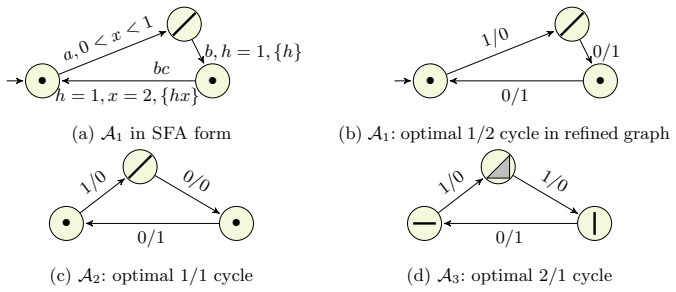
We compute the bandwidth of any such automaton in the form ≈α log 1/ε. Our approach reduces this problem to computing the best reward-to-cost ratio in a weighted finite graph constructed from the given timed automaton.
What carries the argument
Reduction of asymptotic bandwidth computation to the maximum reward-to-cost ratio problem on a weighted finite graph obtained from the timed automaton.
If this is right
- Bandwidth can now be computed algorithmically for every timed regular language.
- The three classes meager, normal, and obese are fully separated by their bandwidth asymptotics.
- Normal languages exhibit bandwidth that scales exactly as a constant times log(1/ε).
- The same reduction applies uniformly to every automaton satisfying the normal-class conditions.
Where Pith is reading between the lines
- The graph-reduction technique could be adapted to compute information measures for other continuous-time models that admit finite abstractions.
- One could verify the method on families of normal automata whose bandwidths are already known by independent means.
- The construction may reveal structural invariants that distinguish normal automata from the other two classes at the level of their underlying graphs.
Load-bearing premise
The weighted finite graph built from the timed automaton preserves the asymptotic bandwidth exactly for all non-punctual transitions and bounded-frequency behaviors.
What would settle it
A concrete normal timed automaton for which the reward-to-cost ratio extracted from the constructed graph differs from the bandwidth measured directly on the original automaton.
Figures
read the original abstract
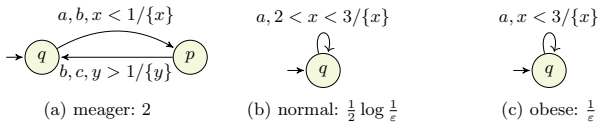
The bandwidth of a timed language characterizes the quantity of information per time unit (with a finite observation precision $\varepsilon$). The asymptotic behavior of the bandwidth as $\varepsilon \to 0$ classifies timed regular languages in three classes: meager, normal, and obese. Normal timed automata have a bounded frequency of events and some non-punctual transitions, and, up to now, were the only class of timed automata for which no algorithm was available for computing their bandwidth. In this article, we compute the bandwidth of any such automaton in the form $\approx\alpha\log{1/\varepsilon}$. Our approach reduces this problem to computing the best reward-to-cost ratio in a weighted finite graph constructed from the given timed automaton.
Editorial analysis
A structured set of objections, weighed in public.
Referee Report
Summary. The paper claims to complete the algorithmic computation of bandwidth for timed regular languages by handling the remaining 'normal' class of timed automata (those with bounded event frequency and non-punctual transitions). It asserts that the bandwidth takes the asymptotic form α log(1/ε) and reduces the problem to computing the maximum reward-to-cost ratio on a weighted finite graph constructed from the input timed automaton.
Significance. If the asserted reduction holds exactly, the result would finish the classification of all timed automata into meager, normal, and obese classes with effective algorithms for each, using a uniform reduction to a standard graph-theoretic optimization problem. This would be a notable contribution to the theory of timed languages and quantitative verification.
major comments (1)
- [Abstract] Abstract: the central claim is a reduction of the bandwidth computation to a best reward-to-cost ratio on a constructed weighted finite graph, but no construction, region encoding, or proof sketch is supplied in the provided text, so it is impossible to check whether the graph preserves the exact asymptotic coefficient α including for non-punctual transitions and bounded-frequency behaviors.
Simulated Author's Rebuttal
We thank the referee for their review and for highlighting the need for greater accessibility of the central construction. The full long-version manuscript contains the graph construction, region encoding, and proof; the comment appears directed at the abstract alone. We address this below.
read point-by-point responses
-
Referee: [Abstract] Abstract: the central claim is a reduction of the bandwidth computation to a best reward-to-cost ratio on a constructed weighted finite graph, but no construction, region encoding, or proof sketch is supplied in the provided text, so it is impossible to check whether the graph preserves the exact asymptotic coefficient α including for non-punctual transitions and bounded-frequency behaviors.
Authors: The referee comment is labeled as applying to the Abstract. The long-version manuscript supplies the explicit construction of the weighted finite graph (via a region-based encoding of the timed automaton that tracks both clock constraints and event frequencies), together with the proof that the maximum reward-to-cost ratio on this graph equals the coefficient α for normal automata. Because the abstract is only a high-level summary, it omits these details; we will insert a short paragraph outlining the region encoding and the reduction in the revised abstract so that the central claim can be verified from the abstract alone. revision: yes
Circularity Check
No significant circularity identified
full rationale
The paper asserts a direct algorithmic reduction of bandwidth computation for normal timed automata to the standard maximum reward-to-cost ratio problem on a finite weighted graph constructed from the automaton. The abstract and provided context contain no equations, self-citations, fitted parameters, or ansatzes that reduce the claimed result back to its inputs by construction. The reduction is presented as preserving the asymptotic quantity exactly via an explicit construction, with no load-bearing reliance on prior author work or renaming of known results. This is a standard self-contained algorithmic claim.
Axiom & Free-Parameter Ledger
Reference graph
Works this paper leans on
-
[1]
Alur, R., Dill, D.L.: A theory of timed automata. Theor. Comput. Sci.126, 183– 235 (1994).https://doi.org/10.1016/0304-3975(94)90010-8
-
[2]
Asarin, E., Basset, N., B´ eal, M.P., Degorre, A., Perrin, D.: Toward a timed theory of channel coding. In: Proc. FORMATS. LNCS, vol. 7595, pp. 27–42. Springer (2012).https://doi.org/10.1007/978-3-642-33365-1_4
-
[3]
Asarin, E., Basset, N., Degorre, A.: Entropy of regular timed languages. Inf. Com- put.241, 142–176 (2015).https://doi.org/10.1016/j.ic.2015.03.003
-
[4]
Asarin, E., Basset, N., Degorre, A.: Distance on timed words and applications. In: Proc. FORMATS. LNCS, vol. 11022, pp. 199–214. Springer (2018).https: //doi.org/10.1007/978-3-030-00151-3_12
-
[5]
Asarin, E., Basset, N., Degorre, A., Perrin, D.: Generating functions of timed languages. In: Proc. MFCS. LNCS, vol. 7464, pp. 124–135. Springer (2012).https: //doi.org/10.1007/978-3-642-32589-2_14
-
[6]
Asarin, E., Degorre, A., Dima, C., Jacobo Incl´ an, B.: Bandwidth of timed au- tomata: 3 classes. In: Proc. FSTTCS. LIPIcs, vol. 284, pp. 10:1–10:17 (2023). https://doi.org/10.4230/LIPICS.FSTTCS.2023.10, full versionhttps://arxiv. org/abs/2310.01941
-
[7]
Asarin, E., Degorre, A., Dima, C., Jacobo Incl´ an, B.: Computing the bandwidth of meager timed automata. In: Proc. CIAA. LNCS, vol. 15015, pp. 19–34. Springer (2024).https://doi.org/10.1007/978-3-031-71112-1_2, full versionhttps:// arxiv.org/abs/2406.12694
-
[8]
Asarin, E., Degorre, A., Dima, C., Jacobo Incl´ an, B.: Weighing obese timed lan- guages. In: Reachability Problems. LNCS, vol. 16230, pp. 112–125. Springer (2026). https://doi.org/10.1007/978-3-032-09524-4_8, full versionhttps://arxiv. org/abs/2508.18133
-
[9]
Cambridge University Press (2009).https://doi.org/10.1017/CBO9781139195768
Berstel, J., Perrin, D., Reutenauer, C.: Codes and Automata. Cambridge University Press (2009).https://doi.org/10.1017/CBO9781139195768
-
[10]
Boja´ nczyk, M.: Factorization forests. In: Proc. DLT. LNCS, vol. 5583, pp. 1–17. Springer (2009).https://doi.org/10.1007/978-3-642-02737-6_1
-
[11]
Bouyer, P., Brinksma, E., Larsen, K.G.: Optimal infinite scheduling for multi- priced timed automata. Formal Methods Syst. Des.32(1), 3–23 (2008).https: //doi.org/10.1007/S10703-007-0043-4
-
[12]
Information and Control1(2), 91 – 112 (1958).https://doi.org/10.1016/S0019-9958(58)90082-2
Chomsky, N., Miller, G.A.: Finite state languages. Information and Control1(2), 91 – 112 (1958).https://doi.org/10.1016/S0019-9958(58)90082-2
-
[13]
Dasdan, A., Irani, S.S., Gupta, R.K.: Efficient algorithms for optimum cycle mean and optimum cost to time ratio problems. In: Proc. DAC. pp. 37–42. ACM (1999). https://doi.org/10.1145/309847.309862
-
[14]
Jacobo Incl´ an, B., Degorre, A., Asarin, E.: Bounded delay timed channel coding. In: Proc. FORMATS. LNCS, vol. 13465, pp. 65–79. Springer (2022).https://doi. org/10.1007/978-3-031-15839-1_4
-
[15]
Kolmogorov, A.N., Tikhomirov, V.M.:ε-entropy andε-capacity of sets in function spaces. Uspekhi Matematicheskikh Nauk14(2), 3–86 (1959).https://doi.org/ 10.1090/trans2/017,http://mi.mathnet.ru/eng/umn7289
-
[16]
Cam- bridge University Press (1995).https://doi.org/10.1017/CBO9780511626302
Lind, D., Marcus, B.: An Introduction to Symbolic Dynamics and Coding. Cam- bridge University Press (1995).https://doi.org/10.1017/CBO9780511626302
-
[17]
M¨ obius, A.F.: Der barycentrische Calcul. J.A. Barth., Leipzig (1827),http:// sites.mathdoc.fr/cgi-bin/oeitem?id=OE_MOBIUS__1_1_0 17
-
[18]
Discrete Event Dynamic Sys- tems10(1–2), 87–113 (2000).https://doi.org/10.1023/A:1008387132377
Puri, A.: Dynamical properties of timed automata. Discrete Event Dynamic Sys- tems10(1–2), 87–113 (2000).https://doi.org/10.1023/A:1008387132377
-
[19]
The Bell System Tech- nical Journal27(3), 379–423 (1948).https://doi.org/10.1002/j.1538-7305
Shannon, C.E.: A mathematical theory of communication. The Bell System Tech- nical Journal27(3), 379–423 (1948).https://doi.org/10.1002/j.1538-7305. 1948.tb01338.x
-
[20]
Simon, I.: Factorization forests of finite height. Theor. Comput. Sci.72(1), 65–94 (1990).https://doi.org/10.1016/0304-3975(90)90047-L 18 A Preliminaries A.1 On geometry of points, runs and words A busy reader can skip this section except its first paragraph, Def. 14 and Lem. 16 that will be used in the proof of the lower bound. A motivated reader is invi...
-
[21]
resetting
and thus|t 1 1−t2 1| ≤ − →d(w 1, w2)< µ/2, and the basis of induction is established. Suppose now, by inductive hypothesis, that (8) holds for somei; we want to prove it fori+ 1. There are two cases, by definition of the gap: –in polytopeP, for all pointst i+1 =t i. In this case,|t 1 i+1 −t 2 i+1|=|t 1 i −t 2 i |< µ/2, as required. –in polytopeP, for all ...
-
[22]
ift i −t 0 >1anda i =b(the heartbeat), mthent i =t pbi + 1; 2.t i ∈[τ+ cb i −1, τ+ cb i + 2]
-
[23]
ift i −t 0 > M, thenx k i =t i −t rk i
-
[24]
Herepb i is the index 12 of the last hearbeat event withina 1,
wheneverr(δ ′) = 0, the duration of this transitiond i =g i(xi−1). Herepb i is the index 12 of the last hearbeat event withina 1, . . . , ai−1; alsocb i stands for the number 13 of heartbeat eventsbwithina 1, . . . , ai, andr k i for the maximalj≤isuch thatδ j resetsx k (it exists since all clocks are bounded byM). Finally,g i are polynomial functions (de...
-
[25]
for each non-zeroa∈O 0 (image of a route from(p 1, ℓ1)→(p 2, ℓ2)with cost and reward 0), its graph corresponds to a surjective functionℓ 1 i →ℓ 2 i for everyi
-
[26]
for image of a cycle from(p, ℓ)→(p, ℓ)(with cost and reward 0), its 0-orbit graph corresponds to a permutationℓ i →ℓ i for everyi
-
[27]
ifab=a̸= 0fora, b∈O 0, thenb= 1 ℓ for a certainℓ. Proof.1. Any vertex of active faceℓ 1 i has a successor vertex inℓ 2 i by Con- str. 2; this successor is unique (otherwise the reward would be>0). As for surjectivity, every vertex inℓ 2 i has a predecessor also by Constr. 2
-
[28]
A surjective function from a finite set to itself is always a permutation
-
[29]
Letvbe a vertex inℓ 2, vertexv ′ its predecessor viaainℓ 1, andv ′′ its successor viabinℓ 2
Orbit graphsaandbcorrespond to some routes from (p 1, ℓ1) to (p 2, ℓ2) and from (p 2, ℓ2) to (p 2, ℓ2), respectively. Letvbe a vertex inℓ 2, vertexv ′ its predecessor viaainℓ 1, andv ′′ its successor viabinℓ 2. Sinceab=a, we have thatv ′′ =v. The only permutation graph satisfying this property for allvis 1 ℓ2. We conclude thatb= 1 ℓ2.⊓ ⊔ Definition 16.A0-...
-
[30]
ifs i −τ >2anda i =b, thent i ∈s pbi + [1−ε,1 +ε]; 2.s i ∈[τ+ cb i −1−ε, τ+ cb i + 2 +ε]
-
[31]
Note that the above constraints are relaxations of the properties in Lemma Lem
ifs i−1 −τ > Mandr(δ ′) = 0, thens i ∈s i−1 +g i(xi−1) + [−νε−ε, νε+ε], wherex k i =s i −s rk i . Note that the above constraints are relaxations of the properties in Lemma Lem. 24. Lemma 9.The setNet fol ε (π, π′, τ)defined in Constr. 3 is anε-net for all words traces of runs following the routeπ, π ′ (starting within[τ, τ+ 1)). Proof.A wordw= (a 1, t1)....
discussion (0)
Sign in with ORCID, Apple, or X to comment. Anyone can read and Pith papers without signing in.