REVIEW 3 major objections 6 minor 37 references
Semi-Automatic Labeling for Deep Learning in Robotics
T0 review · 3 major / 6 minor · reviewed 2026-08-14 · deepseek-v4-flash
Pith's one-line read Drawing a few 3D virtual boxes once in a robot-tracked scene can auto-generate bounding-box labels for tens of thousands of frames, training detectors that match or beat manual annotation.
desk verdict A useful, reproducible AR labeling pipeline whose headline 15% claim overstates a single-run detector comparison; revise the claims, keep the system. read the letter →
The pith
A machine-rendered reading of the paper's core claim, the machinery that carries it, and where it could break.
The reading
What carries the argument
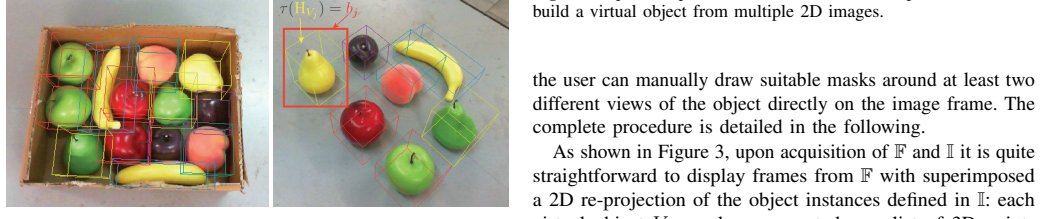
The load-bearing object is the 3D virtual box $V_j = \{ ^{0}T_j, s_j, c_j\}$: a pose, size, and class label attached to each object instance in the world frame. The user defines these boxes either online with an augmented-reality pen (the ARP) whose marker-tracked tip is used to measure four corner points, or offline by drawing masks in two tracked frames and taking their visual hull. During dataset generation, each box's eight vertices are transformed into the camera frame by $^{cam_i}T_0$ and projected through the intrinsics matrix $\hat{A}$ to produce 2D points $H_{V_j}$, from which a bounding box $b_j = \tau(H_{V_j})$ (typically the minimum 2D bounding box, though $\tau$ can be replaced by any custom function) is computed for every frame. The mechanism works only if the tracking poses are accurate enough that reprojection error stays within the label tolerance; the paper shows robot kinematics provides this accuracy, while direct monocular SLAM output does not.
What would settle it
Run the ARS pipeline on a scene where one object moves or deforms between frames after its virtual box is defined, then train a detector and compare its precision and recall to a detector trained on manual labels for the same frames; if the auto-labeled detector performs comparably, the central claim survives, whereas a sharp drop would confirm that the static-rigid-object and pose-accuracy assumptions are load-bearing.
Extended reading notes
Core claim
The central claim is that, given a set of images with accurate 6-DoF camera poses and a small set of user-defined 3D virtual boxes $V_j = \{ ^{0}T_j, s_j, c_j\}$, a deterministic reprojection pipeline can create an arbitrarily large labeled dataset of 2D bounding boxes $b_j = \tau(H_{V_j})$ whose quality is comparable to, and in practice better than, human annotation. The paper demonstrates this on two new datasets, one of electromechanical components and one of fruit, training YOLO and SSD detectors on automatically labeled subsets of increasing size. The central quantitative claims are that nine sequences of about 35,000 frames were annotated in under one hour (a gain factor around 450 over manual labeling), and that both precision and recall of the resulting detectors increase by about 15% relative to training on manually labeled data. A corollary is that the pipeline can also expose the distribution of viewpoints seen during training, which the paper argues matters more than raw dataset size.
Load-bearing premise
The entire pipeline assumes that a 3D virtual box drawn once stays an exact geometric match to its physical object in every frame of the sequence, which requires the objects to be rigid and static, the initial box to be accurate, and the camera pose per frame to be accurate enough that reprojection error stays within the label tolerance.
Editorial extensions
If this is right
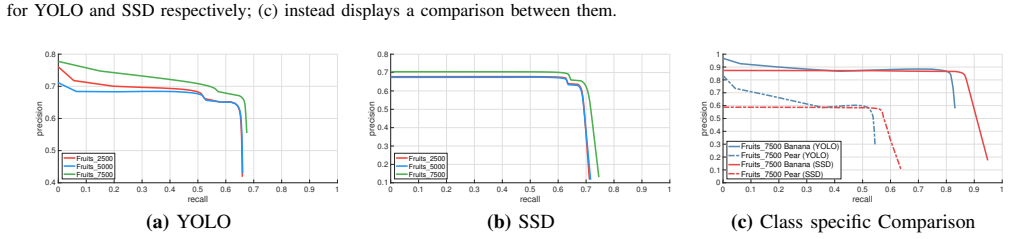
- Dataset creation cost becomes nearly constant once sequences and virtual boxes exist; scaling from 1,000 to 15,000 labeled images no longer costs man-hours, and detector mAP rises with that scale (e.g., SSD gains +0.23 mAP from 1,000 to 15,000 images on the Industrial test set).
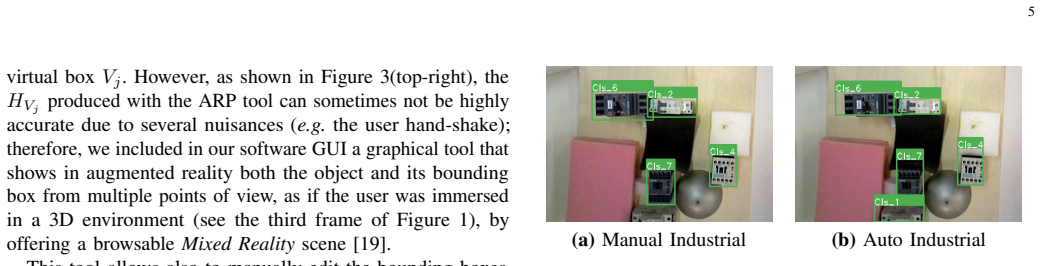
- Auto-generated labels can replace manual labels for training: on the Industrial 1000 set, YOLO achieves mAP 0.731 with ARS labels versus 0.589 with manual labels, while SSD is comparable (0.562 versus 0.619), and both improve as more auto-labeled images are added.
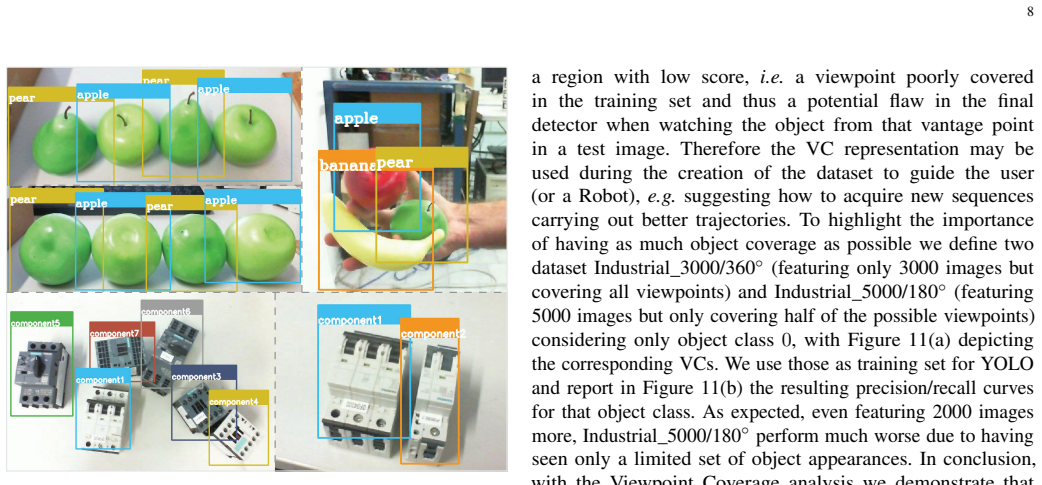
- The Viewpoint Coverage histogram lets a user or a robot see which object orientations are under-represented in training; a 3,000-image set covering all viewpoints outperforms a 5,000-image set covering only half, so acquisition trajectories can be guided by coverage rather than sheer count.
- Because ARS stores each object's 6-DoF pose per frame, the same pipeline can be extended to train 3D pose estimators, not just 2D detectors.
- Monocular SLAM tracking (e.g., ORB-SLAM2) can supply camera poses for sequences where a robot is unavailable, but the paper finds the direct SLAM output yields misaligned annotations that need manual correction to become competitive with robot-based tracking.
Reading between the lines
- The same virtual-box machinery should extend beyond bounding boxes: since $\tau$ is arbitrary, one could emit segmentation masks, keypoints, or oriented boxes from the same 3D boxes, and the paper's claim about label quality would transfer only if the chosen $\tau$ matches the task's annotation convention.
- A natural stress test the paper does not run is to apply ARS to non-rigid or moving objects; the geometric-registration assumption is one of rigidity and static scenes, so deformable objects would require per-frame box updates that the pipeline does not provide.
- If the robot were replaced by a handheld phone using ARKit or ARCore (an extension the authors mention), the reliability of the auto-labels would hinge on per-frame pose drift, and the paper's Section IV-D SLAM results suggest that careful drift correction or closed-loop tracking would be needed; a testable prediction is that handheld tracking would land between the robot and raw monocular SLAM qu
- The comparison between manual and auto labels is complicated by the fact that manual boxes only enclose visible portions of occluded objects while virtual boxes enclose the full 3D extent; a detector trained on full-extent labels should be better at localizing heavily occluded objects but may be penalized by IoU metrics against visible-part manual labels, which could explain part of the reported a
Signed reviews
Editorial analysis
A structured set of objections, weighed in public.
Referee Report
Summary. The paper presents ARS, a semi-automatic labeling pipeline for creating large annotated image datasets for training object detectors. A 2D camera is mounted on a robot arm in an eye-on-hand configuration to acquire image sequences with precisely tracked camera poses; the user defines 3D virtual boxes either online with an augmented-reality pen or offline with a visual-hull interface; the boxes are then reprojected onto all frames to generate 2D bounding-box labels automatically. The authors contribute two new datasets (an industrial electromechanical-components dataset and a fruits dataset), train YOLO and SSD detectors on subsets of these datasets, compare ARS labels with manual labels on a 1000-image training set, compare robot-based camera tracking with monocular ORB-SLAM, and introduce a Viewpoint Coverage visualization for analyzing training-set viewpoint distribution. The paper claims a labeling speedup of about 450x and states that both precision and recall are increased by about 15% relative to manual labeling.
Significance. If the central performance claim were made statistically robust, the contribution would be significant for robotics and computer vision: ARS offers a practical way to generate large real-image datasets for instance-level detection with very little human effort, and the public release of the ROS package and datasets supports reproducibility and future work. The Viewpoint Coverage analysis is a useful and relatively novel diagnostic tool for planning data acquisition. The main evidence for the headline claim, however, is currently incomplete: the only same-size comparison between ARS and manual labels is a single run of two detectors on one dataset, and the results point in opposite directions for YOLO and SSD. The paper's strongest contribution is therefore the pipeline and datasets; its strongest quantitative claim is not yet demonstrated.
major comments (3)
- [Abstract; Section IV-C, Table I] The controlled comparison between Industrial_1000_A and Industrial_1000_M is the only direct evidence for label-quality equivalence, but it does not support the abstract's unconditional statement that 'both the precision and recall of object detection is increased by about 15% with respect to manual labelling.' For YOLO the ARS labels give mAP 0.731 versus 0.589 for manual labels, while for SSD the same comparison gives 0.562 versus 0.619, i.e., the opposite conclusion. No random seeds, repeated runs, standard deviations, or confidence intervals are reported, so the observed differences are indistinguishable from training stochasticity. Also, Table I reports only mAP and avgIOU; the precision and recall values underlying the 15% figure are not shown anywhere. I request multiple seeded runs per configuration with means and variances (or paired statistical tests), and a rewording of the abstract and conclusions so that they do not overstate the evidence.
- [Section IV-B] The annotation study treats manual annotations as detections and ARS annotations as ground truth, yielding Precision = 98.49%, Recall = 95.02%, and avgIOU = 0.7 at IOU_th = 0.3. This is a reasonable agreement check, but it does not establish that the two label sources are equivalent for training detectors. The avgIOU of 0.7 is well below the 0.5 threshold commonly used for detector evaluation, and the paper itself notes a systematic difference: ARS boxes always enclose the full object (including occluded portions), while human annotators tend to label only the visible portion. The text claims that 'the dataset labelled with ARS can effectively be used to train and validate any machine learning based object detector obtaining performance comparable with a manually annotated dataset,' but the evidence for that claim is the single-run mAP comparison in Table I plus the aggregate agreement numbers. I recommend reporting the per-box IoU distribution between the two label sets and, if possible, measuring human-labeler variability, so readers can see how the label noise varies with object size, occlusion, and viewpoint.
- [Section IV-D] The comparison with monocular SLAM shows a limitation that is only briefly acknowledged: the uncorrected ORB-SLAM poses produce misaligned annotations, and the resulting Industrial_1000_SLAM detector performs worse than the robot-tracked version. The labels become usable only after manual correction, which directly contradicts the implicit claim that ARS can operate with 'any method to track the camera movement' (Section III-B). The paper should state this limitation in the abstract or introduction and should quantify the misalignment, for example by reporting reprojection error or the mAP of the uncorrected versus corrected SLAM labels. Without such quantification, the reader cannot judge when the method is applicable outside the robot-arm setting.
minor comments (6)
- [Abstract] The abstract says 'proving precise camera tracking'; this should be 'providing precise camera tracking.'
- [Section III-E] The heading 'Genaration of the Training Data' contains a typo; it should be 'Generation of the Training Data.'
- [Section III] The sentence 'The reminder of this section will describe...' should read 'The remainder of this section...'.
- [Section IV-C] In the Fruits experiment description, 'SDD' should be 'SSD', and the sentence containing 'quite very robust object detectors' should be rephrased.
- [Section IV-A] The composition of Fruits Test (1000 images from two sequences) is described in the text, but the number of images and the fact that these are manually annotated should be stated more prominently, in the same way as for Industrial Test+.
- [Section III-C] The accuracy of the ARP pose estimation is delegated to references [12] and [34], but no indication of the expected tip-position accuracy is given even though the method's output depends on it; one sentence with a typical error range would help.
Circularity Check
No significant circularity: ARS labels are forward geometric reprojections and are evaluated on independent manual test sets.
full rationale
The ARS labeling pipeline is a forward geometric projection: given camera poses 0Ci and user-defined virtual boxes Vj, labels are produced as bj = tau(HVj) via reprojection of the 3D box vertices into each frame (Eq. 4 and Section III-E). No detector output, test-set annotation, or fitted performance parameter is fed back into the label-generation process, so the claimed automatic labels are not equivalent to the measured outcomes by construction. Detector training and evaluation use independently manually annotated test sets (Industrial Test+ and Fruits Test), and the manual-versus-auto annotation study (Section IV-B) compares two independently produced label sets rather than deriving one from the other. The paper does cite the authors' own prior work ([5], [6], [10]), but those citations concern robot-vision integration and are not load-bearing for the central ARS claim; they are background and motivation, not a uniqueness or correctness argument. The main weakness is empirical rather than circular: the abstract's 'about 15%' precision/recall improvement over manual labeling is not consistently supported by Table I, since SSD performs worse on Industrial_1000_A than on Industrial_1000_M (0.562 vs 0.619), and no repeated runs or confidence intervals are reported. That is a support and statistical-rigor concern, not a circularity concern. Therefore the derivation chain is self-contained and no load-bearing step reduces to its own inputs.
Assumptions & free parameters
assumptions (5)
- standard math The pinhole camera model with calibrated intrinsics and extrinsics accurately predicts where 3D points project in each image (Eq. 2 and Eq. 4).
- domain assumption The scene is static and the objects are rigid, so a virtual box fixed in world coordinates remains registered to the object for all frames.
- domain assumption Robot kinematics provide camera poses accurate enough for labeling (repeatability under 0.05 mm); SLAM poses need manual correction.
- domain assumption The AR pen tip pose, estimated from visible squared markers, is accurate enough to define initial virtual boxes.
- domain assumption The visual hull built from two manually drawn 2D masks gives a usable 3D box for non-box-shaped objects.
Cite this review
Pith. "Pith review of Semi-Automatic Labeling for Deep Learning in Robotics." pith.science (2026). https://pith.science/paper/RR7DKL3H
@misc{pith2026190801862,
  author       = {Pith},
  title        = {Pith review of: Semi-Automatic Labeling for Deep Learning in Robotics},
  year         = {2026},
  howpublished = {\url{https://pith.science/paper/RR7DKL3H}},
  note         = {Machine review of arXiv:1908.01862}
}
read the original abstract
In this paper, we propose Augmented Reality Semi-automatic labeling (ARS), a semi-automatic method which leverages on moving a 2D camera by means of a robot, proving precise camera tracking, and an augmented reality pen to define initial object bounding box, to create large labeled datasets with minimal human intervention. By removing the burden of generating annotated data from humans, we make the Deep Learning technique applied to computer vision, that typically requires very large datasets, truly automated and reliable. With the ARS pipeline, we created effortlessly two novel datasets, one on electromechanical components (industrial scenario) and one on fruits (daily-living scenario), and trained robustly two state-of-the-art object detectors, based on convolutional neural networks, such as YOLO and SSD. With respect to the conventional manual annotation of 1000 frames that takes us slightly more than 10 hours, the proposed approach based on ARS allows annotating 9 sequences of about 35000 frames in less than one hour, with a gain factor of about 450. Moreover, both the precision and recall of object detection is increased by about 15\% with respect to manual labeling. All our software is available as a ROS package in a public repository alongside the novel annotated datasets.
Figures


Figures from the paper (8 more)




Reference graph
Works this paper leans on
-
[1]
International Journal of Computer Vision 63(3), 225–245 (2005)
Baker, S., Kanade, T., et al.: Shape-from-silhouette across time part ii: Applications to human modeling and markerless motion tracking. International Journal of Computer Vision 63(3), 225–245 (2005)
work page 2005
-
[2]
arXiv preprint arXiv:1709.07857 (2017)
Bousmalis, K., Irpan, A., Wohlhart, P., Bai, Y ., Kelcey, M., Kalakrishnan, M., Downs, L., Ibarz, J., Pastor, P., Konolige, K., et al.: Using simulation and domain adaptation to improve efficiency of deep robotic grasping. arXiv preprint arXiv:1709.07857 (2017)
arXiv 2017
-
[3]
The International Journal of Robotics Research p
Calli, B., Singh, A., Bruce, J., Walsman, A., Konolige, K., Srinivasa, S., Abbeel, P., Dollar, A.M.: Yale-CMU-Berkeley dataset for robotic manipulation research. The International Journal of Robotics Research p. 027836491770071 (2017). DOI 10.1177/0278364917700714
-
[4]
In: Robotics and Automation (ICRA), 2017 IEEE International Conference on, pp
Carlucci, F.M., Russo, P., Caputo, B.: A deep representation for depth images from synthetic data. In: Robotics and Automation (ICRA), 2017 IEEE International Conference on, pp. 1362–1369. IEEE (2017)
work page 2017
-
[5]
In: Computer Vision–ECCV 2016 Workshops, pp
De Gregorio, D., Tombari, F., Di Stefano, L.: Robotfusion: Grasping with a robotic manipulator via multi-view reconstruction. In: Computer Vision–ECCV 2016 Workshops, pp. 634–647. Springer (2016)
work page 2016
-
[6]
IEEE Transactions on Automation Science and Engineering (99), 1–14 (2018)
De Gregorio, D., Zanella, R., Palli, G., Pirozzi, S., Melchiorri, C.: Integration of robotic vision and tactile sensing for wire-terminal insertion tasks. IEEE Transactions on Automation Science and Engineering (99), 1–14 (2018)
work page 2018
-
[7]
In: European Conference on Computer Vision, pp
Engel, J., Sch ¨ops, T., Cremers, D.: Lsd-slam: Large-scale direct monoc- ular slam. In: European Conference on Computer Vision, pp. 834–849. Springer (2014)
work page 2014
-
[8]
International journal of computer vision 111(1), 98–136 (2015)
Everingham, M., Eslami, S.A., Van Gool, L., Williams, C.K., Winn, J., Zisserman, A.: The pascal visual object classes challenge: A retrospective. International journal of computer vision 111(1), 98–136 (2015)
work page 2015
Show all 37 references
-
[9]
CoRR abs/1702.07836 (2017)
Georgakis, G., Mousavian, A., Berg, A.C., Kosecka, J.: Synthesizing 10 training data for object detection in indoor scenes. CoRR abs/1702.07836 (2017)
2017 arXiv
-
[10]
IEEE Transactions on Automation Science and Engineering pp
Gregorio, D.D., Zanella, R., Palli, G., Pirozzi, S., Melchiorri, C.: Integration of robotic vision and tactile sensing for wire-terminal insertion tasks. IEEE Transactions on Automation Science and Engineering pp. 1–14 (2018). DOI 10.1109/TASE.2018.2847222
2018
-
[11]
In: Proceedings of the IEEE Conference on Computer Vision and Pattern Recognition (2017)
Huang, J., Rathod, V ., Sun, C., Zhu, M., Korattikara, A., Fathi, A., Fischer, I., Wojna, Z., Song, Y ., Guadarrama, S., et al.: Speed/accuracy trade-offs for modern convolutional object detectors. In: Proceedings of the IEEE Conference on Computer Vision and Pattern Recogniti...
2017
-
[12]
In: Image Analysis and Signal Processing (IASP), 2010 International Conference on, pp
Jiawei, W., Li, Y ., Tao, L., Yuan, Y .: Three-dimensional interactive pen based on augmented reality. In: Image Analysis and Signal Processing (IASP), 2010 International Conference on, pp. 7–11. IEEE (2010)
2010
-
[13]
Johnson-Roberson, M., Barto, C., Mehta, R., Sridhar, S.N., Rosaen, K., Vasudevan, R.: Driving in the matrix: Can virtual worlds replace human- generated annotations for real world tasks? In: Robotics and Automation (ICRA), 2017 IEEE International Conference on, pp. 746–753. IE...
2017
-
[14]
In: The IEEE International Conference on Computer Vision (ICCV) (2017)
Kehl, W., Manhardt, F., Tombari, F., Ilic, S., Navab, N.: Ssd-6d: Making rgb-based 3d detection and 6d pose estimation great again. In: The IEEE International Conference on Computer Vision (ICCV) (2017)
2017
-
[15]
In: 2017 12th IEEE International Conference on Automatic Face Gesture Recognition (FG 2017), pp
Kendrick, C., Tan, K., Williams, T., Yap, M.H.: An online tool for the annotation of 3d models. In: 2017 12th IEEE International Conference on Automatic Face Gesture Recognition (FG 2017), pp. 362–369 (2017). DOI 10.1109/FG.2017.52
2017 doi
-
[16]
In: The IEEE International Conference on Computer Vision (ICCV) (2017)
Lin, T.Y ., Goyal, P., Girshick, R., He, K., Dollar, P.: Focal loss for dense object detection. In: The IEEE International Conference on Computer Vision (ICCV) (2017)
2017
-
[17]
In: European conference on computer vision, pp
Lin, T.Y ., Maire, M., Belongie, S., Hays, J., Perona, P., Ramanan, D., Doll´ar, P., Zitnick, C.L.: Microsoft coco: Common objects in context. In: European conference on computer vision, pp. 740–755. Springer (2014)
2014
-
[18]
In: Proceedings of the IEEE Conference on Computer Vision and Pattern Recognition, pp
Mayer, N., Ilg, E., Hausser, P., Fischer, P., Cremers, D., Dosovitskiy, A., Brox, T.: A large dataset to train convolutional networks for disparity, optical flow, and scene flow estimation. In: Proceedings of the IEEE Conference on Computer Vision and Pattern Recognition, pp. 40...
2016
-
[19]
IEICE TRANSACTIONS on Information and Systems 77(12), 1321– 1329 (1994)
Milgram, P., Kishino, F.: A taxonomy of mixed reality visual displays. IEICE TRANSACTIONS on Information and Systems 77(12), 1321– 1329 (1994)
1994
-
[20]
In: Intelligent Robots and Systems (IROS), 2017 IEEE/RSJ International Conference on, pp
Mitash, C., Bekris, K.E., Boularias, A.: A self-supervised learning system for object detection using physics simulation and multi-view pose estimation. In: Intelligent Robots and Systems (IROS), 2017 IEEE/RSJ International Conference on, pp. 545–551. IEEE (2017)
2017
-
[21]
Movshovitz-Attias, Y ., Kanade, T., Sheikh, Y .: How useful is photo- realistic rendering for visual learning? In: Computer Vision–ECCV 2016 Workshops, pp. 202–217. Springer (2016)
2016
-
[22]
Universidad de C ´ordoba (2012)
Munoz-Salinas, R.: Aruco: a minimal library for augmented reality applications based on opencv. Universidad de C ´ordoba (2012)
2012
-
[23]
IEEE Transactions on Robotics 33(5), 1255–1262 (2017)
Mur-Artal, R., Tard ´os, J.D.: Orb-slam2: An open-source slam system for monocular, stereo, and rgb-d cameras. IEEE Transactions on Robotics 33(5), 1255–1262 (2017)
2017
-
[24]
arXiv preprint arXiv:1610.05883 (2016)
Nguyen, D.T., Hua, B.S., Yu, L.F., Yeung, S.K.: A robust 3d-2d interactive tool for scene segmentation and annotation. arXiv preprint arXiv:1610.05883 (2016)
2016 arXiv
-
[25]
In: International Conference on Computer Vision, vol
Rad, M., Lepetit, V .: Bb8: A scalable, accurate, robust to partial occlusion method for predicting the 3d poses of challenging objects without using depth. In: International Conference on Computer Vision, vol. 1, p. 5 (2017)
2017
-
[26]
In: Proceedings of the IEEE Conference on Computer Vision and Pattern Recognition (2017)
Redmon, J., Farhadi, A.: Yolo9000: better, faster, stronger. In: Proceedings of the IEEE Conference on Computer Vision and Pattern Recognition (2017)
2017
-
[27]
In: IEEE Robotics and Automation Letters, vol
Rennie, C., Shome, R., Bekris, K.E., De Souza, A.F.: A dataset for improved rgbd-based object detection and pose estimation for warehouse pick-and-place. In: IEEE Robotics and Automation Letters, vol. 1, pp. 1179–1185. IEEE (2016)
2016
-
[28]
In: European Conference on Computer Vision, pp
Richter, S.R., Vineet, V ., Roth, S., Koltun, V .: Playing for data: Ground truth from computer games. In: European Conference on Computer Vision, pp. 102–118. Springer (2016)
2016
-
[29]
In: Proceedings of the IEEE Conference on Computer Vision and Pattern Recognition, pp
Ros, G., Sellart, L., Materzynska, J., Vazquez, D., Lopez, A.M.: The synthia dataset: A large collection of synthetic images for semantic segmentation of urban scenes. In: Proceedings of the IEEE Conference on Computer Vision and Pattern Recognition, pp. 3234–3243 (2016)
2016
-
[30]
In: Proceedings of the IEEE Conference on Computer Vision and Pattern Recognition (2017)
Shrivastava, A., Pfister, T., Tuzel, O., Susskind, J., Wang, W., Webb, R.: Learning from simulated and unsupervised images through adversarial training. In: Proceedings of the IEEE Conference on Computer Vision and Pattern Recognition (2017)
2017
-
[31]
In: European Conference on Computer Vision, pp
Sundermeyer, M., Marton, Z.C., Durner, M., Brucker, M., Triebel, R.: Implicit 3d orientation learning for 6d object detection from rgb images. In: European Conference on Computer Vision, pp. 712–729. Springer (2018)
2018
-
[32]
In: Computer Vision and Pattern Recognition (CVPR), vol
Tzeng, E., Hoffman, J., Saenko, K., Darrell, T.: Adversarial discriminative domain adaptation. In: Computer Vision and Pattern Recognition (CVPR), vol. 1, p. 4 (2017)
2017
-
[33]
In: Computer Graphics Forum, vol
Wong, Y .S., Chu, H.K., Mitra, N.J.: Smartannotator an interactive tool for annotating indoor rgbd images. In: Computer Graphics Forum, vol. 34, pp. 447–457. Wiley Online Library (2015)
2015
-
[34]
In: Proceedings of the 30th Annual ACM Symposium on User Interface Software and Technology, pp
Wu, P.C., Wang, R., Kin, K., Twigg, C., Han, S., Yang, M.H., Chien, S.Y .: Dodecapen: Accurate 6dof tracking of a passive stylus. In: Proceedings of the 30th Annual ACM Symposium on User Interface Software and Technology, pp. 365–374. ACM (2017)
2017
-
[35]
arXiv preprint arXiv:1711.00199 (2017)
Xiang, Y ., Schmidt, T., Narayanan, V ., Fox, D.: Posecnn: A convolutional neural network for 6d object pose estimation in cluttered scenes. arXiv preprint arXiv:1711.00199 (2017)
2017 arXiv
-
[36]
In: Robotics and Automation (ICRA), 2017 IEEE International Conference on, pp
Zeng, A., Yu, K.T., Song, S., Suo, D., Walker, E., Rodriguez, A., Xiao, J.: Multi-view self-supervised deep learning for 6d pose estimation in the amazon picking challenge. In: Robotics and Automation (ICRA), 2017 IEEE International Conference on, pp. 1386–1383. IEEE (2017)
2017
-
[37]
In: Proceedings of the IEEE Conference on Computer Vision and Pattern Recognition, pp
Zhang, Y ., Qiu, Z., Yao, T., Liu, D., Mei, T.: Fully convolutional adaptation networks for semantic segmentation. In: Proceedings of the IEEE Conference on Computer Vision and Pattern Recognition, pp. 6810–6818 (2018) Daniele De Gregorio received the B.Sc. and M.Sc. degrees f...
2018
Reviewed August 14, 2026 · model on record in the stance chip above.
Discussion (0). Continue with ORCID to comment.