REVIEW 4 major objections 8 minor 176 references
Cosmic-web cosmic rays can heat and thin cold gas streams feeding massive galaxies, acting first on diffuse envelopes rather than dense cores.
Reviewed by Pith at T0; open to challenge. T0 means a machine referee read the full paper against a public rubric. the ladder, T0–T4 →
T0 review · grok-4.5
2026-07-31 14:16 UTC pith:RRM2STBR
load-bearing objection Solid first calculation of external cosmic-web CR heating on cold streams; the selectivity picture is coherent, but the quantitative strong-heating claim rides on an uncomputed entrainment factor. the 4 major comments →
Cosmic ray heating of cold streams: Implications for the gas supply and growth of massive galaxies
The pith
A machine-rendered reading of the paper's core claim, the machinery that carries it, and where it could break.
Core claim
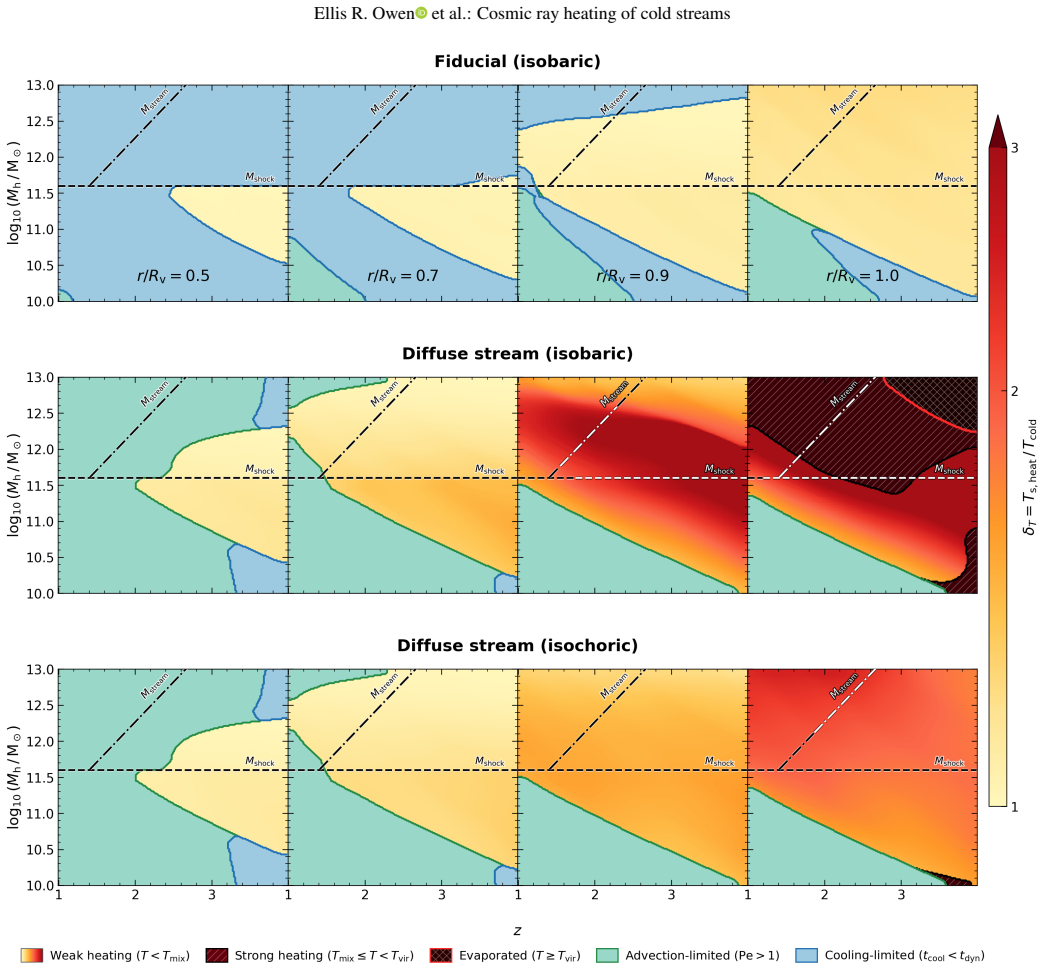
Externally supplied cosmic rays entrained from the cosmic web can alter cold-stream thermodynamics in a density- and location-dependent way. Dense cores experience only weak heating insufficient to overcome cooling at the stream–halo interface, while diffuse streams and partially mixed interface gas in massive haloes near the virial radius can be heated toward or above the mixing-layer temperature, weakening stream stability and introducing selectivity into cold-gas accretion.
What carries the argument
A quasi-steady, spectrally resolved one-dimensional cosmic-ray transport equation (diffusion, advection, continuous energy change, catastrophic losses) solved on a fixed redshift-dependent analytic magnetised cold-stream background, with heating channels (proton Coulomb, hadronic, streaming, electron collisional) compared to radiative cooling and dynamical times.
Load-bearing premise
A substantial external cosmic-ray reservoir is efficiently captured, compressed, and kept coupled to the magnetised inflow at the virial boundary rather than leaking across the stream edge.
What would settle it
In massive high-redshift systems with independent signs of cosmic-web non-thermal activity (for example diffuse filament synchrotron), extended cold-gas tracers such as Lyα structures or metal-poor Lyman-limit systems should show weaker covering fraction, thinner morphology, or larger scatter at fixed halo mass and accretion rate than otherwise similar systems without those non-thermal signatures.
If this is right
- Cold streams are most vulnerable to external cosmic-ray heating at large galactocentric radius, high halo mass, and in diffuse or partially mixed material.
- Dense stream spines can remain cold while their mixed envelopes are heated, eroding cold substructure without fully destroying the core.
- Surviving cold flows may appear thinner and more sharply confined deep into galaxy haloes.
- External cosmic rays can act as a non-thermal selection mechanism that increases halo-to-halo scatter in cold-gas survival near the cold-stream to hot-mode transition.
- Complete stream evaporation is rare and requires extreme conditions; the typical effect is weakening and envelope erosion rather than wholesale destruction.
Where Pith is reading between the lines
- If sub-GeV cosmic rays dominate the heating, feedback-supplied populations depleted at low energy could pressurise cold gas without the same collisional heating, so external and internal cosmic-ray channels may push multiphase halo gas in opposite directions.
- Multidimensional streaming and perpendicular diffusion across a turbulent mixing layer could lower residence times enough to move the strong-heating boundary outward in mass and redshift relative to the one-dimensional calculation.
- Joint radio continuum and extended Lyα or metal-poor absorber surveys at z~2–3 offer a practical path to test whether cosmic-ray-rich environments suppress cold-flow signatures.
Editorial analysis
A structured set of objections, weighed in public.
Referee Report
Summary. The manuscript investigates whether cosmic rays supplied by cosmic-web filaments and entrained into magnetized cold streams can heat those streams and modify cold-gas accretion onto massive galaxies. The authors construct an analytic, redshift-dependent stream/halo model, impose an externally supplied CR spectrum at the virial radius, and solve a steady-state, spectrally resolved diffusion-advection-loss equation for protons and electrons, including Coulomb, hadronic, streaming, radiative, adiabatic, and secondary-production terms. Heating is compared with CLOUDY cooling rates for the stream spine and mixing layer, bracketing isobaric and isochoric thermal responses. The main result is a density-, radius-, mass-, and redshift-dependent transition from weak heating of resilient dense streams to a strong-heating regime in diffuse streams and interface gas near the virial radius. The authors argue that this preferential heating could erode cold envelopes, weaken marginal streams, and introduce selectivity into massive-galaxy fueling.
Significance. If the adopted external supply is realized, the paper identifies a physically interesting and relatively unexplored accretion-selection mechanism, distinct from the pressure-dominated effects usually emphasized for feedback-produced GeV CRs. Its principal strengths are the species- and energy-resolved transport calculation, explicit secondary-electron production, separation of the relevant heating channels, and systematic mapping of the heating/cooling/advection balance over stream density, halo mass, redshift, and diffusion coefficient. The isobaric/isochoric bracketing and the proposed connection to cold-gas observables make the qualitative mechanism testable. The paper is also commendably explicit about many assumptions. At present, however, the size and even the existence of the strong-heating region depend directly on an imposed, energy-independent boundary compression and on a stream background that cannot react to CR heating or pressure; these issues must be better bounded before the quantitative conclusions are secure.
major comments (4)
- [§2.2, Eq. (1), Table 1, and §3.2] The central strong-heating result is controlled by the imposed boundary energy density, U_CR,ext=C(z,M_h)U_CR,bg, with C~4000 and U_CR,ext~0.4 eV cm^-3 in the fiducial case. Yet the heating is dominated by sub-GeV protons (§2.5 and App. D), whose capture, escape, Coulomb/ionization losses, and adiabatic evolution during compression should be energy-dependent. Treating C as a single number for the whole 10 MeV–10 TeV spectrum is therefore not sufficient. Appendix E varies D0 after the boundary normalization has been fixed, but the results are not shown for a reduced or energy-dependent supplied population. Please quantify how Figs. 3–7 change under an explicit factor C_eff (or U_CR,ext) scan and, ideally, a simple C_eff(E) estimate based on the coupling criterion stated in §2.2. At minimum, show the reduction factor at which the fiducial near-R_v equality Q~Lambda and the Fig. 6–7 strong-
- [§3.1.2, Eq. (26), Figs. 5–7, and §3.4] The fixed-background approximation becomes load-bearing precisely in the regime used to infer stream weakening and interface erosion. The fiducial supplied CR energy density corresponds to P_CR~U_CR/3~0.13 eV cm^-3, which is of order the thermal pressure of the outer stream quoted in §2.2. Strong heating would additionally change the density, cross-section, magnetic field, CR pressure gradient, and adiabatic CR losses, none of which are allowed to respond in Eqs. (14)–(18). The isobaric/isochoric integrations bracket local heat-capacity limits, but they do not bracket this hydrodynamic and CR backreaction. Please report P_CR/P_th (and, where relevant, P_CR/P_tot) in the main figures or maps, explicitly flag where the passive-background solution is no longer self-consistent, and phrase the disruption conclusions as onset/susceptibility criteria unless a dynamical response is calculated.
- [§2.3, §2.5, Fig. 7, and Appendix A] The key conclusion that CRs act first on the stream–CGM interface depends on the CR density assigned to the mixing layer. The transport solution in Eqs. (A.1)–(A.6) is one-dimensional along the stream axis and uses the stream area, density, velocity, and magnetic-field profile, whereas the mixing layer has a different density, temperature, magnetic geometry, and no independently modeled transverse CR supply. It is not clear from the main text whether Q_{l,j,mix} uses the spine CR spectrum at each radius, an ambient reservoir value, or some other prescription. Please state this explicitly and provide at least bounding calculations for the interface CR density—for example, spine-spectrum coupling versus reduced lateral penetration or escape. Without this, the Fig. 7 division into heating- and cooling-dominated interface gas is difficult to interpret quantitatively.
- [§2.3, Appendix A.3, and Appendix D] The adopted boundary spectrum extends a q=2.2 proton power law down to 10 MeV. Because Appendix D shows that the efficient-heating regime changes sharply between 10 MeV, 100 MeV, and 1 GeV, the conclusion is sensitive not just to the total boundary energy density but to the low-energy spectral shape and survival of the sub-GeV component. The statement that reasonable E_min choices do not change the conclusions does not fully address a rollover, break, or prior Coulomb depletion below ~1 GeV. Please add a small set of low-energy spectral-shape variations, or otherwise derive the retained sub-GeV fraction from the upstream transport history, and indicate how the Fig. 6 mass–redshift thresholds shift.
minor comments (8)
- [§2.3, Eq. (2)] Typographical issue: “where γ_j as the Lorentz factor” should read “where γ_j is the Lorentz factor.” The sentence could also define the sign convention for lambda_j and state whether decay losses are actually used for either species.
- [§2.3, Eq. (3)] For clarity, state explicitly whether D(E,r) is evaluated using the local stream field B_s(r) from Eq. (18), and whether E or magnetic rigidity is used for protons and electrons. The present definition is understandable but leaves the spatial B dependence implicit.
- [§2.5, Fig. 2] The diagnostic uses r_s=10 kpc, beta=100 in the stream, and beta=1 in the mixing layer, but these choices appear only in the text. Adding them to the caption would make the figure easier to interpret independently.
- [Table 1 and §2.3] The minimum energy is given as both 10 MeV and 10^-2 GeV. These are equivalent, but using one convention consistently in the table and text would avoid confusion.
- [Fig. 5] The temperature-axis presentation mixes logarithmic-looking major labels (10^4, 10^5) with closely spaced linear intermediate labels. Please clarify the axis scale and consider plotting the temperature ratio directly, as in Fig. 6.
- [Figs. 6–7] The multiple hatch/color combinations are information-rich but difficult to decode. Please state whether white regions are simply delta_T~1 and indicate which thermodynamic limit and stream-density case is used for each row directly on the panels. The abstract’s statement that complete evaporation is possible only in extreme cases should also point to the specific hatched parameter region.
- [Appendix E] The D0 sensitivity study is useful and directly relevant to the spatial heating pattern. A one-sentence summary of its outcome in §3.1 or §3.2 would help readers who do not reach the appendix.
- [§3.3] The proposed Ly-alpha diagnostic is plausible but indirect. It would be helpful to state whether the predicted effect is primarily lower luminosity, smaller spatial extent, or increased halo-to-halo scatter, and which of these is least degenerate with radiative-transfer and illumination effects.
Circularity Check
No significant circularity: CR heating follows from imposed boundary spectra plus standard loss physics on an independent stream background.
full rationale
The paper’s central claim—that externally supplied CRs can weakly heat dense stream cores and strongly heat diffuse/mixed gas near Rv in massive haloes—is obtained by solving a steady diffusion–advection–loss equation for a prescribed outer-boundary CR spectrum, then comparing the resulting volumetric heating rates Q to CLOUDY net cooling and integrating the energy equation over one dynamical time. The boundary normalisation U_CR,bg, compression factor C(z,Mh), D0, Kp/e, spectral index, and the Dekel/Mandelker stream profiles are external or fiducial inputs that are varied rather than fitted to any stream-disruption or galaxy-growth observable; the heating–cooling comparison is therefore not forced by construction. Author-overlapping citations (Ledos et al. 2024a,b) supply the stream magnetisation prescription used for B(r) and vA, but streaming heating is sub-dominant and the Coulomb-dominated result does not reduce to those citations. Uncertainties in entrainment (Eq. 1) are correctness/assumption risks, not circular reductions of outputs to inputs. No self-definitional loop, fitted-as-prediction step, or uniqueness import is present.
Axiom & Free-Parameter Ledger
free parameters (7)
- U_CR,bg (background filament CR energy density) =
10^-4 eV cm^-3
- δ_fil (filament overdensity) =
20
- D0 (CR diffusion normalisation) =
3×10^29 cm^2 s^-1
- K_p/e (proton-to-electron energy-density ratio) =
100
- Spectral index q and E_min/E_max/E_cut,e =
q=2.2; E_min=10 MeV; E_cut,e=10 GeV
- β(Rv) and magnetic amplification χ_B =
β(Rv)=10^5; χ_B~40 average
- Stream/halo nuisance factors (Θ_h, Θ_s, η, s, N_s, f_h, Z) =
fiducial central values; Z=0.1 Z_⊙
axioms (8)
- domain assumption Cold streams are coherent magnetised channels that can be treated with quasi-1D diffusion–advection–loss transport along the stream axis.
- ad hoc to paper External CRs remain coupled during adiabatic compression so U_CR ∝ n_H^{4/3}, yielding the boundary compression C(z,M_h) in Eq. 1.
- domain assumption CR population reaches a quasi-stationary configuration; solve time-independent transport from R_v to 0.1 R_v.
- ad hoc to paper Stream density, velocity, radius, and B are fixed analytic backgrounds (Dekel/Mandelker + Komatsu–Seljak polytrope + Ledos magnetisation) that do not respond to CR heating or pressure.
- domain assumption Effective CR speed is u_eff = v_s + v_A with scalar Kraichnan D(E) ∝ r_L^{1/2}; kinetic self-confinement physics absorbed into coefficients.
- domain assumption Gas heating channels are proton Coulomb, direct hadronic thermalisation (energy-dependent f_heat), streaming losses thermalised locally, and electron collisional losses; synchrotron/IC do not heat gas.
- domain assumption Mixing-layer density and temperature follow ρ_mix=√(ρ_s ρ_h), T_mix=√(T_cold T_h); cooling from CLOUDY + Haardt & Madau UVB.
- standard math Flat ΛCDM with Planck 2020 parameters; NFW haloes with Correa concentration; virial-shock/hot-halo context for M_h ≳ 10^{11.6} M_⊙.
invented entities (1)
-
Externally entrained cosmic-web CR reservoir as a fixed virial-boundary supply distinct from galactic feedback CRs
independent evidence
read the original abstract
Recent observations have demonstrated the presence of cosmic rays (CRs) in cosmic-web filaments. Cold streams supply gas inflows from these filaments into massive galaxies during the cosmic noon. As these streams are expected to be magnetised, external cosmic-web CRs may become entrained with this inflowing gas. We aim to determine whether this externally-supplied CR population can deposit energy to alter or disrupt the supply of cold gas to galaxies. We couple a spectrally-resolved CR transport calculation to a redshift-dependent analytical model of magnetised cold streams in galaxy haloes and investigate whether externally-supplied CRs can modify gas supply through this channel. We find CR energy deposition can alter the thermal state of cold streams. Dense stream cores remain largely resilient and only experience weak heating. Their temperature is raised by less than a factor of 10, which is insufficient to overcome radiative cooling at the stream-CGM interface. In more diffuse streams, and in partially mixed interface gas of the most massive haloes near the virial radius, CR heating becomes strong enough that radiative cooling can no longer balance it, and the gas is heated toward or above the mixing-layer temperature. This weakens the stability of the stream, making it more susceptible to disruption. Complete evaporation is possible only in extreme cases. Cold streams are therefore more vulnerable to CR heating at larger galactocentric radii, higher halo masses, and in more diffuse or partially-mixed stream material. By preferentially heating diffuse gas, externally supplied CRs may introduce additional selectivity into cold-gas accretion that modifies the gas supply and growth of massive galaxies. These CRs weaken fragile streams and erode their cold envelope, and may cause surviving cold flow components to appear thinner and more sharply confined far into galaxy haloes.
Figures



Reference graph
Works this paper leans on
-
[1]
doi:10.1088/0004-637X/755/2/164 , eid = 164, eprint =
, keywords =. doi:10.1088/0004-637X/755/2/164 , eid = 164, eprint =
-
[2]
arXiv , author =:1704.05843 , journal =
doi:10.1051/0004-6361/201730497 , eid =. arXiv , author =:1704.05843 , journal =
-
[3]
doi:10.1093/mnras/stac928 , eprint =
, keywords =. doi:10.1093/mnras/stac928 , eprint =
-
[4]
1903.09666 , issn = 13652966, journal =
Aung, Han and Mandelker, Nir and Nagai, Daisuke and Dekel, Avishai and Birnboim, Yuval , doi =. 1903.09666 , issn = 13652966, journal =
Pith/arXiv arXiv 1903
-
[5]
doi:10.1093/mnras/stae1673 , journal =
-
[6]
arXiv , author =:2502.06484 , journal =
doi:10.1051/0004-6361/202554079 , eid =. arXiv , author =:2502.06484 , journal =
-
[7]
The Physics of the Interstellar Medium and Intergalactic Medium , editor =
-
[8]
doi:10.1038/s42005-024-01778-4 , eid = 286, eprint =
Communications Physics , keywords =. doi:10.1038/s42005-024-01778-4 , eid = 286, eprint =
-
[9]
, journal =
Begelman, Mitchell C. , journal =
-
[10]
Bennett, Jake S. and Sijacki, Debora , doi =. 2006.10058 , issn = 13652966, journal =
Pith/arXiv arXiv 2006
-
[11]
doi:10.1007/s41116-016-0004-3 , eid = 2, journal =
- [12]
-
[13]
doi:10.1046/j.1365-8711.2003.06955.x , eprint =
, keywords =. doi:10.1046/j.1365-8711.2003.06955.x , eprint =
arXiv 2003
-
[14]
doi:10.1093/mnras/staa1594 , eprint =
, keywords =. doi:10.1093/mnras/staa1594 , eprint =
-
[15]
doi:10.1007/s00159-013-0070-7 , eid = 70, eprint =
, keywords =. doi:10.1007/s00159-013-0070-7 , eid = 70, eprint =
-
[16]
doi:10.3390/galaxies11030073 , eid = 73, eprint =
Galaxies , keywords =. doi:10.3390/galaxies11030073 , eid = 73, eprint =
-
[17]
arXiv , author =:1401.7519 , journal =
doi:10.1142/S0218271814300079 , eid =. arXiv , author =:1401.7519 , journal =
- [18]
-
[19]
doi:10.3847/1538-4357/abf64c , eid = 106, eprint =
, keywords =. doi:10.3847/1538-4357/abf64c , eid = 106, eprint =
-
[20]
doi:10.3847/1538-4357/aca021 , eid = 65, eprint =
, keywords =. doi:10.3847/1538-4357/aca021 , eid = 65, eprint =
-
[21]
doi:10.3847/1538-4357/abbad2 , eid = 77, eprint =
, keywords =. doi:10.3847/1538-4357/abbad2 , eid = 77, eprint =
-
[22]
doi:10.3847/1538-4357/ac7ebd , eid = 69, eprint =
, keywords =. doi:10.3847/1538-4357/ac7ebd , eid = 69, eprint =
-
[23]
doi:10.1088/1475-7516/2004/10/007 , eid = 007, eprint =
, keywords =. doi:10.1088/1475-7516/2004/10/007 , eid = 007, eprint =
-
[24]
doi:10.1038/nature12898 , eprint =
, keywords =. doi:10.1038/nature12898 , eprint =
-
[25]
arXiv , author =:1612.00491 , keywords =
Gas Accretion onto Galaxies , doi =. arXiv , author =:1612.00491 , keywords =
-
[26]
doi:10.1088/0004-637X/783/2/91 , eid = 91, eprint =
, keywords =. doi:10.1088/0004-637X/783/2/91 , eid = 91, eprint =
-
[27]
doi:10.1093/mnras/stac384 , eprint =
, keywords =. doi:10.1093/mnras/stac384 , eprint =
-
[28]
doi:10.1093/mnras/stac2966 , eprint =
, keywords =. doi:10.1093/mnras/stac2966 , eprint =
-
[29]
doi:10.1103/PhysRevD.65.023002 , eid = 023002, eprint =
, keywords =. doi:10.1103/PhysRevD.65.023002 , eid = 023002, eprint =
-
[30]
doi:10.48550/arXiv.2605.14869 , eid =. arXiv , author =:2605.14869 , journal =
work page internal anchor Pith review Pith/arXiv arXiv doi:10.48550/arxiv.2605.14869
-
[31]
doi:10.1093/mnras/stz1895 , eprint =
, keywords =. doi:10.1093/mnras/stz1895 , eprint =
-
[32]
arXiv , author =:2512.03845 , journal =
doi:10.48550/arXiv.2512.03845 , eid =. arXiv , author =:2512.03845 , journal =
-
[33]
arXiv , author =:2407.14596 , journal =
doi:10.1051/0004-6361/202450969 , eid =. arXiv , author =:2407.14596 , journal =
-
[34]
doi:10.1093/mnras/stv1363 , eprint =
, keywords =. doi:10.1093/mnras/stv1363 , eprint =
-
[35]
arXiv , author =:1307.6588 , journal =
doi:10.1088/2041-8205/776/2/L18 , eid =. arXiv , author =:1307.6588 , journal =
Pith/arXiv arXiv 2041
-
[36]
arXiv , author =:2203.10880 , journal =
doi:10.1051/0004-6361/202243574 , eid =. arXiv , author =:2203.10880 , journal =
-
[37]
arXiv , author =:2202.03715 , journal =
doi:10.3847/2041-8213/ac531f , eid =. arXiv , author =:2202.03715 , journal =
Pith/arXiv arXiv 2041
-
[38]
1407.7129 , issn = 13652966, journal =
Danovich, Mark and Dekel, Avishai and Hahn, Oliver and Ceverino, Daniel and Primack, Joel , doi =. 1407.7129 , issn = 13652966, journal =
-
[39]
doi:10.1093/mnras/stad3125 , eprint =
, keywords =. doi:10.1093/mnras/stad3125 , eprint =
-
[40]
MNRAS , keywords =
Dekel, Avishai and Birnboim, Yuval , doi =. MNRAS , keywords =
-
[41]
Dekel, A. and Birnboim, Y. and Engel, G. and Freundlich, J. and Goerdt, T. and Mumcuoglu, M. and Neistein, E. and Pichon, C. and Teyssier, R. and Zinger, E. , doi =. 0808.0553 , issn = 00280836, journal =
-
[42]
MNRAS , pages =
Dekel, Avishai and Zolotov, A and Tweed, D and Cacciato, M and Ceverino, D and Primack, J R , doi =. MNRAS , pages =
-
[43]
doi:10.1093/mnras/stad1557 , eprint =
, keywords =. doi:10.1093/mnras/stad1557 , eprint =
-
[44]
doi:10.1088/0004-637X/791/1/51 , eid = 51, eprint =
, keywords =. doi:10.1088/0004-637X/791/1/51 , eid = 51, eprint =
-
[45]
doi:10.1093/mnras/sts224 , eprint =
, keywords =. doi:10.1093/mnras/sts224 , eprint =
-
[46]
doi:10.1126/science.abh2150 , eprint =
Science , keywords =. doi:10.1126/science.abh2150 , eprint =
-
[47]
doi:10.1093/mnras/stac1196 , eprint =
, keywords =. doi:10.1093/mnras/stac1196 , eprint =
-
[48]
and Katz, Neal and Gardner, Jeffrey P
Fardal, Mark A. and Katz, Neal and Gardner, Jeffrey P. and Hernquist, Lars and Weinberg, David H. and Dave, Romeel , doi =. ApJ , number = 2, pages =
-
[49]
doi:10.48550/arXiv.1705.10877 , eprint =
, keywords =. doi:10.48550/arXiv.1705.10877 , eprint =
-
[50]
doi:10.1086/148317 , journal =
-
[51]
doi:10.1093/mnras/stw1782 , eprint =
, keywords =. doi:10.1093/mnras/stw1782 , eprint =
-
[52]
arXiv , author =:1903.11584 , journal =
doi:10.1142/S0218271819300222 , eid =. arXiv , author =:1903.11584 , journal =
Pith/arXiv arXiv 1903
-
[53]
arXiv , author =:2010.15139 , journal =
doi:10.1051/0004-6361/202039781 , eid =. arXiv , author =:2010.15139 , journal =
Pith/arXiv arXiv 2010
-
[54]
doi:10.1038/s41586-023-06346-4 , eprint =
, keywords =. doi:10.1038/s41586-023-06346-4 , eprint =
-
[55]
doi:10.1093/mnras/sty1653 , eprint =
, keywords =. doi:10.1093/mnras/sty1653 , eprint =
-
[56]
doi:10.1093/mnras/stz2961 , eprint =
, keywords =. doi:10.1093/mnras/stz2961 , eprint =
-
[57]
doi:10.1093/mnras/stab3462 , eprint =
, keywords =. doi:10.1093/mnras/stab3462 , eprint =
-
[58]
doi:10.1093/mnras/stad3628 , eprint =
, keywords =. doi:10.1093/mnras/stad3628 , eprint =
-
[59]
doi:10.1146/annurev-astro-052622-033150 , eprint =
, keywords =. doi:10.1146/annurev-astro-052622-033150 , eprint =
-
[60]
arXiv , author =:2601.16566 , journal =
doi:10.48550/arXiv.2601.16566 , eid =. arXiv , author =:2601.16566 , journal =
-
[61]
doi:10.1111/j.1365-2966.2007.12692.x , eprint =
, keywords =. doi:10.1111/j.1365-2966.2007.12692.x , eprint =
arXiv 2007
-
[62]
doi:10.3847/1538-4357/ad7c4c , eid = 10, eprint =
, keywords =. doi:10.3847/1538-4357/ad7c4c , eid = 10, eprint =
-
[63]
doi:10.1088/0004-637X/746/2/125 , eid = 125, journal =
-
[64]
arXiv , author =:2510.24622 , journal =
doi:10.48550/arXiv.2510.24622 , eid =. arXiv , author =:2510.24622 , journal =
-
[65]
doi:10.1007/s41115-021-00011-1 , eid = 2, eprint =
Living Reviews in Computational Astrophysics , keywords =. doi:10.1007/s41115-021-00011-1 , eid = 2, eprint =
-
[66]
Hillier, Andrew and Arregui, I. ApJ , keywords =. doi:10.3847/1538-4357/ab4795 , eprint =
-
[67]
, month = 03, number = 4, pages =
Hong, Wen-Sheng and Zhu, Weishan and Wang, Tian-Rui and Yang, Xiaohu and Feng, Long-Long , doi =. , month = 03, number = 4, pages =. https://academic.oup.com/mnras/article-pdf/529/4/4262/57127551/stae777.pdf , issn =
-
[68]
doi:10.1093/mnras/stz3321 , eprint =
, keywords =. doi:10.1093/mnras/stz3321 , eprint =
-
[69]
doi:10.1093/mnras/staa3692 , eprint =
, keywords =. doi:10.1093/mnras/staa3692 , eprint =
-
[70]
doi:10.33232/001c.141293 , eid = 78, eprint =
The Open Journal of Astrophysics , keywords =. doi:10.33232/001c.141293 , eid = 78, eprint =
-
[71]
arXiv , author =:astro-ph/0701167 , journal =
doi:10.48550/arXiv.astro-ph/0701167 , eid =. arXiv , author =:astro-ph/0701167 , journal =
-
[72]
doi:10.1093/mnras/stx3221 , eprint =
, keywords =. doi:10.1093/mnras/stx3221 , eprint =
-
[73]
arXiv , author =:2007.11015 , journal =
doi:10.3847/2041-8213/abbee4 , eid =. arXiv , author =:2007.11015 , journal =
Pith/arXiv arXiv 2041
-
[74]
doi:10.1093/mnras/staa1849 , eprint =
, keywords =. doi:10.1093/mnras/staa1849 , eprint =
-
[75]
doi:10.1093/mnras/stab1264 , eprint =
, keywords =. doi:10.1093/mnras/stab1264 , eprint =
-
[76]
doi:10.1051/0004-6361:20065295 , eprint =
, keywords =. doi:10.1051/0004-6361:20065295 , eprint =
-
[77]
doi:10.1088/0004-637X/803/2/54 , eid = 54, eprint =
, keywords =. doi:10.1088/0004-637X/803/2/54 , eid = 54, eprint =
-
[78]
doi:10.1016/j.cpc.2019.08.001 , eid = 106846, eprint =
Computer Physics Communications , keywords =. doi:10.1016/j.cpc.2019.08.001 , eid = 106846, eprint =
-
[79]
doi:10.1103/PhysRevD.90.123014 , eid = 123014, eprint =
, keywords =. doi:10.1103/PhysRevD.90.123014 , eid = 123014, eprint =
- [80]
discussion (0)
Sign in with ORCID, Apple, or X to comment. Anyone can read and Pith papers without signing in.