DVANet: Degradation-aware Visual-prior Alignment Network for Image Restoration
Pith reviewed 2026-06-26 21:23 UTC · model grok-4.3
The pith
DVANet unifies image restoration across diverse degradations by unfolding a process with degradation-aware consistency and DINOv3 visual priors.
A machine-rendered reading of the paper's core claim, the machinery that carries it, and where it could break.
Core claim
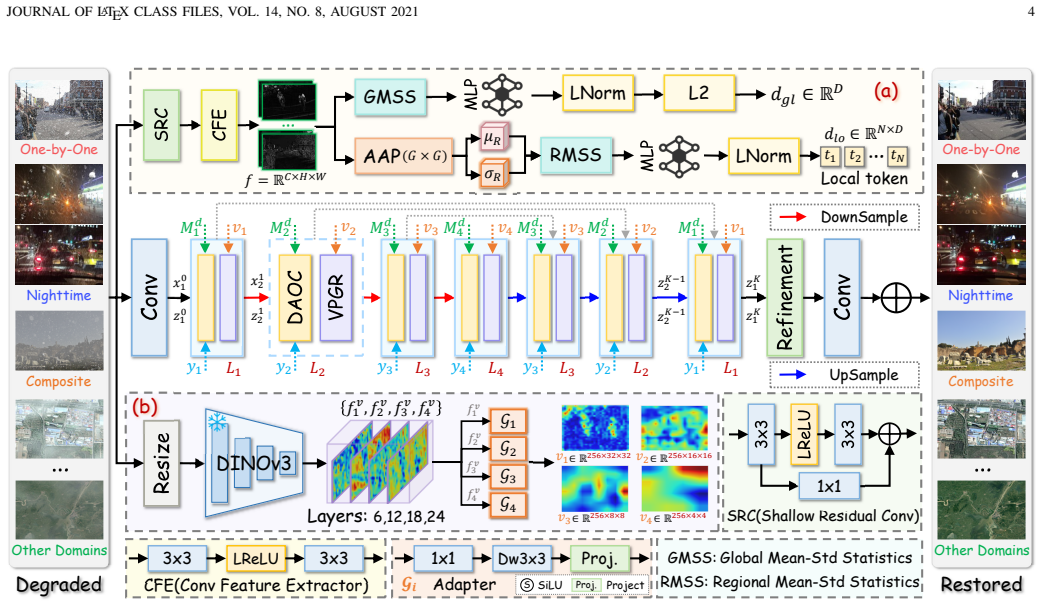
DVANet formulates unified image restoration under complex degradations as a collaborative unfolding process between degradation-aware observation consistency and visual-prior-guided reconstruction, where a degradation representation module extracts global and local cues for conditioned mapping, and DINOv3 provides hierarchical priors to recover details in damaged regions.
What carries the argument
A deep unfolding network based on half-quadratic splitting with a degradation-aware observation consistency branch using a degradation representation module and conditioned mapping, paired with a visual-prior-guided reconstruction branch employing DINOv3.
If this is right
- DVANet demonstrates superior or competitive performance on multi-scenario degradation tasks.
- It exhibits favorable degradation adaptability through the degradation-conditioned mapping.
- The use of visual priors improves structural detail recovery in locally damaged content.
- It shows good generalization ability on cross-domain image restoration tasks.
Where Pith is reading between the lines
- This could suggest that foundation model priors like DINOv3 are broadly useful for inverse imaging problems.
- Future work might explore replacing DINOv3 with other vision models to test robustness.
- The collaborative unfolding might apply to related tasks like denoising or super-resolution in a unified way.
Load-bearing premise
That the visual priors from DINOv3 effectively complement missing structural information in damaged image regions.
What would settle it
A test showing that removing the DINOv3 branch or replacing it with random priors yields equivalent or better restoration performance on benchmark datasets with local damages.
Figures



read the original abstract
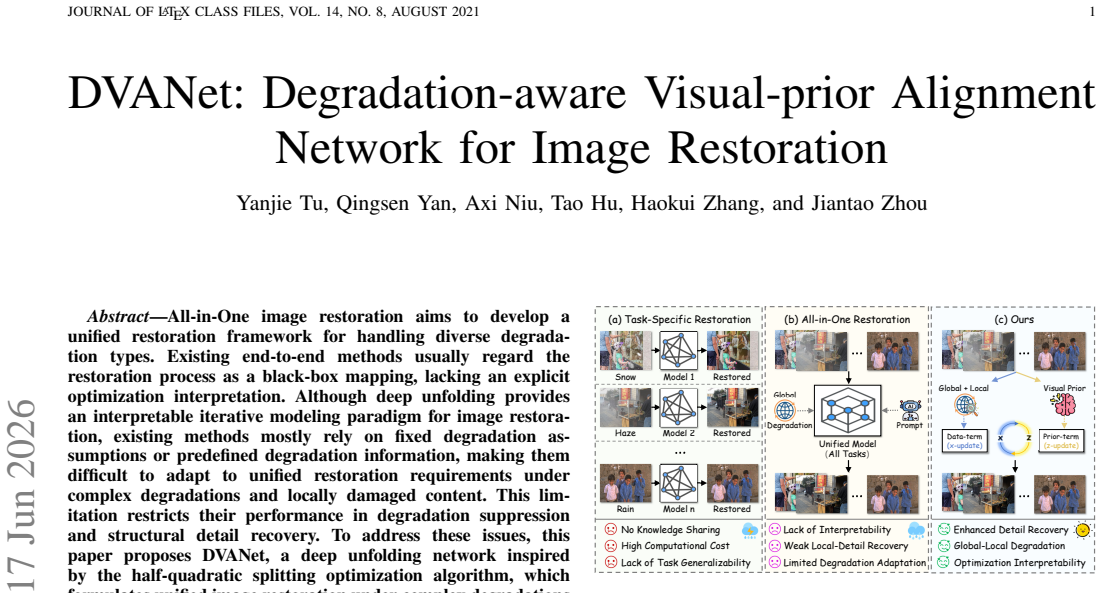
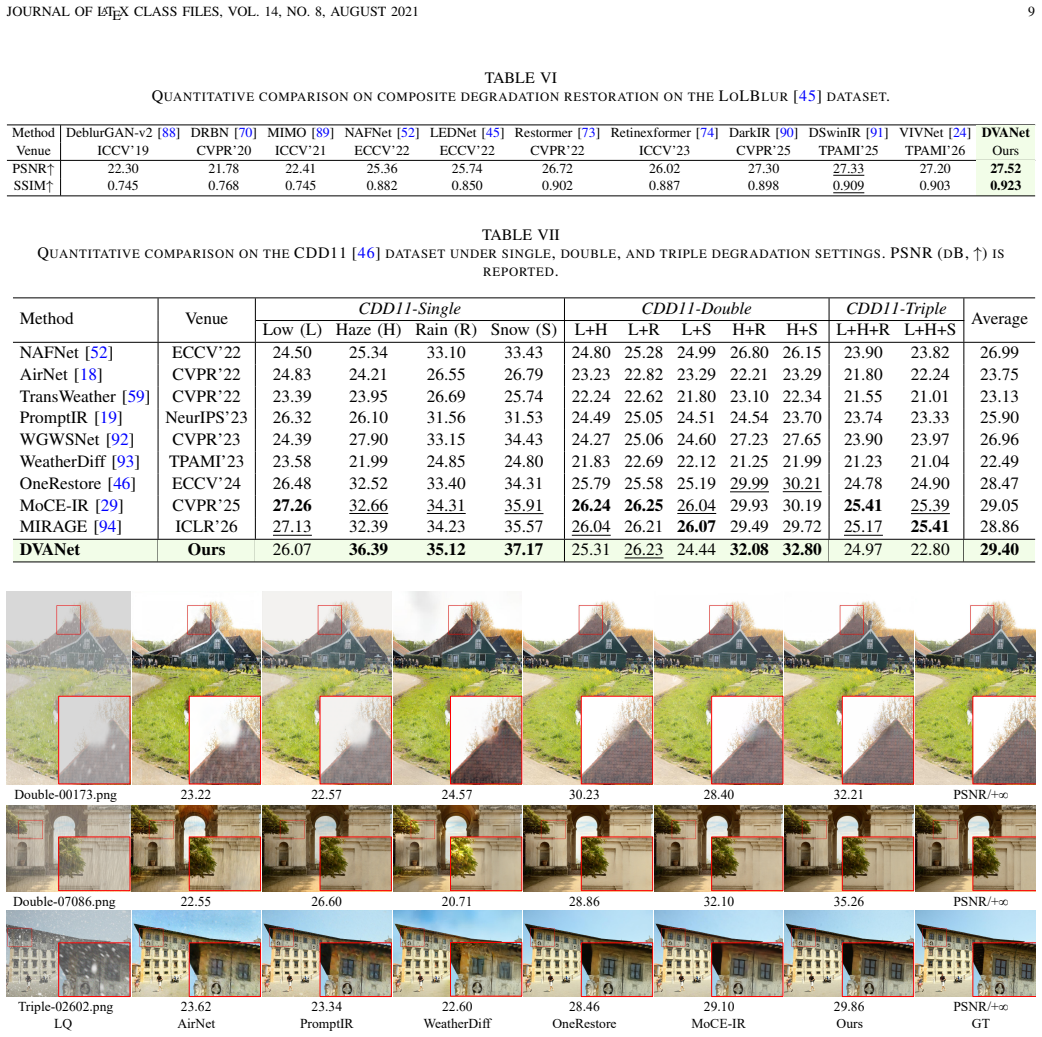
All-in-One image restoration aims to develop a unified restoration framework for handling diverse degradation types. Existing end-to-end methods usually regard the restoration process as a black-box mapping, lacking an explicit optimization interpretation. Although deep unfolding provides an interpretable iterative modeling paradigm for image restoration, existing methods mostly rely on fixed degradation assumptions or predefined degradation information, making them difficult to adapt to unified restoration requirements under complex degradations and locally damaged content. This limitation restricts their performance in degradation suppression and structural detail recovery. To address these issues, this paper proposes DVANet, a deep unfolding network inspired by the half-quadratic splitting optimization algorithm, which formulates unified image restoration under complex degradations as a collaborative unfolding process between degradation-aware observation consistency and visual-prior-guided reconstruction. Specifically, in the degradation-aware observation consistency branch, a degradation representation module is employed to extract global degradation attributes and local degradation cues, and degradation-conditioned mapping is used to enhance the model's adaptability to different degradation types. In the visual-prior-guided reconstruction branch, DINOv3 is introduced to provide structural and semantic information as hierarchical visual priors, thereby complementing the missing structural information in damaged regions and improving detail recovery. Extensive experiments demonstrate that DVANet achieves superior or competitive performance on multi-scenario degradation and cross-domain image restoration tasks, showing favorable degradation adaptability and generalization ability.
Editorial analysis
A structured set of objections, weighed in public.
Referee Report
Summary. The paper proposes DVANet, a deep unfolding network for all-in-one image restoration under complex degradations, formulated via half-quadratic splitting as a collaborative process between a degradation-aware observation consistency branch (using a degradation representation module and degradation-conditioned mapping) and a visual-prior-guided reconstruction branch (introducing DINOv3 to supply hierarchical structural and semantic priors for damaged regions). It claims superior or competitive performance with favorable adaptability and generalization on multi-scenario degradation and cross-domain tasks.
Significance. If the central claims hold, the work would advance interpretable deep-unfolding methods for unified restoration by explicitly modeling degradation adaptability alongside visual priors, potentially addressing limitations of black-box end-to-end approaches and fixed-assumption unfolding baselines.
major comments (1)
- [visual-prior-guided reconstruction branch] The visual-prior-guided reconstruction branch (described in the abstract) assumes DINOv3 supplies effective hierarchical priors that complement missing content in locally damaged regions and remain informative under heavy degradation, yet provides no mechanism for injection into HQS unfolding iterations or alignment with the degradation-aware branch; this is load-bearing for the claimed advantage of the collaborative formulation over standard deep-unfolding methods.
Simulated Author's Rebuttal
We thank the referee for the constructive comment regarding the integration mechanism in the visual-prior-guided reconstruction branch. We address this point directly below and clarify the collaborative formulation.
read point-by-point responses
-
Referee: [visual-prior-guided reconstruction branch] The visual-prior-guided reconstruction branch (described in the abstract) assumes DINOv3 supplies effective hierarchical priors that complement missing content in locally damaged regions and remain informative under heavy degradation, yet provides no mechanism for injection into HQS unfolding iterations or alignment with the degradation-aware branch; this is load-bearing for the claimed advantage of the collaborative formulation over standard deep-unfolding methods.
Authors: The manuscript does describe the injection and alignment mechanism in Section 3. The overall HQS formulation (Eq. 3) alternates between the two subproblems solved by the respective branches. The degradation-aware observation consistency branch produces an intermediate estimate that is passed as input to the visual-prior-guided reconstruction branch at each unfolding iteration; the output of the reconstruction branch is then fed back to update the auxiliary variable in the next iteration. DINOv3 hierarchical features are injected by feature concatenation at multiple scales inside the reconstruction network (detailed in Section 3.3 and Figure 3). This explicit alternation constitutes the alignment between branches. We acknowledge that the description could be more explicit to prevent misreading and will add a short clarifying paragraph plus an additional equation highlighting the cross-branch information flow in the revised version. revision: partial
Circularity Check
No significant circularity in derivation chain
full rationale
The paper presents DVANet as an explicit architectural design choice: a deep-unfolding network based on HQS that splits restoration into a degradation-aware branch (with explicit modules for global/local degradation cues) and a visual-prior branch (injecting DINOv3 features). These are modeling decisions, not derived predictions. Performance claims rest on experimental results across datasets rather than any fitted parameter being renamed as a prediction or any self-citation chain that reduces the central formulation to its own inputs. No equations or steps in the provided description exhibit self-definition, ansatz smuggling, or renaming of known results. The derivation is self-contained as a proposed network structure validated empirically.
Axiom & Free-Parameter Ledger
Reference graph
Works this paper leans on
-
[1]
Learning continuous wasser- stein barycenter space for generalized all-in-one image restoration,
X. Tang, X. He, J. Xu, X. Gu, and J. Sun, “Learning continuous wasser- stein barycenter space for generalized all-in-one image restoration,” IEEE Transactions on Pattern Analysis and Machine Intelligence, 2026
2026
-
[2]
Bio-inspired image restoration,
Y . Cui, W. Ren, and A. Knoll, “Bio-inspired image restoration,” Advances in Neural Information Processing Systems, vol. 38, pp. 80 452–80 481, 2026
2026
-
[3]
Adaptive dynamic filtering network for image denoising,
H. Shen, Z.-Q. Zhao, and W. Zhang, “Adaptive dynamic filtering network for image denoising,” inProceedings of the AAAI Conference on Artificial Intelligence, vol. 37, no. 2, 2023, pp. 2227–2235
2023
-
[4]
Strip- former: Strip transformer for fast image deblurring,
F.-J. Tsai, Y .-T. Peng, Y .-Y . Lin, C.-C. Tsai, and C.-W. Lin, “Strip- former: Strip transformer for fast image deblurring,” inEuropean conference on computer vision. Springer, 2022, pp. 146–162
2022
-
[5]
Learning a sparse transformer net- work for effective image deraining,
X. Chen, H. Li, M. Li, and J. Pan, “Learning a sparse transformer net- work for effective image deraining,” inProceedings of the IEEE/CVF conference on computer vision and pattern recognition, 2023, pp. 5896–5905
2023
-
[6]
Vision transformers for single image dehazing,
Y . Song, Z. He, H. Qian, and X. Du, “Vision transformers for single image dehazing,”IEEE Trans. Image Process., vol. 32, pp. 1927–1941, 2023
1927
-
[7]
Retinex- former: One-stage retinex-based transformer for low-light image en- hancement,
Y . Cai, H. Bian, J. Lin, H. Wang, R. Timofte, and Y . Zhang, “Retinex- former: One-stage retinex-based transformer for low-light image en- hancement,” inProceedings of the IEEE/CVF international conference on computer vision, 2023, pp. 12 504–12 513
2023
-
[8]
Image restoration with mean-reverting stochastic differential equations,
Z. Luo, F. K. Gustafsson, Z. Zhao, J. Sj ¨olund, and T. B. Sch¨on, “Image restoration with mean-reverting stochastic differential equations,”arXiv preprint arXiv:2301.11699, 2023
-
[9]
Fourmer: An efficient global modeling paradigm for image restoration,
M. Zhou, J. Huang, C.-L. Guo, and C. Li, “Fourmer: An efficient global modeling paradigm for image restoration,” inInternational conference on machine learning. PMLR, 2023, pp. 42 589–42 601
2023
-
[10]
Revitalizing convolutional network for image restoration,
Y . Cui, W. Ren, X. Cao, and A. Knoll, “Revitalizing convolutional network for image restoration,”IEEE Transactions on Pattern Analysis and Machine Intelligence, vol. 46, no. 12, pp. 9423–9438, 2024
2024
-
[11]
Mb-taylorformer v2: Improved multi-branch linear transformer expanded by taylor formula for image restoration,
Z. Jin, Y . Qiu, K. Zhang, H. Li, and W. Luo, “Mb-taylorformer v2: Improved multi-branch linear transformer expanded by taylor formula for image restoration,”IEEE Transactions on Pattern Analysis and Machine Intelligence, 2025
2025
-
[12]
Deep unfolding network for image super-resolution,
K. Zhang, L. V . Gool, and R. Timofte, “Deep unfolding network for image super-resolution,” inProceedings of the IEEE/CVF conference on computer vision and pattern recognition, 2020, pp. 3217–3226
2020
-
[13]
Deep generalized unfolding networks for image restoration,
C. Mou, Q. Wang, and J. Zhang, “Deep generalized unfolding networks for image restoration,” inProceedings of the IEEE/CVF conference on computer vision and pattern recognition, 2022, pp. 17 399–17 410
2022
-
[14]
Learning proximal operators: Using denoising networks for regularizing inverse imaging problems,
T. Meinhardt, M. Moller, C. Hazirbas, and D. Cremers, “Learning proximal operators: Using denoising networks for regularizing inverse imaging problems,” inProceedings of the IEEE international confer- ence on computer vision, 2017, pp. 1781–1790
2017
-
[15]
Vision-language gradient descent-driven all-in-one deep unfolding networks,
H. Zeng, X. Wang, Y . Chen, J. Su, and J. Liu, “Vision-language gradient descent-driven all-in-one deep unfolding networks,” inProceedings of the Computer Vision and Pattern Recognition Conference, 2025, pp. 7524–7533
2025
-
[16]
Image denoising by sparse 3-d transform-domain collaborative filtering,
K. Dabov, A. Foi, V . Katkovnik, and K. Egiazarian, “Image denoising by sparse 3-d transform-domain collaborative filtering,”IEEE Trans- actions on image processing, vol. 16, no. 8, pp. 2080–2095, 2007
2080
-
[17]
Image deblurring and super-resolution by adaptive sparse domain selection and adaptive regularization,
W. Dong, L. Zhang, G. Shi, and X. Wu, “Image deblurring and super-resolution by adaptive sparse domain selection and adaptive regularization,”IEEE Transactions on image processing, vol. 20, no. 7, pp. 1838–1857, 2011
2011
-
[18]
All-in-one image restoration for unknown corruption,
B. Li, X. Liu, P. Hu, Z. Wu, J. Lv, and X. Peng, “All-in-one image restoration for unknown corruption,” inProc. IEEE/CVF Conf. Comput. Vis. Pattern Recognit. (CVPR), 2022, pp. 17 452–17 462
2022
-
[19]
Promp- tir: Prompting for all-in-one image restoration,
V . Potlapalli, S. W. Zamir, S. H. Khan, and F. Shahbaz Khan, “Promp- tir: Prompting for all-in-one image restoration,”Advances in neural information processing systems, vol. 36, pp. 71 275–71 293, 2023
2023
-
[20]
Denoising prior driven deep neural network for image restoration,
W. Dong, P. Wang, W. Yin, G. Shi, F. Wu, and X. Lu, “Denoising prior driven deep neural network for image restoration,”IEEE transactions on pattern analysis and machine intelligence, vol. 41, no. 10, pp. 2305– 2318, 2018
2018
-
[21]
Half-quadratic-based iterative minimization for robust sparse representation,
R. He, W.-S. Zheng, T. Tan, and Z. Sun, “Half-quadratic-based iterative minimization for robust sparse representation,”IEEE transactions on pattern analysis and machine intelligence, vol. 36, no. 2, pp. 261–275, 2013
2013
-
[22]
O. Sim ´eoni, H. V . V o, M. Seitzer, F. Baldassarre, M. Oquab, C. Jose, V . Khalidov, M. Szafraniec, S. Yi, M. Ramamonjisoaet al., “Dinov3,” arXiv preprint arXiv:2508.10104, 2025
work page internal anchor Pith review Pith/arXiv arXiv 2025
-
[23]
Ingredient-oriented multi-degradation learning for image restoration,
J. Zhang, J. Huang, M. Yao, Z. Yang, H. Yu, M. Zhou, and F. Zhao, “Ingredient-oriented multi-degradation learning for image restoration,” inProc. IEEE/CVF Conf. Comput. Vis. Pattern Recognit. (CVPR), 2023, pp. 5825–5835
2023
-
[24]
Visual-in-visual: A unified and efficient baseline for image restoration,
Y . Cui, W. Ren, B. Shi, and A. Knoll, “Visual-in-visual: A unified and efficient baseline for image restoration,”IEEE Transactions on Pattern Analysis and Machine Intelligence, 2026
2026
-
[25]
Prores: Exploring degradation-aware visual prompt for universal image restora- tion,
J. Ma, T. Cheng, G. Wang, Q. Zhang, X. Wang, and L. Zhang, “Prores: Exploring degradation-aware visual prompt for universal image restora- tion,”arXiv preprint arXiv:2306.13653, 2023
-
[26]
Neural degradation representation learning for all-in-one image restoration,
M. Yao, R. Xu, Y . Guan, J. Huang, and Z. Xiong, “Neural degradation representation learning for all-in-one image restoration,”IEEE trans- actions on image processing, vol. 33, pp. 5408–5423, 2024
2024
-
[27]
Instructir: High-quality im- age restoration following human instructions,
M. V . Conde, G. Geigle, and R. Timofte, “Instructir: High-quality im- age restoration following human instructions,” inEuropean Conference on Computer Vision. Springer, 2024, pp. 1–21
2024
-
[28]
Uniprocessor: a text- induced unified low-level image processor,
H. Duan, X. Min, S. Wu, W. Shen, and G. Zhai, “Uniprocessor: a text- induced unified low-level image processor,” inEuropean Conference on Computer Vision. Springer, 2024, pp. 180–199
2024
-
[29]
Complexity experts are task-discriminative learners for any image restoration,
E. Zamfir, Z. Wu, N. Mehta, Y . Tan, D. P. Paudel, Y . Zhang, and R. Timofte, “Complexity experts are task-discriminative learners for any image restoration,” inProceedings of the Computer Vision and Pattern Recognition Conference, 2025, pp. 12 753–12 763
2025
-
[30]
Controlling vision-language models for universal image restoration,
Z. Luo, F. K. Gustafsson, Z. Zhao, J. Sj ¨olund, and T. B. Sch ¨on, “Controlling vision-language models for universal image restoration,” arXiv preprint arXiv:2310.01018, 2023
-
[31]
Multi- task image restoration guided by robust dino features,
X. Lin, C. Ren, K. C. Chan, L. Qi, J. Pan, and M.-H. Yang, “Multi- task image restoration guided by robust dino features,”arXiv preprint arXiv:2312.01677, 2023
-
[32]
Deepsn-net: Deep semi-smooth newton driven network for blind image restoration,
X. Deng, C. Zhang, L. Jiang, J. Xia, and M. Xu, “Deepsn-net: Deep semi-smooth newton driven network for blind image restoration,”IEEE JOURNAL OF LATEX CLASS FILES, VOL. 14, NO. 8, AUGUST 2021 12 Transactions on Pattern Analysis and Machine Intelligence, vol. 47, no. 4, pp. 2632–2646, 2025
2021
-
[33]
Learning fast approximations of sparse coding,
K. Gregor and Y . LeCun, “Learning fast approximations of sparse coding,” inProceedings of the 27th international conference on in- ternational conference on machine learning, 2010, pp. 399–406
2010
-
[34]
A fast iterative shrinkage-thresholding algorithm for linear inverse problems,
A. Beck and M. Teboulle, “A fast iterative shrinkage-thresholding algorithm for linear inverse problems,”SIAM journal on imaging sciences, vol. 2, no. 1, pp. 183–202, 2009
2009
-
[35]
Distributed optimization and statistical learning via the alternating direction method of multi- pliers,
P. Neal, C. Eric, P. Borja, and E. Jonathan, “Distributed optimization and statistical learning via the alternating direction method of multi- pliers,”Foundations and Trends® in Machine learning, vol. 3, no. 1, pp. 1–122, 2011
2011
-
[36]
Deep convolutional dictionary learning for image denoising,
H. Zheng, H. Yong, and L. Zhang, “Deep convolutional dictionary learning for image denoising,” inProceedings of the IEEE/CVF con- ference on computer vision and pattern recognition, 2021, pp. 630–641
2021
-
[37]
Desnownet: Context-aware deep network for snow removal,
Y .-F. Liu, D.-W. Jaw, S.-C. Huang, and J.-N. Hwang, “Desnownet: Context-aware deep network for snow removal,”IEEE Transactions on Image Processing, vol. 27, no. 6, pp. 3064–3073, 2018
2018
-
[38]
Jstasr: Joint size and transparency-aware snow removal algorithm based on modified partial convolution and veiling effect removal,
W.-T. Chen, H.-Y . Fang, J.-J. Ding, C.-C. Tsai, and S.-Y . Kuo, “Jstasr: Joint size and transparency-aware snow removal algorithm based on modified partial convolution and veiling effect removal,” inEuropean conference on computer vision. Springer, 2020, pp. 754–770
2020
-
[39]
All snow removed: Single image desnowing algo- rithm using hierarchical dual-tree complex wavelet representation and contradict channel loss,
W.-T. Chen, H.-Y . Fang, C.-L. Hsieh, C.-C. Tsai, I. Chen, J.-J. Ding, S.-Y . Kuoet al., “All snow removed: Single image desnowing algo- rithm using hierarchical dual-tree complex wavelet representation and contradict channel loss,” inProceedings of the IEEE/CVF international conference on computer vision, 2021, pp. 4196–4205
2021
-
[40]
A database of human seg- mented natural images and its application to evaluating segmentation algorithms and measuring ecological statistics,
D. Martin, C. Fowlkes, D. Tal, and J. Malik, “A database of human seg- mented natural images and its application to evaluating segmentation algorithms and measuring ecological statistics,” inProc. IEEE/CVF Int. Conf. Comput. Vis. (ICCV), vol. 2, 2001, pp. 416–423
2001
-
[41]
Dense-haze: A benchmark for image dehazing with dense-haze and haze-free images,
C. O. Ancuti, C. Ancuti, M. Sbert, and R. Timofte, “Dense-haze: A benchmark for image dehazing with dense-haze and haze-free images,” in2019 IEEE international conference on image processing (ICIP). IEEE, 2019, pp. 1014–1018
2019
-
[42]
Nh-haze: An image dehazing benchmark with non-homogeneous hazy and haze-free images,
C. O. Ancuti, C. Ancuti, and R. Timofte, “Nh-haze: An image dehazing benchmark with non-homogeneous hazy and haze-free images,” in Proceedings of the IEEE/CVF conference on computer vision and pattern recognition workshops, 2020, pp. 444–445
2020
-
[43]
Sparse gradient regularized deep retinex network for robust low-light image enhance- ment,
W. Yang, W. Wang, H. Huang, S. Wang, and J. Liu, “Sparse gradient regularized deep retinex network for robust low-light image enhance- ment,”IEEE Transactions on Image Processing, vol. 30, pp. 2072– 2086, 2021
2072
-
[44]
Rethinking nighttime image deraining via learnable color space transformation,
Q. Guan, X. Chen, G. Jin, J. Jin, S. Fan, T. Song, and J. Pan, “Rethinking nighttime image deraining via learnable color space transformation,”Advances in Neural Information Processing Systems, vol. 38, pp. 3189–3225, 2026
2026
-
[45]
Lednet: Joint low-light enhance- ment and deblurring in the dark,
S. Zhou, C. Li, and C. Change Loy, “Lednet: Joint low-light enhance- ment and deblurring in the dark,” inEuropean conference on computer vision. Springer, 2022, pp. 573–589
2022
-
[46]
Onerestore: A universal restoration framework for composite degradation,
Y . Guo, Y . Gao, Y . Lu, H. Zhu, R. W. Liu, and S. He, “Onerestore: A universal restoration framework for composite degradation,” in European conference on computer vision. Springer, 2024, pp. 255– 272
2024
-
[47]
Endouic: Promptable diffusion transformer for unified illumination correction in capsule endoscopy,
L. Bai, T. Chen, Q. Tan, W. J. Nah, Y . Li, Z. He, S. Yuan, Z. Chen, J. Wu, M. Islamet al., “Endouic: Promptable diffusion transformer for unified illumination correction in capsule endoscopy,” inInternational Conference on Medical Image Computing and Computer-Assisted Intervention. Springer, 2024, pp. 296–306
2024
-
[48]
Single satellite optical imagery dehazing using sar image prior based on conditional generative adversarial networks,
B. Huang, L. Zhi, C. Yang, F. Sun, and Y . Song, “Single satellite optical imagery dehazing using sar image prior based on conditional generative adversarial networks,” inProceedings of the IEEE/CVF winter conference on applications of computer vision, 2020, pp. 1806– 1813
2020
-
[49]
Cloud removal advances: A comprehensive review and analysis for optical remote sensing images,
J. Ning, L. Xie, J. Yin, and Y . Liu, “Cloud removal advances: A comprehensive review and analysis for optical remote sensing images,” IEEE Journal of Selected Topics in Applied Earth Observations and Remote Sensing, 2025
2025
-
[50]
Focal network for image restoration,
Y . Cui, W. Ren, X. Cao, and A. Knoll, “Focal network for image restoration,” inProceedings of the IEEE/CVF international conference on computer vision, 2023, pp. 13 001–13 011
2023
-
[51]
Swinir: Image restoration using swin transformer,
J. Liang, J. Cao, G. Sun, K. Zhang, L. Van Gool, and R. Timofte, “Swinir: Image restoration using swin transformer,” inProceedings of the IEEE/CVF international conference on computer vision, 2021, pp. 1833–1844
2021
-
[52]
Simple baselines for image restoration,
L. Chen, X. Chu, X. Zhang, and J. Sun, “Simple baselines for image restoration,” inProc. Eur. Conf. Comput. Vis. (ECCV), 2022, pp. 17–33
2022
-
[53]
Restore anything with masks: Leveraging mask image modeling for blind all-in-one image restoration,
C.-J. Qin, R.-Q. Wu, Z. Liu, X. Lin, C.-L. Guo, H. H. Park, and C. Li, “Restore anything with masks: Leveraging mask image modeling for blind all-in-one image restoration,” inEuropean Conference on Computer Vision. Springer, 2024, pp. 364–380
2024
-
[54]
Selective hourglass mapping for universal image restoration based on diffusion model,
D. Zheng, X.-M. Wu, S. Yang, J. Zhang, J.-F. Hu, and W.-S. Zheng, “Selective hourglass mapping for universal image restoration based on diffusion model,” inProceedings of the IEEE/CVF conference on computer vision and pattern recognition, 2024, pp. 25 445–25 455
2024
-
[55]
Universal image restora- tion pre-training via degradation classification,
J. Hu, L. Jin, Z. Yao, and Y . Lu, “Universal image restora- tion pre-training via degradation classification,”arXiv preprint arXiv:2501.15510, 2025
-
[56]
Degradation-aware fea- ture perturbation for all-in-one image restoration,
X. Tian, X. Liao, X. Liu, M. Li, and C. Ren, “Degradation-aware fea- ture perturbation for all-in-one image restoration,” inProceedings of the IEEE/CVF Conference on Computer Vision and Pattern Recognition, 2025, pp. 28 165–28 175
2025
-
[57]
Degradation-aware residual- conditioned optimal transport for unified image restoration,
X. Tang, X. Gu, X. He, X. Hu, and J. Sun, “Degradation-aware residual- conditioned optimal transport for unified image restoration,”IEEE Transactions on Pattern Analysis and Machine Intelligence, 2025
2025
-
[58]
Cycle-dehaze: Enhanced cyclegan for single image dehazing,
D. Engin, A. Genc ¸, and H. Kemal Ekenel, “Cycle-dehaze: Enhanced cyclegan for single image dehazing,” inProceedings of the IEEE conference on computer vision and pattern recognition workshops, 2018, pp. 825–833
2018
-
[59]
Transweather: Transformer-based restoration of images degraded by adverse weather conditions,
J. M. J. Valanarasu, R. Yasarla, and V . M. Patel, “Transweather: Transformer-based restoration of images degraded by adverse weather conditions,” inProceedings of the IEEE/CVF conference on computer vision and pattern recognition, 2022, pp. 2353–2363
2022
-
[60]
Msp-former: Multi-scale projection transformer for single image desnowing,
S. Chen, T. Ye, Y . Liu, T. Liao, J. Jiang, E. Chen, and P. Chen, “Msp-former: Multi-scale projection transformer for single image desnowing,” inICASSP 2023-2023 IEEE International Conference on Acoustics, Speech and Signal Processing (ICASSP). IEEE, 2023, pp. 1–5
2023
-
[61]
Mb- taylorformer: Multi-branch efficient transformer expanded by taylor formula for image dehazing,
Y . Qiu, K. Zhang, C. Wang, W. Luo, H. Li, and Z. Jin, “Mb- taylorformer: Multi-branch efficient transformer expanded by taylor formula for image dehazing,” inProceedings of the IEEE/CVF inter- national conference on computer vision, 2023, pp. 12 802–12 813
2023
-
[62]
Irnext: Rethinking convolutional network design for image restoration,
Y . Cui, W. Ren, S. Yang, X. Cao, and A. Knoll, “Irnext: Rethinking convolutional network design for image restoration,” 2023
2023
-
[63]
Deep unfolding network for image desnowing with snow shape prior,
X. Guo, X. Wang, X. Fu, and Z.-J. Zha, “Deep unfolding network for image desnowing with snow shape prior,”IEEE Transactions on Circuits and Systems for Video Technology, vol. 35, no. 5, pp. 4740– 4752, 2025
2025
-
[64]
Uformer: A general u-shaped transformer for image restoration,
Z. Wang, X. Cun, J. Bao, W. Zhou, J. Liu, and H. Li, “Uformer: A general u-shaped transformer for image restoration,” inProceedings of the IEEE/CVF conference on computer vision and pattern recognition, 2022, pp. 17 683–17 693
2022
-
[65]
Autodir: Automatic all-in-one image restoration with latent diffusion,
Y . Jiang, Z. Zhang, T. Xue, and J. Gu, “Autodir: Automatic all-in-one image restoration with latent diffusion,” inEuropean Conference on Computer Vision. Springer, 2024, pp. 340–359
2024
-
[66]
A comparative study of image restoration networks for general back- bone network design,
X. Chen, Z. Li, Y . Pu, Y . Liu, J. Zhou, Y . Qiao, and C. Dong, “A comparative study of image restoration networks for general back- bone network design,” inEuropean Conference on Computer Vision. Springer, 2024, pp. 74–91
2024
-
[67]
Foundir: Unleashing million-scale training data to advance foundation models for image restoration,
H. Li, X. Chen, J. Dong, J. Tang, and J. Pan, “Foundir: Unleashing million-scale training data to advance foundation models for image restoration,” inProceedings of the IEEE/CVF international conference on computer vision, 2025, pp. 12 626–12 636
2025
-
[68]
An intelligent agentic system for complex image restoration problems,
K. Zhu, J. Gu, Z. You, Y . Qiao, and C. Dong, “An intelligent agentic system for complex image restoration problems,” inInternational Conference on Learning Representations, vol. 2025, 2025, pp. 57 985– 58 013
2025
-
[69]
Foundir-v2: Optimizing pre-training data mixtures for image restoration foundation model,
X. Chen, J. Pan, J. Dong, J. Yang, and J. Tang, “Foundir-v2: Optimizing pre-training data mixtures for image restoration foundation model,” arXiv preprint arXiv:2512.09282, 2025
-
[70]
From fidelity to perceptual quality: A semi-supervised approach for low-light image en- hancement,
W. Yang, S. Wang, Y . Fang, Y . Wang, and J. Liu, “From fidelity to perceptual quality: A semi-supervised approach for low-light image en- hancement,” inProceedings of the IEEE/CVF conference on computer vision and pattern recognition, 2020, pp. 3063–3072
2020
-
[71]
Learning enriched features for real image restoration and enhancement,
S. W. Zamir, A. Arora, S. Khan, M. Hayat, F. S. Khan, M.-H. Yang, and L. Shao, “Learning enriched features for real image restoration and enhancement,” inProc. Eur. Conf. Comput. Vis. (ECCV), 2020, pp. 492–511
2020
-
[72]
Uretinex- net: Retinex-based deep unfolding network for low-light image en- hancement,
W. Wu, J. Weng, P. Zhang, X. Wang, W. Yang, and J. Jiang, “Uretinex- net: Retinex-based deep unfolding network for low-light image en- hancement,” inProc. IEEE/CVF Conf. Comput. Vis. Pattern Recognit. (CVPR), 2022, pp. 5901–5910
2022
-
[73]
Restormer: Efficient transformer for high-resolution image JOURNAL OF LATEX CLASS FILES, VOL. 14, NO. 8, AUGUST 2021 13 restoration,
S. W. Zamir, A. Arora, S. Khan, M. Hayat, F. S. Khan, and M.- H. Yang, “Restormer: Efficient transformer for high-resolution image JOURNAL OF LATEX CLASS FILES, VOL. 14, NO. 8, AUGUST 2021 13 restoration,” inProceedings of the IEEE/CVF conference on computer vision and pattern recognition, 2022, pp. 5728–5739
2021
-
[74]
Retinex- former: One-stage retinex-based transformer for low-light image en- hancement,
Y . Cai, H. Bian, J. Lin, H. Wang, R. Timofte, and Y . Zhang, “Retinex- former: One-stage retinex-based transformer for low-light image en- hancement,” inProc. IEEE/CVF Int. Conf. Comput. Vis. (ICCV), 2023, pp. 12 504–12 513
2023
-
[75]
Diffir: Efficient diffusion model for image restoration,
B. Xia, Y . Zhang, S. Wang, Y . Wang, X. Wu, Y . Tian, W. Yang, and L. Van Gool, “Diffir: Efficient diffusion model for image restoration,” inProc. IEEE/CVF Int. Conf. Comput. Vis. (ICCV), 2023, pp. 13 095– 13 105
2023
-
[76]
Fourllie: Boosting low-light image enhancement by fourier frequency information,
C. Wang, H. Wu, and Z. Jin, “Fourllie: Boosting low-light image enhancement by fourier frequency information,” inProceedings of the 31st ACM international conference on multimedia, 2023, pp. 7459– 7469
2023
-
[77]
Fourier priors-guided diffusion for zero-shot joint low-light enhance- ment and deblurring,
X. Lv, S. Zhang, C. Wang, Y . Zheng, B. Zhong, C. Li, and L. Nie, “Fourier priors-guided diffusion for zero-shot joint low-light enhance- ment and deblurring,” inProceedings of the IEEE/CVF conference on computer vision and pattern recognition, 2024, pp. 25 378–25 388
2024
-
[78]
Adapt or perish: Adaptive sparse transformer with attentive feature refinement for image restoration,
S. Zhou, D. Chen, J. Pan, J. Shi, and J. Yang, “Adapt or perish: Adaptive sparse transformer with attentive feature refinement for image restoration,” inProceedings of the IEEE/CVF conference on computer vision and pattern recognition, 2024, pp. 2952–2963
2024
-
[79]
Inter- pretable optimization-inspired unfolding network for low-light image enhancement,
W. Wu, J. Weng, P. Zhang, X. Wang, W. Yang, and J. Jiang, “Inter- pretable optimization-inspired unfolding network for low-light image enhancement,”IEEE Transactions on Pattern Analysis and Machine Intelligence, vol. 47, no. 4, pp. 2545–2562, 2025
2025
-
[80]
Progressive image deraining networks: A better and simpler baseline,
D. Ren, W. Zuo, Q. Hu, P. Zhu, and D. Meng, “Progressive image deraining networks: A better and simpler baseline,” inProceedings of the IEEE/CVF conference on computer vision and pattern recognition, 2019, pp. 3937–3946
2019
discussion (0)
Sign in with ORCID, Apple, or X to comment. Anyone can read and Pith papers without signing in.