REVIEW 5 major objections 6 minor 27 references
Spatially-Adaptive Hash Encodings For Neural Surface Reconstruction
T0 review · 5 major / 6 minor · reviewed 2026-08-11 · deepseek-v4-flash
Pith's one-line read A learned spatial mask over multi-resolution hash-grid features lets neural surface reconstruction use fine grids where detail exists and coarse grids elsewhere, achieving state-of-the-art Chamfer-L1 of 0.56 mm on DTU and F1 of 0.53 on…
desk verdict A clean, plausible extension of Neuralangelo with a per-level learned spatial mask over hash features, but the SOTA claim is not yet attributable to the mask: the re-run baseline is unverified and no mask-disabled control exists. read the letter →
The pith
A machine-rendered reading of the paper's core claim, the machinery that carries it, and where it could break.
The reading
What carries the argument
The load-bearing machinery is the learned spatial mask field. A small hash grid (8 levels, feature dimension 4, hash size $2^{18}$) plus a one-hidden-layer MLP with sigmoid activation outputs $N$ scalar weights $s_\ell(x)$, one per level $\ell$ of the main 16-level SDF hash grid (resolutions $32^3$ to $2048^3$, feature dimension 8, hash size $2^{22}$). The final encoding multiplies each level's feature vector by its mask weight before concatenation, so the network can silence any resolution in any region. Progressive unveiling of fine grids, and gradient blocking to masks of inactive grids, prevents the mask from permanently suppressing high frequencies early in training. Numerical-gradient $\epsilon$ scheduling is inherited from the backbone to provide coarse-to-fine surface optimization.
What would settle it
Run the proposed method and the official Neuralangelo baseline from identical code, seeds, iteration counts, and hyperparameters, and check whether the mean DTU Chamfer-L1 gap stays near the reported 0.40 mm; if the gap shrinks or the method no longer beats the published 0.61 mm, the spatial-mask explanation for the gain fails. A complementary check is to inspect the learned high-frequency mask over a known flat region in a synthetic scene, where it should be near zero.
Extended reading notes
Core claim
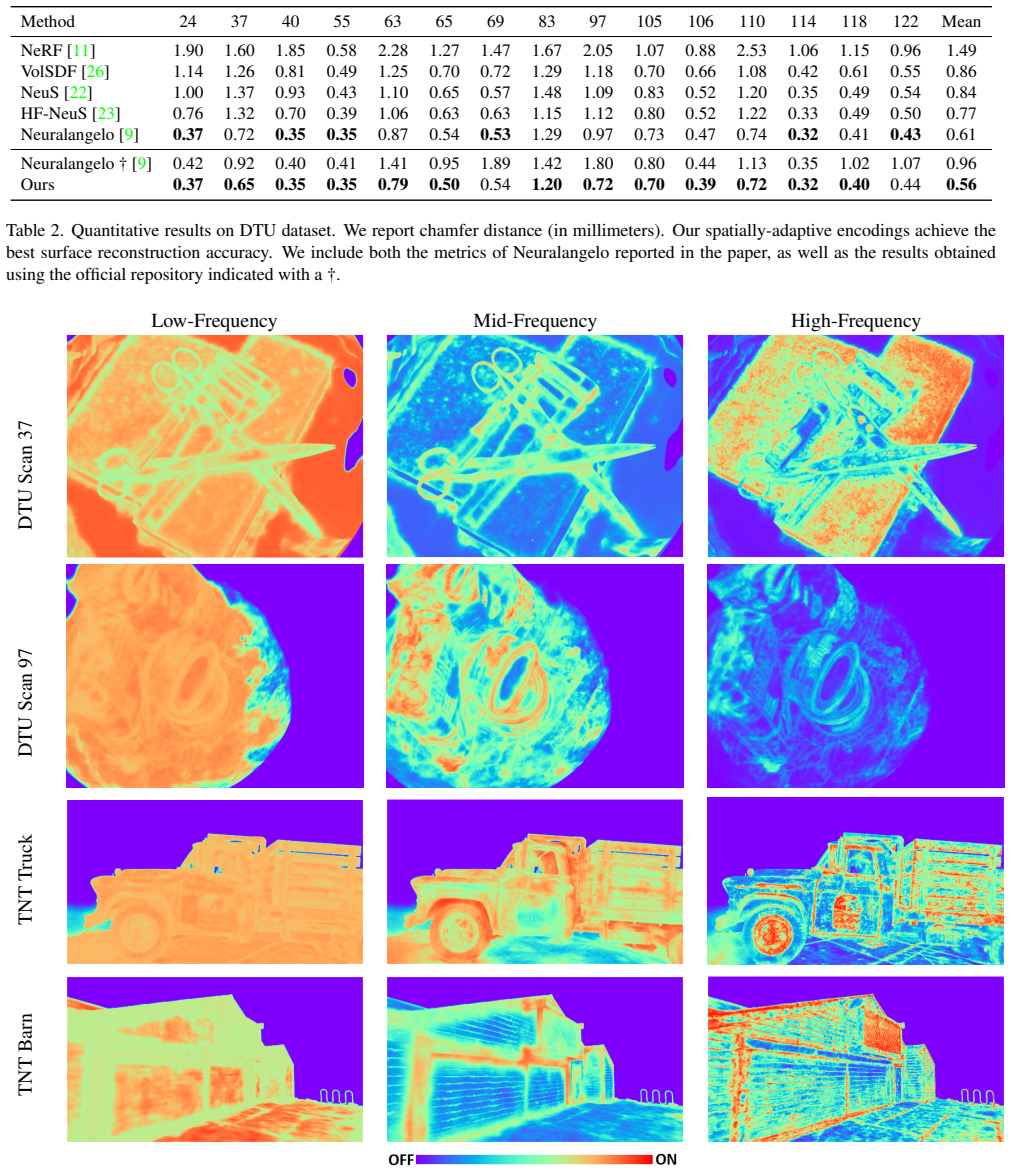
The central discovery is that a spatially varying mask over hash-grid resolutions is enough to fit a wider range of frequencies without adding noise. The mask is produced by a small auxiliary hash grid and a shallow sigmoid MLP, yielding per-level scalars $s_\ell(x) \in (0,1)$; the SDF hash encoding becomes $h(x) = [s_1(x) f_1, \dots, s_N(x) f_N]$, and progressive unveiling blocks gradients to inactive mask levels early in training. Learned masks segment scenes by frequency need: fine grids activate on edges and gratings, while smooth or specular regions fall back to coarse grids. The paper shows this leads to cleaner low-frequency surfaces and improved fine details, with quantitative gains over Neuralangelo on both DTU and Tanks and Temples.
Load-bearing premise
The reported state-of-the-art result rests on the authors' re-run of the official Neuralangelo code, which scores 0.96 mm on DTU rather than the 0.61 mm in the original Neuralangelo paper; if that re-run is not a faithful like-for-like baseline, the improvement attributed to the spatial mask is not established.
Editorial extensions
If this is right
- On the 15-scene DTU benchmark, the method reports a mean Chamfer-L1 of 0.56 mm, below both the re-run Neuralangelo (0.96 mm) and the published Neuralangelo number (0.61 mm).
- On Tanks and Temples, the method's F1 score is 0.53, above the re-run (0.47) and published (0.50) Neuralangelo numbers, with visible gains on structures like the barn grating and truck wheels.
- Ablations show the sigmoid mask activation is important: replacing it with softmax drops performance (Chamfer 0.74 vs 0.65) because the network collapses toward the coarsest resolution.
- The mask network adds only about 8 million parameters (374M vs 366M), so the adaptive bias comes at negligible storage cost beyond the hash-grid features themselves.
Reading between the lines
- If the learned masks genuinely reflect frequency need, they could be reused after training as a pruning map: hash entries in regions where all fine-level masks are near zero are never read, so the about 4.2 GB footprint could be cut without retraining. The paper gestures at this as future work.
- A controlled test of the mechanism would force the high-frequency masks to be active in a smooth region and measure the resulting chamfer error; the heat maps in Figure 4 suggest this should hurt, but the paper does not run that experiment.
- The spatial-mask idea is orthogonal to the choice of encoding beyond hash grids; coupling it with spatially adaptive view-direction encodings could address reflective scenes, a limitation the paper acknowledges. This is a natural next step the authors name.
Signed reviews
Editorial analysis
A structured set of objections, weighed in public.
Referee Report
Summary. The manuscript proposes a spatially-adaptive variant of multi-resolution hash encoding for neural surface reconstruction. Building on Neuralangelo, it learns a per-level scalar mask field, computed from a small hash grid and a shallow MLP, that multiplies the features of each hash-grid level as a function of spatial position. Training uses an RGB rendering loss, eikonal and curvature regularization, and a progressive unveiling of high-resolution grids with gradient blocking for inactive masks. Experiments on DTU and Tanks and Temples report mean Chamfer-L1 of 0.56 mm and F1 of 0.53, which the paper states is state-of-the-art compared with published Neuralangelo numbers of 0.61 mm and 0.50. Ablations examine mask grid resolution, curvature regularization, and sigmoid vs. softmax activations.
Significance. If the claimed improvement is real, the idea is simple, inexpensive, and likely to transfer to other grid-based neural fields. The paper makes a clear empirical contribution: the mask heatmaps provide a useful diagnostic, and the ablations of design choices are appropriate. However, the central SOTA claim depends on a comparison to a re-run Neuralangelo baseline whose training protocol is not documented, on small margins over published numbers, and on single-run results with no variance. No code or data are provided for verification. These gaps mean the result is plausible but not yet established.
major comments (5)
- [Sec. 4.1, Table 2] The re-run of the official Neuralangelo repository (Neuralangelo †) reports a DTU mean Chamfer-L1 of 0.96 mm, compared with the published 0.61 mm. The manuscript does not state the number of training iterations, learning-rate schedule, loss weights, or other hyperparameters for this re-run or for the proposed method. If the re-run used a different or shorter training budget, the 0.40 mm difference between the re-run and the proposed method could be due to training budget rather than the spatial mask. Please provide the exact training configuration and, ideally, reproduce the published Neuralangelo numbers under the same protocol, and report the proposed method under the same protocol.
- [Sec. 3.2 and Tables 1-2] There is no ablation that disables the spatial mask within the proposed pipeline (e.g., fixing s_l(x)=1 for all levels). The progressive unveiling schedule, the gradient blocking to inactive masks, and the additional mask-network parameters are all confounded with the mask itself. A three-way comparison is needed: the full proposed method, the proposed method with the mask fixed to one, and the official Neuralangelo re-run under identical training settings. Without this, the reported gains cannot be attributed specifically to the spatially adaptive mask.
- [Sec. 4.3, Table 3] In the mask grid-resolution ablation, the default setting [5,11] yields Chamfer 0.654 mm, while [4,10] yields the best value of 0.648 mm. The text says the coarsest setting 'highlights the importance' of the mask but does not explain why [5,11] is preferred over [4,10]. Please justify the choice of default or update the main tables if the best configuration differs.
- [Tables 1-2] All results are from a single run with no error bars or significance testing. The mean margins over published Neuralangelo are small (0.05 mm Chamfer on DTU and 0.03 F1 on TNT), and scene-level differences (e.g., DTU Scan 69, where Ours gives 0.54 vs. published 0.53) are within typical run-to-run variation. Please report multiple seeds or a statistical analysis to support the claim that the differences are not noise.
- [Abstract and Tables 1-2] The state-of-the-art claim is scoped to the methods listed in the tables, which are mostly from 2022-2023. Please either clarify that the claim is restricted to the compared baselines or add comparisons to more recent surface reconstruction methods that report DTU/TNT metrics. As written, the abstract's 'state-of-the-art performance on two benchmark datasets' is stronger than the evidence.
minor comments (6)
- [Sec. 4.2] The sentence 'The results are detailed in Section 4.1' is incorrect; the Tanks and Temples results are in Section 4.2, while Section 4.1 presents DTU. Please fix the cross-reference.
- [Sec. 4.2 and Discussion] There are grammatical and typographical errors: 'offical' should be 'official', and 'on both DTU and as well as Tanks and Temples' should be 'on both DTU and Tanks and Temples'.
- [Sec. 4.1] The grid resolution range '323 to 20483' should read '32^3 to 2048^3' with proper superscripts.
- [Figure 4] The caption should state the color scale and the exact level groupings (e.g., levels 1-8, 8-14, 15-16) used for the Low/Mid/High-Frequency heatmaps, rather than leaving this to the body text.
- [General] The paper states that code will be released after acceptance; for reproducibility, please provide code or a detailed configuration listing all hyperparameters at submission time.
- [Eq. (4)] Consider clarifying that the mask s_l(x) is a scalar multiplier shared across all feature channels of level l, since the notation s_l(x) * f_l could also be read as channel-wise multiplication if f_l is treated as a vector.
Circularity Check
No significant circularity: the spatially adaptive mask is learned end-to-end and all reported metrics come from external benchmarks, so no prediction reduces to a fitted input or to a self-citation.
full rationale
I find no circularity in the paper's derivation chain. The proposed construction in Eq. (4) is a feature-wise multiplication h(x)=[s1(x)*f1,...,sN(x)*fN], where the mask network and the SDF/color networks are trained jointly in an end-to-end manner using the rendering loss, the eikonal loss, and the curvature loss in Eq. (8). The benchmark numbers (DTU Chamfer-L1 and Tanks and Temples F1) are obtained from external datasets and official evaluation scripts, so the reported state-of-the-art performance is an empirical outcome rather than a quantity defined by the method's own parameters. The mask grid-resolution choices in Table 3 are hyperparameter selections, not fitted parameters that are subsequently renamed as predictions. The only author self-citation is reference [21] in the related-work passage about explicit parametric surfaces, and it is not load-bearing for the proposed masking scheme, the progressive unveiling schedule, or any performance claim. The discrepancy between the published Neuralangelo numbers and the dagger re-run is a baseline attribution and reproducibility concern, not circularity, because the method's derivation does not assume or enforce that re-run. Likewise, the absence of a mask-disabled control weakens causal attribution but does not make the central claim equivalent to its input. The paper is self-contained against external benchmarks and no step reduces, by construction, to its own inputs.
Assumptions & free parameters
free parameters (6)
- spatial mask grid resolutions [dmin, dmax] =
[5, 11] (32^3 to 2048^3)
- mask hash grid feature dimension =
4
- mask hash dictionary size =
2^18
- mask MLP hidden units =
16
- loss weights w_eik and w_curv =
0.1 and 5e-4
- numerical gradient epsilon schedule =
not specified
assumptions (5)
- domain assumption NeuS volume rendering with logistic SDF-to-density conversion is a valid way to optimize SDFs from images.
- domain assumption Numerical gradients with scheduled epsilon enforce surface normal consistency and coarse-to-fine optimization.
- ad hoc to paper Multiplying hash-grid features by a learned per-level scalar mask preserves the SDF network's ability to represent geometry while adjusting frequency bias.
- domain assumption Hash collisions in the spatial mask grid do not corrupt the mask field.
- ad hoc to paper Blocking gradients to masks of inactive grid resolutions prevents early convergence of masks to zero.
Cite this review
Pith. "Pith review of Spatially-Adaptive Hash Encodings For Neural Surface Reconstruction." pith.science (2026). https://pith.science/paper/RRPF7PXZ
@misc{pith2026241205179,
  author       = {Pith},
  title        = {Pith review of: Spatially-Adaptive Hash Encodings For Neural Surface Reconstruction},
  year         = {2026},
  howpublished = {\url{https://pith.science/paper/RRPF7PXZ}},
  note         = {Machine review of arXiv:2412.05179}
}
read the original abstract
Positional encodings are a common component of neural scene reconstruction methods, and provide a way to bias the learning of neural fields towards coarser or finer representations. Current neural surface reconstruction methods use a "one-size-fits-all" approach to encoding, choosing a fixed set of encoding functions, and therefore bias, across all scenes. Current state-of-the-art surface reconstruction approaches leverage grid-based multi-resolution hash encoding in order to recover high-detail geometry. We propose a learned approach which allows the network to choose its encoding basis as a function of space, by masking the contribution of features stored at separate grid resolutions. The resulting spatially adaptive approach allows the network to fit a wider range of frequencies without introducing noise. We test our approach on standard benchmark surface reconstruction datasets and achieve state-of-the-art performance on two benchmark datasets.
Figures


Figures from the paper (4 more)


Reference graph
Works this paper leans on
-
[1]
Large-scale data for multiple-view stereopsis
Henrik Aanæs, Rasmus Ramsbøl Jensen, George V ogiatzis, Engin Tola, and Anders Bjorholm Dahl. Large-scale data for multiple-view stereopsis. International Journal of Computer Vision, pages 1–16, 2016. 4
work page 2016
-
[2]
Shape reconstruction by learn- ing differentiable surface representations
Jan Bednarik, Shaifali Parashar, Erhan Gundogdu, Mathieu Salzmann, and Pascal Fua. Shape reconstruction by learn- ing differentiable surface representations. In Proceedings of the IEEE/CVF Conference on Computer Vision and Pattern Recognition, pages 4716–4725, 2020. 2
work page 2020
-
[3]
Accurate, dense, and robust multiview stereopsis
Yasutaka Furukawa and Jean Ponce. Accurate, dense, and robust multiview stereopsis. IEEE transactions on pattern analysis and machine intelligence , 32(8):1362–1376, 2009. 1
2009
-
[4]
Implicit geometric regularization for learning shapes
Amos Gropp, Lior Yariv, Niv Haim, Matan Atzmon, and Yaron Lipman. Implicit geometric regularization for learning shapes. arXiv preprint arXiv:2002.10099, 2020. 2, 4
arXiv 2002
-
[5]
A papier-m ˆach´e ap- proach to learning 3d surface generation
Thibault Groueix, Matthew Fisher, Vladimir G Kim, Bryan C Russell, and Mathieu Aubry. A papier-m ˆach´e ap- proach to learning 3d surface generation. In Proceedings of the IEEE conference on computer vision and pattern recog- nition, pages 216–224, 2018. 2
2018
-
[6]
Multiscale tensor decomposition and rendering equation encoding for view synthesis
Kang Han and Wei Xiang. Multiscale tensor decomposition and rendering equation encoding for view synthesis. In Pro- ceedings of the IEEE/CVF Conference on Computer Vision and Pattern Recognition (CVPR) , pages 4232–4241, June
-
[7]
Sape: Spatially-adaptive progressive encoding for neural optimization
Amir Hertz, Or Perel, Raja Giryes, Olga Sorkine-Hornung, and Daniel Cohen-Or. Sape: Spatially-adaptive progressive encoding for neural optimization. Advances in Neural Infor- mation Processing Systems, 34:8820–8832, 2021. 2, 3, 4
work page 2021
-
[8]
Tanks and temples: Benchmarking large-scale scene reconstruction
Arno Knapitsch, Jaesik Park, Qian-Yi Zhou, and Vladlen Koltun. Tanks and temples: Benchmarking large-scale scene reconstruction. ACM Transactions on Graphics, 36(4), 2017. 4, 6
work page 2017
Show all 27 references
-
[9]
Neuralangelo: High-fidelity neural surface reconstruction
Zhaoshuo Li, Thomas M ¨uller, Alex Evans, Russell H Tay- lor, Mathias Unberath, Ming-Yu Liu, and Chen-Hsuan Lin. Neuralangelo: High-fidelity neural surface reconstruction. In Proceedings of the IEEE/CVF Conference on Computer Vi- sion and Pattern Recognition, pages 8456–8465, ...
2023
-
[10]
Neural sparse voxel fields
Lingjie Liu, Jiatao Gu, Kyaw Zaw Lin, Tat-Seng Chua, and Christian Theobalt. Neural sparse voxel fields. Advances in Neural Information Processing Systems, 33:15651–15663,
-
[11]
Nerf: Representing scenes as neural radiance fields for view syn- thesis
Ben Mildenhall, Pratul P Srinivasan, Matthew Tancik, Jonathan T Barron, Ravi Ramamoorthi, and Ren Ng. Nerf: Representing scenes as neural radiance fields for view syn- thesis. Communications of the ACM, 65(1):99–106, 2021. 1, 7
2021
-
[12]
Instant neural graphics primitives with a mul- tiresolution hash encoding
Thomas M ¨uller, Alex Evans, Christoph Schied, and Alexan- der Keller. Instant neural graphics primitives with a mul- tiresolution hash encoding. ACM transactions on graphics (TOG), 41(4):1–15, 2022. 2
2022
-
[13]
Instant neural graphics primitives with a multires- olution hash encoding
Thomas M ¨uller, Alex Evans, Christoph Schied, and Alexan- der Keller. Instant neural graphics primitives with a multires- olution hash encoding. ACM Trans. Graph. , 41(4):102:1– 102:15, July 2022. 2, 3
2022
-
[14]
Rectified linear units im- prove restricted boltzmann machines
Vinod Nair and Geoffrey E Hinton. Rectified linear units im- prove restricted boltzmann machines. In Proceedings of the 27th international conference on machine learning (ICML- 10), pages 807–814, 2010. 4
2010
-
[15]
Structure-from-motion revisited
Johannes Lutz Sch ¨onberger and Jan-Michael Frahm. Structure-from-motion revisited. In Conference on Com- puter Vision and Pattern Recognition (CVPR), 2016. 1, 5
2016
-
[16]
Photo tourism: exploring photo collections in 3d
Noah Snavely, Steven M Seitz, and Richard Szeliski. Photo tourism: exploring photo collections in 3d. In ACM siggraph 2006 papers, pages 835–846. 2006. 1
2006
-
[17]
Neural geometric level of detail: Real-time rendering with implicit 3D shapes
Towaki Takikawa, Joey Litalien, Kangxue Yin, Karsten Kreis, Charles Loop, Derek Nowrouzezahrai, Alec Jacobson, Morgan McGuire, and Sanja Fidler. Neural geometric level of detail: Real-time rendering with implicit 3D shapes. 2021. 2
2021
-
[18]
Fourier features let networks learn high frequency functions in low dimen- sional domains
Matthew Tancik, Pratul Srinivasan, Ben Mildenhall, Sara Fridovich-Keil, Nithin Raghavan, Utkarsh Singhal, Ravi Ra- mamoorthi, Jonathan Barron, and Ren Ng. Fourier features let networks learn high frequency functions in low dimen- sional domains. Advances in neural information ...
2020
-
[19]
Attention is all you need
Ashish Vaswani, Noam Shazeer, Niki Parmar, Jakob Uszko- reit, Llion Jones, Aidan N Gomez, Łukasz Kaiser, and Illia Polosukhin. Attention is all you need. Advances in neural information processing systems, 30, 2017. 2
2017
-
[20]
Ref-nerf: Struc- tured view-dependent appearance for neural radiance fields
Dor Verbin, Peter Hedman, Ben Mildenhall, Todd Zickler, Jonathan T Barron, and Pratul P Srinivasan. Ref-nerf: Struc- tured view-dependent appearance for neural radiance fields. In 2022 IEEE/CVF Conference on Computer Vision and Pat- tern Recognition (CVPR), pages 5481–5490. IE...
2022
-
[21]
Explicit neural surfaces: Learning contin- uous geometry with deformation fields
Thomas Walker, Octave Mariotti, Amir Vaxman, and Hakan Bilen. Explicit neural surfaces: Learning contin- uous geometry with deformation fields. arXiv preprint arXiv:2306.02956, 2023. 2
2023 arXiv
-
[22]
Neus: Learning neural implicit surfaces by volume rendering for multi-view reconstruction,
Peng Wang, Lingjie Liu, Yuan Liu, Christian Theobalt, Taku Komura, and Wenping Wang. Neus: Learning neural implicit surfaces by volume rendering for multi-view reconstruction,
-
[23]
Hf-neus: Improved surface reconstruction using high-frequency de- tails
Yiqun Wang, Ivan Skorokhodov, and Peter Wonka. Hf-neus: Improved surface reconstruction using high-frequency de- tails. Advances in Neural Information Processing Systems , 35:1966–1978, 2022. 2, 3, 7
1966
-
[24]
Deep geomet- ric prior for surface reconstruction
Francis Williams, Teseo Schneider, Claudio Silva, Denis Zorin, Joan Bruna, and Daniele Panozzo. Deep geomet- ric prior for surface reconstruction. In Proceedings of the IEEE/CVF conference on computer vision and pattern recognition, pages 10130–10139, 2019. 2
2019
-
[25]
Hollownerf: Pruning hashgrid-based nerfs with trainable collision mitigation, 2023
Xiufeng Xie, Riccardo Gherardi, Zhihong Pan, and Stephen Huang. Hollownerf: Pruning hashgrid-based nerfs with trainable collision mitigation, 2023. 8
2023
-
[26]
V ol- ume rendering of neural implicit surfaces
Lior Yariv, Jiatao Gu, Yoni Kasten, and Yaron Lipman. V ol- ume rendering of neural implicit surfaces. Advances in Neu- ral Information Processing Systems, 34:4805–4815, 2021. 1, 2, 7
2021
-
[27]
Improving deep neural networks using softplus units
Hao Zheng, Zhanlei Yang, Wenju Liu, Jizhong Liang, and Yanpeng Li. Improving deep neural networks using softplus units. In 2015 International joint conference on neural net- works (IJCNN), pages 1–4. IEEE, 2015. 4
2015
Reviewed August 11, 2026 · model on record in the stance chip above.
Discussion (0). Continue with ORCID to comment.