REVIEW 4 major objections 5 minor 64 references
Situation-Aware Left-Turning Connected and Automated Vehicle Operation at Signalized Intersections
T0 review · 4 major / 5 minor · reviewed 2026-08-14 · deepseek-v4-flash
Pith's one-line read A situation-aware controller lets a left-turning CAV sense an aggressive follower's intent and time its turn to cut the follower's abrupt braking by up to 27% and average travel time by up to 62%.
desk verdict A plausible CAV left-turn module whose headline numbers are confounded by multiple simultaneous changes, so the intent-recognition effect is not yet demonstrated. read the letter →
The pith
A machine-rendered reading of the paper's core claim, the machinery that carries it, and where it could break.
The reading
What carries the argument
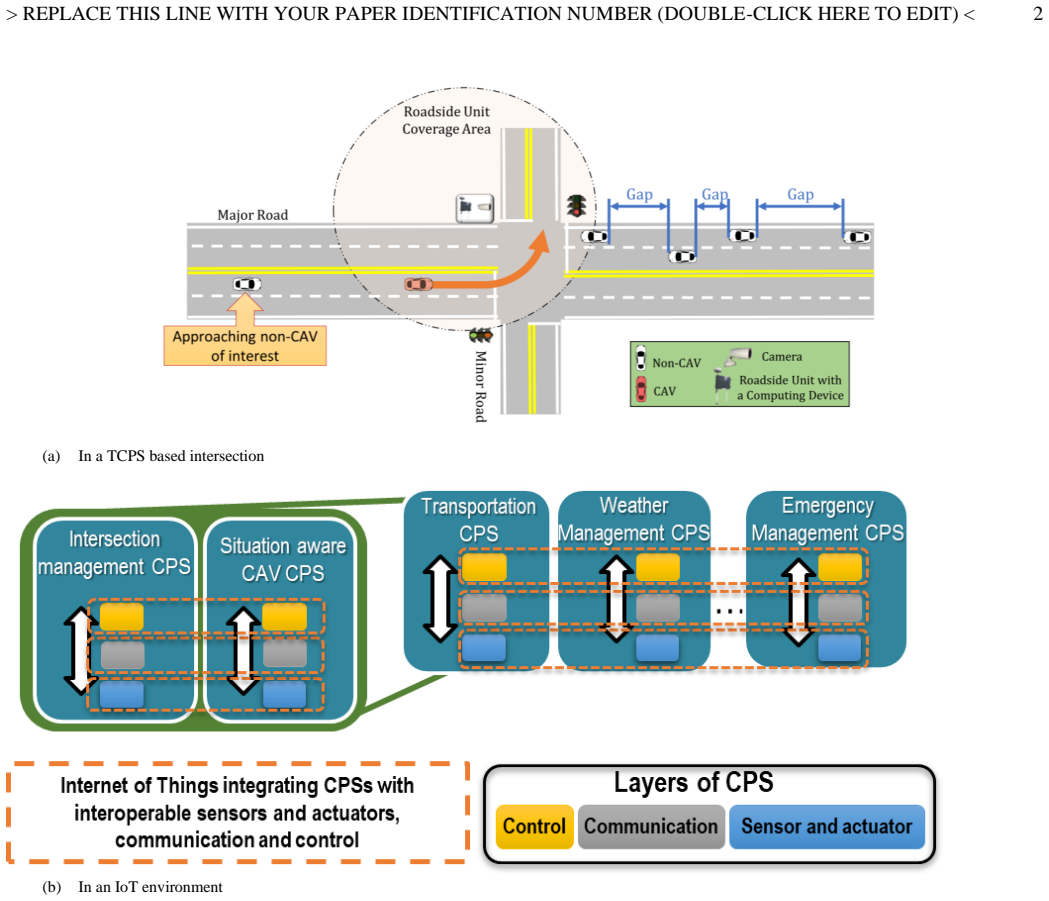
The load-bearing object is the situation-aware CAV controller module, a four-step decision loop: intent recognition, future-state prediction, gap estimation, and movement optimization. Intent recognition is a Bayesian classifier fed by the follower's acceleration and time headway, with Gaussian thresholds ($2\ \mathrm{m/s^2}$ acceleration and 1 s headway for aggressive; $-2\ \mathrm{m/s^2}$ and 2 s for non-aggressive). Gap estimation uses a parabolic left-turn path and vehicle-conflict geometry to define when the opposing lanes are clear. Movement optimization minimizes the jerk of a third-degree-polynomial speed profile in two stages, inflow and outflow, subject to comfortable-jerk and speed-limit constraints. This module is what converts the follower's state into an earlier, smoother left turn that leaves the aggressive follower less reason to brake hard.
What would settle it
Let the following vehicle change lanes in the same simulated intersection and draw its braking and acceleration parameters from observed naturalistic aggressive-driver data; if abrupt-braking and travel-time savings drop to near zero when passing is possible, the module's reported effect is an artifact of the restricted scenario.
Extended reading notes
Core claim
The central claim is that adding situation awareness to a left-turn controller—specifically, recognizing whether the following non-CAV is aggressive and using V2I-provided gap information from the opposing through stream—makes the CAV clear the shared lane sooner and more smoothly. The controller estimates the follower's acceleration and time headway from a rear camera, computes the probability of aggressive intent with Bayes' rule, predicts available gaps in the opposing traffic from a roadside camera, and then solves two jerk-minimizing optimizations to produce a speed profile that brings the CAV to the intersection stop bar with near-zero speed and lets it complete the turn as soon as a safe gap exists. In simulation, this reduces abrupt braking events of an aggressive following driver by 27%, 20%, and 27% for opposing through volumes of 600, 800, and 1000 vehicles per hour per lane, and reduces the follower's average travel time by 58%, 52%, and 62% compared with a travel-time-optimizing base AV. The paper's claim is that these benefits follow specifically from considering the following vehicle's intent, not from the optimization alone.
Load-bearing premise
The simulation locks the aggressive follower into the CAV's lane and defines aggression as hard braking only at very close range, so the reported benefits depend on a follower who cannot pass and whose behavior matches that simplified model.
Editorial extensions
If this is right
- At opposing through volumes of 600, 800, and 1000 vehicles per hour per lane, the situation-aware controller cuts the aggressive follower's abrupt braking events by 27%, 20%, and 27% relative to a base AV that ignores the follower.
- The same controller reduces the following vehicle's average travel time by 58%, 52%, and 62%, and the turning CAV's own travel time by 51%, 47%, and 57%, compared with a travel-time-optimizing base AV.
- These gains come from using the follower's intent plus V2I gap information, so the module requires a rear-facing sensor and roadside-to-vehicle communication of opposing-traffic gaps.
- If the paper's claim holds, adding this module to left-turn controllers could reduce rear-end conflicts and road-rage waiting time in mixed traffic without requiring the human driver to change behavior.
Reading between the lines
- If the aggressive follower is allowed to change lanes instead of being trapped behind the CAV, the measured safety and travel-time benefits may shrink substantially; a natural extension is to re-run the comparison with lane changes enabled.
- The Bayes classifier's thresholds are fixed hand-set Gaussians; training them on naturalistic driving data could make the intent estimate robust to different drivers and lighting or weather conditions.
- The paper assumes perfect V2I with negligible delay; connecting the module to realistic communication loss and delay models would test whether the gap information arrives in time to preserve the benefit.
- The same situation-aware loop could be adapted to other conflict-prone maneuvers—right turns with crossing pedestrians or freeway merges—where the subject vehicle's move is constrained by what the follower or neighbor is likely to do.
Signed reviews
Editorial analysis
A structured set of objections, weighed in public.
Referee Report
Summary. This paper proposes a situation-aware control module for a left-turning connected and automated vehicle (CAV) at a signalized intersection. The module combines a Bayesian classifier of the following vehicle's aggressiveness (using acceleration and time headway), vehicle-to-infrastructure (V2I) gap information about opposing through traffic provided by a roadside unit, and a jerk-minimizing speed-profile optimization. The authors evaluate the module in a SUMO/Webots simulation against two base AV controllers: one without travel-time optimization (Base #1) and one with travel-time optimization (Base #2), both lacking V2I and follower-intent awareness. For opposing through traffic volumes of 600, 800, and 1000 veh/h/lane, the module is reported to reduce abrupt braking events of an aggressive following vehicle by 27%, 20%, and 27%, respectively, and to reduce the following vehicle's average travel time by 58%, 52%, and 62% compared with Base #2. The paper's central claim is that considering the following vehicle's intent produces these safety and efficiency gains.
Significance. If the quantitative claims were established, the result would be practically relevant because rear-end conflicts involving automated vehicles in mixed traffic are a documented problem, and left-turn maneuvers are a high-risk interaction. The paper is commendable for combining a multi-modal simulation (SUMO for background traffic, Webots for the CAV and its sensors), for using a concrete permissive-green left-turn scenario, and for reporting results over multiple opposing-flow volumes. However, the evidence currently does not isolate the effect of the paper's stated novelty—follower-intent recognition—from several other differences between the situation-aware controller and the baseline, and the baseline's gap-acceptance threshold is calibrated by trial-and-error. The contribution is therefore a promising module-level proof-of-concept rather than a validated causal demonstration of an intent-aware benefit. Reproducibility is partial: the software tools are public, but scenario files, detailed parameter values, and solver settings are not provided in the manuscript.
major comments (4)
- [Section VI.A/B vs. Sections III.B-D, IV.B, V.C] The reported benefits are not isolated to the intent-recognition component. The situation-aware CAV differs from Base #2 in several simultaneous respects: it adds V2I-based gap prediction (Section III.B), uses smaller conflict-point thresholds sigma=0.6 m and t=1.2 m (Section V.C), allows a speed up to speed limit +2.24 m/s (Section III.D), and solves the trajectory optimization with MIDACO, whereas Base #2 has no V2I, uses a 5 s gap threshold, strictly follows the speed limit, and uses the MILP-based formulation of Section IV.B. Because no ablation run disables only the follower-intent branch while keeping all other components identical, the abstract's claim that "if the following vehicle's intent is considered" yields the 27%/20% abrupt-braking reductions and the 58%/52%/62% travel-time reductions is not directly supported. Since the paper's stated novelty is intent recognition, this conflation is load-bearing.
- [Section IV (Base AV gap acceptance)] The base AV's 5-second gap acceptance threshold is obtained by "trial-and-error with the simulated scenario" and is set so that "for gaps less than 5 seconds, a collision occurs." This makes the baseline conservative by construction: it is calibrated to fail below the threshold that the situation-aware CAV can exploit with additional sensor information. A fair module-level comparison would require either a matching base AV that also receives V2I gap information but ignores follower intent, or a sensitivity analysis over the base AV's gap threshold. As reported, the magnitude of the claimed benefit may be an artifact of this calibration choice.
- [Section V.A (Aggressive driver model and lane-change restriction)] The aggressive follower is scripted to "not decelerate properly following the leading CAV" and to "apply hard brake only when it is very close to the leading CAV," and the lane-changing capability of the following vehicle is disabled. This setup forces the follower to remain behind the CAV and defines the exact failure mode (hard braking at a stopped leader) that the module is designed to remove. The simulation therefore shows that the module works in the scenario for which it was designed, but the quantitative reduction rates are not robust evidence for real aggressive drivers, who may change lanes or decelerate differently. The paper should either validate the aggressive-driver model against data or report sensitivity to alternative follower behaviors; the conclusions' call for real-world evaluation acknowledges this gap.
- [Section III.A (Bayesian classifier parameters)] The intent-recognition classifier uses uncalibrated prior probabilities P(A)=P(NA)=0.5 and Gaussian distributions with means of 2 m/s^2 for aggressive acceleration, -2 m/s^2 for non-aggressive deceleration, and a standard deviation of 4/3 m/s^2, with the distribution shapes fixed by assumption. No accuracy, confusion-matrix, or sensitivity analysis is reported for the classifier. Because this classifier is the only sensor-level mechanism implementing the paper's claimed novelty of assessing follower intent, the lack of any evaluation of its reliability is a major gap for the stated mechanism.
minor comments (5)
- [Section VI.A] The text states that the situation-aware CAV "reduces 27% of the abrupt braking ... compared to both base scenarios," but it is unclear whether the reduction is identical for Base #1 and Base #2 or whether the percentage is averaged over the two bases; please report each base's absolute event counts and the per-base reduction.
- [Section III.D (outflow constraints)] The outflow optimization constraints are written as "-0.2 ms^-4 < 𝒿_outflow < -0.6 ms^-4", which is infeasible as stated because -0.2 is greater than -0.6; presumably the lower and upper bounds were intended in the reverse order.
- [Section VI (statistical reporting)] The paper does not report confidence intervals or significance tests for the 30 simulation runs per scenario; since the traffic is stochastic, the box plots in Fig. 8 alone do not establish that the mean travel-time reductions are statistically distinguishable across scenarios.
- [General presentation] The manuscript contains numerous typographical and typesetting artifacts (e.g., "int eracting", "vehi cles", "left -turning"), and the template placeholder "REPLACE THIS LINE WITH YOUR PAPER IDENTIFICATION NUMBER" remains on the first page; the text should be cleaned before resubmission.
- [Section III.A (notation)] Equation (4) defines time headway using Δp_t2 and v_t2, but the surrounding text sometimes uses Δp_t1 for the relative position; please standardize the time-index notation for the following vehicle's position and speed.
Circularity Check
Headline safety and efficiency gains are partly built into the simulation's follower model and hand-tuned gap thresholds; the intent-recognition contribution is not isolated.
-
self definitional
[Section V.A (aggressive follower model), Section V.C (module goal), Section VI.A (abrupt-braking result)]
"It will apply hard brake only when it is very close to the leading CAV, while the CAV is waiting to make a left turn at the intersection. ... The goal of the situation-aware CAV controller module is to clear the path from the shared lane for an aggressive through vehicle, so that the aggressive driver does not need to apply a hard brake."
The counted safety metric is defined by exactly the state the controller is designed to prevent: the scripted aggressive follower brakes only when the CAV is stopped waiting to turn. The module's objective is to avoid that waiting state, so the reported 27%/20% abrupt-braking reduction is essentially a check that the controller meets its own design goal, not independent evidence that considering the following vehicle's intent causes the improvement. The 800 vphpln case (20% rather than 27%) shows the reduction is not numerically forced, but the direction of the headline claim is built into the scenario definition.
-
fitted input called prediction
[Section IV (Base AV gap acceptance) and Section V.C (situation-aware CAV thresholds)]
"For this study, after trial-and-error with the simulated scenario, we have found 5 seconds is the accepted gap for the AV left-turn maneuver. For gaps less than 5 seconds, a collision occurs between AVs and the opposite through non-AVs. ... These small distance thresholds were considered as they provide more gaps for a CAV's left-turning maneuver that would avoid rear-end crash likelihood with a following aggressive driver."
The baseline AV's gap acceptance is hand-fitted to the simulated scenario: 5 seconds is chosen so that shorter gaps produce collisions. The situation-aware arm then uses smaller conflict thresholds explicitly selected to provide more gaps. Because no ablation holds V2I, speed allowance, and threshold choices fixed while toggling only the follower-intent branch, the large travel-time and braking differences are partly an artifact of comparing against a calibrated conservative baseline and permissive parameters. The claimed quantity of interest, the benefit of considering the following vehicle's intent, is not isolated from these fitted inputs.
1 more flagged steps
-
self citation load bearing
[Section V.C, after Eqs. (8)-(11)]
"To identify the start and end of the conflict points in the opposing through traffic stream, σ and t values are considered to be 0.6 meter (2 ft.) and 1.2 meter (4 ft.) [63]. These small distance thresholds were considered as they provide more gaps for a CAV's left-turning maneuver that would avoid rear-end crash likelihood with a following aggressive driver."
Reference [63] is the first author's own Clemson dissertation, not an independent source. The gap-availability thresholds are not derived in this paper; they are assumed, and the assumption is justified by a self-citation. Because these thresholds directly increase the number of acceptable gaps, they are load-bearing for the reported travel-time and braking improvements. The self-citation therefore supplies the parameter that creates the claimed benefit rather than providing an independent verification of it.
full rationale
This is a simulation-comparison paper rather than a formal derivation, so there is no equation-level identity in which a predicted quantity is literally an input. However, the headline result is substantially self-confirming. The aggressive following vehicle is scripted to hard-brake only when the CAV is waiting at the intersection, and the situation-aware module's stated purpose is to prevent that waiting; hence the abrupt-braking reduction largely measures whether the controller achieves its own objective. The base AV's 5-second gap threshold is chosen by trial-and-error to be the collision boundary, while the situation-aware arm uses smaller conflict thresholds explicitly chosen to provide more gaps, with those thresholds cited to the first author's dissertation. These choices load the comparison in favor of the proposed module. The reported gains may still be real in the narrow sense of 'situation-aware CAV versus base AV in this simulator,' but the paper's stronger claim that considering the following vehicle's intent produces the improvement is not supported by an ablation and is partly reducible to the fitted baseline and permissive parameters. The partial nature of the circularity, and the fact that traffic-volume variation still changes the outcome (20% vs 27%), keeps this below a score of 8-10.
Assumptions & free parameters
free parameters (5)
- Base AV gap acceptance threshold =
5 seconds
- Aggressive driver hard-brake distance threshold =
not specified ('very close')
- Following vehicle start delay =
8 seconds
- Bayesian classifier distribution parameters =
means: acceleration +2 and -2 m/s^2, sigma 4/3 m/s^2; headway 1s and 2s
- Conflict-point thresholds sigma and t =
0.6 m and 1.2 m
assumptions (8)
- domain assumption The following vehicle's aggressiveness is identifiable from instantaneous acceleration and time headway using the Gaussian likelihoods of Fig. 3.
- domain assumption The simulated aggressive driver behavior is representative of real aggressive drivers.
- domain assumption V2I communication is perfect (no delay, no loss).
- domain assumption Opposite through-traffic vehicles maintain constant speed when approaching the intersection.
- domain assumption The following vehicle cannot change lanes.
- domain assumption The CAV follows a parabolic left-turn path with the conflict geometry of Fig. 4(b) and Eqs. (7)-(11).
- domain assumption The prior probability of the following vehicle being aggressive is 0.5.
- standard math Bayes' theorem and standard calculus apply.
Cite this review
Pith. "Pith review of Situation-Aware Left-Turning Connected and Automated Vehicle Operation at Signalized Intersections." pith.science (2026). https://pith.science/paper/RRWSFKBQ
@misc{pith2026190800981,
  author       = {Pith},
  title        = {Pith review of: Situation-Aware Left-Turning Connected and Automated Vehicle Operation at Signalized Intersections},
  year         = {2026},
  howpublished = {\url{https://pith.science/paper/RRWSFKBQ}},
  note         = {Machine review of arXiv:1908.00981}
}
read the original abstract
One challenging aspect of the Connected and Automated Vehicle (CAV) operation in mixed traffic is the development of a situation-awareness module for CAVs. While operating on public roads, CAVs need to assess their surroundings, especially the intentions of non-CAVs. Generally, CAVs demonstrate a defensive driving behavior, and CAVs expect other non-autonomous entities on the road will follow the traffic rules or common driving behavior. However, the presence of aggressive human drivers in the surrounding environment, who may not follow traffic rules and behave abruptly, can lead to serious safety consequences. In this paper, we have addressed the CAV and non-CAV interaction by evaluating a situation-awareness module for left-turning CAV operations in an urban area. Existing literature does not consider the intent of the following vehicle for a CAVs left-turning movement, and existing CAV controllers do not assess the following non-CAVs intents. Based on our simulation study, the situation-aware CAV controller module reduces up to 27% of the abrupt braking of the following non-CAVs for scenarios with different opposing through movement compared to the base scenario with the autonomous vehicle, without considering the following vehicles intent. The analysis shows that the average travel time reductions for the opposite through traffic volumes of 600, 800, and 1000 vehicle/hour/lane are 58%, 52%, and 62%, respectively, for the aggressive human driver following the CAV if the following vehicles intent is considered by a CAV in making a left turn at an intersection.
Figures


Figures from the paper (1 more)

Reference graph
Works this paper leans on
-
[1]
Collective Awareness for Abnormality Detection in Connected Autonomous Vehicles,
D. T. Kanapram et al., “Collective Awareness for Abnormality Detection in Connected Autonomous Vehicles,” IEEE Internet Things J., vol. 7, no. 5, pp. 3774–3789, May 2020
work page 2020
-
[2]
Y. Chen, C. Lu, and W. Chu, “A Cooperative Driving Strategy Based on Velocity Prediction for Connected Vehicles with Robust Path-Following Control,” IEEE Internet Things J., vol. 7, no. 5, pp. 3822–3832, May 2020
work page 2020
-
[3]
Characterizing Lane Changes via Digitized Infrastructure and Low-Cost GPS,
I. Ahmed, A. Karr, N. M. Rouphail, G. Chun, and S. Tanvir, “Characterizing Lane Changes via Digitized Infrastructure and Low-Cost GPS,” Transp. Res. Rec. J. Transp. Res. Board, p. 036119811984127, Apr. 2019
work page 2019
-
[4]
Road rage: drivers’ understandings and experiences,
D. Lupton, “Road rage: drivers’ understandings and experiences,” J. Sociol., vol. 38, no. 3, pp. 275–290, Sep. 2002
work page 2002
-
[5]
Aggressive driving: The contribution of the drivers and the situation,
D. Shinar, “Aggressive driving: The contribution of the drivers and the situation,” Transp. Res. Part F Traffic Psychol. Behav., vol. 1, no. 2, pp. 137–160, Dec. 1998
work page 1998
-
[6]
Effects of aggressive driving and driver characteristics on road rage,
R. L. Dukes, S. L. Clayton, L. T. Jenkins, T. L. Miller, and S. E. Rodgers, “Effects of aggressive driving and driver characteristics on road rage,” Soc. Sci. J., vol. 38, no. 2, pp. 323–331, Jun. 2001
work page 2001
-
[7]
A. M. Boggs, B. Wali, and A. J. Khattak, “Exploratory analysis of automated vehicle crashes in California: A > REPLACE THIS LINE WITH YOUR PAPER IDENTIFICATION NUMBER (DOUBLE -CLICK HERE TO EDIT) < 15 text analytics & hierarchical Bayesian heterogeneity- based approach,” Accid. Anal. Prev., vol. 135, p. 105354, 2020
work page 2020
-
[8]
Safety Impacts of Automated Vehicles in Mixed Traffic,
R. Arvin, M. Kamrani, A. J. Khattak, and J. Rios- Torres, “Safety Impacts of Automated Vehicles in Mixed Traffic,” in Transportation Research Board Annual Meeting, 2018
work page 2018
Show all 64 references
-
[9]
Examining accident reports involving autonomous vehicles in California,
F. M. Favarò, N. Nader, S. O. Eurich, M. Tripp, and N. Varadaraju, “Examining accident reports involving autonomous vehicles in California,” PLoS One, vol. 12, no. 9, p. e0184952, Sep. 2017
2017
-
[10]
Automated Driving System Collisions: Early Lessons,
W. Biever, L. Angell, and S. Seaman, “Automated Driving System Collisions: Early Lessons,” Hum. Factors, vol. 62, no. 2, 2020
2020
-
[11]
Traffic Efficiency and Safety Impacts of Autonomous Vehicle Aggressiveness,
S. Li, D. Seth, and M. L. Cummings, “Traffic Efficiency and Safety Impacts of Autonomous Vehicle Aggressiveness,” 2019. [Online]. Available: https://hal.pratt.duke.edu/sites/hal.pratt.duke.edu/files/ u36/AV Aggressiveness TRB Paper final.pdf. [Accessed: 26-Aug-2020]
2019
-
[12]
Autonomous driving in urban environments: Boss and the urban challenge,
C. Urmson et al., “Autonomous driving in urban environments: Boss and the urban challenge,” J. F. Robot., vol. 25, no. 8, pp. 425–466, 2008
2008
-
[13]
Modeling Speed Profiles of Turning Vehicles at Signalized Intersections,
A. Wolfermann, W. K. M. Alhajyaseen, and H. Nakamura, “Modeling Speed Profiles of Turning Vehicles at Signalized Intersections,” in 3rd International Conference on Road Safety and Simulation, 2011
2011
-
[14]
Predicting Optimal Trajectory of Left-Turning Vehicle at Signalized Intersection,
C. Dias, M. Iryo-Asano, and T. Oguchi, “Predicting Optimal Trajectory of Left-Turning Vehicle at Signalized Intersection,” in Transportation Research Procedia, 2017
2017
-
[15]
Estimation of left-turning vehicle maneuvers for the assessment of pedestrian safety at intersections,
W. K. M. Alhajyaseen, M. Asano, and H. Nakamura, “Estimation of left-turning vehicle maneuvers for the assessment of pedestrian safety at intersections,” IATSS Res., 2012
2012
-
[16]
Human-like motion planning model for driving in signalized intersections,
Y. Gu, Y. Hashimoto, L. T. Hsu, M. Iryo-Asano, and S. Kamijo, “Human-like motion planning model for driving in signalized intersections,” IATSS Res., 2017
2017
-
[17]
Driving aggressiveness management policy to enhance the performance of mixed traffic conditions in automated driving environments,
S. Lee, E. Jeong, M. Oh, and C. Oh, “Driving aggressiveness management policy to enhance the performance of mixed traffic conditions in automated driving environments,” Transp. Res. Part A Policy Pract., 2019
2019
-
[18]
Kelley Blue Book | MediaRoom - Special Reports,
Cox Automotive, “Kelley Blue Book | MediaRoom - Special Reports,” Kelley Blue Book, 2016. [Online]. Available: https://mediaroom.kbb.com/future- autonomous-vehicle-driver-study. [Accessed: 21-Jul- 2019]
2016
-
[19]
S. M. Khan, M. Chowdhury, E. A. Morris, and L. Deka, “Synergizing Roadway Infrastructure Investment with Digital Infrastructure for Infrastructure-Based Connected Vehicle Applications: Review of Current Status and and Future Directions,” ASCE J. Infrastruct. Syst., 2019
2019
-
[20]
Transportation Cyber-Physical System and its importance for future mobility,
L. Deka, S. M. Khan, M. Chowdhury, and N. Ayres, “Transportation Cyber-Physical System and its importance for future mobility,” in Transportation Cyber-Physical Systems, 2018
2018
-
[21]
Fundamentals of Cyber-Physical Systems,
A. A. Jahromi and D. Kundur, “Fundamentals of Cyber-Physical Systems,” in Cyber-Physical Systems in the Built Environment, Springer International Publishing, 2020, pp. 1–13
2020
-
[22]
Connected and automated vehicle systems: Introduction and overview,
S. E. Shladover, “Connected and automated vehicle systems: Introduction and overview,” J. Intell. Transp. Syst., vol. 22, no. 3, pp. 190–200, May 2018
2018
-
[23]
Fog/edge computing-based IoT (FECIoT): Architecture, applications, and research issues,
B. Omoniwa, R. Hussain, M. A. Javed, S. H. Bouk, and S. A. Malik, “Fog/edge computing-based IoT (FECIoT): Architecture, applications, and research issues,” IEEE Internet Things J., vol. 6, no. 3, pp. 4118–4149, Jun. 2019
2019
-
[24]
A Survey on Internet of Things: Architecture, Enabling Technologies, Security and Privacy, and Applications,
J. Lin, W. Yu, N. Zhang, X. Yang, H. Zhang, and W. Zhao, “A Survey on Internet of Things: Architecture, Enabling Technologies, Security and Privacy, and Applications,” IEEE Internet Things J., vol. 4, no. 5, pp. 1125–1142, Oct. 2017
2017
-
[25]
Speeding | NHTSA,
NHTSA, “Speeding | NHTSA,” 2019. [Online]. Available: https://www.nhtsa.gov/risky- driving/speeding. [Accessed: 19-Jul-2019]
2019
-
[26]
Driver Reaction Time to Tactile and Auditory Rear-End Collision Warnings While Talking on a Cell Phone,
R. Mohebbi, R. Gray, and H. Z. Tan, “Driver Reaction Time to Tactile and Auditory Rear-End Collision Warnings While Talking on a Cell Phone,” Hum. Factors J. Hum. Factors Ergon. Soc., vol. 51, no. 1, pp. 102–110, Feb. 2009
2009
-
[27]
Collision Warning Timing, Driver Distraction, and Driver Response to Imminent Rear- End Collisions in a High-Fidelity Driving Simulator,
J. D. Lee, D. V. McGehee, T. L. Brown, and M. L. Reyes, “Collision Warning Timing, Driver Distraction, and Driver Response to Imminent Rear- End Collisions in a High-Fidelity Driving Simulator,” Hum. Factors J. Hum. Factors Ergon. Soc., vol. 44, no. 2, pp. 314–334, Jun. 2002
2002
-
[28]
Estimating Rear-End Accident Probabilities at Signalized Intersections: A Comparison Study of Intersections With and Without Green Signal Countdown Devices,
Y. Ni and K. Li, “Estimating Rear-End Accident Probabilities at Signalized Intersections: A Comparison Study of Intersections With and Without Green Signal Countdown Devices,” Traffic Inj. Prev., vol. 15, no. 6, pp. 583–590, Aug. 2014
2014
-
[29]
V2V Wireless Communication Protocol for Rear-End Collision Avoidance on Highways,
F. Ye, M. Adams, and S. Roy, “V2V Wireless Communication Protocol for Rear-End Collision Avoidance on Highways,” in ICC Workshops - 2008 IEEE International Conference on Communications Workshops, 2008, pp. 375–379
2008
-
[30]
Situation-aware decision making for autonomous driving on urban road using online POMDP,
W. Liu, S.-W. Kim, S. Pendleton, and M. H. Ang, “Situation-aware decision making for autonomous driving on urban road using online POMDP,” in 2015 IEEE Intelligent Vehicles Symposium (IV), 2015, pp. 1126–1133
2015
-
[31]
Intention-Aware Autonomous Driving Decision-Making in an Uncontrolled Intersection,
W. Song, G. Xiong, and H. Chen, “Intention-Aware Autonomous Driving Decision-Making in an Uncontrolled Intersection,” Math. Probl. Eng., vol. 2016, pp. 1–15, Apr. 2016
2016
-
[32]
Towards artificial situation awareness by autonomous vehicles,
O. McAree, J. M. Aitken, and S. M. Veres, “Towards artificial situation awareness by autonomous vehicles,” IFAC-PapersOnLine, vol. 50, no. 1, pp. 7038–7043, Jul. 2017
2017
-
[33]
Empathic Autonomous Agents,
T. Kampik, J. C. Nieves, and H. Lindgren, “Empathic Autonomous Agents,” arXiv Prepr., 2019
2019
-
[34]
Autonomous vehicle social behavior for highway entrance ramp management,
J. Wei, J. M. Dolan, and B. Litkouhi, “Autonomous vehicle social behavior for highway entrance ramp management,” in IEEE Intelligent Vehicles Symposium, Proceedings, 2013
2013
-
[35]
R. Vaiana et al., “Driving behavior and traffic safety: > REPLACE THIS LINE WITH YOUR PAPER IDENTIFICATION NUMBER (DOUBLE -CLICK HERE TO EDIT) < 16 An acceleration-based safety evaluation procedure for smartphones,” Mod. Appl. Sci., 2014
2014
-
[36]
Driver aggressiveness detection via multisensory data fusion,
O. Kumtepe, G. B. Akar, and E. Yuncu, “Driver aggressiveness detection via multisensory data fusion,” EURASIP J. Image Video Process., vol. 2016, no. 1, p. 5, Dec. 2016
2016
-
[37]
Identifying Driver Behaviors using Trajectory Features for Vehicle Navigation,
E. Cheung, A. Bera, E. Kubin, K. Gray, and D. Manocha, “Identifying Driver Behaviors using Trajectory Features for Vehicle Navigation,” in Transportation Research Board 85th Annual Meeting, 2006
2006
-
[38]
Modeling and detecting aggressiveness from driving signals,
A. B. Rodriguez Gonzalez, M. R. Wilby, J. J. Vinagre Diaz, and C. Sanchez Avila, “Modeling and detecting aggressiveness from driving signals,” IEEE Trans. Intell. Transp. Syst., 2014
2014
-
[39]
A New Car-Following Model considering Driving Characteristics and Preceding Vehicle’s Acceleration,
Y. Zhang, P. Ni, M. Li, H. Liu, and B. Yin, “A New Car-Following Model considering Driving Characteristics and Preceding Vehicle’s Acceleration,” J. Adv. Transp., 2017
2017
-
[40]
Decision making for autonomous driving considering interaction and uncertain prediction of surrounding vehicles,
C. Hubmann, M. Becker, D. Althoff, D. Lenz, and C. Stiller, “Decision making for autonomous driving considering interaction and uncertain prediction of surrounding vehicles,” in IEEE Intelligent Vehicles Symposium, Proceedings, 2017
2017
-
[41]
The multilayer perceptron approach to lateral motion prediction of surrounding vehicles for autonomous vehicles,
S. Yoon and D. Kum, “The multilayer perceptron approach to lateral motion prediction of surrounding vehicles for autonomous vehicles,” in IEEE Intelligent Vehicles Symposium, Proceedings, 2016
2016
-
[42]
Convolutional social pooling for vehicle trajectory prediction,
N. Deo and M. M. Trivedi, “Convolutional social pooling for vehicle trajectory prediction,” in IEEE Computer Society Conference on Computer Vision and Pattern Recognition Workshops, 2018
2018
-
[43]
Earliest Sensor Detection Opportunity for Left Turn Across Path Opposite Direction Crashes,
J. M. Scanlon, R. Sherony, and H. C. Gabler, “Earliest Sensor Detection Opportunity for Left Turn Across Path Opposite Direction Crashes,” IEEE Trans. Intell. Veh., 2017
2017
-
[44]
A Survey of the State-of-the-Art Localization Techniques and Their Potentials for Autonomous Vehicle Applications,
S. Kuutti, S. Fallah, K. Katsaros, M. Dianati, F. Mccullough, and A. Mouzakitis, “A Survey of the State-of-the-Art Localization Techniques and Their Potentials for Autonomous Vehicle Applications,” IEEE Internet of Things Journal, vol. 5, no. 2. Institute of Electrical and Ele...
2018
-
[45]
Driving Style Recognition for Intelligent Vehicle Control and Advanced Driver Assistance: A Survey,
C. Marina Martinez, M. Heucke, F. Y. Wang, B. Gao, and D. Cao, “Driving Style Recognition for Intelligent Vehicle Control and Advanced Driver Assistance: A Survey,” IEEE Transactions on Intelligent Transportation Systems. 2018
2018
-
[46]
Bayes’ theorem in the 21st century,
B. Efron, “Bayes’ theorem in the 21st century,” Science. 2013
2013
-
[47]
Headway on urban streets: Observational data and an intervention to decrease tailgating,
P. G. Michael, F. C. Leeming, and W. O. Dwyer, “Headway on urban streets: Observational data and an intervention to decrease tailgating,” Transp. Res. Part F Traffic Psychol. Behav., 2000
2000
-
[48]
The effects of driving style and vehicle performance on the real-world fuel consumption of US light-duty vehicles,
I. M. Berry, “The effects of driving style and vehicle performance on the real-world fuel consumption of US light-duty vehicles,” Massachusetts Institute of Technology, 2010
2010
-
[49]
Performance analysis and enhancement of the DSRC for VANET’s safety applications,
K. A. Hafeez, L. Zhao, B. Ma, and J. W. Mark, “Performance analysis and enhancement of the DSRC for VANET’s safety applications,” IEEE Trans. Veh. Technol., vol. 62, no. 7, pp. 3069–3083, 2013
2013
-
[50]
DSRC versus 4G-LTE for connected vehicle applications: A study on field experiments of vehicular communication performance,
Z. Xu, X. Li, X. Zhao, M. H. Zhang, and Z. Wang, “DSRC versus 4G-LTE for connected vehicle applications: A study on field experiments of vehicular communication performance,” J. Adv. Transp., vol. 2017, 2017
2017
-
[51]
Performance and reliability evaluation of BSM broadcasting in DSRC with multi-channel schemes,
X. Yin, X. Ma, K. S. Trivedi, and A. Vinel, “Performance and reliability evaluation of BSM broadcasting in DSRC with multi-channel schemes,” IEEE Trans. Comput., vol. 63, no. 12, pp. 3101–3113, 2014
2014
-
[52]
An integrated 802.11p WAVE DSRC and vehicle traffic simulator with experimentally validated urban (LOS and NLOS) propagation models,
S. Biddlestone, K. Redmill, R. Miucic, and Ü. Ozguner, “An integrated 802.11p WAVE DSRC and vehicle traffic simulator with experimentally validated urban (LOS and NLOS) propagation models,” IEEE Trans. Intell. Transp. Syst., vol. 13, no. 4, pp. 1792– 1802, 2012
2012
-
[53]
5G URLLC: Design challenges and system concepts,
Z. Li, H. Shariatmadari, B. Singh, and M. A. Uusitalo, “5G URLLC: Design challenges and system concepts,” in Proceedings of the International Symposium on Wireless Communication Systems, 2018, vol. 2018-August
2018
-
[54]
Vehicle-to-vehicle (V2V) and vehicle- to-infrastructure (V2I) communication in a heterogeneous wireless network – Performance evaluation,
K. C. Dey, A. Rayamajhi, M. Chowdhury, P. Bhavsar, and J. Martin, “Vehicle-to-vehicle (V2V) and vehicle- to-infrastructure (V2I) communication in a heterogeneous wireless network – Performance evaluation,” Transp. Res. Part C Emerg. Technol., vol. 68, pp. 168–184, Jul. 2016
2016
-
[55]
Modelling and simulating head-on conflict-solving behaviour of motorcycles under heterogeneous traffic condition in developing countries,
L. T. Trinh, K. Sano, and K. Hatoyama, “Modelling and simulating head-on conflict-solving behaviour of motorcycles under heterogeneous traffic condition in developing countries,” 2020
2020
-
[56]
Trajectory Prediction for Turning Vehicles at Intersections by Fusing Vehicle Dynamics and Driver’s Future Input Estimation,
P. Wang, J. Wang, C.-Y. Chan, and S. Fang, “Trajectory Prediction for Turning Vehicles at Intersections by Fusing Vehicle Dynamics and Driver’s Future Input Estimation,” Transp. Res. Rec. J. Transp. Res. Board, vol. 2602, no. 1, pp. 68–77, Jan. 2016
2016
-
[57]
Car-Following Models Based on Driving Strategies,
M. Treiber and A. Kesting, “Car-Following Models Based on Driving Strategies,” in Traffic Flow Dynamics, 2013
2013
-
[58]
Gap acceptance for vehicles turning left across on-coming traffic: Implications for,
D. R. Ragland, S. Arroyo, S. E. Shladover, J. A. Misener, and C.-Y. Chan, “Gap acceptance for vehicles turning left across on-coming traffic: Implications for,” in Transportation Research Board 85th Annual Meeting, 2006
2006
-
[59]
Mixed-integer linear programming for optimal scheduling of autonomous vehicle intersection crossing,
S. A. Fayazi and A. Vahidi, “Mixed-integer linear programming for optimal scheduling of autonomous vehicle intersection crossing,” IEEE Trans. Intell. Veh., 2018
2018
-
[60]
Cyberbotics Ltd. WebotsTM: Professional Mobile Robot Simulation,
O. Michel, “Cyberbotics Ltd. WebotsTM: Professional Mobile Robot Simulation,” Int. J. Adv. Robot. Syst., vol. 1, no. 1, p. 5, Mar. 2004
2004
-
[61]
Utilization of modern sensors in autonomous vehicles,
M. Taraba, J. Adamec, M. Danko, and S. P. Drgona, “Utilization of modern sensors in autonomous vehicles,” in 2018 ELEKTRO, 2018, pp. 1–5
2018
-
[62]
MIDACO on MINLP space applications,
M. Schlueter, S. O. Erb, M. Gerdts, S. Kemble, and J. J. Rückmann, “MIDACO on MINLP space applications,” Adv. Sp. Res., 2013. > REPLACE THIS LINE WITH YOUR PAPER IDENTIFICATION NUMBER (DOUBLE -CLICK HERE TO EDIT) < 17
2013
-
[63]
Connected and Automated Vehicles in Urban Transportation Cyber-Physical Systems,
S. M. Khan, “Connected and Automated Vehicles in Urban Transportation Cyber-Physical Systems,” Clemson University, 2019
2019
-
[64]
Real-Time Pedestrian Detection Approach with an Efficient Data Communication Bandwidth Strategy,
M. Rahman, M. Islam, J. Calhoun, and M. Chowdhury, “Real-Time Pedestrian Detection Approach with an Efficient Data Communication Bandwidth Strategy,” Transp. Res. Rec. J. Transp. Res. Board, vol. 2673, no. 6, pp. 129–139, Jun. 2019. Sakib Mahmud Khan is the Assistant Director ...
2019
Reviewed August 14, 2026 · model on record in the stance chip above.
Discussion (0). Continue with ORCID to comment.