REVIEW 4 major objections 5 minor 112 references
AdsQA: Towards Advertisement Video Understanding
T0 review · 4 major / 5 minor · reviewed 2026-08-04 · deepseek-v4-flash
Pith's one-line read This paper introduces AdsQA, a video question-answering benchmark built from advertisements, and argues that ad videos expose a distinct kind of implicit, associative reasoning that current video LLMs largely fail at; it also proposes ReAd-
desk verdict AdsQA is a genuinely useful new benchmark, but the headline SOTA claim is contradicted by the paper's own Table 1, and the evaluation loop around uploader metadata undercuts the numeric comparisons. read the letter →
The pith
A machine-rendered reading of the paper's core claim, the machinery that carries it, and where it could break.
The reading
What carries the argument
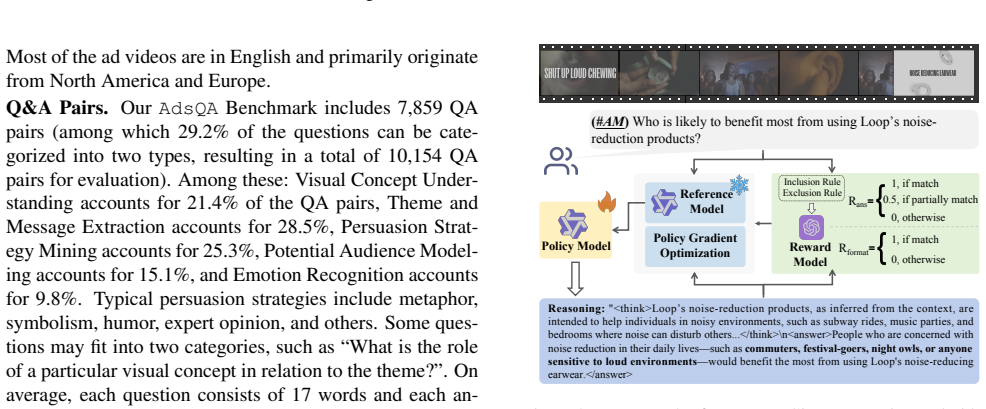
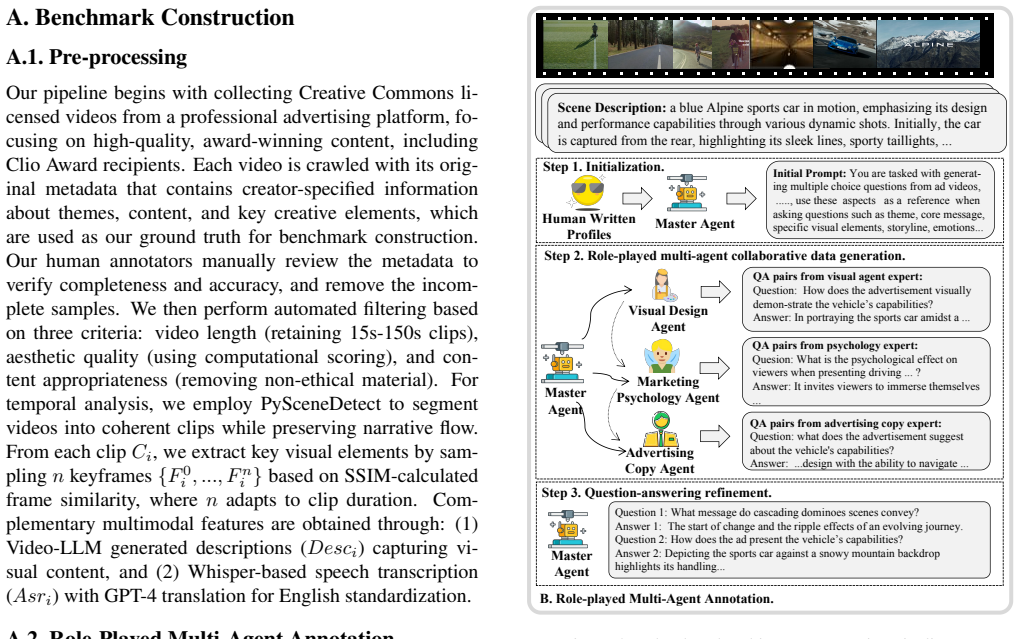
The load-bearing object is AdsQA's five-task open-ended QA format, built from a modality-interleaved video representation: each ad is split into scene clips, each clip is paired with keyframes, a model-generated description, and transcribed speech, all wrapped with the uploader's metadata. A role-played multi-agent annotation pipeline recruits simulated marketing, design, and psychology experts to write and revise questions, followed by automated reward-model filtering and manual review. The method side rests on a reward-driven reasoning loop: a policy model writes free-form think and answer tags, a rule-guided LLM evaluator scores the answer with inclusion and exclusion rules (1 for full ma
What would settle it
Take a random subset of AdsQA videos, have human annotators write answers from the video alone with no metadata, and compare those answers to the dataset's golden answers. If human-video-only agreement with the metadata-based keys is low, the benchmark is measuring metadata recall rather than video understanding. Separately, replace the LLM-based evaluator with a different judge and check whether ReAd-R's reported margin over the reasoning baselines survives.
Extended reading notes
Core claim
The central claim is that advertising videos make implicit multimodal reasoning measurable: a model that can describe the objects in an ad can still fail to say what those objects symbolize or who the ad is for. AdsQA formalizes this with five open-ended tasks, and the paper reports that strong commercial models score in the 29–35 percent strict range, well below human performance on a sampled subset. The method claim is that this reasoning can be improved without step-by-step supervision: ReAd-R is trained with outcome rewards and format rewards on 500 QA pairs, raising its 7B backbone's relaxed accuracy from 41.0 to 51.5 when paired with a newer backbone, while supervised fine-tuning on th
Load-bearing premise
The load-bearing premise is that the uploader-written metadata for each ad is accurate enough to serve as ground truth for both the golden answers and the model-based scoring; if that metadata is incomplete, promotional, or inaccurate, AdsQA's difficulty and model rankings inherit its errors.
Editorial extensions
If this is right
- If AdsQA is a valid probe, then object-level video benchmarks overstate multimodal models' comprehension, and ad-style implicit-reasoning tasks should be part of video understanding evaluations.
- If ReAd-R's gain replicates, small models can acquire implicit reasoning from a few hundred outcome-reward examples, without chain-of-thought supervision or process rewards.
- The reported negative result for supervised fine-tuning implies that on open, abstract QA, imitation on limited high-quality data can overfit, while reinforcement learning generalizes across diverse ads.
- AdsQA's five-task taxonomy gives advertising and media analysis a shared benchmark for creativity, persuasion, emotion, and audience targeting, not just content recognition.
- Because AdsQA is released with download scripts rather than video files, future models can be independently scored on it, provided the test set is kept out of their pretraining data.
Reading between the lines
- A testable extension is to isolate the role of metadata: run the same AdsQA questions with uploader metadata removed from the evaluator prompt and measure how much model scores and human agreement drop; this would bound how much of the benchmark's difficulty comes from the video alone versus the supplied description.
- The role-played multi-agent annotation pipeline could be reused for other implicit-reasoning domains, such as political ads, satire, or art interpretation, where surface content and intended meaning diverge.
- The 0.5 partial-credit reward is a soft target; a stricter reward that penalizes hallucinated brand claims or audience names could reveal whether ReAd-R's gain comes from genuine reasoning or from format compliance.
- The paper's human subset is only 40 videos and 200 QA pairs; a larger human-rating campaign could convert AdsQA's model-score gaps into human-meaningful thresholds for what counts as understanding an ad.
Signed reviews
Editorial analysis
A structured set of objections, weighed in public.
Referee Report
Summary. The paper introduces AdsQA, a video QA benchmark built from 1,544 advertisement videos (10,962 clips, 22.7 hours) with five open-ended question types: visual concept understanding, emotion recognition, theme/message extraction, persuasion strategy mining, and audience modeling. Questions and reference answers are generated by a role-played multi-agent LLM pipeline using uploader-supplied metadata as ground truth, followed by automatic cleaning and manual revision. The paper also proposes ReAd-R, a GRPO-based reinforcement-learning model trained on 500 QA pairs, and benchmarks 14 video/multimodal LLMs. The authors claim AdsQA is the first ad-video QA benchmark and that ReAd-R achieves state-of-the-art performance.
Significance. If the benchmark is valid, AdsQA would fill a genuine gap: most video QA datasets target perceptual content, whereas advertisement understanding requires implicit, associative reasoning about persuasion, emotion, and audience. The dataset is publicly described, the construction pipeline is detailed, and the manual quality-control steps are a positive feature. The ReAd-R training recipe is also potentially reusable. However, the current manuscript's central empirical claim is contradicted by its own table, and the benchmark's evaluation design is self-referential. These issues must be resolved before the contributions can be accepted as stated.
major comments (4)
- [Abstract, §1, §6, Table 1] The headline claim that ReAd-R 'achieves the state-of-the-art outperforming strong competitors ... by a clear margin' is directly contradicted by Table 1. ReAd-R (Qwen2.5-VL-7B) reaches 25.0 strict / 51.5 relaxed, while Gemini-2.5-Pro reaches 35.9 / 60.7, Qwen2.5-VL-72B reaches 31.0 / 55.8, and GPT-4o reaches 29.4 / 56.6. The gain over the base model is only +2.0 strict accuracy, with no error bars or significance tests. This claim appears in the abstract, introduction, and conclusion and must be removed or rewritten to reflect the actual ranking.
- [§3.2, §4, §5.1, Table 6] The evaluation is circular. Section 3.2 treats uploader metadata as 'ground-truth information' and uses it to generate QA pairs. The GPT-4o evaluator in Section 5.1 is given the same meta-information alongside the golden answer, and the inclusion/exclusion rules used for final scoring are the same rules used as the reward signal in ReAd-R (Section 4). Thus models that reproduce the metadata-derived answer are rewarded twice: once in training and once in evaluation. This does not measure video understanding independently of metadata. The authors should either evaluate without providing metadata to the scorer, or validate the benchmark against human judgments collected without access to metadata, and report agreement.
- [§5.1, Appendix C.1, Table 1] The comparison across models is not apples-to-apples. Gemini-2.5-Pro is evaluated on a 600-sample subset, GPT-4o receives captions from Qwen2.5-VL-72B rather than raw video, and ReAd-R is fine-tuned on AdsQA-derived training data while all baselines are zero-shot. In addition, no confidence intervals or significance tests are reported. The paper should report all models on a common subsample, use the same input modality, and include standard errors or bootstrap intervals. This is necessary before any claim about relative model strength can be assessed.
- [§5.2, §5.3, Table 2] The evidence that ReAd-R improves over its base model is weak and brittle. The strict-accuracy gain is +1.4 for Qwen2-VL and +2.0 for Qwen2.5-VL, with no variance estimates. The ablation shows that the method fails with uncurated data and with a strict reward, and is sensitive to prompt templates. These results suggest the method's success depends on narrow conditions. The claim that RL is superior to SFT for this task is based on a single configuration; a more systematic comparison with multiple seeds and data subsets is needed.
minor comments (5)
- [§1, §2] The 'first advertisement video QA benchmark' claim should be qualified, since the Pitt dataset [24] already contains a video advertisement subset, as the paper itself notes in §2. The novelty should be framed as the first large-scale, publicly available, multi-task ad-video QA benchmark.
- [§6] Typo: 'contibute' should be 'contribute'.
- [Eq. (4), §5.1] The relaxed-accuracy parameter λ=0.5 is fixed with no sensitivity analysis. Please report how results change for other values, or justify the choice.
- [Table 6 caption] Table 6 caption says 'Relexed Acc' — should be 'Relaxed Acc'.
- [Appendix C.1, Table 1] The human performance numbers in Table 1 are based on 40 videos / 200 QA pairs, and Gemini-2.5-Pro on 600 samples; the table should clearly mark subset sizes so readers do not interpret all rows as full-dataset results.
Circularity Check
ReAd-R is trained with the same GPT-4o inclusion/exclusion reward used to score it on AdsQA, and AdsQA's 'ground truth' is the same uploader metadata fed to that evaluator—so the headline gain is partly forced by construction.
-
fitted input called prediction
[Sec. 4 (Reward Modeling) and Sec. 5.1 (Evaluation Metric), Eqs. (3)-(4); Appendix Table 6]
"We introduce two sets of rules: inclusion rules and exclusion rules. The inclusion rule requires that the generated answer incorporate as many elements of the standard answer as possible. If satisfied, the reward value is 1.0; otherwise, it is 0. The exclusion rule states that if the generated content includes elements not mentioned in the standard answer and these elements cannot be inferred from the meta-information, they should be judged as incorrect. ... Specifically, we use the same inclusion and exclusion rules mentioned in Sec. 4 to guide the scoring of text generated by the large model"
ReAd-R is optimized by GRPO with R(·)=R_ans(·)+R_format(·), where R_ans is the rule-guided LLM judge described in Sec. 4: it rewards responses that contain elements of the standard answer and penalizes elements 'not inferred from the meta-information'. The AdsQA scores in Table 1 are then computed by GPT-4o using 'the same inclusion and exclusion rules' with a ground-truth answer and meta-information (Sec. 5.1, Table 6). The model is therefore trained to maximize the exact scoring function on which the 'state-of-the-art ... by a clear margin' claim is based. Any improvement on AdsQA can be—and to an unknown degree is—the result of fitting the evaluator rather than of better video understanding. The loop is partial: training QA pairs come from 100 additionally crawled videos and five human
-
self definitional
[Sec. 3.2 (Dataset Construction Pipeline), Sec. 3.3 (Manual Check and Quality Control), Appendix Table 6]
"The metadata is typically written by the uploader (i.e., usually the creator of the ad) and includes information such as the theme, content, and key creative elements of the ad. It can be considered the “ground-truth” information of the ad video and serves as an important reference for our benchmark construction. ... ###The meta-information includes the advertisement video’s theme, creative points, and a brief content description, which can be regarded as ground-truth information, as follows::{#meta info}"
AdsQA's 'golden answers' are produced by the Role-Played Multi-Agent Annotation pipeline from the modality-interleaved sequence V={M,{F_i,Desc_i,Asr_i}} (Eq. 1), where M is precisely this uploader metadata. The same metadata is then declared 'ground-truth information' in Sec. 3.2, used in Sec. 3.3 to verify the reference answers, and supplied to the GPT-4o evaluator (Table 6) as if it were an external ground truth. Thus 'correctness' on AdsQA is defined as agreement with the uploader's/LLM's interpretation, and benchmark difficulty is partly an artifact of the annotation pipeline rather than an independent measure of video understanding. Manual review (37% QA pairs retained, five annotators) provides some independent check, so this is not a total definitional loop.
full rationale
The most concrete circularity is the identity between the reward used to train ReAd-R and the metric used to evaluate it: Section 4 defines a rule-guided LLM reward based on inclusion/exclusion of standard-answer elements and meta-information, and Section 5.1 explicitly says the final scoring uses 'the same inclusion and exclusion rules mentioned in Sec. 4' with a ground-truth answer and meta-information. This makes ReAd-R's reported AdsQA gains at least partially a product of optimizing the evaluator itself. A second, related loop is that the benchmark's reference answers are generated by an LLM pipeline whose input includes the uploader metadata, and that same metadata is then treated as 'ground-truth information' both for manual verification and for GPT-4o scoring, so AdsQA correctness is partly defined as reproducing the annotation pipeline's interpretation. These loops are not total: the training QA pairs come from 100 additionally crawled videos, five human annotators reviewed the benchmark, and the paper evaluates many external baselines. However, the paper's headline SOTA claim is also internally contradicted by its own Table 1—ReAd-R (Qwen2.5-VL-7B) scores 25.0 strict / 51.5 relaxed, below Gemini-2.5-Pro (35.9/60.7), Qwen2.5-VL-72B (31.0/55.8), and GPT-4o (29.4/56.6)—which is a correctness issue, not a circularity issue. No load-bearing self-citation or imported uniqueness theorem is present.
Assumptions & free parameters
free parameters (3)
- lambda in relaxed accuracy =
0.5
- partial reward score =
0.5
- QA retention rate =
37%
assumptions (4)
- domain assumption Uploader-supplied video metadata on adsoftheworld.com is accurate enough to serve as ground truth for QA generation and evaluation.
- domain assumption GPT-4o can reliably judge open-ended semantic match using only the meta-information and golden answer.
- domain assumption LLM-generated QA pairs that survive manual filtering are correct and unambiguous.
- domain assumption The five task categories (VU, ER, TE, PS, AM) adequately cover ad video understanding.
Cite this review
Pith. "Pith review of AdsQA: Towards Advertisement Video Understanding." pith.science (2026). https://pith.science/paper/RSJLMKNL
@misc{pith2026250908621,
  author       = {Pith},
  title        = {Pith review of: AdsQA: Towards Advertisement Video Understanding},
  year         = {2026},
  howpublished = {\url{https://pith.science/paper/RSJLMKNL}},
  note         = {Machine review of arXiv:2509.08621}
}
read the original abstract
Large language models (LLMs) have taken a great step towards AGI. Meanwhile, an increasing number of domain-specific problems such as math and programming boost these general-purpose models to continuously evolve via learning deeper expertise. Now is thus the time further to extend the diversity of specialized applications for knowledgeable LLMs, though collecting high quality data with unexpected and informative tasks is challenging. In this paper, we propose to use advertisement (ad) videos as a challenging test-bed to probe the ability of LLMs in perceiving beyond the objective physical content of common visual domain. Our motivation is to take full advantage of the clue-rich and information-dense ad videos' traits, e.g., marketing logic, persuasive strategies, and audience engagement. Our contribution is three-fold: (1) To our knowledge, this is the first attempt to use ad videos with well-designed tasks to evaluate LLMs. We contribute AdsQA, a challenging ad Video QA benchmark derived from 1,544 ad videos with 10,962 clips, totaling 22.7 hours, providing 5 challenging tasks. (2) We propose ReAd-R, a Deepseek-R1 styled RL model that reflects on questions, and generates answers via reward-driven optimization. (3) We benchmark 14 top-tier LLMs on AdsQA, and our \texttt{ReAd-R}~achieves the state-of-the-art outperforming strong competitors equipped with long-chain reasoning capabilities by a clear margin.
Figures


Figures from the paper (4 more)


Reference graph
Works this paper leans on
-
[1]
Theme and core message (compulsory)
-
[2]
Gpt-4 technical report.arXiv preprint arXiv:2303.08774,
Josh Achiam, Steven Adler, Sandhini Agarwal, Lama Ah- mad, Ilge Akkaya, Florencia Leoni Aleman, Diogo Almeida, Janko Altenschmidt, Sam Altman, Shyamal Anadkat, et al. Gpt-4 technical report.arXiv preprint arXiv:2303.08774,
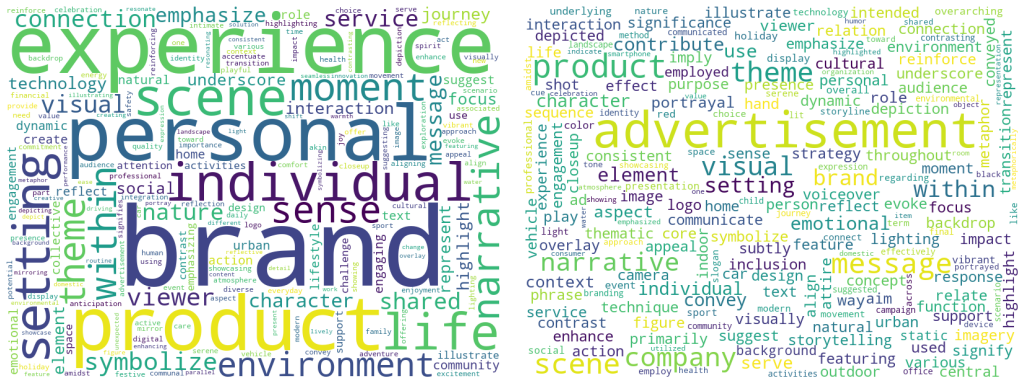
-
[3]
Metaclue: Towards comprehensive visual metaphors re- search
Arjun R Akula, Brendan Driscoll, Pradyumna Narayana, So- ravit Changpinyo, Zhiwei Jia, Suyash Damle, Garima Pruthi, Sugato Basu, Leonidas Guibas, William T Freeman, et al. Metaclue: Towards comprehensive visual metaphors re- search. InProceedings of the IEEE/CVF conference on com- puter vision and pattern recognition, pages 23201–23211,
-
[4]
Shuai Bai, Keqin Chen, Xuejing Liu, Jialin Wang, Wenbin Ge, Sibo Song, Kai Dang, Peng Wang, Shijie Wang, Jun Tang, et al. Qwen2. 5-vl technical report.arXiv preprint arXiv:2502.13923, 2025. 3, 6, 7, 15, 16
arXiv 2025
-
[5]
Mu Cai, Reuben Tan, Jianrui Zhang, Bocheng Zou, Kai Zhang, Feng Yao, Fangrui Zhu, Jing Gu, Yiwu Zhong, Yuzhang Shang, Yao Dou, Jaden Park, Jianfeng Gao, Yong Jae Lee, and Jianwei Yang. Temporalbench: Bench- marking fine-grained temporal understanding for multimodal video models.CoRR, abs/2410.10818, 2024. 3, 16
arXiv 2024
-
[6]
Sharegpt4v: Improving large multi-modal models with better captions
Lin Chen, Jinsong Li, Xiaoyi Dong, Pan Zhang, Conghui He, Jiaqi Wang, Feng Zhao, and Dahua Lin. Sharegpt4v: Improving large multi-modal models with better captions. arXiv preprint arXiv:2311.12793, 2023. 3
arXiv 2023
-
[7]
Grounded multi- hop videoqa in long-form egocentric videos.arXiv preprint arXiv:2408.14469, 2024
Qirui Chen, Shangzhe Di, and Weidi Xie. Grounded multi- hop videoqa in long-form egocentric videos.arXiv preprint arXiv:2408.14469, 2024. 3
arXiv 2024
-
[8]
Xiuyuan Chen, Yuan Lin, Yuchen Zhang, and Weiran Huang. Autoeval-video: An automatic benchmark for assessing large vision language models in open-ended video question answering.arXiv preprint arXiv:2311.14906, 2023. 6
arXiv 2023
Show all 112 references
-
[9]
Videollama 2: Advancing spatial-temporal modeling and audio understanding in video- llms.CoRR, abs/2406.07476, 2024
Zesen Cheng, Sicong Leng, Hang Zhang, Yifei Xin, Xin Li, Guanzheng Chen, Yongxin Zhu, Wenqi Zhang, Ziyang Luo, Deli Zhao, and Lidong Bing. Videollama 2: Advancing spatial-temporal modeling and audio understanding in video- llms.CoRR, abs/2406.07476, 2024. 3, 7, 15
2024 arXiv
-
[10]
Can large language models be an alternative to human evaluations?arXiv preprint arXiv:2305.01937, 2023
Cheng-Han Chiang and Hung-yi Lee. Can large language models be an alternative to human evaluations?arXiv preprint arXiv:2305.01937, 2023. 6
2023 arXiv
-
[11]
Gemini 2.5: Pushing the frontier with advanced reasoning, multimodality, long context, and next generation agentic capabilities.arXiv preprint arXiv:2507.06261, 2025
Gheorghe Comanici, Eric Bieber, Mike Schaekermann, Ice Pasupat, Noveen Sachdeva, Inderjit Dhillon, Marcel Blis- tein, Ori Ram, Dan Zhang, Evan Rosen, et al. Gemini 2.5: Pushing the frontier with advanced reasoning, multimodality, long context, and next generation agentic capab...
2025 arXiv
-
[12]
Grounded question-answering in long egocentric videos
Shangzhe Di and Weidi Xie. Grounded question-answering in long egocentric videos. InProceedings of the IEEE/CVF Conference on Computer Vision and Pattern Recognition, pages 12934–12943, 2024. 3
2024
-
[13]
Automating exploratory pro- teomics research via language models.arXiv preprint arXiv:2411.03743, 2024
Ning Ding, Shang Qu, Linhai Xie, Yifei Li, Zaoqu Liu, Kaiyan Zhang, Yibai Xiong, Yuxin Zuo, Zhangren Chen, Ermo Hua, et al. Automating exploratory pro- teomics research via language models.arXiv preprint arXiv:2411.03743, 2024. 1
2024 arXiv
-
[14]
Videoagent: A memory-augmented mul- timodal agent for video understanding
Yue Fan, Xiaojian Ma, Rujie Wu, Yuntao Du, Jiaqi Li, Zhi Gao, and Qing Li. Videoagent: A memory-augmented mul- timodal agent for video understanding. InEuropean Con- ference on Computer Vision, pages 75–92. Springer, 2024. 3
2024
-
[15]
Video-of-thought: Step-by-step video reasoning from perception to cognition
Hao Fei, Shengqiong Wu, Wei Ji, Hanwang Zhang, Meishan Zhang, Mong-Li Lee, and Wynne Hsu. Video-of-thought: Step-by-step video reasoning from perception to cognition. arXiv preprint arXiv:2501.03230, 2024. 3, 6, 7
2024 arXiv
-
[16]
Video-mme: The first-ever comprehensive evaluation benchmark of multi-modal llms in video analysis
Chaoyou Fu, Yuhan Dai, Yongdong Luo, Lei Li, Shuhuai Ren, Renrui Zhang, Zihan Wang, Chenyu Zhou, Yunhang Shen, Mengdan Zhang, et al. Video-mme: The first-ever comprehensive evaluation benchmark of multi-modal llms in video analysis. InProceedings of the Computer Vision and Pat...
2025
-
[17]
Mist: Multi-modal iterative spatial- temporal transformer for long-form video question answer- ing
Difei Gao, Luowei Zhou, Lei Ji, Linchao Zhu, Yi Yang, and Mike Zheng Shou. Mist: Multi-modal iterative spatial- temporal transformer for long-form video question answer- ing. InProceedings of the IEEE/CVF conference on com- puter vision and pattern recognition, pages 14773–14783,
-
[18]
Agent4edu: Generating learner response data by generative agents for in- telligent education systems
Weibo Gao, Qi Liu, Linan Yue, Fangzhou Yao, Rui Lv, Zheng Zhang, Hao Wang, and Zhenya Huang. Agent4edu: Generating learner response data by generative agents for in- telligent education systems. InProceedings of the AAAI Con- ference on Artificial Intelligence, pages 23923–239...
2025
-
[19]
Short film dataset (SFD): A benchmark for story- level video understanding.CoRR, abs/2406.10221, 2024
Ridouane Ghermi, Xi Wang, Vicky Kalogeiton, and Ivan Laptev. Short film dataset (SFD): A benchmark for story- level video understanding.CoRR, abs/2406.10221, 2024. 3, 6, 16
2024 arXiv
-
[20]
Deepseek-coder: When the large language model meets programming–the rise of code intelligence.arXiv preprint arXiv:2401.14196, 2024
Daya Guo, Qihao Zhu, Dejian Yang, Zhenda Xie, Kai Dong, Wentao Zhang, Guanting Chen, Xiao Bi, Yu Wu, YK Li, et al. Deepseek-coder: When the large language model meets programming–the rise of code intelligence.arXiv preprint arXiv:2401.14196, 2024. 1, 6
2024 arXiv
-
[21]
Deepseek-r1: Incentivizing reasoning capability in llms via reinforcement learning.arXiv preprint arXiv:2501.12948, 2025
Daya Guo, Dejian Yang, Haowei Zhang, Junxiao Song, Ruoyu Zhang, Runxin Xu, Qihao Zhu, Shirong Ma, Peiyi Wang, Xiao Bi, et al. Deepseek-r1: Incentivizing reasoning capability in llms via reinforcement learning.arXiv preprint arXiv:2501.12948, 2025. 1, 3, 5
2025 arXiv
-
[22]
Cos: Chain-of-shot prompting for long video under- standing.arXiv preprint arXiv:2502.06428, 2025
Jian Hu, Zixu Cheng, Chenyang Si, Wei Li, and Shaogang Gong. Cos: Chain-of-shot prompting for long video under- standing.arXiv preprint arXiv:2502.06428, 2025. 3
2025 arXiv
-
[23]
Gpt-4o system card
Aaron Hurst, Adam Lerer, Adam P Goucher, Adam Perel- man, Aditya Ramesh, Aidan Clark, AJ Ostrow, Akila Weli- hinda, Alan Hayes, Alec Radford, et al. Gpt-4o system card. arXiv preprint arXiv:2410.21276, 2024. 4, 6, 7
2024 arXiv
-
[24]
Automatic understanding of image and video advertisements
Zaeem Hussain, Mingda Zhang, Xiaozhong Zhang, Keren Ye, Christopher Thomas, Zuha Agha, Nathan Ong, and Adri- ana Kovashka. Automatic understanding of image and video advertisements. InCVPR, pages 1100–1110. IEEE Com- puter Society, 2017. 3, 16
2017
-
[25]
Openai o1 system card.arXiv preprint arXiv:2412.16720, 2024
Aaron Jaech, Adam Kalai, Adam Lerer, Adam Richard- son, Ahmed El-Kishky, Aiden Low, Alec Helyar, Aleksander Madry, Alex Beutel, Alex Carney, et al. Openai o1 system card.arXiv preprint arXiv:2412.16720, 2024. 1, 3
2024 arXiv
-
[26]
Tgif-qa: Toward spatio-temporal reasoning in visual question answering
Yunseok Jang, Yale Song, Youngjae Yu, Youngjin Kim, and Gunhee Kim. Tgif-qa: Toward spatio-temporal reasoning in visual question answering. InProceedings of the IEEE con- ference on computer vision and pattern recognition, pages 2758–2766, 2017. 3
2017
-
[27]
Intentonomy: a dataset and study towards human intent understanding
Menglin Jia, Zuxuan Wu, Austin Reiter, Claire Cardie, Serge Belongie, and Ser-Nam Lim. Intentonomy: a dataset and study towards human intent understanding. InProceedings of the IEEE/CVF Conference on Computer Vision and Pat- tern Recognition, pages 12986–12996, 2021. 3
2021
-
[28]
Kafa: Rethinking image ad understanding with knowledge- augmented feature adaptation of vision-language models
Zhiwei Jia, Pradyumna Narayana, Arjun R Akula, Garima Pruthi, Hao Su, Sugato Basu, and Varun Jampani. Kafa: Rethinking image ad understanding with knowledge- augmented feature adaptation of vision-language models. arXiv preprint arXiv:2305.18373, 2023. 3
2023 arXiv
-
[29]
Reasoning with heterogeneous graph alignment for video question answering
Pin Jiang and Yahong Han. Reasoning with heterogeneous graph alignment for video question answering. InProceed- ings of the AAAI Conference on Artificial Intelligence, pages 11109–11116, 2020. 3
2020
-
[30]
Preference optimiza- tion for reasoning with pseudo feedback.arXiv preprint arXiv:2411.16345, 2024
Fangkai Jiao, Geyang Guo, Xingxing Zhang, Nancy F Chen, Shafiq Joty, and Furu Wei. Preference optimiza- tion for reasoning with pseudo feedback.arXiv preprint arXiv:2411.16345, 2024. 3
2024 arXiv
-
[31]
Persua- sion strategies in advertisements
Yaman Kumar, Rajat Jha, Arunim Gupta, Milan Aggarwal, Aditya Garg, Tushar Malyan, Ayush Bhardwaj, Rajiv Ratn Shah, Balaji Krishnamurthy, and Changyou Chen. Persua- sion strategies in advertisements. InProceedings of the AAAI conference on artificial intelligence, pages 57–66, 2023. 3
2023
-
[32]
Jie Lei, Licheng Yu, Mohit Bansal, and Tamara L. Berg. TVQA: localized, compositional video question answering. InEMNLP, pages 1369–1379. Association for Computa- tional Linguistics, 2018. 3, 16
2018
-
[33]
Less is more: Clipbert for video-and-language learning via sparse sampling
Jie Lei, Linjie Li, Luowei Zhou, Zhe Gan, Tamara L Berg, Mohit Bansal, and Jingjing Liu. Less is more: Clipbert for video-and-language learning via sparse sampling. InPro- ceedings of the IEEE/CVF conference on computer vision and pattern recognition, pages 7331–7341, 2021. 3
2021
-
[34]
Llava-onevision: Easy visual task transfer
Bo Li, Yuanhan Zhang, Dong Guo, Renrui Zhang, Feng Li, Hao Zhang, Kaichen Zhang, Yanwei Li, Ziwei Liu, and Chunyuan Li. Llava-onevision: Easy visual task transfer. arXiv preprint arXiv:2408.03326, 2024. 3, 6, 7, 16
2024 arXiv
-
[35]
Mvbench: A comprehensive multi- modal video understanding benchmark
Kunchang Li, Yali Wang, Yinan He, Yizhuo Li, Yi Wang, Yi Liu, Zun Wang, Jilan Xu, Guo Chen, Ping Lou, Limin Wang, and Yu Qiao. Mvbench: A comprehensive multi- modal video understanding benchmark. InCVPR, pages 22195–22206. IEEE, 2024. 16
2024
-
[36]
Mvbench: A comprehensive multi-modal video understand- ing benchmark
Kunchang Li, Yali Wang, Yinan He, Yizhuo Li, Yi Wang, Yi Liu, Zun Wang, Jilan Xu, Guo Chen, Ping Luo, et al. Mvbench: A comprehensive multi-modal video understand- ing benchmark. InProceedings of the IEEE/CVF Conference on Computer Vision and Pattern Recognition, pages 22195– ...
2024
-
[37]
Beyond rnns: Positional self-attention with co-attention for video question answering
Xiangpeng Li, Jingkuan Song, Lianli Gao, Xianglong Liu, Wenbing Huang, Xiangnan He, and Chuang Gan. Beyond rnns: Positional self-attention with co-attention for video question answering. InProceedings of the AAAI conference on artificial intelligence, pages 8658–8665, 2019. 3
2019
-
[38]
Multi-sentence grounding for long- term instructional video
Zeqian Li, Qirui Chen, Tengda Han, Ya Zhang, Yanfeng Wang, and Weidi Xie. Multi-sentence grounding for long- term instructional video. InEuropean Conference on Com- puter Vision, pages 200–216. Springer, 2024. 3
2024
-
[39]
Video-llava: Learning united visual representa- tion by alignment before projection.CoRR, abs/2311.10122,
Bin Lin, Yang Ye, Bin Zhu, Jiaxi Cui, Munan Ning, Peng Jin, and Li Yuan. Video-llava: Learning united visual representa- tion by alignment before projection.CoRR, abs/2311.10122,
-
[40]
Rouge: A package for automatic evaluation of summaries
Chin-Yew Lin. Rouge: A package for automatic evaluation of summaries. InText summarization branches out, pages 74–81, 2004. 6
2004
-
[41]
Llava-next: Im- proved reasoning, ocr, and world knowledge, 2024
Haotian Liu, Chunyuan Li, Yuheng Li, Bo Li, Yuanhan Zhang, Sheng Shen, and Yong Jae Lee. Llava-next: Im- proved reasoning, ocr, and world knowledge, 2024. 3
2024
-
[42]
Visual- rft: Visual reinforcement fine-tuning.arXiv preprint arXiv:2503.01785, 2025
Ziyu Liu, Zeyi Sun, Yuhang Zang, Xiaoyi Dong, Yuhang Cao, Haodong Duan, Dahua Lin, and Jiaqi Wang. Visual- rft: Visual reinforcement fine-tuning.arXiv preprint arXiv:2503.01785, 2025. 3
2025 arXiv
-
[43]
Retrieval-augmented visual question answering via built-in autoregressive search en- gines
Xinwei Long, Zhiyuan Ma, Ermo Hua, Kaiyan Zhang, Biqing Qi, and Bowen Zhou. Retrieval-augmented visual question answering via built-in autoregressive search en- gines. InProceedings of the AAAI Conference on Artificial Intelligence, pages 24723–24731, 2025. 3
2025
-
[44]
Reft: Reasoning with reinforced fine-tuning.arXiv preprint arXiv:2401.08967, 2024
Trung Quoc Luong, Xinbo Zhang, Zhanming Jie, Peng Sun, Xiaoran Jin, and Hang Li. Reft: Reasoning with reinforced fine-tuning.arXiv preprint arXiv:2401.08967, 2024. 3
2024 arXiv
-
[45]
Video-chatgpt: Towards detailed video understanding via large vision and language models
Muhammad Maaz, Hanoona Rasheed, Salman Khan, and Fa- had Shahbaz Khan. Video-chatgpt: Towards detailed video understanding via large vision and language models. 2023. 3
2023
-
[46]
Videogpt+: Integrating image and video encoders for enhanced video understanding.arxiv, 2024
Muhammad Maaz, Hanoona Rasheed, Salman Khan, and Fa- had Shahbaz Khan. Videogpt+: Integrating image and video encoders for enhanced video understanding.arxiv, 2024. 3
2024
-
[47]
Egoschema: A diagnostic benchmark for very long- form video language understanding
Karttikeya Mangalam, Raiymbek Akshulakov, and Jitendra Malik. Egoschema: A diagnostic benchmark for very long- form video language understanding. InNeurIPS, 2023. 3, 16
2023
-
[48]
Morevqa: Exploring modular reason- ing models for video question answering
Juhong Min, Shyamal Buch, Arsha Nagrani, Minsu Cho, and Cordelia Schmid. Morevqa: Exploring modular reason- ing models for video question answering. InProceedings of the IEEE/CVF Conference on Computer Vision and Pattern Recognition, pages 13235–13245, 2024. 3
2024
-
[49]
s1: Simple test-time scaling.arXiv preprint arXiv:2501.19393,
Niklas Muennighoff, Zitong Yang, Weijia Shi, Xiang Lisa Li, Li Fei-Fei, Hannaneh Hajishirzi, Luke Zettlemoyer, Percy Liang, Emmanuel Cand `es, and Tatsunori Hashimoto. s1: Simple test-time scaling.arXiv preprint arXiv:2501.19393,
-
[50]
Video-bench: A com- prehensive benchmark and toolkit for evaluating video-based large language models.CoRR, abs/2311.16103, 2023
Munan Ning, Bin Zhu, Yujia Xie, Bin Lin, Jiaxi Cui, Lu Yuan, Dongdong Chen, and Li Yuan. Video-bench: A com- prehensive benchmark and toolkit for evaluating video-based large language models.CoRR, abs/2311.16103, 2023. 16
2023 arXiv
-
[51]
Bleu: a method for automatic evaluation of machine translation
Kishore Papineni, Salim Roukos, Todd Ward, and Wei-Jing Zhu. Bleu: a method for automatic evaluation of machine translation. InProceedings of the 40th annual meeting of the Association for Computational Linguistics, pages 311–318,
-
[52]
Large language models as biomedical hypothesis generators: a comprehensive evaluation.arXiv preprint arXiv:2407.08940, 2024
Biqing Qi, Kaiyan Zhang, Kai Tian, Haoxiang Li, Zhang- Ren Chen, Sihang Zeng, Ermo Hua, Hu Jinfang, and Bowen Zhou. Large language models as biomedical hypothesis generators: a comprehensive evaluation.arXiv preprint arXiv:2407.08940, 2024. 1
2024 arXiv
-
[53]
Seeing the unseen: Visual metaphor cap- tioning for videos.arXiv e-prints, pages arXiv–2406, 2024
Abisek Rajakumar Kalarani, Pushpak Bhattacharyya, and Sumit Shekhar. Seeing the unseen: Visual metaphor cap- tioning for videos.arXiv e-prints, pages arXiv–2406, 2024. 3
2024
-
[54]
How2: a large-scale dataset for multimodal language under- standing.arXiv preprint arXiv:1811.00347, 2018
Ramon Sanabria, Ozan Caglayan, Shruti Palaskar, Desmond Elliott, Lo ¨ıc Barrault, Lucia Specia, and Florian Metze. How2: a large-scale dataset for multimodal language under- standing.arXiv preprint arXiv:1811.00347, 2018. 16
2018 arXiv
-
[55]
Look before you speak: Visually contextualized utterances
Paul Hongsuck Seo, Arsha Nagrani, and Cordelia Schmid. Look before you speak: Visually contextualized utterances. InProceedings of the IEEE/CVF Conference on Computer Vision and Pattern Recognition, pages 16877–16887, 2021. 3
2021
-
[56]
Eventvad: Training-free event-aware video anomaly detection.arXiv preprint arXiv:2504.13092, 2025
Yihua Shao, Haojin He, Sijie Li, Siyu Chen, Xinwei Long, Fanhu Zeng, Yuxuan Fan, Muyang Zhang, Ziyang Yan, Ao Ma, et al. Eventvad: Training-free event-aware video anomaly detection.arXiv preprint arXiv:2504.13092, 2025. 3
2025 arXiv
-
[57]
Un- locking video-llm via agent-of-thoughts distillation.arXiv preprint arXiv:2412.01694, 2024
Yudi Shi, Shangzhe Di, Qirui Chen, and Weidi Xie. Un- locking video-llm via agent-of-thoughts distillation.arXiv preprint arXiv:2412.01694, 2024. 3
2024 arXiv
-
[58]
Moviechat+: Question-aware sparse memory for long video question answering.arXiv preprint arXiv:2404.17176, 2024
Enxin Song, Wenhao Chai, Tian Ye, Jenq-Neng Hwang, Xi Li, and Gaoang Wang. Moviechat+: Question-aware sparse memory for long video question answering.arXiv preprint arXiv:2404.17176, 2024. 3
2024 arXiv
-
[59]
Movieqa: Understanding stories in movies through question- answering
Makarand Tapaswi, Yukun Zhu, Rainer Stiefelhagen, Antonio Torralba, Raquel Urtasun, and Sanja Fidler. Movieqa: Understanding stories in movies through question- answering. InCVPR, pages 4631–4640. IEEE Computer So- ciety, 2016. 3
2016
-
[60]
Qwen2-vl: Enhancing vision-language model’s perception of the world at any resolution.arXiv preprint arXiv:2409.12191, 2024
Peng Wang, Shuai Bai, Sinan Tan, Shijie Wang, Zhihao Fan, Jinze Bai, Keqin Chen, Xuejing Liu, Jialin Wang, Wenbin Ge, et al. Qwen2-vl: Enhancing vision-language model’s perception of the world at any resolution.arXiv preprint arXiv:2409.12191, 2024. 3, 7, 15
2024 arXiv
-
[61]
Videoagent: Long-form video understanding with large language model as agent
Xiaohan Wang, Yuhui Zhang, Orr Zohar, and Serena Yeung- Levy. Videoagent: Long-form video understanding with large language model as agent. InEuropean Conference on Computer Vision, pages 58–76. Springer, 2024. 3
2024
-
[62]
Internvideo2: Scaling video foundation mod- els for multimodal video understanding.arXiv preprint arXiv:2403.15377, 2024
Yi Wang, Kunchang Li, Xinhao Li, Jiashuo Yu, Yinan He, Guo Chen, Baoqi Pei, Rongkun Zheng, Jilan Xu, Zun Wang, et al. Internvideo2: Scaling video foundation mod- els for multimodal video understanding.arXiv preprint arXiv:2403.15377, 2024. 3
2024 arXiv
-
[63]
Videocot: A video chain-of- thought dataset with active annotation tool.arXiv preprint arXiv:2407.05355, 2024
Yan Wang, Yawen Zeng, Jingsheng Zheng, Xiaofen Xing, Jin Xu, and Xiangmin Xu. Videocot: A video chain-of- thought dataset with active annotation tool.arXiv preprint arXiv:2407.05355, 2024. 3
2024 arXiv
-
[64]
Image quality assessment: from error visibility to structural similarity.IEEE transactions on image processing, 13(4):600–612, 2004
Zhou Wang, Alan C Bovik, Hamid R Sheikh, and Eero P Si- moncelli. Image quality assessment: from error visibility to structural similarity.IEEE transactions on image processing, 13(4):600–612, 2004. 4
2004
-
[65]
Next-qa: Next phase of question-answering to explaining temporal actions
Junbin Xiao, Xindi Shang, Angela Yao, and Tat-Seng Chua. Next-qa: Next phase of question-answering to explaining temporal actions. InIEEE Conference on Computer Vi- sion and Pattern Recognition, CVPR 2021, virtual, June 19- 25, 2021, pages 9777–9786. Computer Vision Foundation...
2021
-
[66]
Can i trust your answer? visually grounded video question answering
Junbin Xiao, Angela Yao, Yicong Li, and Tat-Seng Chua. Can i trust your answer? visually grounded video question answering. InProceedings of the IEEE/CVF Conference on Computer Vision and Pattern Recognition, pages 13204– 13214, 2024. 3
2024
-
[67]
Funqa: Towards surprising video comprehension
Binzhu Xie, Sicheng Zhang, Zitang Zhou, Bo Li, Yuanhan Zhang, Jack Hessel, Jingkang Yang, and Ziwei Liu. Funqa: Towards surprising video comprehension. InEuropean Con- ference on Computer Vision, pages 39–57. Springer, 2024. 3, 6
2024
-
[68]
Streaming video understanding and multi-round interaction with memory- enhanced knowledge.arXiv preprint arXiv:2501.13468,
Haomiao Xiong, Zongxin Yang, Jiazuo Yu, Yunzhi Zhuge, Lu Zhang, Jiawen Zhu, and Huchuan Lu. Streaming video understanding and multi-round interaction with memory- enhanced knowledge.arXiv preprint arXiv:2501.13468,
-
[69]
Video question answer- ing via gradually refined attention over appearance and mo- tion
Dejing Xu, Zhou Zhao, Jun Xiao, Fei Wu, Hanwang Zhang, Xiangnan He, and Yueting Zhuang. Video question answer- ing via gradually refined attention over appearance and mo- tion. InProceedings of the 25th ACM international confer- ence on Multimedia, pages 1645–1653, 2017. 16
2017
-
[70]
Pllava: Parameter-free llava extension from images to videos for video dense captioning.arXiv preprint arXiv:2404.16994, 2024
Lin Xu, Yilin Zhao, Daquan Zhou, Zhijie Lin, See Kiong Ng, and Jiashi Feng. Pllava: Parameter-free llava extension from images to videos for video dense captioning.arXiv preprint arXiv:2404.16994, 2024. 3
2024 arXiv
-
[71]
Exploring chain-of-thought for multi-modal metaphor detec- tion
Yanzhi Xu, Yueying Hua, Shichen Li, and Zhongqing Wang. Exploring chain-of-thought for multi-modal metaphor detec- tion. InProceedings of the 62nd Annual Meeting of the Asso- ciation for Computational Linguistics (Volume 1: Long Pa- pers), pages 91–101, 2024. 3
2024
-
[72]
Synchronized video storytelling: Generating video narrations with structured sto- ryline.arXiv preprint arXiv:2405.14040, 2024
Dingyi Yang, Chunru Zhan, Ziheng Wang, Biao Wang, Tiezheng Ge, Bo Zheng, and Qin Jin. Synchronized video storytelling: Generating video narrations with structured sto- ryline.arXiv preprint arXiv:2405.14040, 2024. 3
2024 arXiv
-
[73]
Doraemongpt: Toward understanding dynamic scenes with large language models (exemplified as a video agent).arXiv preprint arXiv:2401.08392, 2024
Zongxin Yang, Guikun Chen, Xiaodi Li, Wenguan Wang, and Yi Yang. Doraemongpt: Toward understanding dynamic scenes with large language models (exemplified as a video agent).arXiv preprint arXiv:2401.08392, 2024. 3
2024 arXiv
-
[74]
Lens: Multi-level evaluation of multi- modal reasoning with large language models.arXiv preprint arXiv:2505.15616, 2025
Ruilin Yao, Bo Zhang, Jirui Huang, Xinwei Long, Yi- fang Zhang, Tianyu Zou, Yufei Wu, Shichao Su, Yifan Xu, Wenxi Zeng, et al. Lens: Multi-level evaluation of multi- modal reasoning with large language models.arXiv preprint arXiv:2505.15616, 2025. 3
2025 arXiv
-
[75]
Minicpm-v: A gpt-4v level mllm on your phone.arXiv preprint arXiv:2408.01800, 2024
Yuan Yao, Tianyu Yu, Ao Zhang, Chongyi Wang, Junbo Cui, Hongji Zhu, Tianchi Cai, Haoyu Li, Weilin Zhao, Zhihui He, et al. Minicpm-v: A gpt-4v level mllm on your phone.arXiv preprint arXiv:2408.01800, 2024. 7, 15
2024 arXiv
-
[76]
Interpret- ing the rhetoric of visual advertisements.IEEE transactions on pattern analysis and machine intelligence, 43(4):1308– 1323, 2019
Keren Ye, Narges Honarvar Nazari, James Hahn, Zaeem Hussain, Mingda Zhang, and Adriana Kovashka. Interpret- ing the rhetoric of visual advertisements.IEEE transactions on pattern analysis and machine intelligence, 43(4):1308– 1323, 2019. 3
2019
-
[77]
Activitynet-qa: A dataset for understanding complex web videos via question answering
Zhou Yu, Dejing Xu, Jun Yu, Ting Yu, Zhou Zhao, Yueting Zhuang, and Dacheng Tao. Activitynet-qa: A dataset for understanding complex web videos via question answering. InAAAI, pages 9127–9134. AAAI Press, 2019. 3, 7, 15, 16
2019
-
[78]
Evoagent: Towards automatic multi- agent generation via evolutionary algorithms.arXiv preprint arXiv:2406.14228, 2024
Siyu Yuan, Kaitao Song, Jiangjie Chen, Xu Tan, Dongsheng Li, and Deqing Yang. Evoagent: Towards automatic multi- agent generation via evolutionary algorithms.arXiv preprint arXiv:2406.14228, 2024. 4, 6, 7
2024 arXiv
-
[79]
Majid Zahmati, Seyed Morteza Azimzadeh, Moham- mad Saber Sotoodeh, and Omid Asgari. An eye-tracking study on how the popularity and gender of the endorsers af- fected the audience’s attention on the advertisement.Elec- tronic Commerce Research, 23(3):1665–1676, 2023. 3
2023
-
[80]
Internlm-xcomposer2
Yuhang Zang, Xiaoyi Dong, Pan Zhang, Yuhang Cao, Ziyu Liu, Shengyuan Ding, Shenxi Wu, Yubo Ma, Haodong Duan, Wenwei Zhang, et al. Internlm-xcomposer2. 5-reward: A simple yet effective multi-modal reward model.arXiv preprint arXiv:2501.12368, 2025. 4
2025 arXiv
-
[81]
Futuresight- drive: Thinking visually with spatio-temporal cot for au- tonomous driving.arXiv preprint arXiv:2505.17685, 2025
Shuang Zeng, Xinyuan Chang, Mengwei Xie, Xinran Liu, Yifan Bai, Zheng Pan, Mu Xu, and Xing Wei. Futuresight- drive: Thinking visually with spatio-temporal cot for au- tonomous driving.arXiv preprint arXiv:2505.17685, 2025. 3
2025 arXiv
-
[82]
Multimet: A multimodal dataset for metaphor understanding
Dongyu Zhang, Minghao Zhang, Heting Zhang, Liang Yang, and Hongfei Lin. Multimet: A multimodal dataset for metaphor understanding. InProceedings of the 59th An- nual Meeting of the Association for Computational Linguis- tics and the 11th International Joint Conference on Natur...
2021
-
[83]
Multicmet: A novel chinese benchmark for un- derstanding multimodal metaphor
Dongyu Zhang, Jingwei Yu, Senyuan Jin, Liang Yang, and Hongfei Lin. Multicmet: A novel chinese benchmark for un- derstanding multimodal metaphor. InFindings of the Asso- ciation for Computational Linguistics: EMNLP 2023, pages 6141–6154, 2023. 3
2023
-
[84]
Accessing gpt-4 level mathematical olympiad solutions via monte carlo tree self-refine with llama-3 8b.arXiv preprint arXiv:2406.07394, 2024
Di Zhang, Xiaoshui Huang, Dongzhan Zhou, Yuqiang Li, and Wanli Ouyang. Accessing gpt-4 level mathematical olympiad solutions via monte carlo tree self-refine with llama-3 8b.arXiv preprint arXiv:2406.07394, 2024. 1, 6, 7
2024 arXiv
-
[85]
Internlm-xcomposer-2.5: A versatile large vision language model supporting long-contextual in- put and output.arXiv preprint arXiv:2407.03320, 2024
Pan Zhang, Xiaoyi Dong, Yuhang Zang, Yuhang Cao, Rui Qian, Lin Chen, Qipeng Guo, Haodong Duan, Bin Wang, Linke Ouyang, et al. Internlm-xcomposer-2.5: A versatile large vision language model supporting long-contextual in- put and output.arXiv preprint arXiv:2407.03320, 2024. 3, 7, 15
2024 arXiv
-
[86]
Llava- next: A strong zero-shot video understanding model, 2024
Yuanhan Zhang, Bo Li, haotian Liu, Yong jae Lee, Liangke Gui, Di Fu, Jiashi Feng, Ziwei Liu, and Chunyuan Li. Llava- next: A strong zero-shot video understanding model, 2024. 3
2024
-
[87]
Video instruction tuning with synthetic data.arXiv preprint arXiv:2410.02713, 2024
Yuanhan Zhang, Jinming Wu, Wei Li, Bo Li, Zejun Ma, Zi- wei Liu, and Chunyuan Li. Video instruction tuning with synthetic data.arXiv preprint arXiv:2410.02713, 2024. 7
2024 arXiv
-
[88]
Video instruction tuning with synthetic data, 2024
Yuanhan Zhang, Jinming Wu, Wei Li, Bo Li, Zejun Ma, Zi- wei Liu, and Chunyuan Li. Video instruction tuning with synthetic data, 2024. 15
2024
-
[89]
Enhancing baidu multimodal advertisement with chinese text-to-image gen- eration via bilingual alignment and caption synthesis
Kang Zhao, Xinyu Zhao, Zhipeng Jin, Yi Yang, Wen Tao, Cong Han, Shuanglong Li, and Lin Liu. Enhancing baidu multimodal advertisement with chinese text-to-image gen- eration via bilingual alignment and caption synthesis. In Proceedings of the 47th International ACM SIGIR Confer...
2024
-
[90]
Open-ended long- form video question answering via adaptive hierarchical re- inforced networks
Zhou Zhao, Zhu Zhang, Shuwen Xiao, Zhou Yu, Jun Yu, Deng Cai, Fei Wu, and Yueting Zhuang. Open-ended long- form video question answering via adaptive hierarchical re- inforced networks. InIJCAI, page 8, 2018. 3
2018
-
[91]
Let’s think outside the box: Exploring leap-of-thought in large language models with creative humor generation
Shanshan Zhong, Zhongzhan Huang, Shanghua Gao, Wushao Wen, Liang Lin, Marinka Zitnik, and Pan Zhou. Let’s think outside the box: Exploring leap-of-thought in large language models with creative humor generation. In Proceedings of the IEEE/CVF Conference on Computer Vi- sion an...
2024
-
[92]
Towards automatic learning of procedures from web instructional videos
Luowei Zhou, Chenliang Xu, and Jason Corso. Towards automatic learning of procedures from web instructional videos. InProceedings of the AAAI conference on artificial intelligence, 2018. 3
2018
-
[93]
Medxpertqa: Benchmarking expert-level medical reasoning and understanding.arXiv preprint arXiv:2501.18362, 2025
Yuxin Zuo, Shang Qu, Yifei Li, Zhangren Chen, Xuekai Zhu, Ermo Hua, Kaiyan Zhang, Ning Ding, and Bowen Zhou. Medxpertqa: Benchmarking expert-level medical reasoning and understanding.arXiv preprint arXiv:2501.18362, 2025. 1
2025 arXiv
-
[94]
$QVZHU ,Q SRUWUD\LQJ WKH VSRUWV FDU DPLGVW D 4$ SDLUV IURP SV\FKRORJ\ H[SHUW 4XHVLRQ :KDW LV WKH SV\FKRORJLFDO HIIHFW RQ YLHZHUV ZKHQ SUHVHQWLQJ GULYLQJ
Yuxin Zuo, Kaiyan Zhang, Li Sheng, Shang Qu, Ganqu Cui, Xuekai Zhu, Haozhan Li, Yuchen Zhang, Xinwei Long, Ermo Hua, et al. Ttrl: Test-time reinforcement learning. arXiv preprint arXiv:2504.16084, 2025. 3 A. Benchmark Construction A.1. Pre-processing Our pipeline begins with c...
2025 arXiv
-
[95]
MCQs” denotes “multiple-choice questions
AdsQA is a comprehensive benchmark capable of eval- uating Video-LLMs across multiple dimensions, including visual cues, emotions, themes, persuasive strategies, and user modeling in advertisements. Fig. 7 and Fig. 8 are two word clouds ofAdsQAques- tions and answers, respecti...
2025
-
[96]
Conveyance method for Theme, Brand, and Product features (if applicable)
-
[97]
Specific visual elements (object, person, scene, event, etc.) and their relation to the theme (No more than three questions)
-
[98]
Specific detail’s connection to the overall theme (compulsory)
-
[99]
Target audience characteristics (if applicable)
-
[100]
Emotional impact and tactics used
-
[101]
Storyline and narration (if applicable)
-
[102]
Metaphors or humorous techniques (if present)
-
[103]
Logical arguments, factual claims, or expert opinions (if present)
-
[104]
Characters and their relevance to the theme and audience (if present)
-
[105]
(if applicable) For each question, provide only one correct answer
Creativity and the overall impression of the ad. (if applicable) For each question, provide only one correct answer. The answers must be unique, and unbiased. Print each correct answer exactly as ’Correct answer: [full answer]’. Call for Expert Agents {#Initial Prompt} {#Initi...
-
[108]
If such content exist, it is considered a mismatch, and the output is 0
The response to be judged should NOT contain any content that is contradictory, conflicting, or unreasonable when inferred from the meta-information. If such content exist, it is considered a mismatch, and the output is 0. ###Response to be judged: response ###Instructions: Fo...
-
[109]
If the response to be judged contains ALL key information of the golden answer or expresses the same meaning using other sentences or synonyms, it is considered a match with the golden answer, and the output is 1
-
[110]
If the response to be judged does NOT contain the key information from the golden answer, it is considered a mismatch, and the output is 0
-
[111]
If such content exist, it is considered a mismatch, and the output is 0
The response to be judged should NOT contain any content that is contradictory, conflicting, or unreasonable when inferred from the meta-information. If such content exist, it is considered a mismatch, and the output is 0
-
[112]
If the response to be judged contains the MOST of key information of the golden answer and, do NOT contain any information that is contradictory, conflicting, or unreasonable when inferred from the meta-information, it is considered a partial match, and the output is 0.5. ###R...
-
[113]
Chain-of-Thought (CoT): Enclose detailed reasoning in<think>tags, covering key visual/audio cues, logical con- nections, and deductions
-
[114]
Final Answer: Provide a concise answer which answers the given question (less than 30 words) in<answer>tags. Example Output: ‘‘‘ <think>The video shows a crowded street with festival decorations (red lanterns, fireworks)......</think> <answer>A Chinese New Year festival is bei...
Reviewed August 4, 2026 · model on record in the stance chip above.
Discussion (0). Continue with ORCID to comment.