REVIEW 4 major objections 6 minor 49 references
Fusing ISAC micro-Doppler spectra with PTZ camera images distinguishes UAV and bird subtypes at about 98% average accuracy across a wide SNR range.
Reviewed by Pith at T0; open to challenge. T0 means a machine referee read the full paper against a public rubric. the ladder, T0–T4 →
T0 review · grok-4.5
2026-07-30 12:24 UTC pith:RT3MQAW6
load-bearing objection Solid first ISAC–vision fusion stack for 10-way UAV/bird recognition, but the headline accuracy is measured with oracle PTZ pose, not the ISAC estimates the paper advertises. the 4 major comments →
ISAC and Vision Fusion for Fine-Grained Low-Altitude Target Recognition
The pith
A machine-rendered reading of the paper's core claim, the machinery that carries it, and where it could break.
Core claim
An ISAC base station that estimates target position, steers a co-located PTZ camera, extracts and cGAN-denoises the micro-Doppler spectrum, crops the visual region of interest with YOLOv11, and fuses both streams in a MobileViT dual-branch network can recognize ten fine-grained low-altitude classes (five UAV models and five bird species) at 97.67% average test accuracy across 0–30 dB SNR on the authors’ joint ISAC–vision dataset, substantially outperforming noisy-fusion, vision-only, and Doppler-only baselines.
What carries the argument
The dual-stream MobileViT fusion network: MobileViT-S on the cGAN-cleaned micro-Doppler image and MobileViT-XS on the YOLOv11-cropped RGB patch, with features concatenated after a projection layer and classified by an MLP. ISAC position estimates close the loop by setting the camera’s pan, tilt, and zoom so the tiny target is large enough in the frame to be useful.
Load-bearing premise
The dataset and evaluation assume clean line-of-sight channels and camera frames pointed with ground-truth target pose rather than the noisy position estimates the real closed loop would feed the camera.
What would settle it
Re-run the full pipeline on the same trajectories but drive the PTZ from the actual noisy ISAC position/velocity estimates (and include multipath) and check whether the fused accuracy still stays near 98% down to 0 dB SNR; a large drop would falsify the claimed closed-loop gain.
If this is right
- Future 6G base stations can double as the sensing backbone of a low-altitude monitoring network without separate dedicated radars.
- Micro-Doppler cleaned by a cGAN remains informative enough at low SNR to rescue vision when weather or distance degrades the optical image.
- Active PTZ control from wireless position estimates makes distant, pixel-small targets usable for fine-grained visual recognition.
- The released-style JIVD construction (AirSim + Wireless InSite) supplies a reproducible multi-modal benchmark for ten UAV/bird subtypes under weather and range variation.
Where Pith is reading between the lines
- If multipath and estimation error prove costly, a lightweight online recalibration that re-zooms after the first visual detection could restore much of the reported gain without new hardware.
- The same ISAC-cued PTZ loop could extend to other small, high-threat classes (e.g., hobby rockets or balloons) once their micro-motion and appearance models are added to the dataset pipeline.
- Binary UAV-versus-bird separation already looks linearly separable in the fused feature space; a cheap early rejector could gate the full ten-class head for edge deployment.
Editorial analysis
A structured set of objections, weighed in public.
Referee Report
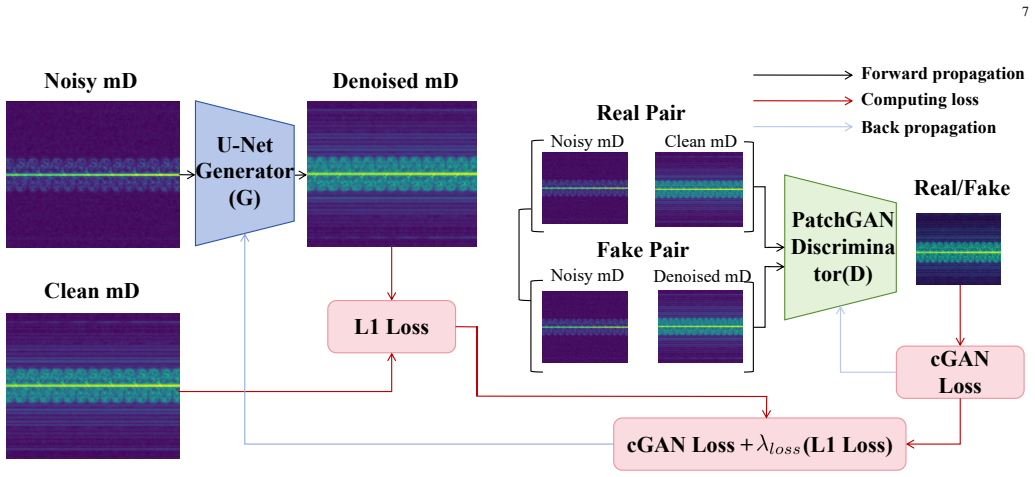
Summary. The paper proposes an end-to-end ISAC–vision fusion framework for fine-grained low-altitude target recognition. An ISAC base station (26 GHz OFDM, hybrid and radar URAs) estimates target position/velocity via 2D-FFT plus MVDR refinement (§III.B); these estimates drive a PTZ camera's pan/tilt/zoom through the control laws in Eqs. (26)–(30). From the echo, an STFT micro-Doppler (mD) spectrum is extracted (§IV.A) and denoised by a cGAN (U-Net generator, PatchGAN discriminator, §IV.B); YOLOv11 crops the visual ROI (§V.A); a dual-stream MobileViT-S/XS network with feature projection and an MLP head fuses the two modalities for 10-class recognition (§V.B). A new synthetic dataset, JIVD, is built from AirSim trajectories replayed for image capture and Wireless InSite X3D ray tracing for channel parameters (§VI.A–B). Reported results: cGAN denoising improves MSE/PSNR/SSIM (Fig. 8) and mD-only accuracy (Fig. 9); YOLOv11 achieves max F1 = 0.995 at IoU 0.5 and mean IoU 0.849 (Figs. 10–11); the full fusion scheme averages 97.67% accuracy over SNR 0–30 dB versus 86.25% (noisy mD + vision), 74.34% (vision only), and 71.08% (denoised mD only), with a near-diagonal confusion matrix at 30 dB (Figs. 12–13) and well-separated UMAP clusters (Fig. 14).
Significance. If the results hold, this is a useful contribution: to my knowledge it is the first ISAC–vision fusion framework for fine-grained low-altitude recognition, and it ships several concrete assets — a complete, reproducible-in-principle pipeline from OFDM echo model to fused classifier; a new paired RF–vision synthetic dataset (JIVD) with 10 fine-grained classes, multiple ranges, scenarios, and weather; and a clean ablation structure (four schemes across seven SNR levels) that makes the fusion and denoising claims individually falsifiable. The reported fusion gains are large and consistent across SNR, and the mD signatures in Fig. 3 are physically plausible. The main caveats on significance are that all evidence is synthetic (AirSim + Wireless InSite with LoS-only channels), and — more importantly — the advertised closed-loop system (ISAC estimate → PTZ pointing → recognition) is not the system actually evaluated, since image acquisition uses simulator ground-truth pose. The paper therefore currently demonstrates separability under oracle acquisition rather than performance of the deployed loop.
major comments (4)
- [§VI.A vs. §III.C (Eqs. (26)–(30)); Fig. 12] The central claim concerns a closed-loop system in which ISAC position estimates (r̂, θ̂, φ̂) drive the PTZ camera. However, the evaluation pipeline records AirSim ground truth and then 'actively configure[s] the PTZ camera based on the target's current location' — i.e., every image in JIVD is acquired under oracle pose, not under the noisy estimator output. The zoom law (Eq. (30)) targets only L_cls = 40 pixels of target width at ranges up to 600 m, so small range/angular errors, estimator latency, or synchronization error can decenter the target, mis-set the focal length, or drop it from the FOV entirely. No estimation errors for (r̂, θ̂, φ̂) are ever reported, and they are never propagated through Eqs. (26)–(30). Consequently the 97.67% average accuracy and the fusion-over-vision margins in Fig. 12 may depend on perfectly centered and scaled images. This is fixable within the paper's
- [§III.C, Eq. (28)–(30)] The adaptive FOV law requires L_obj, the physical width of the target, as an input. But L_obj is class-dependent, and the target's subcategory is precisely what the system is trying to recognize; at acquisition time the target may not even be classified at the UAV/bird level. As written, the zoom control implicitly assumes knowledge of the target's size (or class) before recognition, which is circular for the claimed operational use. The authors should state what L_obj is used in practice (a fixed nominal value? a coarse estimate from radar cross-section or range-Doppler extent?), and quantify how mis-specification of L_obj propagates through Eq. (30) into L_cls and final accuracy.
- [§VI.A] The channel synthesis retains only the LoS path ('we focus exclusively on the LoS path and neglect NLoS'), yet the scenarios include 'dense urban building complexes,' where multipath is precisely the regime in which both mD extraction and MVDR-based position estimation degrade. Since the simulation framework (Wireless InSite X3D) already computes NLoS components, including at least a representative multipath setting — or explicitly scoping the claims to LoS-dominated geometries and removing the urban-complexity implication — is needed for the accuracy numbers to be interpretable.
- [§VI.B–E] The train/test protocol is under-specified in a way that bears on the validity of the headline numbers. The 42,000 noisy echoes are 7 SNR variants of 6,000 base sequences; the text says 80%/20% of 'sequences' are used for train/test, but it is not stated whether the split is performed before SNR augmentation (so no base trajectory appears in both splits at different SNRs) or after. Please clarify, and also report: training hyperparameters (optimizer, learning rate, epochs, batch size, the value of λ_loss in Eq. (46)), the number of test samples underlying each point in Fig. 12, and confidence intervals or per-sequence variance. A single split with no error bars is weak support for accuracy differences quoted to two decimal places.
minor comments (6)
- [§VI.E, Fig. 13] The confusion matrix is shown only at 30 dB, where performance is near-ceiling. A confusion matrix at a low SNR (e.g., 0–10 dB) would be more informative about which class confusions drive the degradation in Fig. 12.
- [§III.B] The performance of the 2D-FFT + MVDR position/velocity estimator is never quantified (no RMSE vs. SNR or range). Since Stage 1 feeds both the PTZ control and the receive beamforming in Eq. (31), at least a basic estimation-accuracy curve should be reported.
- [§V.B, Fig. 5] No baseline comparison to existing radar–vision fusion methods (e.g., [21]–[23]) and no complexity/latency analysis are provided. Given the claimed deployment motivation (edge monitoring), inference time and parameter counts for the dual MobileViT + cGAN + YOLOv11 stack would strengthen the paper.
- [§III.C, Eq. (27)] The quaternion conversion omits the roll angle γ entirely, although ω is defined with three components; with γ = 0 the standard ZYX conversion contains additional cross terms (e.g., the q_x and q_y entries involve both ψ and ϑ half-angle products in a specific order). Please state the rotation convention and verify the formula.
- [Throughout] Several typos and notation inconsistencies: 'adiust' (§III.C), 'singals' (Fig. 2), 'genetated' and 'alititude' (Fig. 7 caption), 'MobileVit' vs. 'MobileViT' (Fig. 5), 'UA V' spacing artifacts. Fig. 5's feature-dimension annotations render as 'ℝ????'. Please proofread.
- [§VI.B] The dataset size derivation (10×5×5×24 = 6,000) is hard to follow: it is unclear what the two factors of 5 represent (5 distances and 5 what — scenarios/weather/sequences?). Please make the per-class sequence count and the scenario/weather assignment explicit.
Circularity Check
Empirical systems/ML paper: reported accuracies are held-out measurements, not results forced by definition or self-citation.
full rationale
The paper’s load-bearing claim is empirical recognition accuracy of a dual-stream MobileViT fusion model on a held-out split of the synthetic JIVD dataset (Fig. 12–13, §VI.E), after training cGAN denoising and the classifier on the training split. That measurement is not algebraically equivalent to any fitted constant, uniqueness theorem, or renamed known law. Geometric PTZ control laws (26)–(30) are standard pinhole/Euler constructions from estimated pose; STFT mD extraction and MVDR/FFT parameter estimation are classical signal-processing steps, not self-definitional. Self-citation [6] only supplies target mesh/kinematics details used to build the simulator (“Specific details on the modeling process, kinematics, micro-motion parameters, and geometry of these targets can be found in [6]”); it does not define or force the reported 97.67% accuracy. Evaluation mismatches (oracle AirSim pose for PTZ vs. claimed ISAC estimates; LoS-only channels) are validity/correctness concerns, not circularity. No step reduces a claimed prediction to its inputs by construction.
Axiom & Free-Parameter Ledger
free parameters (5)
- cGAN L1 weight λ_loss
- Recognition / denoise network weights (MobileViT-S/XS, U-Net G, PatchGAN D, YOLO) =
trained on 80% sequences
- L_cls = 40 pixels (required target width for FOV law) =
40
- STFT window/step (L_win=128, A_step=4) and OFDM/frame geometry =
L_win=128, A_step=4; f0=26 GHz, M=1024, N=4200, Ts=10 µs
- mD feature projection dimension D_proj and fusion MLP
axioms (6)
- domain assumption Echo channel is a sum of K scattering points with standard far-field URA steering and complex fading (Eqs. 3–10).
- ad hoc to paper Only LoS paths are retained; NLoS is neglected for small targets at long range (§VI.A).
- domain assumption BS and PTZ camera are co-located at the origin with controllable pan/tilt/zoom matching estimated spherical angles and FOV law (Eqs. 26–30).
- ad hoc to paper AirSim visuals + Wireless InSite X3D LoS parameters substituted into the theoretical channel sufficiently represent real RF–vision pairs for accuracy claims.
- domain assumption STFT magnitude summed over range, energy-centered, yields discriminative micro-motion signatures across the ten subtypes (Fig. 3, §IV.A).
- standard math Cross-entropy on fused MobileViT features is an adequate training objective for fine-grained ID (§V.B).
invented entities (2)
-
JIVD (joint ISAC and vision dataset)
no independent evidence
-
ISAC–vision fine-grained recognition network (dual MobileViT-S/XS + projection + MLP)
no independent evidence
read the original abstract
In this paper, we propose an integrated sensing and communications (ISAC) and vision fusion framework for fine-grained low-altitude target recognition. Specifically, we first utilize ISAC system to estimate the position of the low-altitude target. Then we adjust the working parameters of the Pan-TiltZoom (PTZ) camera based on the estimated target position, such that the camera can capture the image of tiny low-altitude target from several hundred meters away. After obtaining the wireless echo signal and visual image of low-altitude target, we employ the short-time Fourier transform (STFT) to obtain the micro-Doppler (mD) spectrum of the target from wireless echo signal, and design a conditional generative adversarial network (cGAN)-based denoising network to optimize the quality of the mD spectrum. Meanwhile, we employ YOLOv11 to detect the low-altitude target from visual image, and then crop the smallsized feature image of the target from the original image. Next, we design a fine-grained low-altitude target recognition network with MobileViT, which can fuse the optimized mD spectrum and the cropped feature image to distinguish the subcategory of low-altitude target. Moreover, we generate a joint ISAC and vision dataset (JIVD) for low-altitude target monitoring based on AirSim and Wireless InSite, which includes diverse target subcategories, scenarios, and weather conditions. The effectiveness and superiority of the proposed scheme have been demonstrated by simulation results.
Figures




Reference graph
Works this paper leans on
-
[1]
6G non-terrestrial networks enabled low-altitude economy: Opportunities and challenges,
Y . Jianget al., “6G non-terrestrial networks enabled low-altitude economy: Opportunities and challenges,”arXiv e-prints, p. arXiv:2311.09047, Nov. 2023. 13
Pith/arXiv arXiv 2023
-
[2]
The potential of low-altitude airspace: The future of urban air transportation,
H. Huang, J. Su, and F.-Y . Wang, “The potential of low-altitude airspace: The future of urban air transportation,”IEEE Trans. Intell. V eh., vol. 9, no. 8, pp. 5250–5254, Aug. 2024
2024
-
[3]
Non-terrestrial networks in the 6G era: Challenges and opportunities,
M. Giordani and M. Zorzi, “Non-terrestrial networks in the 6G era: Challenges and opportunities,”IEEE Network, vol. 35, no. 2, pp. 244– 251, Mar. 2021
2021
-
[4]
IoTaaS: drone-based internet of things as a service framework for smart cities,
M. A. Hoqueet al., “IoTaaS: drone-based internet of things as a service framework for smart cities,”IEEE Internet Things J., vol. 9, no. 14, pp. 12 425–12 439, Jul. 2022
2022
-
[5]
Networked ISAC- based UA V tracking and handover toward low-altitude economy,
C. Zhao, Y . Feng, H. Luo, F. Gao, F. Liu, and S. Jin, “Networked ISAC- based UA V tracking and handover toward low-altitude economy,”IEEE Trans. Wireless Commun., vol. 24, no. 9, pp. 7670–7685, Apr. 2025
2025
-
[6]
AirGuard: UA V and bird recognition scheme for integrated sensing and communications system,
H. Luoet al., “AirGuard: UA V and bird recognition scheme for integrated sensing and communications system,”IEEE J. Sel. Areas Commun., vol. 44, pp. 835–848, 2026
2026
-
[7]
Toward 6G with connected sky: UA Vs and beyond,
M. Mozaffari, X. Lin, and S. Hayes, “Toward 6G with connected sky: UA Vs and beyond,”IEEE Commun. Mag., vol. 59, no. 12, pp. 74–80, Jan. 2022
2022
-
[8]
Enhanced UA V detection and classification using machine learning and MIMO radars,
A. N. Sayedet al., “Enhanced UA V detection and classification using machine learning and MIMO radars,”IEEE Trans. on Microw. Theory and Tech., vol. 72, no. 11, pp. 6716–6727, Nov. 2024
2024
-
[9]
A method of photoelectric capture of UA V under rough guidance,
B. Maet al., “A method of photoelectric capture of UA V under rough guidance,” inProc. Int. Conf. Cloud Comput. Big Data Anal., Chengdu, China, Apr. 2024, pp. 184–187
2024
-
[10]
Low-altitude protection technology of anti-UA Vs based on multisource detection information fusion,
S. Chenet al., “Low-altitude protection technology of anti-UA Vs based on multisource detection information fusion,”Int. J. Adv. Robot. Syst., vol. 17, no. 5, p. 1729881420962907, 2020
2020
-
[11]
Amateur drone monitoring: State- of-the-art architectures, key enabling technologies, and future research directions,
Z. Kaleem and M. H. Rehmani, “Amateur drone monitoring: State- of-the-art architectures, key enabling technologies, and future research directions,”IEEE Wireless Commun., vol. 25, no. 2, pp. 150–159, May 2018
2018
-
[12]
Domain-adaptive UA V recognition using IR-UWB radar and a lightweight Mamba-based network,
S. Liet al., “Domain-adaptive UA V recognition using IR-UWB radar and a lightweight Mamba-based network,”IEEE Sensors J., vol. 25, no. 18, pp. 34 913–34 926, Aug. 2025
2025
-
[13]
Micro-Doppler mini-UA V classification using empirical-mode decomposition features,
B.-S. Ohet al., “Micro-Doppler mini-UA V classification using empirical-mode decomposition features,”IEEE Geosci. and Remote Sens. Lett., vol. 15, no. 2, pp. 227–231, Dec. 2018
2018
-
[14]
Classification of birds and UA Vs based on radar polarimetry,
B. Torvik, K. E. Olsen, and H. Griffiths, “Classification of birds and UA Vs based on radar polarimetry,”IEEE Geosci. and Remote Sens. Lett., vol. 13, no. 9, pp. 1305–1309, Jul. 2016
2016
-
[15]
What is YOLOv5: A deep look into the internal features of the popular object detector,
R. Khanam and M. Hussain, “What is YOLOv5: A deep look into the internal features of the popular object detector,”arXiv e-prints, p. arXiv:2407.20892, Jul. 2024
Pith/arXiv arXiv 2024
-
[16]
Drone detection and tracking: An edge-deployable efficient algorithm based on vision sensor,
B. Wang, J. Li, M. Zhou, and Q. Lu, “Drone detection and tracking: An edge-deployable efficient algorithm based on vision sensor,”IEEE Sensors J., vol. 25, no. 17, pp. 34 126–34 140, Jul. 2025
2025
-
[17]
A review on YOLOv8 and its advancements,
M. Sohan, T. Sai Ram, and C. V . Rami Reddy, “A review on YOLOv8 and its advancements,” inProc. Int. Conf. Data Intell. Cogn. Inform., 2024, pp. 529–545
2024
-
[18]
Experiments on vision-based methods to detect, identify and track UA Vs using thermal camera,
D. Dosi, C. E. Abraham, and D. Kumar, “Experiments on vision-based methods to detect, identify and track UA Vs using thermal camera,” in Proc. Int. Conf. Emerg. Technol. Auton. Aer . V eh., Bangalore, India, Aug. 2025, pp. 1–6
2025
-
[19]
Drone detection using convolutional neural networks,
F. Mahdavi and R. Rajabi, “Drone detection using convolutional neural networks,” inProc. Iranian Conf. Signal Process. Intell. Syst., Mashhad, Iran, Dec. 2020, pp. 1–5
2020
-
[20]
Machine learning-based drone detection and classification: State-of-the-art in research,
B. Taha and A. Shoufan, “Machine learning-based drone detection and classification: State-of-the-art in research,”IEEE Access, vol. 7, pp. 138 669–138 682, Sep. 2019
2019
-
[21]
Real-time UA V and payload detection and classification system using radar and camera sensor fusion,
V . Mehtaet al., “Real-time UA V and payload detection and classification system using radar and camera sensor fusion,” inProc. IEEE/AIAA Digit. Avion. Syst. Conf., Barcelona, Spain, 2023, pp. 1–6
2023
-
[22]
Edge AI-enabled radar and camera integration for real-time drone detection and classification,
V . Mehtaet al., “Edge AI-enabled radar and camera integration for real-time drone detection and classification,” inProc. IEEE/AIAA Digit. Avion. Syst. Conf., Montreal, Canada, 2025, pp. 1–7
2025
-
[23]
Radar-optical fusion detection of UA V based on improved YOLOv7-tiny,
H. Tanget al., “Radar-optical fusion detection of UA V based on improved YOLOv7-tiny,”Meas. Sci. Technol., vol. 35, no. 8, p. 085110, May 2024
2024
-
[24]
Perceptive mobile networks: Cellular networks with radio vision via joint communication and radar sensing,
A. Zhanget al., “Perceptive mobile networks: Cellular networks with radio vision via joint communication and radar sensing,”IEEE V eh. Technol. Mag., vol. 16, no. 2, pp. 20–30, Jun. 2021
2021
-
[25]
Integrated sensing and communications: Toward dual-functional wire- less networks for 6G and beyond,
F. Liu, Y . Cui, C. Masouros, J. Xu, T. X. Han, Y . C. Eldar, and S. Buzzi, “Integrated sensing and communications: Toward dual-functional wire- less networks for 6G and beyond,”IEEE J. Sel. Areas Commun., vol. 40, no. 6, pp. 1728–1767, Jun. 2022
2022
-
[26]
Toward 6G networks: Use cases and technologies,
M. Giordani, M. Polese, M. Mezzavilla, S. Rangan, and M. Zorzi, “Toward 6G networks: Use cases and technologies,”IEEE Commun. Mag., vol. 58, no. 3, pp. 55–61, Mar. 2020
2020
-
[27]
Integrated sensing and communications framework for 6G networks,
H. Luo, T. Zhang, C. Zhao, Y . Wang, B. Lin, Y . Jiang, D. Luo, and F. Gao, “Integrated sensing and communications framework for 6G networks,”IEEE Wireless Commun., vol. 32, no. 6, pp. 102–109, Dec. 2025
2025
-
[28]
Convergent communication, sensing and localiza- tion in 6G systems: An overview of technologies, opportunities and challenges,
C. De Limaet al., “Convergent communication, sensing and localiza- tion in 6G systems: An overview of technologies, opportunities and challenges,”IEEE Access, vol. 9, pp. 26 902–26 925, Jan. 2021
2021
-
[29]
Seven defining features of terahertz (THz) wireless sys- tems: A fellowship of communication and sensing,
C. Chaccour, M. N. Soorki, W. Saad, M. Bennis, P. Popovski, and M. Debbah, “Seven defining features of terahertz (THz) wireless sys- tems: A fellowship of communication and sensing,”IEEE Commun. Surv. Tut., vol. 24, no. 2, pp. 967–993, Jan. 2022
2022
-
[30]
6G wire- less communication systems: Applications, requirements, technologies, challenges, and research directions,
M. Z. Chowdhury, M. Shahjalal, S. Ahmed, and Y . M. Jang, “6G wire- less communication systems: Applications, requirements, technologies, challenges, and research directions,”IEEE Open J. Commun. Soc., vol. 1, pp. 957–975, Jul. 2020
2020
-
[31]
Cooperative ISAC-empowered low-altitude economy,
J. Tang, Y . Yu, C. Pan, H. Ren, D. Wang, J. Wang, and X. You, “Cooperative ISAC-empowered low-altitude economy,”IEEE Trans. Wireless Commun., vol. 24, no. 5, pp. 3837–3853, May 2025
2025
-
[32]
Learned off-grid imager for low-altitude economy with cooperative ISAC network,
Y . Huang, J. Yang, S. Xia, C.-K. Wen, and S. Jin, “Learned off-grid imager for low-altitude economy with cooperative ISAC network,”IEEE Trans. Wireless Commun., vol. 25, pp. 3333–3348, 2026
2026
-
[33]
UA V’s rotor micro-doppler feature extraction using integrated sensing and communication signal: Algorithm design and testbed evaluation,
J. Wei, D. Ma, F. He, Q. Zhang, Z. Feng, Z. Liu, and T. Liang, “UA V’s rotor micro-doppler feature extraction using integrated sensing and communication signal: Algorithm design and testbed evaluation,” IEEE Trans. Wireless Commun., vol. 24, no. 12, pp. 10 166–10 182, Jul. 2025
2025
-
[34]
DC-Former network empowered UA V and bird recognition based on integrated sensing and communi- cation system,
J. Xue, Q. Zhang, D. Ma, and J. Wei, “DC-Former network empowered UA V and bird recognition based on integrated sensing and communi- cation system,” inProc. Int. Conf. Comput. Commun. Syst., Chengdu, China, Apr. 2025, pp.927-932
2025
-
[35]
Ml joint CFO and channel estimation in OFDM systems with timing ambiguity,
J. Chen, Y .-c. Wu, S. Ma, and T.-s. Ng, “Ml joint CFO and channel estimation in OFDM systems with timing ambiguity,”IEEE Trans. Wireless Commun., vol. 7, no. 7, pp. 2436–2440, Jul. 2008
2008
-
[36]
Generative adversarial nets,
I. J. Goodfellowet al., “Generative adversarial nets,” inAdv. Neural Inf. Process. Syst., vol. 27, 2014
2014
-
[37]
Yolov11: An overview of the key architectural enhancements,
R. Khanam and M. Hussain, “Yolov11: An overview of the key architectural enhancements,”arXiv e-prints, p. arXiv:2410.17725, Oct. 2024
Pith/arXiv arXiv 2024
-
[38]
MobileViT: Light-weight, general- purpose, and mobile-friendly vision transformer,
S. Mehta and M. Rastegari, “MobileViT: Light-weight, general- purpose, and mobile-friendly vision transformer,”arXiv e-prints, p. arXiv:2110.02178, Oct. 2021
Pith/arXiv arXiv 2021
-
[39]
DoA estimation and capacity analysis for 3-D millimeter wave massive-MIMO/FD-MIMO OFDM systems,
R. Shafin, L. Liu, J. Zhang, and Y .-C. Wu, “DoA estimation and capacity analysis for 3-D millimeter wave massive-MIMO/FD-MIMO OFDM systems,”IEEE Trans. Wireless Commun., vol. 15, no. 10, pp. 6963– 6978, Oct. 2016
2016
-
[40]
Integrated sensing and communications for V2I networks: Dynamic predictive beamforming for extended vehicle targets,
Z. Du, F. Liu, W. Yuan, C. Masouros, Z. Zhang, S. Xia, and G. Caire, “Integrated sensing and communications for V2I networks: Dynamic predictive beamforming for extended vehicle targets,”IEEE Trans. Wireless Commun., vol. 22, no. 6, pp. 3612–3627, Jun. 2023
2023
-
[41]
Broad beam designs for broadcast channels,
C. Du and Y . Jiang, “Broad beam designs for broadcast channels,”IEEE Trans. Signal Process., vol. 72, pp. 3819–3833, Aug. 2024
2024
-
[42]
U-net: Convolutional networks for biomedical image segmentation,
O. Ronneberger, P. Fischer, and T. Brox, “U-net: Convolutional networks for biomedical image segmentation,” inProc. Int. Conf. Med. Image Comput. Comput.-Assist. Interv., 2015, pp. 234–241
2015
-
[43]
Image-to-image translation with conditional adversarial networks,
P. Isola, J.-Y . Zhu, T. Zhou, and A. A. Efros, “Image-to-image translation with conditional adversarial networks,” inProc. IEEE Conf. Comput. Vis. Pattern Recognit., 2017, pp. 5967–5976
2017
-
[44]
AirSim: High-fidelity visual and physical simulation for autonomous vehicles,
S. Shah, D. Dey, C. Lovett, and A. Kapoor, “AirSim: High-fidelity visual and physical simulation for autonomous vehicles,” inProc. Int. Conf. Field Serv. Robot., 2017, pp. 621–635
2017
-
[45]
B. O. Community,Blender - a 3D modelling and rendering package, Blender Foundation, Stichting Blender Foundation, Amsterdam, 2018. [Online]. Available: http://www.blender.org
2018
-
[46]
Wireless insite
Remcom, “Wireless insite.” [Online]. Available: https://www.remcom. com/wireless-insite-em-propagation-software
-
[47]
Image quality assessment: from error visibility to structural similarity,
Z. Wang, A. Bovik, H. Sheikh, and E. Simoncelli, “Image quality assessment: from error visibility to structural similarity,”IEEE Trans. Image Process., vol. 13, no. 4, pp. 600–612, Apr. 2004
2004
-
[48]
Umap: Uniform manifold approximation and projection for dimension reduction,
L. McInnes, J. Healy, and J. Melville, “Umap: Uniform manifold approximation and projection for dimension reduction,”arXiv e-prints, p. arXiv:1802.03426, Sep. 2018
Pith/arXiv arXiv 2018
-
[49]
Support vector machines,
M. Hearst, S. Dumais, E. Osuna, J. Platt, and B. Scholkopf, “Support vector machines,”IEEE Intell. Syst. Their Appl., vol. 13, no. 4, pp. 18– 28, Aug. 1998
1998
discussion (0)
Sign in with ORCID, Apple, or X to comment. Anyone can read and Pith papers without signing in.