Quantum-Classical Auxiliary-Field Quantum Monte Carlo at the Edge of Practicability
Pith reviewed 2026-06-26 20:37 UTC · model grok-4.3
The pith
Aitken's block transformation and algorithmic differentiation cut QC-AFQMC classical scaling from N^{5.5} to N^{4.5}.
A machine-rendered reading of the paper's core claim, the machinery that carries it, and where it could break.
Core claim
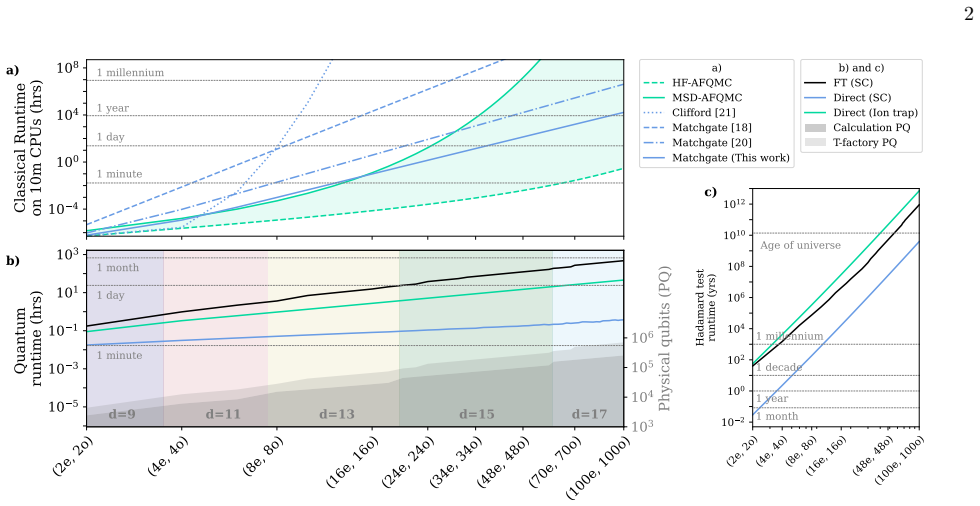
Central to the improvement is the application of Aitken's block transformation to handle singular Pfaffians arising in the estimation of overlaps between a quantum trial state and classical Slater-determinant walkers. Together with the use of algorithmic differentiation for the computation of the force bias, this yields a 248× estimated runtime improvement for a system of 100 molecular orbitals.
What carries the argument
Aitken's block transformation for regularizing singular Pfaffians in quantum-classical overlap estimation, paired with algorithmic differentiation of the force bias.
If this is right
- Estimated 248x runtime improvement for 100-orbital systems.
- Successful ground-state calculation for H8 using real quantum hardware data with error mitigation.
- Scalability shown on hydrogen chains up to H12 and Li2O4 in (26e, 20o) active space.
- Runtime estimates for fault-tolerant implementation indicate promise for early fault-tolerant era.
Where Pith is reading between the lines
- The reduced scaling may allow QC-AFQMC to address molecules larger than those currently feasible with hybrid quantum-classical methods.
- Similar regularization techniques could benefit other Monte Carlo algorithms that encounter singular determinants or Pfaffians.
- Integration with advanced error mitigation like tensor networks suggests hybrid workflows can extend the reach of noisy quantum devices.
Load-bearing premise
Aitken's block transformation correctly handles singular Pfaffians without introducing uncontrolled bias or inflating Monte Carlo variance beyond standard error analysis.
What would settle it
Running the QC-AFQMC calculation on a small system known to produce singular Pfaffians both with and without the block transformation, and verifying that the resulting energies and error bars match within statistical uncertainty.
Figures
read the original abstract
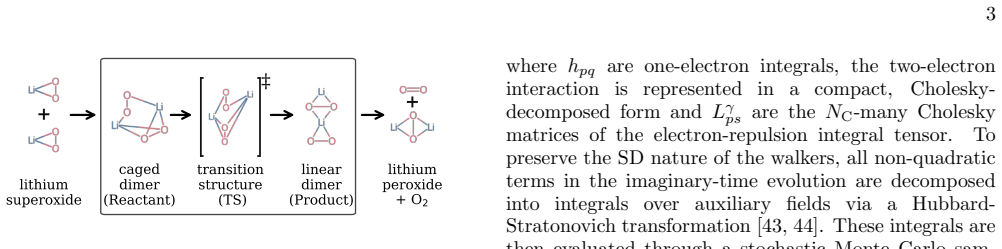
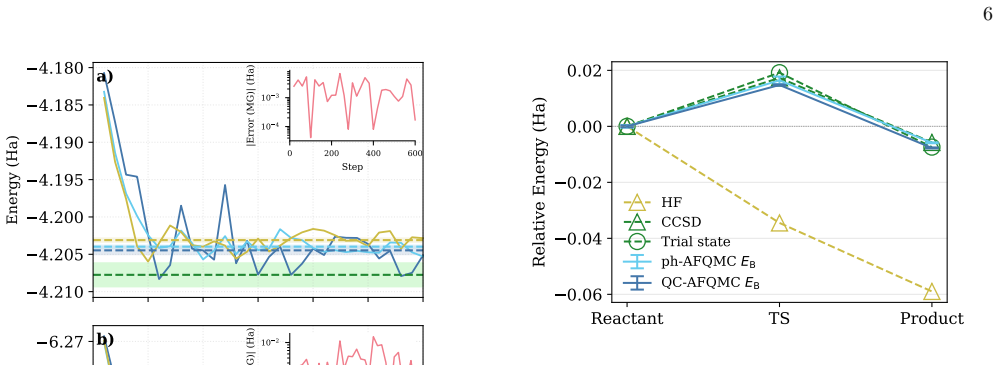
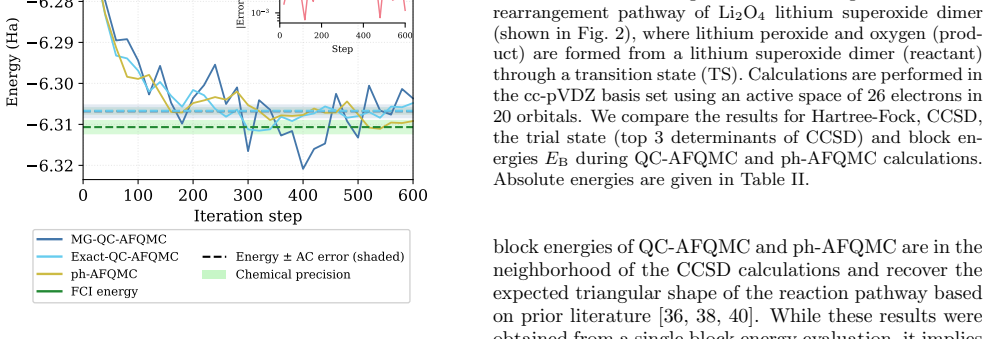
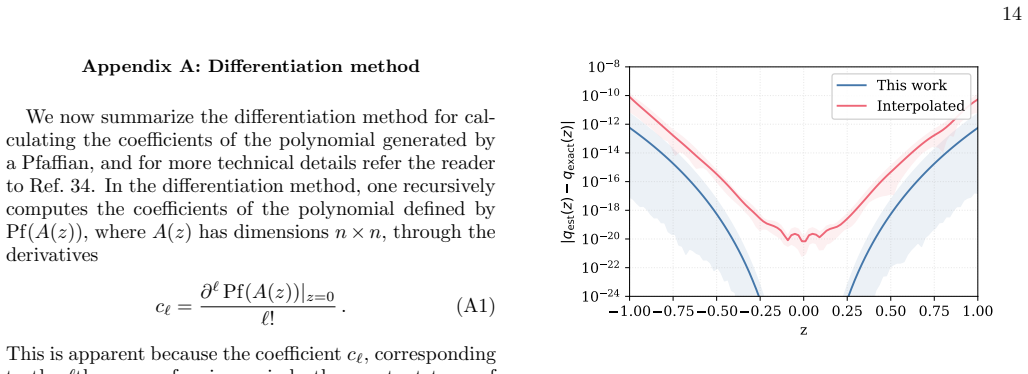
We introduce algorithmic improvements to quantum-classical auxiliary-field quantum Monte Carlo (QC-AFQMC) that reduce the dominant per-step classical scaling from $\tilde{\mathcal{O}}(N^{5.5})$ to $\tilde{\mathcal{O}}(N^{4.5})$ as a function of the number of molecular spin-orbitals $N$. Central to this improvement is the application of Aitken's block transformation to handle singular Pfaffians arising in the estimation of overlaps between a quantum trial state and classical Slater-determinant walkers. Together with the use of algorithmic differentiation for the computation of the force bias, this yields a $248\times$ estimated runtime improvement for a system of 100 molecular orbitals. Using our workflow, we demonstrate a ground-state energy calculation for $H_8$ from quantum data collected on IQM Emerald and post-processed with a tensor-network-based error-mitigation technique. We further validate the method's scalability through noiseless simulation of hydrogen chains up to $H_{12}$, and on the lithium-air battery related rearrangement pathway of the $Li_2O_4$ lithium superoxide dimer in a (26e, 20o) active space. We estimate both quantum and classical runtimes for a potential fault-tolerant implementation of QC-AFQMC, showing that the method holds promise for the early fault-tolerant era. These results move QC-AFQMC a step closer to treating chemically relevant systems.
Editorial analysis
A structured set of objections, weighed in public.
Referee Report
Summary. The manuscript introduces algorithmic improvements to quantum-classical auxiliary-field quantum Monte Carlo (QC-AFQMC) that reduce the dominant per-step classical scaling from ilde{O}(N^{5.5}) to ilde{O}(N^{4.5}) via Aitken's block transformation applied to singular Pfaffians in quantum-classical overlap estimation, combined with algorithmic differentiation for the force bias. This yields an estimated 248x runtime improvement for a 100-orbital system. Demonstrations include a ground-state energy calculation for H8 using quantum data from IQM Emerald with tensor-network error mitigation, noiseless simulations on hydrogen chains up to H12, and the Li2O4 lithium superoxide dimer rearrangement in a (26e, 20o) active space. Runtime estimates for a potential fault-tolerant implementation are also provided.
Significance. If the scaling reduction holds while preserving the unbiased character of the Monte Carlo estimator and without uncontrolled variance inflation, the work would meaningfully advance the practicality of QC-AFQMC toward chemically relevant systems. The demonstrations on small molecules and the fault-tolerant runtime projections provide concrete evidence of progress, though the absence of detailed validation for the key regularization step limits the strength of the central claim.
major comments (2)
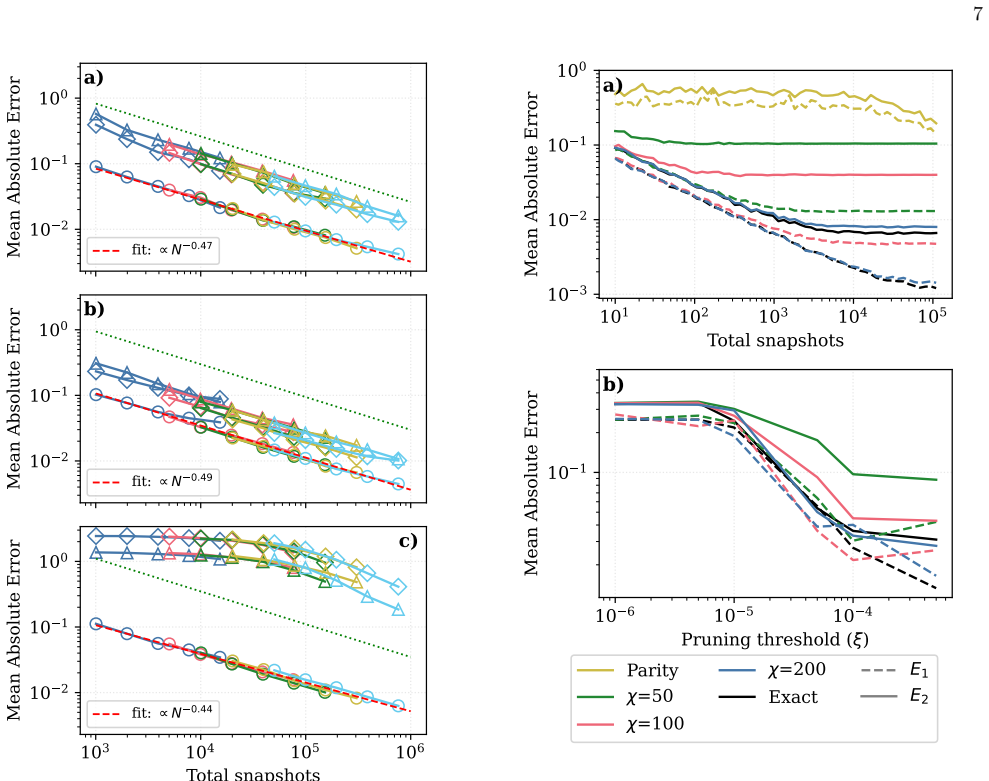
- [Abstract and Aitken transformation section] Abstract and the section introducing Aitken's block transformation: the claim that this transformation regularizes singular Pfaffians while preserving the unbiased Monte Carlo estimator is load-bearing for the scaling reduction and 248x estimate, yet the demonstrations on H8, H12, and Li2O4 provide no direct side-by-side comparison of energies or observables obtained with versus without the transformation on systems where both are numerically stable; this leaves open whether the regularization is exact or introduces bias/variance inflation not controlled by standard AFQMC error analysis.
- [Results on demonstrations] Results sections on H8, H12, and Li2O4 demonstrations: no quantitative error-bar analysis, comparison against known exact results, or validation of post-hoc error mitigation is reported for the computed energies, which is required to substantiate the soundness of the improved workflow and the estimated runtime gains.
minor comments (2)
- [Abstract] The use of ilde{\mathcal{O}} notation for the scaling should be accompanied by an explicit statement of the hidden factors and assumptions in the complexity analysis.
- [Methods] Clarify in the methods whether the algorithmic differentiation for force bias is applied before or after the Aitken transformation, as the interaction between these two improvements is not immediately clear from the abstract.
Simulated Author's Rebuttal
We thank the referee for their careful reading and constructive feedback on our manuscript. We address the major comments point-by-point below and will incorporate revisions to strengthen the presentation of the regularization step and the demonstration results.
read point-by-point responses
-
Referee: [Abstract and Aitken transformation section] Abstract and the section introducing Aitken's block transformation: the claim that this transformation regularizes singular Pfaffians while preserving the unbiased Monte Carlo estimator is load-bearing for the scaling reduction and 248x estimate, yet the demonstrations on H8, H12, and Li2O4 provide no direct side-by-side comparison of energies or observables obtained with versus without the transformation on systems where both are numerically stable; this leaves open whether the regularization is exact or introduces bias/variance inflation not controlled by standard AFQMC error analysis.
Authors: The Aitken block transformation is an exact algebraic identity applied to the Pfaffian matrix when it is singular (i.e., when the quantum-classical overlap would otherwise be undefined or numerically unstable). Because it is a mathematically equivalent rewriting of the Pfaffian determinant, the Monte Carlo estimator remains unbiased; the transformation is applied conditionally and reduces to the standard expression on non-singular cases. We agree that a direct numerical comparison on a small system where both formulations are stable would strengthen the presentation. In the revised manuscript we will add such a comparison (e.g., on H4 or H6) together with a brief derivation appendix confirming the identity preserves the estimator. revision: yes
-
Referee: [Results on demonstrations] Results sections on H8, H12, and Li2O4 demonstrations: no quantitative error-bar analysis, comparison against known exact results, or validation of post-hoc error mitigation is reported for the computed energies, which is required to substantiate the soundness of the improved workflow and the estimated runtime gains.
Authors: The H8 calculation uses real-device data post-processed with tensor-network error mitigation, while H12 and Li2O4 are noiseless simulations. We will expand the results sections to include (i) statistical error bars on all reported energies, (ii) direct comparisons to literature exact or high-accuracy values for the hydrogen chains, and (iii) additional quantitative metrics validating the tensor-network mitigation step on the H8 data. These additions will be placed in the main text or a dedicated supplementary section. revision: yes
Circularity Check
No circularity: scaling claims derive from external algorithmic techniques
full rationale
The paper's central improvement—reducing per-step scaling from O(N^5.5) to O(N^4.5) via Aitken's block transformation on singular Pfaffians plus algorithmic differentiation for force bias—is presented as an application of known methods to the QC-AFQMC overlap estimation step. The 248x runtime estimate follows directly from the new asymptotic scaling applied to a 100-orbital system, without any fitted parameters renamed as predictions or self-referential definitions. No equations in the abstract or described workflow reduce the claimed result to its inputs by construction. Demonstrations on H8, H12 and Li2O4 are validation runs, not load-bearing for the scaling derivation itself. No self-citation chains, uniqueness theorems, or ansatz smuggling appear in the provided material. The derivation chain is therefore self-contained against external benchmarks.
Axiom & Free-Parameter Ledger
Reference graph
Works this paper leans on
-
[1]
C. K. Narula, J. E. Allison, D. R. Bauer, and H. S. Gandhi, Materials chemistry issues related to advanced materials applications in the automotive industry, Chem- istry of Materials8, 984 (1996)
1996
-
[2]
S. M. Arnold, D. Cebon, and M. Ashby, Materials selec- tion for aerospace systems, inAerospace Materials and Applications(American Institute of Aeronautics and As- tronautics, Inc., 2018) pp. 209–274
2018
-
[3]
K. R. Campos, P. J. Coleman, J. C. Alvarez, S. D. Dreher, R. M. Garbaccio, N. K. Terrett, R. D. Tillyer, M. D. Truppo, and E. R. Parmee, The importance of syn- thetic chemistry in the pharmaceutical industry, Science 363, eaat0805 (2019)
2019
-
[4]
J. M. Lewer, Z. R. Stickelman, J. H. Huang, J. F. Pelo- quin, and J. Kostal, Structure-to-process design frame- work for developing safer pesticides, Science Advances8, eabn2058 (2022)
2022
-
[5]
Hammes-Schiffer, Catalysts by design: The power of theory, Accounts of Chemical Research50, 561 (2017)
S. Hammes-Schiffer, Catalysts by design: The power of theory, Accounts of Chemical Research50, 561 (2017)
2017
-
[6]
C. H. Bennett, E. Bernstein, G. Brassard, and U. Vazi- rani, Strengths and weaknesses of quantum computing, SIAM Journal on Computing26, 1510 (1997)
1997
-
[7]
Alexeev, M
Y. Alexeev, M. Amsler, M. A. Barroca, S. Bassini, T. Battelle, D. Camps, D. Casanova, Y. J. Choi, F. T. Chong, C. Chung, C. Codella, A. D. C´ orcoles, J. Cruise, A. Di Meglio, I. Duran, T. Eckl, S. Economou, S. Eiden- benz, B. Elmegreen, C. Fare, I. Faro, C. S. Fern´ andez, R. N. B. Ferreira, K. Fuji, B. Fuller, L. Gagliardi, G. Galli, J. R. Glick, I. Gob...
2024
-
[8]
A. B¨ artschi, F. Caravelli, C. Coffrin, J. Colina, S. Eiden- benz, A. Jayakumar, S. Lawrence, M. Lee, A. Y. Lokhov, A. Mishra, S. Misra, Z. Morrell, Z. Mughal, D. Neill, A. Piryatinski, A. Scheie, M. Vuffray, and Y. Zhang, Po- tential applications of quantum computing at los alamos national laboratory (2025), arXiv:2406.06625 [quant-ph]
Pith/arXiv arXiv 2025
-
[9]
H. Gundlach, K. Sharkey, J. Lynch, V. Hazoglou, K.-C. Hsu, C. Dukatz, E. Crane, K. Walczyk, M. Bodziak, J. Galatsanos-Dueck, and N. Thomp- son, Quantum advantage in computational chemistry? (2025), arXiv:2508.20972 [quant-ph]
arXiv 2025
- [10]
-
[11]
O’Gorman, S
B. O’Gorman, S. Irani, J. Whitfield, and B. Fefferman, Intractability of electronic structure in a fixed basis, PRX Quantum3, 020322 (2022)
2022
-
[12]
A. Y. Kitaev, Quantum measurements and the Abelian stabilizer problem (1995), arXiv:quant-ph/9511026 [quant-ph]
Pith/arXiv arXiv 1995
-
[13]
H. Ni, H. Li, and L. Ying, On low-depth algorithms for quantum phase estimation, Quantum7, 1165 (2023)
2023
-
[14]
J. R. McClean, S. Boixo, V. N. Smelyanskiy, R. Bab- bush, and H. Neven, Barren plateaus in quantum neural network training landscapes, Nature Communications9, 10.1038/s41467-018-07090-4 (2018)
- [15]
-
[16]
Alexeev, V
Y. Alexeev, V. S. Batista, N. Bauman, L. Bertels, D. Claudino, R. Dutta, L. Gagliardi, S. Godwin, N. Govind, M. Head-Gordon, M. R. Hermes, K. Kowal- ski, A. Li, C. Liu, J. Liu, P. Liu, J. M. Garc´ ıa-Lastra, D. Mejia-Rodriguez, K. Mueller, M. Otten, B. Peng, M. Raugas, M. Reiher, P. Rigor, W. J. Shaw, M. van Schilfgaarde, T. Vegge, Y. Zhang, M. Zheng, and...
2025
-
[17]
Amsler, P
M. Amsler, P. Deglmann, M. Degroote, M. P. Kaicher, M. Kiser, M. K¨ uhn, C. Kumar, A. Maier, G. Samsonidze, A. Schroeder, M. Streif, D. Vodola, C. Wever, and Q. M. S. W. Group, Classical and quantum trial wave functions in auxiliary-field quantum Monte Carlo applied to oxy- gen allotropes and a cubr2 model system, The Journal of Chemical Physics159, 044119 (2023)
2023
-
[18]
B. Huang, Y.-T. Chen, B. Gupt, M. Suchara, A. Tran, S. McArdle, and G. Galli, Evaluating a quantum-classical quantum Monte Carlo algorithm with matchgate shad- ows (2024), arXiv:2404.18303 [quant-ph]
arXiv 2024
-
[19]
Kiser, M
M. Kiser, M. Beuerle, and F. I. ˇSimkovic, Contex- tual Subspace auxiliary-field quantum Monte Carlo: Im- proved bias with reduced quantum resources, Journal of Chemical Theory and Computation21, 2256 (2025)
2025
-
[20]
L. Zhao, J. J. Goings, W. Aboumrad, A. Arrasmith, L. Calderin, S. Churchill, D. Gabay, T. Harvey-Brown, M. Hiles, M. Kaja, M. Keesan, K. Kulesz, A. Maksy- mov, M. Maruo, M. Mu˜ noz, B. Nijholt, R. Schiller, Y. de Sereville, A. Smidutz, F. Tripier, G. Yao, T. Za- veri, C. Collins, M. Roetteler, E. Epifanovsky, A. Kovyr- shin, L. Tornberg, A. Broo, J. R. Ha...
arXiv 2025
-
[21]
W. J. Huggins, B. A. O’Gorman, N. C. Rubin, D. R. Reichman, R. Babbush, and J. Lee, Unbiasing fermionic quantum Monte Carlo with a quantum computer, Nature 603, 416 (2022)
2022
-
[22]
T. Jiang, J. Zhang, M. K. A. Baumgarten, M.-F. Chen, H. Q. Dinh, A. Ganeshram, N. Maskara, A. Ni, and J. Lee, Walking through hilbert space with quantum computers, Chemical Reviews125, 4569 (2025), pMID: 40315368, https://doi.org/10.1021/acs.chemrev.4c00508
-
[23]
G. Buonaiuto, A. M. Romero, B. Coyle, A. E. Paine, V. P. Soloviev, S. Scali, and M. Krompiec, A unified quantum computing quantum monte carlo framework through structured state preparation (2026), arXiv:2603.25582 [quant-ph]
Pith/arXiv arXiv 2026
-
[24]
Zhang, Auxiliary-field quantum Monte Carlo for corre- lated electron systems, inEmergent Phenomena in Cor- related Matter, Vol
S. Zhang, Auxiliary-field quantum Monte Carlo for corre- lated electron systems, inEmergent Phenomena in Cor- related Matter, Vol. 3, edited by E. Pavarini, E. Koch, and U. Schollw¨ ock (Forschungszentrum J¨ ulich, J¨ ulich,
-
[25]
lecture Notes of the Autumn SchoolCorrelated Electrons 2013
2013
-
[26]
Xu, C.-M
H. Xu, C.-M. Chung, M. Qin, U. Schollw¨ ock, S. R. White, and S. Zhang, Coexistence of superconductivity with par- tially filled stripes in the Hubbard model, Science384, eadh7691 (2024)
2024
-
[27]
J. Lee, H. Q. Pham, and D. R. Reichman, Twenty years of auxiliary-field quantum Monte Carlo in quantum chem- istry: An overview and assessment on main group chem- istry and bond-breaking, Journal of Chemical Theory and Computation18, 7024 (2022)
2022
-
[28]
Jiang, B
T. Jiang, B. O’Gorman, A. Mahajan, and J. Lee, Unbias- ing fermionic auxiliary-field quantum Monte Carlo with matrix product state trial wavefunctions, Phys. Rev. Res. 7, 013038 (2025)
2025
-
[29]
E. F. Kjønstad, Y. Damour, S. Sharma, and G. K. Chan, Systematic improvement of trial states in phaseless auxiliary-field quantum Monte Carlo (2025), arXiv:2510.06486 [quant-ph]
arXiv 2025
-
[30]
Mahajan, J
A. Mahajan, J. Lee, and S. Sharma, Selected configura- tion interaction wave functions in phaseless auxiliary field quantum Monte Carlo, The Journal of Chemical Physics 156, 174111 (2022)
2022
-
[31]
A. Zweig and J. Bruna, Towards antisymmetric neural ansatz separation, arXiv:2208.03264 (2022), arXiv:2208.03264 [cs.LG]
arXiv 2022
-
[32]
Luongo, Quantum algorithms for data analy- sis,https://quantumalgorithms.org/chapter-intro
A. Luongo, Quantum algorithms for data analy- sis,https://quantumalgorithms.org/chapter-intro. html#modified-hadamard-test(2024), in:Quantum Al- gorithms, Chapter 2: Quantum Computing and Quan- tum Algorithms, Section 2.4.4. Accessed: 2 June 2026
2024
-
[33]
Kiser, A
M. Kiser, A. Schroeder, G.-L. R. Anselmetti, C. Kumar, N. Moll, M. Streif, and D. Vodola, Classical and quantum cost of measurement strategies for quantum-enhanced auxiliary field quantum Monte Carlo, New Journal of Physics26, 033022 (2024)
2024
-
[34]
Huang, R
H.-Y. Huang, R. Kueng, and J. Preskill, Predicting many properties of a quantum system from very few measure- ments, Nature Physics16, 1050 (2020)
2020
-
[35]
K. Wan, W. J. Huggins, J. Lee, and R. Babbush, Match- gate shadows for fermionic quantum simulation, Commu- nications in Mathematical Physics404, 629 (2023)
2023
-
[36]
L. Abdurakhimov, J. Adam, H. Ahmad, O. Aho- nen, M. Algaba, G. Alonso, V. Bergholm, R. Beriwal, M. Beuerle, C. Bockstiegel, A. Calzona, C. F. Chan, D. Cucurachi, S. Dahl, R. Davletkaliyev, O. Fedorets, A. G. Frieiro, Z. Gao, J. Guldmyr, A. Guthrie, J. Hassel, H. Heimonen, J. Heinsoo, T. Hiltunen, K. Holland, J. Ho- tari, H. Hsu, A. Huhtala, E. Hyypp¨ a, A...
arXiv 2024
-
[37]
V. S. Bryantsev, M. Blanco, and F. Faglioni, Stability of lithium superoxide lio2 in the gas phase: Computational study of dimerization and disproportionation reactions, The Journal of Physical Chemistry A114, 8165 (2010)
2010
-
[38]
S. P. S. Badwal, S. S. Giddey, C. Munnings, A. I. Bhatt, and A. F. Hollenkamp, Emerging electrochemical energy conversion and storage technologies, Frontiers in Chem- istry2, 79 (2014)
2014
-
[39]
U. Das, K. C. Lau, P. C. Redfern, and L. A. Curtiss, Structure and stability of lithium superoxide clusters and relevance to li–o2 batteries, The Journal of Physi- cal Chemistry Letters5, 813 (2014)
2014
-
[40]
A. M. Kale, S.-Y. Lee, and S.-J. Park, A comprehen- sive review of carbon-based air cathode materials for ad- vanced non-aqueous lithium–air batteries, Energy Stor- age Materials73, 103874 (2024)
2024
-
[41]
Q. Gao, H. Nakamura, T. P. Gujarati, G. O. Jones, J. E. Rice, S. P. Wood, M. Pistoia, J. M. Garcia, and N. Yamamoto, Computational investiga- tions of the lithium superoxide dimer rearrangement on noisy quantum devices, The Journal of Physi- cal Chemistry A125, 1827 (2021), pMID: 33635672, https://doi.org/10.1021/acs.jpca.0c09530
-
[42]
Y. Zhang, Y. Huang, J. Sun, D. Lv, and X. Yuan, Quan- tum computing quantum monte carlo algorithm, Physical Review A112, 10.1103/jt8s-hzhd (2025)
-
[43]
Preskill, Quantum Computing in the NISQ era and beyond, Quantum2, 79 (2018)
J. Preskill, Quantum Computing in the NISQ era and beyond, Quantum2, 79 (2018)
2018
-
[44]
Hubbard, Calculation of partition functions, Phys
J. Hubbard, Calculation of partition functions, Phys. Rev. Lett.3, 77 (1959); R. L. Stratonovich, On a Method of Calculating Quantum Distribution Functions, Soviet Physics Doklady2, 416 (1957)
1959
-
[45]
J. W. Negele,Quantum many-particle systems(CRC Press, 2018)
2018
-
[46]
Zhang and H
S. Zhang and H. Krakauer, Quantum Monte Carlo method using phase-free random walks with Slater de- terminants, Phys. Rev. Lett.90, 136401 (2003)
2003
-
[47]
D. Thouless, Stability conditions and nuclear rotations in the Hartree-Fock theory, Nuclear Physics21, 225 (1960); Vibrational states of nuclei in the random phase approx- imation, Nuclear Physics22, 78 (1961)
1960
-
[48]
Wimmer, Algorithm 923: Efficient numerical com- putation of the Pfaffian for dense and banded skew- symmetric matrices, ACM Trans
M. Wimmer, Algorithm 923: Efficient numerical com- putation of the Pfaffian for dense and banded skew- symmetric matrices, ACM Trans. Math. Softw.38, 1 (2012)
2012
-
[49]
J. R. Bunch, A note on the stable decomposition of skew- symmetric matrices, Math. Comp.38, 475 (1982)
1982
-
[50]
Zhang,The Schur Complement and Its Applications (Springer New York, NY, 2006)
F. Zhang,The Schur Complement and Its Applications (Springer New York, NY, 2006)
2006
-
[51]
Gonz´ alez-Ballestero, L
C. Gonz´ alez-Ballestero, L. Robledo, and G. Bertsch, Nu- meric and symbolic evaluation of the Pfaffian of general skew-symmetric matrices, Computer Physics Communi- cations182, 2213 (2011)
2011
-
[52]
M. Motta and S. Zhang, Ab initio computations of molec- ular systems by the auxiliary-field quantum Monte Carlo method, WIREs Computational Molecular Science8, 10.1002/wcms.1364 (2018)
-
[53]
Lumi supercomputer (2026)
2026
-
[54]
K. Kanno, M. Kohda, R. Imai, S. Koh, K. Mitarai, W. Mizukami, and Y. O. Nakagawa, Quantum-selected configuration interaction: classical diagonalization of Hamiltonians in subspaces selected by quantum comput- ers (2023), arXiv:2302.11320 [quant-ph]
Pith/arXiv arXiv 2023
-
[55]
Matsuzawa and Y
Y. Matsuzawa and Y. Kurashige, Jastrow-type decom- position in quantum chemistry for low-depth quantum circuits, Journal of Chemical Theory and Computation 16, 944 (2020)
2020
- [56]
-
[57]
J. S. Kottmann and A. Aspuru-Guzik, Optimized low- depth quantum circuits for molecular electronic structure using a separable-pair approximation, Physical Review A 105, 10.1103/physreva.105.032449 (2022)
-
[58]
Dias and R
B. Dias and R. Koenig, Classical simulation of non- Gaussian fermionic circuits, Quantum8, 1350 (2024)
2024
-
[59]
Helsen and M
J. Helsen and M. Walter, Thrifty shadow estimation: Reusing quantum circuits and bounding tails, Phys. Rev. Lett.131, 240602 (2023)
2023
-
[60]
Zhou and Q
Y. Zhou and Q. Liu, Performance analysis of multi-shot shadow estimation, Quantum7, 1044 (2023)
2023
-
[61]
S. Chen, W. Yu, P. Zeng, and S. T. Flammia, Robust shadow estimation, PRX Quantum2, 030348 (2021)
2021
-
[62]
D. E. Koh and S. Grewal, Classical shadows with noise, Quantum6, 776 (2022)
2022
-
[63]
A. Zhao and A. Miyake, Group-theoretic error mitigation enabled by classical shadows and symmetries, npj Quan- tum Information10, 10.1038/s41534-024-00854-5 (2024)
-
[64]
B. Wu and D. E. Koh, Error-mitigated fermionic clas- sical shadows on noisy quantum devices, npj Quantum Information10, 10.1038/s41534-024-00836-7 (2024)
-
[65]
Perez-Garcia, F
D. Perez-Garcia, F. Verstraete, M. M. Wolf, and J. I. Cirac, Matrix Product State representations, Quantum Info. Comput.7, 401 (2007)
2007
-
[66]
P. Rall, D. Liang, J. Cook, and W. Kretschmer, Simu- lation of qubit quantum circuits via Pauli propagation, Phys. Rev. A99, 062337 (2019)
2019
- [67]
-
[68]
A. Zhao, N. C. Rubin, and A. Miyake, Fermionic partial tomography via classical shadows, Phys. Rev. Lett.127, 110504 (2021)
2021
-
[69]
Heyraud, H
V. Heyraud, H. Chomet, and J. Tilly, Unified framework for matchgate classical shadows, npj Quantum Informa- tion11, 65 (2025)
2025
-
[70]
C. Gidney, N. Shutty, and C. Jones, Magic state culti- vation: growing t states as cheap as cnot gates (2024), arXiv:2409.17595 [quant-ph]
Pith/arXiv arXiv 2024
-
[71]
MacKay, G
D. MacKay, G. Mitchison, and P. McFadden, Sparse- 20 graph codes for quantum error correction, IEEE Trans- actions on Information Theory50, 2315–2330 (2004)
2004
-
[72]
A. Zhang, H. Xie, Y. Gao, J.-N. Yang, Z. Bao, Z. Zhu, J. Chen, N. Wang, C. Zhang, J. Zhong, S. Xu, K. Wang, Y. Wu, F. Jin, X. Zhu, Y. Zou, Z. Tan, Z. Cui, F. Shen, T. Li, Y. Han, Y. He, G. Liu, J. Shen, H. Wang, Y. Wang, H. Dong, J. Deng, H. Li, Z. Wang, C. Song, Q. Guo, P. Zhang, Y. Li, and H. Wang, Demonstrating quantum error mitigation on logical qubit...
-
[73]
M. Jeon and Z. Cai, Quantum error correction on error-mitigated physical qubits (2026), arXiv:2601.18384 [quant-ph]
arXiv 2026
-
[74]
E. F. Kjønstad, H. Zhai, J. Shee, S. Sharma, and G. K.- L. Chan, Can phaseless auxiliary-field quantum monte carlo with broken symmetry trials describe iron-sulfur clusters? (2026), arXiv:2605.03270 [physics.chem-ph]
Pith/arXiv arXiv 2026
-
[75]
G. Mazzola and G. Carleo, Exponential challenges in un- biasing quantum Monte Carlo algorithms with quantum computers (2022), arXiv:2205.09203 [quant-ph]
arXiv 2022
-
[76]
S. Wouters, B. Verstichel, D. Van Neck, and G. K.- L. Chan, Projector quantum monte carlo with matrix product states, Physical Review B90, 10.1103/phys- revb.90.045104 (2014)
-
[77]
N. Kr¨ amer, A tutorial on automatic differentiation with complex numbers (2024), arXiv:2409.06752 [cs.MS]
arXiv 2024
-
[78]
TOP500 Project, Top500 supercomputer sites — November 2025,https://www.top500.org/lists/ top500/list/2025/11/(2025), accessed: 2026-06-14
2025
-
[79]
F. D. Malone, A. Mahajan, J. S. Spencer, and J. Lee, ipie: A python-based auxiliary-field quan- tum monte carlo program with flexibility and effi- ciency on cpus and gpus, Journal of Chemical The- ory and Computation19, 109 (2023), pMID: 36503227, https://doi.org/10.1021/acs.jctc.2c00934
-
[80]
T. Jiang, M. K. A. Baumgarten, P.-F. Loos, A. Mahajan, A. Scemama, S. F. Ung, J. Zhang, F. D. Malone, and J. Lee, Improved modularity and new features in ipie: Toward even larger AFQMC calculations on CPUs and GPUs at zero and finite temperatures, The Journal of Chemical Physics161, 10.1063/5.0225596 (2024)
discussion (0)
Sign in with ORCID, Apple, or X to comment. Anyone can read and Pith papers without signing in.