REVIEW 2 major objections 3 minor 17 references
An elementary renormalization-group approach to the Generalized Central Limit Theorem and Extreme Value Distributions
T0 review · 2 major / 3 minor · reviewed 2026-08-14 · deepseek-v4-flash
Pith's one-line read The paper shows that both the Generalized Central Limit Theorem and the three extreme value classes follow from one elementary self-similarity argument.
desk verdict The GCLT part is a clean elementary rewrite worth teaching from, but the Weibull branch of the EVD derivation has an inverted exponent and a sign error that make one of the three universality classes wrong as written. read the letter →
The pith
A machine-rendered reading of the paper's core claim, the machinery that carries it, and where it could break.
The reading
What carries the argument
The machinery is the pair of scaling coefficients $(a_n, b_n)$ together with the self-similarity of the running sum or running maximum. Defining the scaled variable $\xi_n=(s_n-b_n)/a_n$ (for sums) or $\xi_n=(X_n-b_n)/a_n$ (for maxima), the paper requires that the distribution of $\xi_n$ becomes independent of $n$ in the large-$n$ limit. Combining this with the fact that a sum of $nm$ variables may be viewed as a sum of $m$ sums of $n$ variables (and similarly for maxima) gives a functional equation for the characteristic function $\phi$ or the cumulative distribution $G$. Differentiating this equation with respect to $n$ at fixed $N=nm$, and assuming that $\frac{n}{a_n}\frac{da_n}{dn}$ and $\frac{n}{a_n}\frac{db_n}{dn}$ tend to constants, converts the functional equation into a linear first-order ODE. This ODE is the load-bearing object: its solutions are exactly the stable laws and the three extreme value classes. The characteristic function is the natural variable for sums because independent variables multiply in Fourier space; the cumulative distribution plays the same role for maxima because the maximum's CDF is the $n$-th power of the underlying CDF.
What would settle it
Take a distribution with two power-law tails, $p(x)\sim A_+ x^{-1-\mu}$ for $x>0$ and $p(x)\sim A_- |x|^{-1-\mu}$ for $x<0$, and compute its characteristic function $\phi(\omega)$ numerically at small $\omega$. If the ratio $-\mathrm{Im}\,\phi(\omega)/(1-\mathrm{Re}\,\phi(\omega))$ does not approach $\tan(\pi\mu/2)(A_+-A_-)/(A_++A_-)$ as $\omega\to0$, then the general stable form of Eq. (32) -- and with it the paper's central derivation -- fails in a directly checkable case.
Extended reading notes
Core claim
The central discovery is that a single 'renormalization-group-like' consistency condition organizes both sides of extreme-value universality. For sums of n independent variables, the characteristic function of the scaled variable is required to be invariant when n is multiplied by m and the result is rescaled again; for maxima of n variables, the same requirement is imposed on the cumulative distribution. Under the assumption that the scaling coefficients satisfy $\lim_{n\to\infty} \frac{n}{a_n}\frac{da_n}{dn}=C_1$ and $\lim_{n\to\infty}\frac{n}{a_n}\frac{db_n}{dn}=C_2$, the sum-side condition reduces to $\frac{\phi'(\tilde\omega)}{\phi(\tilde\omega)}-\frac{C_1}{\tilde\omega}\log\phi(\tilde\omega)=iC_2$, whose solution is $\phi(\omega)=e^{A|\omega|^{\mu}[1-i\beta\,\mathrm{sign}(\omega)\tan(\pi\mu/2)]}$, the Lévy stable family. The maximum-side condition similarly reduces to an ODE for $\log(-\log G(\tilde x))$; its solutions are the Fréchet distribution $e^{-a x^{-1/\alpha}}$ for $\alpha>0$, the Weibull distribution $e^{a(x_*-x)^{1/\alpha}}$ for $\alpha<0$, and the Gumbel distribution $e^{-e^{-(ax+b)}}$ for $\alpha=0$. The paper also shows that the sum and the maximum of heavy-tailed variables with tail exponent $\mu<1$ scale with the same power $n^{1/\mu}$, which explains why rare single jumps dominate the sum for such distributions.
Load-bearing premise
The derivation assumes that the scaling coefficients $a_n$ and $b_n$ vary regularly enough that $\frac{n}{a_n}\frac{da_n}{dn}$ and $\frac{n}{a_n}\frac{db_n}{dn}$ settle to constants as $n$ grows; if these logarithmic derivatives drift appreciably, the differential equations that produce the Lévy and extreme-value families cease to be valid.
Editorial extensions
If this is right
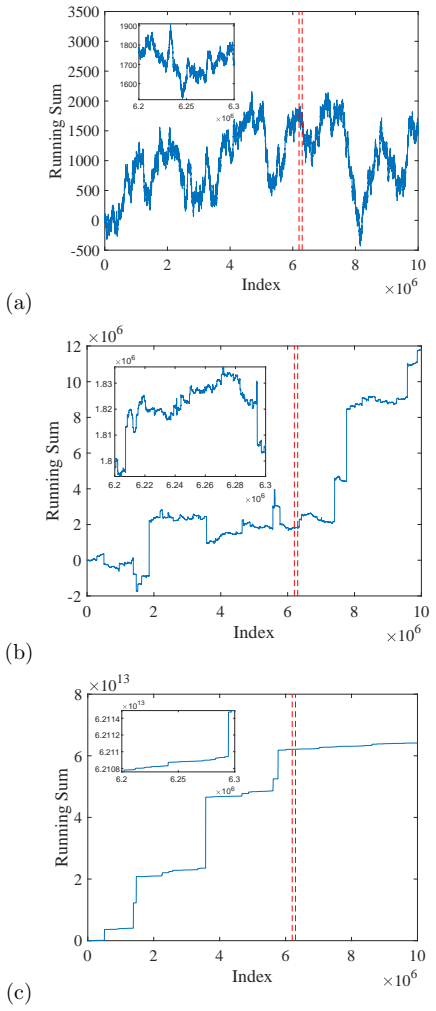
- For heavy-tailed variables with tail exponent $0<\mu<2$, the $\sqrt{N}$ scaling of the classical CLT is replaced by $a_n\propto n^{1/\mu}$; when $\mu<1$ the sum and the maximum of $N$ variables scale identically, implying that a single extreme event dominates the sum for any $N$.
- The Gumbel class is special: its shape is universal, but the location and width coefficients $a_n$ and $b_n$ are not fixed by the RG condition, so they must be computed from the tail of the original distribution, as illustrated by the Gaussian case.
- The asymmetry parameter $\beta$ in the Lévy stable family is bounded to $[-1,1]$ and equals $(A_+-A_-)/(A_++A_-)$, where $A_\pm$ are the amplitudes of the right and left power-law tails; $\beta=1$ gives a one-sided stable law.
- The same framework treats the minimum of $n$ variables by reflecting the variable, yielding the Weibull class for distributions with a finite upper endpoint, with the exponent $1/\alpha$ determined by the behavior of the density near the cutoff.
Reading between the lines
- Because the Gumbel scaling coefficients are left undetermined, finite-sample corrections to Gumbel convergence are likely non-universal, so data collapses for Gaussian maxima should require empirically fitted shifts rather than the $\sqrt{2\log n}$ form.
- The same self-consistency argument could be adapted to order statistics beyond the maximum (e.g., the second largest, or the sum of the largest $k$ values), potentially producing analogous classifications for 'intermediate' extremes.
- The derivation suggests that the distinction between the three extreme value classes is controlled entirely by the regular-variation index $\alpha$ of the scaling coefficient; if a future theorem replaced the constant-log-derivative assumption by a slowly varying function, the ODEs would need to be solved with variable coefficients, but the universality classes themselves would likely survive.
Signed reviews
Editorial analysis
A structured set of objections, weighed in public.
Referee Report
Summary. The manuscript presents an elementary renormalization-group-like derivation of two classical results: the Lévy stable family for sums of i.i.d. variables (the Generalized Central Limit Theorem) and the three extreme-value universality classes (Gumbel, Fréchet, Weibull). The argument is based on self-consistency under block addition: for sums, the characteristic function of a suitably scaled sum must satisfy a functional equation that, after treating the block size n as continuous and assuming certain scaling limits exist, reduces to a linear ODE; for maxima, the cumulative distribution function satisfies an analogous equation. Solving these ODEs yields the Lévy characteristic function and the three extreme-value limiting distributions. The author explicitly states that the derivation is not mathematically rigorous, does not specify precise convergence conditions, and is aimed at a physics audience. The paper also includes a brief discussion of special cases (Cauchy, Lévy, Gumbel) and a short appendix with code for the running-sum figures.
Significance. If the technical issues are corrected, the paper would provide a genuinely transparent and unified heuristic derivation of two well-known universality theorems, using a single self-consistency principle for both sums and maxima. Its strengths are the clarity of the presentation, the absence of fitted parameters, the explicit acknowledgment of the non-rigorous steps in Section III, and the reproducible code for the illustrative figures. The GCLT portion is largely sound in its main line, and the special cases are correctly identified. The extreme-value portion, however, contains a sign error in the Weibull formula that affects a central displayed result, so the current version cannot be accepted without revision. For a pedagogical physics contribution, this is a meaningful but fixable defect.
major comments (2)
- [V.D and V.B (Eqs. 59, 74)] The Weibull distribution is written with the wrong exponent and sign. Solving Eq. (68) for α<0 and β=0 gives d/dξ log(-log G) = -1/(αξ); integrating for ξ<0 yields -log G = C|ξ|^{-1/α}, hence G(ξ) = exp[-a|ξ|^{-1/α}], i.e., up to the scaling factor, G = exp[-a(x_* - x)^{-1/α}]. Equation (74), G = e^{a(x_* - x)^{1/α}}, is not a valid CDF for α<0: as x → x_*^- the exponent diverges, so the expression either diverges or tends to 0 depending on the sign of a. The uniform example confirms the error: for p(x)=1 on [0,1], α=-1 and the maximum CDF is e^{-n(1-x)}, whereas Eq. (74) would give e^{a/(1-x)}. The subsequent statement that p(x) ~ (x_* - x)^c leads to 1/α = c+1 is also sign-reversed: since the norming constant is a_n ∝ n^{-1/(c+1)}, one has α = -1/(c+1), so -1/α = c+1. Equations (59) and (74) and the surrounding discussion must be corrected.
- [IV (Eqs. 30 and 32)] The 'general formula' φ(ω) = e^{A|ω|^{C1}+Dω} is presented as the characteristic function for all C1 ≠ 1, but the derivation from the ODE does not enforce the condition that φ be a characteristic function (positive definiteness). In particular, for C1 > 2 the function e^{-a|ω|^{C1}} is not a characteristic function of a probability distribution. The later tail analysis in Section IV correctly restricts attention to 0 < μ < 2 and the endpoint μ = 2, but the text should explicitly state this restriction when presenting Eq. (30) as the general solution, and explain that the ODE argument alone does not exclude C1 > 2.
minor comments (3)
- [V.B and V.D] The discussion of the Weibull example is confusing because Section V.B treats the minimum of an exponential variable, while Eqs. (59) and (74) are supposed to give the maximum of a variable with an upper bound x_*. The statement 'p(x) approached a non-zero constant near x_*, hence we found α=1' is inconsistent with the maximum convention used in Eq. (64): for a density that is constant at the upper endpoint, a_n ∝ n^{-1} and α = -1, not 1.
- [III and V.D] The 'word of caution' in Section III correctly notes that logarithmic corrections to the power-law scaling also satisfy the RG self-consistency condition. The analogous caveat is missing in Section V.D, where Eqs. (69)-(70) make the same type of regular-variation assumption for the scaling coefficients a_n and b_n of the maximum; adding an explicit caveat there would make the heuristic status of the EVD derivation as clear as that of the GCLT part.
- [IV, Eq. (45)] In Eq. (45), the term Dω log ω is written for all ω, but log ω is undefined for ω < 0. The later discussion and Eq. (46) correctly use log|ω|, so the notation in Eq. (45) should be adjusted to make the separate treatment of ω > 0 and ω < 0 explicit.
Circularity Check
No circularity: the RG derivation is self-consistent and does not fit or import the target distributions.
full rationale
The paper explicitly rederives the known GCLT and extreme-value classifications from a self-consistency/RG fixed-point condition. It assumes only that a limiting distribution exists under linear scaling (Eqs. 6-7 and 64-65), not the functional form of the limit. The characteristic-function ODE (Eq. 17) and the EVD ODE (Eq. 68) are derived from the requirement that summing or maximizing in blocks reproduces the same result (Eqs. 12-16 and 66-67); the integration constants (A, C1, D, alpha, beta) label solution families rather than being adjusted to match known results. The tail analysis in Section IV is used to interpret beta and connect mu to tail exponents, which is consistency checking rather than circular prediction. The paper's own 'word of caution' in Section III admits that the RG condition does not pin down logarithmic corrections to the scaling coefficients, and Section V.D notes that basins of attraction are not derived; these are rigor/completeness limitations, not circularity. There are no load-bearing self-citations: the derivation is self-contained, and the cited external works (Feller, Fisher-Tippett, prior RG papers) are standard references rather than the source of the paper's central equations. Any mathematical issues in the final expressions, such as the sign or exponent of the Weibull formula in Eq. (74), would be correctness concerns outside the scope of a circularity pass, because they do not reduce the derivation to its inputs by construction.
Assumptions & free parameters
assumptions (5)
- domain assumption The sum of n i.i.d. variables converges, after linear rescaling, to a limiting distribution with a characteristic function phi(omega) that is independent of n.
- ad hoc to paper The block size n can be treated as a continuous variable so that a derivative with respect to n can be applied to the scaled characteristic function.
- ad hoc to paper The quantities a_n/(n da_n/dn) and (dd_n/dn)/(n da_n/dn) tend to constants C1 and C2 for large n.
- domain assumption For extreme values, the limits alpha = lim (n/a_n) da_n/dn and beta = lim (n/a_n) db_n/dn exist.
- domain assumption The input distributions are sufficiently smooth to have densities and characteristic functions, and have power-law tails with a single exponent mu.
Cite this review
Pith. "Pith review of An elementary renormalization-group approach to the Generalized Central Limit Theorem and Extreme Value Distributions." pith.science (2026). https://pith.science/paper/RUKFTJ4K
@misc{pith2026190803580,
  author       = {Pith},
  title        = {Pith review of: An elementary renormalization-group approach to the Generalized Central Limit Theorem and Extreme Value Distributions},
  year         = {2026},
  howpublished = {\url{https://pith.science/paper/RUKFTJ4K}},
  note         = {Machine review of arXiv:1908.03580}
}
read the original abstract
The Generalized Central Limit Theorem is a remarkable generalization of the Central Limit Theorem, showing that the sum of a large number of independent, identically-distributed (i.i.d) random variables with infinite variance may converge under appropriate scaling to a distribution belonging to a special family known as Levy stable distributions. Similarly, the maximum of i.i.d. variables may converge to a distribution belonging to one of three universality classes (Gumbel, Weibull and Frechet). Here, we rederive these known results following a mathematically non-rigorous yet highly transparent renormalization-group-like approach that captures both of these universal results following a nearly identical procedure.
Figures
Reference graph
Works this paper leans on
-
[1]
(2008) An introduction to probability theory and its applications
Feller, W. (2008) An introduction to probability theory and its applications . (John Wiley & Sons) Vol. 1
work page 2008
-
[2]
(2000) Stable distributions, pseudorandom generators, embeddings and data stream computation
Indyk, P. (2000) Stable distributions, pseudorandom generators, embeddings and data stream computation . (IEEE), pp. 189--197
work page 2000
-
[3]
(2006) Statistical mechanics: entropy, order parameters, and complexity
Sethna, J. (2006) Statistical mechanics: entropy, order parameters, and complexity . (Oxford University Press) Vol. 14
work page 2006
-
[4]
(2001) Renormalization group and probability theory
Jona-Lasinio, G. (2001) Renormalization group and probability theory. Physics Reports 352 , 439--458
work page 2001
-
[5]
Calvo, I, Cuch \' , J. C, Esteve, J. G, & Falceto, F. (2010) Generalized central limit theorem and renormalization group. Journal of Statistical Physics 141 , 409--421
work page 2010
-
[6]
Taleb, N. N. (2007) The black swan: The impact of the highly improbable . (Random house) Vol. 2
work page 2007
-
[7]
Fisher, R. A & Tippett, L. H. C. (1928) Limiting forms of the frequency distribution of the largest or smallest member of a sample . (Cambridge University Press), Vol. 24, pp. 180--190
work page 1928
-
[8]
(2010) Renormalization flow in extreme value statistics
Bertin, E & Gy \"o rgyi, G. (2010) Renormalization flow in extreme value statistics. Journal of Statistical Mechanics: Theory and Experiment 2010 , P08022
work page 2010
Show all 17 references
-
[9]
C, Esteve, J
Calvo, I, Cuch \' , J. C, Esteve, J. G, & Falceto, F. (2012) Extreme-value distributions and renormalization group. Physical Review E 86 , 041109
2012
-
[10]
K, Alava, M
Manzato, C, Shekhawat, A, Nukala, P. K, Alava, M. J, Sethna, J. P, & Zapperi, S. (2012) Fracture strength of disordered media: Universality, interactions, and tail asymptotics. Physical review letters 108 , 065504
2012
-
[11]
(2008) Finite-size scaling in extreme statistics
Gy \"o rgyi, G, Moloney, N, Ozog \'a ny, K, & R \'a cz, Z. (2008) Finite-size scaling in extreme statistics. Physical review letters 100 , 210601
2008
-
[12]
(2010) Renormalization-group theory for finite-size scaling in extreme statistics
Gy \"o rgyi, G, Moloney, N, Ozog \'a ny, K, R \'a cz, Z, & Droz, M. (2010) Renormalization-group theory for finite-size scaling in extreme statistics. Physical Review E 81 , 041135
2010
-
[13]
(2019) Single-big-jump principle in physical modeling
Vezzani, A, Barkai, E, & Burioni, R. (2019) Single-big-jump principle in physical modeling. Physical Review E 100 , 012108
2019
-
[14]
(2019) Transport in disordered systems: the single big jump approach
Wang, W, Vezzani, A, Burioni, R, & Barkai, E. (2019) Transport in disordered systems: the single big jump approach. arXiv preprint arXiv:1906.04249
2019 arXiv
-
[15]
(2014) On the concentration of large deviations for fat tailed distributions, with application to financial data
Filiasi, M, Livan, G, Marsili, M, Peressi, M, Vesselli, E, & Zarinelli, E. (2014) On the concentration of large deviations for fat tailed distributions, with application to financial data. Journal of Statistical Mechanics: Theory and Experiment 2014 , P09030
2014
-
[16]
(2015) Large deviations of the maximum of independent and identically distributed random variables
Vivo, P. (2015) Large deviations of the maximum of independent and identically distributed random variables. European Journal of Physics 36 , 055037
2015
-
[17]
(2012) Multidimensional levy walk and its scaling limits
Teuerle, M, \.Z ebrowski, P, & Magdziarz, M. (2012) Multidimensional levy walk and its scaling limits. Journal of Physics A: Mathematical and Theoretical 45 , 385002
2012
Reviewed August 14, 2026 · model on record in the stance chip above.
Discussion (0). Continue with ORCID to comment.