REVIEW 4 major objections 6 minor 38 references
Novel Approaches to Artificial Intelligence Development Based on the Nearest Neighbor Method
T0 review · 4 major / 6 minor · reviewed 2026-08-05 · deepseek-v4-flash
Pith's one-line read A nearest-neighbor tree cut MNIST search time 800x
desk verdict A readable, honest proof-of-concept for SOM-based hierarchical k-NN; the MNIST speedup is plausible but unverified without baselines or code, and the hallucination claims far outrun the evidence. read the letter →
The pith
A machine-rendered reading of the paper's core claim, the machinery that carries it, and where it could break.
The reading
What carries the argument
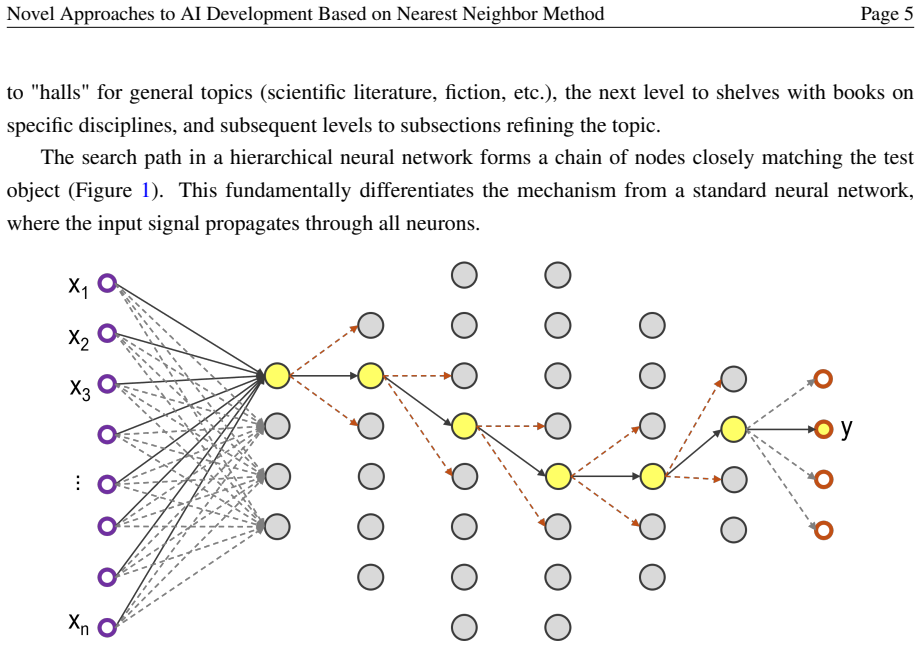
The central object is the hierarchical SOM search tree. Each level is obtained by running Kohonen self-organizing map clustering on the objects in the current node, producing a fixed set of child nodes whose weight vectors summarize the local data. A query vector descends greedily—at each level it picks the child whose weight vector is nearest—until it reaches a leaf, where exhaustive k-NN over the few stored objects gives the final answer. This single structure does all the work: it is the learned 'model', the index that provides the speedup, and the storage that makes additions and auditing easy.
What would settle it
Measure greedy-tree recall@1 against exact brute-force k-NN on a high-dimensional embedding set, such as sentence or image embeddings, and compare with a graph-based approximate search like HNSW. If the tree's recall drops well below the graph's at equal speedup, the accuracy loss is a routing failure rather than noise; the paper reports error rates on MNIST only, so this experiment would show whether the 800x claim transfers.
Extended reading notes
Core claim
The paper proposes a retrieval-based alternative to trained neural networks: store training examples in a hierarchical tree built by recursive Kohonen self-organizing map clustering, and answer queries by greedy descent to a leaf followed by an exhaustive k-nearest-neighbor scan. Its central claim is that this keeps k-NN's no-training, explainable, hallucination-free, and incrementally updatable properties while removing the linear scan bottleneck. On MNIST, brute force took over 80 minutes at 3.69% error; the tree took about 6 seconds at 5.64% error, an 800x speedup. A Russian-English subtitle demo indexes sentence vectors; the authors state it does not compete with seq2seq translation. The
Load-bearing premise
The whole speedup rests on the routing rule of Section 4: at each level, pick the single nearest node and descend only through its children; if that greedy step chooses a wrong branch, the true neighbor is never seen, and Section 7 admits boundary ambiguity while MNIST error rises from 3.69% to 5.64%.
Editorial extensions
If this is right
- On MNIST-like data, the method reduces k-NN test-time cost from linear in dataset size to roughly logarithmic depth, with an accuracy loss around two percentage points.
- Adding new examples or whole new classes requires inserting into the tree and possibly forming a new leaf, not retraining weights; this directly addresses catastrophic forgetting and expensive fine-tuning.
- Queries whose nearest neighbor falls below a similarity threshold can be explicitly flagged as out-of-distribution, giving a concrete mechanism to refuse answers rather than hallucinate.
- Every prediction is traceable to concrete stored examples, so domain experts can audit or challenge results by inspecting the retrieved peers.
- Because tree training scales linearly with dataset size and can start from a single object, the method could be deployed in settings with limited data or incremental data streams.
Reading between the lines
- The paper measures speed and accuracy but not retrieval recall: it never reports how often greedy descent actually finds the true nearest neighbor. The 800x figure should be read as conditional on the tree routing correctly; adding recall@1 measurement would settle this.
- The 'no hallucination' claim is best read as 'failures are detectable': an out-of-domain query still gets a nearest neighbor, so the safeguard is a distance threshold, not the absence of wrong answers.
- A natural extension the authors leave implicit is soft routing—sending a query down the top two or three child branches and merging leaf results—which directly targets the boundary-ambiguity error they report.
- Applied to text embeddings such as sentence vectors, the method becomes a lightweight, continuously updatable memory for LLM-style models; the paper gestures at this but provides no experiment beyond the toy subtitle demo.
Editorial analysis
A structured set of objections, weighed in public.
Referee Report
Summary. The paper proposes replacing or supplementing neural-network models with k-nearest-neighbor (k-NN) search over a hierarchical tree built with Kohonen self-organizing maps (SOMs). The authors argue that k-NN avoids hallucination, supports incremental updates, and is interpretable. To address k-NN's computational cost, Section 4 describes a greedy routing rule through a SOM-based decision tree. Section 6 reports two experiments: MNIST digit classification and Russian-English subtitle translation. On MNIST, brute-force k-NN gives 3.69% error and takes more than 80 minutes, while the hierarchical tree is reported to take about 6 seconds at 5.64% error, an 'acceleration of over 800 times.' The translation experiment is qualitative. Sections 7-11 discuss limitations, advantages, and applications.
Significance. If the experimental claims were fully supported, the paper would provide a useful demonstration of an interpretable, incrementally updateable retrieval model with a large speedup on MNIST. The MNIST experiment is concrete and reproducible in outline, and the authors are honest about the main limitation in Section 7. However, the paper's central quantitative evidence is not yet sufficient to establish the claimed speed/accuracy trade-off: no timing methodology, no comparison to established ANN indices, no recall metric, and no variance information are reported. The hallucination-elimination and text-translation claims are not quantitatively evaluated. The contribution is potentially useful but currently at the level of a feasibility report rather than a validated method.
major comments (4)
- [Section 6.1] The 800x speedup claim is the load-bearing result, but the manuscript reports no timing methodology. It states 'more than 80 minutes on standard single-thread execution' for brute force and 'approximately 0.1 minutes (≈6 seconds)' for the tree, without specifying hardware, software, implementation language, number of runs, or whether both timings come from the same codebase. A single unlabeled timing pair is not sufficient to support 'over 800 times.' Please provide reproducible timing details, report multiple runs, and compare against standard ANN baselines (e.g., HNSW, kd-tree, FLANN) at matched accuracy. Also report leaf-recall or recall@k for the proposed tree.
- [Section 6.1] The error rises from 369 to 564 misclassifications, a 53% relative increase in error rate. The paper calls this 'slight,' but no statistical analysis supports that characterization. Because SOM initialization is random (Section 5.1), the reader needs variance across tree constructions. Please report mean plus/minus standard deviation over repeated runs and a recall metric showing how often greedy routing reaches a leaf containing the true nearest neighbor.
- [Section 4] The entire acceleration rests on the greedy rule 'At each hierarchy level, the nearest node is chosen, and the search continues only through its child nodes.' No correctness or approximation bound is given, and Section 7 concedes 'ambiguity in clustering objects located at cluster boundaries.' Without a bound or empirical recall/error analysis, the speed/accuracy trade-off cannot be extrapolated to other datasets, particularly the high-dimensional sentence vectors in Section 6.2. Please quantify routing failures (e.g., oracle versus greedy leaf selection) on MNIST and on the text data.
- [Sections 6.2, 8, Abstract] The machine translation experiment is qualitative only: no evaluation metric, no size of the training set, no SOM/tree hyperparameters, and no comparison are provided. The claim that a similarity threshold 'avoids hallucinations' is not tested; no out-of-distribution queries or hallucination benchmark are presented. The abstract's broad claim that k-NN 'significantly reduces or completely eliminates hallucination effects' should be narrowed or supported by a specific experiment.
minor comments (6)
- [Section 5.2, Eq. (3)] The text says a random vector S_i is selected, but Eq. (3) is written as if the winner is computed by looping over all training objects. Please clarify that the argmin is over the SOM neurons for the selected vector.
- [Section 5.2] SOM training details are missing: number of epochs/iterations, learning-rate schedule alpha(t), initial sigma, and the exact neighborhood function. These are free parameters that affect the quality of the tree and should be reported for reproducibility.
- [Section 6.1] Branching factor 10 and depth 5 gives up to 100,000 leaves, which is larger than the 60,000 training samples. Please explain how empty leaves are handled and whether depth counts the root level.
- [Section 6.2] The sentence vectorization uses frequency-ranked token indices with -1 padding; this is not a semantic embedding, and the paper later suggests using embeddings/attention. The current representation limits the strength of any conclusion about text processing.
- [Section 7] The sentence 'deep hierarchical structures with numerous nodes at each level significantly increase nearest-neighbor search times' seems to contradict the reported speedup. Clarify that this concern refers to wider/deeper trees than the tested configuration.
- [General] Minor typographical issues: author 'A.V . Shubin' has an extra space; 'CO 2-equivalent' lacks a space; and 'O(n·d)' would be clearer as 'O(n*d)' or 'O(nd)'.
Circularity Check
No circular derivation: benchmark evidence is external; self-citation is provenance only.
full rationale
The paper's derivation chain is not circular. The core load-bearing evidence is the MNIST experiment in Section 6.1: brute-force error 3.69% and wall-clock time >80 minutes versus hierarchical error 5.64% and time ~6 seconds. These are measured outcomes on a public benchmark, not fitted parameters renamed as predictions. The speedup is a direct consequence of the stated tree structure (branching factor 10, depth 5), and accuracy is evaluated against the external MNIST test set. The only self-citation, [33], is used to attribute the earlier proposal of the hierarchical method and its seismic application, but the present paper re-describes the algorithm fully and re-tests it on new data; no load-bearing conclusion rests on unverified content of [33]. Section 7's admission of ambiguity at cluster boundaries is an honest limitation, not a circular step. I found no constructed equivalence between inputs and outputs, and no fitted value is presented as a prediction.
Assumptions & free parameters
free parameters (6)
- Branching factor per level =
10
- Tree depth =
5
- SOM map size and training hyperparameters (learning rate, neighborhood width, iterations) =
not reported
- k in k-nearest neighbors =
not reported
- Similarity threshold for rejecting out-of-set queries =
not quantified
- Sentence vector representation (length 200, frequency-ranked token indices, -1 padding) =
L=200
assumptions (4)
- domain assumption Greedy descent through nearest nodes reaches a leaf containing the true or near nearest neighbor.
- domain assumption Feature-space closeness implies label or target closeness.
- standard math SOM training yields a topology-preserving map so clusters are coherent.
- domain assumption Adding new objects to the tree requires no global restructuring.
Cite this review
Pith. "Pith review of Novel Approaches to Artificial Intelligence Development Based on the Nearest Neighbor Method." pith.science (2026). https://pith.science/paper/RULYGU5N
@misc{pith2026250818953,
  author       = {Pith},
  title        = {Pith review of: Novel Approaches to Artificial Intelligence Development Based on the Nearest Neighbor Method},
  year         = {2026},
  howpublished = {\url{https://pith.science/paper/RULYGU5N}},
  note         = {Machine review of arXiv:2508.18953}
}
read the original abstract
Modern neural network technologies, including large language models, have achieved remarkable success in various applied artificial intelligence applications, however, they face a range of fundamental limitations. Among them are hallucination effects, high computational complexity of training and inference, costly fine-tuning, and catastrophic forgetting issues. These limitations significantly hinder the use of neural networks in critical areas such as medicine, industrial process management, and scientific research. This article proposes an alternative approach based on the nearest neighbors method with hierarchical clustering structures. Employing the k-nearest neighbors algorithm significantly reduces or completely eliminates hallucination effects while simplifying model expansion and fine-tuning without the need for retraining the entire network. To overcome the high computational load of the k-nearest neighbors method, the paper proposes using tree-like data structures based on Kohonen self-organizing maps, thereby greatly accelerating nearest neighbor searches. Tests conducted on handwritten digit recognition and simple subtitle translation tasks confirmed the effectiveness of the proposed approach. With only a slight reduction in accuracy, the nearest neighbor search time was reduced hundreds of times compared to exhaustive search methods. The proposed method features transparency and interpretability, closely aligns with human cognitive mechanisms, and demonstrates potential for extensive use in tasks requiring high reliability and explainable results.
Figures


Figures from the paper (3 more)


Reference graph
Works this paper leans on
-
[33]
I.I. Priezzhev, D.A. Danko, and A.N. Onishchenko, “Hierarchical neural networks in prediction of oil and gas reservoir properties using well and seismic data,” Russian Geology and Geophysics , 2024, in press
work page 2024
-
[1]
On the surprising behavior of distance metrics in high dimensional space,
C.C. Aggarwal, A. Hinneburg, and D.A. Keim, “On the surprising behavior of distance metrics in high dimensional space,” Database Theory—ICDT 2001, Springer, pp. 420–434, 2001
work page 2001
-
[2]
Aggarwal, Data Mining: The Textbook, Springer, 2015
C.C. Aggarwal, Data Mining: The Textbook, Springer, 2015
work page 2015
-
[3]
Multidimensional binary search trees used for associative searching,
J.L. Bentley, “Multidimensional binary search trees used for associative searching,” Communica- tions of the ACM, vol. 18, no. 9, pp. 509–517, 1975
work page 1975
-
[4]
When is ’nearest neighbor’ meaningful?
K. Beyer, J. Goldstein, R. Ramakrishnan, and U. Shaft, “When is ’nearest neighbor’ meaningful?” in Database Theory—ICDT’99, Springer, pp. 217–235, 1999
work page 1999
-
[5]
Bishop, Pattern Recognition and Machine Learning, Springer, 2006
C.M. Bishop, Pattern Recognition and Machine Learning, Springer, 2006
2006
-
[6]
Language models are few-shot learners,
T. Brown, B. Mann, N. Ryder, M. Subbiah, J.D. Kaplan, P. Dhariwal, A. Neelakantan, P. Shyam, G. Saxena, S. Santurkar, et al. , “Language models are few-shot learners,” Advances in Neural Information Processing Systems, vol. 33, pp. 1877–1901, 2020
work page 1901
-
[7]
Gender shades: Intersectional accuracy disparities in commercial gender classification,
J. Buolamwini and T. Gebru, “Gender shades: Intersectional accuracy disparities in commercial gender classification,” in Conference on Fairness, Accountability and Transparency , PMLR, pp. 77–91, 2018
work page 2018
Show all 38 references
-
[8]
Anomaly detection: A survey,
V . Chandola, A. Banerjee, and V . Kumar, “Anomaly detection: A survey,”ACM Computing Surveys, vol. 41, no. 3, pp. 1–58, 2009
2009
-
[9]
Nearest neighbor pattern classification,
T. Cover and P. Hart, “Nearest neighbor pattern classification,” IEEE Transactions on Information Theory, vol. 13, no. 1, pp. 21–27, 1967
1967
-
[10]
BERT: Pre-training of Deep Bidirectional Transformers for Language Understanding,
J. Devlin, M.-W. Chang, K. Lee, and K. Toutanova, “BERT: Pre-training of Deep Bidirectional Transformers for Language Understanding,” arXiv preprint arXiv:1810.04805, 2018
2018 arXiv
-
[11]
Dermatologist- level classification of skin cancer with deep neural networks,
A. Esteva, B. Kuprel, R.A. Novoa, J. Ko, S.M. Swetter, H.M. Blau, and S. Thrun, “Dermatologist- level classification of skin cancer with deep neural networks,” Nature, vol. 542, no. 7639, pp. 115–118, 2017
2017
-
[12]
Discriminatory analysis. Nonparametric discrimination: consistency properties,
E. Fix and J.L. Hodges Jr., “Discriminatory analysis. Nonparametric discrimination: consistency properties,” Tech. Rep. 4, Project 21-49-004, USAF School of Aviation Medicine, Randolph Field, TX, 1951
1951
-
[13]
Goodfellow, Y
I. Goodfellow, Y . Bengio, and A. Courville,Deep Learning, MIT Press, 2016
2016
-
[14]
Explainable artificial intelligence (XAI),
D. Gunning, “Explainable artificial intelligence (XAI),” Defense Advanced Research Projects Agency (DARPA), Tech. Rep., 2017
2017
-
[15]
On calibration of modern neural networks,
C. Guo, G. Pleiss, Y . Sun, and K.Q. Weinberger, “On calibration of modern neural networks,” in International Conference on Machine Learning , PMLR, pp. 1321–1330, 2017
2017
-
[16]
J. Han, J. Pei, and M. Kamber, Data Mining: Concepts and Techniques, 3rd ed., Morgan Kaufmann, 2011. Novel Approaches to AI Development Based on Nearest Neighbor Method Page 16
2011
-
[17]
Hastie, R
T. Hastie, R. Tibshirani, and J. Friedman, The Elements of Statistical Learning: Data Mining, Inference, and Prediction, 2nd ed., Springer Science & Business Media, 2009
2009
-
[18]
Haykin, Neural Networks and Learning Machines , 3rd ed., vol
S.S. Haykin, Neural Networks and Learning Machines , 3rd ed., vol. 3, Pearson, 2009
2009
-
[19]
LoRA: Low- Rank Adaptation of Large Language Models,
E.J. Hu, Y . Shen, P. Wallis, Z. Allen-Zhu, Y . Li, S. Wang, L. Wang, and W. Chen, “LoRA: Low- Rank Adaptation of Large Language Models,” arXiv preprint arXiv:2106.09685, 2022
2022 arXiv
-
[20]
Jain and R.C
A.K. Jain and R.C. Dubes, Algorithms for Clustering Data , Prentice-Hall, 1988
1988
-
[21]
Survey of hallucination in natural language generation,
Z. Ji, N. Lee, R. Frieske, T. Yu, D. Su, Y . Xu, E. Ishii, Y .J. Bang, A. Madotto, and P. Fung, “Survey of hallucination in natural language generation,” ACM Computing Surveys , vol. 55, no. 12, pp. 1–38, 2023
2023
-
[22]
Machine learning: Trends, perspectives, and prospects,
M.I. Jordan and T.M. Mitchell, “Machine learning: Trends, perspectives, and prospects,” Science, vol. 349, no. 6245, pp. 255–260, 2015
2015
-
[23]
Scaling laws for neural language models,
J. Kaplan, S. McCandlish, T. Henighan, T.B. Brown, B. Chess, R. Child, S. Gray, A. Radford, J. Wu, and D. Amodei, “Scaling laws for neural language models,”arXiv preprint arXiv:2001.08361, 2020
2001 arXiv
-
[24]
Kaufman and P.J
L. Kaufman and P.J. Rousseeuw, Finding Groups in Data: An Introduction to Cluster Analysis , John Wiley & Sons, 1990
1990
-
[25]
Overcoming catastrophic forgetting in neural networks,
J. Kirkpatrick, R. Pascanu, N. Rabinowitz, J. Veness, G. Desjardins, A.A. Rusu, K. Milan, J. Quan, T. Ramalho, A. Grabska-Barwinska, et al. , “Overcoming catastrophic forgetting in neural networks,” Proceedings of the National Academy of Sciences , vol. 114, no. 13, pp. 3521–3...
2017
-
[26]
Kohonen, Self-Organizing Maps, 3rd ed., vol
T. Kohonen, Self-Organizing Maps, 3rd ed., vol. 30, Springer, 1995
1995
-
[27]
Koller and N
D. Koller and N. Friedman, Probabilistic Graphical Models: Principles and Techniques , MIT Press, 2009
2009
-
[28]
Complete the missing half: Augment- ing aggregation filtering with diversification for graph convolutional networks,
S. Luan, M. Zhao, X.-W. Chang, and D. Precup, “Complete the missing half: Augment- ing aggregation filtering with diversification for graph convolutional networks,” arXiv preprint arXiv:2008.08844, 2020
2008 arXiv
-
[29]
Efficient and robust approximate nearest neighbor search using hierarchical navigable small world graphs,
Y .A. Malkov and D.A. Yashunin, “Efficient and robust approximate nearest neighbor search using hierarchical navigable small world graphs,” IEEE Transactions on Pattern Analysis and Machine Intelligence, vol. 42, no. 4, pp. 824–836, 2020
2020
-
[30]
Deep k-nearest neighbors: Towards confident, interpretable and robust deep learning,
N. Papernot and P. McDaniel, “Deep k-nearest neighbors: Towards confident, interpretable and robust deep learning,” arXiv preprint arXiv:1803.04765, 2018
2018 arXiv
-
[31]
Continual lifelong learning with neural networks: A review,
G.I. Parisi, R. Kemker, J.L. Part, C. Kanan, and S. Wermter, “Continual lifelong learning with neural networks: A review,” Neural Networks, vol. 113, pp. 54–71, 2019. Novel Approaches to AI Development Based on Nearest Neighbor Method Page 17
2019
-
[32]
Seismic waveform classi- fication based on Kohonen 3D neural networks with RGB visualization,
I.I. Priezzhev, A.I. Fedorov, A.A. Shevchenko, and A.N. Onishchenko, “Seismic waveform classi- fication based on Kohonen 3D neural networks with RGB visualization,” First Break, vol. 37, no. 2, pp. 37–43, 2019
2019
-
[34]
Energy and policy considerations for deep learning in NLP,
E. Strubell, A. Ganesh, and A. McCallum, “Energy and policy considerations for deep learning in NLP,” Proceedings of the 57th Annual Meeting of the Association for Computational Linguistics , pp. 3645–3650, 2019
2019
-
[35]
Intriguing properties of neural networks,
C. Szegedy, W. Zaremba, I. Sutskever, J. Bruna, D. Erhan, I. Goodfellow, and R. Fergus, “Intriguing properties of neural networks,” arXiv preprint arXiv:1312.6199, 2013
2013 arXiv
-
[36]
Attention is all you need,
A. Vaswani, N. Shazeer, N. Parmar, J. Uszkoreit, L. Jones, A.N. Gomez, Ł. Kaiser, and I. Polo- sukhin, “Attention is all you need,” Advances in Neural Information Processing Systems , vol. 30, pp. 5998–6008, 2017
2017
-
[37]
Survey of clustering algorithms,
R. Xu and D. Wunsch, “Survey of clustering algorithms,” IEEE Transactions on Neural Networks , vol. 16, no. 3, pp. 645–678, 2005
2005
-
[38]
Understanding deep learning requires rethinking generalization,
C. Zhang, S. Bengio, M. Hardt, B. Recht, and O. Vinyals, “Understanding deep learning requires rethinking generalization,” arXiv preprint arXiv:1611.03530, 2016
2016 arXiv
Reviewed August 5, 2026 · model on record in the stance chip above.
Discussion (0). Sign in to comment.