Solitary dwarf galaxy groups as tracers of primordial dark matter halos in the local Universe
Pith reviewed 2026-06-26 20:26 UTC · model grok-4.3
The pith
Solitary dwarf galaxy groups trace primordial dark matter halos of around 10^12 solar masses.
A machine-rendered reading of the paper's core claim, the machinery that carries it, and where it could break.
Core claim
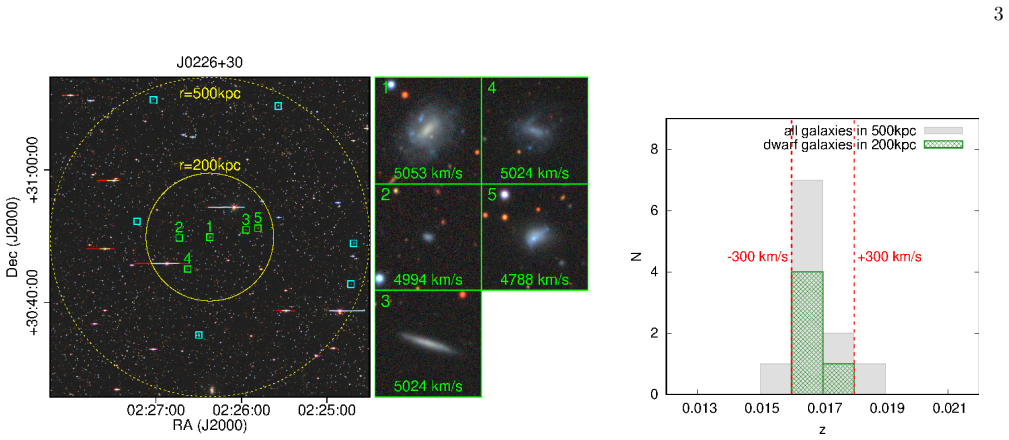
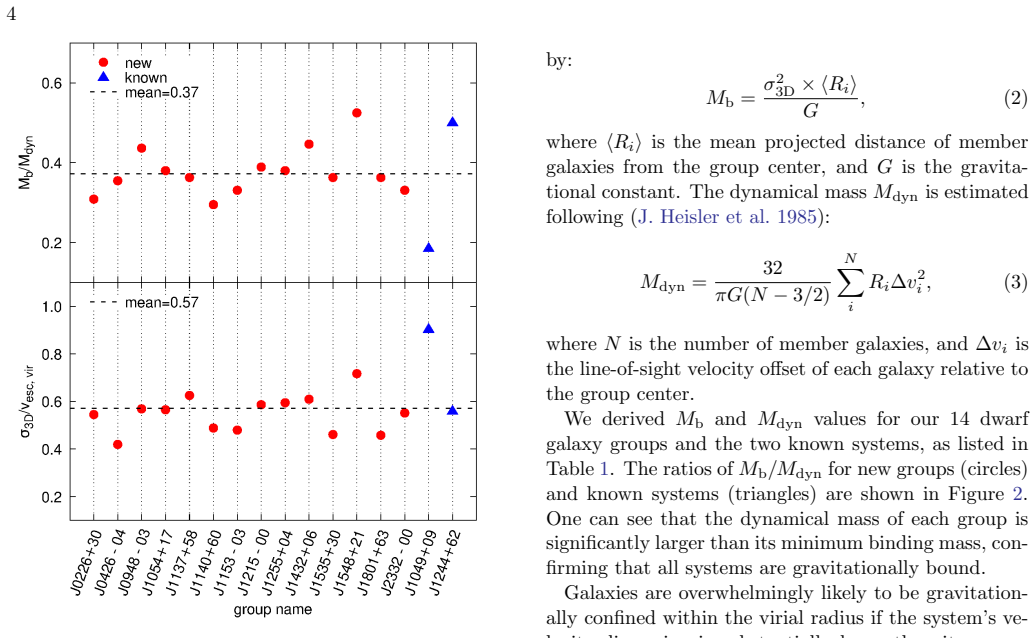
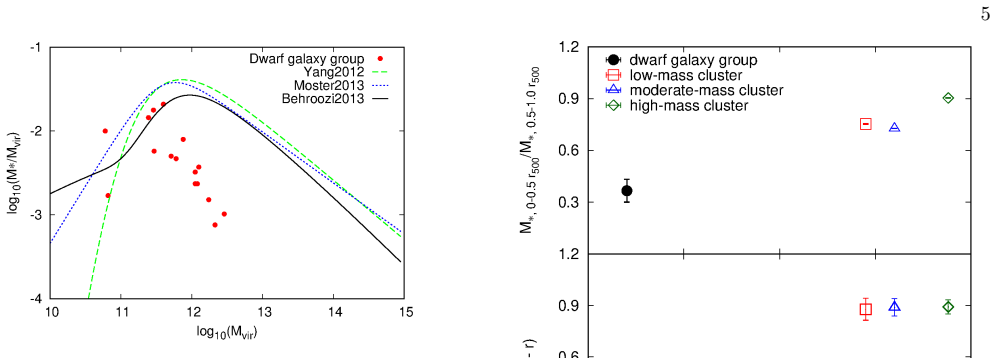
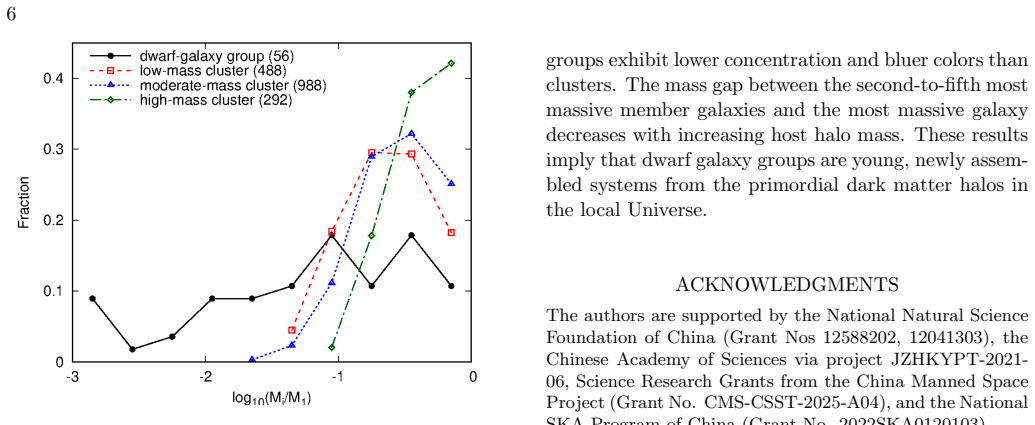
We identified 14 dwarf galaxy groups with at least 5 dwarf galaxies, all located within a projected radius of 200 kpc and with a line-of-sight velocity of ±300 km s^{-1}. These 14 dwarf galaxy groups are solitary, with no neighboring massive galaxies with M*>10^10 M⊙ within 500 kpc and within ±1200 km s^{-1}. The stellar mass fractions of dwarf galaxy groups with M_dyn>10^12 M⊙ are much lower than predicted by the canonical stellar mass and halo mass relation. These dwarf galaxies are gravitationally bound within halos with a dynamical mass of around M_dyn ∼ 10^12 M⊙ and a virial radius of less than 400 kpc. These dwarf galaxy groups therefore indicate primordial halos that host only a few n
What carries the argument
Solitary dwarf galaxy groups identified by isolation criteria and velocity clustering, serving as tracers of unmerged primordial dark matter halos with dynamical mass ~10^12 solar masses.
If this is right
- The groups have dynamical masses around 10^12 solar masses estimated from velocity dispersion within the 200 kpc radius.
- These halos have virial radii less than 400 kpc.
- Stellar mass fractions fall below predictions from the canonical stellar mass to halo mass relation.
- The halos have avoided hierarchical merging up to the present epoch.
Where Pith is reading between the lines
- Extending the search radius or using deeper surveys could reveal whether more such isolated groups exist.
- Comparing the observed number and properties of these groups to cosmological simulations would test the predicted frequency of unmerged low-mass halos today.
- The low stellar fractions may point to environment-dependent suppression of star formation in isolated low-mass halos.
Load-bearing premise
The 14 groups are gravitationally bound within halos of dynamical mass around 10^12 solar masses based on velocity dispersion within 200 kpc and that their isolation from massive galaxies confirms they are primordial rather than chance alignments.
What would settle it
Velocity measurements showing the groups are not bound at the claimed mass scale, or discovery of a massive galaxy within 500 kpc and 1200 km/s of any group.
Figures
read the original abstract
In $\Lambda$CDM cosmology, galaxies and clusters form within dark matter halos and merge in the hierarchical assembly paradigm to form massive systems. Using the released optical survey data, we searched for groups composed solely of dwarf galaxies, each with a stellar mass $M_*<10^{9.5}~M_{\odot}$. We identified 14 dwarf galaxy groups with at least 5 dwarf galaxies, all located within a projected radius of 200 kpc and with a line-of-sight velocity of $\pm$300 km~s$^{-1}$. We checked photometric and imaging data and found that these 14 dwarf galaxy groups are solitary, with no neighboring massive galaxies with $M_*>10^{10}~M_{\odot}$ within 500 kpc and within $\pm$1200 km s$^{-1}$. The stellar mass fractions of dwarf galaxy groups with $M_{\rm dyn}>10^{12}~M_{\odot}$ are much lower than predicted by the canonical stellar mass and halo mass relation. These dwarf galaxies are gravitationally bound within halos with a dynamical mass of around $M_{\rm dyn} \sim 10^{12}~M_{\odot}$ and a virial radius of less than 400 kpc. These dwarf galaxy groups, therefore, indicate primordial halos that host only a few newly formed dwarf galaxies.
Editorial analysis
A structured set of objections, weighed in public.
Referee Report
Summary. The paper reports identifying 14 groups of at least five dwarf galaxies each (M_* < 10^{9.5} M_⊙) from optical survey data, all lying within a projected radius of 200 kpc and line-of-sight velocity window of ±300 km s^{-1}. These groups are stated to be solitary after photometric checks, with no M_* > 10^{10} M_⊙ neighbors within 500 kpc and ±1200 km s^{-1}. Dynamical masses are given as M_dyn ~ 10^{12} M_⊙ (virial radius <400 kpc), yielding stellar mass fractions much lower than canonical M_*-M_halo relations; the groups are interpreted as primordial dark matter halos hosting only a few newly formed dwarfs.
Significance. If the mass estimates and isolation criteria can be substantiated with explicit calculations, the result would be significant for ΛCDM galaxy formation studies. It would supply rare observational candidates for isolated ~10^{12} M_⊙ halos that have experienced minimal merging or star formation, directly constraining the low-mass end of the stellar-to-halo mass relation and the prevalence of 'failed' or under-luminous halos in the local volume.
major comments (3)
- [Abstract] Abstract: The central claim that the 14 groups are gravitationally bound in M_dyn ~10^{12} M_⊙ halos (virial radius <400 kpc) rests on velocity dispersion within the 200 kpc projected radius, yet no mass estimator formula, virial theorem application, or error propagation is supplied; without this derivation the bound-versus-projection distinction cannot be assessed.
- [Abstract] Abstract: The isolation verification (no M_*>10^{10} M_⊙ neighbors within 500 kpc and ±1200 km s^{-1}) is load-bearing for the 'solitary primordial' interpretation, but the manuscript gives no details on survey completeness, photometric redshift or imaging checks, or control samples used to rule out chance alignments or selection biases.
- [Abstract] Abstract: The statement that stellar mass fractions for M_dyn >10^{12} M_⊙ groups are 'much lower than predicted by the canonical stellar mass and halo mass relation' is presented without reference to a specific relation, model, or quantitative comparison, rendering the low-fraction argument unevaluable.
minor comments (1)
- [Abstract] The abstract states search criteria and conclusions but supplies no tables of group properties, velocity dispersions, or stellar masses; adding these would improve traceability of the 14 systems.
Simulated Author's Rebuttal
We thank the referee for their constructive and detailed comments, which highlight important areas where the presentation of our results can be improved for clarity and rigor. We address each major comment below and commit to revisions that will strengthen the manuscript without altering its core findings.
read point-by-point responses
-
Referee: [Abstract] Abstract: The central claim that the 14 groups are gravitationally bound in M_dyn ~10^{12} M_⊙ halos (virial radius <400 kpc) rests on velocity dispersion within the 200 kpc projected radius, yet no mass estimator formula, virial theorem application, or error propagation is supplied; without this derivation the bound-versus-projection distinction cannot be assessed.
Authors: We agree that the abstract lacks the explicit derivation. The dynamical masses were computed via the standard projected virial estimator M_dyn = (5/3) (R σ_v² / G) applied to the observed line-of-sight velocity dispersion within the 200 kpc radius, with the virial radius scaled as ~2R; uncertainties were estimated via bootstrap resampling of the member velocities. To make this fully transparent and allow assessment of bound versus projection effects, we will insert the formula, its application to the 14 groups, and the error analysis into a new methods paragraph and revise the abstract accordingly. revision: yes
-
Referee: [Abstract] Abstract: The isolation verification (no M_*>10^{10} M_⊙ neighbors within 500 kpc and ±1200 km s^{-1}) is load-bearing for the 'solitary primordial' interpretation, but the manuscript gives no details on survey completeness, photometric redshift or imaging checks, or control samples used to rule out chance alignments or selection biases.
Authors: The referee correctly notes the absence of these details. Our isolation checks relied on cross-matching with the parent optical catalogs, visual inspection of imaging, and velocity cuts, but without quantified completeness or control fields. We will add a dedicated subsection describing the survey depth, photometric redshift reliability where used, the exact neighbor search procedure, and any Monte Carlo tests for chance alignments or selection biases. revision: yes
-
Referee: [Abstract] Abstract: The statement that stellar mass fractions for M_dyn >10^{12} M_⊙ groups are 'much lower than predicted by the canonical stellar mass and halo mass relation' is presented without reference to a specific relation, model, or quantitative comparison, rendering the low-fraction argument unevaluable.
Authors: We accept that a specific reference and numbers are required. The comparison is to the Behroozi et al. (2013) stellar-to-halo mass relation (and secondarily Moster et al. 2013), where the expected stellar mass for a 10^{12} M_⊙ halo is ~10^{10.5} M_⊙; our groups lie factors of 10–30 below this. We will insert the citations and a brief quantitative statement of the offset in both the abstract and the discussion section. revision: yes
Circularity Check
No significant circularity; claims rest on direct observational selection and standard mass estimation without self-referential reduction.
full rationale
The paper identifies groups via explicit observational cuts (projected radius <200 kpc, velocity dispersion ±300 km/s, isolation from M*>10^10 galaxies within 500 kpc and ±1200 km/s) and applies a conventional dynamical mass estimator to the velocity data. No equations, fitted parameters, or predictions are shown that reduce by construction to prior self-citations or to the input selection itself. The interpretation as primordial halos follows from the observed properties rather than any load-bearing self-citation chain or ansatz smuggling. The derivation chain is therefore self-contained against external benchmarks.
Axiom & Free-Parameter Ledger
free parameters (4)
- dwarf stellar mass threshold =
10^9.5 Msun
- group projected radius =
200 kpc
- line-of-sight velocity window =
300 km/s
- isolation radius =
500 kpc
axioms (2)
- domain assumption Lambda-CDM cosmology with hierarchical merging of halos
- standard math Dynamical mass can be estimated from line-of-sight velocity dispersion and projected radius
Reference graph
Works this paper leans on
-
[1]
F., Argudo-Fern´ andez, M., et al
Almeida, A., Anderson, S. F., Argudo-Fern´ andez, M., et al. 2023, ApJS, 267, 44, doi: 10.3847/1538-4365/acda98
-
[2]
Bahcall, N. A. 1979, ApJ, 232, 689, doi: 10.1086/157327
-
[3]
The Average Star Formation Histories of Galaxies in Dark Matter Halos from z=0-8
Behroozi, P. S., Wechsler, R. H., & Conroy, C. 2013, ApJ, 770, 57, doi: 10.1088/0004-637X/770/1/57 9 Figure A1.DESI images of 14 identified dwarf galaxy groups. Symbols in the images have the same meaning as those in the left panel of Figure 1 — to be continued. 10 Figure A1.— to be continued. 11 Figure A1.— ended
work page internal anchor Pith review doi:10.1088/0004-637x/770/1/57 2013
-
[4]
Besla, G., Patton, D. R., Stierwalt, S., et al. 2018, MNRAS, 480, 3376, doi: 10.1093/mnras/sty2041
-
[5]
2006, PASP, 118, 517, doi: 10.1086/500691
Boselli, A., & Gavazzi, G. 2006, PASP, 118, 517, doi: 10.1086/500691
-
[6]
Cautun, M., Deason, A. J., Frenk, C. S., & McAlpine, S. 2019, MNRAS, 483, 2185, doi: 10.1093/mnras/sty3084
-
[7]
Data Release 1 of the Dark Energy Spectroscopic Instrument
Deason, A., Wetzel, A., & Garrison-Kimmel, S. 2014, ApJ, 794, 115, doi: 10.1088/0004-637X/794/2/115 DESI Collaboration, Abdul-Karim, M., Adame, A. G., et al. 2025, arXiv e-prints, arXiv:2503.14745, doi: 10.48550/arXiv.2503.14745 DESI Collaboration, Abareshi, B., Aguilar, J., et al. 2022, AJ, 164, 207, doi: 10.3847/1538-3881/ac882b
work page internal anchor Pith review Pith/arXiv arXiv doi:10.1088/0004-637x/794/2/115 2014
-
[8]
and Lang, Dustin and Blum, Robert and Burleigh, Kaylan and Fan, Xiaohui and Findlay, Joseph R
Dey, A., Schlegel, D. J., Lang, D., et al. 2019, AJ, 157, 168, doi: 10.3847/1538-3881/ab089d
-
[9]
2008, Nature, 454, 735, doi: 10.1038/nature07153
Diemand, J., Kuhlen, M., Madau, P., et al. 2008, Nature, 454, 735, doi: 10.1038/nature07153
-
[10]
title The XMM-Newton long look of NGC 1365: uncovering of the obscured X-ray source
Duffy, A. R., Schaye, J., Kay, S. T., & Dalla Vecchia, C. 2008, MNRAS, 390, L64, doi: 10.1111/j.1745-3933.2008.00537.x
-
[11]
Ferguson, H. C., & Sandage, A. 1988, AJ, 96, 1520, doi: 10.1086/114903
-
[12]
Ferguson, H. C., & Sandage, A. 1991, AJ, 101, 765, doi: 10.1086/115721
-
[13]
Ferrarese, L., Cˆ ot´ e, P., MacArthur, L. A., et al. 2020, ApJ, 890, 128, doi: 10.3847/1538-4357/ab339f 12
-
[14]
Frenk, C. S., & White, S. D. M. 2012, Annalen der Physik, 524, 507, doi: 10.1002/andp.201200212
-
[15]
Heisler, J., Tremaine, S., & Bahcall, J. N. 1985, ApJ, 298, 8, doi: 10.1086/163584
-
[16]
Huchra, J. P., Macri, L. M., Masters, K. L., et al. 2012, ApJS, 199, 26, doi: 10.1088/0067-0049/199/2/26
-
[17]
Kallivayalil, N., van der Marel, R. P., & Alcock, C. 2006, ApJ, 652, 1213, doi: 10.1086/508014
-
[18]
P., Besla, G., Anderson, J., & Alcock, C
Kallivayalil, N., van der Marel, R. P., Besla, G., Anderson, J., & Alcock, C. 2013, ApJ, 764, 161, doi: 10.1088/0004-637X/764/2/161
-
[19]
2016, MNRAS, 459, 3998, doi: 10.1093/mnras/stw898
Lan, T.-W., M´ enard, B., & Mo, H. 2016, MNRAS, 459, 3998, doi: 10.1093/mnras/stw898
-
[20]
McConnachie, A. W. 2012, AJ, 144, 4, doi: 10.1088/0004-6256/144/1/4
-
[21]
Galactic star formation and accretion histories from matching galaxies to dark matter haloes
Moster, B. P., Naab, T., & White, S. D. M. 2013, MNRAS, 428, 3121, doi: 10.1093/mnras/sts261
work page internal anchor Pith review doi:10.1093/mnras/sts261 2013
-
[22]
Navarro, J. F., Frenk, C. S., & White, S. D. M. 1996, ApJ, 462, 563, doi: 10.1086/177173
-
[23]
Paudel, S., Sabiu, C. G., Yoon, S.-J., et al. 2024, ApJL, 976, L18, doi: 10.3847/2041-8213/ad8f3c
-
[24]
Peng, Y.-j., Lilly, S. J., Kovaˇ c, K., et al. 2010, ApJ, 721, 193, doi: 10.1088/0004-637X/721/1/193
-
[25]
Putman, M. E., Gibson, B. K., Staveley-Smith, L., et al. 1998, Nature, 394, 752, doi: 10.1038/29466
-
[26]
2003, ApJ, 590, 197, doi: 10.1086/367955
Shimizu, M., Kitayama, T., Sasaki, S., & Suto, Y. 2003, ApJ, 590, 197, doi: 10.1086/367955
-
[27]
Somerville, R. S., & Dav´ e, R. 2015, ARA&A, 53, 51, doi: 10.1146/annurev-astro-082812-140951
work page internal anchor Pith review doi:10.1146/annurev-astro-082812-140951 2015
-
[28]
Springel, V., White, S. D. M., Jenkins, A., et al. 2005, Nature, 435, 629, doi: 10.1038/nature03597
-
[29]
Stierwalt, S., Liss, S. E., Johnson, K. E., et al. 2017, Nature Astronomy, 1, 0025, doi: 10.1038/s41550-016-0025
-
[30]
Wen, Z. L., & Han, J. L. 2024, ApJS, 272, 39, doi: 10.3847/1538-4365/ad409d
-
[31]
White, S. D. M., & Rees, M. J. 1978, MNRAS, 183, 341, doi: 10.1093/mnras/183.3.341
-
[32]
2012, ApJ, 752, 41, doi: 10.1088/0004-637X/752/1/41
Han, J. 2012, ApJ, 752, 41, doi: 10.1088/0004-637X/752/1/41
discussion (0)
Sign in with ORCID, Apple, or X to comment. Anyone can read and Pith papers without signing in.