REVIEW 4 major objections 4 minor 47 references
Grapheayne: a class of low-energy carbon allotropes with diverse optoelectronic and topological properties
T0 review · 4 major / 4 minor · reviewed 2026-08-14 · deepseek-v4-flash
Pith's one-line read The paper predicts a family of three-dimensional carbon allotropes, grapheaynes, that are energetically stable and can be tuned from direct-gap semiconductors to topological nodal-line semimetals by choosing ribbon width.
desk verdict A genuinely new family of carbon allotropes with useful electronic properties, but the most eye-catching claims are a bit ahead of the evidence. read the letter →
The pith
A machine-rendered reading of the paper's core claim, the machinery that carries it, and where it could break.
The reading
What carries the argument
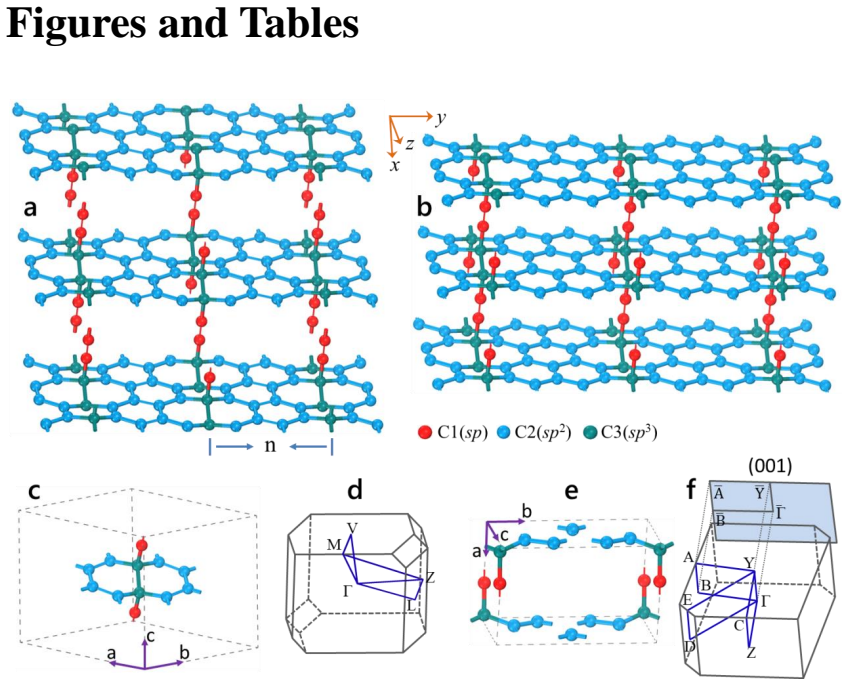
The central design element is the acetylenic linkage –C≡C– inserted between graphene nanoribbon segments, which widens the interlayer spacing to 4.12–5.00 Å and introduces sp-hybridized carbon while keeping sp2 ribbon units and sp3 junction atoms. The electronic behavior is governed by the ribbon width n: the ratio of sp:sp2:sp3 carbon is 1:n:1, and the π/π* states of the ribbon's C2 atoms dominate the band edges. The width rule n = 3p + 2 selects a symmetry-protected band crossing, a nodal ring with winding number N = 1, while other widths open a direct or indirect gap. A tight-binding model on the C2 sublattice captures the low-energy physics.
What would settle it
For any width n in the predicted ranges, run an unbiased structure search, such as evolutionary or random sampling, on a cell of the same stoichiometry; finding a lower-energy polymorph with a different band gap or nodal-line topology than the reported grapheayne-n would refute the design rule, and synthesizing grapheayne-4 and comparing its XRD pattern and optical gap to the predictions would settle it experimentally.
Extended reading notes
Core claim
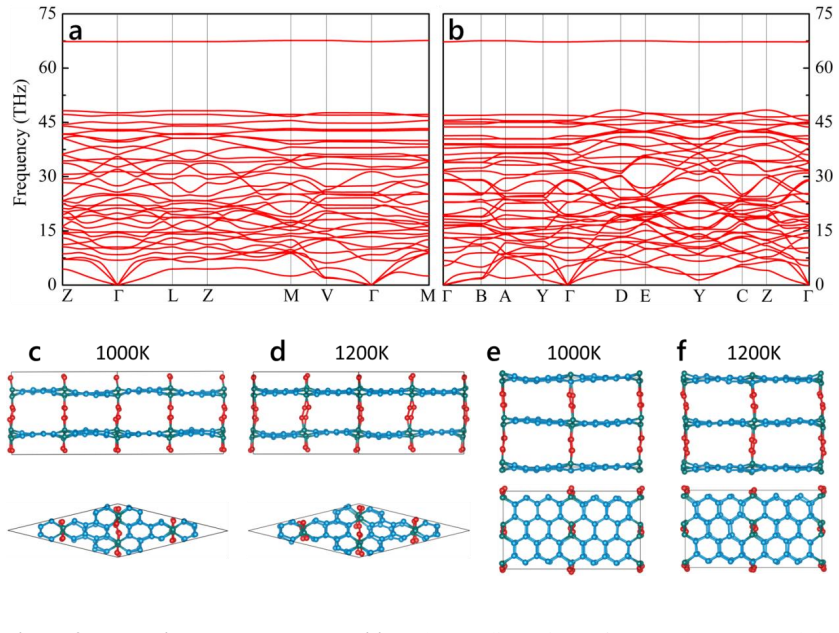
Grapheaynes are 3D carbon networks in which armchair graphene nanoribbons of width n are joined by –C≡C– linkages, producing crystals with space groups P2/m for odd n and C2/m for even n and a 1:n:1 ratio of sp, sp2, and sp3 carbon atoms. The paper establishes, by density functional theory total energies, phonon spectra, and finite-temperature molecular dynamics, that these crystals are dynamically and thermally stable and are the lowest-energy known acetylenic carbon allotropes. Electronically, the width n controls the band structure: for n = 3p + 2 the valence and conduction bands cross along a symmetry-protected nodal ring, making a PT-symmetric nodal-line semimetal with drumhead surface states; for other widths the material is a semiconductor, and some members (n = 3, 4, 7, 10) have direct narrow gaps with low effective masses and strong optical absorption.
Load-bearing premise
The predictions assume that the specific symmetric arrangement of ribbons and linkages used in the calculations is the lowest-energy structure for each width, since no global structural search was performed to rule out lower-energy reconstructions.
Editorial extensions
If this is right
- Grapheayne-n with n > 15 should be synthesizable as a metastable carbon phase energetically between diamond and graphite, if the assumed geometries are reachable in experiment.
- Semiconducting members with direct gaps of 1.07–1.87 eV would be competitive photovoltaic absorbers with strong absorption starting at the gap; stacking several widths could cover a broad solar spectrum.
- Widths satisfying n = 3p + 2 provide a family of topological nodal-line semimetals with drumhead surface states detectable by angle-resolved photoemission spectroscopy.
- The enlarged interlayer spacing and acetylenic linkages suggest reversible lithium and sodium storage with reduced swelling in battery anodes.
- The width rule gives a practical tuning knob: choose n to select a direct-gap semiconductor, an indirect-gap semiconductor, or a nodal-line semimetal.
Reading between the lines
- If the width rule holds, the same ribbon-and-linker construction could be applied to zigzag-edged nanoribbons to generate related carbon families with different nodal-line geometries and gap sequences.
- The reduction to a tight-binding model on the C2 sublattice implies that the low-energy physics of all widths may be captured by a single effective model, which could be used to screen very large n without full density functional theory.
- Because the gaps vary with n, a graded assembly of several grapheayne widths could act as a broadband solar absorber; the paper hints at this but does not calculate it.
- The main risk to the design rule is the absence of a global structural search: if a lower-energy polymorph of the same stoichiometry exists for some n, the predicted gap or topology would apply to the wrong structure.
Signed reviews
Editorial analysis
A structured set of objections, weighed in public.
Referee Report
Summary. The manuscript proposes a family of three-dimensional carbon allotropes, grapheayne-n, formed by linking armchair graphene nanoribbons of width n with acetylenic (−C≡C−) linkages. Using DFT (PBE and HSE06), phonon calculations, AIMD simulations, and Wannier-based tight-binding analysis, the authors report that grapheaynes are dynamically and thermally stable, lower in energy than graphdiyne and other acetylenic carbon allotropes, and that for n>15 their cohesive energy falls below that of diamond and approaches graphite. Electronically, the paper claims a classification rule: grapheayne-n is a topological nodal-line semimetal when n=3p+2 and a semiconductor otherwise, with some members (n=3, 4, 7, 10) having direct gaps in the 1.07–1.87 eV range and, for grapheayne-10, the highest absorption coefficients among all known semiconducting carbon allotropes. Applications in photovoltaics, energy storage, and molecular sieves are proposed, and a tentative synthesis route via brominated graphene and acetylene insertion is sketched.
Significance. If the reported stability and electronic properties hold, grapheaynes would be a genuinely interesting family of carbon allotropes that combines tunable direct band gaps in the photovoltaic range with topological nodal-line semimetal behavior in the same structural series. The calculations are carried out with standard, state-of-the-art first-principles methods: PBE and HSE06 for electronic structure, phonon calculations for dynamical stability, AIMD for thermal stability, and WannierTools-based analysis of the nodal rings and drumhead surface states. The family-wide design rule (n=3p+2) is an attractive organizing principle. However, the most prominent claims in the abstract and title—'low-energy allotrope', 'lower than graphdiyne', 'highest absorption coefficients among all known semiconducting carbon allotropes', and the n>15 stability crossing—are not fully supported by the calculations actually shown, so the significance of the paper as written is lower than its headline claims suggest.
major comments (4)
- [Results, 'Lattice structure and stability'; Figs. 1–2; Table I] The grapheayne-n family is defined by a single hand-built connectivity motif (armchair nanoribbons linked by –C≡C–), and only those symmetric structures are relaxed. No global or evolutionary structure search, and no enumeration of alternative linker registrations, linker densities, stacking sequences, or reconstructions at the same stoichiometry, is reported. The paper's central stability hierarchy—'low-energy carbon allotropes', more stable than graphdiyne, and n>15 below diamond—therefore characterizes the chosen motif, not the ground-state arrangement for that stoichiometry. Moreover, the n>15 statement is an extrapolation from n=1–10 cells shown in Table I; no calculation at n=15 or beyond is presented. To support the title and abstract, the authors should either perform an explicit structure search or explicitly restrict all stability claims to the constructed motif and label the large-n behavior as an extrapolation.
- [Abstract; Results, 'Electronic, optical, and topological properties'] The claim that grapheayne-10 possesses 'the highest absorption coefficients among all known semiconducting carbon allotropes' is not substantiated by the evidence shown. Figure 4d compares only GaN, ZnO, CKL, and T-carbon, which does not constitute an exhaustive survey of semiconducting carbon allotropes. This superlative should either be removed, restricted to 'among the materials compared here', or supported by a systematic comparison with a broad set of known semiconducting carbon allotropes.
- [Abstract; Results, 'Lattice structure and stability'] The abstract states that grapheaynes have formation energies lower than the experimentally synthesized graphdiyne, but neither Table I nor the text reports a computed cohesive energy for graphdiyne. The text instead cites graphyne (–8.58 eV per C atom), which is a different member of the graphyne family, and carboneyane. The authors should clarify whether graphdiyne was actually computed, report its value if so, and revise the abstract and the comparison paragraph accordingly, since the current wording is not backed by the data presented.
- [Results, 'Electronic, optical, and topological properties'; Fig. 2] The rule 'if n=3p+2 then a nodal-line semimetal; otherwise a semiconductor' is presented as a general result, but calculations are shown only for n=1–10, and a general symmetry or tight-binding derivation is sketched only for grapheayne-5. The same applies to the direct-gap series n=3, 4, 7, and 10. Please state explicitly whether the n=3p+2 rule is proven for all n or is an observed trend for n≤10, and if the latter, limit the family-wide statements or provide the missing general argument.
minor comments (4)
- [Methods] Typographical errors should be corrected: 'Brillion zone' appears twice in the Methods section and should be 'Brillouin zone'; 'spin-orbital coupling' in the Results should be 'spin-orbit coupling'; 'mimimum' in the Fig. 4 caption should be 'minimum'; and 'the the X-ray diffraction' in the Discussion should be 'the X-ray diffraction'.
- [References] Reference 15 and reference 33 contain corrupted or garbled text ('Tunable Assemb l y of sp s' and 'Thinhinrsons, J., Polman, A. & Atwater, H. A. Highly'), which should be repaired before publication.
- [Fig. 3; Results, 'Lattice structure and stability'] The text concludes that the grapheaynes are 'thermally stable up to 1000 K', but AIMD simulations are reported only for grapheayne-4 at 1000 K and grapheayne-5 at 1200 K. The general stability statement should be restricted to these members or accompanied by AIMD results for other values of n.
- [Fig. 4d; Methods] The optical absorption is obtained from the independent-particle frequency-dependent dielectric matrix at the HSE06 level, without explicit excitonic or local-field effects. The absolute absorption coefficients should therefore be described as approximate, especially for quantitative comparison with other materials.
Circularity Check
No significant circularity: the central predictions are direct first-principles outputs, not fitted, self-defined, or self-citation-dependent quantities.
full rationale
The paper's central results—cohesive energies, band gaps (PBE and HSE06), optical absorption, effective masses, phonon stability, and nodal-line topology—are obtained from direct first-principles calculations (VASP, PHONOPY, WannierTools) with no parameters fitted to the quantities being predicted. The n=3p+2 nodal-line/semiconductor classification is derived from the computed band representations and the PT-symmetry winding-number argument for grapheayne-5, not from a fit to a subset of data. Comparison allotropes (graphdiyne, carboneyane, T-carbon, diamond, graphite) are explicitly recomputed with the same method ('For consistency, all data shown here are obtained by our own calculations using the same computational method'), so the stability comparisons are not imported as fitted inputs. The hand-constructed geometries and the extrapolation beyond n=10 (the n>15 claim) are legitimate completeness/correctness concerns—no global structure search is performed and no calculation at n=15 is shown—but they are not circular: nothing in the derivation defines the target property in terms of itself. Any self-citation overlap (e.g., the carboneyane comparison) is not load-bearing because the comparison data are recalculated here rather than adopted from the cited work. I find no circular step.
Assumptions & free parameters
assumptions (2)
- domain assumption DFT with PBE and HSE06 functionals provides sufficiently accurate total energies, band gaps, and optical response for carbon allotropes.
- domain assumption The constructed grapheayne structures are the energetically relevant minima for each width n.
invented entities (1)
-
Grapheayne-n family (3D carbon allotropes)
independent evidence
Cite this review
Pith. "Pith review of Grapheayne: a class of low-energy carbon allotropes with diverse optoelectronic and topological properties." pith.science (2026). https://pith.science/paper/RVLZSOXA
@misc{pith2026190801282,
  author       = {Pith},
  title        = {Pith review of: Grapheayne: a class of low-energy carbon allotropes with diverse optoelectronic and topological properties},
  year         = {2026},
  howpublished = {\url{https://pith.science/paper/RVLZSOXA}},
  note         = {Machine review of arXiv:1908.01282}
}
abstract
A series of carbon allotropes with novel optoelectronic and rich topological properties is predicted by systematic first-principles calculations. These fascinating carbon allotropes can be derived by inserting acetylenic linkages (-C$\equiv$C-) into graphite, hence they are termed as grapheaynes. Grapheaynes possess two different space groups, $P$2/$m$ or $C$2/$m$, and contain simultaneously the $sp$, $sp^2$, and $sp^3$ chemical bonds. They have formation energies lower than the already experimentally synthesized graphdiyne and other theoretically predicted carbon allotropes with acetylenic linkages. Particularly, when the width $n$ of grapheayne-$n$ exceeds 15, its cohesive energy is lower than that of diamond, and approaches that of graphite with increasing $n$. Remarkably, we find that some grapheaynes behave as semiconductors with direct narrow band gaps and own the highest absorption coefficients among all known semiconducting carbon allotropes, while some others are topological semimetals with nodal lines. Especially, some grapheaynes can be engineered with tunable direct band gaps in the range of 1.07-1.87 eV and have ideal properties for photovoltaic applications. Our work not only uncovers the unique atomic arrangement and prominent properties of the grapheayne family, but also offers a treasury that provides promising materials for catalyst, energy storage, molecular sieves, solar cell, and electronic devices.
Figures

Figures from the paper (1 more)

Reference graph
Works this paper leans on
-
[1]
Neto, A. C., Guinea, F., Peres, N. M., Novoselov, K. S. & Geim, A. K. The electronic properties of graphene. Rev. Mod. Phys. 81, 109 (2009)
work page 2009
-
[2]
In the figure, the black dotted line represents the energy of diamond and the lower bound of the energy axis represents the cohesive energy of graphite. One can observe that when the width of grapheayne-n exceeds 15, the system is energetically lower than diamond, and its Ecoh approaches graphite (Fig. 2). We have also calculated the total energy against ...
-
[3]
Novoselov, K. S. , et al. Electric field effect in atomically thin carbon films. Science 306, 666-669 (2004)
work page 2004
-
[4]
Allen, M. J., Tung, V . C. & Kaner, R. B. Honeycomb carbon: a review of graphene. Chem. Rev. 110, 132-145 (2009)
work page 2009
-
[5]
Chen, D., Tang, L. & Li, J. Graphene -based materials in electrochemistry. Chem. Soc. Rev. 39, 3157-3180 (2010)
work page 2010
-
[6]
Rao, C. N. R., Sood, A. K., Subrahmanyam, K. S. & Govindaraj, A. Graphene: the new two‐dimensional nanomaterial. Angew. Chem. Int. Ed. 48, 7752-7777 (2009)
work page 2009
- [7]
-
[8]
Schwierz, F. Graphene transistors. Nat. Nanotechnol. 5, 487 (2010)
work page 2010
Show all 47 references
-
[9]
Novoselov, K. S. , et al. Two-dimensional gas of massless Dirac fermion s in graphene. Nature 438, 197-200 (2005)
2005
-
[10]
Y ., Young, A
Meric, I., Han, M. Y ., Young, A. F., Ozyilmaz, B., Kim, P. & Shepard, K. L. Current saturation in zero -bandgap, top -gated graphene field -effect transistors. Nat. Nanotechnol. 3, 654-659 (2008)
2008
-
[11]
& Scuseria, G
Barone, V ., Hod, O. & Scuseria, G. E. Electronic structure and stability of semiconducting graphene nanoribbons. Nano Lett. 6, 2748-2754 (2006)
2006
-
[12]
Direct observation of a widely tunable bandgap in bilayer graphene
Zhang, Y ., et al. Direct observation of a widely tunable bandgap in bilayer graphene. Nature 459, 820 (2009)
2009
-
[13]
Atomically precise bottom-up fabrication of graphene nanoribbons
Cai, J., et al. Atomically precise bottom-up fabrication of graphene nanoribbons. Nature 466, 470 (2010)
2010
-
[14]
Son, Y .-W., Cohen, M. L. & Louie, S. G. Energy gaps in graphene nanoribbons. Phys. Rev. Lett. 97, 216803 (2006)
2006
-
[15]
-H., Son, Y .-W., Cohen, M
Yang, L., Park, C. -H., Son, Y .-W., Cohen, M. L. & Louie, S. G. Quasiparticle energies and band gaps in graphene nanoribbons. Phys. Rev. Lett. 99, 186801 (2007). 16 / 24
2007
-
[16]
Jiang, X., Zhao, J., Li, Y . L. & Ahuja, R. Tunable Assembly of sp 3 Cross, X., Zhao, J., Li, Y . L. & Ahuja, R. Tunable Assembl y of sp s Adv. Funct. Mater. 23, 5846-5853 (2013)
2013
-
[17]
& Shuai, Z
Long, M., Tang, L., Wang, D., Li, Y . & Shuai, Z. Electronic structure and carrier mobility in graphdiyne sheet and nanoribbons: theoretical predictions. ACS Nano 5, 2593-2600 (2011)
2011
-
[18]
& Loh, K
Wang, Y ., Jaiswal, M., Lin, M., Saha, S., Ozyilmaz, B. & Loh, K. P. Electronic properties of nanodiamond decorated graphene. ACS Nano 6, 1018-1025 (2012)
2012
-
[19]
Balog, R. , et al. Bandgap opening in graphene induced by patterned hydrogen adsorption. Nat. Mater. 9, 315-319 (2010)
2010
-
[20]
& Shi, G
Li, C. & Shi, G. Three -dimensional graphene architectures. Nanoscale 4, 5549-5563 (2012)
2012
-
[21]
& Kertesz, M
Baughman, R., Eckhardt, H. & Kertesz, M. Structure‐property predictions for new planar forms of carbon: Layered phases containing sp 2 and sp atoms. J. Chem. Phys. 87, 6687-6699 (1987)
1987
-
[22]
& Nakao, K
Narita, N., Nagai, S., Suzuki, S. & Nakao, K. Optimized geometries and electronic structures of graphyne and its family. Phys. Rev. B 58, 11009 (1998)
1998
-
[23]
& Zhu, D
Li, G., Li, Y ., Liu, H., Guo, Y ., Li, Y . & Zhu, D. Architecture of graphdiyne nanoscale films. Chem. Commun. 46, 3256-3258 (2010)
2010
-
[24]
Progress in research into 2D graphdiyne -based materials
Huang, C., et al. Progress in research into 2D graphdiyne -based materials. Chem. Rev. 118, 7744-7803 (2018)
2018
-
[25]
Kang, J., Wei, Z. & Li, J. Graphyne and its family: recent theoretical advances. ACS Appl. Mater. Interfaces 11, 2692-2706 (2019)
2019
-
[26]
Graphynes and graphdyines
Ivanovskii, A. Graphynes and graphdyines. Prog. Solid State Chem. 41, 1 -19 (2013)
2013
-
[27]
Carboneyane: A nodal line topological carbon with sp−sp 2−sp3 chemical bonds
You, J.-Y., et al. Carboneyane: A nodal line topological carbon with sp−sp 2−sp3 chemical bonds. Carbon 152, 909-914 (2019)
2019
-
[28]
L., Yan, Q
Sheng, X. L., Yan, Q. B., Ye, F., Zheng, Q. R. & Su, G. T-carbon: a novel carbon allotrope. Phys. Rev. Lett. 106, 155703 (2011)
2011
-
[29]
Chen, Y . , et al. Carbon kagome lattice and orbital -frustration-induced 17 / 24 metal-insulator transition for optoelectronics. Phys. Rev. Lett. 113, 085501 (2014)
2014
-
[30]
& Queisser, H
Shockley, W. & Queisser, H. J. Detailed balance limit of efficiency of p‐n junction solar cells. J. Appl. Phys. 32, 510-519 (1961)
1961
-
[31]
Hybertsen, M. S. & Louie, S. G. First -principles theory of quasiparticles: calculation of band gaps in semiconductors and insulators. Phys. Rev. Lett. 55, 1418 (1985)
1985
-
[32]
Wang, Q. , et al. Direct band gap silicon allotropes. J. Am. Chem. Soc. 136, 9826-9829 (2014)
2014
-
[33]
D., Atwater, J
Kosten, E. D., Atwater, J. H., Parsons, J., Polman, A. & Atwater, H. A. Highly efficient GaAs solar cells by limiting light emission angle. Light Sci. Appl. 2, e45 (2013)
2013
-
[34]
& Ferekides, C
Britt, J. & Ferekides, C. Thinhinrsons, J., Polman, A. & Atwater, H. A. Highly Appl. Phys. Lett. 62, 2851-2852 (1993)
1993
-
[35]
A., Emery, K., Hishikawa, Y ., Warta, W
Green, M. A., Emery, K., Hishikawa, Y ., Warta, W. & Dunlop, E. D. Solar cell efficiency tables (version 47). Prog. Photovolt. Res. Appl. 24, 3-11 (2016)
2016
-
[36]
M., Tuttle, J
Gabor, A. M., Tuttle, J. R., Albin, D. S., Contreras, M . A., Noufi, R. & Hermann, A. M. High‐efficiency CuInxGa1−xSe2 solar cells made from (Inx, Ga1−x)2Se3 precursor films. Appl. Phys. Lett. 65, 198-200 (1994)
1994
-
[37]
Liu, M., Johnston, M. B. & Snaith, H. J. Efficient planar heterojunction perovskite solar cells by vapour deposition. Nature 501, 395 (2013)
2013
-
[38]
C., Ehrler, B
Polman, A., Knight, M., Garnett, E. C., Ehrler, B. & Sinke, W. C. Photovoltaic materials: Present efficiencies and future challenges. Science 352, aad4424 (2016)
2016
-
[39]
P., et al
Perdew, J. P., et al. Atoms, molecules, solids, and surfaces: Applications of the generalized gradient approximation for exchange and correlation. Phys. Rev. B 46, 6671-6687 (1992)
1992
-
[40]
Blö chl, P. E. Projector augmented-wave method. Phys. Rev. B 50, 17953-17979 (1994)
1994
-
[41]
& Furthmüller, J
Kresse, G. & Furthmüller, J. Efficiency of ab -initio total energy calculations for metals and semiconductors using a plane-wave basis set. Comput. Mater. Sci. 6, 15-50 (1996). 18 / 24
1996
-
[42]
Heyd, J., Scuseria, G. E. & Ernzerhof, M. Hybrid functionals based on a screened Coulomb potential. J. Chem. Phys. 118, 8207-8215 (2003)
2003
-
[43]
& Bechstedt, F
Gajdoš, M., Hummer, K., Kresse, G., Furthmüller, J. & Bechstedt, F. Linear optical properties in the projector -augmented wave methodology. Phys. Rev. B 73, 045112 (2006)
2006
-
[44]
& Tanaka, I
Togo, A., Oba, F. & Tanaka, I. Firs t-principles calculations of the ferroelastic transition between rutile-type and CaCl2-type SiO2 at high pressures. Phys. Rev. B 78, 134106 (2008)
2008
-
[45]
A unified formulation of the constant temperature molecular dynamics methods
Nose, S. A unified formulation of the constant temperature molecular dynamics methods. J. Chem. Phys. 81, 511-519 (1984)
1984
-
[46]
& Soluyanov, A
Wu, Q., Zhang, S., Song, H.-F., Troyer, M. & Soluyanov, A. A. WannierTools: An open-source software package for novel topological materials. Comput. Phys. Commun. 224, 405-416 (2018)
2018
-
[47]
A., Yates, J
Mostofi, A. A., Yates, J. R., Lee, Y . -S., Souza, I., Vanderbilt, D. & Marzari, N. wannier90: A tool for obtaining maximally -localised Wannier functions. Comput. Phys. Commun. 178, 685-699 (2008). 19 / 24 Figures and Tables Figure 1. Crystal structure and Brillion zone (BZ) ...
2008
Reviewed August 14, 2026 · model on record in the stance chip above.
Discussion (0). Continue with ORCID to comment.