REVIEW 3 major objections 4 minor 128 references
The Dark Side of a Tera-Z Factory
T0 review · 3 major / 4 minor · reviewed 2026-08-06 · deepseek-v4-flash
Pith's one-line read The paper argues that a Tera-Z electron-positron collider can indirectly probe dark matter through tiny loop-level deviations in electroweak precision observables, with two-loop effects sometimes dominating and distinguishing portal…
desk verdict A genuinely useful, transparent forward projection of Tera-Z sensitivity to t-channel DM portals—the new two-loop RGE terms are real and dominate in quark portals—but the headline reach is gated by an explicit optimistic assumption about SM theory errors on R_b and A_FB^b. read the letter →
The pith
A machine-rendered reading of the paper's core claim, the machinery that carries it, and where it could break.
The reading
What carries the argument
The machinery is one-loop SMEFT matching followed by renormalization-group evolution: the heavy t-channel mediator and dark matter are integrated out at their mass scale, and the resulting Wilson coefficients are run down to $m_Z$. The workhorse is the combination of operators that shifts the $Z b_L b_L$ vertex, $[C_{Hq}^{(1)}+C_{Hq}^{(3)}]_{33}$, which sets $R_b$ and $A_{FB}^b$. On top of the finite one-loop matching, four-quark operators generated at one loop mix into this combination through top-Yukawa-enhanced anomalous dimensions, producing two-loop leading-log terms — Eqs. (9) and (13) — that dominate the signal in the quark portals. These terms are the named objects carrying the argument: they convert a precision measurement into a dark-matter constraint and give each portal a characteristic sign.
What would settle it
Compute the complete two-loop matching for the $\chi\Phi u_R$ portal and redo the fit: if the leading-log result of Eq. (13) is reduced by more than roughly a factor of two, the claimed 30-fold enhancement and sign flip of $\delta R_b$ disappear. Alternatively, if a future Tera-Z measurement of $R_b$ matches the Standard Model within the currently achievable theory uncertainty band, the claimed sensitivity to these portals would not materialize.
Extended reading notes
Core claim
The central claim is that a Tera-Z run can indirectly probe the presence of dark matter in a broad class of $Z_2$-symmetric t-channel simplified models, and that in some cases it is the only probe. The paper establishes this by matching each portal at one loop onto the SMEFT, evolving the Wilson coefficients to the $Z$ pole, and confronting the resulting shifts in the $Z$-pole observables with projected FCC-ee sensitivities. The sharp quantitative findings are two two-loop leading-log RGE terms: in the $\chi\Phi q_L$ portal the term of Eq. (9) dominates the one-loop matching and improves the bound on the portal coupling by a factor of two, while in the $\chi\Phi u_R$ portal Eq. (13) exceeds the one-loop result by a factor of about 30 and flips the sign of $\delta R_b$. These effects give the Tera-Z program sensitivity to mediator masses around a TeV and dark matter masses in the 0.5–2 TeV range, and the resulting sign and correlation patterns of the deviations discriminate between quark-doublet and quark-singlet portals.
Load-bearing premise
The whole projected reach rests on the assumption that Standard Model theory uncertainties on the key observables will be reduced enough that the experimental Tera-Z precision is not spoiled; otherwise the exclusion regions in the figures shrink or disappear.
Editorial extensions
If this is right
- A Tera-Z run would exclude or constrain TeV-scale t-channel mediator models over much of the thermal relic-abundance target region, including parts of parameter space that DARWIN and CTAO cannot reach.
- The two-loop leading-log terms are not a small correction: including them strengthens the $\chi\Phi q_L$ bound by a factor of two and makes the $\chi\Phi u_R$ signal about 30 times larger than the one-loop estimate, so omitting them would badly misestimate the reach.
- Measuring the sign of $\delta R_b$ (positive for quark-doublet portals, negative for quark-singlet portals) would discriminate between the two portal structures using $Z$-pole data alone.
- In leptophilic portals such as $\chi\Phi e_R$ and $\phi\Psi e_R$, electroweak precision observables would be the only practical probe of thermal dark matter parameter space, since direct detection is suppressed by lepton masses.
- Correlations among electroweak precision observables, not just individual pulls, carry portal-discriminating information, and improved Standard Model theory calculations for $R_b$ and $A_{FB}^b$ would unlock most of the gain.
Reading between the lines
- If two-loop leading-log effects are this large, a full two-loop matching computation could shift the normalization of the bounds; the qualitative conclusion that Tera-Z probes t-channel dark matter is robust, but the exact contours in the exclusion figures should be treated as order-of-magnitude until then.
- The same $Z b_L b_L$ operator combination is constrained by top-quark and flavor observables; cross-correlating Tera-Z projections with high-luminosity LHC top measurements could independently test the two-loop RGE picture.
- The sign-of-$\delta R_b$ diagnostic could be applied to other electroweak-charged dark sectors beyond t-channel portals, turning $R_b$ measurements into a general probe of dark-sector loop imprints.
- If Standard Model theory errors on $R_b$ are not reduced below the projected experimental precision, the claimed 'only probe' role in leptonic portals would weaken, although complementarity with direct and indirect searches would remain.
Editorial analysis
A structured set of objections, weighed in public.
Referee Report
Summary. This paper analyzes the potential of a future Tera-Z factory (FCC-ee/CEPC) to indirectly probe t-channel dark matter portals, in which a Z2-odd dark sector (Majorana fermion or scalar DM plus a scalar or fermion mediator) couples to SM fermions. The authors perform one-loop SMEFT matching with SOLD and matchmakereft, include one-loop RGE running with DSixTools, and derive analytic expressions for the dominant Wilson coefficients (Eqs. 8-24). They compute projected sensitivities for electroweak precision observables, using R_b and A_FB^b as the most powerful probes, and combine these with relic-density, direct-detection, and indirect-detection constraints. The central claims are that a Tera-Z run can indirectly probe otherwise inaccessible t-channel DM parameter space, that two-loop leading-log effects can dominate and even flip the sign of the deviation in the u_R portal, and that correlation patterns among observables can discriminate between portal structures.
Significance. If the quantitative reach claims hold, this is a valuable and timely contribution: it provides a systematic, forward (non-circular) calculation for a broad class of t-channel DM models, with explicit analytic expressions and publicly used automated tools, and it gives falsifiable sign-correlation patterns between precision observables. The qualitative complementarity arguments, especially for leptonic portals where Tera-Z may be the only probe, are convincing. However, the headline numerical claims are currently gated by two explicitly acknowledged but unquantified assumptions: SM theory uncertainties not spoiling the experimental precision, and the neglect of Sommerfeld/bound-state effects in the coannihilation region. The paper deserves publication after those load-bearing points are addressed.
major comments (3)
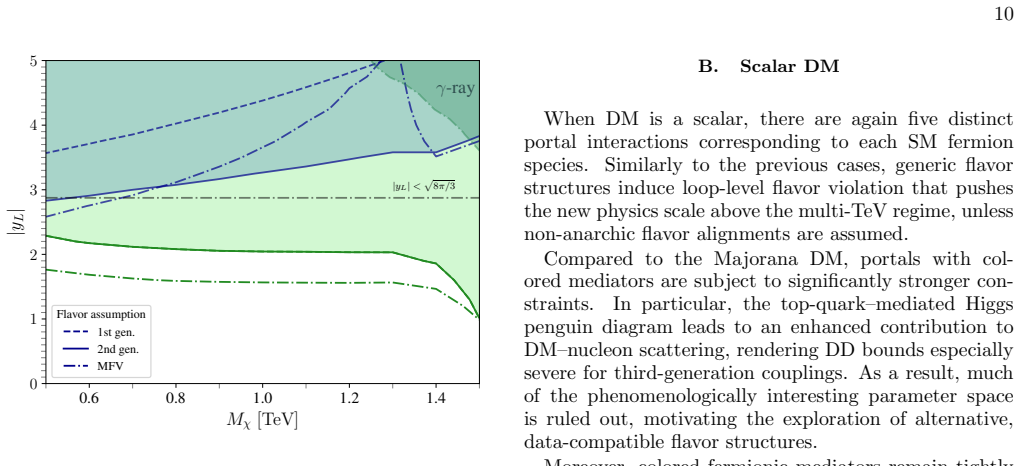
- [Sec. III.A, Eq. (4)] The chi-squared in Eq. (4) and all exclusion contours in Figs. 1, 6, 8, 10, 11, 13, and 15 are built using only projected experimental uncertainties. The text states the 'optimistic assumption that theoretical uncertainties do not spoil the experimental ones,' but no theory-error covariance term or improvement scenario is included. Since R_b and A_FB^b are the dominant observables and their current SM theory errors are comparable to or larger than the FCC-ee projections, this assumption is load-bearing for the central claim that two-loop effects become accessible. Please quantify the effect of including current and improved SM theory uncertainties (e.g., the scenarios of Ref. [88]) on at least the main contour figures, and specify the theory-error budget required for the two-loop contributions to be observable.
- [Sec. III.B, Fig. 5] The relic-density target regions are computed neglecting Sommerfeld enhancement and bound-state formation, as stated in Sec. III.B. This is most consequential in the coannihilation and near-degeneracy region, where the paper claims unique Tera-Z sensitivity (for example Fig. 5 with y_Q = 0 and small mass splitting). These non-perturbative effects can significantly modify the annihilation cross section and therefore shift the positions of the target lines. Please include an estimate of their impact, based on Refs. [99-102] or a dedicated calculation, and state how the complementarity conclusions change if the thermal target lines move.
- [Sec. IV.A.1-IV.A.2, Eqs. (9) and (13)] The central two-loop claims are based on one-loop matching plus one-loop RGE, retaining only the leading-log mixing of four-quark operators into the Hq operators. The paper states that a full two-loop matching would 'only lead to slight corrections,' but no estimate or bound is provided. Given that the signal size is at the percent-to-per-mille level and that the claim 'improves the bound up to a factor of two' is quantitative, please provide an estimate of the neglected two-loop finite terms and of the uncertainty from the truncation of the RGE, and show that they are small compared to the projected precision and to the one-loop signal. Without this, the factor-of-two improvement and the sign-discrimination claim are not yet demonstrated to be robust.
minor comments (4)
- [Fig. 2 caption] The caption displays the Lagrangian as -y_U χ q_L^3 Φ† + h.c., but the section and text describe the χΦqL model with coupling y_Q; please correct the caption.
- [Conclusions, Sec. V] The statement that this article is 'the first study' of Tera-Z sensitivity to one-loop-generated effects is too strong in light of Refs. [52, 55, 56] and related SMEFT Tera-Z literature; please qualify the novelty claim.
- [Sec. IV.A.1, Eq. (9)] For reproducibility, please provide the intermediate one-loop matching coefficients for the four-quark operators O_qq^(1) and O_qq^(3) that enter the leading-log expression in Eq. (9), since those coefficients are not written explicitly in the text.
- [Eq. (4)] Please specify how correlations among the electroweak observables are implemented in the projected Tera-Z covariance matrix, in particular whether only experimental correlations are included and how the input scheme {α_EM, m_Z, G_F} is propagated.
Circularity Check
Forward one-loop matching plus RGE calculation with no fitted target observables; stated theory-error caveats are assumptions, not circular reductions.
full rationale
The core derivation is self-contained: each portal starts from a UV Lagrangian (e.g., Eq. 7), is matched onto SMEFT at one loop using stated analytic expressions (Eqs. 8, 12, 15, 18, 20, 22, 24), is run to the weak scale with one-loop RGEs (Eqs. 9, 13), and is converted to EWPO shifts compared with projected experimental uncertainties via the chi-squared in Eq. 4. No parameter is fitted to the target observables, and the two-loop-leading-log contributions are computed, not adjusted, so the predictions do not reduce to their inputs by construction. The paper explicitly flags the main gating assumptions: "we adopt an optimistic assumption where theoretical uncertainties do not spoil the experimental ones" (Sec. III.A), and it neglects Sommerfeld enhancement and bound-state formation in the coannihilation regime (Sec. III.B); these are honest caveats about future theory-error budgets, not circular steps. Self-citations (matchmakereft, SOLD, and methodology Ref. [85]) support tooling or fitting methodology and do not supply the novel physics claims; no uniqueness theorem or pre-adopted ansatz is invoked to force the result. Accordingly, no circular step is exhibited.
Assumptions & free parameters
free parameters (3)
- Portal couplings |yQ|, |yU|, |yE|, |yL| =
Scanned, e.g. 0 to 3 at fixed mediator masses; perturbative unitarity caps in Tab. II
- Quartic Higgs-mediator couplings kappa, kappa1, kappa2 =
Set to 0 for the base contours; kappa2 excluded above about 0.15 for M_Phi = 2 TeV
- Mass splitting (MMed - MDM)/MMed =
Scanned from 0 to 1; benchmark mediator masses 1.5, 2, 2.5 TeV
assumptions (8)
- domain assumption Standard thermal freeze-out with a standard cosmological history sets the DM target region via the relic abundance Omega h^2 < 0.12
- domain assumption A Z2 symmetry stabilizes the DM and forces all visible-sector effects to appear first at one loop
- domain assumption The heavy DM and mediator can be integrated out at one loop onto the SMEFT, with the leading effects captured by one-loop matching
- ad hoc to paper Standard Model theory uncertainties will not spoil the projected experimental precision at Tera-Z
- domain assumption One-loop RGE on top of one-loop matching captures the dominant two-loop corrections (Eqs. 9 and 13)
- domain assumption Sommerfeld enhancement and bound-state formation are negligible in the relic density calculation
- domain assumption Specific flavor alignments suppress loop-level flavor violation: third-generation-only quark couplings, single-generation or MFV lepton couplings
- domain assumption An Einasto dark matter profile and standard astrophysical inputs describe the indirect detection signals
Cite this review
Pith. "Pith review of The Dark Side of a Tera-Z Factory." pith.science (2026). https://pith.science/paper/RVSGY6LX
@misc{pith2026250717803,
  author       = {Pith},
  title        = {Pith review of: The Dark Side of a Tera-Z Factory},
  year         = {2026},
  howpublished = {\url{https://pith.science/paper/RVSGY6LX}},
  note         = {Machine review of arXiv:2507.17803}
}
abstract
The future circular $e^+e^-$ collider (FCC-ee or CEPC) will provide unprecedented sensitivity to indirect new physics signals emerging as small deviations from the Standard Model predictions in electroweak precision tests. Assuming new physics scenarios containing a dark matter candidate and a $t$-channel mediator, we analyse the synergy and interplay of future Tera-$Z$ factories and non-collider tests conducted through direct and indirect searches of dark matter. Our results highlight the excellent prospect for a Tera-$Z$ run to indirectly probe the presence and nature of dark matter.
Figures


Figures from the paper (14 more)





Reference graph
Works this paper leans on
-
[88]
A. Freitas et al.,Theoretical uncertainties for electroweak and Higgs-boson precision measurements at FCC-ee,1906.05379. [89]https://indico.cern.ch/event/1551879/
arXiv 1906
- [1]
- [2]
-
[3]
D. O’Connell, M. J. Ramsey-Musolf and M. B. Wise, Minimal Extension of the Standard Model Scalar Sector,Phys. Rev. D75(2007) 037701, [hep-ph/0611014]
arXiv 2007
-
[4]
Krnjaic,Probing Light Thermal Dark-Matter With a Higgs Portal Mediator,Phys
G. Krnjaic,Probing Light Thermal Dark-Matter With a Higgs Portal Mediator,Phys. Rev. D94(2016) 073009, [1512.04119]
arXiv 2016
- [5]
- [6]
- [7]
Show all 128 references
-
[8]
Holdom,Two U(1)’s and Epsilon Charge Shifts, Phys
B. Holdom,Two U(1)’s and Epsilon Charge Shifts, Phys. Lett. B166(1986) 196–198
1986
-
[9]
Fayet,Extra U(1)’s and New Forces,Nucl
P. Fayet,Extra U(1)’s and New Forces,Nucl. Phys. B 347(1990) 743–768
1990
-
[10]
B. A. Dobrescu,Massless gauge bosons other than the photon,Phys. Rev. Lett.94(2005) 151802, [hep-ph/0411004]
2005 arXiv
-
[11]
del Aguila, M
F. del Aguila, M. Masip and M. Perez-Victoria, Physical parameters and renormalization of U(1)-a x U(1)-b models,Nucl. Phys. B456(1995) 531–549, [hep-ph/9507455]
1995 arXiv
-
[12]
Graham, C
M. Graham, C. Hearty and M. Williams,Searches for Dark Photons at Accelerators,Ann. Rev. Nucl. Part. Sci.71(2021) 37–58, [2104.10280]
2021 arXiv
-
[13]
Nomura and J
Y. Nomura and J. Thaler,Dark Matter through the Axion Portal,Phys. Rev. D79(2009) 075008, [0810.5397]
2009 arXiv
-
[14]
S. Gola, S. Mandal and N. Sinha,ALP-portal majorana dark matter,Int. J. Mod. Phys. A37(2022) 2250131, [2106.00547]
2022 arXiv
-
[15]
Bharucha, F
A. Bharucha, F. Br¨ ummer, N. Desai and S. Mutzel, Axion-like particles as mediators for dark matter: beyond freeze-out,JHEP02(2023) 141, [2209.03932]
2023 arXiv
-
[16]
D. K. Ghosh, A. Ghoshal and S. Jeesun,Axion-like particle (ALP) portal freeze-in dark matter confronting ALP search experiments,JHEP01(2024) 026, [2305.09188]
2024 arXiv
-
[17]
J. A. Dror, S. Gori and P. Munbodh,QCD axion-mediated dark matter,JHEP09(2023) 128, [2306.03145]
2023 arXiv
-
[18]
Armando, P
G. Armando, P. Panci, J. Weiss and R. Ziegler, Leptonic ALP portal to the dark sector,Phys. Rev. D 109(2024) 055029, [2310.05827]
2024 arXiv
-
[19]
Allen, A
S. Allen, A. Blackburn, O. Cardenas, Z. Messenger, N. H. Nguyen and B. Shuve,Electroweak axion portal to dark matter,Phys. Rev. D110(2024) 095010, [2405.02403]
2024 arXiv
-
[20]
D’Eramo and T
F. D’Eramo and T. Sassi,Axion portal to scalar Dark Matter: unveiling stabilizing symmetry footprints, JHEP07(2025) 031, [2502.19491]
2025 arXiv
-
[21]
Blennow, E
M. Blennow, E. Fernandez-Martinez, A. Olivares-Del Campo, S. Pascoli, S. Rosauro-Alcaraz and A. V. Titov,Neutrino Portals to Dark Matter, Eur. Phys. J. C79(2019) 555, [1903.00006]
2019 arXiv
-
[22]
Gorbunov and M
D. Gorbunov and M. Shaposhnikov,How to find neutral leptons of theνMSM?,JHEP10(2007) 015, 16 [0705.1729]
2007 arXiv
-
[23]
Alekhin et al.,A facility to Search for Hidden Particles at the CERN SPS: the SHiP physics case, Rept
S. Alekhin et al.,A facility to Search for Hidden Particles at the CERN SPS: the SHiP physics case, Rept. Prog. Phys.79(2016) 124201, [1504.04855]
2016 arXiv
-
[24]
Davighi, A
J. Davighi, A. Greljo and N. Selimovic,Topological Portal to the Dark Sector,Phys. Rev. Lett.134(2025) 111804, [2401.09528]
2025 arXiv
-
[25]
Davighi, S
J. Davighi, S. Moldovsky, H. Murayama, C. Scherb and N. Selimovic,Topological Freeze-out by Semi-Annihilation,2506.05468
-
[26]
Arcadi, D
G. Arcadi, D. Cabo-Almeida, M. Dutra, P. Ghosh, M. Lindner, Y. Mambrini et al.,The Waning of the WIMP: Endgame?,2403.15860
-
[27]
Garny, A
M. Garny, A. Ibarra and S. Vogl,Signatures of Majorana dark matter with t-channel mediators,Int. J. Mod. Phys. D24(2015) 1530019, [1503.01500]
2015 arXiv
-
[28]
Giacchino, A
F. Giacchino, A. Ibarra, L. L. Honorez, M. H. Tytgat and S. Wild,Signatures from scalar dark matter with a vector-like quark mediator,Journal of Cosmology and Astroparticle Physics2016(2016) 002
2016
-
[29]
S. Baek, P. Ko and P. Wu,Top-philic scalar dark matter with a vector-like fermionic top partner, Journal of High Energy Physics2016(2016) 1–22
2016
-
[30]
Garny, J
M. Garny, J. Heisig, M. Hufnagel and B. L¨ ulf, Top-philic dark matter within and beyond the WIMP paradigm,Phys. Rev. D97(2018) 075002, [1802.00814]
2018 arXiv
-
[31]
Colucci, B
S. Colucci, B. Fuks, F. Giacchino, L. L. Honorez, M. H. Tytgat and J. Vandecasteele,Top-philic vectorlike portal to scalar dark matter,Physical Review D98(2018) 035002
2018
-
[32]
Arina, B
C. Arina, B. Fuks, L. Mantani, H. Mies, L. Panizzi and J. Salko,Closing in ont-channel simplified dark matter models,Phys. Lett. B813(2021) 136038, [2010.07559]
2021 arXiv
-
[33]
Arina, B
C. Arina, B. Fuks, J. Heisig, M. Kr¨ amer, L. Mantani and L. Panizzi,Comprehensive exploration of t-channel simplified models of dark matter,Phys. Rev. D108 (2023) 115007, [2307.10367]
2023 arXiv
-
[34]
Bertuzzo, T
E. Bertuzzo, T. Sassi and A. Tesi,Complex dark photon dark matter EFT,JHEP10(2024) 109, [2406.14437]
2024 arXiv
-
[35]
Arina et al.,t-channel dark matter at the LHC, 2504.10597
C. Arina et al.,t-channel dark matter at the LHC, 2504.10597
-
[36]
A. Roy, M. A. Schmidt and G. Valencia,Monojet and direct detection constraints on real scalar dark matter: EFT and a simple UV completion,2509.14869
-
[37]
Angel, D
L. Angel, D. Borah, J. P. Neto, F. S. Queiroz and V. de Souza,Constraining Effective Field Theories for dark matter candidates annihilating into gamma-ray lines with CTAO,2509.08050
-
[38]
I. Reis, A. Scaffidi, E. Moulin and M. White,The complementary of CTAO, direct detection and collider searches for dark matter in Effective Field Theories and Simplified models,2509.06628
-
[39]
B´ elanger, M
G. B´ elanger, M. Mitra, R. Padhan and A. Roy, Illuminating Scalar Dark Matter Co-Scattering in EFT with Monophoton Signatures,2508.06040
-
[40]
Biondini, L
S. Biondini, L. Tiberi and O. Panella,Connecting t-channel dark matter models to the Standard Model Effective Field Theory,JHEP10(2025) 060, [2507.00925]. [41]FCCcollaboration, M. Benedikt et al.,Future Circular Collider Feasibility Study Report: Volume 1, Physics, Experiments...
2025 arXiv
-
[43]
Anastopoulos et al.,LEP3: A High-Luminosity e+e- Higgs and ElectroweakFactory in the LHC Tunnel,2504.00541
C. Anastopoulos et al.,LEP3: A High-Luminosity e+e- Higgs and ElectroweakFactory in the LHC Tunnel,2504.00541
-
[44]
Accettura et al.,Towards a muon collider,Eur
C. Accettura et al.,Towards a muon collider,Eur. Phys. J. C83(2023) 864, [2303.08533]. [45]ILCcollaboration,The International Linear Collider Technical Design Report - Volume 2: Physics, 1306.6352. [46]CLICdp, CLICcollaboration, T. K. Charles et al., The Compact Linear Collide...
2023 arXiv
-
[48]
de Blas,New physics at the FCC-ee: indirect discovery potential,Eur
J. de Blas,New physics at the FCC-ee: indirect discovery potential,Eur. Phys. J. Plus136(2021) 897
2021
-
[49]
de Blas, Y
J. de Blas, Y. Du, C. Grojean, J. Gu, V. Miralles, M. E. Peskin et al.,Global SMEFT Fits at Future Colliders, inSnowmass 2021, 6, 2022,2206.08326
2021 arXiv
-
[50]
J. F. Kamenik, A. Korajac, M. Szewc, M. Tammaro and J. Zupan,Flavor-violating Higgs and Z boson decays at a future circular lepton collider,Phys. Rev. D109(2024) L011301, [2306.17520]
2024 arXiv
-
[51]
Celada, T
E. Celada, T. Giani, J. ter Hoeve, L. Mantani, J. Rojo, A. N. Rossia et al.,Mapping the SMEFT at high-energy colliders: from LEP and the (HL-)LHC to the FCC-ee,JHEP09(2024) 091, [2404.12809]
2024 arXiv
-
[52]
Allwicher, M
L. Allwicher, M. McCullough and S. Renner,New physics at Tera-Z: precision renormalised,JHEP02 (2025) 164, [2408.03992]
2025 arXiv
-
[53]
B. A. Erdelyi, R. Gr¨ ober and N. Selimovic,How large can the light quark Yukawa couplings be?,JHEP05 (2025) 189, [2410.08272]
2025 arXiv
-
[54]
Greljo, H
A. Greljo, H. Tiblom and A. Valenti,New physics through flavor tagging at FCC-ee,2411.02485
-
[55]
Gargalionis, J
J. Gargalionis, J. Quevillon, P. N. H. Vuong and T. You,Linear Standard Model extensions in the SMEFT at one loop and Tera-Z,2412.01759
-
[56]
Maura, B
V. Maura, B. A. Stefanek and T. You,Accuracy complements energy: electroweak precision tests at Tera-Z,2412.14241
-
[57]
Davighi,In Search of an InvisibleZ ′,2412.07694
J. Davighi,In Search of an InvisibleZ ′,2412.07694
-
[58]
B. A. Erdelyi, R. Gr¨ ober and N. Selimovic,Probing new physics with the electron Yukawa coupling,JHEP 05(2025) 135, [2501.07628]
2025 arXiv
-
[59]
ter Hoeve, L
J. ter Hoeve, L. Mantani, J. Rojo, A. N. Rossia and E. Vryonidou,Connecting scales: RGE effects in the SMEFT at the LHC and future colliders,JHEP06 (2025) 125, [2502.20453]
2025 arXiv
- [60]
-
[61]
Allwicher, G
L. Allwicher, G. Isidori and M. Pesut,Flavored circular collider: cornering New Physics at FCC-ee via flavor-changing processes,Eur. Phys. J. C85(2025) 631, [2503.17019]. [62]FCCcollaboration,Prospects in BSM physics at FCC,
2025 arXiv
-
[63]
Greljo, B
A. Greljo, B. A. Stefanek and A. Valenti,Cornering Natural SUSY at a Tera-ZFactory,2507.03073. 17
-
[64]
Cornet-Gomez, V
F. Cornet-Gomez, V. Miralles, M. Miralles L´ opez, M. Moreno Ll´ acer and M. Vos,Future collider constraints on top-quark operators,2503.11518. [65]DAR WINcollaboration, J. Aalbers et al.,DAR WIN: towards the ultimate dark matter detector,JCAP11 (2016) 017, [1606.07001]. [66]C...
2016
-
[67]
Cirelli, N
M. Cirelli, N. Fornengo and A. Strumia,Minimal dark matter,Nucl. Phys. B753(2006) 178–194, [hep-ph/0512090]
2006 arXiv
-
[68]
Cirelli, A
M. Cirelli, A. Strumia and M. Tamburini,Cosmology and Astrophysics of Minimal Dark Matter,Nucl. Phys. B787(2007) 152–175, [0706.4071]
2007 arXiv
-
[69]
Cirelli and A
M. Cirelli and A. Strumia,Minimal Dark Matter: Model and results,New J. Phys.11(2009) 105005, [0903.3381]
2009 arXiv
-
[70]
Hambye, F
T. Hambye, F. S. Ling, L. Lopez Honorez and J. Rocher,Scalar Multiplet Dark Matter,JHEP07 (2009) 090, [0903.4010]
2009 arXiv
-
[71]
Cohen, J
T. Cohen, J. Kearney, A. Pierce and D. Tucker-Smith, Singlet-Doublet Dark Matter,Phys. Rev. D85(2012) 075003, [1109.2604]
2012 arXiv
-
[72]
Kumericki, I
K. Kumericki, I. Picek and B. Radovcic,TeV-scale Seesaw with Quintuplet Fermions,Phys. Rev. D86 (2012) 013006, [1204.6599]. [73]ALEPH, DELPHI, L3, OPAL, SLD, LEP Electroweak Working Group, SLD Electroweak Group, SLD Heavy Flavour Groupcollaboration, S. Schael et al.,Precision ...
2012 arXiv
-
[75]
Janot and S
P. Janot and S. Jadach,Improved Bhabha cross section at LEP and the number of light neutrino species,Phys. Lett. B803(2020) 135319, [1912.02067]
2020 arXiv
-
[76]
d’Enterria and C
D. d’Enterria and C. Yan,Revised QCD effects on the Z→b ¯bforward-backward asymmetry,2011.00530. [77]SLDcollaboration, K. Abe et al.,First direct measurement of the parity violating coupling of the Z0 to the s quark,Phys. Rev. Lett.85(2000) 5059–5063, [hep-ex/0006019]. [78]Par...
2000 arXiv
-
[84]
Bres´ o-Pla, A
V. Bres´ o-Pla, A. Falkowski and M. Gonz´ alez-Alonso, AF Bin the SMEFT: precision Z physics at the LHC, JHEP08(2021) 021, [2103.12074]
2021 arXiv
-
[85]
Allwicher, G
L. Allwicher, G. Isidori, J. M. Lizana, N. Selimovic and B. A. Stefanek,Third-family quark-lepton Unification and electroweak precision tests,JHEP05 (2023) 179, [2302.11584]
2023 arXiv
-
[86]
Altmann et al.,ECF A Higgs, electroweak, and top Factory Study, vol
J. Altmann et al.,ECF A Higgs, electroweak, and top Factory Study, vol. 5/2025 ofCERN Yellow Reports: Monographs. 6, 2025, 10.23731/CYRM-2025-005
2025 doi
-
[87]
Belloni et al.,Report of the Topical Group on Electroweak Precision Physics and Constraining New Physics for Snowmass 2021,2209.08078
A. Belloni et al.,Report of the Topical Group on Electroweak Precision Physics and Constraining New Physics for Snowmass 2021,2209.08078
2021 arXiv
-
[90]
Brivio and M
I. Brivio and M. Trott,The Standard Model as an Effective Field Theory,Phys. Rept.793(2019) 1–98, [1706.08945]
2019 arXiv
-
[91]
Guedes, P
G. Guedes, P. Olgoso and J. Santiago,Towards the one loop IR/UV dictionary in the SMEFT: One loop generated operators from new scalars and fermions, SciPost Phys.15(2023) 143, [2303.16965]
2023 arXiv
-
[92]
Guedes and P
G. Guedes and P. Olgoso,From the EFT to the UV: the complete SMEFT one-loop dictionary,2412.14253
-
[93]
R. M. Fonseca,GroupMath: A Mathematica package for group theory calculations,Comput. Phys. Commun. 267(2021) 108085, [2011.01764]
2021 arXiv
-
[94]
Carmona, A
A. Carmona, A. Lazopoulos, P. Olgoso and J. Santiago,Matchmakereft: automated tree-level and one-loop matching,SciPost Phys.12(2022) 198, [2112.10787]
2022 arXiv
-
[95]
Garny, A
M. Garny, A. Ibarra and S. Vogl,Dark matter annihilations into two light fermions and one gauge boson: General analysis and antiproton constraints, Journal of Cosmology and Astroparticle Physics2012 (2012) 033
2012
-
[96]
Toma,Internal bremsstrahlung signature of real scalar dark matter and consistency¡? format?¿ with thermal relic density,Physical Review Letters111 (2013) 091301
T. Toma,Internal bremsstrahlung signature of real scalar dark matter and consistency¡? format?¿ with thermal relic density,Physical Review Letters111 (2013) 091301
2013
-
[97]
Ibarra, T
A. Ibarra, T. Toma, M. Totzauer and S. Wild,Sharp Gamma-ray Spectral Features from Scalar Dark Matter Annihilations,Phys. Rev. D90(2014) 043526, [1405.6917]
2014 arXiv
-
[98]
Sommerfeld, ¨Uber die beugung und bremsung der elektronen,Annalen der Physik403(1931) 257–330
A. Sommerfeld, ¨Uber die beugung und bremsung der elektronen,Annalen der Physik403(1931) 257–330
1931
-
[99]
Garny and J
M. Garny and J. Heisig,Bound-state effects on dark matter coannihilation: Pushing the boundaries of conversion-driven freeze-out,Physical Review D105 (2022) 055004
2022
-
[100]
Becker, E
M. Becker, E. Copello, J. Harz, K. A. Mohan and D. Sengupta,Impact of sommerfeld effect and bound state formation in simplified t-channel dark matter models,Journal of High Energy Physics2022(2022) 1–54. 18
2022
-
[101]
Biondini and S
S. Biondini and S. Vogl,Scalar dark matter coannihilating with a coloured fermion,Journal of High Energy Physics2019(2019) 1–39
2019
-
[102]
Becker, K
M. Becker, K. Fridell, J. Harz and C. Hati,Impact of Bound State Formation on Baryogenesis,2408.08361
-
[103]
Belanger, F
G. Belanger, F. Boudjema, A. Pukhov and A. Semenov,MicrOMEGAs 2.0: A Program to calculate the relic density of dark matter in a generic model,Comput. Phys. Commun.176(2007) 367–382, [hep-ph/0607059]. [104]Planckcollaboration, N. Aghanim et al.,Planck 2018 results. VI. Cosmolog...
2007 arXiv
-
[106]
H. H. Patel,Package-X: A Mathematica package for the analytic calculation of one-loop integrals,Comput. Phys. Commun.197(2015) 276–290, [1503.01469]
2015 arXiv
-
[107]
Gondolo and S
P. Gondolo and S. Scopel,On the sbottom resonance in dark matter scattering,JCAP10(2013) 032, [1307.4481]
2013 arXiv
-
[108]
Hisano, R
J. Hisano, R. Nagai and N. Nagata,Effective Theories for Dark Matter Nucleon Scattering,JHEP05(2015) 037, [1502.02244]
2015 arXiv
-
[109]
K. A. Mohan, D. Sengupta, T. M. P. Tait, B. Yan and C. P. Yuan,Direct detection and LHC constraints on a t-channel simplified model of Majorana dark matter at one loop,JHEP05(2019) 115, [1903.05650]
2019 arXiv
-
[110]
Arcadi, D
G. Arcadi, D. Cabo-Almeida, F. Mescia and J. Virto, Dark Matter Direct Detection int-channel mediator models,JCAP02(2024) 005, [2309.07896]. [111]LZcollaboration, J. Aalbers et al.,First Dark Matter Search Results from the LUX-ZEPLIN (LZ) Experiment,Phys. Rev. Lett.131(2023) 0...
2024 arXiv
-
[115]
Schumann, L
M. Schumann, L. Baudis, L. B¨ utikofer, A. Kish and M. Selvi,Dark matter sensitivity of multi-ton liquid xenon detectors,JCAP10(2015) 016, [1506.08309]. [116]Fermi-LAT, DEScollaboration, A. Albert et al., Searching for Dark Matter Annihilation in Recently Discovered Milky Way ...
2015 arXiv
-
[117]
Geringer-Sameth, S
A. Geringer-Sameth, S. M. Koushiappas and M. Walker,Dwarf galaxy annihilation and decay emission profiles for dark matter experiments, Astrophys. J.801(2015) 74, [1408.0002]
2015 arXiv
-
[118]
Bergstrom,Radiative Processes in Dark Matter Photino Annihilation,Phys
L. Bergstrom,Radiative Processes in Dark Matter Photino Annihilation,Phys. Lett. B225(1989) 372–380
1989
-
[119]
Flores, K
R. Flores, K. A. Olive and S. Rudaz,Radiative Processes in Lsp Annihilation,Phys. Lett. B232 (1989) 377–382
1989
-
[120]
Srednicki, S
M. Srednicki, S. Theisen and J. Silk,Cosmic Quarkonium: A Probe of Dark Matter,Phys. Rev. Lett.56(1986) 263
1986
-
[121]
Bergstrom and H
L. Bergstrom and H. Snellman,Observable Monochromatic Photons From Cosmic Photino Annihilation,Phys. Rev. D37(1988) 3737–3741
1988
-
[122]
Bergstrom, T
L. Bergstrom, T. Bringmann, M. Eriksson and M. Gustafsson,Gamma rays from Kaluza-Klein dark matter,Phys. Rev. Lett.94(2005) 131301, [astro-ph/0410359]
2005 arXiv
-
[123]
Bringmann, L
T. Bringmann, L. Bergstrom and J. Edsjo,New Gamma-Ray Contributions to Supersymmetric Dark Matter Annihilation,JHEP01(2008) 049, [0710.3169]
2008 arXiv
-
[124]
Bergstrom, T
L. Bergstrom, T. Bringmann and J. Edsjo, Complementarity of direct dark matter detection and indirect detection through gamma-rays,Phys. Rev. D 83(2011) 045024, [1011.4514]
2011 arXiv
-
[125]
Okada and T
H. Okada and T. Toma,Effect of degenerate particles on internal bremsstrahlung of majorana dark matter, Physics Letters B750(Nov., 2015) 266–271
2015
-
[126]
Garny, A
M. Garny, A. Ibarra, M. Pato and S. Vogl,Internal bremsstrahlung signatures in light of direct dark matter searches,JCAP12(2013) 046, [1306.6342]
2013 arXiv
-
[127]
Einasto,O postroenii sostavnoy modeli galaktiki i opredelenii sistemy galakticheskikh parametrov,Trudy Astrofizicheskogo Instituta Alma-Ata5(1965) 87–100
J. Einasto,O postroenii sostavnoy modeli galaktiki i opredelenii sistemy galakticheskikh parametrov,Trudy Astrofizicheskogo Instituta Alma-Ata5(1965) 87–100. [128]HESScollaboration, H. Abdallah et al.,Search for γ-Ray Line Signals from Dark Matter Annihilations in the Inner Ga...
1965 arXiv
-
[131]
Cuoco, J
A. Cuoco, J. Heisig, M. Korsmeier and M. Kr¨ amer, Constraining heavy dark matter with cosmic-ray antiprotons,JCAP04(2018) 004, [1711.05274]
2018 arXiv
-
[132]
Demetriou, G
G. Demetriou, G. Isidori, G. Piazza and E. Pinsard, The third-generation-philic WIMP: an EFT analysis, 2505.04708. [133]CMScollaboration, T. C. Collaboration et al.,Search for supersymmetry in proton-proton collisions at 13 TeV in final states with jets and missing transverse ...
2019 arXiv
-
[138]
Cid Vidal et al.,Report from Working Group 3: Beyond the Standard Model physics at the HL-LHC and HE-LHC,CERN Yellow Rep
X. Cid Vidal et al.,Report from Working Group 3: Beyond the Standard Model physics at the HL-LHC and HE-LHC,CERN Yellow Rep. Monogr.7(2019) 585–865, [1812.07831]. [139]ATLAScollaboration,Prospects for benchmark Supersymmetry searches at the high luminosity LHC with the ATLAS D...
2019 arXiv
-
[143]
Grzadkowski, M
B. Grzadkowski, M. Iskrzynski, M. Misiak and J. Rosiek,Dimension-Six Terms in the Standard Model Lagrangian,JHEP10(2010) 085, [1008.4884]
2010 arXiv
-
[144]
Gherardi, D
V. Gherardi, D. Marzocca and E. Venturini,Matching scalar leptoquarks to the SMEFT at one loop,JHEP 07(2020) 225, [2003.12525]
2020 arXiv
-
[145]
E. E. Jenkins, A. V. Manohar and M. Trott, Renormalization Group Evolution of the Standard Model Dimension Six Operators II: Yukawa Dependence,JHEP01(2014) 035, [1310.4838]
2014 arXiv
-
[146]
Celis, J
A. Celis, J. Fuentes-Martin, A. Vicente and J. Virto, DsixTools: The Standard Model Effective Field Theory Toolkit,Eur. Phys. J. C77(2017) 405, [1704.04504]
2017 arXiv
-
[147]
D’Ambrosio, G
G. D’Ambrosio, G. F. Giudice, G. Isidori and A. Strumia,Minimal flavor violation: An Effective field theory approach,Nucl. Phys. B645(2002) 155–187, [hep-ph/0207036]
2002 arXiv
-
[148]
Guedes and J
G. Guedes and J. Santiago,New leptons with exotic decays: collider limits and dark matter complementarity,JHEP01(2022) 111, [2107.03429]
2022 arXiv
-
[149]
C. E. Yaguna,Gamma rays from the annihilation of singlet scalar dark matter,Journal of Cosmology and Astroparticle Physics2009(Mar., 2009) 003–003
2009
-
[150]
Gonderinger, Y
M. Gonderinger, Y. Li, H. Patel and M. J. Ramsey-Musolf,Vacuum stability, perturbativity, and scalar singlet dark matter,Journal of High Energy Physics2010(Jan., 2010)
2010
-
[151]
Djouadi, O
A. Djouadi, O. Lebedev, Y. Mambrini and J. Quevillon,Implications of lhc searches for higgs-portal dark matter,Physics Letters B709(Mar.,
-
[152]
J. M. Cline, P. Scott, K. Kainulainen and C. Weniger, Update on scalar singlet dark matter,Physical Review D88(Sept., 2013)
2013
-
[153]
Kaplinghat, S
M. Kaplinghat, S. Tulin and H.-B. Yu,Direct detection portals for self-interacting dark matter,Physical Review D89(2014) 035009
2014
-
[154]
Duerr, P
M. Duerr, P. Fileviez P´ erez and J. Smirnov,Scalar Dark Matter: Direct vs. Indirect Detection,JHEP06 (2016) 152, [1509.04282]
2016 arXiv
-
[155]
Han and S
H. Han and S. Zheng,New constraints on higgs-portal scalar dark matter,Journal of High Energy Physics 2015(2015) 1–14
2015
-
[156]
G. B. Gelmini, V. Takhistov and E. Vitagliano,Scalar direct detection: In-medium effects,Physics Letters B 809(2020) 135779
2020
-
[157]
S. M. Vermeulen, P. Relton, H. Grote, V. Raymond, C. Affeldt, F. Bergamin et al.,Direct limits for scalar field dark matter from a gravitational-wave detector, Nature600(2021) 424–428
2021
-
[158]
Itzykson and J
C. Itzykson and J. B. Zuber,Quantum Field Theory. International Series In Pure and Applied Physics. McGraw-Hill, New York, 1980
1980
-
[159]
M. S. Chanowitz, M. A. Furman and I. Hinchliffe, Weak Interactions of Ultraheavy Fermions. 2.,Nucl. Phys. B153(1979) 402–430
1979
-
[160]
Di Luzio and M
L. Di Luzio and M. Nardecchia,What is the scale of new physics behind theB-flavour anomalies?,Eur. Phys. J. C77(2017) 536, [1706.01868]
2017 arXiv
-
[161]
Hisano, K
J. Hisano, K. Ishiwata and N. Nagata,Gluon contribution to the dark matter direct detection,Phys. Rev. D82(2010) 115007, [1007.2601]
2010 arXiv
-
[162]
Hisano, R
J. Hisano, R. Nagai and N. Nagata,Singlet Dirac Fermion Dark Matter with Mediators at Loop,JHEP 12(2018) 059, [1808.06301]
2018 arXiv
-
[163]
R. J. Hill and M. P. Solon,Standard Model anatomy of WIMP dark matter direct detection II: QCD analysis and hadronic matrix elements,Phys. Rev. D91(2015) 043505, [1409.8290]
2015 arXiv
-
[164]
R. D. Young and A. W. Thomas,Octet baryon masses and sigma terms from an SU(3) chiral extrapolation, Phys. Rev. D81(2010) 014503, [0901.3310]. [165]JLQCD Collaborationcollaboration, H. Ohki, K. Takeda, S. Aoki, S. Hashimoto, T. Kaneko, H. Matsufuru et al.,Nucleon strange quark...
2010 arXiv
-
[166]
J. F. Owens, A. Accardi and W. Melnitchouk,Global parton distributions with nuclear and finite-Q 2 corrections,Phys. Rev. D87(2013) 094012, [1212.1702]
2013 arXiv
Reviewed August 6, 2026 · model on record in the stance chip above.
Discussion (0). Continue with ORCID to comment.