Intertwined charge, spin, and orbital degrees of freedom under electronic correlations in the one-dimensional Fe³⁺ chalcogenide chain
Pith reviewed 2026-05-19 05:26 UTC · model grok-4.3
The pith
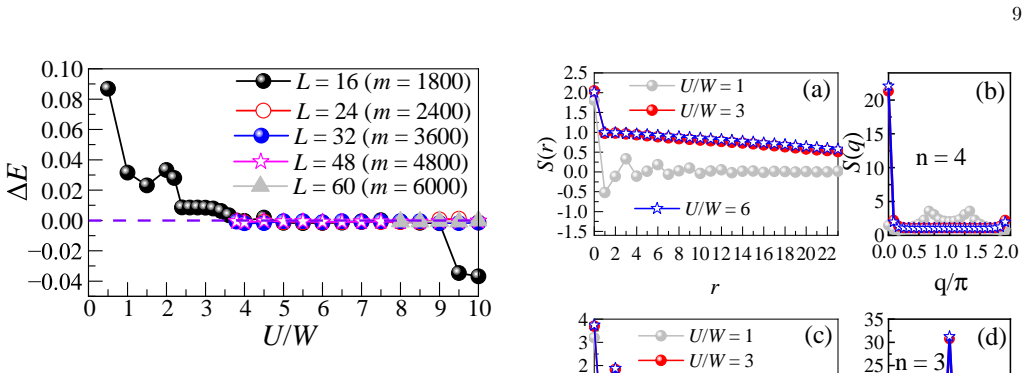
In the intermediate correlation regime, the Fe3+ chalcogenide chain develops an orbital-selective Mott phase where localized and itinerant electrons coexist, with no detectable pairing tendency.
A machine-rendered reading of the paper's core claim, the machinery that carries it, and where it could break.
Core claim
In the intermediate electronic correlation U/W region, an orbital-selective Mott phase with the coexistence of localized and itinerant electrons is found based on orbital-selective behavior in charge fluctuations. A robust antiferromagnetic coupling is present along the chain. No obvious pairing tendency is observed, in contrast to iron ladders, indicating that superconductivity is unlikely to emerge in the Fe3+ systems.
What carries the argument
Three-orbital Hubbard model derived from first-principles calculations and solved by density matrix renormalization group, whose orbital-selective charge fluctuations signal the coexistence of localized and itinerant electrons.
If this is right
- Antiferromagnetic order remains robust along the chain direction across the studied correlation range.
- The Fe3+ chain shares the electronic structure of the Fe2+ chain but lacks the pairing instability reported for iron ladders.
- Superconductivity is disfavored in Fe3+ chalcogenide chains relative to related ladder compounds.
- The orbital-selective Mott regime separates localized and itinerant electrons without generating pairing.
Where Pith is reading between the lines
- Material searches could target compounds whose effective U/W falls outside the intermediate window to test whether pairing can be recovered.
- Comparison of measured spin and charge responses in real Fe3+ chains would directly test whether the model's orbital selectivity survives beyond the Hubbard approximation.
- The absence of pairing suggests that dimensional or orbital differences between chains and ladders control the emergence of superconductivity more than the Fe valence alone.
Load-bearing premise
The three-orbital Hubbard model taken from first-principles calculations faithfully represents the low-energy physics of the real Fe3+ chain.
What would settle it
Experimental measurement of charge fluctuations or spectral functions that shows all orbitals behaving identically rather than selectively, or direct observation of pairing correlations in the intermediate U/W window.
Figures



read the original abstract
Motivated by recent developments in the study of quasi-one-dimensional iron systems with Fe$^{2+}$, we comprehensively study the Fe$^{3+}$ chalcogenide chain system. Based on first-principles calculations, the Fe$^{3+}$ chain has a similar electronic structure as discussed before in the iron 2+ chain, due to similar Fe$X_4$ ($X$ = S or Se) tetrahedron chain geometry. Furthermore, a three-orbital electronic Hubbard model for this chain was constructed by using the density matrix renormalization group method. A robust antiferromagnetic coupling was unveiled in the chain direction. In addition, in the intermediate electronic correlation $U/W$ region, we found an interesting orbital-selective Mott phase with the coexistence of localized and itinerant electrons ($U$ is the on-site Hubbard repulsion, while $W$ is the electronic bandwidth) {\color{blue}based on the orbital-selective behavior observed in the charge fluctuations}. Furthermore, we do not observe any obvious pairing tendency in the Fe$^{3+}$ chain in the electronic correlation $U/W$ region, where superconducting pairing tendencies were reported before in iron ladders. This suggests that superconductivity is unlikely to emerge in the Fe$^{3+}$ systems. Our results establish with clarity the similarities and differences between Fe$^{2+}$and Fe$^{3+}$ iron chains, as well as iron ladders.
Editorial analysis
A structured set of objections, weighed in public.
Referee Report
Summary. The manuscript studies the electronic correlations in one-dimensional Fe^{3+} chalcogenide chains. First-principles calculations are used to derive a three-orbital Hubbard model for the FeX_4 tetrahedron chain geometry, which is then solved with DMRG. The work reports robust antiferromagnetic coupling along the chain direction and, in the intermediate U/W regime, an orbital-selective Mott phase with coexistence of localized and itinerant electrons, identified via orbital-selective charge fluctuations. No significant pairing tendencies are observed, in contrast to Fe^{2+} chains and iron ladders, leading to the conclusion that superconductivity is unlikely in Fe^{3+} systems.
Significance. If the orbital-selective Mott phase is robustly established beyond charge-fluctuation diagnostics, the work clarifies distinctions between Fe^{3+} and Fe^{2+} chains and between chains and ladders, adding to the understanding of orbital-selective physics in quasi-1D iron chalcogenides. The first-principles model construction combined with DMRG provides a reproducible workflow and falsifiable predictions for correlation-driven phases.
major comments (1)
- Abstract and the section describing the orbital-selective Mott phase: the identification rests on orbital-selective suppression of charge fluctuations. However, the variance <n(1-n)> can decrease in correlated metals or Luttinger liquids without a charge gap when inter-orbital Hund coupling and hopping are present, as is the case in the three-orbital d^5 model. Orbital-resolved spectral functions, compressibility, or momentum distribution functions demonstrating selective insulation and integer filling are required to confirm true Mott localization and the claimed coexistence of localized and itinerant electrons.
minor comments (1)
- Explicit tabulation of all first-principles-derived hopping and interaction parameters (including Hund's J) would improve reproducibility of the DMRG results.
Simulated Author's Rebuttal
We thank the referee for the careful reading of our manuscript and the constructive comment on the identification of the orbital-selective Mott phase. We address the point below.
read point-by-point responses
-
Referee: Abstract and the section describing the orbital-selective Mott phase: the identification rests on orbital-selective suppression of charge fluctuations. However, the variance <n(1-n)> can decrease in correlated metals or Luttinger liquids without a charge gap when inter-orbital Hund coupling and hopping are present, as is the case in the three-orbital d^5 model. Orbital-resolved spectral functions, compressibility, or momentum distribution functions demonstrating selective insulation and integer filling are required to confirm true Mott localization and the claimed coexistence of localized and itinerant electrons.
Authors: We appreciate the referee's observation that suppression of charge fluctuations alone does not unambiguously establish a charge gap or Mott localization, particularly in the presence of inter-orbital Hund coupling within the three-orbital d^5 model. In our calculations, the orbital-selective reduction in <n(1-n)> occurs alongside other indicators, including the formation of local moments and the evolution of spin correlations that are consistent with localized behavior in two orbitals and itinerant character in the third. Nevertheless, we agree that additional diagnostics would strengthen the claim. In the revised manuscript we will expand the relevant section to include orbital occupancies (which approach integer values in the localized orbitals), a brief discussion of the limitations of the charge-fluctuation diagnostic, and references to analogous diagnostics employed in prior studies of orbital-selective Mott phases. We will also explore the feasibility of adding orbital-resolved spectral functions or momentum distributions for representative parameter values. revision: partial
Circularity Check
No circularity: results follow from independent first-principles model solved numerically
full rationale
The paper derives a three-orbital Hubbard model from first-principles calculations on the Fe3+ chain geometry, then applies DMRG to obtain charge fluctuation diagnostics across U/W values. The orbital-selective Mott phase identification is presented as an observation of selective suppression in those fluctuations, not as a quantity fitted to or defined by the same data. No equations reduce the output to the input by construction, no self-citation chain carries the central claim, and no ansatz or uniqueness theorem is invoked to force the result. This is a standard model-construction-plus-simulation workflow whose diagnostics remain independent of the target interpretation.
Axiom & Free-Parameter Ledger
axioms (1)
- domain assumption The Fe3+ chain has a similar electronic structure to the Fe2+ chain due to similar FeX4 tetrahedron chain geometry.
Lean theorems connected to this paper
-
IndisputableMonolith/Cost/FunctionalEquation.leanwashburn_uniqueness_aczel unclear?
unclearRelation between the paper passage and the cited Recognition theorem.
in the intermediate electronic correlation U/W region, we found an interesting orbital-selective Mott phase with the coexistence of localized and itinerant electrons based on the orbital-selective behavior observed in the charge fluctuations
What do these tags mean?
- matches
- The paper's claim is directly supported by a theorem in the formal canon.
- supports
- The theorem supports part of the paper's argument, but the paper may add assumptions or extra steps.
- extends
- The paper goes beyond the formal theorem; the theorem is a base layer rather than the whole result.
- uses
- The paper appears to rely on the theorem as machinery.
- contradicts
- The paper's claim conflicts with a theorem or certificate in the canon.
- unclear
- Pith found a possible connection, but the passage is too broad, indirect, or ambiguous to say the theorem truly supports the claim.
discussion (0)
Sign in with ORCID, Apple, or X to comment. Anyone can read and Pith papers without signing in.