REVIEW 3 major objections 5 minor 48 references
Laser-Controlled Nonlinear Hall Effect in Tellurium Solids via Nonlinear Phononics
T0 review · 3 major / 5 minor · reviewed 2026-08-12 · deepseek-v4-flash
Pith's one-line read A strong THz laser pulse can reverse the direction of the nonlinear Hall current in electron-doped tellurium by transiently distorting its helical lattice.
desk verdict A plausible and genuinely new prediction of laser-driven NHE sign reversal in Te, but the static-displacement bridge from the oscillating lattice to the BCD flip is not justified and should be tested before publication. read the letter →
The pith
A machine-rendered reading of the paper's core claim, the machinery that carries it, and where it could break.
The reading
What carries the argument
The central object is the total potential energy of the two coupled phonon modes, $V(Q_{A2}, Q_{A1})$, containing harmonic terms for both modes, anharmonic cubic and quartic terms for A1, a quartic term for A2, and the symmetry-allowed couplings $g_1 Q_{A2}^2 Q_{A1}$ and $g_2 Q_{A2}^2 Q_{A1}^2$. Solving the coupled equations of motion with the laser force applied only to A2 yields a nonzero time-averaged shift of $Q_{A1}$, i.e. the lattice distortion. That distortion is then fed into density-functional band structure calculations, and the nonlinear Hall response is evaluated from the Berry curvature dipole $D_{zz}(\epsilon)$, the Fermi-surface integral of $v_z \Omega_z$, which is the standard quantity controlling the nonlinear Hall current.
What would settle it
A time-resolved nonlinear Hall transport experiment on electron-doped Te under a resonant THz pump, sweeping pump fluence and measuring the transverse second-harmonic voltage, would settle the claim: if the Hall signal does not reverse sign at the fluence corresponding to $Q_{A1} \approx 0.78$ $\mathrm{\AA}\sqrt{\mathrm{amu}}$, the central prediction fails.
Extended reading notes
Core claim
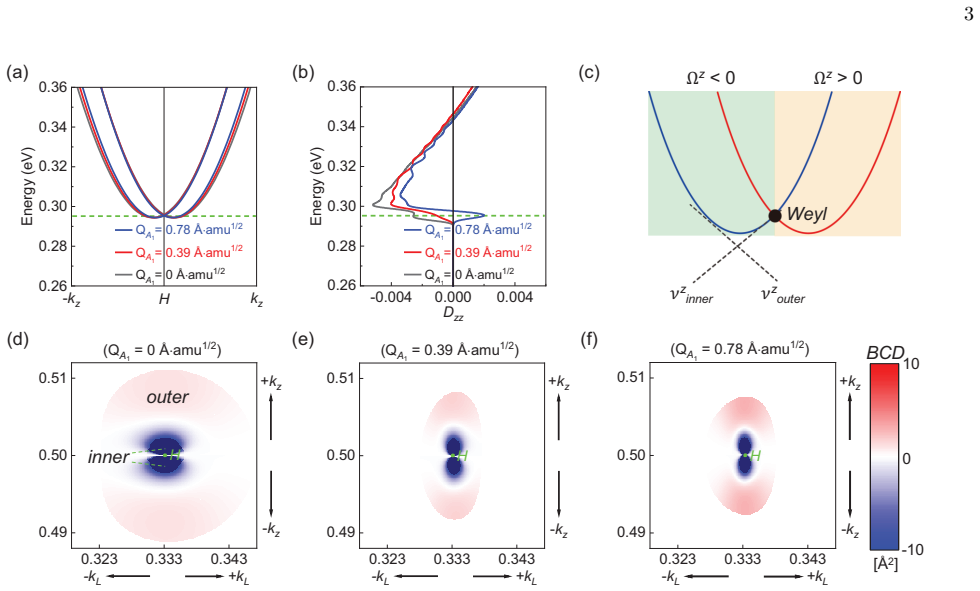
On its own terms, the paper establishes that a resonant THz pump on tellurium does more than heat it: it creates a transient non-equilibrium lattice state in which the A1 breathing mode acquires an equilibrium displacement $\delta Q_{A1}$ while the driving A2 mode oscillates. Because the A1 potential is anharmonic (a sizeable cubic term), and because symmetry allows a $g_1 Q_{A2}^2 Q_{A1}$ coupling, the time average of the driven motion is a net expansion of the helical chain radius. First-principles band calculations for frozen displacements of $Q_{A1} = 0, 0.39, 0.78$ $\mathrm{\AA}\sqrt{\mathrm{amu}}$ show the conduction-band edge along $\Gamma$-$A$ dropping below the $H$-point minimum, turning Te into an indirect semiconductor, and the bands around the Weyl point at $H$ being deformed. Integrating the Berry curvature dipole $D_{zz}$ over the Fermi surface for electron-doped Te then gives a sign reversal of $D_{zz}$ as $Q_{A1}$ grows, which the paper reads as a reversal of the nonlinear Hall current under increasing laser strength.
Load-bearing premise
The calculation replaces the laser-driven oscillating lattice by a static displacement along the A1 mode; if the Berry curvature dipole is not nearly linear in that displacement over the oscillation amplitude, the predicted time-averaged sign reversal could differ from the static result.
Editorial extensions
If this is right
- Resonant THz excitation of Te should produce a measurable transient sign flip of the nonlinear Hall voltage in electron-doped crystals, with the flip occurring before any structural phase transition.
- The same lattice-distortion channel should push Te's fundamental gap from direct to indirect transiently, observable as a change in recombination or optical absorption dynamics.
- The predicted equilibrium shift along A1 scales monotonically with pump strength, giving a continuous knob for Berry curvature dipole magnitude rather than an on-off switch.
- Since the A2–A1 coupling and anharmonic A1 potential are symmetry-allowed in other chiral elemental solids, similar THz control of the BCD should occur in related materials.
- The mechanism does not require time-reversal symmetry breaking, so it applies to inversion-broken but non-magnetic crystals.
Reading between the lines
- A natural testable extension is to compute the time-averaged BCD over one full A1+A2 oscillation rather than at frozen displacements; if the sign reversal survives averaging, the static approximation is confirmed, but if it does not, the reversal would be weaker or delayed.
- The paper's static-displacement calculation implicitly assumes the electronic response follows the lattice adiabatically; at THz timescales, a non-adiabatic treatment could modify both the magnitude and the switching speed of the Hall signal.
- One could also probe the direct-to-indirect transition independently with time-resolved terahertz conductivity or photoemission, cross-checking the same lattice distortion that produces the Hall reversal.
- The sign-reversal criterion could be applied to other Weyl systems: any material whose Weyl-point dispersion responds to a symmetry-preserving phonon displacement should show BCD control at similar fluences.
Editorial analysis
A structured set of objections, weighed in public.
Referee Report
Summary. The paper proposes a mechanism for ultrafast laser control of the nonlinear Hall effect in elemental tellurium. A THz laser resonantly drives the infrared-active A2 phonon; because of nonlinear phonon coupling, this indirectly excites the Raman-active A1 mode, whose anharmonic potential produces a rectified lattice displacement along the A1 coordinate. Using first-principles DFT calculations and coupled-phonon dynamics with parameters fitted to DFT (Table I), the authors find that the resulting lattice distortion changes Te from a direct to an indirect semiconductor and, at electron-doped Fermi energies near the Weyl point at H, reverses the Berry curvature dipole component Dzz. They interpret the reversal through the momentum-space redistribution of Berry curvature and Fermi velocity contributions around the Weyl point, and conclude that the nonlinear Hall current direction in electron-doped Te can be reversed by a strong THz laser field.
Significance. If the predicted sign reversal survives a more complete treatment of the driven lattice, this would be a notable demonstration of nonlinear-phononics control over a Berry-curvature-derived transport response in a simple elemental solid, connecting ultrafast lattice dynamics with topological transport. The paper's strengths include the explicit first-principles construction of the coupled phonon potential, the dynamical simulation of the A1-A2 coupling with a clear zero-frequency displacement component, and the direct frozen-phonon DFT evaluation of the BCD from first-principles band structures rather than from the fitted model. The mechanism proposed — competition between inner and outer Fermi-velocity regions around the Weyl point — is concrete and falsifiable. However, the central transport prediction is currently computed from static displacements only, and the connection between the oscillating laser-driven lattice and the time-averaged nonlinear Hall signal is not established; this is the main load-bearing gap.
major comments (3)
- [Fig. 2(c)-(d) and Fig. 4(b)] The central claim of sign reversal is supported by computing Dzz only for static A1 displacements QA1 = 0, 0.39, 0.78 Å√amu, while the actual laser-driven state shown in Fig. 2(c) oscillates with frequency components at zero, 2ω_A2, and ω_A1,eff. The paper does not justify that the time-averaged BCD is equal to the BCD evaluated at the rectified displacement. Because Fig. 4(b) shows Dzz crossing zero between QA1 = 0.39 and 0.78, the oscillatory part of the trajectory could sample regions of opposite Dzz sign, and the time-averaged signed current could differ from or even cancel the static prediction. Please provide a time-resolved estimate of Dzz along the actual trajectory, or an explicit argument that Dzz is approximately linear in QA1 over the oscillation amplitude so that only the mean displacement matters.
- [Fig. 2(e) and the surrounding text] The mapping from laser pump strength to the rectified displacement δQA1 ≈ 0.78 Å√amu is asserted through a brief statement involving Te atomic mass, Born effective charge, and 'experimentally achievable pump strength,' but no formula, no pump field amplitude, and no pulse duration are given. Since the BCD reversal in Fig. 4 is computed precisely at QA1 = 0.78, the experimental feasibility of reaching that displacement within the phonon lifetime is load-bearing. Please state the conversion, the corresponding electric-field amplitude and pulse length, the phonon lifetime, and the resulting duration during which the distorted structure is present relative to the transport measurement time.
- [Eq. (4) and the paragraph after it] The manuscript defines the Berry curvature dipole Dzz but never writes the nonlinear Hall current expression that connects Dzz to the measurable current. The abstract claims a sign reversal of the 'nonlinear Hall-like current,' yet the text only states that the in-plane NHE current flows along the trigonal axis, citing Ref. [36]. Please give the full nonlinear current formula (including the relaxation-time prefactor and the direction of flow) and show explicitly that the sign change of Dzz in Fig. 4(b) corresponds to a sign change of the measurable current for the relevant electron-doped Fermi energy and scattering time. Without this, the central transport claim is not completely specified.
minor comments (5)
- [Introduction, first paragraph] There are typographical and grammatical errors, e.g., 'In stead of phase transitions' should be 'Instead of phase transitions,' and 'could enables dynamic structure design' should be 'could enable dynamic structure design.'
- [Eq. (1) and the discussion of Table I] The statement that the absolute value of a3 (7.62 meV/amu^{3/2} Å^3) is 'significant compared to' ω²_A1 (38.74 meV/amu Å^2) is dimensionally inconsistent because a3 multiplies Q^3 while ω²_A1 multiplies Q^2; the relative importance depends on the amplitude of QA1. The conclusion that the A1 mode is anharmonic can be justified, but the comparison should be made through a dimensionless ratio such as a3 A / ω²_A1 for a relevant amplitude A.
- [Fig. 4 caption and Fig. 3(c)] The conversions between normal-coordinate values QA1 = 0.39 and 0.78 Å√amu and atomic displacements of 0.1 and 0.2 Å are stated without derivation; please clarify the normal-mode normalization and show how the atomic displacement is obtained from QA1.
- [Note added and Ref. [48]] The 'Note added' disclosing the related e-print is appreciated, but the manuscript would benefit from a brief comparison of the results and methods with Ref. [48] so that the novelty and differences are clear to the reader.
- [Throughout] Several references to the Supplemental Material (Sec. II, Sec. III, Figs. S1-S6, Table S1) carry essential technical details, including the analytical derivation of the zero-frequency shift and the coupling equations of motion. These details should be summarized at least briefly in the main text so that the core derivation is self-contained.
Circularity Check
No significant circularity: the BCD reversal is computed directly from first-principles electronic structure at displaced geometries, and the fitted phonon model supplies only the displacement scale.
full rationale
The paper's derivation chain is self-contained. The phonon potential parameters in Table I are fitted to DFT total energies and are used to simulate the laser-driven A2/A1 dynamics and to estimate the rectified A1 displacement of about 0.8 Å·amu^(1/2). The central transport prediction, however, is the reversal of Dzz, which is obtained by evaluating the Berry curvature dipole from first-principles band structures at frozen A1 displacements QA1 = 0, 0.39, and 0.78 Å·amu^(1/2). The sign reversal is therefore a direct electronic-structure result for the displaced lattice, not a restatement of the fitted phonon parameters. No predicted quantity is equivalent by construction to a parameter fitted to the target data. The only coauthor self-citation, Ref. [20] by Shin, Rubio, and Tang, appears in a contextual list of non-equilibrium steady states and is not load-bearing for the BCD calculation or the sign-reversal claim. The static-displacement approximation for the time-averaged BCD under an oscillating lattice is a physical approximation that could affect accuracy, but an approximation or possible failure is a correctness risk, not circularity. Accordingly, no circular step is identified.
Assumptions & free parameters
free parameters (4)
- Potential coefficients ω²_A2, b4, ω²_A1, a3, a4, g1, g2 =
26.72, 0.28, 38.74, -7.62, 0.24, -0.85, -2.02 (in meV and mixed units)
- Pump driving force F =
not specified in main text
- QA1 displacement values =
0.39 and 0.78 Å√amu
- Electron doping level / Fermi energy =
energy near the Weyl point at H
assumptions (5)
- domain assumption DFT with an approximate exchange-correlation functional gives accurate band structure and Berry curvature for Te.
- domain assumption The coupled phonon dynamics can be described by classical equations of motion with the fitted potential Eq. 3.
- ad hoc to paper The time-averaged effect of the laser-driven lattice motion is captured by a static displacement along A1 only.
- standard math Symmetry selection rule A2⊗A2⊗A1⊗...⊗A1 ⊃ A1 governs the allowed couplings.
- domain assumption The Berry curvature dipole formula Eq. 4 describes the nonlinear Hall current.
Cite this review
Pith. "Pith review of Laser-Controlled Nonlinear Hall Effect in Tellurium Solids via Nonlinear Phononics." pith.science (2026). https://pith.science/paper/RWO35RSU
@misc{pith2026241118843,
  author       = {Pith},
  title        = {Pith review of: Laser-Controlled Nonlinear Hall Effect in Tellurium Solids via Nonlinear Phononics},
  year         = {2026},
  howpublished = {\url{https://pith.science/paper/RWO35RSU}},
  note         = {Machine review of arXiv:2411.18843}
}
read the original abstract
A Terahertz (THz) laser with strong strength could excite more than one phonons and induce a transient lattice distortion termed as nonlinear phononics. This process allows dynamic control of various physical properties, including topological properties. Here, using first-principles calculations and dynamical simulations, we demonstrate that THz laser excitation can modulate the electronic structure and the signal of nonlinear Hall effect in elemental solid tellurium (Te). By strongly exciting the chiral phonon mode, we observe a non-equilibrium steady state characterized by lattice distortion along the breathing vibrational mode. This leads to a transition of Te from a direct to an indirect semiconductor. In addition, the energy dispersion around the Weyl point is deformed, leading to variations in the local Berry curvature dipole. As a result, the nonlinear Hall-like current in Te can be modulated with electron doping where the sign of current could be reversed under a strong THz laser field. Our results may stimulate further research on coupled quasiparticles in solids and the manipulation of their topological transport properties using THz lasers.
Figures


Reference graph
Works this paper leans on
-
[48]
Light-induced renormalization of the band structure of chiral tellurium
G. Gatti, N. Tancogne-Dejean, H. H¨ ubener, U. D. Gio- vannini, J. Dai, S. Polishchuk, P. Bugnon, F. Frassetto, L. Poletto, M. Chergui, M. Grioni, A. Rubio, M. Pup- pin, and A. Crepaldi, arXiv preprint arXiv:2411.13954 (2024)
work page Pith review arXiv 2024
-
[36]
S. S. Tsirkin, P. A. Puente, and I. Souza, Phys. Rev. B 97, 035158 (2018)
work page 2018
-
[1]
Forn-D ´ ıaz, L
P. Forn-D ´ ıaz, L. Lamata, E. Rico, J. Kono, and E. Solano, Rev. Mod. Phys. 91, 025005 (2019)
2019
- [2]
-
[3]
R. B. Liu, W. Yao, and L. J. Sham, Adv. Phys. 59, 703 (2010)
work page 2010
-
[4]
M. F¨ orst, C. Manzoni, S. Kaiser, Y. Tomioka, Y. Tokura, R. Merlin, and A. Cavalleri, Nat. Phys. 7, 854 (2011)
work page 2011
-
[5]
O. Neufeld, J. Zhang, U. De Giovannini, H. H¨ ubener, and A. Rubio, Proc. Natl. Acad. Sci. 119, e2204219119 (2022)
work page 2022
- [6]
Show all 48 references
-
[7]
Fechner, M
M. Fechner, M. F¨ orst, G. Orenstein, V. Krapivin, A. S. Disa, M. Buzzi, A. von Hoegen, G. de la Pena, Q. L. Nguyen, R. Mankowsky, M. Sander, H. Lemke, Y. Deng, M. Trigo, and A. Cavalleri, Nat. Mater. 23, 363 (2024)
2024
-
[8]
Subedi, A
A. Subedi, A. Cavalleri, and A. Georges, Phys. Rev. B 89, 220301 (2014)
2014
-
[9]
Mankowsky, M
R. Mankowsky, M. F¨ orst, T. Loew, J. Porras, B. Keimer, and A. Cavalleri, Phys. Rev. B 91, 094308 (2015)
2015
-
[10]
Fechner and N
M. Fechner and N. A. Spaldin, Phys. Rev. B 94, 134307 (2016)
2016
-
[11]
D. M. Juraschek, M. Fechner, and N. A. Spaldin, Phys. Rev. Lett. 118, 054101 (2017)
2017
-
[12]
Frenzel, M
M. Frenzel, M. Cherasse, J. M. Urban, F. Wang, B. Xiang, L. Nest, L. Huber, L. Perfetti, M. Wolf, T. Kampfrath, X. Y. Zhu, and S. F. Maehrlein, Sci. Adv. 9, eadg3856 (2023)
2023
-
[13]
E. J. Sie, C. M. Nyby, C. D. Pemmaraju, S. J. Park, X. Shen, J. Yang, M. C. Hoffmann, B. K. Ofori-Okai, R. Li, A. H. Reid, S. Weathersby, E. Mannebach, N. Finney, D. Rhodes, D. Chenet, A. Antony, L. Bali- cas, J. Hone, T. P. Devereaux, T. F. Heinz, X. Wang, and A. M. Lindenber...
2019
-
[14]
T. F. Nova, A. Cartella, A. Cantaluppi, M. F¨ orst, D. Bossini, R. V. Mikhaylovskiy, A. V. Kimel, R. Merlin, and A. Cavalleri, Nat. Phys. 13, 132 (2017)
2017
-
[15]
A. S. Disa, M. Fechner, T. F. Nova, B. L. Liu, M. F¨ orst, D. Prabhakaran, P. G. Radaelli, and A. Cavalleri, Nat. Phys. 16, 937 (2020)
2020
-
[16]
Afanasiev, J
D. Afanasiev, J. R. Hortensius, B. A. Ivanov, A. Sasani, E. Bousquet, Y. M. Blanter, R. V. Mikhaylovskiy, A. V. Kimel, and A. D. Caviglia, Nat. Mater. 20, 607 (2021)
2021
-
[17]
R. Tang, F. Boi, and Y. H. Cheng, npj Quantum Mater. 8, 78 (2023). 5
2023
-
[18]
Mankowsky, A
R. Mankowsky, A. Subedi, M. F¨ orst, S. O. Mariager, M. Chollet, H. T. Lemke, J. S. Robinson, J. M. Glow- nia, M. P. Minitti, A. Frano, M. Fechner, N. A. Spaldin, T. Loew, B. Keimer, A. Georges, and A. Cavalleri, Na- ture 516, 71 (2014)
2014
-
[19]
Radhakrishnan, K
P. Radhakrishnan, K. S. Rabinovich, A. V. Boris, K. F¨ ursich, M. Minola, G. Christiani, G. Logvenov, B. Keimer, and E. Benckiser, Nat. Phys. 10.1038/s41567- 024-02686-8 (2024)
2024 doi
-
[20]
D. Shin, A. Rubio, and P. Tang, Phys. Rev. Lett. 132, 016603 (2024)
2024
-
[21]
Q. Ma, S. Y. Xu, C. K. Chan, C. L. Zhang, G. Chang, Y. Lin, W. Xie, T. Palacios, H. Lin, S. Jia, P. A. Lee, P. Jarillo-Herrero, and N. Gedik, Nat. Phys. 13, 842 (2017)
2017
-
[22]
E. A. Mashkovich, K. A. Grishunin, R. M. Dubrovin, A. K. Zvezdin, R. V. Pisarev, and A. V. Kimel, Science 374, 1608 (2021)
2021
-
[23]
Subedi, Phys
A. Subedi, Phys. Rev. B 92, 214303 (2015)
2015
-
[24]
Mankowsky, A
R. Mankowsky, A. von Hoegen, M. F¨ orst, and A. Caval- leri, Phys. Rev. Lett. 118, 197601 (2017)
2017
-
[25]
Sodemann and L
I. Sodemann and L. Fu, Phys. Rev. Lett. 115, 216806 (2015)
2015
-
[26]
J. Wang, H. Zeng, W. Duan, and H. Huang, Phys. Rev. Lett. 131, 056401 (2023)
2023
-
[27]
Y. K. Kato, R. C. Myers, A. C. Gossard, and D. D. Awschalom, Science 306, 1910 (2004)
2004
-
[28]
C. Z. Chang, J. Zhang, X. Feng, J. Shen, Z. Zhang, M. Guo, K. Li, Y. Ou, P. Wei, L. L. Wang, Z. Q. Ji, Y. Feng, S. Ji, X. Chen, J. Jia, X. Dai, Z. Fang, S. C. Zhang, K. He, Y. Wang, L. Lu, X. C. Ma, and Q. K. Xue, Science 340, 167 (2013)
2013
-
[29]
P. J. M. W¨ oltgens, C. Dekker, and H. W. de Wijn, Phys. Rev. Lett. 71, 3858 (1993)
1993
-
[30]
H. Yang, Y. Liu, C. Zhuang, J. Shi, Y. Yao, S. Massidda, M. Monni, Y. Jia, X. Xi, Q. Li, Z. K. Liu, Q. Feng, and H. H. Wen, Phys. Rev. Lett. 101, 067001 (2008)
2008
-
[31]
Zhang, L
X. Zhang, L. Yu, S. von Moln´ ar, Z. Fisk, and P. Xiong, Phys. Rev. Lett. 103, 106602 (2009)
2009
-
[32]
V. K. Dugaev, M. Inglot, E. Y. Sherman, J. Berakdar, and J. Barna´ s, Phys. Rev. Lett.109, 206601 (2012)
2012
-
[33]
M. S. Hossain, F. Schindler, R. Islam, Z. Muhammad, Y. X. Jiang, Z. J. Cheng, Q. Zhang, T. Hou, H. Chen, M. Litskevich, B. Casas, J. X. Yin, T. A. Cochran, M. Yahyavi, X. P. Yang, L. Balicas, G. Chang, W. Zhao, T. Neupert, and M. Z. Hasan, Nature 628, 527 (2024)
2024
-
[34]
I. K. Drozdov, A. Alexandradinata, S. Jeon, S. Nadj- Perge, H. Ji, R. J. Cava, B. A. Bernevig, and A. Yazdani, Nat. Phys. 10, 664 (2014)
2014
-
[35]
Schindler, Z
F. Schindler, Z. Wang, M. G. Vergniory, A. M. Cook, A. Murani, S. Sengupta, A. Y. Kasumov, R. Deblock, S. Jeon, I. Drozdov, H. Bouchiat, S. Gu´ eron, A. Yaz- dani, B. A. Bernevig, and T. Neupert, Nat. Phys. 14, 918 (2018)
2018
-
[37]
Gatti, D
G. Gatti, D. Gos´ albez-Mart ´ ınez, S. S. Tsirkin, M. Fan- ciulli, M. Puppin, S. Polishchuk, S. Moser, L. Testa, E. Martino, S. Roth, P. Bugnon, L. Moreschini, A. Bost- wick, C. Jozwiak, E. Rotenberg, G. Di Santo, L. Petaccia, I. Vobornik, J. Fujii, J. Wong, D. Jariwala, H. A...
2020
-
[38]
Sakano, M
M. Sakano, M. Hirayama, T. Takahashi, S. Akebi, M. Nakayama, K. Kuroda, K. Taguchi, T. Yoshikawa, K. Miyamoto, T. Okuda, K. Ono, H. Kumigashira, T. Ideue, Y. Iwasa, N. Mitsuishi, K. Ishizaka, S. Shin, T. Miyake, S. Murakami, T. Sasagawa, and T. Kondo, Phys. Rev. Lett. 124, 136...
2020
-
[39]
Furukawa, Y
T. Furukawa, Y. Watanabe, N. Ogasawara, K. Kobayashi, and T. Itou, Phys. Rev. Res. 3, 023111 (2021)
2021
-
[40]
V. A. Shalygin, A. N. Sofronov, L. E. Vorob’ev, and I. I. Farbshtein, Phys. Solid State 54, 2362 (2012)
2012
-
[41]
L. A. Agapito, N. Kioussis, W. A. Goddard, and N. P. Ong, Phys. Rev. Lett. 110, 176401 (2013)
2013
-
[42]
Hirayama, R
M. Hirayama, R. Okugawa, S. Ishibashi, S. Murakami, and T. Miyake, Phys. Rev. Lett. 114, 5 (2015)
2015
-
[43]
H. Ning, O. Mehio, C. Lian, X. Li, E. Zoghlin, P. Zhou, B. Cheng, S. D. Wilson, B. M. Wong, and D. Hsieh, Phys. Rev. B 106, 205118 (2022)
2022
-
[44]
Jnawali, Y
G. Jnawali, Y. Xiang, S. M. Linser, I. A. Shojaei, R. Wang, G. Qiu, C. Lian, B. M. Wong, W. Wu, P. D. Ye, Y. Leng, H. E. Jackson, and L. M. Smith, Nat. Commun. 11, 3991 (2020)
2020
-
[45]
for supplementary notes, Figs
See Supplemental Material at ... for supplementary notes, Figs. S1-S6, and Table S1
-
[46]
H. Peng, N. Kioussis, and D. A. Stewart, Appl. Phys. Lett. 107, 251904 (2015)
2015
-
[47]
Shalaby and C
M. Shalaby and C. P. Hauri, Nat. Commun. 6, 5976 (2015)
2015
Reviewed August 12, 2026 · model on record in the stance chip above.
Discussion (0). Continue with ORCID to comment.