REVIEW 4 major objections 6 minor 15 cited by
XVerse: Consistent Multi-Subject Control of Identity and Semantic Attributes via DiT Modulation
T0 review · 4 major / 6 minor · reviewed 2026-08-06 · deepseek-v4-flash
Pith's one-line read XVerse claims that turning reference images into per-word text-stream modulation offsets gives precise, independent control over multiple subjects while preserving the base model's composition.
desk verdict A plausible tuning-free multi-subject control method for FLUX-based DiT, but the paper never specifies how references bind to prompt tokens at inference, and the evaluation is too thin to support the SOTA claim. read the letter →
The pith
A machine-rendered reading of the paper's core claim, the machinery that carries it, and where it could break.
The reading
What carries the argument
The load-bearing mechanism is token-specific text-stream modulation in DiT blocks. A DiT block already derives scale and bias parameters from a conditioning vector $y = \operatorname{MLP}(t, f_p)$, where $t$ is the timestep and $f_p$ is the CLIP embedding of the prompt. XVerse turns each reference image into an offset $\Delta_{\text{cross}}$ with a perceiver resampler that uses the CLIP image features, then adds that offset to $y$. The offset is split into a shared component and per-block components, analogous to the $W{+}$ expansion in StyleGAN, giving $y_i^* = \operatorname{MLP}(t,f_p) + \Delta_{\text{shared}} + \Delta_i^{\text{per-block}}$. Because the injection happens in the text-modulation stream rather than in attention or latents, the paper argues the base model's composition is preserved, while VAE features provide fine detail in a single block. Two regularizers -- a region-preservation loss and a text-image attention loss -- keep the modulated model's behavior aligned with the untouched text-to-image branch.
What would settle it
The paper's own appendix runs a decisive test: a reference image of a person paired with the injected token 'a dog' makes injection consistently fail. A systematic sweep over mismatched reference-token pairs, measuring Face ID similarity and DPG score, would show how much of the multi-subject claim depends on the user supplying an unambiguous match.
Extended reading notes
Core claim
On its own terms, the paper's discovery is that the modulation vector computed inside each DiT block -- normally a function of the timestep and the text embedding only -- can be augmented with image-derived offsets without destroying the generative prior. For a reference image $I_c$, the adapter computes $\Delta_{\text{cross}} = \operatorname{Resampler}(f_p, f_c)$ with $f_c = \operatorname{CLIP}(I_c)$, then decomposes it into a shared part and per-block parts, so block $i$ receives $y_i^* = \operatorname{MLP}(t, f_p) + \Delta_{\text{shared}} + \Delta_i^{\text{per-block}}$. VAE-encoded reference features are added in only a single block as a detail-supporting signal. Trained with region-preservation and text-image attention losses on phrase-grounded data, the model reports the best overall XVerseBench score of 73.40 among the methods compared, with a single-subject average of 76.72.
Load-bearing premise
The method depends on the user's prompt clearly matching each reference image to a specific word or phrase, because the paper provides no mechanism at inference for deciding which reference goes with which word.
Editorial extensions
If this is right
- If the central claim holds, one tuning-free model can personalize a scene with one, two, or three subjects without per-subject fine-tuning.
- Semantic attributes such as pose, lighting, clothing, and artistic style become editable by directing reference images at the corresponding prompt words, without task-specific training data.
- Because the base text-to-image branch is preserved through the two regularizers, the generated scene stays open to further editing instead of being locked to the reference image.
- The method's reported XVerseBench result (overall 73.40, single-subject average 76.72) would make it the strongest of the six compared methods on that benchmark.
Reading between the lines
- An implicit and untested step is how the user tells the model which reference image belongs to which prompt word; the training pipeline obtains this by phrase grounding, but no inference-time binding or fallback is described, so the method's practical range depends on this unstated step.
- Because the injection avoids the attention and latent streams, XVerse's offsets may compose with other DiT conditioners that do modify those streams; this is a testable extension the paper does not run.
- The paper's own appendix shows that a large semantic mismatch between a reference image and its assigned prompt word makes injection fail, so the practical limit is not subject count but the quality of prompt-reference alignment; a stress benchmark of mismatched bindings would map that limit.
Editorial analysis
A structured set of objections, weighed in public.
Referee Report
Summary. The paper introduces XVerse, a FLUX.1-dev-based method for multi-subject personalization in text-to-image generation. The core idea is to convert reference images into offsets added to the text-stream modulation vectors of DiT blocks (Eqs. 4–6), rather than injecting image features through attention. Fine-grained details are supplemented by VAEs features injected into a single FLUX block, and two regularizations (a region preservation loss and a text-image attention loss) are proposed to preserve editability and disentangle subjects. The authors report a new benchmark, XVerseBench, and claim an overall score of 73.40, outperforming six baselines, together with qualitative demonstrations of pose, style, lighting, and clothing control.
Significance. If the claims are substantiated, the paper opens a useful direction: exploiting the underused modulation pathway of DiTs for subject-specific control, which could reduce artifacts and attribute entanglement compared with attention-based injection. The training-data pipeline and benchmark are also of potential community value. The paper is honest about some limitations, and the architecture is described in enough detail for a plausibility check. However, the central mechanism of token-specific multi-subject control is incompletely specified at inference time, and the quantitative evidence is weakened by the absence of error bars, the self-built nature of the benchmark, and qualitative-only ablations. These issues need to be resolved before the SOTA claim can be accepted.
major comments (4)
- [§3.2, Eqs. (4)–(6)] The central claim of token-specific control is not formalized for multiple reference images. Eq. (4) takes a single conditioning image and text features, Eq. (5) adds a single offset to the global conditioning vector, and Eq. (6) decomposes that offset into shared and per-block components, where the index i indexes DiT blocks rather than text tokens. No equation or algorithm specifies how N reference images produce N per-token offsets at inference. The only token-image correspondence described is in the training-data pipeline (Section 3.4) via phrase grounding; the paper does not state how this correspondence is obtained or enforced at inference time for arbitrary user prompts.
- [Appendix B] Appendix B reports that when the prompt is semantically mismatched to the reference image, "the injection process consistently fails." This is direct internal evidence that the learned adapter has not acquired a general reference-to-token binding rule; it depends on the user supplying a prompt that is already aligned with each reference. Since no inference-time binding interface, fallback, or error handling is described, the claimed precise and independent multi-subject control is conditional on an unspecified user-dependent alignment. The XVerseBench evaluation does not test counterfactual bindings (e.g., swapped reference order or ambiguous subject descriptions), so the reported 73.40 overall score does not establish the claimed generality.
- [Table 1 and §4.2] The SOTA claim rests on a single run of each method on a self-built benchmark with no error bars, no multiple-seed results, and no statistical significance test. The benchmark also includes FLUX-generated content (Section 3.4) while the model is built on FLUX.1-dev, which may inflate self-consistency for the proposed method. The paper should report standard deviations or confidence intervals, specify how many images are generated per prompt and how per-prompt scores are aggregated, and ideally include an external or human-aligned evaluation to support the claim of significant outperformance.
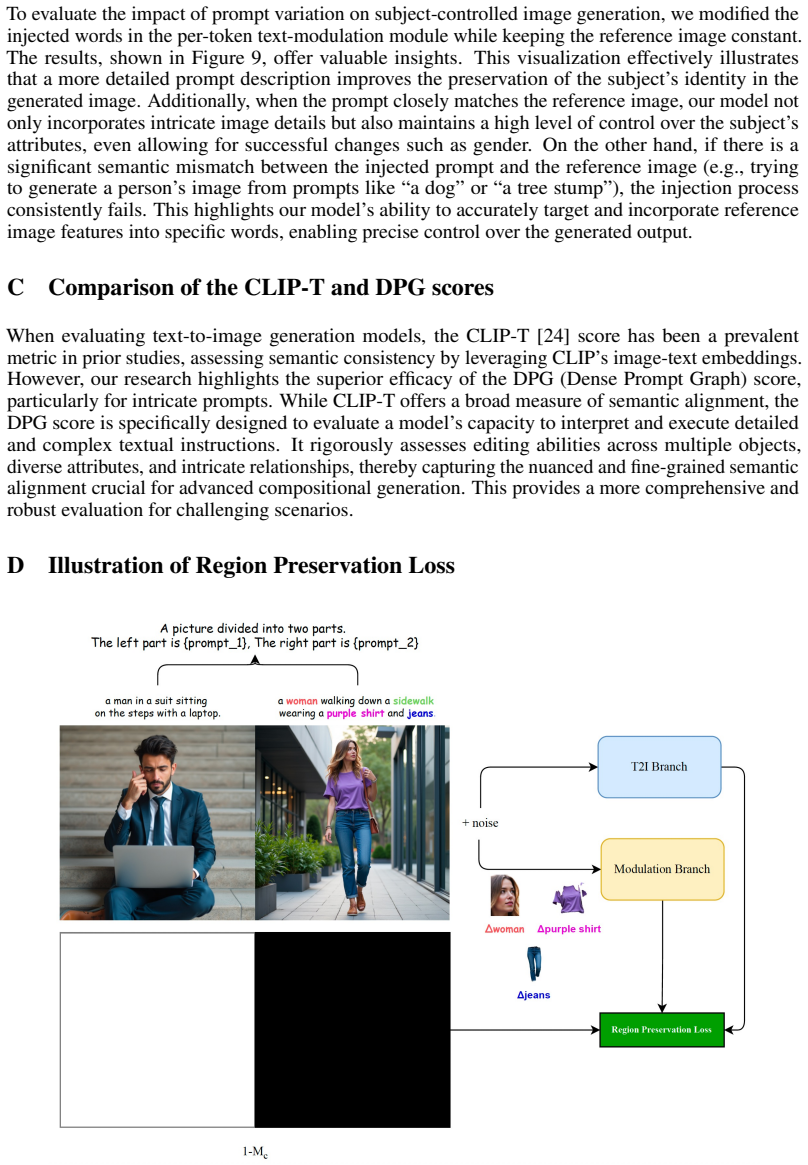
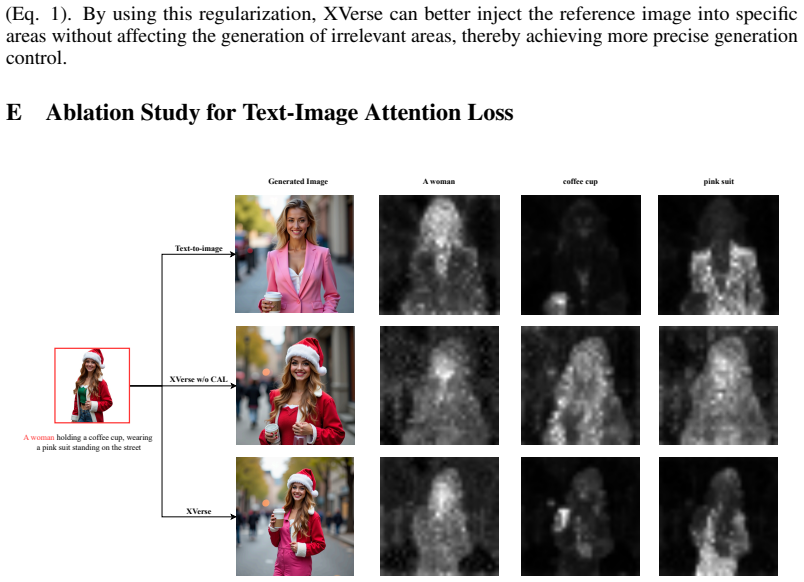
- [§4.3 and Appendix E] The ablations for the two regularizations are qualitative only. Figures 6 and 11 show example images and attention maps, but there are no quantitative results for removing the region preservation loss or the text-image attention loss. Given that these losses are presented as critical for multi-subject disentanglement and editability preservation, the paper should provide at least the same metrics used in Table 1 for the ablated variants.
minor comments (6)
- [§3.2 title and Introduction] There are typos and grammar issues, including "Multi-subject Controled Generation" in the Section 3.2 heading, "we leverages" in the Introduction, and "exprsss" in the contribution list; these should be corrected.
- [Appendix D] Appendix D refers to "Eq. 1" when describing the region preservation loss, but the equation is numbered (7) in the main text; the cross-reference should be fixed.
- [Table 1] Several numeric entries in Table 1 are run together without spacing (e.g., "96.896.52" and "55.7159.6354.69"), making the table difficult to read; the values should be separated clearly.
- [Figure 7 caption] The caption contains a typo: "The control of sementic attributes" should read "semantic attributes."
- [§4.1] The paper says VAEs features are injected into "single blocks" of FLUX but does not specify which block(s); please state the exact block index or selection rule, as this affects reproducibility.
- [§4.1 and §3.4] The relationship between the "20 newly generated portrait images" in the XVerseBench description and the "20 distinct human identities" is unclear; please clarify whether the 20 portraits are the test identities or an additional augmentation.
Circularity Check
No significant circularity: XVerse's claims are architectural and empirical, not derived from their inputs by construction.
full rationale
XVerse does not present a derivation or prediction that reduces to its inputs. Equations (4)-(6) define the modulation-adapter architecture: Delta_cross = Resampler(f_p, f_c) and y*_i = MLP(t, f_p) + Delta_shared + Delta_i_per-block are construction choices, not results claimed to follow deductively from assumptions. The token-reference correspondence is obtained at training time by Florence2/SAM2 grounding; the absence of an inference-time binding rule is a generality gap (acknowledged in Appendix B, which reports failure under prompt-reference mismatch), not circularity, because the method's success is not asserted by definition. The headline benchmark result (73.40 on XVerseBench) is an empirical comparison against six external methods using automated metrics; although XVerseBench was assembled by the authors and includes FLUX-generated images, that is benchmark design rather than a self-referential derivation. The only self-citation, Photoverse [10] in related work, is contextual and not load-bearing. No fitted parameter is renamed as a prediction, no uniqueness theorem is imported, and no known result is repackaged. No significant circularity found.
Assumptions & free parameters
free parameters (4)
- LoRA rank =
128
- Loss weights =
region preservation loss 10, text-image attention loss 0.01
- Training iterations =
70K / 150K / 10K for stages 1, 2, and 3
- Resampler dimension =
3072
assumptions (4)
- ad hoc to paper The DiT modulation pathway can be decomposed into separate text-stream and image-stream modulations, and adding an offset to the text-stream conditioning vector is sufficient to inject subject identity without perturbing the pretrained model's output.
- domain assumption At inference, users can specify which reference image binds to which text token in the prompt, preserving the training-time phrase-grounding correspondence.
- ad hoc to paper The L2 losses on unmodulated regions and on cross-attention maps make the modulated model preserve the base text-to-image model's composition and editability.
- domain assumption The dataset of 1M FLUX-synthesized images is a valid proxy for real-world multi-entity distributions.
Cite this review
Pith. "Pith review of XVerse: Consistent Multi-Subject Control of Identity and Semantic Attributes via DiT Modulation." pith.science (2026). https://pith.science/paper/RWUHUIUD
@misc{pith2026250621416,
  author       = {Pith},
  title        = {Pith review of: XVerse: Consistent Multi-Subject Control of Identity and Semantic Attributes via DiT Modulation},
  year         = {2026},
  howpublished = {\url{https://pith.science/paper/RWUHUIUD}},
  note         = {Machine review of arXiv:2506.21416}
}
read the original abstract
Achieving fine-grained control over subject identity and semantic attributes (pose, style, lighting) in text-to-image generation, particularly for multiple subjects, often undermines the editability and coherence of Diffusion Transformers (DiTs). Many approaches introduce artifacts or suffer from attribute entanglement. To overcome these challenges, we propose a novel multi-subject controlled generation model XVerse. By transforming reference images into offsets for token-specific text-stream modulation, XVerse allows for precise and independent control for specific subject without disrupting image latents or features. Consequently, XVerse offers high-fidelity, editable multi-subject image synthesis with robust control over individual subject characteristics and semantic attributes. This advancement significantly improves personalized and complex scene generation capabilities.
Figures



Figures from the paper (7 more)


Forward citations
Cited by 15 Pith papers
-
InstructMoLE: Instruction-Guided Mixture of Low-rank Experts for Multi-Conditional Image Generation
InstructMoLE replaces per-token routing with instruction-guided global routing for mixture-of-low-rank-experts in diffusion transformers and adds an output-space orthogonality loss to improve multi-conditional image g...
-
MOSAIC: Multi-Subject Personalized Generation via Correspondence-Aware Alignment and Disentanglement
MOSAIC improves multi-subject personalized image generation by supervising attention maps with semantic point correspondences and a disentanglement loss, and introduces the SemAlign-MS dataset for training.
-
MIBE: Multi-subject Interaction Benchmark and Evaluator for Personalized Image Generation
MIBE introduces a multi-subject interaction benchmark (MIB) with silver and gold sets and a dual-head evaluator (MIE) trained on VLM labels that outperforms baselines in matching human judgments.
-
Scaling Multi-Reference Image Generation with Dynamic Reward Optimization
Introduces OmniRef-Bench benchmark and DyRef two-stage framework using Difficulty-aware Advantage Reweighting and Discriminative Reward Scaling to improve open-source models on complex multi-reference image generation.
-
Training-Free Image Editing with Visual Context Integration and Concept Alignment
VicoEdit performs training-free image editing by transforming source images directly with visual context and concept-alignment-guided posterior sampling, outperforming training-based methods.
-
Premier: Personalized Preference Modulation with Learnable User Embedding in Text-to-Image Generation
Premier learns user-specific embeddings to modulate text-to-image generation, outperforming prior methods on preference alignment, text consistency, and expert ratings even with limited history.
-
Hierarchical Concept-to-Appearance Guidance for Multi-Subject Image Generation
A diffusion-transformer framework with VLM-grounded masked attention and VAE dropout improves identity and prompt fidelity for multi-subject image generation.
-
Scone: Bridging Composition and Distinction in Subject-Driven Image Generation via Unified Understanding-Generation Modeling
Scone adds a semantic-bridge attention-masking step to a unified understanding-generation model, improving subject distinction in multi-candidate reference images, and introduces the SconeEval benchmark.
-
Scone: Bridging Composition and Distinction in Subject-Driven Image Generation via Unified Understanding-Generation Modeling
Scone unifies subject understanding and generation in a two-stage trained model to improve both composition and distinction in multi-subject image generation, outperforming prior open-source models on new benchmarks.
-
Adversarial Concept Distillation for One-Step Diffusion Personalization
OPAD enables reliable high-quality personalization of one-step diffusion models via multi-step teacher distillation combined with adversarial alignment losses.
-
UMO: Scaling Multi-Identity Consistency for Image Customization via Matching Reward
A reinforcement-learning reward based on bipartite face matching improves multi-identity consistency and reduces identity confusion in image customization models.
-
FocusDPO: Dynamic Preference Optimization for Multi-Subject Personalized Image Generation via Adaptive Focus
FocusDPO adds dynamic spatial weighting to preference-based fine-tuning, improving subject fidelity and reducing attribute leakage in multi-subject personalized image generation.
-
PSR: Scaling Multi-Subject Personalized Image Generation with Pairwise Subject-Consistency Rewards
A data-generation pipeline plus pairwise subject-consistency rewards in RL improve consistency and prompt adherence for multi-subject personalized image generation.
-
UniVerse: A Unified Modulation Framework for Segmentation-Free,Disentangled Multi-Concept Personalization
UniVerse proposes a unified modulation framework for segmentation-free, disentangled multi-concept personalization in diffusion transformers, claiming superior localization and fidelity over baselines.
-
EditIDv2: Editable ID Customization with Data-Lubricated ID Feature Integration for Text-to-Image Generation
EditIDv2 fine-tunes only PerceiverAttention cross-attention weights on 3K images to inject editability into Flux-based ID customization, reporting selective gains on the self-proposed IBench benchmark.
Reference graph
Works this paper leans on
-
[1]
Ian Goodfellow, Jean Pouget-Abadie, Mehdi Mirza, Bing Xu, David Warde-Farley, Sherjil Ozair, Aaron Courville, and Yoshua Bengio. Generative adversarial nets. InAdvances in neural information processing systems 27, 2014
work page 2014
-
[2]
Auto-encoding variational Bayes.arXiv preprint arXiv:1312.6114, 2013
Diederik P Kingma and Max Welling. Auto-encoding variational Bayes.arXiv preprint arXiv:1312.6114, 2013
arXiv 2013
-
[3]
Deep unsupervised learning using nonequilibrium thermodynamics
Jascha Sohl-Dickstein, Eric A Weiss, Niru Maheswaranathan, and Surya Ganguli. Deep unsupervised learning using nonequilibrium thermodynamics. InInternational conference on machine learning, pages 2256–2265. PMLR, 2015
work page 2015
-
[4]
Denoising diffusion probabilistic models
Jonathan Ho, Ajay Jain, and Pieter Abbeel. Denoising diffusion probabilistic models. In Advances in Neural Information Processing Systems, volume 33, pages 6840–6851, 2020
2020
-
[5]
Scaling rectified flow trans- formers for high-resolution image synthesis
Patrick Esser, Sumith Kulal, Andreas Blattmann, Rahim Entezari, Jonas Müller, Harry Saini, Yam Levi, Dominik Lorenz, Axel Sauer, Frederic Boesel, et al. Scaling rectified flow trans- formers for high-resolution image synthesis. InForty-first international conference on machine learning, 2024
2024
-
[6]
Flux: Official inference repository for flux.1 models, 2024
Black Forest Labs. Flux: Official inference repository for flux.1 models, 2024. Accessed: 2024-11-12
2024
-
[7]
An image is worth one word: Personalizing text-to-image generation using textual inversion
Rinon Gal, Yuval Alaluf, Yuval Atzmon, Or Patashnik, Amit Haim Bermano, Gal Chechik, and Daniel Cohen-or. An image is worth one word: Personalizing text-to-image generation using textual inversion. InThe Eleventh International Conference on Learning Representations, 2023
work page 2023
-
[8]
Dreambooth: Fine tuning text-to-image diffusion models for subject-driven generation
Nataniel Ruiz, Yuanzhen Li, Varun Jampani, Yael Pritch, Michael Rubinstein, and Kfir Aberman. Dreambooth: Fine tuning text-to-image diffusion models for subject-driven generation. In Proceedings of the IEEE/CVF Conference on Computer Vision and Pattern Recognition, pages 22500–22510, 2023
2023
Show all 37 references
-
[9]
Ip-adapter: Text compatible image prompt adapter for text-to-image diffusion models.arXiv preprint arXiv:2308.06721, 2023
Hu Ye, Jun Zhang, Sibo Liu, Xiao Han, and Wei Yang. Ip-adapter: Text compatible image prompt adapter for text-to-image diffusion models.arXiv preprint arXiv:2308.06721, 2023
2023 arXiv
-
[10]
Photoverse: Tuning-free image customization with text-to-image diffusion models.arXiv preprint arXiv:2309.05793, 2023
Li Chen, Mengyi Zhao, Yiheng Liu, Mingxu Ding, Yangyang Song, Shizun Wang, Xu Wang, Hao Yang, Jing Liu, Kang Du, et al. Photoverse: Tuning-free image customization with text-to-image diffusion models.arXiv preprint arXiv:2309.05793, 2023
2023 arXiv
-
[11]
Ominicontrol: Minimal and universal control for diffusion transformer.arXiv preprint arXiv:2411.15098, 2024
Zhenxiong Tan, Songhua Liu, Xingyi Yang, Qiaochu Xue, and Xinchao Wang. Ominicontrol: Minimal and universal control for diffusion transformer.arXiv preprint arXiv:2411.15098, 2024
2024 arXiv
-
[12]
Unireal: Universal image generation and editing via learning real-world dynamics.arXiv preprint arXiv:2412.07774, 2024
Xi Chen, Zhifei Zhang, He Zhang, Yuqian Zhou, Soo Ye Kim, Qing Liu, Yijun Li, Jianming Zhang, Nanxuan Zhao, Yilin Wang, et al. Unireal: Universal image generation and editing via learning real-world dynamics.arXiv preprint arXiv:2412.07774, 2024
2024 arXiv
-
[13]
Less-to- more generalization: Unlocking more controllability by in-context generation.arXiv preprint arXiv:2504.02160, 2025
Shaojin Wu, Mengqi Huang, Wenxu Wu, Yufeng Cheng, Fei Ding, and Qian He. Less-to- more generalization: Unlocking more controllability by in-context generation.arXiv preprint arXiv:2504.02160, 2025
2025 arXiv
-
[14]
Dreamo: A unified framework for image customization
Chong Mou, Yanze Wu, Wenxu Wu, Zinan Guo, Pengze Zhang, Yufeng Cheng, Yiming Luo, Fei Ding, Shiwen Zhang, Xinghui Li, et al. Dreamo: A unified framework for image customization. arXiv preprint arXiv:2504.16915, 2025. 10
2025
-
[15]
Scalable diffusion models with transformers
William Peebles and Saining Xie. Scalable diffusion models with transformers. InProceedings of the IEEE/CVF International Conference on Computer Vision, pages 4195–4205, 2023
2023
-
[16]
A style-based generator architecture for generative adversarial networks
Tero Karras, Samuli Laine, and Timo Aila. A style-based generator architecture for generative adversarial networks. InProceedings of the IEEE/CVF conference on computer vision and pattern recognition, pages 4401–4410, 2019
2019
-
[17]
Designing an encoder for stylegan image manipulation.ACM Transactions on Graphics (TOG), 40(4):1–14, 2021
Omer Tov, Yuval Alaluf, Yotam Nitzan, Or Patashnik, and Daniel Cohen-Or. Designing an encoder for stylegan image manipulation.ACM Transactions on Graphics (TOG), 40(4):1–14, 2021
2021
-
[18]
Ganspace: Discovering interpretable gan controls
Erik Härkönen, Aaron Hertzmann, Jaakko Lehtinen, and Sylvain Paris. Ganspace: Discovering interpretable gan controls. InAdvances in neural information processing systems, volume 33, pages 9841–9850, 2020
2020
-
[19]
Encoding in style: a stylegan encoder for image-to-image translation
Elad Richardson, Yuval Alaluf, Or Patashnik, Yotam Nitzan, Yaniv Azar, Stav Shapiro, and Daniel Cohen-Or. Encoding in style: a stylegan encoder for image-to-image translation. In Proceedings of the IEEE/CVF conference on computer vision and pattern recognition, pages 2287–2296, 2021
2021
-
[20]
Pivotal tuning for latent-based editing of real images.ACM Transactions on graphics (TOG), 42(1):1–13, 2022
Daniel Roich, Ron Mokady, Amit H Bermano, and Daniel Cohen-Or. Pivotal tuning for latent-based editing of real images.ACM Transactions on graphics (TOG), 42(1):1–13, 2022
2022
-
[21]
In-domain gan inversion for real image editing
Jiapeng Zhu, Yujun Shen, Deli Zhao, and Bolei Zhou. In-domain gan inversion for real image editing. InEuropean conference on computer vision, pages 592–608, 2020
2020
-
[22]
Film: Visual reasoning with a general conditioning layer
Ethan Perez, Florian Strub, Harm De Vries, Vincent Dumoulin, and Aaron Courville. Film: Visual reasoning with a general conditioning layer. InProceedings of the AAAI conference on artificial intelligence, volume 32, 2018
2018
-
[23]
Tokenverse: Versatile multi-concept personalization in token modulation space.arXiv preprint arXiv:2501.12224, 2025
Daniel Garibi, Shahar Yadin, Roni Paiss, Omer Tov, Shiran Zada, Ariel Ephrat, Tomer Michaeli, Inbar Mosseri, and Tali Dekel. Tokenverse: Versatile multi-concept personalization in token modulation space.arXiv preprint arXiv:2501.12224, 2025
2025 arXiv
-
[24]
Learning transferable visual models from natural language supervision
Alec Radford, Jong Wook Kim, Chris Hallacy, Aditya Ramesh, Gabriel Goh, Sandhini Agarwal, Girish Sastry, Amanda Askell, Pamela Mishkin, Jack Clark, et al. Learning transferable visual models from natural language supervision. InInternational conference on machine learning, pag...
2021
-
[25]
Flamingo: a visual language model for few-shot learning.Advances in neural information processing systems, 35: 23716–23736, 2022
Jean-Baptiste Alayrac, Jeff Donahue, Pauline Luc, Antoine Miech, Iain Barr, Yana Hasson, Karel Lenc, Arthur Mensch, Katherine Millican, Malcolm Reynolds, et al. Flamingo: a visual language model for few-shot learning.Advances in neural information processing systems, 35: 23716...
2022
-
[26]
Florence-2: Advancing a unified representation for a variety of vision tasks
Bin Xiao, Haiping Wu, Weijian Xu, Xiyang Dai, Houdong Hu, Yumao Lu, Michael Zeng, Ce Liu, and Lu Yuan. Florence-2: Advancing a unified representation for a variety of vision tasks. InProceedings of the IEEE/CVF Conference on Computer Vision and Pattern Recognition, pages 4818–...
2024
-
[27]
Sam 2: Segment anything in images and videos.arXiv preprint arXiv:2408.00714, 2024
Nikhila Ravi, Valentin Gabeur, Yuan-Ting Hu, Ronghang Hu, Chaitanya Ryali, Tengyu Ma, Haitham Khedr, Roman Rädle, Chloe Rolland, Laura Gustafson, et al. Sam 2: Segment anything in images and videos.arXiv preprint arXiv:2408.00714, 2024
2024 arXiv
-
[28]
Dinov2: Learning robust visual features without supervision.arXiv preprint arXiv:2304.07193, 2023
Maxime Oquab, Timothée Darcet, Théo Moutakanni, Huy V o, Marc Szafraniec, Vasil Khalidov, Pierre Fernandez, Daniel Haziza, Francisco Massa, Alaaeldin El-Nouby, et al. Dinov2: Learning robust visual features without supervision.arXiv preprint arXiv:2304.07193, 2023
2023 arXiv
-
[29]
Lora: Low-rank adaptation of large language models.ICLR, 1 (2):3, 2022
Edward J Hu, Yelong Shen, Phillip Wallis, Zeyuan Allen-Zhu, Yuanzhi Li, Shean Wang, Lu Wang, Weizhu Chen, et al. Lora: Low-rank adaptation of large language models.ICLR, 1 (2):3, 2022
2022
-
[30]
Dreambench++: A human-aligned benchmark for personalized image generation
Yuang Peng, Yuxin Cui, Haomiao Tang, Zekun Qi, Runpei Dong, Jing Bai, Chunrui Han, Zheng Ge, Xiangyu Zhang, and Shu-Tao Xia. Dreambench++: A human-aligned benchmark for personalized image generation. InThe Thirteenth International Conference on Learning Representations, 2025. 11
2025
-
[31]
Ella: Equip diffusion models with llm for enhanced semantic alignment.arXiv preprint arXiv:2403.05135, 2024
Xiwei Hu, Rui Wang, Yixiao Fang, Bin Fu, Pei Cheng, and Gang Yu. Ella: Equip diffusion models with llm for enhanced semantic alignment.arXiv preprint arXiv:2403.05135, 2024
2024 arXiv
-
[32]
Arcface: Additive angular margin loss for deep face recognition
Jiankang Deng, Jia Guo, Niannan Xue, and Stefanos Zafeiriou. Arcface: Additive angular margin loss for deep face recognition. InProceedings of the IEEE/CVF conference on computer vision and pattern recognition, 2019
2019
-
[33]
Aesthetic predictor v2.5: Siglip-based aesthetic score predictor
discus0434. Aesthetic predictor v2.5: Siglip-based aesthetic score predictor. https://github. com/discus0434/aesthetic-predictor-v2-5, 2024. Accessed: 2024-12-08
2024
-
[34]
Ms-diffusion: Multi- subject zero-shot image personalization with layout guidance
Xierui Wang, Siming Fu, Qihan Huang, Wanggui He, and Hao Jiang. Ms-diffusion: Multi- subject zero-shot image personalization with layout guidance. InThe Thirteenth International Conference on Learning Representations, 2025
2025
-
[35]
Resolving multi- condition confusion for finetuning-free personalized image generation
Qihan Huang, Siming Fu, Jinlong Liu, Hao Jiang, Yipeng Yu, and Jie Song. Resolving multi- condition confusion for finetuning-free personalized image generation. InProceedings of the AAAI Conference on Artificial Intelligence, volume 39, pages 3707–3714, 2025
2025
-
[36]
Omnigen: Unified image generation.arXiv preprint arXiv:2409.11340, 2024
Shitao Xiao, Yueze Wang, Junjie Zhou, Huaying Yuan, Xingrun Xing, Ruiran Yan, Shuting Wang, Tiejun Huang, and Zheng Liu. Omnigen: Unified image generation.arXiv preprint arXiv:2409.11340, 2024
2024 arXiv
-
[37]
a dog” or “a tree stump
Chenyuan Wu, Pengfei Zheng, Ruiran Yan, Shitao Xiao, Xin Luo, Yueze Wang, Wanli Li, Xiyan Jiang, Yexin Liu, Junjie Zhou, Ze Liu, Ziyi Xia, Chaofan Li, Haoge Deng, Jiahao Wang, Kun Luo, Bo Zhang, Defu Lian, Xinlong Wang, Zhongyuan Wang, Tiejun Huang, and Zheng Liu. Omnigen2: Ex...
2025 arXiv
Reviewed August 6, 2026 · model on record in the stance chip above.
Discussion (0). Sign in to comment.