REVIEW 5 major objections 6 minor 60 references
AGS: Accelerating 3D Gaussian Splatting SLAM via CODEC-Assisted Frame Covisibility Detection
T0 review · 5 major / 6 minor · reviewed 2026-08-05 · deepseek-v4-flash
Pith's one-line read AGS repurposes the video CODEC's motion-estimation SAD values as a frame-covisibility signal, using it to skip redundant pose refinement and non-contributory Gaussian computations throughout 3DGS-SLAM training.
desk verdict A serious, ambitious 3DGS-SLAM accelerator with a real mechanism gap in the mapping path and simulator-only speedups. read the letter →
The pith
A machine-rendered reading of the paper's core claim, the machinery that carries it, and where it could break.
The reading
What carries the argument
Frame covisibility (FC): the accumulated minimum-SAD values the video CODEC's motion estimation produces between macro-blocks of consecutive frames. It is the single signal that drives movement-adaptive tracking's threshold on whether to run fine-grained pose refinement, and Gaussian contribution-aware mapping's key/non-key frame designation and the GS skipping table's non-contributory-Gaussian prediction. On the hardware side, the central mechanisms are the GS logging table and GS skipping table with hot-Gaussian caching to reduce DRAM traffic, and the GPE scheduler with an alpha buffer that disassembles alpha computation from color rendering so that idle processing elements can prefetch wo
What would settle it
Run a controlled sequence with a stationary camera and varying illumination, or a large moving object, and compare the CODEC's accumulated minimum SAD against the ground-truth camera motion. If the SAD swings widely while the pose is fixed, AGS will misclassify frames as low-covisibility, designate key frames, and run full mapping — collapsing the claimed speedup and raising the 5.7% false-positive rate; observing that collapse would falsify the covisibility proxy.
Extended reading notes
Core claim
The paper's central claim is that frame covisibility — a scalar extracted from the video CODEC's motion-estimation SAD values — is a sufficient runtime signal to drive both pose tracking and Gaussian mapping in 3DGS-SLAM. High covisibility between the current frame and the previous key frame means the camera moved little; AGS then accepts a coarse pose estimate from a lightweight neural tracker instead of running 3DGS pose refinement, and treats the frame as a non-key frame whose mapping skips the Gaussians the key frame logged as non-contributory. Low covisibility frames become key frames, receive fine-grained pose refinement and full mapping, and refresh the logged contribution information
Load-bearing premise
Everything rests on the accumulated minimum-SAD values from the codec's macro-block matching being a trustworthy stand-in for how much the camera moved and for which Gaussians will stay useless in the next frame; if lighting, exposure, or moving objects dominate pixel differences, high-FC frames would still need full refinement and the predicted Gaussian skips would be wrong.
Editorial extensions
If this is right
- If AGS is right, near-real-time photorealistic SLAM becomes feasible on edge devices: the 7.25 mm2 AGS-Edge reaches 17.12x over the mobile GPU baseline and 42.28x energy efficiency, which would let construction or delivery robots finish scene mapping in minutes rather than hours.
- The speedup applies to the whole training pipeline, not just rendering: both tracking and mapping are accelerated, so the comparison to GSCore (5.41x server, 14.63x edge) reflects training support that inference-only accelerators lack.
- The 63.8% share of high-covisibility adjacent frames on TUM-RGBD means most frames skip fine-grained pose refinement entirely, turning pose tracking from a 3DGS-iteration bottleneck into a lightweight network pass.
- Because the scheme is keyed on frame covisibility rather than SplaTAM-specific details, it transfers to other 3DGS-SLAM backbones (5.11x on Gaussian-SLAM), suggesting it is a general acceleration strategy for the class.
- Tracking accuracy need not be sacrificed for speed: AGS reports 1.97x better ATE than SplaTAM, because the coarse tracker plus selective fine refinement produces poses that agree better with the reconstructed scene than the baseline's fully iterative tracking.
Reading between the lines
- A testable extension: run AGS on sequences with strong photometric variation or dynamic objects; because SAD accumulates all pixel differences regardless of cause, the proxy should misclassify those frames as low-covisibility and the speedup should shrink, revealing how much of the gain is genuinely motion-specific.
- The same CODEC-SAD signal could be routed into other streaming neural reconstruction pipelines, such as NeRF-based SLAM or online radiance-field training, since the signal itself is agnostic to the renderer being accelerated.
- The paper's own ablation implies the algorithm alone is not the story: AGS on GPU gives only 1.12x speedup, with the rest coming from the custom GS arrays, logging/skipping tables, and the GPE scheduler; a software-only deployment would capture little of the claimed benefit.
- The hot-Gaussian cache speculation in the logging table is a general temporal-locality technique: any streaming workload with skewed, repeatable access to a large off-chip table could reuse the same fetch-frequency heuristic.
Editorial analysis
A structured set of objections, weighed in public.
Referee Report
Summary. The paper proposes AGS, an algorithm-architecture co-design framework for accelerating 3D Gaussian Splatting (3DGS) SLAM. The key idea is to treat the video CODEC's motion-estimation SAD values as a proxy for frame covisibility, and to use this signal to (1) skip fine-grained 3DGS pose refinement on high-covisibility frames and (2) run selective mapping on non-key frames by predicting and skipping non-contributory Gaussians. A hardware design adds an FC detection engine, a pose tracking engine, a mapping engine, and a GPE scheduler to redistribute rendering workload. Evaluation on TUM-RGBD, Replica, and ScanNet++ claims up to 17.12x/6.71x speedups over a mobile GPU/A100 and 5.41x over a GSCore baseline, with an average 2.36% PSNR loss and 5.7% FP rate for Gaussian-skipping predictions.
Significance. If the claims hold, AGS is a novel and timely contribution to 3DGS-SLAM acceleration: it is the first work to repurpose CODEC intermediate data for covariance-aware SLAM scheduling, and it addresses a realistic bottleneck (the training pipeline, not just inference). Strengths of the paper include the use of standard external benchmarks, a clear ablation decomposition (algorithm, MAT, GCM, GS array), a discussion of hyperparameter effects, and a full-chip area/power estimation via synthesis. However, the performance results are entirely generated from an unreleased cycle-level simulator, and the central CODEC-SAD mechanism has a load-bearing underspecification for non-consecutive key frames. These issues make the quantitative claims currently difficult to trust or reproduce.
major comments (5)
- [Sec. 4.3 vs Secs. 2.3, 4.1, 5.1] The mapping path requires frame covisibility of the current frame with a previous key frame, which may not be the immediately preceding frame. Sec. 4.3 states 'we obtain the frame covisibility of the current frame with a previous key frame from the CODEC'. However, the CODEC SAD extraction described in Secs. 2.3, 4.1, and 5.1 is explicitly for consecutive frames (matching between 'the current frame and the previous frame'). When a run of non-key frames occurs, the required SAD between the current frame and the last key frame is not produced by the described mechanism, and no reconfiguration of the CODEC to an arbitrary reference frame or combination of consecutive-frame SADs is specified. Since selective mapping is a major component of the claimed speedup (Fig. 17b, Fig. 18), this is a load-bearing omission. Please provide the actual mechanism or revise the algorithm to use only consecut
- [Secs. 2.3, 4.1, 6.2] The SAD proxy conflates camera-motion covisibility with photometric variation. SAD is a pixel-difference metric: illumination shifts, auto-exposure, or dynamic objects also produce large SAD values, so a 'low FC' frame may reflect photometric change rather than camera motion, and a static scene with lighting flicker may generate high FC. Observations 1 and 2 (Sec. 3) and the 63.8% high-FC measurement (Fig. 22) assume FC is a reliable indicator of pose-difficulty and Gaussian-contribution persistence. The paper reports only a 5.7% FP rate on the benchmark evaluation set, with no stress test for photometric variation. I ask for a concrete robustness test, e.g., applying artificial illumination/exposure changes or evaluating on a dynamic-objects sequence, and reporting ATE/PSNR, FP, and speedups in those conditions.
- [Secs. 6.1, 6.3] All end-to-end speedup numbers come from an unreleased cycle-level simulator that encodes the authors' own hardware assumptions. The GPU and GSCore baselines are described only as 'scaled ... to ensure the same area budget', and no validation of the simulator against real hardware is given. The headline speedups (17.12x, 6.71x, 5.41x) are reported without error bars or sensitivity analysis to simulator parameters such as DRAM bandwidth, area scaling, or GSCore configuration. For an architecture paper, these claims should be reproducible (source code or detailed configuration) or at least accompanied by simulator validation against the real GPUs and a precise description of the baseline modeling.
- [Sec. 6.6 vs Table 2 and Fig. 15] The operating point is selected on the Desk scene in the sensitivity study (Figs. 19-21), but the same scene is then included in the accuracy and speedup results (Table 2, Fig. 15) without a held-out tuning protocol. Because Iter_T, Thresh_M, and Thresh_N materially affect the speedup/accuracy trade-off, tuning on a benchmark scene and then reporting that scene's results is a form of test-set selection. Please report results with pre-registered thresholds, use cross-validation, or at least show that the conclusions are unchanged when the tuning scene is excluded.
- [Sec. 4.3 vs Sec. 5.2/Fig. 12] The threshold for skipping non-contributory Gaussians is inconsistent. Sec. 4.3 defines Thresh_N as the non-contributory pixel-count threshold and says that Gaussians with non-contributory number >= Thresh_N are skipped. Sec. 5.2 and Fig. 12 instead say the comparison unit evaluates against Thresh_M, with Thresh_M = 35 in the figure. In addition, Fig. 8's example uses Thresh_N = 2, while Sec. 6.6 sets Thresh_N = 450. These three values cannot all be correct for the same variable. Please disambiguate the nomenclature and ensure the hardware datapath and the simulator use the same threshold as the algorithm.
minor comments (6)
- [Fig. 4] The axes are not labeled, and the 'accuracy loss of 6.7%' is not defined. Please specify the metric, the covariance levels, and how the percentages are computed.
- [Fig. 6] The five FC levels are not defined. A short description of how level-1 through level-5 are quantized is needed.
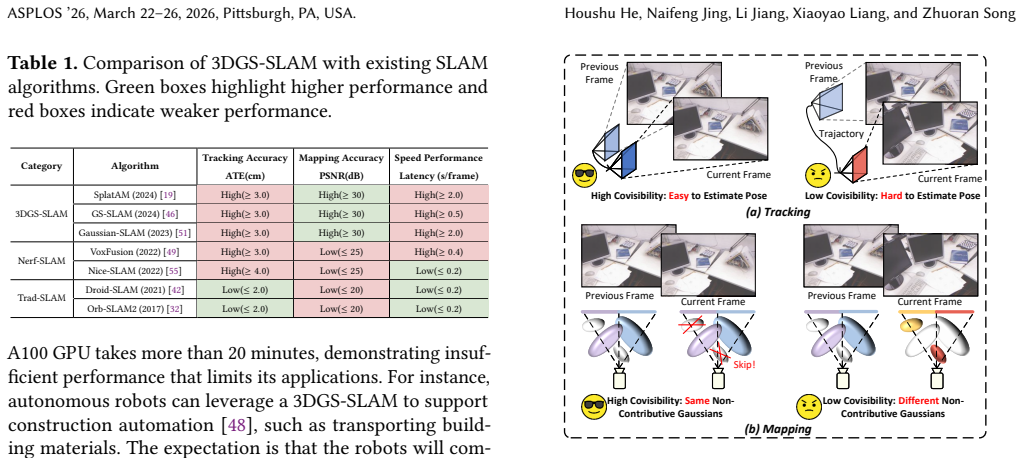
- [Table 1] The 'High(≥3.0)' notation for ATE is counterintuitive because lower ATE is better. Please clarify the color semantics or invert the numeric ranges.
- [Sec. 5.2] The phrase 'To ensure memory consistency, recording or retrieving them causes frequent DRAM access' is confusing; the intent is likely to reduce DRAM traffic. Please reword.
- [Sec. 6.1] The description of the GPU/GSCore baselines is vague: 'we scale the number of computing cores to ensure the same area budget' needs details on how many cores, what frequency, what memory system, and how the CPU-side training is modeled.
- [Throughout] There is inconsistent spelling of 'SplatAM' vs 'SplaTAM'; please use the official name consistently.
Circularity Check
No significant circularity: the speedup and accuracy claims rest on independent measurements, external baselines, and a disclosed (not definitionally forced) sensitivity study.
full rationale
The paper's derivation chain is not circular. Frame covisibility (FC) is defined independently as the accumulated minimum SAD values produced by the video CODEC during motion estimation (Sections 2.3 and 4.1). The subsequent uses of FC are empirical correlations, not definitions: Observation 1 (high-FC frames tolerate fewer tracking iterations) is supported by the accuracy-loss experiment in Fig. 4, and Observation 2 (high-FC frames share non-contributory Gaussian sets) is supported by the contribution-similarity measurement in Fig. 6. Neither observation defines FC in terms of tracking iterations or Gaussian contributions, so the acceleration does not reduce to its input by construction. The mapping and tracking decisions compare FC against thresholds, but the thresholds (Iter_T, Thresh_M, Thresh_N) are tuned in a disclosed sensitivity study on the Desk scene (Section 6.6); the reported speedups are cycle-level simulator measurements on external benchmarks, not analytically forced consequences of the fitted thresholds. The FP-rate validation in Section 6.2 compares predicted non-contributory Gaussian IDs against baseline-identified IDs, which is an external correctness check rather than a renamed fit. There are no load-bearing self-citations: the coarse pose estimator is built on Droid-SLAM, and comparisons are made against SplaTAM, GSCore, and Gaussian-SLAM, all external. No uniqueness theorem or ansatz is imported from the authors' own prior work. The reviewer-flagged concern that CODEC SAD is described for consecutive frames while key-frame designation requires covisibility with a previous key frame (Section 4.3 vs. Sections 2.3 and 5.1) is a potential missing mechanism or correctness gap, not circularity: if the SAD signal for the key-frame path does not exist, the claim would be unsupported, not true by definition. The paper is therefore self-contained against its stated assumptions and benchmarks, with no circular step to report.
Assumptions & free parameters
free parameters (5)
- Iter_T (fine-grained tracking iterations) =
20
- Thresh_M (key/non-key frame threshold) =
50%
- Thresh_N (non-contributory pixel count threshold) =
450
- Thresh_T (tracking covisibility threshold) =
90%
- Thresh_alpha (Gaussian contribution threshold) =
1/255
assumptions (6)
- domain assumption Accumulated minimum-SAD values from CODEC motion estimation are a usable proxy for frame covisibility and pose-estimation difficulty.
- domain assumption Gaussians that are non-contributory in a key frame remain non-contributory in following high-covisibility frames.
- domain assumption A cycle-level simulator fed with traces from GPU runs of SplaTAM faithfully predicts the performance of the proposed AGS hardware.
- domain assumption The video CODEC IP can be modified to export per-macro-block minimum SAD values through DRAM without significant cost.
- ad hoc to paper The alpha-computation stage dominates GPE rendering time, making stage disassembly and workload redistribution profitable.
- standard math 3DGS rendering equations (Eqns. 1 and 2) from Kerbl et al. [20] are correct.
invented entities (4)
-
FC detection engine (adders and comparators)
-
Pose tracking engine (systolic arrays plus lightweight GS array)
-
Mapping engine with GS logging table, update unit, GS skipping table, and comparison unit
-
GPE scheduler, alpha buffer, and workload table
Cite this review
Pith. "Pith review of AGS: Accelerating 3D Gaussian Splatting SLAM via CODEC-Assisted Frame Covisibility Detection." pith.science (2026). https://pith.science/paper/RXDDN3CK
@misc{pith2026250900433,
  author       = {Pith},
  title        = {Pith review of: AGS: Accelerating 3D Gaussian Splatting SLAM via CODEC-Assisted Frame Covisibility Detection},
  year         = {2026},
  howpublished = {\url{https://pith.science/paper/RXDDN3CK}},
  note         = {Machine review of arXiv:2509.00433}
}
abstract
Simultaneous Localization and Mapping (SLAM) is a critical task that enables autonomous vehicles to construct maps and localize themselves in unknown environments. Recent breakthroughs combine SLAM with 3D Gaussian Splatting (3DGS) to achieve exceptional reconstruction fidelity. However, existing 3DGS-SLAM systems provide insufficient throughput due to the need for multiple training iterations per frame and the vast number of Gaussians. In this paper, we propose AGS, an algorithm-hardware co-design framework to boost the efficiency of 3DGS-SLAM based on the intuition that SLAM systems process frames in a streaming manner, where adjacent frames exhibit high similarity that can be utilized for acceleration. On the software level: 1) We propose a coarse-then-fine-grained pose tracking method with respect to the robot's movement. 2) We avoid redundant computations of Gaussians by sharing their contribution information across frames. On the hardware level, we propose a frame covisibility detection engine to extract intermediate data from the video CODEC. We also implement a pose tracking engine and a mapping engine with workload schedulers to efficiently deploy the AGS algorithm. Our evaluation shows that AGS achieves up to $17.12\times$, $6.71\times$, and $5.41\times$ speedups against the mobile and high-end GPUs, and a state-of-the-art 3DGS accelerator, GSCore.
Figures


Figures from the paper (12 more)


Reference graph
Works this paper leans on
-
[1]
Michal Adamkiewicz, Timothy Chen, Adam Caccavale, Rachel Gardner, Preston Culbertson, Jeannette Bohg, and Mac Schwager. 2022. Vision- only robot navigation in a neural radiance world. IEEE Robotics and Automation Letters 7, 2 (2022), 4606–4613
work page 2022
-
[2]
Rajeev Balasubramonian, Andrew B Kahng, Naveen Muralimanohar, Ali Shafiee, and Vaishnav Srinivas. 2017. CACTI 7: New tools for interconnect exploration in innovative off-chip memories. ACM Trans- actions on Architecture and Code Optimization (TACO) 14, 2 (2017), 1–25
work page 2017
-
[3]
Jonathan T Barron, Ben Mildenhall, Matthew Tancik, Peter Hedman, Ricardo Martin-Brualla, and Pratul P Srinivasan. 2021. Mip-nerf: A multiscale representation for anti-aliasing neural radiance fields. In Proceedings of the IEEE/CVF international conference on computer vision . 5855–5864
work page 2021
-
[4]
Michael Bloesch, Jan Czarnowski, Ronald Clark, Stefan Leutenegger, and Andrew J Davison. 2018. Codeslam—learning a compact, optimis- able representation for dense visual slam. In Proceedings of the IEEE conference on computer vision and pattern recognition . 2560–2568
work page 2018
-
[5]
Mark Buckler, Philip Bedoukian, Suren Jayasuriya, and Adrian Samp- son. 2018. EVA 2: Exploiting temporal redundancy in live computer vision. In 2018 ACM/IEEE 45th Annual International Symposium on Computer Architecture (ISCA). IEEE, 533–546
work page 2018
-
[6]
Arunkumar Byravan, Jan Humplik, Leonard Hasenclever, Arthur Brussee, Francesco Nori, Tuomas Haarnoja, Ben Moran, Steven Bohez, Fereshteh Sadeghi, Bojan Vujatovic, et al. 2023. Nerf2real: Sim2real transfer of vision-guided bipedal motion skills using neural radiance fields. In 2023 IEEE International Conference on Robotics and Automation (ICRA). IEEE, 9362–9369
work page 2023
-
[7]
Junyi Cao, Zhichao Li, Naiyan Wang, and Chao Ma. 2024. Lightning NeRF: Efficient Hybrid Scene Representation for Autonomous Driving. arXiv preprint arXiv:2403.05907 (2024)
work page Pith review arXiv 2024
-
[8]
Timothy Chen, Preston Culbertson, and Mac Schwager. 2024. Catnips: Collision avoidance through neural implicit probabilistic scenes. IEEE Transactions on Robotics (2024)
work page 2024
Show all 60 references
-
[9]
Jack Choquette and Wish Gandhi. 2020. Nvidia a100 gpu: Performance & innovation for gpu computing. In2020 IEEE Hot Chips 32 Symposium (HCS). IEEE Computer Society, 1–43
2020
-
[10]
Nianchen Deng, Zhenyi He, Jiannan Ye, Budmonde Duinkharjav, Praneeth Chakravarthula, Xubo Yang, and Qi Sun. 2022. Fov-nerf: Foveated neural radiance fields for virtual reality. IEEE Transactions on Visualization and Computer Graphics 28, 11 (2022), 3854–3864
2022
-
[11]
Guangchi Fang and Bing Wang. 2024. Mini-splatting: Representing scenes with a constrained number of gaussians. InEuropean Conference on Computer Vision. Springer, 165–181
2024
-
[12]
Yu Feng, Zihan Liu, Jingwen Leng, Minyi Guo, and Yuhao Zhu. 2024. Cicero: Addressing Algorithmic and Architectural Bottlenecks in Neu- ral Rendering by Radiance Warping and Memory Optimizations.arXiv preprint arXiv:2404.11852 (2024)
2024 arXiv
-
[13]
Yu Feng, Paul Whatmough, and Yuhao Zhu. 2019. Asv: Accelerated stereo vision system. In Proceedings of the 52nd Annual IEEE/ACM International Symposium on Microarchitecture . 643–656
2019
-
[14]
Yiming Gan, Yuxian Qiu, Lele Chen, Jingwen Leng, and Yuhao Zhu
-
[15]
Jianfei Guo, Nianchen Deng, Xinyang Li, Yeqi Bai, Botian Shi, Chiyu Wang, Chenjing Ding, Dongliang Wang, and Yikang Li. 2023. Street- surf: Extending multi-view implicit surface reconstruction to street views. arXiv preprint arXiv:2306.04988 (2023)
2023 arXiv
-
[16]
Benran Hu, Junkai Huang, Yichen Liu, Yu-Wing Tai, and Chi-Keung Tang. 2023. Nerf-rpn: A general framework for object detection in nerfs. In Proceedings of the IEEE/CVF Conference on Computer Vision and Pattern Recognition. 23528–23538. ASPLOS ’26, March 22–26, 2026, Pittsburgh...
2023
-
[17]
Shahram Izadi, David Kim, Otmar Hilliges, David Molyneaux, Richard Newcombe, Pushmeet Kohli, Jamie Shotton, Steve Hodges, Dustin Freeman, Andrew Davison, et al . 2011. Kinectfusion: real-time 3d reconstruction and interaction using a moving depth camera. In Pro- ceedings of th...
2011
-
[18]
Julius Kammerl, Nico Blodow, Radu Bogdan Rusu, Suat Gedikli, Michael Beetz, and Eckehard Steinbach. 2012. Real-time compres- sion of point cloud streams. In 2012 IEEE international conference on robotics and automation. IEEE, 778–785
2012
-
[19]
Nikhil Keetha, Jay Karhade, Krishna Murthy Jatavallabhula, Gengshan Yang, Sebastian Scherer, Deva Ramanan, and Jonathon Luiten. 2024. SplaTAM: Splat Track & Map 3D Gaussians for Dense RGB-D SLAM. In Proceedings of the IEEE/CVF Conference on Computer Vision and Pattern Recognit...
2024
-
[20]
Bernhard Kerbl, Georgios Kopanas, Thomas Leimkühler, and George Drettakis. 2023. 3D Gaussian Splatting for Real-Time Radiance Field Rendering. ACM Trans. Graph. 42, 4 (2023), 139–1
2023
-
[21]
Yoongu Kim, Weikun Yang, and Onur Mutlu. 2015. Ramulator: A fast and extensible DRAM simulator. IEEE Computer architecture letters 15, 1 (2015), 45–49
2015
-
[22]
Junseo Lee, Seokwon Lee, Jungi Lee, Junyong Park, and Jaewoong Sim
-
[23]
Ke Li, Susanne Schmidt, Tim Rolff, Reinhard Bacher, Wim Leemans, and Frank Steinicke. 2024. Magic nerf lens: Interactive fusion of neural radiance fields for virtual facility inspection.Frontiers in Virtual Reality 5 (2024), 1377245
2024
-
[24]
Yanyan Li, Nikolas Brasch, Yida Wang, Nassir Navab, and Federico Tombari. 2020. Structure-slam: Low-drift monocular slam in indoor environments. IEEE Robotics and Automation Letters 5, 4 (2020), 6583– 6590
2020
-
[25]
Zhengqi Li, Simon Niklaus, Noah Snavely, and Oliver Wang. 2021. Neural scene flow fields for space-time view synthesis of dynamic scenes. In Proceedings of the IEEE/CVF Conference on Computer Vision and Pattern Recognition. 6498–6508
2021
-
[26]
Weikai Lin, Yu Feng, and Yuhao Zhu. 2025. Metasapiens: Real-time neu- ral rendering with efficiency-aware pruning and accelerated foveated rendering. In Proceedings of the 30th ACM International Conference on Architectural Support for Programming Languages and Operating System...
2025
-
[27]
Dominic Maggio, Marcus Abate, Jingnan Shi, Courtney Mario, and Luca Carlone. 2023. Loc-nerf: Monte carlo localization using neural radiance fields. In 2023 IEEE International Conference on Robotics and Automation (ICRA). IEEE, 4018–4025
2023
-
[28]
Hidenobu Matsuki, Riku Murai, Paul HJ Kelly, and Andrew J Davi- son. 2024. Gaussian splatting slam. In Proceedings of the IEEE/CVF Conference on Computer Vision and Pattern Recognition . 18039–18048
2024
-
[29]
Ben Mildenhall, Pratul P Srinivasan, Matthew Tancik, Jonathan T Barron, Ravi Ramamoorthi, and Ren Ng. 2021. Nerf: Representing scenes as neural radiance fields for view synthesis. Commun. ACM 65, 1 (2021), 99–106
2021
-
[30]
Thomas Müller, Alex Evans, Christoph Schied, and Alexander Keller
-
[31]
Raul Mur-Artal, Jose Maria Martinez Montiel, and Juan D Tardos. 2015. ORB-SLAM: a versatile and accurate monocular SLAM system. IEEE transactions on robotics 31, 5 (2015), 1147–1163
2015
-
[32]
Raul Mur-Artal and Juan D Tardós. 2017. Orb-slam2: An open-source slam system for monocular, stereo, and rgb-d cameras. IEEE transac- tions on robotics 33, 5 (2017), 1255–1262
2017
-
[33]
Thu Nguyen-Phuoc, Feng Liu, and Lei Xiao. 2022. Snerf: stylized neural implicit representations for 3d scenes. arXiv preprint arXiv:2207.02363 (2022)
2022 arXiv
-
[34]
NVIDIA. 2018. NVIDIA Xavier System-on-Chip. In HotChips 30
2018
-
[35]
Satyabrata Sarangi and Bevan Baas. 2021. DeepScaleTool: A tool for the accurate estimation of technology scaling in the deep-submicron era. In 2021 IEEE International Symposium on Circuits and Systems (ISCAS). IEEE, 1–5
2021
-
[36]
Seokchan Song, Seryeong Kim, Wonhoon Park, Jongjun Park, Sanghyuk An, Gwangtae Park, Minseo Kim, and Hoi-Jun Yoo. 2025. IRIS: A 8.55 mJ/frame Spatial Computing SoC for Interactable Render- ing and Surface-Aware Modeling with 3D Gaussian Splatting. In 2025 IEEE International So...
2025
-
[37]
Julian Straub, Thomas Whelan, Lingni Ma, Yufan Chen, Erik Wij- mans, Simon Green, Jakob J. Engel, Raul Mur-Artal, Carl Ren, Shobhit Verma, Anton Clarkson, Mingfei Yan, Brian Budge, Yajie Yan, Xiaqing Pan, June Yon, Yuyang Zou, Kimberly Leon, Nigel Carter, Jesus Bri- ales, Tyle...
2019 arXiv
-
[38]
Sturm, N
J. Sturm, N. Engelhard, F. Endres, W. Burgard, and D. Cremers. 2012. A Benchmark for the Evaluation of RGB-D SLAM Systems. In Proc. of the International Conference on Intelligent Robot Systems (IROS)
2012
-
[39]
Edgar Sucar, Shikun Liu, Joseph Ortiz, and Andrew J Davison. 2021. imap: Implicit mapping and positioning in real-time. In Proceedings of the IEEE/CVF international conference on computer vision . 6229–6238
2021
-
[40]
Gary J Sullivan, Jens-Rainer Ohm, Woo-Jin Han, and Thomas Wiegand
-
[41]
Keisuke Tateno, Federico Tombari, Iro Laina, and Nassir Navab. 2017. Cnn-slam: Real-time dense monocular slam with learned depth pre- diction. In Proceedings of the IEEE conference on computer vision and pattern recognition. 6243–6252
2017
-
[42]
Zachary Teed and Jia Deng. 2021. Droid-slam: Deep visual slam for monocular, stereo, and rgb-d cameras. Advances in neural information processing systems 34 (2021), 16558–16569
2021
-
[43]
Thomas Whelan, Michael Kaess, Maurice Fallon, Hordur Johanns- son, John Leonard, and John McDonald. 2012. Kintinuous: Spatially extended kinectfusion. (2012)
2012
-
[44]
Thomas Whelan, Stefan Leutenegger, Renato F Salas-Moreno, Ben Glocker, and Andrew J Davison. 2015. ElasticFusion: Dense SLAM without a pose graph.. In Robotics: science and systems , Vol. 11. Rome
2015
-
[45]
Chenming Wu, Jiadai Sun, Zhelun Shen, and Liangjun Zhang. 2023. Mapnerf: Incorporating map priors into neural radiance fields for driving view simulation. In 2023 IEEE/RSJ International Conference on Intelligent Robots and Systems (IROS) . IEEE, 7082–7088
2023
-
[46]
Chi Yan, Delin Qu, Dan Xu, Bin Zhao, Zhigang Wang, Dong Wang, and Xuelong Li. 2024. Gs-slam: Dense visual slam with 3d gaussian splatting. In Proceedings of the IEEE/CVF Conference on Computer Vision and Pattern Recognition. 19595–19604
2024
-
[47]
Honghui Yang, Sha Zhang, Di Huang, Xiaoyang Wu, Haoyi Zhu, Tong He, Shixiang Tang, Hengshuang Zhao, Qibo Qiu, Binbin Lin, et al. 2024. Unipad: A universal pre-training paradigm for autonomous driving. In Proceedings of the IEEE/CVF Conference on Computer Vision and Pattern Rec...
2024
-
[48]
Liu Yang. 2023. Redefining Visual SLAM for Construction Robots: Ad- dressing Dynamic Features and Semantic Composition for Robust Perfor- mance. Ph. D. Dissertation. Purdue University Graduate School
2023
-
[49]
Xingrui Yang, Hai Li, Hongjia Zhai, Yuhang Ming, Yuqian Liu, and Guofeng Zhang. 2022. Vox-fusion: Dense tracking and mapping with AGS: Accelerating 3D Gaussian Splatting SLAM via CODEC-Assisted Frame Covisibility Detection ASPLOS ’26, March 22–26, 2026, Pittsburgh, PA, USA. vo...
2022
-
[50]
Chandan Yeshwanth, Yueh-Cheng Liu, Matthias Nießner, and Angela Dai. 2023. ScanNet++: A High-Fidelity Dataset of 3D Indoor Scenes. In Proceedings of the International Conference on Computer Vision (ICCV)
2023
-
[51]
Vladimir Yugay, Yue Li, Theo Gevers, and Martin R Oswald. 2023. Gaussian-slam: Photo-realistic dense slam with gaussian splatting. arXiv preprint arXiv:2312.10070 (2023)
2023 arXiv
-
[52]
Shulin Zhao, Haibo Zhang, Sandeepa Bhuyan, Cyan Subhra Mishra, Ziyu Ying, Mahmut T Kandemir, Anand Sivasubramaniam, and Chita R Das. 2020. Déja view: Spatio-temporal compute reuse for ‘energy- efficient 360 vr video streaming. In 2020 ACM/IEEE 47th Annual Inter- national Sympo...
2020
-
[53]
Shulin Zhao, Haibo Zhang, Cyan Subhra Mishra, Sandeepa Bhuyan, Ziyu Ying, Mahmut Taylan Kandemir, Anand Sivasubramaniam, and Chita Das. 2021. Holoar: On-the-fly optimization of 3d holographic processing for augmented reality. InMICRO-54: 54th Annual IEEE/ACM International Symp...
2021
-
[54]
Yuhao Zhu, Anand Samajdar, Matthew Mattina, and Paul Whatmough
-
[55]
Zihan Zhu, Songyou Peng, Viktor Larsson, Weiwei Xu, Hujun Bao, Zhaopeng Cui, Martin R Oswald, and Marc Pollefeys. 2022. Nice- slam: Neural implicit scalable encoding for slam. In Proceedings of the IEEE/CVF conference on computer vision and pattern recognition . 12786–12796
2022
-
[2012]
IEEE Transactions on circuits and systems for video technology 22, 12 (2012), 1649–1668
Overview of the high efficiency video coding (HEVC) standard. IEEE Transactions on circuits and systems for video technology 22, 12 (2012), 1649–1668
2012
-
[2018]
arXiv preprint arXiv:1803.11232 (2018)
Euphrates: Algorithm-soc co-design for low-power mobile con- tinuous vision. arXiv preprint arXiv:1803.11232 (2018)
2018 arXiv
-
[2020]
In Proceedings of the ACM International Conference on Parallel Architectures and Compilation Techniques
Low-latency proactive continuous vision. In Proceedings of the ACM International Conference on Parallel Architectures and Compilation Techniques. 329–342
-
[2022]
ACM transactions on graphics (TOG) 41, 4 (2022), 1–15
Instant neural graphics primitives with a multiresolution hash encoding. ACM transactions on graphics (TOG) 41, 4 (2022), 1–15
2022
-
[2024]
In Proceedings of the 29th ACM International Conference on Architectural Support for Programming Languages and Operating Systems, Volume 3
GSCore: Efficient Radiance Field Rendering via Architectural Support for 3D Gaussian Splatting. In Proceedings of the 29th ACM International Conference on Architectural Support for Programming Languages and Operating Systems, Volume 3 . 497–511
Reviewed August 5, 2026 · model on record in the stance chip above.
Discussion (0). Sign in to comment.