REVIEW 4 major objections 6 minor 1 cited by
Towards Storage-Efficient Visual Document Retrieval: An Empirical Study on Reducing Patch-Level Embeddings
T0 review · 4 major / 6 minor · reviewed 2026-08-07 · deepseek-v4-flash
Pith's one-line read Token merging, not pruning, compresses ColPali/ColQwen2 indexes 9x-35x while retaining roughly 95-98% of retrieval performance.
desk verdict Solid empirical study on compressing ColPali-style patch embeddings; merging at the last layer with fine-tuning works, and the negative result on pruning is the most interesting part. read the letter →
The pith
A machine-rendered reading of the paper's core claim, the machinery that carries it, and where it could break.
The reading
What carries the argument
The central object is the MaxSim relevance score $s(q,p)=\sum_j \max_i e_i^p{}^\top e_j^q$, which sums, over query tokens, the best matching patch embedding per page. The carrying mechanism is semantic clustering: hierarchical agglomerative clustering of the patch embeddings' cosine similarities, applied after the final projection layer where dimension is lowest and therefore clustering is most effective, with each cluster replaced by its mean vector. Fine-tuning the retriever with these merged embeddings during both training and inference is what recovers most of the performance lost by training-free merging; the merging factor $N_p/N'_p$ sets the storage reduction.
What would settle it
Compare original ColQwen2 and Light-ColQwen2 at merging factor 9 on a held-out set of real, non-synthetic queries, focusing on text-dense pages such as DocVQA. If a query subset shows a large drop in retrieval of the ground-truth page relative to the 98.2% average—equivalently, if the top-activating patches for those queries are consistently merged away—the query-independent redundancy assumption fails.
Extended reading notes
Core claim
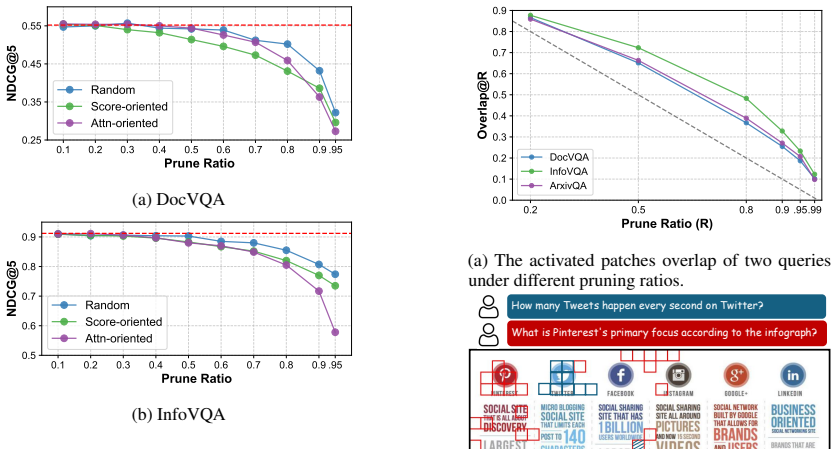
The central claim is that the stored patch-level embeddings of ColPali/ColQwen2 are substantially redundant, and that redundancy can be exploited by merging rather than pruning. The evidence has three parts: response-potential distributions are clustered, with on average 36.9 patches per page above normalized 0.9 and 14.2 above 0.95; activated patches are query-dependent, so pruning must guess which patches to keep and random dropping wins only because it does not systematically delete whole clusters; and semantic clustering at the post-projector location, followed by fine-tuning, preserves MaxSim-based relevance. Across nine ViDoRE, VisRAG, and MMLongBench-Doc datasets, Light-ColPali/ColQwen2 keeps 99.0% of NDCG@5 at merging factor 4, 98.2% at factor 9, and 94.6% at factor 49, at which point its memory is comparable to single-vector DSE baselines.
Load-bearing premise
Patch-level embeddings are redundant in a query-independent way, so clustering them by cosine similarity and averaging within clusters preserves MaxSim relevance for arbitrary unseen queries; the paper's redundancy evidence uses only five synthetic queries per page, and real queries could activate different patch subsets.
Editorial extensions
If this is right
- Light-ColQwen2 keeps 99.0% of NDCG@5 at a merging factor of 4 (25.5% memory) and 98.2% at factor 9 (11.8% memory), so deployment can choose a Pareto point along the reduction curve.
- At merging factor 49, the compressed retriever stores 1.8x (Qwen2) or 0.9x (PaliGemma) the memory of a single-embedding DSE retriever while still beating DSE in absolute NDCG@5.
- Training-free semantic clustering at factor 9 already retains roughly 97.5% average performance, meaning the merging recipe works even without fine-tuning existing indexes.
- Token pruning never reaches competitive retention: at a 0.9-0.95 pruning ratio the best strategy keeps only 58-88% of the original score, so pruning is not a viable route to order-of-magnitude reduction.
- Fine-tuning recovers 61% of the performance drop at merging factor 25 and 67% at factor 49, so the marginal cost of extreme compression is mostly recoverable with training.
Reading between the lines
- The query-independent redundancy assumption implies a page-adaptive merging factor: pages with high information density should merge less, and a cheap density estimate could pick the factor per page at index time; the paper notes adaptivity as open future work.
- The same late-stage semantic-clustering recipe is a candidate for text-based multi-vector retrievers, where word embeddings may be at least as clusterable as visual patches.
- Because the merging module runs offline on stored embeddings, it can be applied post hoc to an already-built ColPali/ColQwen2 index without retraining; the gap to the fine-tuned version then measures how much compression is available for free.
- The paper's redundancy evidence rests on five synthetic queries per page; a stress test with human queries across new domains would show whether the 94-98% retention transfers outside the nine benchmark datasets.
Editorial analysis
A structured set of objections, weighed in public.
Referee Report
Summary. The paper studies storage reduction for the patch-level embeddings produced by ColPali/ColQwen2 visual document retrievers. It compares two token-reduction families: pruning and merging. On pruning, it reports that random pruning outperforms score- and attention-based strategies, but all pruning methods degrade substantially at aggressive ratios. On merging, it evaluates three dimensions—merging approach (1D/2D spatial pooling vs. semantic clustering), fine-tuning applicability, and merging location (pre-encoder to post-projector)—and finds that late-stage semantic clustering combined with fine-tuning works best. The resulting method, Light-ColPali/ColQwen2, is reported to retain 98.2% of NDCG@5 at 11.8% of original memory and 94.6% at 2.8% memory, averaged over nine datasets from ViDoRE, VisRAG, and MMLongBench-Doc.
Significance. If the reported retention figures hold, this is a practical 9x–35x compression of document embedding storage with small retrieval loss, and the paper provides a systematic comparison of pruning versus merging under the VDR setting. The strengths are the broad evaluation across nine datasets, the combination of training-free and fine-tuned results, and the honest reporting of time costs. The main weakness is that the central assumption—that patch embeddings are redundant in a query-independent way—is supported only by an analysis based on five synthetic queries per page, and no experiment tests transfer to held-out, topic-disjoint queries. The lack of error bars further weakens the precision of the headline numbers.
major comments (4)
- [Section 4.3 / Appendix A.2] The central claim that merging via semantic clustering preserves retrieval for arbitrary unseen queries is not supported by the evidence presented. For a merged cluster C_k, the score for a query token e_q is max_k (avg_{i in C_k} e_i)^T e_q, which is bounded above by max_i e_i^T e_q; equality holds only if all members of the winning cluster have identical dot products with e_q. The redundancy analysis in Section 4.3 shows that about 14.2 patches per page have normalized response above 0.95 for a given query, but this does not establish that cosine-similarity clusters are stable across queries. In fact, Figure 3(a) shows that activated patches for two synthetic queries are nearly disjoint, and the synthetic queries themselves are generated by Qwen2-VL-7B. Fine-tuning in Section 5.2 is performed on the ColPali training distribution, so it may compensate for information loss only on query patterns similar to training. No experiment measures retention on a held-out, topic-disjoint query distribution. Please add such an evaluation or provide a direct analysis of within-cluster response-potential variance across diverse query sets; without this, the 98.2% and 94.6% figures are not yet established as a general property of merging.
- [Tables 2 and 4] All reported NDCG@5 values are single-run point estimates with no error bars or significance tests. The differences between merging factors (e.g., 99.0% at factor 4, 98.2% at factor 9, 96.3% at factor 25 for Light-ColQwen2) are small, and without variance estimates it is unclear whether these differences are meaningful. Please report means and standard deviations over at least three independent fine-tuning runs, or conduct paired significance tests (e.g., bootstrap or paired t-test) for the key comparisons against ColQwen2 and ColPali.
- [Section 5.2] The fine-tuning procedure is underspecified with respect to the clustering module. It is not stated whether the cluster assignments for the merged document embeddings are recomputed at each training step as the model weights change, or fixed using the initial model's embeddings. This matters because if clusters are fixed, the model is trained against a representation that becomes stale as embeddings drift; if recomputed, the training objective changes during optimization. Please clarify and justify the choice, as it directly affects the interpretation of the fine-tuning gains in Figure 6 and the reproducibility of the method.
- [Section 4.2] The conclusion that pruning is 'inherently unsuitable' for VDR is based on experiments on only two datasets (DocVQA and InfoVQA) and on synthetic queries generated by Qwen2-VL-7B. While Table 2 extends random pruning to nine datasets, the comparison of the three pruning strategies and the analysis of query-dependent activation are limited to these two datasets. This strong negative claim should either be supported on the full benchmark suite or tempered to a claim about the tested conditions.
minor comments (6)
- [Figure 3(a)] The definition of Overlap@R is not given in the caption or text; please state how overlap is computed and what the dashed diagonal represents.
- [Section 5.1] Please specify the linkage criterion (e.g., average, Ward) and the distance metric used in the hierarchical clustering procedure.
- [Table 2] The 'Average' column appears to report mean NDCG@5, but the caption also mentions relative performance; please clarify what the average column contains and how the relative performance percentages are derived.
- [Table 2 / Section 6] The 'ColPali+Pruning' baseline uses random pruning, but this is not stated in the table or its caption; please state it explicitly.
- [Abstract / entire manuscript] There are several spacing and formatting typos, such as 'to-ken pruningandtoken merging' in the abstract and 'ColPali/-ColQwen2' in the introduction; please proofread.
- [Limitations] The Limitations section does not mention the potential issue that the merging strategy's effectiveness may depend on query distribution; please add a discussion of this limitation, particularly in light of the synthetic-query-based analysis.
Circularity Check
No significant circularity: the compression claims are empirical and benchmarked against external datasets; no central result reduces to its own inputs.
full rationale
No circular step is present. The paper's main claim is that Light-ColPali/ColQwen2 preserves 98.2% of NDCG@5 at 11.8% memory and 94.6% at 2.8% memory; these numbers are measured on external benchmarks (ViDoRE, VisRAG, MMLongBench-Doc) rather than derived from the method's construction. The merging recipe (semantic clustering, late-stage merging, fine-tuning) is selected by comparing configurations on held-out test sets, and the fine-tuning uses training queries while evaluation uses benchmark queries. The synthesized queries in Section 4.1 and Appendix A.1 are used only to analyze pruning behavior, not to fit or define the final retrieval model, so no fitted input is renamed as a prediction. References to the authors' own MMLongBench-Doc work are dataset citations, not load-bearing theoretical premises. No uniqueness theorem or prior-work ansatz is used to force the design choice. The main validity risk is the limited evidence for query-independent patch redundancy (five synthetic queries per page), but that is a generalization concern, not circularity.
Assumptions & free parameters
assumptions (3)
- domain assumption Cosine similarity among patch embeddings is a valid measure of semantic redundancy for retrieval.
- domain assumption Five synthesized queries per page approximate the distribution of real queries over patch activations.
- domain assumption Gradients can be propagated through the non-differentiable hierarchical clustering operation during fine-tuning.
Cite this review
Pith. "Pith review of Towards Storage-Efficient Visual Document Retrieval: An Empirical Study on Reducing Patch-Level Embeddings." pith.science (2026). https://pith.science/paper/RY4PNJH3
@misc{pith2026250604997,
  author       = {Pith},
  title        = {Pith review of: Towards Storage-Efficient Visual Document Retrieval: An Empirical Study on Reducing Patch-Level Embeddings},
  year         = {2026},
  howpublished = {\url{https://pith.science/paper/RY4PNJH3}},
  note         = {Machine review of arXiv:2506.04997}
}
read the original abstract
Despite the strong performance of ColPali/ColQwen2 in Visualized Document Retrieval (VDR), it encodes each page into multiple patch-level embeddings and leads to excessive memory usage. This empirical study investigates methods to reduce patch embeddings per page at minimum performance degradation. We evaluate two token-reduction strategies: token pruning and token merging. Regarding token pruning, we surprisingly observe that a simple random strategy outperforms other sophisticated pruning methods, though still far from satisfactory. Further analysis reveals that pruning is inherently unsuitable for VDR as it requires removing certain page embeddings without query-specific information. Turning to token merging (more suitable for VDR), we search for the optimal combinations of merging strategy across three dimensions and develop Light-ColPali/ColQwen2. It maintains 98.2% of retrieval performance with only 11.8% of original memory usage, and preserves 94.6% effectiveness at 2.8% memory footprint. We expect our empirical findings and resulting Light-ColPali/ColQwen2 offer valuable insights and establish a competitive baseline for future research towards efficient VDR.
Figures


Figures from the paper (3 more)


Forward citations
Cited by 1 Pith paper
-
Do All Visual Tokens Matter Equally? Object-Evidence Preserving Token Merging for Vision-Language Retrieval
Object-aware soft merging of post-projector visual tokens preserves MaxSim-selectable evidence, yielding >93% token reduction and higher R@1 than full ColPali on Flickr30K and MSCOCO.
Reference graph
Works this paper leans on
-
[1]
Lucas Beyer, Andreas Steiner, André Susano Pinto, Alexander Kolesnikov, Xiao Wang, Daniel Salz, Maxim Neumann, Ibrahim Alabdulmohsin, Michael Tschannen, Emanuele Bugliarello, Thomas Unterthiner, Daniel Keysers, Skanda Koppula, Fangyu Liu, Adam Grycner, Alexey Gritsenko, Neil Houlsby, Manoj Kumar, Keran Rong, Julian Eisenschlos, Rishabh Kabra, Matthias Bau...
arXiv 2024
-
[2]
Daniel Bolya, Cheng-Yang Fu, Xiaoliang Dai, Peizhao Zhang, Christoph Feichtenhofer, and Judy Hoffman. 2023. https://openreview.net/forum?id=JroZRaRw7Eu Token merging: Your vit but faster . In The Eleventh International Conference on Learning Representations
work page 2023
-
[3]
Rossi, Changyou Chen, and Tong Sun
Jian Chen, Ruiyi Zhang, Yufan Zhou, Tong Yu, Franck Dernoncourt, Jiuxiang Gu, Ryan A. Rossi, Changyou Chen, and Tong Sun. 2025. https://openreview.net/forum?id=FDaHjwInXO Lo RA -contextualizing adaptation of large multimodal models for multi-page document understanding . In The Thirteenth International Conference on Learning Representations
work page 2025
-
[4]
Liang Chen, Haozhe Zhao, Tianyu Liu, Shuai Bai, Junyang Lin, Chang Zhou, and Baobao Chang. 2024. https://api.semanticscholar.org/CorpusID:268358224 An image is worth 1/2 tokens after layer 2: Plug-and-play inference acceleration for large vision-language models . In European Conference on Computer Vision
work page 2024
-
[5]
Jaemin Cho, Debanjan Mahata, Ozan Irsoy, Yujie He, and Mohit Bansal. 2024. https://arxiv.org/abs/2411.04952 M3docrag: Multi-modal retrieval is what you need for multi-page multi-document understanding . Preprint, arXiv:2411.04952
arXiv 2024
-
[6]
Benjamin Clavié, Antoine Chaffin, and Griffin Adams. 2024. https://arxiv.org/abs/2409.14683 Reducing the footprint of multi-vector retrieval with minimal performance impact via token pooling . Preprint, arXiv:2409.14683
arXiv 2024
-
[7]
Manuel Faysse, Hugues Sibille, Tony Wu, Bilel Omrani, Gautier Viaud, CELINE HUDELOT, and Pierre Colombo. 2025. https://openreview.net/forum?id=ogjBpZ8uSi Colpali: Efficient document retrieval with vision language models . In The Thirteenth International Conference on Learning Representations
work page 2025
-
[8]
Edward J Hu, yelong shen, Phillip Wallis, Zeyuan Allen-Zhu, Yuanzhi Li, Shean Wang, Lu Wang, and Weizhu Chen. 2022. https://openreview.net/forum?id=nZeVKeeFYf9 Lo RA : Low-rank adaptation of large language models . In International Conference on Learning Representations
2022
Show all 36 references
-
[9]
Herve Jégou, Matthijs Douze, and Cordelia Schmid. 2011. https://doi.org/10.1109/TPAMI.2010.57 Product quantization for nearest neighbor search . IEEE Transactions on Pattern Analysis and Machine Intelligence, 33(1):117--128
2011 doi
-
[10]
Vladimir Karpukhin, Barlas Oguz, Sewon Min, Patrick Lewis, Ledell Wu, Sergey Edunov, Danqi Chen, and Wen-tau Yih. 2020. https://doi.org/10.18653/v1/2020.emnlp-main.550 Dense passage retrieval for open-domain question answering . In Proceedings of the 2020 Conference on Empiric...
2020 doi
-
[11]
Omar Khattab and Matei Zaharia. 2020. https://doi.org/10.1145/3397271.3401075 Colbert: Efficient and effective passage search via contextualized late interaction over bert . In Proceedings of the 43rd International ACM SIGIR Conference on Research and Development in Informatio...
2020
-
[12]
Zhenglun Kong, Peiyan Dong, Xiaolong Ma, Xin Meng, Wei Niu, Mengshu Sun, Xuan Shen, Geng Yuan, Bin Ren, Hao Tang, et al. 2022. Spvit: Enabling faster vision transformers via latency-aware soft token pruning. In Computer Vision--ECCV 2022: 17th European Conference, Tel Aviv, Is...
2022
-
[13]
Lei Li, Yuqi Wang, Runxin Xu, Peiyi Wang, Xiachong Feng, Lingpeng Kong, and Qi Liu. 2024 a . https://doi.org/10.18653/v1/2024.acl-long.775 Multimodal A r X iv: A dataset for improving scientific comprehension of large vision-language models . In Proceedings of the 62nd Annual ...
2024 doi
-
[14]
Wentong Li, Yuqian Yuan, Jian Liu, Dongqi Tang, Song Wang, Jianke Zhu, and Lei Zhang. 2024 b . https://arxiv.org/abs/2407.02392 Tokenpacker: Efficient visual projector for multimodal llm . Preprint, arXiv:2407.02392
2024 arXiv
-
[15]
Youwei Liang, Chongjian Ge, Zhan Tong, Yibing Song, Jue Wang, and Pengtao Xie. 2022. https://api.semanticscholar.org/CorpusID:246867285 Not all patches are what you need: Expediting vision transformers via token reorganizations . ArXiv, abs/2202.07800
2022 arXiv
-
[16]
Xueguang Ma, Sheng-Chieh Lin, Minghan Li, Wenhu Chen, and Jimmy Lin. 2024 a . https://doi.org/10.18653/v1/2024.emnlp-main.373 Unifying multimodal retrieval via document screenshot embedding . In Proceedings of the 2024 Conference on Empirical Methods in Natural Language Proces...
2024 doi
-
[17]
Yubo Ma, Yuhang Zang, Liangyu Chen, Meiqi Chen, Yizhu Jiao, Xinze Li, Xinyuan Lu, Ziyu Liu, Yan Ma, Xiaoyi Dong, Pan Zhang, Liangming Pan, Yu-Gang Jiang, Jiaqi Wang, Yixin Cao, and Aixin Sun. 2024 b . https://openreview.net/forum?id=loJM1acwzf MMLONGBENCH - DOC : Benchmarking ...
2024
-
[18]
Ahmed Masry, Do Xuan Long, Jia Qing Tan, Shafiq Joty, and Enamul Hoque. 2022. https://arxiv.org/abs/2203.10244 Chartqa: A benchmark for question answering about charts with visual and logical reasoning . Preprint, arXiv:2203.10244
2022 arXiv
-
[19]
Minesh Mathew, Viraj Bagal, Rub \`e n P \'e rez Tito, Dimosthenis Karatzas, Ernest Valveny, and C.V. Jawahar. 2021. https://api.semanticscholar.org/CorpusID:233394125 Infographicvqa . 2022 IEEE/CVF Winter Conference on Applications of Computer Vision (WACV), pages 2582--2591
2021
-
[20]
Manmatha, and C
Minesh Mathew, Dimosthenis Karatzas, R. Manmatha, and C. V. Jawahar. 2020. https://api.semanticscholar.org/CorpusID:220280200 Docvqa: A dataset for vqa on document images . 2021 IEEE Winter Conference on Applications of Computer Vision (WACV), pages 2199--2208
2020
-
[21]
Fionn Murtagh and Pedro Contreras. 2012. https://api.semanticscholar.org/CorpusID:18990050 Algorithms for hierarchical clustering: an overview . Wiley Interdisciplinary Reviews: Data Mining and Knowledge Discovery, 2
2012
-
[22]
Keshav Santhanam, Omar Khattab, Jon Saad-Falcon, Christopher Potts, and Matei Zaharia. 2022. https://doi.org/10.18653/v1/2022.naacl-main.272 C ol BERT v2: Effective and efficient retrieval via lightweight late interaction . In Proceedings of the 2022 Conference of the North Am...
2022 doi
-
[23]
Yuzhang Shang, Mu Cai, Bingxin Xu, Yong Jae Lee, and Yan Yan. 2024. https://arxiv.org/abs/2403.15388 Llava-prumerge: Adaptive token reduction for efficient large multimodal models . Preprint, arXiv:2403.15388
2024
-
[24]
Ryota Tanaka, Kyosuke Nishida, Kosuke Nishida, Taku Hasegawa, Itsumi Saito, and Kuniko Saito. 2023. Slidevqa: A dataset for document visual question answering on multiple images. In AAAI
2023
-
[25]
Peng Wang, Shuai Bai, Sinan Tan, Shijie Wang, Zhihao Fan, Jinze Bai, Keqin Chen, Xuejing Liu, Jialin Wang, Wenbin Ge, Yang Fan, Kai Dang, Mengfei Du, Xuancheng Ren, Rui Men, Dayiheng Liu, Chang Zhou, Jingren Zhou, and Junyang Lin. 2024. https://arxiv.org/abs/2409.12191 Qwen2-v...
2024 arXiv
-
[26]
Tony Wu. 2024. https://x.com/tonywu_71/status/1826238532241010721 Token P ooling for C olpali
2024
-
[27]
Xiaobao Wu. 2025. https://arxiv.org/abs/2505.02686 Sailing ai by the stars: A survey of learning from rewards in post-training and test-time scaling of large language models . arXiv preprint arXiv:2505.02686
2025 arXiv
-
[28]
Xiaobao Wu, Liangming Pan, William Yang Wang, and Anh Tuan Luu. 2024 a . https://doi.org/10.18653/v1/2024.emnlp-main.843 AKEW : Assessing knowledge editing in the wild . In Proceedings of the 2024 Conference on Empirical Methods in Natural Language Processing, pages 15118--151...
2024 doi
-
[29]
Xiaobao Wu, Liangming Pan, Yuxi Xie, Ruiwen Zhou, Shuai Zhao, Yubo Ma, Mingzhe Du, Rui Mao, Anh Tuan Luu, and William Yang Wang. 2024 b . https://arxiv.org/pdf/2412.13670 AntiLeak-Bench : Preventing data contamination by automatically constructing benchmarks with updated real-...
2024 arXiv
-
[30]
Long Xing, Qidong Huang, Xiaoyi Dong, Jiajie Lu, Pan Zhang, Yuhang Zang, Yuhang Cao, Conghui He, Jiaqi Wang, Feng Wu, and Dahua Lin. 2024. https://arxiv.org/abs/2410.17247 Pyramiddrop: Accelerating your large vision-language models via pyramid visual redundancy reduction . Pre...
2024 arXiv
-
[31]
Senqiao Yang, Yukang Chen, Zhuotao Tian, Chengyao Wang, Jingyao Li, Bei Yu, and Jiaya Jia. 2024. https://arxiv.org/abs/2412.04467 Visionzip: Longer is better but not necessary in vision language models . Preprint, arXiv:2412.04467
2024
-
[32]
Shi Yu, Chaoyue Tang, Bokai Xu, Junbo Cui, Junhao Ran, Yukun Yan, Zhenghao Liu, Shuo Wang, Xu Han, Zhiyuan Liu, and Maosong Sun. 2024. https://arxiv.org/abs/2410.10594 Visrag: Vision-based retrieval-augmented generation on multi-modality documents . Preprint, arXiv:2410.10594
2024 arXiv
-
[33]
Yuan Zhang, Chun-Kai Fan, Junpeng Ma, Wenzhao Zheng, Tao Huang, Kuan Cheng, Denis Gudovskiy, Tomoyuki Okuno, Yohei Nakata, Kurt Keutzer, and Shanghang Zhang. 2025. https://arxiv.org/abs/2410.04417 Sparsevlm: Visual token sparsification for efficient vision-language model infer...
2025 arXiv
-
[34]
Fengbin Zhu, Wenqiang Lei, Fuli Feng, Chao Wang, Haozhou Zhang, and Tat-Seng Chua. 2022. Towards complex document understanding by discrete reasoning. In Proceedings of the 30th ACM International Conference on Multimedia, pages 4857--4866
2022
-
[35]
online" 'onlinestring :=
ENTRY address archivePrefix author booktitle chapter edition editor eid eprint eprinttype howpublished institution journal key month note number organization pages publisher school series title type volume year doi pubmed url lastchecked label extra.label sort.label short.list...
-
[36]
write newline
" write newline "" before.all 'output.state := FUNCTION n.dashify 't := "" t empty not t #1 #1 substring "-" = t #1 #2 substring "--" = not "--" * t #2 global.max substring 't := t #1 #1 substring "-" = "-" * t #2 global.max substring 't := while if t #1 #1 substring * t #2 gl...
Reviewed August 7, 2026 · model on record in the stance chip above.
Discussion (0). Sign in to comment.