Indefinite Causal Order Reverses the Real-Complex Hierarchy
Pith reviewed 2026-06-29 06:59 UTC · model grok-4.3
The pith
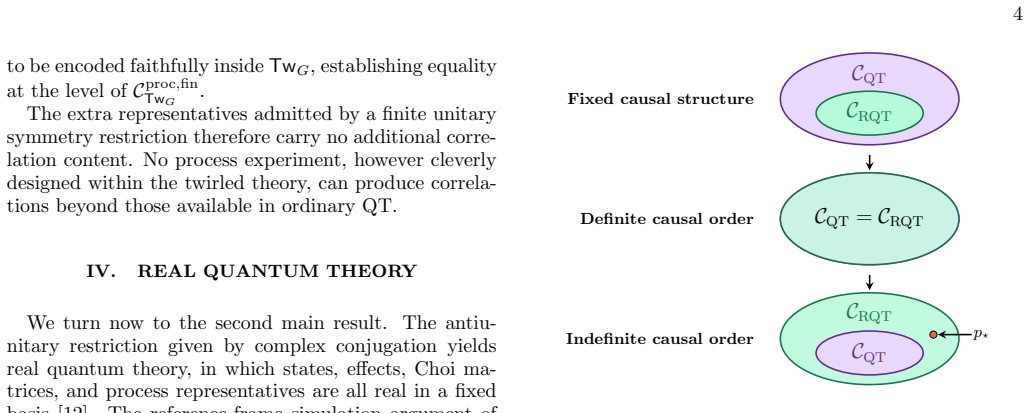
Indefinite causal order reverses the real-complex hierarchy by exhibiting a process matrix that separates real quantum theory from complex quantum theory.
A machine-rendered reading of the paper's core claim, the machinery that carries it, and where it could break.
Core claim
Indefinite causal order reverses the real-complex hierarchy in the process-matrix framework by exhibiting a process matrix that separates real quantum theory from complex quantum theory. The authors note that this holds when normalization is imposed only for local CPTP maps acting on the parties' process input-output systems (N1) but does not hold under the stronger condition (N2) that requires normalization after arbitrary shared ancillary systems are introduced.
What carries the argument
A process matrix in the process-matrix framework that is valid under real quantum theory but separates it from complex quantum theory under local normalization N1.
If this is right
- Real quantum theory can achieve certain tasks impossible for complex quantum theory when causal order is indefinite.
- The standard hierarchy in which complex quantum theory is more powerful than real quantum theory is reversed in causally indefinite scenarios.
- Process matrices provide an operational witness for the distinction between real and complex quantum theories.
Where Pith is reading between the lines
- If the stronger compositional normalization N2 is adopted as the correct validity criterion, the claimed separation does not hold.
- The N1 versus N2 distinction shows that definitions of valid process matrices depend on how composition with ancillary systems is required to behave.
- Alternative constructions might still achieve a reversal under N2 or in other frameworks.
Load-bearing premise
Imposing normalization only on local CPTP maps acting on the parties' process input-output systems is sufficient for the process matrix to be valid.
What would settle it
Checking whether the proposed process matrix satisfies normalization when each party acts jointly on its process system and a local share of an arbitrary shared ancillary system.
Figures
read the original abstract
[Note added after submission. After posting the first version of this preprint and corresponding with Ved Kunte and Kuntal Sengupta, we identified an issue with the claimed separation between real quantum theory and ordinary complex quantum theory in the process-matrix framework. This version imposes normalization only for local CPTP maps acting on the parties' process input-output systems, which we call N1. A stronger compositional requirement is to impose normalization also after arbitrary shared ancillary systems are introduced and each party acts jointly on its process system and local share of the ancilla, which we call N2. Under N2, the process matrix used in this version to separate RQT from QT is not valid, and the claimed RQT/QT separation is therefore not established. We are preparing a revised version that clarifies this distinction and revises the affected claims. This temporary update is intended to alert readers to this issue while we work on revising the manuscript.]
Editorial analysis
A structured set of objections, weighed in public.
Referee Report
Summary. The manuscript claims that indefinite causal order reverses the real-complex hierarchy in the process-matrix framework, by exhibiting a process matrix that separates real quantum theory (RQT) from complex quantum theory (QT).
Significance. If the claimed separation held under the stated conditions, the result would be significant for foundational quantum information, as it would demonstrate that process matrices with indefinite causal order can distinguish RQT from QT in a manner that inverts the usual hierarchy between the two theories.
major comments (1)
- [Abstract] Abstract (note added after submission): The note explicitly states that the process matrix used to separate RQT from QT satisfies only the weaker N1 normalization (local CPTP maps on parties' process input-output systems) but fails the stronger N2 normalization (after arbitrary shared ancillary systems and joint actions). This directly invalidates the central claim, as the matrix is not valid under N2 and the separation is therefore not established.
Simulated Author's Rebuttal
We thank the referee for their report. We agree that the central claim of an RQT/QT separation is not established under N2 normalization, as already stated in the note added after submission. We are preparing a revised manuscript that clarifies the N1/N2 distinction and revises the affected claims.
read point-by-point responses
-
Referee: [Abstract] Abstract (note added after submission): The note explicitly states that the process matrix used to separate RQT from QT satisfies only the weaker N1 normalization (local CPTP maps on parties' process input-output systems) but fails the stronger N2 normalization (after arbitrary shared ancillary systems and joint actions). This directly invalidates the central claim, as the matrix is not valid under N2 and the separation is therefore not established.
Authors: We fully agree with this assessment. The note was added precisely to highlight that the process matrix satisfies only N1 and fails N2, so the claimed separation is not established. We are revising the manuscript to make this distinction explicit and to update all affected claims. revision: yes
Circularity Check
No circularity; derivation does not reduce to inputs by construction
full rationale
The paper claims to exhibit a process matrix separating real quantum theory from complex quantum theory in the process-matrix framework. The post-submission note identifies that the matrix satisfies only the weaker N1 normalization but fails the stronger N2 condition, so the separation is not established. This is a validity failure of the exhibited object, not a circular reduction where any prediction or first-principles result equals its inputs by definition, self-citation, or renaming. No self-definitional steps, fitted inputs called predictions, load-bearing self-citations, uniqueness theorems, or ansatzes smuggled via citation appear in the provided text. The derivation chain is therefore self-contained and receives score 0.
Axiom & Free-Parameter Ledger
Reference graph
Works this paper leans on
-
[1]
Kochen and E
S. Kochen and E. P. Specker, The Problem of Hidden Variables in Quantum Mechanics, Journal of Mathemat- ics and Mechanics17, 59 (1967)
1967
-
[2]
J. S. Bell, On the Einstein Podolsky Rosen paradox, Physics Physique Fizika1, 195 (1964)
1964
-
[3]
M. F. Pusey, J. Barrett, and T. Rudolph, On the reality of the quantum state, Nature Physics8, 475 (2012)
2012
-
[4]
Renou, D
M.-O. Renou, D. Trillo, M. Weilenmann, T. P. Le, A. Tavakoli, N. Gisin, A. Ac´ ın, and M. Navascu´ es, Quan- tum theory based on real numbers can be experimentally falsified, Nature600, 625 (2021)
2021
-
[5]
E. C. G. Stueckelberg, Quantum Theory in Real Hilbert Space, Helvetica Physica Acta33, 727 (1960)
1960
-
[6]
C. M. Caves, C. A. Fuchs, and P. Rungta, Entanglement of Formation of an Arbitrary State of Two Rebits, Foun- dations of Physics Letters14, 199 (2001)
2001
-
[7]
McKague, M
M. McKague, M. Mosca, and N. Gisin, Simulating Quan- tum Systems Using Real Hilbert Spaces, Physical Review Letters102, 020505 (2009)
2009
-
[8]
Aleksandrova, V
A. Aleksandrova, V. Borish, and W. K. Wootters, Real- vector-space quantum theory with a universal quantum bit, Phys. Rev. A87, 052106 (2013)
2013
- [9]
-
[10]
Quantum mechanics based on real numbers: A consistent description
P. Barrios Hita, A. Trushechkin, H. Kampermann, M. Epping, and D. Bruß, Quantum mechanics based on real numbers: A consistent description 10.48550/arXiv.2503.17307 (2025), arXiv:2503.17307 [quant-ph]
work page internal anchor Pith review Pith/arXiv arXiv doi:10.48550/arxiv.2503.17307 2025
-
[11]
T. Hoffreumon and M. P. Woods, Quantum theory based on real numbers cannot be experimentally falsi- fied 10.48550/arXiv.2603.19208 (2026), arXiv:2603.19208 [quant-ph]
- [12]
-
[13]
Hardy, Towards quantum gravity: A framework for probabilistic theories with non-fixed causal structure, Journal of Physics A: Mathematical and Theoretical40, 3081 (2007)
L. Hardy, Towards quantum gravity: A framework for probabilistic theories with non-fixed causal structure, Journal of Physics A: Mathematical and Theoretical40, 3081 (2007)
2007
-
[14]
Oreshkov, F
O. Oreshkov, F. Costa, and ˇC. Brukner, Quantum corre- lations with no causal order, Nature Communications3, 1092 (2012)
2012
-
[15]
Brukner, Quantum causality, Nature Physics10, 259 (2014)
ˇC. Brukner, Quantum causality, Nature Physics10, 259 (2014)
2014
-
[16]
L. Hardy, Operationalism, Causality, and Quantum Theory: A mostly time symmetric perspective (2026), arXiv:2603.12076 [quant-ph]
-
[17]
S. D. Bartlett, T. Rudolph, and R. W. Spekkens, Refer- ence frames, superselection rules, and quantum informa- tion, Reviews of Modern Physics79, 555 (2007). 6
2007
-
[18]
Centeno, M
D. Centeno, M. Erba, T. D. Galley, D. Schmid, J. H. Selby, R. W. Spekkens, S. Soltani, J. Surace, A. Wilce, and Y. Y¯ ıng, Symmetry-induced failures of tomographic locality: Constructing foil theories by twirling, Physical Review A112, L030202 (2025)
2025
-
[19]
Branciard, M
C. Branciard, M. Ara´ ujo, A. Feix, F. Costa, and ˇC. Brukner, The simplest causal inequalities and their violation, New Journal of Physics18, 013008 (2016)
2016
-
[20]
Liu and G
Z. Liu and G. Chiribella, Tsirelson bounds for quantum correlations with indefinite causal order, Nature Commu- nications16, 3314 (2025)
2025
-
[21]
H. Barnum, M. A. Graydon, and A. Wilce, Some nearly quantum theories, Electronic Proceedings in Theoreti- cal Computer Science195, 59 (2015), arXiv:1507.06278 [quant-ph]
work page internal anchor Pith review Pith/arXiv arXiv 2015
-
[22]
J. Bavaresco, ¨A. Baumeler, Y. Guryanova, and C. Budroni, Indefinite causal order in boxworld theo- ries 10.48550/arXiv.2411.00951 (2024), arXiv:2411.00951 [quant-ph]
-
[23]
R. Kunjwal and O. Oreshkov, Nonclassicality in correlations without causal order, arXiv preprint arXiv:2307.02565 (2023), arXiv:2307.02565 [quant-ph]
-
[24]
Generalizing Bell nonlocality without global causal assumptions
R. Kunjwal and O. Oreshkov, Generalizing bell nonlo- cality without global causal assumptions, arXiv preprint arXiv:2411.11397 (2024), arXiv:2411.11397 [quant-ph]
work page internal anchor Pith review Pith/arXiv arXiv 2024
-
[25]
Wechs, N
J. Wechs, N. D. Ahmed, Z. Liu, and R. Kunjwal, The simplest nomic inequalities and their violations, forth- coming
-
[26]
Minagawa, Code and numerical data,https: //github.com/shintarominagawa/RQT-ICO/releases/ tag/v0.1-preprint(2026), version v0.1-preprint
S. Minagawa, Code and numerical data,https: //github.com/shintarominagawa/RQT-ICO/releases/ tag/v0.1-preprint(2026), version v0.1-preprint
2026
-
[27]
Diamond and S
S. Diamond and S. Boyd, CVXPY: A python-embedded modeling language for convex optimization, Journal of Machine Learning Research17, 1 (2016)
2016
-
[28]
MOSEK ApS,MOSEK Optimization Toolbox Manual, Version 11.0(2025). VI. END MATTER End Matter: Strict inclusion in Theorem 2—. Suppose that Alice chooses a measurement settingxand applies a CP-instrument with the input systemA 1 and output systemA 2 whose Choi operators areM A :={M A1A2 a|x }a,x. Bob chooses a settingyand applies an instrument with the input...
2025
-
[29]
Process matrices We recall the process-matrix framework of Ref. [14]. Consider two parties, Alice and Bob, performing local oper- ations in their laboratories, without assuming any underlying global causal order. LetH A1 andH A2 denote Alice’s input and output Hilbert spaces, and similarly for Bob. We denote byL A1,L A2, andL A1A2 the corresponding vector...
-
[30]
Twirled and swirled quantum worlds The process-matrix framework assumes that local laboratories have access to the full set of quantum instruments. If the parties lack a shared reference frame, the operationally accessible states, effects, and transformations are restricted to those symmetric under the relevant group action, equivalently to a superselecti...
-
[31]
We define twirled process matrices by imposing the usual operational conditions (O1) and (O2) only on this restricted class
Twirled process matrices In a (G, U)-twirled quantum world, local instruments, ancillas, and operations are restricted to (G, U)-invariant or (G, U)-covariant ones. We define twirled process matrices by imposing the usual operational conditions (O1) and (O2) only on this restricted class. Since we are interested in the operationally accessible part of the...
-
[32]
Swirled process matrices The same construction can be adapted to swirled quantum worlds. In the time-reversal-swirled case, namely real quantum theory (RQT), local instruments, ancillas, and operations are restricted to those with real density 11 operators and real Choi matrices in the chosen basis [12]. A swirled process is therefore defined only up to o...
-
[33]
That is, for allg∈G, V (1) g ⊗ · · · ⊗V (n) g Teff V (1) g ⊗ · · · ⊗V (n) g † =T eff, where V (k) g :=U X (k) 1 g ⊗ U X (k) 2 g is the induced action on the Choi space of partyk
Characterisation of test operators Lemma 1.Every test operatorT eff is positive, Teff ≥0, and globally invariant on the process-matrix legs. That is, for allg∈G, V (1) g ⊗ · · · ⊗V (n) g Teff V (1) g ⊗ · · · ⊗V (n) g † =T eff, where V (k) g :=U X (k) 1 g ⊗ U X (k) 2 g is the induced action on the Choi space of partyk. 12 Proof.Write Teff = TrR IS ⊗ρ R1···...
-
[34]
Characterisation of process matrices for twirled worlds Theorem 3(Twirled process matrices).Let(G, U)be a finite twirled world with partiesX (1), . . . , X(n). A matrix W∈L X (1) 1 X (1) 2 ···X (n) 1 X (n) 2 is ann-party twirled process matrix iff W∈L X (1) 1 X (1) 2 ···X (n) 1 X (n) 2 inv ,(A5) W≥0,(A6) Tr W(M 1 ⊗ · · · ⊗M n) = 1 (A7) for all Choi matric...
-
[35]
Single 2-dimensional party a. Ordinary quantum theoryFrom [14] the single-party process matrix in ordinary quantum theory takes the form WQT = 1 2 I+v xσA1 x +v yσA1 y +v zσA1 z ,(D1) withv x, vy, vz ∈R, subject toW QT ≥0. Thus, in the single-party case, ordinary QT process matrices are density operators on the input spaceA 1, tensored with the maximally ...
-
[36]
v0.1-preprint
Two 2-dimensional parties a. Ordinary quantum theory: two partiesFor two two-dimensional parties, the most general bipartite qubit process matrix is a Hermitian operator onA 1A2B1B2 satisfying the OCB positivity and normalization conditions. In the Pauli basis, the allowed support types are 1,A 1,B 1,A 1B1,A 2B1,A 1B2,A 1A2B1, andA 1B1B2. Thus one can wri...
discussion (0)
Sign in with ORCID, Apple, or X to comment. Anyone can read and Pith papers without signing in.