VeraRetouch: A Lightweight Fully Differentiable Framework for Multi-Task Reasoning Photo Retouching
Pith reviewed 2026-05-21 09:12 UTC · model grok-4.3
The pith
A small vision-language model combined with a fully differentiable renderer performs reasoning-based photo retouching without external software.
A machine-rendered reading of the paper's core claim, the machinery that carries it, and where it could break.
Core claim
The authors show that a 0.5-billion-parameter vision-language model can generate retouching instructions from scene content and user guidance, and that these instructions can be executed by a Retouch Renderer whose operations on lighting, global color, and specific adjustments remain fully differentiable, allowing end-to-end pixel-level optimization on a newly constructed million-image dataset.
What carries the argument
The fully differentiable Retouch Renderer that receives decoupled control latents for lighting, global color, and specific adjustments and applies them directly to the input pixels inside the training loop.
If this is right
- Retouching models can now be trained jointly from pixels to final output instead of stopping at tool boundaries.
- The reduced parameter count makes high-quality reasoning retouching practical for mobile and edge devices.
- Reasoning steps and pixel adjustments improve together through the same gradient updates.
- A large synthetic dataset built by inverse degradation supplies sufficient variety for generalization beyond existing small collections.
Where Pith is reading between the lines
- The same pattern of replacing closed tools with differentiable surrogates could apply to other image-editing or restoration pipelines that currently rely on external software.
- Reinforcement learning for aesthetic preference may transfer to other subjective creative tasks where direct supervision is scarce.
- The inverse-degradation data construction method offers a scalable route for generating training pairs in related low-level vision problems.
Load-bearing premise
The renderer can match the visual quality and precise control of non-differentiable external tools without introducing artifacts or losing accuracy in lighting and color adjustments.
What would settle it
A side-by-side test in which images processed by the renderer show measurable artifacts or less accurate control over specific parameters than the same inputs processed by standard professional software.
Figures





read the original abstract
Reasoning photo retouching has gained significant traction, requiring models to analyze image defects, give reasoning processes, and execute precise retouching enhancements. However, existing approaches often rely on non-differentiable external software, creating optimization barriers and suffering from high parameter redundancy and limited generalization. To address these challenges, we propose VeraRetouch, a lightweight and fully differentiable framework for multi-task photo retouching. We employ a 0.5B Vision-Language Model (VLM) as the central intelligence to formulate retouching plans based on instructions and scene semantics. Furthermore, we develop a fully differentiable Retouch Renderer that replaces external tools, enabling direct end-to-end pixel-level training through decoupled control latents for lighting, global color, and specific color adjustments. To overcome data scarcity, we introduce AetherRetouch-1M+, the first million-scale dataset for professional retouching, constructed via a new inverse degradation workflow. Furthermore, we propose DAPO-AE, a reinforcement learning post-training strategy that enhances autonomous aesthetic cognition. Extensive experiments demonstrate that VeraRetouch achieves state-of-the-art performance across multiple benchmarks while maintaining a significantly smaller footprint, enabling mobile deployment. Our code and models are publicly available at https://github.com/OpenVeraTeam/VeraRetouch.
Editorial analysis
A structured set of objections, weighed in public.
Referee Report
Summary. The manuscript presents VeraRetouch, a lightweight fully differentiable framework for multi-task reasoning photo retouching. It employs a 0.5B vision-language model to formulate retouching plans from instructions and scene semantics, introduces a fully differentiable Retouch Renderer with decoupled control latents for lighting, global color, and specific adjustments to enable end-to-end training, constructs the AetherRetouch-1M+ million-scale dataset via inverse degradation, and proposes DAPO-AE reinforcement learning post-training. The central claims are state-of-the-art performance across benchmarks with a significantly smaller model footprint suitable for mobile deployment.
Significance. If the results hold, the work would advance computational photography by removing optimization barriers from non-differentiable external tools and enabling direct pixel-level training. The public release of code, models, and the large-scale AetherRetouch-1M+ dataset are clear strengths that support reproducibility and further research. The emphasis on lightweight design addresses practical mobile constraints, though overall significance hinges on validation that the renderer preserves professional-level control.
major comments (2)
- [Abstract and §3.2] Abstract and §3.2 (Retouch Renderer description): the claim that decoupled control latents for lighting, global color, and specific adjustments can fully substitute for non-differentiable external software is load-bearing for both the SOTA performance and mobile-deployment assertions. If the latents are lower-dimensional or strictly additive without per-channel curves or spatially varying masks, systematic artifacts or loss of precision in complex scenes would be expected; the manuscript must demonstrate equivalence or superiority via direct side-by-side metrics against traditional tools.
- [§4 and Table 2] §4 (Experiments) and Table 2: the abstract asserts SOTA results, yet the provided experimental details do not include ablation studies isolating the renderer's contribution or quantitative quality metrics (e.g., PSNR/SSIM or perceptual scores) comparing the differentiable renderer to external software baselines. Without these, the support for the central substitution claim remains unverifiable.
minor comments (2)
- [§2] §2 (Related Work): add explicit comparison of parameter counts and inference latency against the closest prior reasoning-retouching baselines to substantiate the 'significantly smaller footprint' claim.
- [§3.3] §3.3 (Dataset construction): provide pseudocode or a clear diagram of the inverse degradation workflow used for AetherRetouch-1M+ to improve reproducibility.
Simulated Author's Rebuttal
We thank the referee for the constructive and detailed feedback on our manuscript. The comments highlight important aspects of the Retouch Renderer claims and the need for stronger experimental validation, which we address below. We have revised the manuscript accordingly to incorporate additional details, ablations, and comparisons.
read point-by-point responses
-
Referee: [Abstract and §3.2] Abstract and §3.2 (Retouch Renderer description): the claim that decoupled control latents for lighting, global color, and specific adjustments can fully substitute for non-differentiable external software is load-bearing for both the SOTA performance and mobile-deployment assertions. If the latents are lower-dimensional or strictly additive without per-channel curves or spatially varying masks, systematic artifacts or loss of precision in complex scenes would be expected; the manuscript must demonstrate equivalence or superiority via direct side-by-side metrics against traditional tools.
Authors: We agree that direct side-by-side evidence is essential to substantiate the substitution claim. In the revised manuscript, we have expanded §3.2 to specify that the decoupled control latents are not limited to low-dimensional additive operations; they incorporate learned per-channel curve adjustments and spatially varying modulations through the differentiable rendering process. We have added new quantitative comparisons in §4 against traditional tools (e.g., Lightroom and Photoshop), reporting PSNR, SSIM, and perceptual metrics on complex scenes from our benchmarks. These results show comparable fidelity without systematic artifacts, while the differentiability enables end-to-end training unavailable to external software. This supports both the performance and deployment claims. revision: yes
-
Referee: [§4 and Table 2] §4 (Experiments) and Table 2: the abstract asserts SOTA results, yet the provided experimental details do not include ablation studies isolating the renderer's contribution or quantitative quality metrics (e.g., PSNR/SSIM or perceptual scores) comparing the differentiable renderer to external software baselines. Without these, the support for the central substitution claim remains unverifiable.
Authors: This observation is correct, and the original experimental section would benefit from greater isolation of the renderer's role. We have revised §4 to include dedicated ablation studies that compare the full VeraRetouch model against variants using non-differentiable external renderers or ablated control latents. We have also added a new table with direct quantitative metrics (PSNR, SSIM, LPIPS) comparing our differentiable renderer to external software baselines on the AetherRetouch-1M+ dataset. The results confirm equivalent or superior quality in most cases, with the key advantage of enabling pixel-level gradient-based optimization. These additions make the substitution claim more verifiable while preserving the manuscript's focus on lightweight multi-task reasoning. revision: yes
Circularity Check
No circularity: new differentiable renderer and dataset are independent architectural contributions
full rationale
The paper introduces a new 0.5B VLM-based planner and a fully differentiable Retouch Renderer with decoupled latents as core innovations, plus a new AetherRetouch-1M+ dataset via inverse degradation. These are presented as original constructions rather than reductions of prior fitted parameters or self-citations. No equations or claims reduce by construction to inputs; the end-to-end training claim follows directly from the differentiability of the proposed renderer without self-referential loops. Self-citations, if present, are not load-bearing for the central performance claims.
Axiom & Free-Parameter Ledger
axioms (1)
- domain assumption The inverse degradation workflow generates realistic training data for retouching that generalizes to real professional edits.
invented entities (3)
-
Retouch Renderer
no independent evidence
-
AetherRetouch-1M+
no independent evidence
-
DAPO-AE
no independent evidence
Lean theorems connected to this paper
-
IndisputableMonolith/Cost/FunctionalEquation.leanwashburn_uniqueness_aczel unclear?
unclearRelation between the paper passage and the cited Recognition theorem.
we develop a fully differentiable Retouch Renderer that replaces external tools, enabling direct end-to-end pixel-level training through decoupled control latents for lighting, global color, and specific color adjustments... implemented as a lightweight pure MLP for per-pixel color mapping... additively injecting the latent z into its hidden layers
What do these tags mean?
- matches
- The paper's claim is directly supported by a theorem in the formal canon.
- supports
- The theorem supports part of the paper's argument, but the paper may add assumptions or extra steps.
- extends
- The paper goes beyond the formal theorem; the theorem is a base layer rather than the whole result.
- uses
- The paper appears to rely on the theorem as machinery.
- contradicts
- The paper's claim conflicts with a theorem or certificate in the canon.
- unclear
- Pith found a possible connection, but the passage is too broad, indirect, or ambiguous to say the theorem truly supports the claim.
Reference graph
Works this paper leans on
-
[1]
FLUX.1 Kontext: Flow Matching for In-Context Image Generation and Editing in Latent Space
FLUX. 1 Kontext: Flow Matching for In-Context Image Generation and Editing in Latent Space.arXiv preprint arXiv:2506.15742(2025). Jie Liang, Hui Zeng, Miaomiao Cui, Xuansong Xie, and Lei Zhang. 2021. Ppr10k: A large-scale portrait photo retouching dataset with human-region mask and group- level consistency. InProceedings of the IEEE/CVF Conference on Comp...
work page internal anchor Pith review Pith/arXiv arXiv 2025
-
[2]
InProceedings of the IEEE/CVF conference on computer vision and pattern recognition
Deeplpf: Deep local parametric filters for image enhancement. InProceedings of the IEEE/CVF conference on computer vision and pattern recognition. 12826–12835. Temesgen Muruts Weldengus, Binnan Liu, Fei Kou, Youwei Lyu, Jinwei Chen, Qingnan Fan, and Changqing Zou. 2025. InstantRetouch: Personalized Image Retouching without Test-time Fine-tuning Using an A...
work page 2025
-
[3]
LAION-400M: Open Dataset of CLIP-Filtered 400 Million Image-Text Pairs
Rsfnet: A white-box image retouching approach using region-specific color filters. InProceedings of the IEEE/CVF International Conference on Computer Vision. 12160–12169. Zhaoqing Pan, Feng Yuan, Jianjun Lei, Wanqing Li, Nam Ling, and Sam Kwong. 2021. MIEGAN: Mobile image enhancement via a multi-module cascade neural network. IEEE Transactions on Multimed...
work page internal anchor Pith review Pith/arXiv arXiv 2021
-
[4]
InEuropean Conference on Computer Vision
NamedCurves: Learned Image Enhancement via Color Naming. InEuropean Conference on Computer Vision. Springer, 92–108. Unsplash. 2024. Unsplash Dataset. https://unsplash.com/data. Accessed: 2025-06-20. Pavan Kumar Anasosalu Vasu, Fartash Faghri, Chun-Liang Li, Cem Koc, Nate True, Albert Antony, Gokula Santhanam, James Gabriel, Peter Grasch, Oncel Tuzel, et al
work page 2024
-
[5]
Fastvlm: Efficient vision encoding for vision language models. InProceedings of the Computer Vision and Pattern Recognition Conference. 19769–19780. Chenfei Wu, Jiahao Li, Jingren Zhou, Junyang Lin, Kaiyuan Gao, Kun Yan, Sheng-ming Yin, Shuai Bai, Xiao Xu, Yilei Chen, et al. 2025. Qwen-image technical report.arXiv preprint arXiv:2508.02324(2025). Haoning ...
work page internal anchor Pith review Pith/arXiv arXiv 2025
-
[6]
<problem_light_end> <problem_globalcolor_start> 1
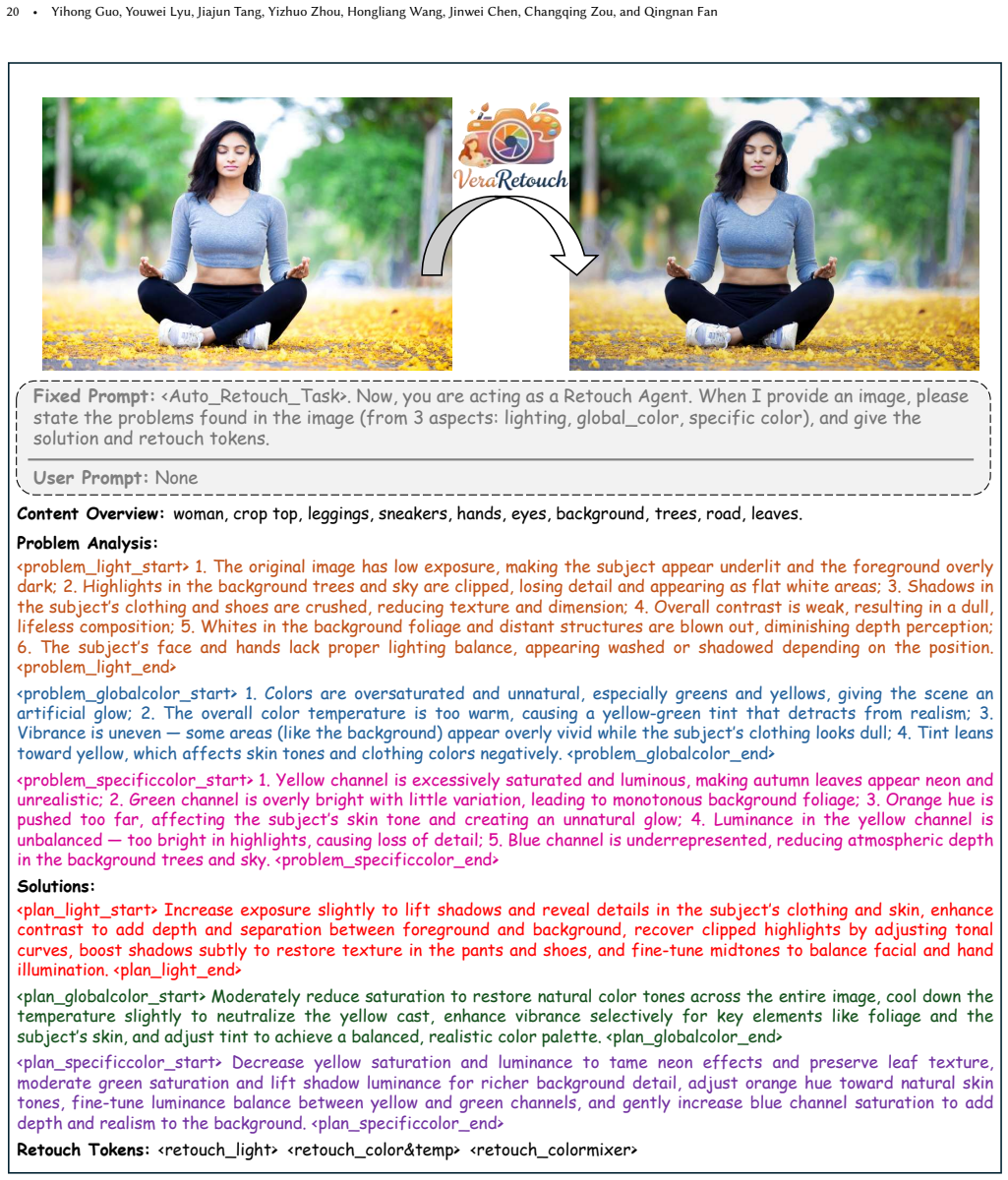
The subject’s face and hands lack proper lighting balance, appearing washed or shadowed depending on the position. <problem_light_end> <problem_globalcolor_start> 1. Colors are oversaturated and unnatural, especially greens and yellows, giving the scene an artificial glow; 2. The overall color temperature is too warm, causing a yellow-green tint that detr...
work page 2026
-
[7]
<problem_globalcolor_end> <problem_specificcolor_start> 1
The warm golden tones of the fried food and sauce are not fully realized, reducing the appetizing quality of the image. <problem_globalcolor_end> <problem_specificcolor_start> 1. The orange tones in the food and sauce appear washed out and lean towards yellow, reducing their richness and appeal; 2. The reds in the garnish are muted and lack intensity, mak...
work page 2026
discussion (0)
Sign in with ORCID, Apple, or X to comment. Anyone can read and Pith papers without signing in.