REVIEW 3 major objections 5 minor
Tri-Manual Visuomotor Imitation Learning of Robot Policies
T0 review · 3 major / 5 minor · reviewed 2026-08-04 · deepseek-v4-flash
Pith's one-line read A dependency-aware retiming step turns pairwise teleoperation demonstrations into synchronous three-arm training data, making learned robot policies 42% faster with equal success.
desk verdict Novel retiming-as-scheduling idea with an honest matched real-robot evaluation; the weak spot is the untested physical coherence of retimed composites, and that deserves a direct audit before the result is treated as robust. read the letter →
The pith
A machine-rendered reading of the paper's core claim, the machinery that carries it, and where it could break.
The reading
What carries the argument
The central object is Dependency-Aware Tri-Arm Scheduling (DATS), a constrained scheduling formulation. Each demonstrated episode is segmented into fixed-duration subtask intervals annotated with required-arm sets and predecessor relations, reviewed by a human to encode task prerequisites and shared-workspace orderings. DATS solves a makespan-minimization optimization problem — using a constraint-optimization solver — that enforces finish-to-start precedence edges and per-arm no-overlap constraints, producing a new start time for every segment. The mapping preserves local sensorimotor timing within segments while composing arm streams recorded at different raw times into new observation-acti
What would settle it
Take one task (e.g., tote-card insertion) and corrupt the dependency graph by randomly permuting predecessor edges while keeping the same segment motions; train policies on DATS with the shuffled graphs. If success remains at the reported level and time reduction persists, the graph annotation is not the source of the gain; if success collapses, the human-reviewed dependencies are doing the work. A second check: use motion capture during overlaps to measure whether the retimed composite states actually occur without contact violations.
Extended reading notes
Core claim
The central claim is that a mode-switched teleoperation demonstration contains the right local motions on the wrong global clock: an arm waits because the operator is controlling another pair, not because the task requires a delay. DATS replaces that clock with one defined by a human-reviewed dependency graph and arm-resource constraints, solving a fixed-duration interval scheduling problem that minimizes total episode duration. The resulting retimed streams are what train a synchronous action-chunked transformer policy for all three arms. Across 237 demonstrations and 300 real-robot trials on six tasks, DATS-trained policies achieved 129/150 successes versus 126/150 for baseline, with avera
Load-bearing premise
The load-bearing premise is that arm-centric motion segments recorded at different raw times remain locally meaningful when composed into new observation-action windows — if the retimed composites are not physically coherent sensorimotor context, the policy could learn from impossible states and the real-robot success would be a lucky artifact; this depends on the human-reviewed graph correctly encoding every task prerequisite and on interface-induced delays being separable f
Editorial extensions
If this is right
- Deployment needs no dependency graph or scheduler: the retimed data train a policy that acts directly from observations, so the added machinery lives entirely in offline data construction.
- One operator can demonstrate tasks for three (or, by the same resource formulation, more) arms through pairwise control rather than requiring multi-user teleoperation.
- Retiming yields faster coordinated execution on all six tasks — time reductions between 31% and 50% — without sacrificing observed success.
- The same exclusivity constraint can encode non-arm resources such as tools or workspace regions, so the method generalizes beyond manipulators.
- For two tasks the timeline hardly shortened, yet co-window coverage rose sharply, showing that retiming can improve joint supervision even when episode duration is unchanged.
Reading between the lines
- The central assumption that graph-compatible segments remain physically coherent once composed could be tested directly by running DATS-retimed policies with dependency graphs whose precedence edges are randomly shuffled; if success survives, the human-reviewed graph is not doing the load-bearing work.
- The method suggests a general principle for imitation learning: separate 'what to do' from 'when to do it' when the collection interface is less parallel than the embodiment, which may apply to asymmetric bimanual setups, mobile manipulators, or any channel-limited teaching interface.
- Because DATS only relocates recorded segments, its ceiling is set by the coverage of the original demonstrations; tasks requiring genuinely novel cross-arm coordination outside the raw data would need additional collection, not just retiming.
- A natural next step is to automate the dependency-graph annotation (currently proposed by a vision-language model and reviewed by a human); if that automation matures, DATS becomes a drop-in data preprocessing module for existing action-chunked imitation pipelines.
Signed reviews
Editorial analysis
A structured set of objections, weighed in public.
Referee Report
Summary. TriManPolicy extends teleoperated imitation learning to a three-arm robot using a single operator who switches between two-arm control modes. The central component, Dependency-Aware Tri-Arm Scheduling (DATS), takes human-reviewed subtask graphs, preserves fixed-duration arm-centric segments, and reschedules them under predecessor and per-arm non-overlap constraints by minimizing episode makespan. Retimed demonstrations train a single action-chunked transformer policy that controls all three arms synchronously. In six real-world tasks with 237 processed demonstrations and 25 trials per condition, DATS-trained policies complete successful trials faster (macro-mean 47.8 s vs. 83.1 s) with comparable observed success (129/150 vs. 126/150). Offline diagnostics separate duration reduction from changes in which cross-arm segment pairs share training windows.
Significance. If the central claim holds, the paper makes a useful contribution: it identifies interface-induced timing as a learnable artifact in imitation learning and proposes a simple, interpretable scheduling transformation that preserves demonstrated local motions while changing their global placement. The evaluation is genuinely matched—same demonstrations, same policy architecture, same trial protocol, interleaved trials—and the six-task suite gives the result breadth. The offline decomposition of duration change from target-window composition is a thoughtful diagnostic, and the use of CP-SAT with all 237 graphs solved is a practical strength. The main uncertainty is whether the retimed composite observations are physically coherent, since the closed-loop success counts are only an indirect test of that assumption.
major comments (3)
- [Sec. III-E, Eq. (9)] The load-bearing assumption that 'graph-compatible arm-centric segments remain locally meaningful when composed' is stated but not directly validated. Eq. (9) shifts each arm's samples by a segment offset, so the constructed observation windows combine arm-centric streams recorded at different raw timestamps. The scheduler enforces NoOverlap per arm but, as noted in Sec. III-D, it does not impose raw order on same-arm segments; a same-arm pair with no dependency path can in principle be reordered, changing arm-local continuity at segment boundaries. Aggregate real-robot success (Sec. IV-B) is a weak isolation: a policy can ignore inconsistent streams in some windows and still succeed on 25 trials. Please add a direct fused-state audit, e.g., verify that composed observations satisfy the checked object-state predicates at segment boundaries, or simulate the retimed arm trajectories to che
- [Sec. IV-B, Table II] The headline empirical claims rest on 25 trials per condition and a single training seed. The aggregate success difference is 129/150 vs. 126/150, and per-task differences are a few successes. No confidence intervals or significance tests are reported, and completion times are computed only on successful trials, which introduces a selection effect. Please report bootstrap confidence intervals for per-task and aggregate success and time, use appropriate per-task tests (e.g., Fisher exact for success counts, paired bootstrap for time), and ideally retrain with multiple seeds. The Discussion's sentence in Sec. IV-E correctly acknowledges that one seed does not estimate variation across training seeds, but this limitation should appear in the main results, not only as a caveat.
- [Sec. IV-C, Tables III–IV, Eq. (11)] The co-window coverage audit measures temporal co-occurrence inside a fixed 2.0 s horizon, so it is a direct readout of the interval-scheduling objective: it counts how many eligible pairs are placed in a common window. It cannot validate that the newly composed streams are physically coherent, and the paper itself treats Gap as an offline diagnostic rather than a trained condition. As written, the offline analysis supports the claim that DATS changes which segment targets share a window, but not the stronger claim that the resulting supervision is executable. Please state this distinction explicitly in the main text. If the decomposition is intended to support a mechanistic explanation of the rollout results, training a policy on Gap timelines would be needed to separate duration effects from target-composition effects.
minor comments (5)
- [Sec. III-D, Eq. (5)] The notation is inconsistent: the raw interval uses hats, but the scheduled start and end are then written as s_j and e_j without hats, and the equation appears as 'ej = s_j + d_j'. Please unify the notation, e.g., use s_j^*, e_j^* for scheduled times throughout.
- [Fig. 6] The caption states that all 237 episodes show higher DATS than Gap co-window coverage, but no paired effect size or confidence interval is given. Add a paired summary (e.g., mean paired difference with CI) to quantify the consistency.
- [Sec. IV-C, Eq. (11)] It is clear that each eligible pair contributes at most once, but the denominator |C_n| counts pairs, while the numerator counts pairs with at least one valid window. Consider stating explicitly that a pair is counted once even if it co-occurs in multiple windows.
- [Sec. IV-B] Table II reports mean completion time over successful trials only, but does not report the number of successful trials used for the time mean per task (the Succ. column gives this, so this is a minor formatting point). Please clarify in the table caption that the time statistics are conditional on success.
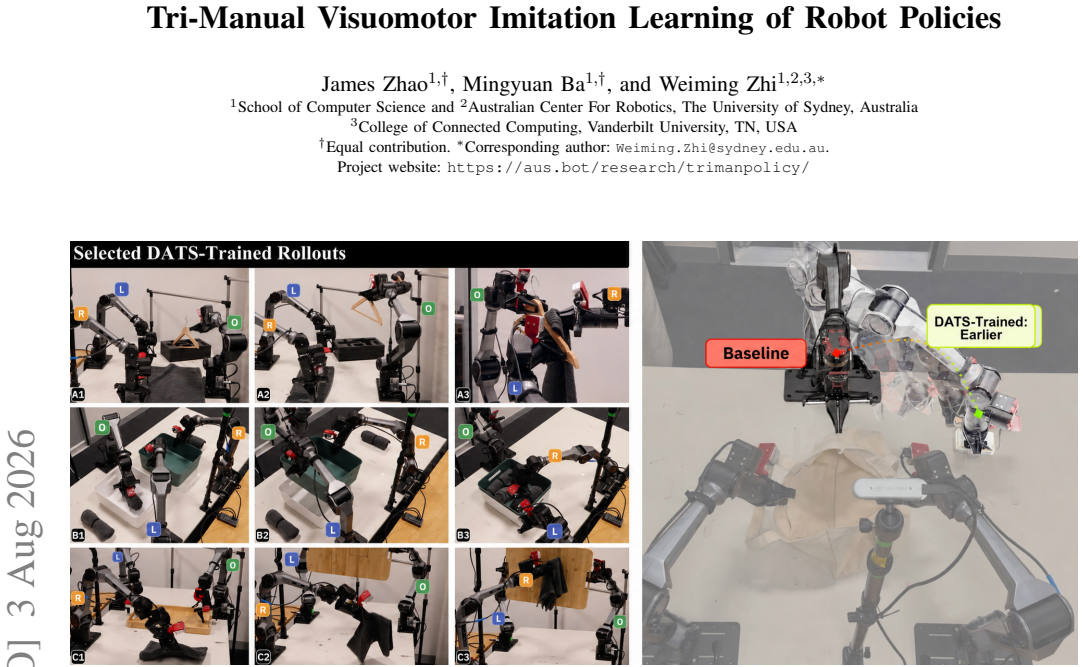
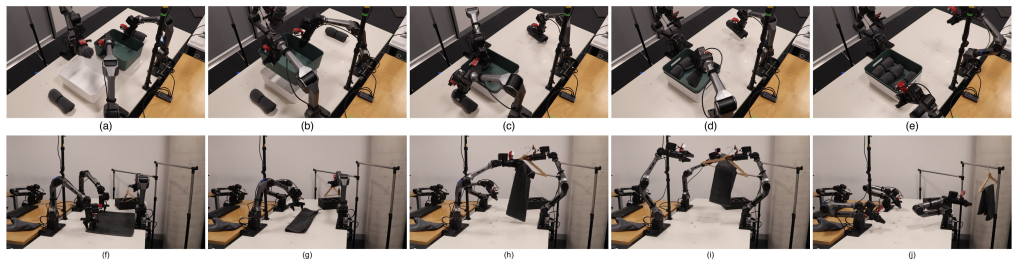
- [Sec. IV-D] The selected rollouts in Figs. 7–9 are illustrative and necessarily cherry-picked. This is acceptable, but the caption should explicitly say that these are selected successful rollouts and not representative of all trials.
Circularity Check
No significant circularity: DATS is an explicit data transformation with real-robot evaluation; self-citations are not load-bearing.
full rationale
The paper's claimed derivation chain does not reduce to its inputs. DATS is a clearly specified data transformation: it takes annotated, fixed-duration segments and optimizes their start times under predecessor and per-arm non-overlap constraints (Eqs. 5–8). The reported speed-up is an empirical robot outcome, not an equation-level consequence: a behavior-cloning policy trained on shorter supervision could fail to transfer if the retimed composite observations were physically incoherent, and the real-robot trials (Table II) provide an external, falsifiable test. The co-window coverage diagnostic (Eq. 11) is presented as a descriptive audit of the constructed supervision, explicitly contrasted with Gap and with deployment time, and the paper states it measures target-window composition, not concurrency quality. The central assumption in Sec. III-E — that graph-compatible arm-centric segments remain locally meaningful when composed — is explicitly stated as an assumption and then tested by closed-loop robot trials; it is not silently folded into a predicted result. Self-citations [5, 11–14, 28] appear only in related-work comparisons and are not used to justify the method, invoke a uniqueness theorem, or forbid alternatives. No fitted parameter is renamed as a prediction, and no ansatz is smuggled in via self-citation. Consequently, no specific circular step can be exhibited; the contribution is empirically grounded, with the flagged composability assumption being a limitation rather than a circularity.
Assumptions & free parameters
free parameters (2)
- Action horizon H =
100 steps (2.0 s)
- Tick duration Delta t =
0.01 s
assumptions (5)
- domain assumption Human-reviewed subtask graph G_n correctly encodes task prerequisites and required-arm sets.
- domain assumption Graph-compatible arm-centric segments remain locally meaningful when composed after retiming.
- domain assumption Interface-induced delays can be separated from task-required delays using the dependency graph.
- standard math CP-SAT/OR-Tools solves the formulated interval scheduling problem correctly and optimally.
- domain assumption Observation space (arm-centric RGB + proprioception) is sufficient for closed-loop control under retimed supervision.
Cite this review
Pith. "Pith review of Tri-Manual Visuomotor Imitation Learning of Robot Policies." pith.science (2026). https://pith.science/paper/RZ432M3U
@misc{pith2026260725731,
  author       = {Pith},
  title        = {Pith review of: Tri-Manual Visuomotor Imitation Learning of Robot Policies},
  year         = {2026},
  howpublished = {\url{https://pith.science/paper/RZ432M3U}},
  note         = {Machine review of arXiv:2607.25731}
}
read the original abstract
Bimanual teleoperation provides an effective way to collect robot demonstrations, but it assumes that the operator and robot have matching numbers of simultaneous control channels. This assumption breaks for tri-manual systems: the robot can coordinate three arms concurrently, whereas a single operator can continuously control only two. Pairwise mode switching may therefore record otherwise independent motions sequentially, causing behaviour cloning to reproduce delays imposed by the interface rather than required by the task. We present TriManPolicy, a tri-manual imitation learning system that allows one operator to demonstrate behaviours for three arms. Its central component is Dependency-Aware Tri-Arm Scheduling (DATS). The key idea is to preserve the demonstrated arm motions while reconsidering when they occur. DATS retimes demonstrations offline by preserving local sensorimotor segments of fixed duration and repositioning them according to constraints on task order and arm usage that are reviewed by a human. The resulting data train a single synchronous policy for all three arms, while deployment requires neither the dependency graph nor the scheduler. Across six challenging tasks performed in the real world, policies trained on demonstrations retimed by DATS exhibit more efficient coordination while maintaining comparable observed task success. Offline analysis further shows that DATS changes the supervision across arms rather than merely removing idle periods. Project videos and additional material are available at https://aus.bot/trimanpolicy/.
Figures


Figures from the paper (5 more)



Reviewed August 4, 2026 · model on record in the stance chip above.
Discussion (0). Continue with ORCID to comment.