REVIEW 3 major objections 5 minor 1 cited by
Feature Interaction-aware Graph Neural Networks
T0 review · 3 major / 5 minor · reviewed 2026-08-14 · deepseek-v4-flash
Pith's one-line read This paper proposes FI-GNNs, a plug-and-play extension of graph neural networks that adds pairwise feature interactions with personalized attention, and claims it consistently improves node classification and link prediction on…
desk verdict A useful but modest plug-and-play idea—FM-style pairwise feature interactions inside GNNs—with a clean formal hook and consistently positive results, undercut mainly by a missing ablation that would actually test the mechanism and by absent error bars. read the letter →
The pith
A machine-rendered reading of the paper's core claim, the machinery that carries it, and where it could break.
The reading
What carries the argument
The central mechanism is the feature factorizer paired with a personalized attention layer. The factorizer projects each nonzero feature $x_{ij}$ into a $k$-dimensional embedding $v_j$, rescales by the feature value, and represents the interaction between features $j_1$ and $j_2$ as the element-wise product $x_{ij_1}v_{j_1} \odot x_{ij_2}v_{j_2}$. A softmax attention over these products, computed with the GNN's aggregated representation $h_i$ as query, assigns a per-node weight to each interaction, and the final representation concatenates $h_i$ with the weighted interaction sum $f_i$. Because the message aggregator is any standard GNN layer and the interaction stream is added on top, the framework is plug-and-play with arbitrary GNN backbones.
What would settle it
Take a graph whose node labels are generated purely from aggregated one-hop feature sums, so raw pairwise feature interactions carry no extra signal. If FI-GNN with equal hyperparameters still matches plain GNN after the factorizer's pairwise products are replaced with random feature-pair embeddings, the central claim would fail; more directly, the paper's reported gains should largely vanish under that ablation if the premise holds.
Extended reading notes
Core claim
The paper claims that a GNN's neighborhood aggregation alone is insufficient on feature-sparse graphs, and that explicitly modeling pairwise interactions among raw node features produces more discriminative node representations. Its FI-GNN framework runs a factorizer that projects each nonzero feature value into a low-dimensional embedding and forms each second-order interaction as the element-wise product of two feature embeddings, then uses a personalized attention layer, queried by the GNN's aggregated node representation, to highlight the informative interactions for each node. The final node representation is the concatenation of the aggregated representation and the attention-weighted interaction sum. The paper demonstrates that two instantiations, FI-GCN and FI-GraphSAGE, outperform their plain GNN backbones on semi-supervised node classification and unsupervised link prediction across BlogCatalog, Flickr, ACM, and DBLP, and it proves that ignoring graph dependencies and attention reduces the model to a vanilla factorization machine.
Load-bearing premise
The load-bearing premise is that pairwise interactions among raw node features carry predictive signal for graph tasks over and above what the GNN's neighborhood aggregation already extracts from the same features.
Editorial extensions
If this is right
- Plugging FI-GNN modules into any GNN should improve node classification and link prediction on graphs with high-dimensional sparse node features, with larger gains when labels depend more on features than on structure.
- The framework reduces to a vanilla factorization machine when graph dependencies and attention are stripped away, so it is a graph-structured generalization of factorization machines.
- With an unsupervised link prediction loss, the learned representations improve link prediction without labels, making the framework usable for downstream tasks that lack supervision.
- The reported gains are larger on social networks than on citation networks, suggesting the benefit grows with feature sparsity and with the strength of the feature-label relationship.
Reading between the lines
- An untested extension is to let the factorizer capture higher-order feature tuples, which the paper notes is possible but never evaluates.
- Because the attention query is the aggregated node representation, the module can only highlight interactions relevant to that aggregate context; task-specific query vectors might produce different personalization, a testable alternative.
- The sparse-feature embedding layer shares parameters across nodes and ignores zero-valued features, which may act as an implicit regularizer for rare features; this could explain stable performance on small training sets but is not examined.
- A concrete prediction following from the paper is that the gains should shrink as feature density increases, since dense low-dimensional features leave less residual signal in pairwise interactions.
Signed reviews
Editorial analysis
A structured set of objections, weighed in public.
Referee Report
Summary. The paper proposes FI-GNN, a plug-and-play framework that augments any GNN with a feature factorizer and a personalized attention module. The feature factorizer computes pairwise feature interactions via element-wise products of feature embeddings (Eq. 3), and the attention module reweights these interactions based on the aggregated node representation (Eqs. 4-5). The final node representation concatenates the GNN-aggregated embedding and the interaction embedding. The authors prove that an FI-GCN variant reduces to a vanilla factorization machine when node dependencies and attention are ignored (Lemma 3.1), and they report consistent accuracy and link-prediction improvements over GCN and GraphSAGE on BlogCatalog, Flickr, ACM, and DBLP, with an ablation showing that the personalized attention module helps.
Significance. If the empirical claims hold, FI-GNN is a simple and useful extension that brings factorization-machine-style feature interactions into graph neural networks. The framework is coherent, the plug-and-play design is attractive, and the theoretical reduction to FM in Lemma 3.1 is a nice sanity check that gives credit to the architectural choices. However, the central mechanism—pairwise feature interactions—is not empirically isolated from a same-capacity non-interaction module, and the reported results lack variance information, so the evidence for the core claim is currently incomplete. The paper is a reasonable contribution to the GNN literature, but the experiments need strengthening before the claims can be fully supported.
major comments (3)
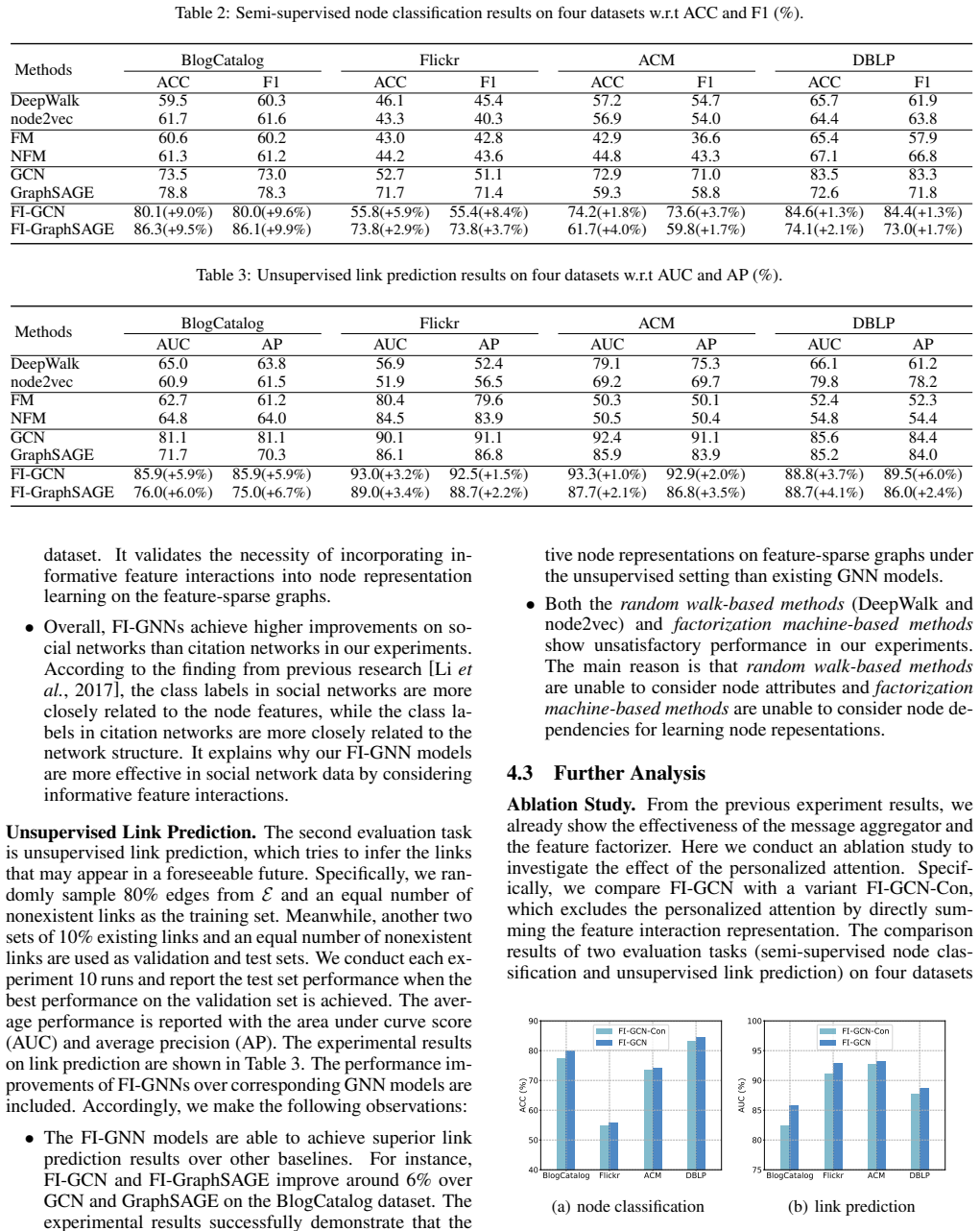
- [§4.3, Tables 2 and 3] The paper attributes the gains to pairwise feature interactions, but no experiment isolates the feature factorizer from a same-capacity non-interaction module. The only ablation, FI-GCN-Con, removes personalized attention while retaining the factorizer, so it cannot separate the value of pairwise interactions from the value of the additional parameters and the embedding pathway. A linear combination f_i = sum_j x_ij v_j of the same per-feature embeddings would consume the same parameter budget and could plausibly produce the observed gains, especially on BlogCatalog and Flickr. Please add ablations that (i) replace the factorizer with a linear embedding combination of equal capacity, and (ii) remove the factorizer entirely while adding an equivalent linear layer to the message aggregator, and report the resulting performance on all four datasets.
- [§4.2, Tables 2 and 3] All results are reported as 10-run averages without standard deviations or significance tests. The improvements on ACM and DBLP are small (roughly 1–4 percentage points), so without variance estimates or paired tests the reader cannot determine whether the claimed gains, and hence the central empirical claim, are reliable. Please report mean ± standard deviation over the 10 runs and, ideally, paired significance tests against the corresponding base GNN.
- [§4.1 Implementation Details] The model-selection protocol is asymmetric: baseline hyperparameters are selected by validation performance, while the FI-GNN learning rate and dropout rate are fixed at 0.005 and 0.1 without a reported validation search. Since the paper's conclusions rest on the magnitude of the performance deltas, FI-GNN hyperparameters should be tuned on the same validation splits as the baselines, or a sensitivity analysis should be reported to show the results are not sensitive to these choices.
minor comments (5)
- [§3.5, Eq. (10)] In the proof of Lemma 3.1, the inner product is written as ⟨vj1 vj2⟩; it should be ⟨vj1, vj2⟩ or vj1^T vj2. Also, in the same equation, the element-wise product term should use xij2 vj2 rather than xij1 vj2, and the second subscript of v is printed as j1 in one place.
- [§3.2, Eq. (3)] The set R_x is defined as {(i,j)} with i,j ranging over d, but this conflicts with the use of i as the node index throughout the paper. It should be defined as pairs of feature indices (j1, j2) with j2 > j1.
- [§4.3, Figure 2] The ablation figure does not show error bars or numerical values, and the DBLP difference between FI-GCN-Con and FI-GCN appears small. Please report the underlying numbers so that the magnitude of the attention module's contribution can be assessed.
- [§1 and §6] The claim of being the 'first' to study feature interaction-aware node representation learning is difficult to verify and should be softened or supported by a more systematic comparison to existing GNN variants that incorporate feature crossing or feature interactions.
- [§3.4, Eq. (7)] The unsupervised loss uses negative sampling, but the number of negative samples per positive edge and the sampling procedure are not specified; this information is needed for reproducibility.
Circularity Check
No significant circularity: the FI-GNN model is trained on labeled or link data and evaluated on held-out nodes; Lemma 3.1 is a structural equivalence, not a fitted prediction.
full rationale
No circularity found. The central claim is that adding the feature factorizer (Eq. 3) and personalized attention (Eqs. 4-5) to a GNN message aggregator improves node representations on feature-sparse graphs. This claim is tested by training the full model on labeled nodes or edges and evaluating on held-out nodes and edges (Section 4.2), so the reported accuracy and link-prediction gains are not fitted inputs renamed as predictions. The factorizer parameters v_j and the attention projection W_f are learned jointly from the task loss, not from the evaluation targets used to compute the improvements. Lemma 3.1 is a simplifying equivalence: it shows that when node dependencies, attention, and the projection vector are sequentially removed, the model algebraically reduces to a vanilla factorization machine (Eqs. 8-10). This lemma is not used to force the empirical result; it is presented as a connection to a known model. The only ablation (FI-GCN-Con vs. FI-GCN, Section 4.3) isolates the personalized attention module rather than the factorizer, which is an experimental limitation, not a circularity. Self-citations, such as [Li et al., 2015] for dataset construction and [Li et al., 2017] for interpreting social versus citation network label behavior, are not load-bearing for the derivation of the model or for the evaluation protocol.
Assumptions & free parameters
free parameters (4)
- feature embedding dimension k =
16
- GNN layer widths =
32 and 16
- learning rate =
0.005
- dropout rate =
0.1
assumptions (4)
- domain assumption Pairwise interactions among raw node features are informative for graph learning on feature-sparse graphs.
- domain assumption The aggregated GNN representation h_i is a suitable query for identifying informative feature interactions per node.
- domain assumption Second-order feature interactions are sufficient for the target tasks.
- ad hoc to paper Concatenating h_i and f_i is an effective fusion strategy for the two signal sources.
Cite this review
Pith. "Pith review of Feature Interaction-aware Graph Neural Networks." pith.science (2026). https://pith.science/paper/RZ47IK7M
@misc{pith2026190807110,
  author       = {Pith},
  title        = {Pith review of: Feature Interaction-aware Graph Neural Networks},
  year         = {2026},
  howpublished = {\url{https://pith.science/paper/RZ47IK7M}},
  note         = {Machine review of arXiv:1908.07110}
}
read the original abstract
Inspired by the immense success of deep learning, graph neural networks (GNNs) are widely used to learn powerful node representations and have demonstrated promising performance on different graph learning tasks. However, most real-world graphs often come with high-dimensional and sparse node features, rendering the learned node representations from existing GNN architectures less expressive. In this paper, we propose \textit{Feature Interaction-aware Graph Neural Networks (FI-GNNs)}, a plug-and-play GNN framework for learning node representations encoded with informative feature interactions. Specifically, the proposed framework is able to highlight informative feature interactions in a personalized manner and further learn highly expressive node representations on feature-sparse graphs. Extensive experiments on various datasets demonstrate the superior capability of FI-GNNs for graph learning tasks.
Figures

Forward citations
Cited by 1 Pith paper
-
Transferring Robustness for Graph Neural Network Against Poisoning Attacks
PA-GNN meta-learns to penalize adversarial edges on clean graphs and retains that penalization when fine-tuned on a poisoned graph, improving node classification accuracy under poisoning attacks.
Reference graph
Works this paper leans on
-
[1]
Relational inductive biases, deep learning, and graph networks.arXiv preprint arXiv:1806.01261,
[Battaglia et al., 2018] Peter W Battaglia, Jessica B Ham- rick, Victor Bapst, Alvaro Sanchez-Gonzalez, Vinicius Zambaldi, Mateusz Malinowski, Andrea Tacchetti, David Raposo, Adam Santoro, Ryan Faulkner, et al. Relational inductive biases, deep learning, and graph networks.arXiv preprint arXiv:1806.01261,
arXiv 2018
-
[6]
Neural message passing for quantum chemistry
[Gilmer et al., 2017] Justin Gilmer, Samuel S Schoenholz, Patrick F Riley, Oriol Vinyals, and George E Dahl. Neural message passing for quantum chemistry. In ICML,
work page 2017
-
[8]
Deepfm: a factorization-machine based neural network for ctr predic- tion
[Guo et al., 2017] Huifeng Guo, Ruiming Tang, Yunming Ye, Zhenguo Li, and Xiuqiang He. Deepfm: a factorization-machine based neural network for ctr predic- tion. arXiv preprint arXiv:1703.04247,
arXiv 2017
-
[9]
Inductive representation learning on large graphs
[Hamilton et al., 2017] Will Hamilton, Zhitao Ying, and Jure Leskovec. Inductive representation learning on large graphs. In Advances in Neural Information Processing Systems,
work page 2017
-
[10]
Neu- ral factorization machines for sparse predictive analytics
[He and Chua, 2017] Xiangnan He and Tat-Seng Chua. Neu- ral factorization machines for sparse predictive analytics. In SIGIR,
work page 2017
-
[11]
Adam: A method for stochastic optimization
[Kingma and Ba, 2014] Diederik P Kingma and Jimmy Ba. Adam: A method for stochastic optimization. arXiv preprint arXiv:1412.6980,
arXiv 2014
-
[13]
Unsupervised streaming feature selection in social media
[Li et al., 2015] Jundong Li, Xia Hu, Jiliang Tang, and Huan Liu. Unsupervised streaming feature selection in social media. In CIKM,
work page 2015
-
[15]
Feature selection: A data perspective
[Li et al., 2018] Jundong Li, Kewei Cheng, Suhang Wang, Fred Morstatter, Robert P Trevino, Jiliang Tang, and Huan Liu. Feature selection: A data perspective. CSUR,
work page 2018
Show all 29 references
-
[16]
Visualizing data using t-sne
[Maaten and Hinton, 2008] Laurens van der Maaten and Ge- offrey Hinton. Visualizing data using t-sne. Journal of machine learning research,
2008
-
[18]
Deepwalk: Online learning of social rep- resentations
[Perozzi et al., 2014] Bryan Perozzi, Rami Al-Rfou, and Steven Skiena. Deepwalk: Online learning of social rep- resentations. In KDD,
2014
-
[19]
Factorization machines
[Rendle, 2010] Steffen Rendle. Factorization machines. In ICDM,
2010
-
[21]
Learning with kernels: support vector machines, regularization, optimization, and beyond
[Scholkopf and Smola, 2001] Bernhard Scholkopf and Alexander J Smola. Learning with kernels: support vector machines, regularization, optimization, and beyond
2001
-
[23]
Social identity and intergroup relations, volume
[Tajfel, 2010] Henri Tajfel. Social identity and intergroup relations, volume
2010
-
[24]
Arnetminer: extraction and mining of academic social networks
[Tang et al., 2008] Jie Tang, Jing Zhang, Limin Yao, Juanzi Li, Li Zhang, and Zhong Su. Arnetminer: extraction and mining of academic social networks. In KDD,
2008
-
[25]
Graph attention networks
[Veliˇckovi´c et al., 2017] Petar Veliˇckovi´c, Guillem Cucurull, Arantxa Casanova, Adriana Romero, Pietro Lio, and Yoshua Bengio. Graph attention networks. arXiv preprint arXiv:1710.10903,
2017 arXiv
-
[26]
Deep & cross network for ad click predic- tions
[Wang et al., 2017] Ruoxi Wang, Bin Fu, Gang Fu, and Min- gliang Wang. Deep & cross network for ad click predic- tions. In KDD. ACM,
2017
-
[27]
Atten- tional factorization machines: Learning the weight of fea- ture interactions via attention networks
[Xiao et al., 2017] Jun Xiao, Hao Ye, Xiangnan He, Han- wang Zhang, Fei Wu, and Tat-Seng Chua. Atten- tional factorization machines: Learning the weight of fea- ture interactions via attention networks. arXiv preprint arXiv:1708.04617,
2017 arXiv
-
[28]
How powerful are graph neural net- works? arXiv preprint arXiv:1810.00826,
[Xu et al., 2018] Keyulu Xu, Weihua Hu, Jure Leskovec, and Stefanie Jegelka. How powerful are graph neural net- works? arXiv preprint arXiv:1810.00826,
2018 arXiv
-
[29]
Understanding bag-of-words model: a statistical framework
[Zhang et al., 2010] Yin Zhang, Rong Jin, and Zhi-Hua Zhou. Understanding bag-of-words model: a statistical framework. International Journal of Machine Learning and Cybernetics, 2010
2010
-
[2001]
Deep crossing: Web- scale modeling without manually crafted combinatorial features
[Shan et al., 2016] Ying Shan, T Ryan Hoens, Jian Jiao, Hai- jing Wang, Dong Yu, and JC Mao. Deep crossing: Web- scale modeling without manually crafted combinatorial features. In KDD,
2016
-
[2008]
Automatic differentiation in pytorch
[Paszke et al., 2017] Adam Paszke, Sam Gross, Soumith Chintala, Gregory Chanan, Edward Yang, Zachary De- Vito, Zeming Lin, Alban Desmaison, Luca Antiga, and Adam Lerer. Automatic differentiation in pytorch
2017
-
[2010]
The graph neural network model
[Scarselli et al., 2008] Franco Scarselli, Marco Gori, Ah Chung Tsoi, Markus Hagenbuchner, and Gabriele Monfardini. The graph neural network model. IEEE Transactions on Neural Networks,
2008
-
[2013]
Bayesian personalized feature in- teraction selection for factorization machines
[Chen et al., 2019] Yifan Chen, Pengjie Ren, Yang Wang, and Maarten de Rijke. Bayesian personalized feature in- teraction selection for factorization machines
2019
-
[2014]
Semi-supervised classification with graph convolutional networks
[Kipf and Welling, 2016] Thomas N Kipf and Max Welling. Semi-supervised classification with graph convolutional networks. arXiv preprint arXiv:1609.02907,
2016 arXiv
-
[2015]
Attributed network em- bedding for learning in a dynamic environment
[Li et al., 2017] Jundong Li, Harsh Dani, Xia Hu, Jiliang Tang, Yi Chang, and Huan Liu. Attributed network em- bedding for learning in a dynamic environment. In CIKM,
2017
-
[2016]
Spectral networks and lo- cally connected networks on graphs
[Bruna et al., 2013] Joan Bruna, Wojciech Zaremba, Arthur Szlam, and Yann LeCun. Spectral networks and lo- cally connected networks on graphs. arXiv preprint arXiv:1312.6203,
2013 arXiv
-
[2017]
node2vec: Scalable feature learning for networks
[Grover and Leskovec, 2016] Aditya Grover and Jure Leskovec. node2vec: Scalable feature learning for networks. In KDD,
2016
-
[2018]
Polynomial networks and factorization machines: New insights and efficient training algorithms
[Blondel et al., 2016] Mathieu Blondel, Masakazu Ishihata, Akinori Fujino, and Naonori Ueda. Polynomial networks and factorization machines: New insights and efficient training algorithms. arXiv preprint arXiv:1607.08810 ,
2016 arXiv
-
[2019]
Convolutional neural net- works on graphs with fast localized spectral filtering
[Defferrard et al., 2016] Micha¨el Defferrard, Xavier Bres- son, and Pierre Vandergheynst. Convolutional neural net- works on graphs with fast localized spectral filtering. In Advances in neural information processing systems ,
2016
Reviewed August 14, 2026 · model on record in the stance chip above.
Discussion (0). Continue with ORCID to comment.