REVIEW 2 major objections 4 minor 18 references
Quantum Blackjack or Can MIT Bring Down the House Again?
T0 review · 2 major / 4 minor · reviewed 2026-08-14 · deepseek-v4-flash
Pith's one-line read Shared entanglement beats any one-bit classical strategy in small-shoe blackjack.
desk verdict The hyperbit formalism is a real contribution, but the blackjack mapping has an internal inconsistency: Alice's hit removes a card from the finite shoe, so the payoff matrix is not action-independent and the reported advantage is for a different game. read the letter →
The pith
A machine-rendered reading of the paper's core claim, the machinery that carries it, and where it could break.
The reading
What carries the argument
The central object is the expected-sign strategy matrix $S_{st}$, the difference between Bob's hit and stand probabilities given the private cards $s$ and $t$. A classical one-bit strategy is constrained to $S_{st}=p_s\alpha_t+(1-p_s)\beta_t$ with $\alpha_t,\beta_t\in\{\pm1\}$; a hyperbit strategy instead has $S_{st}=\gamma_t + \mathbf{x}_s\cdot\mathbf{y}_t$, where Alice's unit vector $\mathbf{x}_s$ is her encoded private input, Bob's vector $\mathbf{y}_t$ and scalar offset $\gamma_t$ are his measurement choice, and the constraints $\|\mathbf{x}_s\|\le1$ and $|\gamma_t|+\|\mathbf{y}_t\|\le1$ keep the entries valid. The optimization is split into Bob's discrete choices for the default signs $\gamma_t$ and a semidefinite program over the Gram matrix $G=Z^T Z$ formed from all Alice and Bob vectors, with unit diagonal and positive semidefiniteness. The standard correlation construction for two-player XOR games realizes any such dot-product matrix as measurement correlations on a shared entangled state, and because optimal $\mathbf{y}_t$ can be written as sums of the $\mathbf{x}_s$, the shared state needs only $\min(M,N)$ dimensions instead of $M+N$.
What would settle it
Keep the finite shoe through the entire blackjack round instead of reshuffling to an infinite deck after Bob's first move, recompute the payoff matrix for the [A,A,8,10] deal, and rerun the classical-versus-hyperbit semidefinite program. If the hyperbit value no longer exceeds the classical value, the reported 0.0087 advantage rests on the reshuffle assumption rather than on the game's intrinsic structure.
Extended reading notes
Core claim
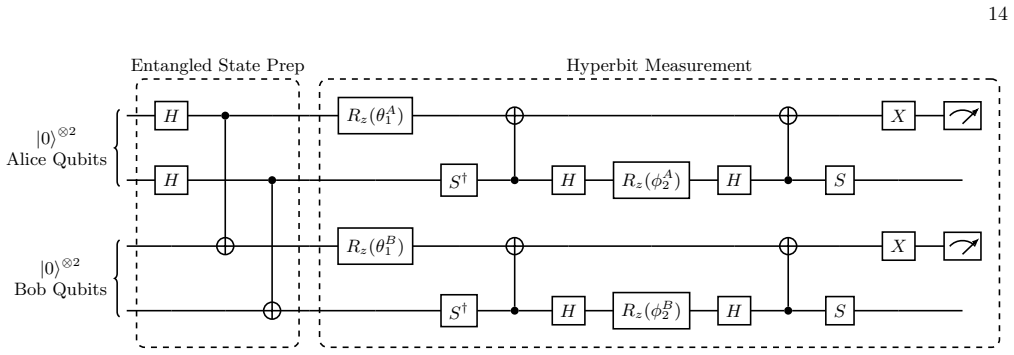
On its own terms, the paper's central discovery is that there exist blackjack-type games in which a single classical bit of communication plus pre-shared entanglement yields a strictly higher expected payout than the same bit without entanglement. For the sign-matrix structure of these games, the optimal classical strategy sacrifices one particular payoff entry relative to perfect information, while the optimal hyperbit strategy depends only on the angle between Bob's two unit vectors; quantum advantage appears exactly when that optimal angle lies strictly between the parallel and antiparallel extremes. Enumerating shoes left with 3 to 8 cards after the face-up deal, the paper states that there are definitively no advantages for 3 cards and finds and enumerates advantages for 4 to 8 cards. A representative three-by-three-dimensional case has Bob and the dealer showing 9 and 10 with a four-card shoe [A,A,8,10]; the hyperbit strategy gains 0.0087 over the best classical single-bit strategy, and the paper tabulates the measurement angles as a circuit on two qubits per player.
Load-bearing premise
The load-bearing premise is that immediately after Bob's first hit-or-stand choice the shoe is replaced by an infinite 52-card deck, so the rest of the round no longer depends on Alice's hidden card; if that reshuffle rule is changed, the payoff matrix and the claimed advantage values would change.
Editorial extensions
If this is right
- In blackjack with four to eight cards left in the shoe, there are concrete and enumerated deals where two cooperating players who share entanglement and one classical bit outperform any classical one-bit team.
- The same search finds no quantum advantage for full 52-card shoes or for three-card shoes, so the effect appears where Alice's hidden card has the largest influence on the remaining shoe.
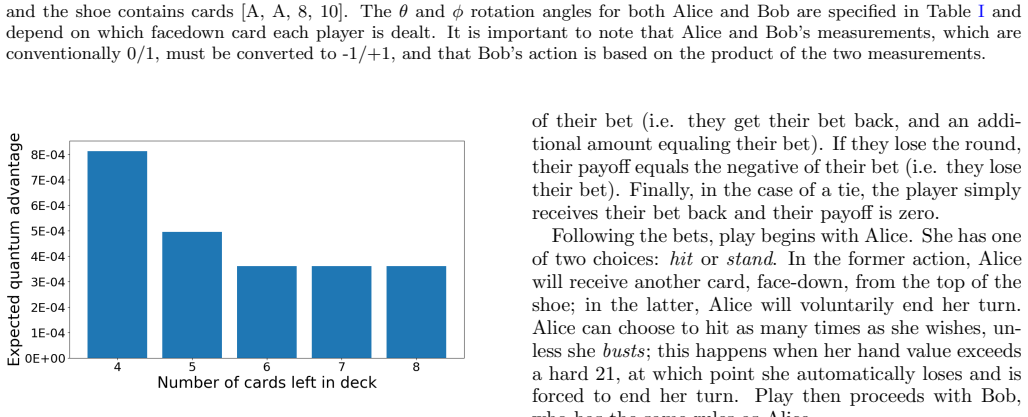
- The expected advantage falls off and then plateaus as the shoe size grows from 4 to 8 cards, so the effect is strongest in the smallest viable shoes.
- Optimal hyperbit strategies can be compiled into circuits using only nearest-neighbour single- and two-qubit gates, which makes them compatible with limited-connectivity quantum hardware.
- The value-of-game formulation applies to any cooperative two-player sequential game whose payoff depends only on Bob's action, so the same SDP-based search can be run on other communication-limited games.
Reading between the lines
- Beyond the paper: retaining a finite shoe through the dealer's play, rather than reshuffling to an infinite deck after Bob's first move, could alter the payoff matrix; testing this variant would show whether the reported 0.0087 advantage survives a more casino-realistic rule.
- Beyond the paper: the hyperbit advantage can be read as a non-locality violation embedded inside a sequential game, which suggests that similar searches in simplified bridge or poker bidding, where private cards are concealed and one public action is sent, may also reveal small entanglement advantages.
- Beyond the paper: the plotted trend is based on shoe sizes 4 through 8, so an exhaustive enumeration of 9-to-12-card shoes would show whether the plateau persists or the advantage eventually vanishes.
- Beyond the paper: the published circuit is directly testable on current small quantum devices; a few hundred experimental shots should reproduce the predicted measurement correlations and confirm the sign of the payoff gap.
Signed reviews
Editorial analysis
A structured set of objections, weighed in public.
Referee Report
Summary. This paper studies cooperative two-party sequential games in which Alice, who moves first, can send Bob a single classical bit. The authors compare three communication regimes: unrestricted communication, one-bit classical communication, and one-bit classical communication supplemented by shared entanglement in the hyperbit model. They derive an SDP formulation for the optimal hyperbit strategy, give an analytic treatment of 3x2 games, and apply the framework to a modified blackjack-like ruleset. They report small numerical quantum advantages for certain small-shoe configurations, including an explicit 3x3 example with advantage 0.0087, and provide a quantum circuit for the winning strategy.
Significance. If the modeling issues are resolved, the paper is a useful proof-of-principle that entanglement can provide a strictly higher expected payoff than any classical strategy in a communication-limited card game. The SDP formulation, the reduction to Tsirelson's characterization, and the explicit nearest-neighbor-gate circuit are valuable and clearly presented. The paper is appropriately cautious: it distinguishes hyperbit advantage from general quantum advantage and provides code and numerical data. The main caveat is that the 'blackjack' variant is heavily modified (infinite-deck reshuffle after Bob's first move, negligible Alice bet, no doubling/splitting), and the reported advantage is tiny and appears only in artificial small-shoe scenarios. The significance is therefore primarily theoretical, as a demonstration of quantum advantage in one-bit communication games, rather than a practical casino threat.
major comments (2)
- [II.1, II.2, Appendix A, VII] The formal model assumes that the expected payoff depends only on s, t, and b, and Section II.2 defines the coefficient matrix C_st = π(s,t)(V^+_{s,t} − V^−_{s,t}) with V(b|s,t) independent of Alice's action a. However, Appendix A states that if Alice hits, she receives another face-down card from the shoe. Under that rule, when a=hit one uniformly random card is removed from the finite shoe before Bob's first hit decision, while when a=stand it is not. Bob's first-hit-card distribution therefore depends on a, so the true expected payoff V(b|s,t,a) depends on a. This contradicts the assertion in Section II.1 that the payoff 'has intentionally excluded a,' and it invalidates the use of a single C matrix in Eq. (5). The optimization over S in Sections III–IV and the numerical advantage 0.0087 in Section VII are computed for a game in which Alice's action does not consume a card, not for the game described by the stated rules. The manuscript must either explicitly stipulate that Alice's hit is a purely communicative action that does not remove a card from the shoe, or re-derive the formalism and numerical results with a-dependent payoff matrices.
- [VII, Figure 4] The claim that 'We exhaustively enumerated cases in which, after only the face up cards were dealt, the remaining shoe had between 3 to 8 cards left' is not accompanied by a precise description of the enumeration space. It is unclear whether the cases are all multisets of card denominations of a given size, all assignments of Bob's and the dealer's face-up cards, or ordered deals. It is also not stated what numerical criterion is used to declare a 'quantum advantage' (strict positivity, a threshold, or an SDP tolerance). In addition, the caption of Figure 4 says 'we sample the k cards from an infinite number of full 52-card decks,' which is in tension with exhaustive enumeration: if the cases are enumerated exactly, the expectation can be computed exactly, whereas sampling suggests a Monte Carlo estimate. The manuscript should specify the enumeration algorithm, the comparison tolerance, and how the expectation in Figure 4 was computed, so that the claim of enumerated advantages is reproducible.
minor comments (4)
- [VI.3] The argument for restricting to γ_t = 0 is too terse. The statement 'Since there is at most one column left, that column can be specified in the classical strategy' is correct only because, with a single hyperbit column, the optimal Alice vectors are aligned with that single Bob vector, so the column takes at most two values and can be matched by a classical strategy. The paper should spell out this reasoning.
- [V.2] Equations (45) and (48) contain subscript typos in the coefficient labels (e.g., 'c2X2Z1' and 'c3Y2Z1' should be 'c3X2Z1' and 'c4Y2Z1'), and the text after Eq. (47) uses '⃗ y_s' where '⃗ y_t' is meant.
- [VII] The 'advantage amount' of 0.0087 should be defined explicitly as I_H(S) − I_C(S), and the units (expected payoff per round in units of Bob's bet) should be stated.
- [II] The artificial reshuffle rule—replacing the finite shoe with an infinite 52-card deck immediately after Bob's first hit/stand decision—is a substantial deviation from casino blackjack. It is stated in the text, but it should be highlighted in the introduction as a modeling assumption rather than buried in the ruleset description.
Circularity Check
No significant circularity: the optimization pipeline is self-contained, with C derived from the game rules and strategy advantages computed rather than fitted.
full rationale
The paper's derivation chain is self-contained with respect to its stated model. The central quantity C_st is defined directly from the game's payoff table and prior distribution in Eq. (3), and the classical and hyperbit strategy sets are specified independently in Eqs. (9) and (14). The cited hyperbit model [7] and Tsirelson's theorem [8] are external benchmarks, not results of this paper, and no load-bearing self-citation was found. The blackjack-specific advantage in Section VII is obtained by enumerating shoe configurations, computing C for each configuration, solving the SDP in Eq. (31), and comparing the resulting optimal values I_C and I_H; there is no free parameter fitted to the reported advantage of 0.0087. The one-parameter sweep in Section VI.5 is an illustrative scan over C = A + Bt, not a retrofitted prediction. The assumption that Alice's action does not enter the payoff (Section II.1) is a stated modeling restriction; whether it is fully consistent with the physical blackjack rules is a correctness concern, not evidence that the derivation reduces to its own inputs. Accordingly, no circular step satisfying the quoted-evidence standard was identified.
Assumptions & free parameters
assumptions (4)
- standard math Tsirelson's characterization of XOR games (Ref [8,11])
- domain assumption Hyperbit model is a valid class of quantum strategies (Ref [7])
- domain assumption Modified blackjack rules: zero Alice bet, single bit actions, reshuffle to infinite deck after Bob's first move
- domain assumption Dealer strategy: hit on soft 17, infinite deck approximation
Cite this review
Pith. "Pith review of Quantum Blackjack or Can MIT Bring Down the House Again?." pith.science (2026). https://pith.science/paper/RZ65X6TE
@misc{pith2026190809417,
  author       = {Pith},
  title        = {Pith review of: Quantum Blackjack or Can MIT Bring Down the House Again?},
  year         = {2026},
  howpublished = {\url{https://pith.science/paper/RZ65X6TE}},
  note         = {Machine review of arXiv:1908.09417}
}
read the original abstract
We examine the advantages that quantum strategies afford in communication-limited games. Inspired by the card game blackjack, we focus on cooperative, two-party sequential games in which a single classical bit of communication is allowed from the player who moves first to the player who moves second. Within this setting, we explore the usage of quantum entanglement between the players and find analytic and numerical conditions for quantum advantage over classical strategies. Using these conditions, we study a family of blackjack-type games with varying numbers of card types, and find a range of parameters where quantum advantage is achieved. Furthermore, we give an explicit quantum circuit for the strategy achieving quantum advantage.
Figures

Figures from the paper (1 more)
Reference graph
Works this paper leans on
-
[1]
send as much in- formation as possible,
Since the pair are cooperating, it is their combined payoff that matters. Second, note that their actions in any round of play is characterized only by a single bit, a and b. For both, this means that they must play a predetermined strategy after their first hit/stand choice. In Alice’s case, we simply assume she hits at most once. In this way, she only com...
-
[2]
S12, 2) S21, 3) S22, 4) S31, and 5) both S11 and S32. These strategies then give IC(S) that is less than I∗ U by an amount 2δ, for δ equal to 1) |C12|, 2)|C21|, 3)|C22|, 4)|C31|, and 5) |C11| +|C32| respectively. The optimal classical strategy is determined by which of these values is the smallest ; if the number is δ∗, then the classical strategy game va...
-
[3]
If f′(−1) < 0, then f′(z) < 0 ∀z∈ [−1, 1] =⇒ z∗ =−1
-
[4]
If f′(1)> 0, then f′(z)> 0∀z∈ [−1, 1] =⇒ z∗ = 1
-
[5]
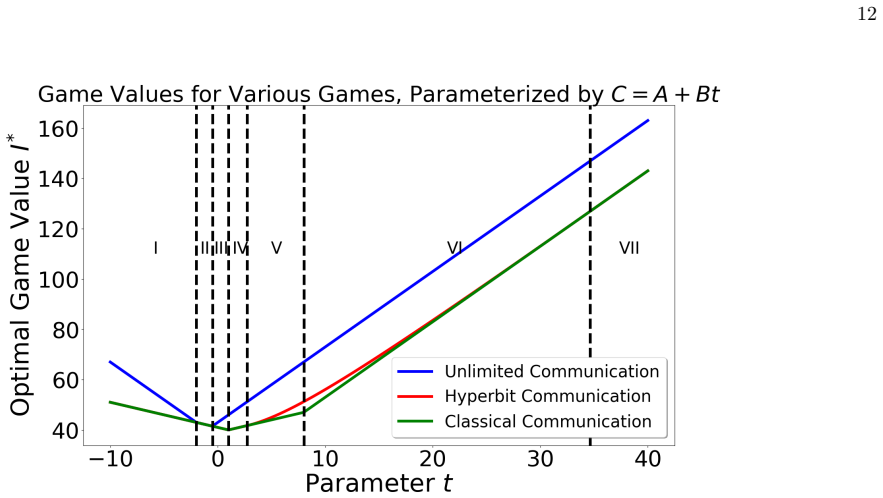
Otherwise, z∗∈ (−1, 1) such that f′(z∗) = 0. Note that in the first two cases, the objective function value is given by f(−1) =|C11−C12| +|C21−C22| +|C31−C32| (63) =|C11−C12| +|C21| +|C22| +|C31−C32| (64) and f(1) =|C11 +C12| +|C21 +C22| +|C31 +C32| (65) =|C11| +|C12| +|C21 +C22| +|C31| +|C32| (66) respectively. Note the simplifications come from the sign m...
-
[6]
B. Mezrich. Bringing Down the House: The Inside Story of Six MIT Students Who Took Vegas for Millions . Free Press, 2002
work page 2002
-
[7]
Consequences and limits of nonlocal strate- gies
Richard Cleve, Peter Hoyer, Benjamin Toner, and John Watrous. Consequences and limits of nonlocal strate- gies. In Computational Complexity, 2004. Proceedings. 19th IEEE Annual Conference on , pages 236–249. IEEE, 2004
work page 2004
-
[8]
Quantum And Relativistic Protocols For Secure Multi-Party Computation
Roger Colbeck. Quantum And Relativistic Protocols For Secure Multi-Party Computation . PhD thesis, University of Cambridge, 2006
work page 2006
Show all 18 references
-
[9]
Quantum cryptography based on Bell’s theorem
Artur K Ekert. Quantum cryptography based on Bell’s theorem. Physical review letters , 67(6):661, 1991
1991
-
[10]
Classical command of quantum systems
Ben W Reichardt, Falk Unger, and Umesh Vazi- rani. Classical command of quantum systems. Nature, 496(7446):456–460, 2013
2013
-
[11]
Quantum bidding in bridge
Sadiq Muhammad, Armin Tavakoli, Maciej Kurant, Marcin Paw lowski, Marek ˙Zukowski, and Mohamed Bourennane. Quantum bidding in bridge. Physical Re- view X , 4(2):021047, 2014
2014
-
[12]
The optimum strategy in black- jack
Roger R Baldwin, Wilbert E Cantey, Herbert Maisel, and James P McDermott. The optimum strategy in black- jack. Journal of the American Statistical Association , 51(275):429–439, 1956
1956
-
[13]
Hyperbits: The information quasiparticles
Marcin Paw lowski and Andreas Winter. Hyperbits: The information quasiparticles. Physical Review A , 85(2):022331, 2012
2012
-
[14]
Quantum analogues of the Bell in- equalities
Boris S Tsirelson. Quantum analogues of the Bell in- equalities. the case of two spatially separated domains. Journal of Soviet Mathematics , 36(4):557–570, 1987
1987
-
[15]
Guillaume Sagnol. PICOS. https://github.com/ gsagnol/picos, 2018
2018
-
[16]
CVX: Matlab software for disciplined convex programming, 2008
Michael Grant and Stephen Boyd. CVX: Matlab software for disciplined convex programming, 2008
2008
-
[17]
Tsirelson’s characterization of XOR games, 2014
Thomas Vidick. Tsirelson’s characterization of XOR games, 2014. lecture notes available at http://users.cms.caltech.edu/~vidick/teaching/ 286_qPCP/lecture15.pdf
2014
-
[21]
Note that the players only compete with the dealer, and not each other
If, at any point, a card holder’s hand value exceeds a hard 21 (in particular, the value cannot be made lower by converting any Ace values from 11 to 1), the individual automatically loses. Note that the players only compete with the dealer, and not each other. Before beginnin...
Reviewed August 14, 2026 · model on record in the stance chip above.
Discussion (0). Continue with ORCID to comment.