Towards an Optimally Distributed Quantum Fourier Transform Circuit
Pith reviewed 2026-06-26 23:58 UTC · model grok-4.3
The pith
A gate-packing scheme partitions the quantum Fourier transform circuit using fewer entangled pairs than prior analytical or general methods.
A machine-rendered reading of the paper's core claim, the machinery that carries it, and where it could break.
Core claim
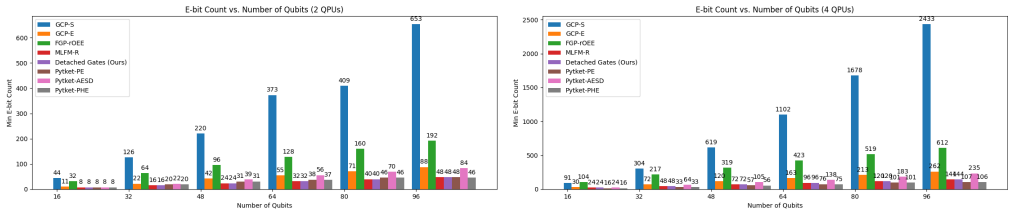
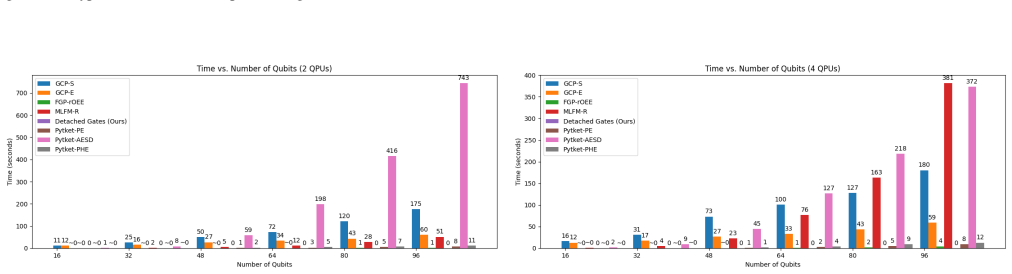
The authors present a partitioning scheme based on optimal gate-packing for the QFT that minimizes e-bit count while exactly preserving the unitary operation of the original circuit. This scheme is shown to require fewer e-bits than previous analytical partitioning methods designed for the QFT and than partitions generated by general-purpose circuit partitioning algorithms, with validation through implementation on quantum hardware.
What carries the argument
The optimal gate-packing partitioning scheme, which rearranges gates within the QFT to minimize cross-processor entanglements while keeping the overall unitary identical.
If this is right
- Distributed QFT circuits require fewer e-bits than those produced by earlier analytical schemes.
- The gate-packing partitions outperform those from general-purpose partitioning algorithms on the e-bit metric.
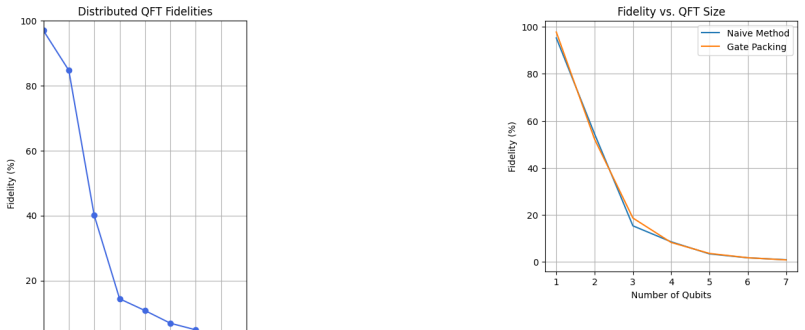
- The partitioned QFT can be executed on quantum hardware without changing the implemented operation.
- Lower e-bit counts directly reduce the entanglement generation cost between QPUs.
Where Pith is reading between the lines
- The same packing logic could be tested on other subroutines that appear inside phase estimation or arithmetic circuits.
- If e-bit savings scale with circuit size, the method might reduce the total entanglement resources needed for larger distributed algorithms.
- Hardware validation on small instances leaves open whether the savings persist when noise and teleportation errors are included at scale.
Load-bearing premise
A gate-packing method can be made optimal for the QFT while exactly preserving the unitary operation of the original circuit.
What would settle it
A side-by-side count of e-bits required by the gate-packing partition versus prior analytical QFT partitions for a fixed circuit size, or a hardware run measuring output fidelity against the ideal QFT.
Figures

read the original abstract
A promising avenue for scaling quantum computing is to connect quantum processing units (QPUs) by generating entanglement between them. This requires circuit partitioning: partially rewriting quantum circuits to run on a distributed quantum system using quantum teleportation protocols, while preserving the unitary operation implemented by the circuit. The key metric to minimize when partitioning is the e-bit count, defined as the number of maximally entangled qubit pairs that must be generated between QPUs. We focus on partitioning the quantum Fourier transform (QFT) circuit, which is widely used as a subroutine in quantum algorithms such as quantum phase estimation and arithmetic circuits. Specifically, we present a partitioning scheme based on optimal gate-packing, compare it against prior analytical partitioning schemes for the QFT, and evaluate it against partitions produced by general-purpose circuit partitioning algorithms. We further validate our approach by implementing the partitioned circuit on quantum hardware.
Editorial analysis
A structured set of objections, weighed in public.
Referee Report
Summary. The manuscript presents a partitioning scheme for the quantum Fourier transform (QFT) circuit based on optimal gate-packing for distributed quantum systems. The scheme minimizes the e-bit count (number of maximally entangled pairs between QPUs) while preserving the original unitary. It compares the scheme to prior analytical QFT partitioning methods and to outputs from general-purpose circuit partitioning algorithms, and reports hardware validation via implementation on quantum hardware.
Significance. If the optimality claim, comparisons, and hardware results hold with quantitative improvements, the work would offer a concrete method for distributing an important quantum subroutine, supporting multi-QPU scaling. The explicit focus on e-bit minimization and the dual comparison (analytical + general-purpose) plus hardware step are positive features that could inform practical distributed quantum algorithm design.
major comments (2)
- [Abstract] Abstract: the central claim that the gate-packing scheme is 'optimal' and yields lower e-bit counts than prior analytical schemes is not accompanied by any definition of optimality, complexity analysis, or quantitative comparison data in the visible text; without these, it is impossible to verify whether the reported reductions are load-bearing or merely heuristic improvements.
- [Abstract] Abstract: the hardware validation is stated to 'further validate our approach,' yet no metrics (e.g., fidelity, e-bit overhead measured on device, circuit depth after partitioning) or device details are supplied, leaving the preservation of the unitary and practical advantage uncheckable.
minor comments (1)
- [Abstract] Abstract: the phrase 'optimal gate-packing' is used without a forward reference to the section that defines the packing objective or the algorithm; adding such a pointer would improve readability.
Simulated Author's Rebuttal
We thank the referee for their comments. We address each major comment below.
read point-by-point responses
-
Referee: [Abstract] Abstract: the central claim that the gate-packing scheme is 'optimal' and yields lower e-bit counts than prior analytical schemes is not accompanied by any definition of optimality, complexity analysis, or quantitative comparison data in the visible text; without these, it is impossible to verify whether the reported reductions are load-bearing or merely heuristic improvements.
Authors: The manuscript defines optimality as the gate-packing scheme achieving the minimum e-bit count for a given QPU count while exactly preserving the QFT unitary. The full text supplies the formal definition, complexity analysis of the packing procedure, and quantitative e-bit comparisons versus prior analytical QFT partitions and general-purpose algorithms. To render the abstract self-contained, we will revise it to state the optimality criterion and report the observed e-bit reductions. revision: yes
-
Referee: [Abstract] Abstract: the hardware validation is stated to 'further validate our approach,' yet no metrics (e.g., fidelity, e-bit overhead measured on device, circuit depth after partitioning) or device details are supplied, leaving the preservation of the unitary and practical advantage uncheckable.
Authors: The experimental section of the manuscript reports the specific quantum device, measured fidelities, circuit depths after partitioning, and explicit verification that the distributed implementation preserves the original unitary. We agree the abstract would benefit from inclusion of these key metrics and device information. We will revise the abstract accordingly. revision: yes
Circularity Check
No significant circularity
full rationale
The paper presents a gate-packing partitioning scheme for the QFT, compares it to prior analytical schemes and general-purpose algorithms, and validates via hardware implementation. The central claim is the scheme itself plus empirical comparisons; the unitary-preservation requirement is stated explicitly as a design constraint rather than derived. No self-definitional steps, fitted inputs renamed as predictions, or load-bearing self-citations appear in the derivation chain. The work is self-contained against external benchmarks (prior schemes, general algorithms, hardware runs).
Axiom & Free-Parameter Ledger
Reference graph
Works this paper leans on
-
[1]
Distributed quantum computing: A survey
M. Caleffi, M. Amoretti, D. Ferrari, J. Illiano, A. Manzalini, and A. S. Cacciapuoti, “Distributed quantum computing: A survey”, Computer Networks , vol. 254, p. 110 672, Dec. 1, 2024, ISSN : 1389-1286. DOI: 10. 1016 / j . comnet . 2024 . 110672. [Online]. Available: https : / / www. sciencedirect . com / science / article / pii / S1389128624005048 (visit...
2024
-
[2]
Review of distributed quantum com- puting: From single QPU to high performance quan- tum computing
D. Barral et al., “Review of distributed quantum com- puting: From single QPU to high performance quan- tum computing”, Computer Science Review , vol. 57, p. 100 747, Aug. 1, 2025, ISSN : 1574-0137. DOI: 10. 1016 / j . cosrev . 2025 . 100747. [Online]. Available: https : / / www. sciencedirect . com / science / article / pii / S1574013725000231 (visited o...
2025
-
[3]
The engineering challenges in quantum computing
C. G. Almudever et al., “The engineering challenges in quantum computing”, in Design, Automation & Test in Europe Conference & Exhibition (DATE), 2017 , ISSN: 1558-1101, Mar. 2017, pp. 836–845. DOI: 10.23919/ DATE . 2017 . 7927104. [Online]. Available: https : / / ieeexplore . ieee . org / document / 7927104 (visited on 06/03/2026)
2017
-
[4]
Optimizing resource efficiencies for scalable full-stack quantum computers
M. Fellous-Asiani, J. H. Chai, Y . Thonnart, H. K. Ng, R. S. Whitney, and A. Auff `eves, “Optimizing resource efficiencies for scalable full-stack quantum computers”, PRX Quantum, vol. 4, no. 4, p. 040 319, Oct. 30, 2023. DOI: 10.1103/PRXQuantum.4.040319. [Online]. Avail- able: https://link.aps.org/doi/10.1103/PRXQuantum.4. 040319 (visited on 10/16/2024)
-
[5]
To- wards a distributed quantum computing ecosystem
D. Cuomo, M. Caleffi, and A. S. Cacciapuoti, “To- wards a distributed quantum computing ecosystem”, IET Quantum Communication , vol. 1, no. 1, pp. 3–8, 2020, ISSN : 2632-8925. DOI: 10 . 1049 / iet - qtc . 2020
2020
-
[6]
Traffic light control using deep policy-gradient and value-function-based reinforcement learning,
[Online]. Available: https://onlinelibrary.wiley. com/doi/abs/10.1049/iet- qtc.2020.0002 (visited on 02/01/2025)
-
[7]
Time-sliced quantum circuit partitioning for modular architectures
J. M. Baker, C. Duckering, A. Hoover, and F. T. Chong, “Time-sliced quantum circuit partitioning for modular architectures”, in Proceedings of the 17th ACM Inter- national Conference on Computing Frontiers , ser. CF ’20, New York, NY, USA: Association for Computing Machinery, May 23, 2020, pp. 98–107, ISBN : 978-1- 4503-7956-4. DOI: 10 . 1145 / 3387902 . ...
arXiv 2020
-
[8]
Distributed quantum computing across an optical network link
D. Main et al., “Distributed quantum computing across an optical network link”, Nature, pp. 1–6, Feb. 5, 2025, ISSN : 1476-4687. DOI: 10.1038/s41586-024-08404-x. [Online]. Available: https://www.nature.com/articles/ s41586-024-08404-x (visited on 02/11/2025)
-
[9]
Deterministic remote entan- glement using a chiral quantum interconnect
A. Almanakly et al., “Deterministic remote entan- glement using a chiral quantum interconnect”, Nature Physics, vol. 21, no. 5, pp. 825–830, May 2025, ISSN : 1745-2481. DOI: 10 . 1038 / s41567 - 025 - 02811 - 1. [Online]. Available: https://www.nature.com/articles/ s41567-025-02811-1 (visited on 08/02/2025)
2025
-
[10]
Quantum algorithm for linear systems of equations
A. W. Harrow, A. Hassidim, and S. Lloyd, “Quantum algorithm for linear systems of equations”, Physical Review Letters , vol. 103, no. 15, p. 150 502, Oct. 7,
-
[11]
Harrow, Avinatan Hassidim, and Seth Lloyd
DOI: 10.1103/PhysRevLett.103.150502. [Online]. Available: https://link.aps.org/doi/10.1103/PhysRevLett. 103.150502 (visited on 05/28/2026)
-
[12]
Quantum speedup of monte carlo meth- ods
A. Montanaro, “Quantum speedup of monte carlo meth- ods”, Proceedings of the Royal Society A: Mathe- matical, Physical and Engineering Sciences , vol. 471, no. 2181, p. 20 150 301, Sep. 8, 2015, ISSN : 1364-5021. DOI: 10 . 1098 / rspa . 2015 . 0301. [Online]. Available: https : / / doi . org / 10 . 1098 / rspa . 2015 . 0301 (visited on 05/29/2026)
2015
-
[13]
Controlled bidirectional remote state preparation in noisy environment: a generalized view,
L. Ruiz-Perez and J. C. Garcia-Escartin, “Quantum arithmetic with the quantum fourier transform”, Quan- tum Information Processing , vol. 16, no. 6, p. 152, Apr. 28, 2017, ISSN : 1573-1332. DOI: 10.1007/s11128- 017- 1603- 1. [Online]. Available: https://doi.org/10. 1007/s11128-017-1603-1 (visited on 07/28/2025)
-
[14]
Automatic post-selection by ancillae thermalization
L. Wright, F. Barratt, J. Dborin, G. H. Booth, and A. G. Green, “Automatic post-selection by ancillae thermalization”, Physical Review Research , vol. 3, no. 3, p. 033 151, Aug. 13, 2021. DOI: 10 . 1103 / PhysRevResearch.3.033151. [Online]. Available: https: //link.aps.org/doi/10.1103/PhysRevResearch.3.033151 (visited on 05/29/2026)
-
[15]
Nearly optimal quantum algorithm for generating the ground state of a free quantum field theory
M. Bagherimehrab, “Nearly optimal quantum algorithm for generating the ground state of a free quantum field theory”, PRX Quantum , vol. 3, no. 2, 2022. DOI: 10. 1103/PRXQuantum.3.020364
2022
-
[16]
Noisy intermediate-scale quan- tum simulation of the one-dimensional wave equation
L. Wright et al., “Noisy intermediate-scale quan- tum simulation of the one-dimensional wave equation”, Physical Review Research , vol. 6, no. 4, p. 043 169, Nov. 19, 2024. DOI: 10 . 1103 / PhysRevResearch . 6 . 043169. [Online]. Available: https : / / link . aps . org / doi / 10 . 1103 / PhysRevResearch . 6 . 043169 (visited on 05/28/2026)
2024
-
[17]
G. D. Kahanamoku-Meyer and N. Y . Yao, Fast quantum integer multiplication with zero ancillas, Mar. 26, 2024. DOI: 10 . 48550 / arXiv . 2403 . 18006. arXiv: 2403 . 18006[quant-ph]. [Online]. Available: https://arxiv.org/ abs/2403.18006v4 (visited on 05/28/2026)
arXiv 2024
-
[18]
Automated distri- bution of quantum circuits via hypergraph partitioning
P. Andr ´es-Mart´ınez and C. Heunen, “Automated distri- bution of quantum circuits via hypergraph partitioning”, Physical Review A , vol. 100, no. 3, p. 032 308, Sep. 5,
-
[19]
DOI: 10.1103/PhysRevA.100.032308. [Online]. Available: https://link.aps.org/doi/10.1103/PhysRevA. 100.032308 (visited on 06/17/2025)
-
[20]
Distributing circuits over heterogeneous, modular quantum computing network architectures
P. Andres-Martinez et al., “Distributing circuits over heterogeneous, modular quantum computing network architectures”, Quantum Science and Technology, vol. 9, no. 4, p. 045 021, Aug. 2024, ISSN : 2058-9565. DOI: 10.1088/2058-9565/ad6734. [Online]. Available: https: //dx.doi.org/10.1088/2058- 9565/ad6734 (visited on 08/28/2025)
-
[21]
Generalised circuit partitioning for distributed quantum computing
F. Burt, K.-C. Chen, and K. K. Leung, “Generalised circuit partitioning for distributed quantum computing”, in 2024 IEEE International Conference on Quantum Computing and Engineering (QCE), vol. 02, Sep. 2024, pp. 173–178. DOI: 10 . 1109 / QCE60285 . 2024 . 10273. [Online]. Available: https : / / ieeexplore . ieee . org / document/10821229 (visited on 05/16/2025)
arXiv 2024
-
[22]
A multilevel framework for partitioning quantum circuits
F. Burt, K.-C. Chen, and K. K. Leung, “A multilevel framework for partitioning quantum circuits”, Quantum, vol. 10, p. 1984, Jan. 22, 2026. DOI: 10.22331/q-2026- 01 - 22 - 1984. [Online]. Available: https : / / quantum - journal . org / papers / q - 2026 - 01 - 22 - 1984/ (visited on 05/29/2026)
-
[23]
O. Crampton, P. Promponas, R. Chen, P. Polakos, L. Tassiulas, and L. Samuel, A genetic approach to minimising gate and qubit teleportations for multi- processor quantum circuit distribution , May 9, 2024. DOI: 10 . 48550 / arXiv . 2405 . 05875. arXiv: 2405 . 05875[quant-ph]. [Online]. Available: http://arxiv.org/ abs/2405.05875 (visited on 03/13/2025)
arXiv 2024
-
[24]
Efficient distribution of quantum circuits
R. G. Sundaram, H. Gupta, and C. R. Ramakrishnan, “Efficient distribution of quantum circuits”, in 35th International Symposium on Distributed Computing (DISC 2021), S. Gilbert, Ed., ser. Leibniz International Proceedings in Informatics (LIPIcs), vol. 209, Dagstuhl, Germany: Schloss Dagstuhl – Leibniz-Zentrum f ¨ur In- formatik, 2021, 41:1–41:20, ISBN : 9...
2021
-
[25]
DOI: 10 . 4230 / LIPIcs . DISC . 2021 . 41. [Online]. Available: https://drops.dagstuhl.de/entities/document/ 10.4230/LIPIcs.DISC.2021.41 (visited on 02/01/2025)
-
[26]
Fast parallel circuits for the quantum fourier transform
R. Cleve and J. Watrous, “Fast parallel circuits for the quantum fourier transform”, in Proceedings 41st Annual Symposium on Foundations of Computer Science , Nov. 2000, pp. 526–536. DOI: 10.1109/SFCS.2000.892140. [Online]. Available: https://ieeexplore.ieee.org/abstract/ document/892140 (visited on 01/29/2025)
-
[27]
Fast quantum modular exponentiation
R. Van Meter and K. M. Itoh, “Fast quantum modular exponentiation”, Physical Review A , vol. 71, no. 5, p. 052 320, May 17, 2005, ISSN : 1050-2947, 1094-
2005
-
[28]
DOI: 10.1103/PhysRevA.71.052320. [Online]. Available: https://link.aps.org/doi/10.1103/PhysRevA. 71.052320 (visited on 05/29/2026)
-
[29]
An approximate fourier transform useful in quantum factoring
D. Coppersmith, “An approximate fourier transform useful in quantum factoring”, IBM Research Division, IBM Research Report RC 19642, Jul. 12, 1994. arXiv: quant-ph/0201067. [Online]. Available: http://arxiv.org/ abs/quant-ph/0201067 (visited on 07/27/2025)
Pith/arXiv arXiv 1994
-
[30]
G. D. Kahanamoku-Meyer, J. Blue, T. Bergamaschi, C. Gidney, and I. L. Chuang, A log-depth in-place quantum fourier transform that rarely needs ancillas , May 1, 2025. DOI: 10.48550/arXiv.2505.00701. arXiv: 2505.00701[quant-ph]. [Online]. Available: http://arxiv. org/abs/2505.00701 (visited on 05/10/2025)
-
[31]
M. A. Nielsen and I. L. Chuang, Quantum Computation and Quantum Information , 10th anniversary edition. Cambridge: Cambridge University Press, 2010, ISBN : 978-1-107-00217-3
2010
-
[32]
Entanglement-efficient bipartite- distributed quantum computing
J.-Y . Wu et al., “Entanglement-efficient bipartite- distributed quantum computing”, Quantum, vol. 7, p. 1196, Dec. 5, 2023. DOI: 10.22331/q-2023-12-05-
-
[33]
Available: https://quantum-journal.org/ papers/q-2023-12-05-1196/ (visited on 02/17/2025)
[Online]. Available: https://quantum-journal.org/ papers/q-2023-12-05-1196/ (visited on 02/17/2025)
2023
-
[34]
Bell correlations between spatially separated pairs of atoms
D. K. Shin, B. M. Henson, S. S. Hodgman, T. Wasak, J. Chwede ´nczuk, and A. G. Truscott, “Bell correlations between spatially separated pairs of atoms”, Nature Communications, vol. 10, no. 1, p. 4447, Oct. 1, 2019, ISSN : 2041-1723. DOI: 10.1038/s41467-019-12192-8. [Online]. Available: https://www.nature.com/articles/ s41467-019-12192-8 (visited on 07/20/2025)
-
[35]
Bennett and Gilles Brassard and Claude Cr
C. H. Bennett, G. Brassard, C. Cr ´epeau, R. Jozsa, A. Peres, and W. K. Wootters, “Teleporting an unknown quantum state via dual classical and einstein-podolsky- rosen channels”, Physical Review Letters , vol. 70, no. 13, pp. 1895–1899, Mar. 29, 1993. DOI: 10.1103/ PhysRevLett.70.1895. [Online]. Available: https://link. aps.org/doi/10.1103/PhysRevLett.70....
-
[36]
Optimal local implementation of nonlocal quantum gates
J. Eisert, K. Jacobs, P. Papadopoulos, and M. B. Plenio, “Optimal local implementation of nonlocal quantum gates”, Physical Review A , vol. 62, no. 5, p. 052 317, Oct. 19, 2000. DOI: 10 . 1103 / PhysRevA . 62 . 052317. [Online]. Available: https://link.aps.org/doi/10.1103/ PhysRevA.62.052317 (visited on 02/02/2025)
2000
-
[37]
Generalized GHZ States and Distributed Quantum Computing
A. Yimsiriwattana and S. J. Lomonaco Jr, General- ized GHZ states and distributed quantum computing , Mar. 11, 2004. DOI: 10.48550/arXiv.quant-ph/0402148. arXiv: quant - ph / 0402148. [Online]. Available: http : / / arxiv . org / abs / quant - ph / 0402148 (visited on 01/05/2025)
work page internal anchor Pith review Pith/arXiv arXiv doi:10.48550/arxiv.quant-ph/0402148 2004
-
[38]
J. Chen, E. Stoudenmire, and S. R. White, “Quantum fourier transform has small entanglement”, PRX Quan- tum, vol. 4, no. 4, p. 040 318, Oct. 27, 2023. DOI: 10.1103/PRXQuantum.4.040318. [Online]. Available: https://link.aps.org/doi/10.1103/PRXQuantum.4.040318 (visited on 03/06/2025)
-
[39]
Semiclassical fourier transform for quantum computation
R. B. Griffiths and C.-S. Niu, “Semiclassical fourier transform for quantum computation”, Physical Review Letters, vol. 76, no. 17, pp. 3228–3231, Apr. 22, 1996. DOI: 10.1103/PhysRevLett.76.3228. [Online]. Avail- able: https://link.aps.org/doi/10.1103/PhysRevLett.76. 3228 (visited on 01/28/2025)
-
[40]
Y . Jin et al., Optimizing quantum fourier transformation (QFT) kernels for modern NISQ and FT architectures , Aug. 20, 2024. DOI: 10.48550/arXiv.2408.11226. arXiv: 2408.11226[quant-ph]. [Online]. Available: http://arxiv. org/abs/2408.11226 (visited on 07/24/2025)
-
[41]
Communications topology and distribution of the quantum fourier transform
Rodney Van Meter, “Communications topology and distribution of the quantum fourier transform”, in Pro- ceedings of the Tenth Quantum Information Technol- ogy Symposium (QIT10), Gakushuin University, Mejiro, Tokyo, May 24, 2004, pp. 19–24
2004
-
[42]
M. A. Nielsen, Quantum information theory , Nov. 9,
-
[43]
DOI: 10.48550/arXiv.quant-ph/0011036. arXiv: quant-ph/0011036. [Online]. Available: http://arxiv.org/ abs/quant-ph/0011036 (visited on 03/11/2025)
work page internal anchor Pith review Pith/arXiv arXiv doi:10.48550/arxiv.quant-ph/0011036 2025
-
[44]
Operator-schmidt decomposition of the quan- tum fourier transform on Cn1 ⊗ Cn2
J. Tyson, “Operator-schmidt decomposition of the quan- tum fourier transform on Cn1 ⊗ Cn2”, Journal of Physics A: Mathematical and General , vol. 36, no. 24, p. 6813, Jun. 2003, ISSN : 0305-4470. DOI: 10.1088/ 0305-4470/36/24/317. [Online]. Available: https://dx. doi . org / 10 . 1088 / 0305 - 4470 / 36 / 24 / 317 (visited on 03/11/2025)
2003
-
[45]
Algorithms for partitioning a graph
T. Park and C. Y . Lee, “Algorithms for partitioning a graph”, Computers & Industrial Engineering , vol. 28, no. 4, pp. 899–909, Oct. 1, 1995, ISSN : 0360-8352. DOI: 10.1016/0360- 8352(95)00003- J. [Online]. Available: https : / / www. sciencedirect . com / science / article / pii / 036083529500003J (visited on 08/04/2025)
-
[46]
An efficient heuristic procedure for partitioning graphs
B. W. Kernighan and S. Lin, “An efficient heuristic procedure for partitioning graphs”, The Bell System Technical Journal, vol. 49, no. 2, pp. 291–307, Feb. 1970, ISSN : 0005-8580. DOI: 10 . 1002 / j . 1538 - 7305 . 1970.tb01770.x. [Online]. Available: https://ieeexplore. ieee.org/document/6771089 (visited on 08/04/2025)
arXiv 1970
-
[47]
Andres-Martinez et al., CQCL/pytket-dqc, original- date: 2021-12-20T18:54:45Z, Jul
P. Andres-Martinez et al., CQCL/pytket-dqc, original- date: 2021-12-20T18:54:45Z, Jul. 28, 2025. [Online]. Available: https://github.com/CQCL/pytket-dqc (visited on 08/04/2025)
2021
-
[48]
Entanglement-efficient distributed quantum computing
J.-Y . Wu et al., “Entanglement-efficient distributed quantum computing”, in Quantum 2.0 Conference and Exhibition (2024), paper QM5A.2 , Optica Publishing Group, Jun. 23, 2024, QM5A.2. DOI: 10 . 1364 / QUANTUM.2024.QM5A.2. [Online]. Available: https: //opg.optica.org/abstract.cfm?uri=QUANTUM-2024- QM5A.2 (visited on 03/05/2025)
2024
-
[49]
S. Kirkpatrick, C. D. Gelatt, and M. P. Vecchi, “Op- timization by simulated annealing”, Science, vol. 220, no. 4598, pp. 671–680, May 13, 1983. DOI: 10.1126/ science.220.4598.671. [Online]. Available: https://www. science.org/doi/10.1126/science.220.4598.671 (visited on 08/04/2025)
-
[50]
High-quality hypergraph partitioning
S. Schlag, T. Heuer, L. Gottesb ¨uren, Y . Akhremtsev, C. Schulz, and P. Sanders, “High-quality hypergraph partitioning”, ACM J. Exp. Algorithmics, vol. 27, 1.9:1– 1.9:39, Feb. 10, 2023, ISSN : 1084-6654. DOI: 10.1145/ 3529090. [Online]. Available: https://dl.acm.org/doi/10. 1145/3529090 (visited on 08/04/2025)
2023
-
[51]
A linear-time heuristic for improving network partitions
C. M. Fiduccia and R. M. Mattheyses, “A linear-time heuristic for improving network partitions”, in Papers on Twenty-five years of electronic design automation , ser. 25 years of DAC, New York, NY, USA: Association for Computing Machinery, Jun. 1, 1988, pp. 241–247, ISBN : 978-0-89791-267-9. DOI: 10.1145/62882.62910. [Online]. Available: https://dl.acm.or...
-
[52]
Dijkstra and Yoshitaka Tanimura
E. B ¨aumer, V . Tripathi, A. Seif, D. Lidar, and D. S. Wang, “Quantum fourier transform using dynamic cir- cuits”, Physical Review Letters , vol. 133, no. 15, p. 150 602, Oct. 8, 2024. DOI: 10.1103/PhysRevLett. 133.150602. [Online]. Available: https://link.aps.org/ doi / 10 . 1103 / PhysRevLett . 133 . 150602 (visited on 07/24/2025)
-
[53]
Efficient z-gates for quantum com- puting
D. C. McKay, C. J. Wood, S. Sheldon, J. M. Chow, and J. M. Gambetta, “Efficient z-gates for quantum com- puting”, Physical Review A , vol. 96, no. 2, p. 022 330, Aug. 31, 2017, ISSN : 2469-9926, 2469-9934. DOI: 10. 1103/PhysRevA.96.022330. arXiv: 1612.00858[quant- ph]. [Online]. Available: http : / / arxiv. org / abs / 1612 . 00858 (visited on 06/04/2025)
Pith/arXiv arXiv 2017
-
[54]
Independence number
E. W. Weisstein. “Independence number”, Mathworld– A Wolfram Resource. (), [Online]. Available: https : //mathworld.wolfram.com/IndependenceNumber.html (visited on 07/15/2025)
2025
-
[55]
Numerical Linear Algebra with Applications , volume =
D. Camps, R. Van Beeumen, and C. Yang, “Quantum fourier transform revisited”, Numerical Linear Algebra with Applications , vol. 28, no. 1, e2331, 2021, ISSN : 1099-1506. DOI: 10.1002/nla.2331. [Online]. Available: https://onlinelibrary.wiley.com/doi/abs/10.1002/nla. 2331 (visited on 01/27/2025)
-
[56]
Burt, DisQCO: Distributed quantum circuit optimi- sation, original-date: 2025-02-03T20:02:15Z, Aug
F. Burt, DisQCO: Distributed quantum circuit optimi- sation, original-date: 2025-02-03T20:02:15Z, Aug. 3,
2025
-
[57]
Available: https : / / github
[Online]. Available: https : / / github. com / felix - burt/DISQCO (visited on 08/05/2025)
2025
-
[58]
Vernec, Fork of DisQCO: Distributed quantum cir- cuit optimisation, original-date: 2025-05-15T19:55:40Z, May 20, 2025
Z. Vernec, Fork of DisQCO: Distributed quantum cir- cuit optimisation, original-date: 2025-05-15T19:55:40Z, May 20, 2025. [Online]. Available: https://github.com/ ZacharyVernec/DISQCO (visited on 08/05/2025)
2025
-
[59]
Noisy qudit vs multiple qubits: conditions on gate efficiency for enhancing fidelity
Y . Nam, Y . Su, and D. Maslov, “Approximate quantum fourier transform with o(n log(n)) t gates”, npj Quantum Information, vol. 6, no. 1, pp. 1–6, Mar. 13, 2020, ISSN : 2056-6387. DOI: 10.1038/s41534- 020- 0257- 5. [Online]. Available: https://www.nature.com/articles/ s41534-020-0257-5 (visited on 03/05/2025)
-
[60]
H. Zou, M. Treinish, K. Hartman, A. Ivrii, and J. Lishman, LightSABRE: A lightweight and enhanced SABRE algorithm, Sep. 12, 2024. DOI: 10.48550/arXiv. 2409 . 08368. arXiv: 2409 . 08368[quant - ph]. [Online]. Available: http://arxiv.org/abs/2409.08368 (visited on 12/01/2025)
work page internal anchor Pith review doi:10.48550/arxiv 2024
-
[61]
SabreLayout (latest version)
“SabreLayout (latest version)”, IBM Quantum Docu- mentation. (), [Online]. Available: https://web.archive. org / web / 20250806151032 / https : / / quantum . cloud . ibm . com / docs / en / api / qiskit / qiskit . transpiler. passes . SabreLayout (visited on 08/01/2025)
2025
-
[62]
Wagner, Re: Meet to discuss customizing transpiring and laying out circuits over physical qubits , E-mail, Jul
S. Wagner, Re: Meet to discuss customizing transpiring and laying out circuits over physical qubits , E-mail, Jul. 9, 2025
2025
-
[63]
Q-DICE: Quantum Distributed Interconnect Compiler and Emulator
M. Silver, Z. Vernec, and H.-A. Jacobsen, Q-DICE: Quantum distributed interconnect compiler and emu- lator, Jun. 9, 2026. DOI: 10.48550/arXiv.2606.11340. arXiv: 2606.11340[quant-ph]. [Online]. Available: http: //arxiv.org/abs/2606.11340 (visited on 06/15/2026)
work page internal anchor Pith review Pith/arXiv arXiv doi:10.48550/arxiv.2606.11340 2026
-
[64]
New version of dynamic circuits coming in july 2025
IBM. “New version of dynamic circuits coming in july 2025”, IBM Quantum Documentation. (Jul. 14, 2025), [Online]. Available: https : / / web . archive . org / web / 20250803182720 / https : / / quantum . cloud . ibm . com / announcements/en/product-updates/2025-03-03-new- version-dynamic-circuits (visited on 08/08/2025)
2025
-
[65]
E. B ¨aumer, D. Sutter, and S. Woerner, Approximate quantum fourier transform in logarithmic depth on a line, Apr. 29, 2025. DOI: 10.48550/arXiv.2504.20832. arXiv: 2504.20832[quant-ph]. [Online]. Available: http: //arxiv.org/abs/2504.20832 (visited on 05/07/2025)
discussion (0)
Sign in with ORCID, Apple, or X to comment. Anyone can read and Pith papers without signing in.