REVIEW 4 major objections 6 minor 16 references
Prospects for new glueballs and exotics searches
T0 review · 4 major / 6 minor · reviewed 2026-08-16 · deepseek-v4-flash
Pith's one-line read This paper argues that the reliable way to identify glueballs and hybrid mesons is to follow cascade decays in which glue-rich states convert into each other via eta and eta-prime modes.
desk verdict A short, honest prospects piece whose cascade-decay idea is worth testing, but the anomaly enhancement that motivates it is asserted, not shown. read the letter →
The pith
A machine-rendered reading of the paper's core claim, the machinery that carries it, and where it could break.
The reading
What carries the argument
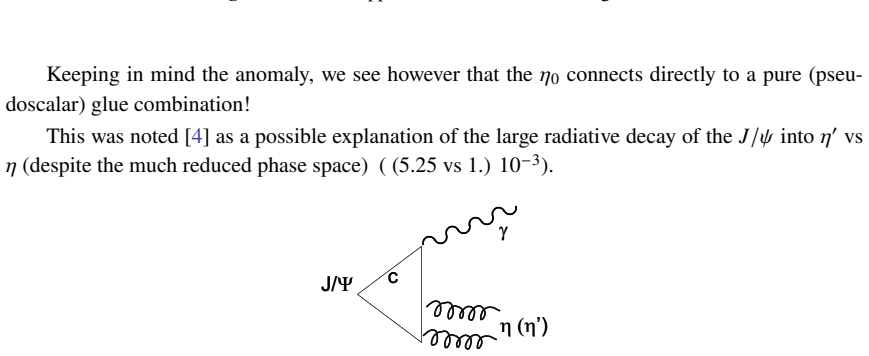
The load-bearing object is the QCD axial anomaly, the identity that makes the divergence of the SU(3)-singlet axial current proportional to the gluon field-strength combination $G\tilde G$. Because of this term, the $\eta'$ acquires a direct coupling to a pure gluon pseudoscalar state, which the paper uses to explain enhanced $\eta/\eta'$ modes in hybrid and glueball decays. The operative tool built on it is the 'chain-decay' indicator: the product of branching ratios across a decay chain, exemplified by $J/\psi \to \gamma X$, $X \to f_0(1500)\eta'$, $f_0(1500)\to\pi^+\pi^-$, which quantifies glue-rich production times glue-rich decay in one number.
What would settle it
Measure $\Gamma(\pi_1 \to \eta'\pi)/\Gamma(\pi_1 \to \eta\pi)$ for the lightest hybrid candidate with high statistics; if it is close to 1 rather than around 5.5, the anomaly-driven enhancement is contradicted and the cascade interpretation of glueball searches loses its main quantitative support.
Extended reading notes
Core claim
On the paper's own terms, the central discovery is a strategy: glueballs and hybrids should be sought not as isolated peaks but through chains of decays in which states with a large gluon component preferentially decay into other glue-rich states, most recognizably via $\eta$ and $\eta'$ modes. The quantitative anchor is the product branching ratio measured for a pseudoscalar glueball candidate, $B(J/\psi \to \gamma X(2600)) \cdot B(X(2600) \to f_0(1500)\eta') \cdot B(f_0(1500)\to \pi^+\pi^-) = (3.39 \pm 0.18^{+0.91}_{-0.66})\times10^{-5}$, which the paper interprets as a combined measure of 'glue-rich production' and 'glue-rich decay.' The author traces this preference to the strong axial anomaly: the divergence of the singlet axial current contains a gluon term, $(3/4)(\alpha_s/\pi) G\tilde G$, so the $\eta'$ in particular can couple directly to a pseudoscalar gluon combination. The same anomaly is invoked to explain the observed enhancement of $\eta'$ over $\eta$ modes in hybrid candidates and the dominance of the $f_0(1500)$'s $\eta'\eta$ coupling once phase space is corrected. The paper therefore claims that the recurrent appearance of $\eta'$ in glueball and hybrid searches is not a coincidence but a signal to be exploited.
Load-bearing premise
The entire cascade strategy rests on the assumption that the QCD axial anomaly quantitatively enhances decays into $\eta$ and $\eta'$ modes for any state with a significant gluon component, so that observed branching ratios track gluon richness rather than phase space or background effects.
Editorial extensions
If this is right
- Radiative charmonium decays into final states containing $\eta'$ become a dedicated search ground, since every measured chain can be compared against the predicted 'glue-rich' pattern.
- Coupled-channel analyses of hybrid candidates will need to include the $\eta$ and $\eta'$ modes, because the anomaly predicts a specific enhancement relative to $\rho\pi$ modes.
- If the cascade pattern holds across scalar, pseudoscalar, and tensor candidates, the product branching ratio becomes a practical classification observable that can be incorporated into future partial-wave fits.
- Heavy-ion collisions, currently used mainly to characterize the produced medium, could be revisited for the same $\eta'$ chain signatures in a glue-rich environment.
Reading between the lines
- A natural extension is to compute the same product branching ratio for a large set of conventional quark-antiquark resonances; if it comes out systematically lower than for glueball candidates, the tag becomes genuinely selective.
- One testable extension is to compute the absolute product branching ratio from lattice or sum-rule estimates of the two factors, which would show whether the measured $3.39\times10^{-5}$ really requires a large gluon component.
- The $\eta'$ enhancement, if real, should also appear in other glue-rich production channels, such as B-meson decays or proton-antiproton annihilation; a blind search for $\eta'$-rich decay chains there would give an independent test.
Signed reviews
Editorial analysis
A structured set of objections, weighed in public.
Referee Report
Summary. This proceedings contribution argues that the QCD axial anomaly provides a preferential coupling of gluon-rich states to eta and eta-prime final states, and that this effect can be used to identify glueballs and hybrid mesons. The paper reviews evidence from GAMS, COMPASS, and BESIII, including the hybrid candidates pi1 and eta1, the scalar glueball candidate f0(1500), and the pseudoscalar candidate X(2600). Its central forward-looking proposal, stated in Section 5, is that 'chains of decays' such as J/psi -> gamma X(2600), X(2600) -> f0(1500) eta', f0(1500) -> pi+ pi- can serve as a quantitative indicator of 'glue-rich production times glue-rich decay', using the BESIII product branching ratio (3.39 +/- 0.18 +0.91 -0.66) x 10^-5. The paper also briefly mentions heavy-ion collisions as an under-exploited glue-rich source.
Significance. If the anomaly-cascade connection is quantitatively correct, the paper identifies a practical and falsifiable search strategy for glueballs and hybrids, and it usefully collects the relevant BESIII, COMPASS, and GAMS measurements into one place. The paper is honest about several limitations, including the difficulty of comparing absolute eta and eta-prime rates and the absence of comprehensive coupled-channel analyses. Its strengths are the clarity of the experimental summary and the explicit identification of missing amplitude analyses. However, the quantitative anomaly-match claims in Sections 3 and 4 are asserted rather than derived, and the Section 5 interpretation of the BESIII product branching ratio as a glue-richness indicator is not tested against a non-glue control. As a prospects piece the cascade proposal is valuable; as a quantitative claim it currently lacks support.
major comments (4)
- [Sec. 3, Eq. (1)] The claim that the measured ratio Gamma(pi eta')/Gamma(pi eta) ~ 5.5 'matches the expectations of an anomaly-mediated process' is asserted rather than derived. Equation (1) displays the anomalous term in the divergence of the singlet axial current, but the manuscript does not show how this term produces a quantitative prediction for the hybrid decay ratio, and the immediately following caveat that absolute branching ratios into eta and eta-prime modes are difficult to compare further weakens the match. Please provide the derivation or a quantitative error bar from a published calculation, or downgrade the statement to a qualitative expectation.
- [Sec. 4, Fig. 5] The statement that, for f0(1500), 'if corrected for a very small phase space, the eta' eta coupling dominates' is not supported by an amplitude analysis. A simple phase-space rescaling of observed branching fractions is not reliable for a broad resonance very near threshold, where the result depends on the choice of barrier factors and form factors; no such model is specified. Please either cite a coupled-channel analysis that contains this correction or explicitly present the phase-space model and its sensitivity.
- [Sec. 5] The interpretation of the BESIII product branching ratio B(J/psi -> gamma X(2600)) * B(X(2600) -> f0(1500) eta') * B(f0(1500) -> pi+ pi-) as an indicator of 'glue-rich production times glue-rich decay' is not established because no non-glue control chain is provided. To make the indicator quantitative, compare with an ordinary q-qbar cascade measured in the same experiment, or with a state whose glue content is not disputed; without such a control, the measured product is consistent with a conventional meson chain and cannot test the anomaly-enhancement hypothesis.
- [Secs. 4-5] The cascade proposal rests on the assumption that both X(2600) and f0(1500) have large glue components, and the manuscript acknowledges that the identification of the scalar glueball candidate is disputed. The proposal should be framed more clearly as a conditional search strategy: the chain measurement is a useful observable regardless of the interpretation, but the claim that it 'effectively quantifies' the product of glue-rich production and decay needs the identification to be established independently.
minor comments (6)
- [Sec. 3] The ratio is printed as Gamma(pi eta')/Gamma(pi eta') ~ 5.5; if the intended ratio is Gamma(pi eta')/Gamma(pi eta), please correct the typo.
- [Sec. 2] The paragraph after Eq. (1) contains a stray 'sqrt(2)' fragment and the sentence 'The physical states are however mixings of the current ones, in a complicated pattern, with the heavier eta' closer to the singlet state' is grammatically incomplete; please clean up.
- [Sec. 3] There are several typos, including 'observaiion', 'desintegration', and 'orignally'; please proofread the text.
- [Sec. 4] The phrase 'the heJ/psi' appears to be a typo for 'the J/psi'; please correct it.
- [Sec. 5, Fig. 6] Figure 6 mixes a measurement with an interpretation; please add a caption that clearly explains the columns and the source [16].
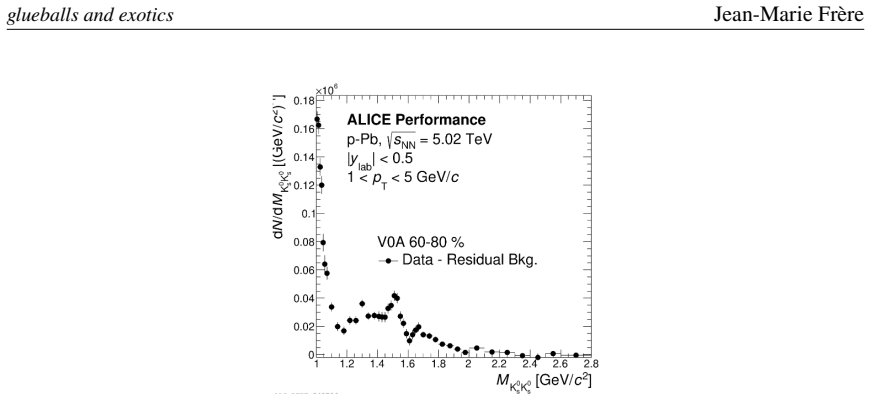
- [Sec. 6, Fig. 7] The ALICE poster is reproduced without quantitative details or a citable reference; please add a caption and a formal citation to the poster source.
Circularity Check
No significant circularity: the anomaly link is standard QCD, the key quantitative inputs are external BESIII/COMPASS measurements, and self-citations play a supporting rather than load-bearing role.
full rationale
The paper's derivation chain rests on Eq. (1), the standard QCD axial-anomaly divergence relation, from which the singlet pseudoscalar connection to gluonic components follows directly; this is not an output of the paper. The ratio Gamma(pi eta')/Gamma(pi eta) ~ 5.5 is taken from the external coupled-channel analysis [6] and compared with, not fitted to, the expectation from [8]; even though [8] is authored by Frere, it is a prior, externally falsifiable prediction, and the comparison is expressly hedged: 'It is however difficult (in particular in the context of QCD sum rules) to compare in absolute terms the branching ratios into the eta and eta' mode.' The Sec. 4 statement that f0(1500)'s eta' eta coupling dominates after phase-space correction is a rescaling of observed PDG branching fractions, not a prediction generated from those same data, and it is accompanied by the paper's own caveat about 'very distorted phase space.' The BESIII product branching ratio quoted in Sec. 5 is an external measurement; calling it a possible 'glue-rich production times glue-rich decay' indicator is an interpretive label, not a quantity derived from that label. Self-citations [1-3,8,12] support standard eta-eta' mixing and prior phenomenological proposals, but the load-bearing data and confirming analyses ([4], [6], [9], and BESIII/COMPASS) are external, and the paper explicitly asks for the currently lacking coupled-channel analyses rather than claiming them as established. No step reduces by construction to its input, so no circularity is present.
Assumptions & free parameters
assumptions (5)
- domain assumption The singlet axial current divergence contains the gluon anomaly term (3/4)(alpha_s/pi) G G-tilde (Eq. 1), so the eta-prime current connects directly to a pure glue combination.
- domain assumption Glueballs and hybrids exist as QCD bound states, with the lightest glueball having 0++ quantum numbers and hybrids having exotic quantum numbers such as 1-+.
- domain assumption Glueball decays are approximately flavor blind, despite corrections from wave-function overlap and direct glue couplings.
- ad hoc to paper The QCD axial anomaly provides a quantitative enhancement of eta and eta-prime decay modes of hybrids and glueballs.
- domain assumption The candidate states X(2600), f0(1500), and f2'(1525) are glue-rich enough for their cascade chain to serve as a glueball tag.
Cite this review
Pith. "Pith review of Prospects for new glueballs and exotics searches." pith.science (2026). https://pith.science/paper/RZHTQECI
@misc{pith2026250421611,
  author       = {Pith},
  title        = {Pith review of: Prospects for new glueballs and exotics searches},
  year         = {2026},
  howpublished = {\url{https://pith.science/paper/RZHTQECI}},
  note         = {Machine review of arXiv:2504.21611}
}
read the original abstract
Glueballs and Hybrids are solid predictions of QCD, but none have this far been identified in an undisputable way. We list several strategies, including the very promising search for "cascade" decays of glueballs and hybrids into each others, and mention the yet under-exploited sources in heavy ion collisions
Figures


Figures from the paper (4 more)


Reference graph
Works this paper leans on
-
[1]
R.AkhouryandJ.M.Frere,“ 𝜂,𝜂′MixingandAnomalies,”Phys.Lett.B 220(1989),258-264 doi:10.1016/0370-2693(89)90048-8
-
[2]
Phenomenological Evidence for the Gluon Content of $\eta$ and $\eta'$
P. Ball, J. M. Frere and M. Tytgat, “Phenomenological evidence for the gluon content of eta and eta-prime,” Phys. Lett. B365 (1996), 367-376 doi:10.1016/0370-2693(95)01287-7 [arXiv:hep-ph/9508359 [hep-ph]]. and references therein
work page Pith review arXiv 1996
-
[3]
Study of the eta - eta-prime system in the two mixing angle scheme,
R. Escribano and J. M. Frere, “Study of the eta - eta-prime system in the two mixing angle scheme,” JHEP06 (2005), 029 doi:10.1088/1126-6708/2005/06/029 [arXiv:hep-ph/0501072 [hep-ph]]
arXiv 2005
-
[4]
Gershtein, S.S., Likhoded, A.A. and Prokoshkin, Y.D. G(1590)-Meson and possible charac- teristic features of a glueball, Z. Phys. C - Particles and Fields 24, 385 (1984)
work page 1984
-
[5]
Evidence for a 1-+ Exotic Meson,
D. Alde et al. [IHEP-Brussels-Los Alamos-Annecy(LAPP)], “Evidence for a 1-+ Exotic Meson,” Phys. Lett. B205 (1988), 397 doi:10.1016/0370-2693(88)91686-3
-
[6]
B. Kopf, M. Albrecht, H. Koch, M. Küßner, J. Pychy, X. Qin and U. Wiedner, “Investiga- tion of the lightest hybrid meson candidate with a coupled-channel analysis of¯𝑝𝑝-, 𝜋−𝑝- 8 glueballs and exotics Jean-Marie Frère and𝜋𝜋-Data,” Eur. Phys. J. C81 (2021) no.12, 1056 doi:10.1140/epjc/s10052-021-09821-2 [arXiv:2008.11566 [hep-ph]]
arXiv 2021
-
[7]
SOME DECAY MODES OF 1-+ HYBRID MESONS,
F. De Viron and J. Govaerts, “SOME DECAY MODES OF 1-+ HYBRID MESONS,” Phys. Rev. Lett.53(1984), 2207-2210 doi:10.1103/PhysRevLett.53.2207
-
[8]
ANEWLOOKATEXOTICDECAYSrho-tilde(1-+,I=1)— >eta- primepiversusrhopi,
J.M.FrereandS.Titard,“ANEWLOOKATEXOTICDECAYSrho-tilde(1-+,I=1)— >eta- primepiversusrhopi,”Phys.Lett.B 214(1988),463-466doi:10.1016/0370-2693(88)91395-0
Show all 16 references
-
[9]
H. X. Chen, N. Su and S. L. Zhu, ‘QCD Axial Anomaly Enhances the𝜂𝜂’ Decay of the Hybrid Candidate𝜂 1(1855),” Chin. Phys. Lett.39 (2022) no.5, 051201 doi:10.1088/0256- 307X/39/5/051201 [arXiv:2202.04918 [hep-ph]]
2022 arXiv
-
[10]
Exotic meson𝜋1(1600) with 𝐽𝑃𝐶 = 1−+ and its decay into 𝜌(770)𝜋,
M. G. Alexeevet al. [COMPASS], “Exotic meson𝜋1(1600) with 𝐽𝑃𝐶 = 1−+ and its decay into 𝜌(770)𝜋,” Phys. Rev. D105 (2022) no.1, 012005 doi:10.1103/PhysRevD.105.012005 [arXiv:2108.01744 [hep-ex]]
2022 arXiv
-
[11]
A. V. Sarantsev, I. Denisenko, U. Thoma and E. Klempt, Phys. Lett. B816 (2021), 136227 doi:10.1016/j.physletb.2021.136227 [arXiv:2103.09680 [hep-ph]]
2021
-
[12]
Scalar glueballs: Constraints from the decays into𝜂 or 𝜂′,
J. M. Frère and J. Heeck, “Scalar glueballs: Constraints from the decays into𝜂 or 𝜂′,” Phys. Rev. D92(2015) no.11, 114035 doi:10.1103/PhysRevD.92.114035 [arXiv:1506.04766 [hep-ph]]
2015 arXiv
-
[13]
ASpinanalysisofthe4pichannelsproducedincentralppinterac- tionsat450-GeV/c,
D.Barberis et al.[WA102],“ASpinanalysisofthe4pichannelsproducedincentralppinterac- tionsat450-GeV/c,”Phys.Lett.B 471(2000),440-448doi:10.1016/S0370-2693(99)01413-6 [arXiv:hep-ex/9912005 [hep-ex]]
2000 arXiv
-
[14]
An updated review of the new hadron states,
H. X. Chen, W. Chen, X. Liu, Y. R. Liu and S. L. Zhu, “An updated review of the new hadron states,” Rept. Prog. Phys.86 (2023) no.2, 026201 doi:10.1088/1361-6633/aca3b6 [arXiv:2204.02649 [hep-ph]]
2023 arXiv
-
[15]
Observation of a State 𝑋(2600) in the 𝜋+𝜋−𝜂′ Sys- tem in the Process 𝐽/𝜓 → 𝛾𝜋+𝜋−𝜂′,
M. Ablikim et al. [BESIII], “Observation of a State 𝑋(2600) in the 𝜋+𝜋−𝜂′ Sys- tem in the Process 𝐽/𝜓 → 𝛾𝜋+𝜋−𝜂′,” Phys. Rev. Lett. 129 (2022) no.4, 042001 doi:10.1103/PhysRevLett.129.042001 [arXiv:2201.10796 [hep-ex]]
2022
-
[16]
PartialwaveanalysisofJ/ 𝜓→𝛾𝜂𝜂’,
M.Ablikim et al.[BESIII],“PartialwaveanalysisofJ/ 𝜓→𝛾𝜂𝜂’,”Phys.Rev.D 106(2022)no.7, 072012[erratum: Phys.Rev.D 107(2023)no.7,079901]doi:10.1103/PhysRevD.106.072012 [arXiv:2202.00623 [hep-ex]]. 9
2022
Reviewed August 16, 2026 · model on record in the stance chip above.
Discussion (0). Continue with ORCID to comment.