REVIEW 3 major objections 3 minor 1 cited by
Zak-OTFS with Spread Carrier Waveforms
T0 review · 3 major / 3 minor · reviewed 2026-08-15 · deepseek-v4-flash
Pith's one-line read A unitary change of basis turns Zak-OTFS pulsones into constant-envelope carriers with 5.6 dB less peak power.
desk verdict A clean, correct-in-example unitary construction that turns Zak-OTFS pulsones into CAZAC waveforms; the low-PAPR claim holds, but the channel-estimation equivalence rests on a crystallization condition that is checked by grid search rather than proven. read the letter →
The pith
A machine-rendered reading of the paper's core claim, the machinery that carries it, and where it could break.
The reading
What carries the argument
The GDAFT is the unitary transform $(\mathcal{F}_a x)[n] = \frac{1}{\sqrt{MN}} \sum_{m=0}^{MN-1} e^{j 2\pi (A n^2 + B n m + C m^2)/(MN)} x[m]$, with $A,B,C$ coprime to $MN$ and $MN$ the frame size. Its quadratic phase factor is what carries the argument: applied to a time-localized pulsone, the phase makes the inverse Zak-domain delta spread into a constant-envelope generalized Zadoff–Chu sequence (Theorem 1), and unitarity guarantees the spread carriers inherit orthonormality. For channel estimation, the GDAFT's action on the cross-ambiguity function (Theorem 2) maps the pulsone alias lattice to a rotated lattice $(k'_{n,m},l'_{n,m})$; Lemma 2 then says the channel estimate is exact exactly when the translated copies of the true channel support do not overlap—the crystallization condition—so $A,B,C$ must be chosen accordingly.
What would settle it
Run the crystallization-condition check of Lemma 2 for a channel whose delay-Doppler support is larger than the spacing between the shifted copies produced by the reported parameters $A=3,B=5,C=7$—for instance, a Veh-A channel with delay spread exceeding the example's $k$ range, or a support spanning several aliases. If any translated support intersects the original, the theory predicts an aliased channel estimate; if one finds such an $(M,N,S,A,B,C)$ and the simulation still matches pulsone-based NMSE/BER, the claimed equivalence fails. Conversely, a constructive search for parameters for random $(M,N,S)$ would test how generally the condition holds.
Extended reading notes
Core claim
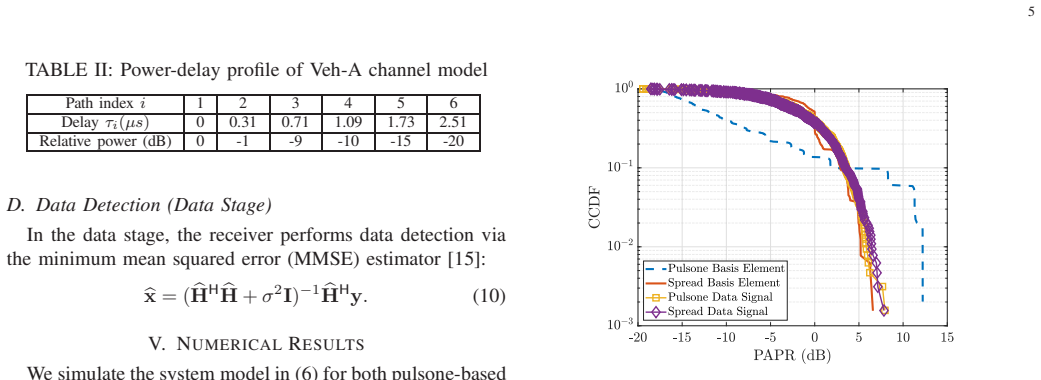
Corollary 1 states the central discovery: applying the GDAFT to the orthonormal pulsone basis of Zak-OTFS produces another orthonormal basis whose elements are spread CAZAC waveforms, each a generalized Zadoff–Chu sequence. Since the GDAFT is unitary (Lemma 1), inner products and noise statistics are preserved; hence $MN$ information symbols can still be carried at full spectral efficiency. Theorem 1 gives the formula for the spread carrier $x^{(c)}_{(k_0,l_0)}[n]$, and Theorem 2 describes how the GDAFT rotates the cross-ambiguity lattice. The paper's simulations show the spread-carrier system achieving the same channel-estimation NMSE and BER as pulsone-based Zak-OTFS, while each basis element has $5.6$ dB lower PAPR ($6.58$ dB versus $12.2$ dB).
Load-bearing premise
The load-bearing premise is that the delay-Doppler region occupied by the channel can always be kept from overlapping its shifted copies, which the paper demonstrates for one example and then handles by grid search rather than a guarantee for all frame sizes and channels.
Editorial extensions
If this is right
- Spread-carrier Zak-OTFS reaches full spectral efficiency with per-basis PAPR $6.58$ dB, eliminating the bandwidth penalty that DFT-spread-OFDM pays for low PAPR.
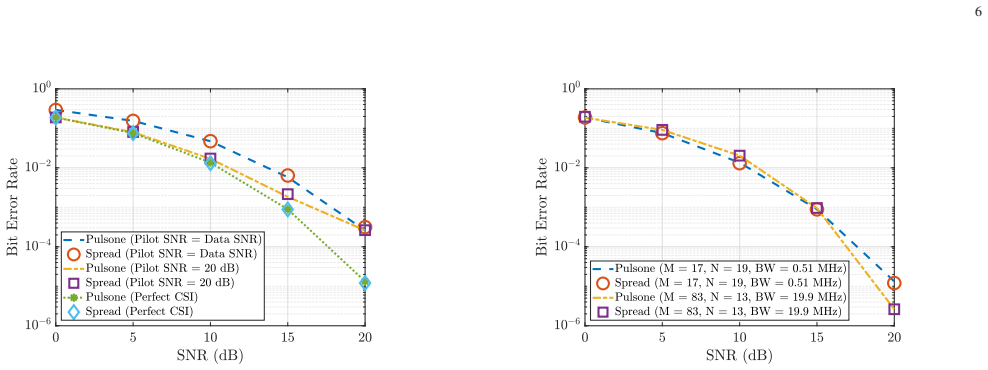
- Channel estimation and BER equal pulsone-based Zak-OTFS in the simulated six-path Veh-A channel, so changing the basis costs no accuracy.
- At $15$ dB SNR and above, the scheme beats OFDM, DFT-spread-OFDM, and OTFS in high-mobility BER, extending the non-fading predictability of Zak-OTFS to a low-PAPR waveform.
- The result holds for both narrowband ($0.51$ MHz) and wideband ($19.9$ MHz, 5G-NR-like) settings.
Reading between the lines
- A natural next step the authors do not take: because the GDAFT parameters $A,B,C$ generate a family of unitary bases, one could view the 'good' parameters as a code over the symplectic group and combinatorially characterize which frame sizes admit the crystallization condition.
- Per-basis PAPR of 6.58 dB does not automatically mean the summed data signal has that PAPR; the paper's own data signals show 7.83 dB versus 7.95 dB, so the practical amplifier gain may be smaller than 5.6 dB once random data superpose carriers.
- The CAZAC structure could enable alternatives beyond communication, such as low-power sensing or secure signaling, though the paper only lists these as future work.
- The grid-search step suggests a testable extension: a constructive algorithm for $A,B,C$ from coarse channel-support bounds would turn the method from a demonstrated example into a general design rule.
Signed reviews
Editorial analysis
A structured set of objections, weighed in public.
Referee Report
Summary. The paper proposes a low-PAPR spread-carrier implementation of Zak-OTFS. It defines a generalized discrete affine Fourier transform (GDAFT) that maps the orthonormal pulsone basis to another orthonormal basis of constant-envelope (CAZAC) waveforms, proves the unitarity of the GDAFT, derives a closed-form CAZAC expression for the image of a pulsone, and derives the transformation rule for cross-ambiguity functions under the GDAFT. The channel-estimation analysis shows that spread-carrier and pulsone-based systems are equivalent provided a crystallization condition on the GDAFT parameters and the channel support holds. Numerical results compare PAPR, channel-estimation NMSE, and BER for the two Zak-OTFS variants and compare against OTFS, OFDM, and DFT-spread-OFDM in Veh-A channels.
Significance. If the construction is fully validated, it is a useful contribution: it gives a simple unitary basis change that reduces per-basis-element PAPR by about 5.6 dB without sacrificing spectral efficiency, and the authors are honest that the data-signal PAPR gain is much smaller (Section V.A). The derivations are grounded in standard identities, and the simulations cover both narrowband and wideband regimes with a doubly selective channel. The NMSE and BER comparisons between pulsone- and spread-carrier Zak-OTFS are a good falsifiable check of the unitary-basis claim. The main unresolved issue is the general existence of GDAFT parameters satisfying the crystallization condition; this limits the generality of the claims as stated.
major comments (3)
- [Section IV.C, Lemma 2] The equivalence between spread-carrier and pulsone-based Zak-OTFS is conditional on the crystallization condition S ∩ (∪_{(n,m)≠(0,0)} (S + (k'_{n,m}, l'_{n,m}))) = ∅. The paper verifies this condition for one favorable example (M=17, N=19, A=3, B=5, C=7) and then states that 'grid search is performed' in practice. No theorem, counting argument, or constructive algorithm establishes that such a triple exists for general M, N, and channel support S, nor is the grid search shown to be exhaustive or its complexity quantified. Because equation (8) and Lemma 2 are the mechanism that connects the pilot stage to the NMSE/BER equivalence in Section V and to the 'Predictable' entry in Table I, this missing existence result is load-bearing. The wideband simulation in Section V.E also appears to use the same A=3, B=5, C=7 without displaying a verification of the crystallization condition for M=83, N=13. Please provide a sufficient condition or counting argument for the existence of admissible (A,B,C), or explicitly scope the claims to parameter regimes in which the condition is verified, and report the search procedure.
- [Section III, Theorem 1 and Identity 2] The closed-form expression for x^{(c)}_{(k0,l0)}[n] is obtained by applying the quadratic Gauss sum Identity 2 to the sum over d of e^{j2π/N (CM d^2 + (Bn+l0+2Ck0)d)}. Identity 2 requires N odd and gcd(CM,N)=1, but Definition 1 imposes only gcd(A,MN)=gcd(B,MN)=gcd(C,MN)=1. Consequently, for N even or gcd(M,N)>1, Theorem 1 as stated is not proved and the 'CAZAC' / '6.58 dB PAPR' claims do not follow. Please add the hypotheses N odd and gcd(M,N)=1 (or the appropriate Gauss-sum conditions) to Theorem 1 and Corollary 1, and note that the numerical examples satisfy them.
- [Section IV.C, Lemma 2] The crystallization condition is not fully well-defined as written because the expressions for k'_{n,m} and l'_{n,m} use B^{-1}_{MN}, i.e., residues modulo MN, while the channel support S is a set of integer pairs that may include negative values. The example appears to use a particular integer lift of these residue classes when drawing the dashed red rectangles, but this lift is not specified. Please state explicitly that the condition is checked for the unique representatives in a fixed fundamental domain (or equivalently formulated modulo MN), otherwise the verification in the example is ambiguous.
minor comments (3)
- [Section III, Identity 2] The statement of Identity 2 says 'a, b ∈ Z+', but the identity is valid for b ∈ Z (and for a an integer coprime to N). The argument b = Bn + l0 + 2Ck0 in Theorem 1 is nonnegative in the intended regime, but the hypothesis should be stated for all integers to avoid confusion.
- [Section II] The paper does not state whether M and N are required to be coprime or whether N is odd, even though these assumptions appear in the Gauss-sum evaluation in Theorem 1 and are satisfied by all simulations. Please state these assumptions in the preliminaries.
- [Section IV.C, Example] The sentence 'prior knowledge of channel support S does not need to be exact' is used to justify approximating S by a rectangle, but no bound on the estimation error of kmin, kmax, lmin, lmax is given. A short statement on how much margin is needed would make the practical claim more precise.
Circularity Check
No significant circularity: the central equivalence is a direct unitary-transform derivation, and the channel-estimation equivalence is conditional on an explicitly stated support condition rather than on fitted data.
full rationale
The derivation chain is self-contained. Lemma 1 proves that the GDAFT is unitary using the roots-of-unity identity; Theorem 1 evaluates the GDAFT on a point pulsone and obtains the CAZAC form via the quadratic Gauss sum; Theorem 2 is a direct computation of the cross-ambiguity function under the unitary GDAFT. Lemma 2 is a conditional statement: the spread-carrier channel estimate equals the true effective channel only if the crystallization condition on the channel support and the GDAFT parameters holds. The parameters A, B, C are chosen by grid search to satisfy that sufficient condition, with one explicit favorable example, and they are not fitted to the simulated BER or NMSE outcomes. The simulations are therefore confirmatory rather than circular. The paper cites prior work by overlapping authors for the pulsone ambiguity expression and for orthonormality of the pulsone basis, but these are standard mathematical identities with independent content; they serve as inputs to the new derivation, not as the conclusion. No prediction reduces by construction to a fitted parameter or to a self-referential definition. The only notable weakness is that no general existence proof for the crystallization condition is provided, but that is a completeness risk, not circularity.
Assumptions & free parameters
free parameters (1)
- GDAFT parameters A, B, C =
A=3, B=5, C=7 in simulations; chosen by grid search
assumptions (3)
- standard math Quadratic Gauss sum Identity 2 holds, requiring N odd and gcd(CM,N)=1
- domain assumption The channel support S is compact and the crystallization condition in Lemma 2 is satisfied by the chosen GDAFT parameters
- domain assumption The channel is constant across pilot and data stages, and the physical channel is a sum of P resolvable paths sampled via the effective channel in equations (11) and (12)
Cite this review
Pith. "Pith review of Zak-OTFS with Spread Carrier Waveforms." pith.science (2026). https://pith.science/paper/RZJLEBNS
@misc{pith2026250508079,
  author       = {Pith},
  title        = {Pith review of: Zak-OTFS with Spread Carrier Waveforms},
  year         = {2026},
  howpublished = {\url{https://pith.science/paper/RZJLEBNS}},
  note         = {Machine review of arXiv:2505.08079}
}
abstract
Zak-OTFS (orthogonal time frequency space) modulation is a communication framework that parameterizes the wireless channel in the delay-Doppler (DD) domain, where the parameters map directly to physical attributes of the scatterers that comprise the scattering environment. As a consequence, the channel can be efficiently acquired and equalized. The Zak-OTFS carrier is a pulse in the DD domain, and the Zak transform converts it to a pulse train modulated by a tone (pulsone) in the time domain. The pulsone waveform is localized rather than spread, and it suffers from high peak-to-average power ratio (PAPR). We describe how to transform the orthonormal basis of Zak-OTFS pulsones into an orthonormal basis of spread carrier waveforms with low PAPR (only $6.58$ dB) that support communication in the presence of mobility and delay spread. This transformation is realized by a unitary transform based on the discrete affine Fourier transform. Unlike other spread modulations that achieve low PAPR by spreading information across a wider bandwidth (thus reducing the spectral efficiency), the proposed spread carrier-based Zak-OTFS achieves full spectral efficiency like pulsone-based Zak-OTFS, with $5.6$ dB lower PAPR per basis element. We demonstrate uncoded bit error rate (BER) similar to pulsone-based Zak-OTFS, and improved BER performance over competing methods based on OFDM and OTFS in high mobility & delay spread environments.
Figures


Figures from the paper (2 more)

Forward citations
Cited by 1 Pith paper
-
Differential Communication in Channels with Mobility and Delay Spread using Zak-OTFS
In Zak-OTFS, the cross-ambiguity of received and transmitted random data is approximately the channel, so detected data can replace periodic pilots and enable pilot-free differential detection.
Reference graph
Works this paper leans on
-
[7]
Zak-OTFS for integration of sensing and commu- nication,
M. Ubadah, S. K. Mohammed, R. Hadani, S. Kons, A. Chockali ngam, and R. Calderbank, “Zak-OTFS for integration of sensing and commu- nication,” arXiv preprint arXiv:2404.04182 , 2024
arXiv 2024
-
[1]
OTFS—a mathematical foundation for communication and rad ar sens- ing in the delay-Doppler domain,
S. K. Mohammed, R. Hadani, A. Chockalingam, and R. Calder bank, “OTFS—a mathematical foundation for communication and rad ar sens- ing in the delay-Doppler domain,” IEEE BITS the Information Theory Magazine, vol. 2, no. 2, pp. 36–55, 2022
work page 2022
-
[2]
OTFS—predictability in the delay-Doppler domain a nd its value to communication and radar sensing,
——, “OTFS—predictability in the delay-Doppler domain a nd its value to communication and radar sensing,” IEEE BITS the Information Theory Magazine , vol. 3, no. 2, pp. 7–31, 2023
work page 2023
-
[3]
Y . Wu, F. Lemic, C. Han, and Z. Chen, “Sensing Integrated D FT- Spread OFDM Waveform and Deep Learning-Powered Receiver De sign for Terahertz Integrated Sensing and Communication System s,” IEEE Transactions on Communications , vol. 71, no. 1, pp. 595–610, 2023
work page 2023
-
[4]
Orthogonal Time Frequency Spa ce Modulation,
R. Hadani, S. Rakib, M. Tsatsanis, A. Monk, A. J. Goldsmit h, A. F. Molisch, and R. Calderbank, “Orthogonal Time Frequency Spa ce Modulation,” in 2017 IEEE Wireless Communications and Networking Conference (WCNC), 2017, pp. 1–6
work page 2017
-
[5]
Space- Time Shift Keying Aided OTFS Modulation for Orthogonal Multiple Access,
Z. Sui, H. Zhang, S. Sun, L.-L. Y ang, and L. Hanzo, “Space- Time Shift Keying Aided OTFS Modulation for Orthogonal Multiple Access,” IEEE Transactions on Communications, vol. 71, no. 12, pp. 7393–7408, 2023
work page 2023
-
[6]
Low Complexity Detection of Spatial Modulation Aided OTFS in Do ubly- Selective Channels,
Z. Sui, H. Zhang, Y . Xin, T. Bao, L.-L. Y ang, and L. Hanzo, “ Low Complexity Detection of Spatial Modulation Aided OTFS in Do ubly- Selective Channels,” IEEE Transactions on V ehicular Technology , vol. 72, no. 10, pp. 13 746–13 751, 2023. 7
work page 2023
-
[8]
A Primer on Zadoff Chu Sequences,
J. G. Andrews, “A Primer on Zadoff Chu Sequences,” arXiv preprint arXiv:2211.05702, 2022
arXiv 2022
Show all 16 references
-
[9]
Zak-OTFS fo r Mutually Unbiased Sensing and Communication,
N. Mehrotra, S. R. Mattu, and R. Calderbank, “Zak-OTFS fo r Mutually Unbiased Sensing and Communication,” 2025. [Online]. Avai lable: https://arxiv.org/abs/2503.23540
2025 arXiv
-
[10]
Phase-Coded Waveforms and Their Design,
J. J. Benedetto, I. Konstantinidis, and M. Rangaswamy, “Phase-Coded Waveforms and Their Design,” IEEE Signal Processing Magazine , vol. 26, no. 1, pp. 22–31, 2009
2009
-
[11]
Closed-Form Discrete Fracti onal and Affine Fourier Transforms,
S.-C. Pei and J.-J. Ding, “Closed-Form Discrete Fracti onal and Affine Fourier Transforms,” IEEE Transactions on Signal Processing , vol. 48, no. 5, pp. 1338–1353, 2000
2000
-
[12]
Discrete Zak transforms , polyphase transforms, and applications,
H. Bolcskei and F. Hlawatsch, “Discrete Zak transforms , polyphase transforms, and applications,” IEEE Transactions on Signal Processing , vol. 45, no. 4, pp. 851–866, 1997
1997
-
[13]
Evaluation of the quadratic Gau ss sum,
M. Murty and S. Pathak, “Evaluation of the quadratic Gau ss sum,” Evaluation, vol. 86, no. 1-2, 2017
2017
-
[14]
Decimation generator of zadoff-chu seque nces,
S. Budisin, “Decimation generator of zadoff-chu seque nces,” in Se- quences and Their Applications – SETA 2010 , C. Carlet and A. Pott, Eds. Berlin, Heidelberg: Springer Berlin Heidelberg, 2010 , pp. 30–40
2010
-
[15]
Tse and P
D. Tse and P . Viswanath, Fundamentals of wireless communication . Cambridge university press, 2005
2005
-
[16]
Guidelines for evaluation of radio tran smission tech- nologies for IMT-2000,
ITU–R M.1225, “Guidelines for evaluation of radio tran smission tech- nologies for IMT-2000,” International Telecommunication Union Radio communication, 1997
2000
Reviewed August 15, 2026 · model on record in the stance chip above.
Discussion (0). Continue with ORCID to comment.