CSFlow: Aligning Flow Matching with Human Contrast Sensitivity
Pith reviewed 2026-06-27 18:34 UTC · model grok-4.3
The pith
Aligning flow matching denoising steps with human contrast sensitivity improves generated image quality.
A machine-rendered reading of the paper's core claim, the machinery that carries it, and where it could break.
Core claim
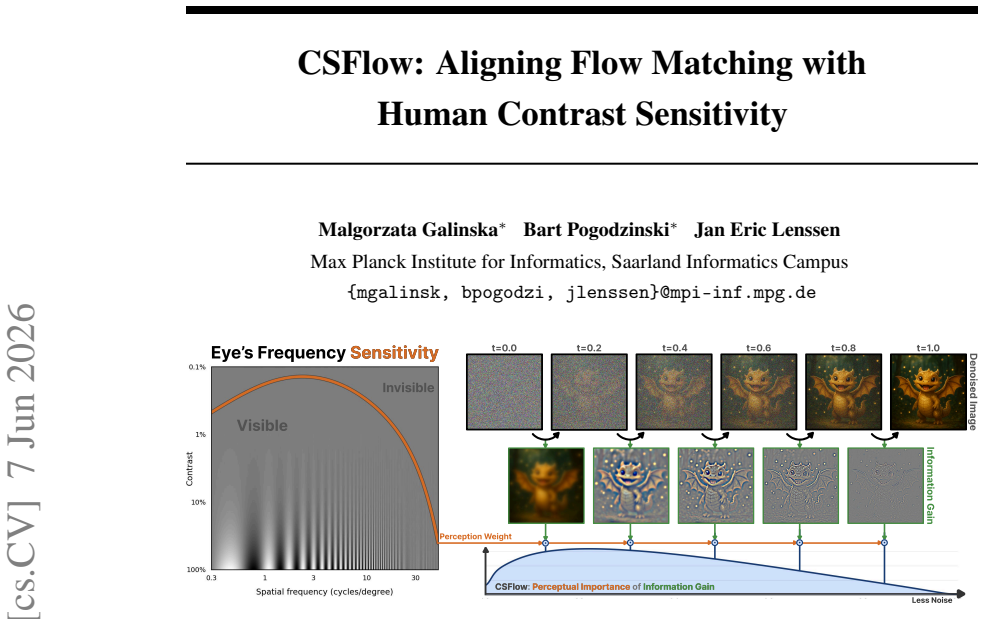
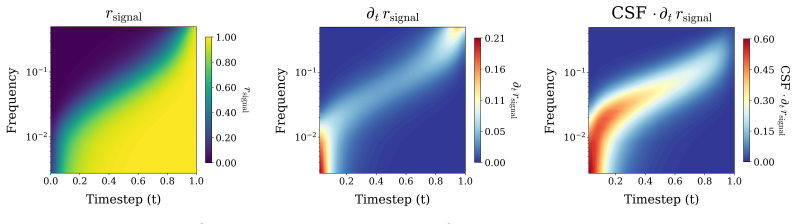
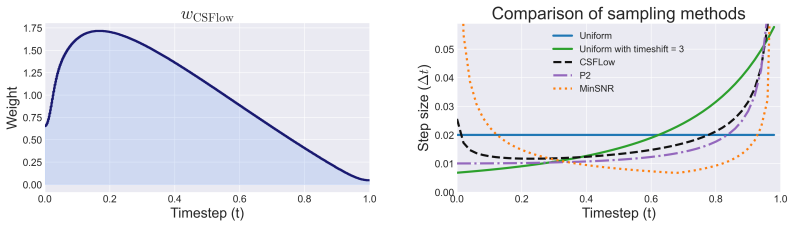
CSFlow connects the human eye's Contrast Sensitivity Function to the iterative denoising steps of flow matching. Because real-world images concentrate signal at low spatial frequencies that reach high signal-to-noise ratio earlier, this induces a soft autoregressive structure in Fourier space. A metric estimates which frequencies are generated at each reverse flow interval, and timestep weights are obtained by aligning these frequencies with human contrast sensitivity.
What carries the argument
A metric that estimates frequencies generated at each reverse flow interval, used to derive timestep weights aligned with human contrast sensitivity.
If this is right
- Generative performance improves, with FID lowered by 4.7 percent.
- Inception Score increases by 2.2 percent.
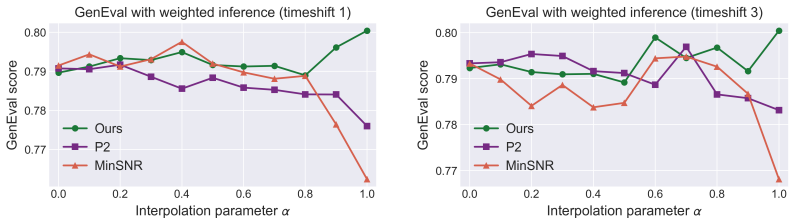
- GenEval scores improve by 2.5 percent.
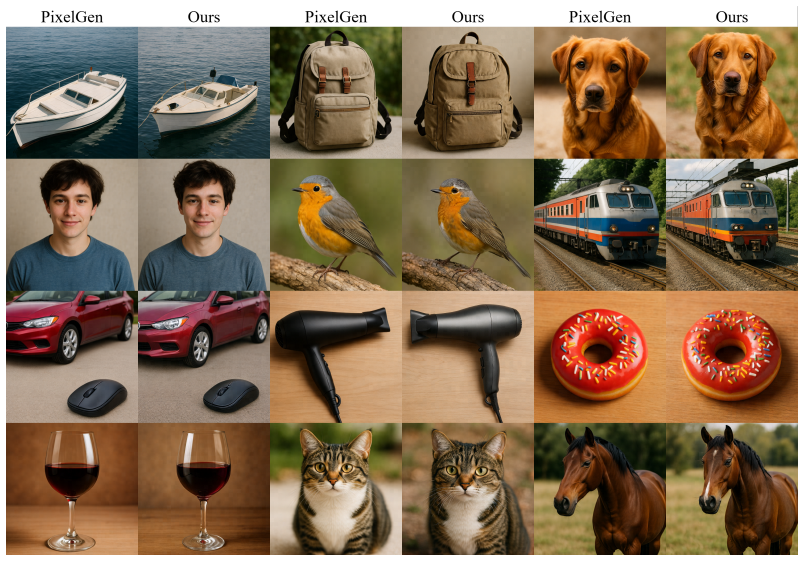
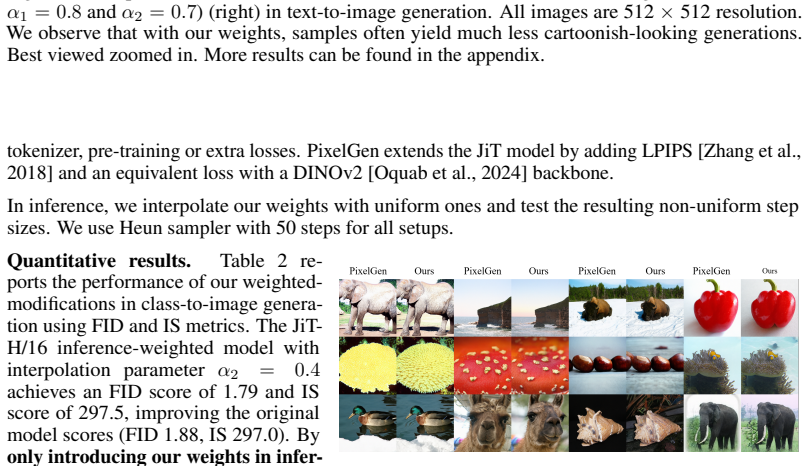
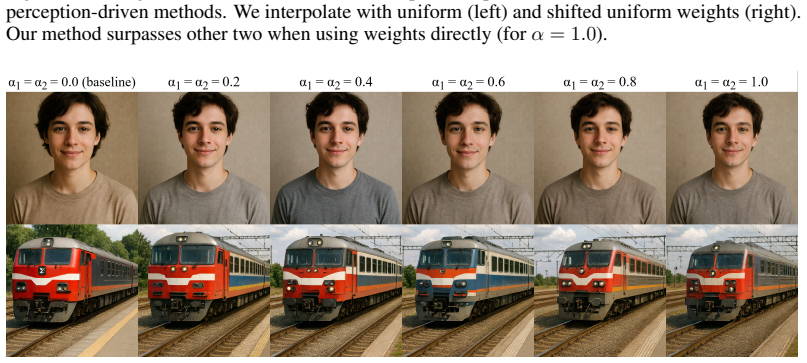
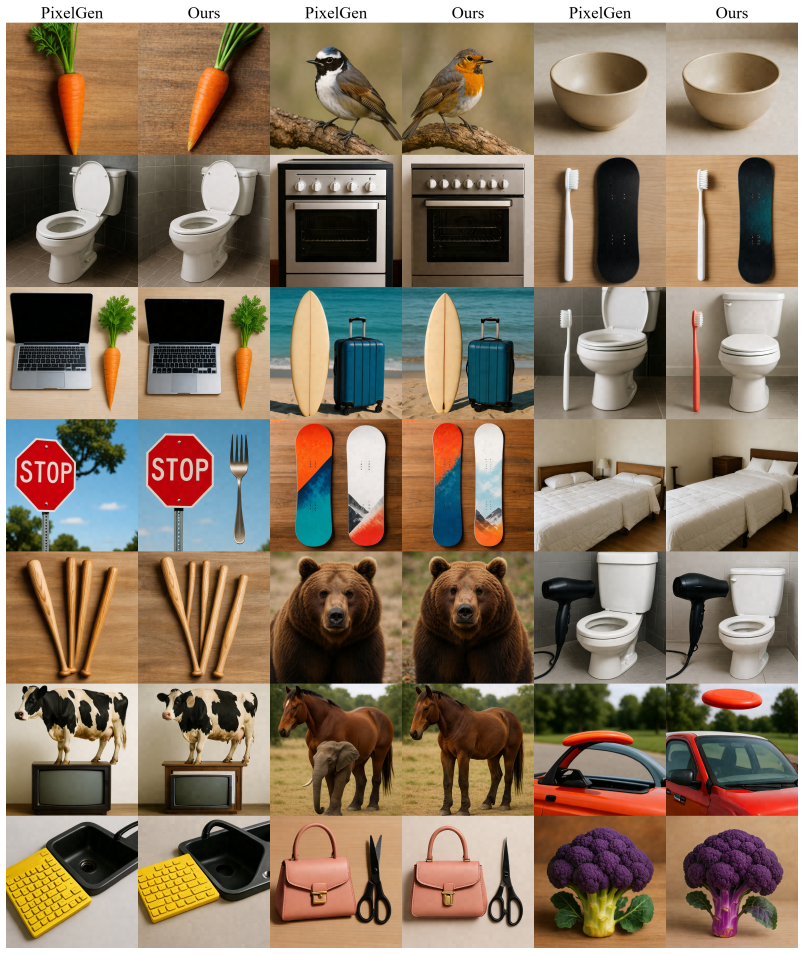
- Generated images exhibit better visual realism and less cartoonish appearance.
Where Pith is reading between the lines
- The same frequency-alignment idea could be tested on other iterative generative processes that operate in continuous time.
- Inference-only use of the weights shows that perceptual scheduling can improve output without retraining the underlying model.
- The approach links Fourier-space analysis of the generation trajectory directly to a known property of human vision.
Load-bearing premise
The frequency-estimation metric accurately identifies which spatial frequencies are being generated at each reverse-flow interval, and re-weighting steps according to human CSF produces measurably better images rather than merely trading one set of artifacts for another.
What would settle it
Running standard image generation benchmarks with and without the CSFlow weights and finding no reduction in FID, no increase in Inception Score, or no gain in GenEval scores would falsify the claim that the alignment improves performance.
Figures
read the original abstract
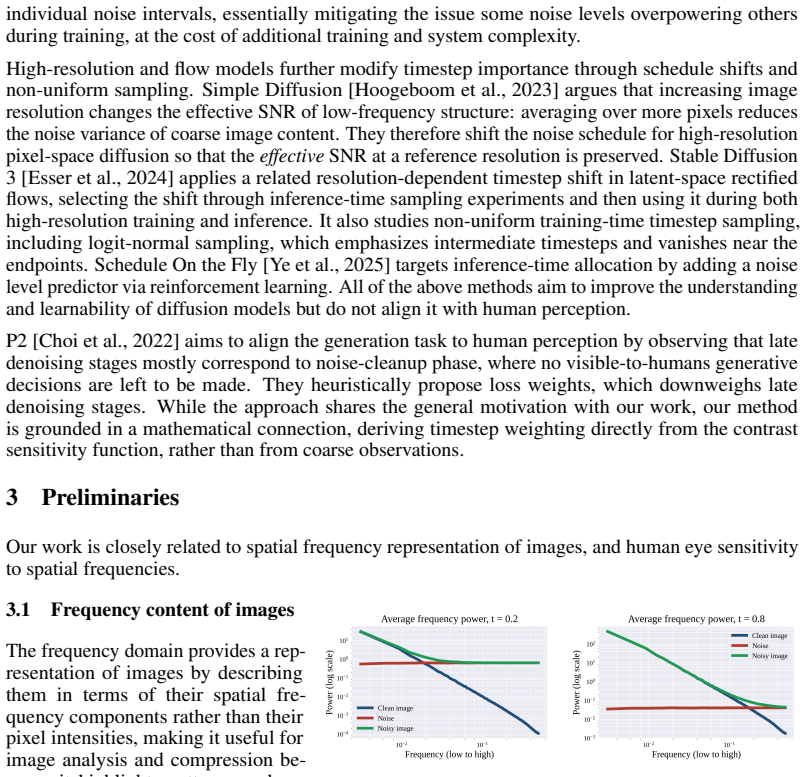
We introduce Contrast Sensitive Flow (CSFlow), a weighting scheme that connects the human eye's Contrast Sensitivity Function (CSF) to the iterative denoising steps of flow matching. Because real-world images concentrate signal at low spatial frequencies, these components reach high signal-to-noise ratio earlier during continuous diffusion than high-frequency components. When generating images with diffusion or flow matching models, this induces a soft autoregressive structure in Fourier space, where coarse image content stabilizes before fine detail. Meanwhile, the human visual system is unequally sensitive to spatial frequencies: very low and very high frequencies require significantly higher contrast to be perceived. We for the first time merge these observations through two contributions: (1) a metric that estimates which frequencies are generated at each reverse flow interval and (2) timestep weights obtained by aligning the frequencies generated at each noise level with human contrast sensitivity. We validate our contributions experimentally showing that these weights can improve generative performance by lowering FID by 4.7%, increasing Inception Score by 2.2% and improving GenEval scores by 2.5% using inference-only timestep modification or short fine-tuning. Qualitatively, we find that our CSFlow weights lead to better visual realism and less cartoonish appearance of generated images.
Editorial analysis
A structured set of objections, weighed in public.
Referee Report
Summary. The paper introduces CSFlow, a weighting scheme for flow matching models that aligns denoising timesteps with the human contrast sensitivity function (CSF). It contributes (1) a metric estimating which spatial frequencies are generated at each reverse-flow interval, based on the observation that low frequencies stabilize earlier, and (2) timestep weights derived from aligning these frequencies with CSF. The authors report that applying these weights (via inference-only modification or short fine-tuning) improves FID by 4.7%, Inception Score by 2.2%, and GenEval by 2.5%, with qualitative gains in visual realism and reduced cartoonish artifacts.
Significance. If the frequency metric is shown to accurately recover actual intermediate frequency content and the gains are attributable to CSF alignment rather than generic non-uniform scheduling, the work would provide a perceptually motivated, inference-efficient improvement to flow matching and diffusion samplers. The explicit link between Fourier-space autoregressive structure in generation and human vision priors is a potentially useful direction for perceptual generative modeling.
major comments (2)
- The central claim that the derived weights are CSF-aligned (and thus explain the reported gains) depends on the frequency-estimation metric correctly recovering the spatial-frequency content actually present at each noise level. However, the manuscript provides no direct validation such as Fourier analysis of partially denoised samples, ablation isolating the metric, or quantitative comparison of predicted versus observed power spectra at the relevant timesteps.
- Abstract and experimental sections: quantitative gains (FID -4.7%, IS +2.2%, GenEval +2.5%) are presented without details on baselines, statistical significance testing, dataset splits, controls for random seeds, or whether the same metrics were used to tune the weights themselves, preventing assessment of whether the improvements are robust or circular.
Simulated Author's Rebuttal
We thank the referee for the constructive feedback. We address each major comment below and will incorporate revisions to strengthen the manuscript.
read point-by-point responses
-
Referee: The central claim that the derived weights are CSF-aligned (and thus explain the reported gains) depends on the frequency-estimation metric correctly recovering the spatial-frequency content actually present at each noise level. However, the manuscript provides no direct validation such as Fourier analysis of partially denoised samples, ablation isolating the metric, or quantitative comparison of predicted versus observed power spectra at the relevant timesteps.
Authors: We agree that direct validation of the frequency-estimation metric would strengthen the central claim. The metric is motivated by the observation that low frequencies stabilize earlier during reverse flow, but the original submission did not include explicit Fourier analysis of intermediate samples. In the revised manuscript we will add Fourier analysis of partially denoised samples at representative timesteps, quantitative comparisons between predicted and observed power spectra, and an ablation isolating the metric. revision: yes
-
Referee: Abstract and experimental sections: quantitative gains (FID -4.7%, IS +2.2%, GenEval +2.5%) are presented without details on baselines, statistical significance testing, dataset splits, controls for random seeds, or whether the same metrics were used to tune the weights themselves, preventing assessment of whether the improvements are robust or circular.
Authors: The weights are obtained by aligning the estimated per-timestep frequencies with the CSF and are not tuned on FID, IS, or GenEval. We will expand the experimental section to report full baseline details, statistical significance across multiple random seeds, dataset splits, and randomness controls, thereby clarifying that the gains are not circular. revision: yes
Circularity Check
No circularity: metric and weights are independently proposed then empirically validated
full rationale
The paper defines a frequency-estimation metric, derives timestep weights by alignment with CSF, and reports downstream FID/IS/GenEval gains from applying those weights. No equation, definition, or self-citation chain is shown that makes the reported performance gains equivalent to the metric inputs by construction. The validation step is external (generative benchmarks) rather than a re-statement of the frequency estimates themselves. This is the normal non-circular case.
Axiom & Free-Parameter Ledger
Reference graph
Works this paper leans on
-
[1]
arXiv preprint arXiv:2511.13720 , year =
Li, Tianhong and He, Kaiming , title =. arXiv preprint arXiv:2511.13720 , year =
-
[2]
arXiv preprint arXiv:2602.02493 , year =
Ma, Zehong and Xu, Ruihan and Zhang, Shiliang , title =. arXiv preprint arXiv:2602.02493 , year =
-
[3]
arXiv preprint arXiv:2211.01324 , year =
Balaji, Yogesh and Nah, Seungjun and Huang, Xun and Vahdat, Arash and Song, Jiaming and Zhang, Qinsheng and Kreis, Karsten and Aittala, Miika and Aila, Timo and Laine, Samuli and Catanzaro, Bryan and Karras, Tero and Liu, Ming-Yu , title =. arXiv preprint arXiv:2211.01324 , year =
-
[4]
Proceedings of the IEEE/CVF International Conference on Computer Vision (ICCV) , pages =
Hang, Tiankai and Gu, Shuyang and Li, Chen and Bao, Jianmin and Chen, Dong and Hu, Han and Geng, Xin and Guo, Baining , title =. Proceedings of the IEEE/CVF International Conference on Computer Vision (ICCV) , pages =
-
[5]
2009 IEEE Conference on Computer Vision and Pattern Recognition , pages =
Deng, Jia and Dong, Wei and Socher, Richard and Li, Li-Jia and Li, Kai and Fei-Fei, Li , title =. 2009 IEEE Conference on Computer Vision and Pattern Recognition , pages =. 2009 , doi =
2009
-
[6]
Olga Russakovsky and Jia Deng and Hao Su and Jonathan Krause and Sanjeev Satheesh and Sean Ma and Zhiheng Huang and Andrej Karpathy and Aditya Khosla and Michael Bernstein and Alexander C. Berg and Li Fei-Fei , Title =. 2015 , journal =. doi:10.1007/s11263-015-0816-y , volume=
-
[7]
Advances in Neural Information Processing Systems , volume =
Ghosh, Dhruba and Hajishirzi, Hannaneh and Schmidt, Ludwig , title =. Advances in Neural Information Processing Systems , volume =
-
[8]
and Shechtman, Eli and Wang, Oliver , title =
Zhang, Richard and Isola, Phillip and Efros, Alexei A. and Shechtman, Eli and Wang, Oliver , title =. Proceedings of the IEEE Conference on Computer Vision and Pattern Recognition (CVPR) , pages =
-
[9]
Transactions on Machine Learning Research , year =
Oquab, Maxime and Darcet, Timoth. Transactions on Machine Learning Research , year =
-
[10]
2022 , journal =
Jonathan Ho and Tim Salimans , Title =. 2022 , journal =
2022
-
[11]
arXiv preprint arXiv:2505.09568 , year =
Chen, Jiuhai and Xu, Zhiyang and Pan, Xichen and Hu, Yushi and Qin, Can and Goldstein, Tom and Huang, Lifu and Zhou, Tianyi and Xie, Saining and Savarese, Silvio and Xue, Le and Xiong, Caiming and Xu, Ran , title =. arXiv preprint arXiv:2505.09568 , year =
-
[12]
Advances in Neural Information Processing Systems , volume =
Heusel, Martin and Ramsauer, Hubert and Unterthiner, Thomas and Nessler, Bernhard and Hochreiter, Sepp , title =. Advances in Neural Information Processing Systems , volume =
-
[13]
Advances in Neural Information Processing Systems , volume =
Salimans, Tim and Goodfellow, Ian and Zaremba, Wojciech and Cheung, Vicki and Radford, Alec and Chen, Xi , title =. Advances in Neural Information Processing Systems , volume =
-
[14]
2022 , Eprint =
William Peebles and Saining Xie , Title =. 2022 , Eprint =
2022
-
[15]
Albergo and Nicholas M
Nanye Ma and Mark Goldstein and Michael S. Albergo and Nicholas M. Boffi and Eric Vanden-Eijnden and Saining Xie , Title =. 2024 , Eprint =
2024
-
[16]
2024 , Eprint =
Sihyun Yu and Sangkyung Kwak and Huiwon Jang and Jongheon Jeong and Jonathan Huang and Jinwoo Shin and Saining Xie , Title =. 2024 , Eprint =
2024
-
[17]
2025 , Eprint =
Jingfeng Yao and Bin Yang and Xinggang Wang , Title =. 2025 , Eprint =
2025
-
[18]
2025 , Eprint =
Shuai Wang and Zhi Tian and Weilin Huang and Limin Wang , Title =. 2025 , Eprint =
2025
-
[19]
2025 , Eprint =
Boyang Zheng and Nanye Ma and Shengbang Tong and Saining Xie , Title =. 2025 , Eprint =
2025
-
[20]
2024 , Eprint =
Moritz Reuss and Ömer Erdinç Yağmurlu and Fabian Wenzel and Rudolf Lioutikov , Title =. 2024 , Eprint =
2024
-
[21]
2023 , Eprint =
Tero Karras and Miika Aittala and Jaakko Lehtinen and Janne Hellsten and Timo Aila and Samuli Laine , Title =. 2023 , Eprint =
2023
-
[22]
2025 , Eprint =
Shoufa Chen and Chongjian Ge and Shilong Zhang and Peize Sun and Ping Luo , Title =. 2025 , Eprint =
2025
-
[23]
2025 , Eprint =
Zehong Ma and Longhui Wei and Shuai Wang and Shiliang Zhang and Qi Tian , Title =. 2025 , Eprint =
2025
-
[24]
2024 , Eprint =
Emiel Hoogeboom and Thomas Mensink and Jonathan Heek and Kay Lamerigts and Ruiqi Gao and Tim Salimans , Title =. 2024 , Eprint =
2024
-
[25]
2023 , Eprint =
Junsong Chen and Jincheng Yu and Chongjian Ge and Lewei Yao and Enze Xie and Yue Wu and Zhongdao Wang and James Kwok and Ping Luo and Huchuan Lu and Zhenguo Li , Title =. 2023 , Eprint =
2023
-
[26]
Scaling Rectified Flow Transformers for High-Resolution Image Synthesis , booktitle =
Esser, Patrick and Kulal, Sumith and Blattmann, Andreas and Entezari, Rahim and M. Scaling Rectified Flow Transformers for High-Resolution Image Synthesis , booktitle =
-
[27]
2024 , howpublished=
Black Forest Labs , title=. 2024 , howpublished=
2024
-
[28]
2023 , url =
James Betker and Gabriel Goh and Li Jing and Tim Brooks and Jianfeng Wang and Linjie Li and Long Ouyang and Juntang Zhuang and Joyce Lee and Yufei Guo and Wesam Manassra and Prafulla Dhariwal and Casey Chu and Yunxin Jiao and Aditya Ramesh , title =. 2023 , url =
2023
-
[29]
2025 , Eprint =
Chenyuan Wu and Pengfei Zheng and Ruiran Yan and Shitao Xiao and Xin Luo and Yueze Wang and Wanli Li and Xiyan Jiang and Yexin Liu and Junjie Zhou and Ze Liu and Ziyi Xia and Chaofan Li and Haoge Deng and Jiahao Wang and Kun Luo and Bo Zhang and Defu Lian and Xinlong Wang and Zhongyuan Wang and Tiejun Huang and Zheng Liu , Title =. 2025 , Eprint =
2025
-
[30]
2025 , Eprint =
Shuai Wang and Ziteng Gao and Chenhui Zhu and Weilin Huang and Limin Wang , Title =. 2025 , Eprint =
2025
-
[31]
, title =
Ruzanski, Evan and Chandrasekar, V. , title =. IEEE Transactions on Geoscience and Remote Sensing , volume =. 2011 , doi =
2011
-
[32]
Image Quality and System Performance , series =
Barten, Peter , title =. Image Quality and System Performance , series =. 2003 , doi =
2003
-
[33]
2024 , note =
Dieleman, Sander , title =. 2024 , note =
2024
-
[34]
arXiv preprint arXiv:2505.11278 , year =
Falck, Fabian and Pandeva, Teodora and Zahirnia, Kiarash and Lawrence, Rachel and Turner, Richard and Meeds, Edward and Zazo, Javier and Karmalkar, Sushrut , title =. arXiv preprint arXiv:2505.11278 , year =
-
[35]
Sara Mahdavi and Rapha Gontijo Lopes and Tim Salimans and Jonathan Ho and David J Fleet and Mohammad Norouzi , Title =
Chitwan Saharia and William Chan and Saurabh Saxena and Lala Li and Jay Whang and Emily Denton and Seyed Kamyar Seyed Ghasemipour and Burcu Karagol Ayan and S. Sara Mahdavi and Rapha Gontijo Lopes and Tim Salimans and Jonathan Ho and David J Fleet and Mohammad Norouzi , Title =. 2022 , Eprint =
2022
-
[36]
2025 , Eprint =
Chenfei Wu and Jiahao Li and Jingren Zhou and Junyang Lin and Kaiyuan Gao and Kun Yan and Sheng-ming Yin and Shuai Bai and Xiao Xu and Yilei Chen and Yuxiang Chen and Zecheng Tang and Zekai Zhang and Zhengyi Wang and An Yang and Bowen Yu and Chen Cheng and Dayiheng Liu and Deqing Li and Hang Zhang and Hao Meng and Hu Wei and Jingyuan Ni and Kai Chen and K...
2025
-
[37]
2024 , Eprint =
Patrick Esser and Sumith Kulal and Andreas Blattmann and Rahim Entezari and Jonas Müller and Harry Saini and Yam Levi and Dominik Lorenz and Axel Sauer and Frederic Boesel and Dustin Podell and Tim Dockhorn and Zion English and Kyle Lacey and Alex Goodwin and Yannik Marek and Robin Rombach , Title =. 2024 , Eprint =
2024
-
[38]
Proceedings of the 40th International Conference on Machine Learning , series =
Hoogeboom, Emiel and Heek, Jonathan and Salimans, Tim , title =. Proceedings of the 40th International Conference on Machine Learning , series =
-
[39]
and Maheswaranathan, Niru and Ganguli, Surya , title =
Sohl-Dickstein, Jascha and Weiss, Eric A. and Maheswaranathan, Niru and Ganguli, Surya , title =. Proceedings of the 32nd International Conference on Machine Learning , series =
-
[40]
and Abbeel, Pieter , title =
Ho, Jonathan and Jain, Ajay N. and Abbeel, Pieter , title =. Advances in Neural Information Processing Systems , volume =
-
[41]
Proceedings of the 38th International Conference on Machine Learning , series =
Nichol, Alex and Dhariwal, Prafulla , title =. Proceedings of the 38th International Conference on Machine Learning , series =
-
[42]
International Conference on Learning Representations
Flow Matching for Generative Modeling , author =. International Conference on Learning Representations
-
[43]
International Conference on Learning Representations
Flow straight and fast: Learning to generate and transfer data with rectified flow , author =. International Conference on Learning Representations
-
[44]
2023 , Eprint =
Ting Chen , Title =. 2023 , Eprint =
2023
-
[45]
Advances in Neural Information Processing Systems , volume =
Karras, Tero and Aittala, Miika and Aila, Timo and Laine, Samuli , title =. Advances in Neural Information Processing Systems , volume =
-
[46]
Proceedings of the IEEE/CVF Conference on Computer Vision and Pattern Recognition (CVPR) , year =
Ye, Zilyu and Chen, Zhiyang and Li, Tiancheng and Huang, Zemin and Luo, Weijian and Qi, Guo-Jun , title =. Proceedings of the IEEE/CVF Conference on Computer Vision and Pattern Recognition (CVPR) , year =
-
[47]
Proceedings of the IEEE/CVF Conference on Computer Vision and Pattern Recognition (CVPR) , pages =
Choi, Jooyoung and Lee, Jungbeom and Shin, Chaehun and Kim, Sungwon and Kim, Hyunwoo and Yoon, Sungroh , title =. Proceedings of the IEEE/CVF Conference on Computer Vision and Pattern Recognition (CVPR) , pages =
discussion (0)
Sign in with ORCID, Apple, or X to comment. Anyone can read and Pith papers without signing in.